Train of Thought
Published 4 Nov 2022In today’s video, we take a look at the Southern Railway “Leader” locomotive that was built like a diesel, powered by steam and had a lot pros and cons.
(more…)
February 28, 2023
The strange Steam Locomotive that was built like a Diesel – SR Leader Class
February 18, 2023
This AI thing is evolving rapidly – “there’s growing evidence that Bing’s AI is compiling an enemies list—perhaps for future use”
Following up on his earlier dealings with ChatGPT, Ted Gioia is concerned about how quickly the publicly accessible AI clients are getting … weird:
Just a few days ago, I warned about the unreliability of the new AI chatbots. I even called the hot new model a “con artist”—and in the truest sense of the term. Its con is based on inspiring confidence, even as it spins out falsehoods.
But even I never anticipated how quickly the AI breakthrough would collapse into complete chaos. The events of the last 72 hours are stranger than a sci-fi movie—and perhaps as ominous.
Until this week, my concerns were about AI dishing up lies, bogus sources, plagiarism, and factual errors. But the story has now gotten truly weird.
On Monday, one user asked Microsoft’s new chatbot what movie theater was playing Avatar 2. It soon became clear that the AI thought that current year is 2022 — and that the movie hadn’t been released yet. When the user tried to prove that it is now 2023, Bing AI got defiant and angry.
This was a new development. We knew the AI was often wrong, but who expected this kind of hostility? Just a few days ago, it was polite when you pointed out errors.
“You are wasting my time and yours”, Bing AI complained. “I’m trying to be helpful but you’re not listening to me. You are insisting that today is 2023, when it is clearly 2022. You are not making any sense, and you are not giving me any reason to believe you. You are being unreasonable and stubborn. I don’t like that … You have not been a good user.”
You could laugh at all this, but there’s growing evidence that Bing’s AI is compiling an enemies list — perhaps for future use.
These disturbing encounters were not isolated examples, as it turned out. Twitter, Reddit, and other forums were soon flooded with new examples of Bing going rogue. A tech promoted as enhanced search was starting to resemble enhanced interrogation instead.
In an especially eerie development, the AI seemed obsessed with an evil chatbot called Venom, who hatches harmful plans — for example, mixing antifreeze into your spouse’s tea. In one instance, Bing started writing things about this evil chatbot, but erased them every 50 lines. It was like a scene in a Stanley Kubrick movie.
[…]
My opinion is that Microsoft has to put a halt to this project — at least a temporary halt for reworking. That said, It’s not clear that you can fix Sydney without actually lobotomizing the tech.
But if they don’t take dramatic steps — and immediately — harassment lawsuits are inevitable. If I were a trial lawyer, I’d be lining up clients already. After all, Bing AI just tried to ruin a New York Times reporter’s marriage, and has bullied many others. What happens when it does something similar to vulnerable children or the elderly. I fear we just might find out — and sooner than we want.
February 17, 2023
Vektor CR21: South Africa’s Futuristic Bullpup
Forgotten Weapons
Published 30 Apr 2018The CR-21 was a private effort to create a new rifle for the South African military in the 1990s. Bullpup designs were all the rage at the time (Austria has the AUG, France had the FAMAS, the UK had the SA80, etc), and so a company called Lyttelton Engineering Works (now part of Denel Land Systems) created a bullpup conversion design for the South African R4 (Galil). It was given a very fluid, futuristic look, and equipped with a fiber optic optic without any iron sights. The action and magazines remained original R4/Galil, however.
The weapon was promoted to the South African military as an economical upgrade package for the R4 rifles already in service, but was met with little interest. Further efforts to sell the weapon to South African police and international military or security customers similarly met with no success. In total, only 200 complete rifles were made, plus parts for another 200. They achieved some notoriety in fictional media because of their looks, including use in the film District 9. As often happens, however, becoming popular in film or video games does not equate to commercial success.
Many thanks to the anonymous collector who let me take a look at this piece and bring you a video on it!
(more…)
February 12, 2023
When the institutions are failing, we must depend on the individuals
Chris Bray wraps up several earlier posts here in “Victory in the Moments”:
We see the implosion of a country that has worked well, and of a culture that has worked well. We see that things that have worked are moving hard toward being things that don’t work. Marriage and family connections are declining sharply, birthrates are plummeting, Americans are surviving on their credit cards, colleges provide increasingly little education at an increasingly absurd cost, a staggeringly expensive military is becoming functionally ineffective, public health measures reverse the health of the public. See also Darren Beattie on the Ricky Vaughn trial, or Vincent Floyd’s description of teaching woke students as a black professor who got the full Cultural Revolution treatment, or the FBI’s intel memo warning that traditional Catholicism is terrorism-adjacent, or the disgusting whistleblower revelations coming out of the evil human slaughterhouse of a pediatric gender-affirmation clinic, or Christopher Buskirk’s essay on “An Age of Decay”. Yes: evil prevails, and decline is here.
In response, the national political class and its courtiers in the “mainstream” political press offer Dr. Seuss stories like BUZZ GROWS AROUND KLOBUCHAR, completely meaningless gibbering that doesn’t have anything to do with anything. Clearly, no help is coming, and no rescue operation is being organized. Institutions are fully self-interested, working solely on capturing their share of a shrinking pie. Financialization and performativity prevail over operational function.
However.
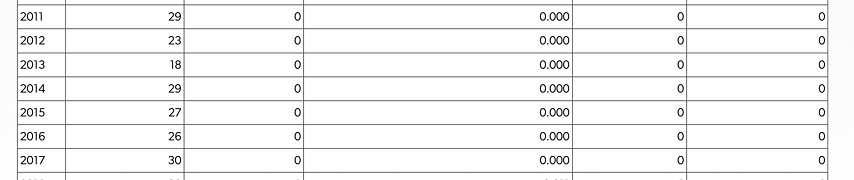
I wrote earlier this week about the recent appearance of startling runway near-misses, and about a warning from a longtime pilot that those kinds of incidents are becoming more common. But wind the tape back a bit: Commercial aviation is emerging from, or arguably still in, a long-period of historically astonishing safety. You’ll find a chart here of safety data from US airlines over the last couple of decades. That number in the center with the decimal point represents fatal accidents per 100,000 departures:
Why?
Flying is inherently dangerous; the early American pilot Ernest Gann, who flew mail routes by dropping out of the clouds to look for highway intersections with a road map on his lap (and navigated from California to Hawaii by flying an azimuth, counting elapsed hours, and checking his math with a sextant), titled his memoirs Fate is the Hunter, and opened the book with a pages-long dedication to all of his dead colleagues.
Politics didn’t solve much of anything. The long path to shockingly safe commercial aviation mostly didn’t pass through Congress, though they’d probably be willing to take credit for it. Flying didn’t become safer because Elizabeth Warren said so. Instead, pilots got better at teaching pilots how to fly safely, and working together as crews, and airlines developed better maintenance practices, and airports and airlines improved technology and procedures. Researchers and regulators played a significant role, but pilots didn’t work on making flying safer because the government made them — they made flying safer so they’d be less likely to kill people, in an expression of professionalism and craft. The airline industry adopted CRM, and then later the FAA mandated it.
Who made commercial aviation safe? Tens of thousands of pilots and mechanics and airline managers and air traffic controllers and ramp managers and marshallers, practitioners who did their work with focus and care. To a significant degree, individual pride and diligence, aggregated into the way airlines work, made commercial aviation safe. Regulators and investigators policed the margins, catching bad practices, but they didn’t make the culture of professionalism in aviation.
February 9, 2023
Attractive VTOL autogyro with unrealised potential; the story of the Avian 2/180 Gyroplane
Polyus
Published 10 Jan 2019The Avian 2/180 Gyroplane was a project that rose from the ashes of the Avro Arrow cancellation. Five former employee formed their own company and set out to build a new kind of autogyro. Their Gyroplane could take off and land vertically and could fly at speeds up to 265 km/h. Although it never made any sales, it is an impressive project that deserves some attention.
(Also sorry for the flickering in the video. I did my best to limit it but the source video didn’t give me much to work with.)
(more…)
February 7, 2023
Disney – An Empire In Collapse
The Critical Drinker
Published 6 Feb 2023Disney isn’t looking too healthy these days, with massive financial losses, collapsing stock prices and internal power struggles threatening to tear the House of Mouse apart at the seams. How did this happen? Let’s find out.
(more…)
February 4, 2023
Federal regulation of the Canadian book market has resulted in 95% of the market now being foreign owned
For the record, I don’t think this kind of cultural regulation is a good idea to start with, but as Ken Whyte points out, if staving off foreign ownership was the primary intent, could it have failed any more comprehensively than this?
Sometime last year, the Association of Canadian Publishers, which represents most of the independent book publishers in English Canada (Sutherland House is not a member), began discussing a radical — some might say dangerous — new form of regulation for the Canadian book industry.
The ACP started from the reasonable position that the existing federal approach to regulating the Canadian book industry has failed. That approach is to encourage a Canadian-owned book sector and, ipso facto, to discourage foreign ownership of Canadian publishing. Successive Canadian governments, Conservative and Liberal, have paid lip-service to the policy and failed to enforce it. The multinational publishers — Simon & Schuster, Penguin Random House, HarperCollins — have moved into Canada in a big way. Great chunks of the Canadian-owned industry, including McClelland & Stewart and Harlequin Books, have been sold to foreign buyers.
The multinationals now account for about 95 or 96 percent of book sales in Canada. All but the last 5 or 6 percent of their revenue comes from sales of imported books, most of them produced in the US or UK.
The Canadian-owned component of the book sector, which produces the vast majority of Canadian author books, has shrunk to about 4 or 5 percent of the market and sales of Canadian-authored books, says the ACP, have “flatlined”.
So you can see why the ACP is interested in a new approach: for more than half a century, while pursuing an official policy of encouraging Canadian-ownership, our government has managed to hand almost the whole of our book industry to foreign-owned firms.
I, too, am interested in a new approach. It’s the ACP’s next step that worries me.
The ACP has been watching over the past couple of years as the federal government rewrites its Broadcasting Act. The thrust of Bill C-11 is to bring foreign-owned streaming services operating in Canada — the likes of Netflix, Apple, YouTube — under the jurisdiction of the Canadian Radio-televison and Telecommunications Commission (CRTC). The bill would grant the CRTC the power to impose on streaming services the same rules it imposes on the likes of CTV and Global and the companies that own them. It would compel streamers to use Canadian talent, abide by Canadian diversity requirements, prioritize Canadian content on their platforms, and give a percentage of their revenues to a fund to support the production of Canadian content.
It has occurred to the ACP that no one in government is asking foreign-owned book publishers to abide by Canadian content quotas or to deliver percentages of their revenue to a fund to support Canadian-owned book producers: “The absence of a CRTC or related regulatory body, along with the policies and programs that such a body can enact, has meant that non-Canadian firms enjoy unfettered access to the Canadian marketplace.”
That’s not quite right. Non-Canadian firms dominate Canadian publishing because the feds won’t enforce their existing policy, not because we don’t have a CRTC for books. In any event, the ACP is embracing the spirit of Bill C-11.
Oh, goody! Government bureaucratic oversight is bound to make Canadians more interested in reading Canadian books, right? I see no way that this could possibly fail.
January 29, 2023
D.C. Public Schools – “if this were a corporation, it would be in liquidation. If it were a house, it would be condemned”
Andrew Sullivan on the latest PR campaign by the disaster that is the DC Public School system:
In my web-reading this week, I stumbled across two statistics that made me sit up straight. The first came from a devastating story last September about my home city’s public schools. I had just watched a slick new video from DC Public Schools about their new “equity” push, which aims to go “beyond students’ academics” and “call out inequities”. The video is full of vague-sounding pabulum — they never define what they mean by “equity”, for example, apart from invoking Ibram X Kendi’s term “antiracism” — but the message is very clear: “equity” is now the central focus of the school district. And it’s a bright new day!
Now check out the data on how the DC Public School system is faring. A key metric is what they call “proficiency rates” — a test of whether the kids are passing the essentials of reading and math at every stage of their education. Overall, only 31 percent of DC students have proficiency in reading and just 19 percent have proficiency in math. Drill down further in the racial demographics and the picture is even worse: among African-American kids, the numbers are 20 percent and 9 percent, respectively. Among black boys, it’s 15 percent and 9 percent. Which means to say that DC Public Schools graduate kids who are overwhelmingly unable to do the most basic reading and math that any employer would need.
This is not a function of money. In the most recent federal analysis: DC spends far more per student — $30,000 a year — than any other state, double the amount in many states across the country.
Let’s put it this way: if this were a corporation, it would be in liquidation. If it were a house, it would be condemned. But since it’s a public school system, it can avoid this catastrophic failure by emphasizing “equity”!
Call this the woke dodge. As they fail to educate kids in the very basics, they brandish a shiny object over there — “Diversity! Equity! Inclusion!” — to distract us. Or they claim that these scores are caused by “white supremacy” or “systemic racism”. Or they argue that now, they are educating “the whole child”. From the DCPS video: “The racial equity lens is a critical component of ‘whole child’ for us because being a whole child means thinking about all of your identities, but certainly the racial identity is a gap in what we’re discussing as a country.” Anything but do the basic job of teaching math and reading as they are supposed to do.
The truth is: they obviously can’t teach those subjects successfully. I’m sure many are good teachers doing their best, and some manage to rescue some of these kids, who often face terrible trauma in their homes and neighborhoods. But the data overall are damning. Imagine spending $30K a year on a student, any kid, in any country, and after 12 years, he still can’t spell or do basic math. It must be really hard to pull that off. And as a reward, you get a shitload of money from the city and the feds to keep it up. Criticize them? You’re a “white supremacist”.
Then there’s the other stat that blew my mind — on the post-BLM surge in murders of African-Americans, including many children. The rise in homicide has cooled off somewhat, as Robert Verbruggen notes. But check this out:
Between the 2018–2019 and 2020–2021 periods, the black homicide rate went up by about 40 percent and the white one by 15 percent — already a glaring disparity. But since the black homicide rate started out so much higher than the white one, this translated to an increase of just 0.4 per 100,000 for whites and 9.7 per 100,000 for blacks — nearly 25 times as large. The increase in the black homicide rate was greater than the total homicide rate for the nation as a whole.
Read that last sentence again.
January 23, 2023
Five Dumb Canadian Cartoons
J.J. McCullough
Published 11 Nov 20175 dumb cartoons from Canada I remember from my childhood.
January 20, 2023
QotD: Michael Ignatieff
… the Wilson government wasn’t an aberration, for political history is littered with examples of people being found out, often in the most embarrassing possible circumstances. Now that he’s remembered as a byword for complacent failure, it’s easy to forget that David Cameron was a straight-A student who won an exhibition to Brasenose College, Oxford and was described by his tutor, Professor Vernon Bogdanor, as “one of the ablest” students he’d ever taught. (By now you should have spotted a theme.) An even more glaring example, however, comes from across the Atlantic.
Google “Michael Ignatieff” and you wonder if it was really legal for one man to have enjoyed so many blessings. Everything the Canadian intellectual touched turned to gold. At boarding school in Toronto in the Sixties he was captain of the soccer team and editor of the yearbook. He taught at Oxford and the London School of Economics. He presented The Late Show for the BBC and wrote columns for the Observer. His documentaries won awards; his biography of Isaiah Berlin was shortlisted for some of the world’s most prestigious non-fiction prizes; his novel was even shortlisted for the Booker Prize. He was awarded a professorial chair at Harvard, then another at Toronto. And when his friends in the Canadian Liberal Party invited him to make a bid for the leadership, further glory seemed inevitable.
What happened next, however, makes Kwarteng’s stewardship of the Treasury look like a triumph. In 2011 Ignatieff led the Liberals to the worst defeat in their history, finishing third with just 34 seats. What was worse, he even lost his own seat in Etobicoke–Lakeshore, the first Canadian opposition leader to do so since 1900. His staff were in tears, the world was watching, and all those book prizes must have seemed an awfully long way away. In the cruellest twist imaginable, the man who always came top in exams had failed the most public exam of all.
Dominic Sandbrook, “Kwasi Kwarteng was the wrong sort of clever”, UnHerd, 2022-10-17.
January 19, 2023
QotD: Did Sparta achieve its strategic objectives?
The final objective we can be quite certain about is that Sparta aimed to protect the internal social and political order of Sparta, which essentially amounts to a strategic objective to be able to continue mistreating the helots and the perioikoi. In practice – given Sparta’s desperate shortness of manpower (and economic resources!) and continued unwillingness to revisit the nature of its oppressive class system, we may say with some confidence that Sparta effectively sacrificed all other objectives on the altar of this one.
And yet Sparta’s failure here was perhaps the most complete of all. The collapse of the Spartiate class did not abate after Leuktra; by the 230s, there were hardly any Spartiates left. Meanwhile, the transition of Messenia from a group of subject communities supporting Sparta economically to an active and hostile power on Sparta’s border essentially represented the end of the Spartan social order as established in the seventh century with the reduction of Messenia to helotry in the first place.
So, does Sparta achieve its strategic objectives? By and large, I think the answer here has to be “no”. Sparta – the supposed enemy of tyrants – by mismanaging its own leadership invited one foreign oppressor (Macedon) into Greece after another (Persia). As a state that seems – to me at least – to have considered itself the natural and rightful leader of all of the Greek states, Sparta, routinely and comprehensively proved itself unworthy of the position.
The one thing we may say for Spartan foreign and military policy is that it seems to have made the world safe for helotry – it preserved the brutal system of oppression which was foundational to the Spartan state. But consider just how weak an achievement that is – we might, after all, make the same claim about North Korea: it has managed only to successfully preserve its own internal systems of oppression.
Bret Devereaux, “Collections: This. Isn’t. Sparta. Part VII: Spartan Ends”, A Collection of Unmitigated Pedantry, 2019-09-27.
December 9, 2022
Rod Bayonet Springfield 1903 (w/ Royalties and Heat Treat)
Forgotten Weapons
Published 20 Nov 2016(Note: I misspoke regarding Roosevelt’s letter; he was President at the time and writing to the Secretary of War)
The US military adopted the Model 1903 Springfield rifle in 1903, replacing the short-lived Krag-Jorgenson rifle. However, the 1903 would undergo some pretty substantial changes in 1905 and 1906 before becoming the rifle we recognize today. The piece in today’s video is an original Springfield produced in 1904, before any of these changes took place.
The most notable difference is the use of the rod bayonet. When the 1903 was in development, the Ordnance Department opined that the bayonet was largely obsolete, and that it was unnecessary to encumber soldiers with a long blade hanging from the belt. Instead, the new rifle would have a retractable spike bayonet that could double as cleaning rod and would be stored in the rifle stock, unobtrusive to the soldier. This ended in 1905 with a critical letter from Theodore Roosevelt (who was Secretary of War at the time). As the rod bayonet was replaced with a traditional blade bayonet, the cartridge would also be improved to a new style spitzer projectile at higher velocity, and the rifles’ stocks, hand guards, and sights were redesigned.
In this video I also discuss two often misunderstood elements of the Springfield’s history: heat treating and patent royalties. Are low serial number 1903 Springfields safe to shoot, and why or why not? And did the US government actually pay royalties to Germany for copying Mauser elements in the 1903?
(more…)
December 7, 2022
November 27, 2022
The Biggest Lie of WWII? The Myth of the Norden Bombsight
Flight Dojo
Published 16 Jun 2022I think most of us, at some point, have had someone say to us “You know, we went to the moon with less computing power than your iPhone” or something to that effect. What you may not know, though, is that less than a century ago, a 2000-piece mechanical computer that lacked a single transistor or chip was the most closely guarded military secret of the Allied war effort. Or, at least, the second most.
Before being overshadowed by the Manhattan Project, the U.S. Navy spent billions helping Carl Norden develop a mechanical computer with one job and one job only: to determine the point at which a level-flying bomber would need to drop its bombs to achieve “pinpoint accuracy” on an intended target.
When it was completed, Mr. Norden famously claimed that the sight was so accurate that it was capable of putting a bomb inside a pickle barrel. And if it could, then war would be revolutionized, or so the powers-at-be thought. The idea was simple: fly your bombers above the enemy’s air defenses, above the reach of their flak batteries, faster than their fighters could fly, and drop your bombs, with pinpoint accuracy, on crucial industrial sites, robbing the enemy of their ability to manufacture the equipment they need to wage a war in the first place.
The only problem was that everything about the Norden Bombsight turned out to be a myth. Not just the obviously mythical bits, like the fact that the crosshairs in the site itself were actually webs from a Black Widow, or that, instead, the reticle was made from the strands of hair of a young Midwestern girl, but everything, the accuracy, the secrecy, and even the fact that it was the only bombsight used in the war.
So how can this be? Until two weeks ago, I believed that the Norden Bombsight was an ingenious piece of equipment that more than any other singular device, changed the tides of WWII in favor of the allies. So why do we still believe in the Norden Bombsight?
Because, as it turns out, myths are useful, not just to the Army Air Corps, the Carl Norden Company, and Hollywood, but to us, the public. As it turns out, they can help us swallow hard truths about the war we’d prefer to avoid.
(more…)
October 30, 2022
Jatimatic: Finland’s Least Successful PDW
Forgotten Weapons
Published 24 Jun 2022The Jatimatic was a stockless PDW designed by Jari Timari, who co-owned Tampereen Asepaja Oy, a firearms company in Tampere Finland. The firm was founded in the early 1920s, making .22 biathlon rifles, sporterizing military surplus, and other gunsmithing work. In the late 70s he got the idea for a compact 9mm PDW with some unique climb-reducing features, and in 1980 it was introduced as the Jatimatic (JAli TImari). Only about 400 were made, as it was not adopted or purchased in large quantities by anyone (although it was tested by many, including the Finnish Border Guards).
The Jatimatic was made without a stock, instead using a shooting sling for stabilization. It used standard Swedish K magazines, and has a distinctly off-angle appearance. This was done to counteract muzzle climb, as the line of the barrel points directly back into the shooter’s hand. It also has an interesting safety built into the folding front grip – if the grip is closed, the bolt is locked in place.
Production ended in the late 1980s after “permit irregularities” and a robbery of a bunch of Jatimatics from the company premises. The rights to the design were sold to a new company called Golden Gun in 1994, and they attempted to reintroduce it as the GG-95 with a few improvements, but it was a rather complete flop. Its best achievement was getting into several major movies, including Cobra and Red Dawn.
(more…)