Quotulatiousness

December 8, 2009

This is what qualifies as “toughened” standards?

Filed under: Economics, USA — Tags: , , , — Nicholas @ 13:58

An aside in this week’s Tuesday Morning Quarterback column by Gregg Easterbrook caught me completely by surprise. I had no idea that the US housing market was quite this dysfunctional:

As Part of Tough New Standards for Subsidized Mortgages, Home Buyers Will Be Required to Rub Their Heads and Pat Their Stomachs at the Same Time: The Federal Housing Administration underwrites mortgages for people having problems. Before 2008, the FHA supported about 2 percent of the nation’s mortgages, now the number is nearly at 30 percent, which shows how deep the subprime mortgage issue runs and how much taxpayers now subsidize home ownership. Last week, the FHA said it will toughen lending rules. Borrowers will now be required to put up 3.5 percent of the mortgage as cash or gifts from relatives, and there will be a cross-check against the down payment’s appearing to come as a gift from a charity but actually coming from the seller or builder through a middleman disguised as a charity. A generation ago — a decade ago! — home buyers were expected to have a 20 percent down payment; that made them unlikely to try to buy something they could not afford, and banks wouldn’t be exposed if something went wrong, since they were lending only 80 percent of the value of the property. Now requiring 3.5 percent down is viewed as “toughening” standards. Isn’t this an invitation for yet another cycle of mortgage problems?

Absolutely mind-boggling.

December 4, 2009

PayPal detects phishing attempt . . . from PayPal

Filed under: Technology — Tags: , , — Nicholas @ 08:34

You know those bogus emails you get pretending to be from PayPal, including poisoned links? If you’re the conscientious type, you forward them on to the anti-phishing folks at PayPal, right? You’ll usually get a response saying something like You’re right, it does look suspicious:

Banks and financial institutions are fond of lecturing customers about the perils of phishing emails, the bogus messages that attempt to trick marks into handing over their login credentials to fraudulent sites. Yet many undo this good work by sending out emails themselves that invite users to click on a link and log into their account rather than going a safer route and telling users to use bookmarked versions of their site.

The problems of the former approach are neatly illustrated by a blog posting by Randy Abrams, a former Microsoft staffer who is now director of technical education at anti-virus firm Eset. Abrams complained about the inclusion of a link in an email from PayPal as it looked rather too much like a phishing email.

I’ve noticed a number of rather more sophisticated phishing attempts in the last couple of weeks, which makes this PayPal error all the more dangerous . . . because it lowers peoples’ wariness about other legitimate-seeming messages.

December 1, 2009

QotD: Nomenclature, 2.0

Filed under: Economics, Humour, Quotations — Tags: , , — Nicholas @ 13:28

Paused over lunch to roll through the Deadpool on TechCrunch, reading about expired internet companies. Been a while. Most had to do with “social media,” and most got millions of dollars to produce a novel way where X could connect Y with P using Z, and then: profit! The names of these companies makes me weep:

Zopo, Lefora, Meetro, Ning, Sinopio, CapaZoo, Joox, Foonz.

These are not businesses. These are characters in a pre-school TV show. I have a tough time imagining a hard-nosed venture capitalist saying Well, it’s an interesting idea you have, and on behalf of my group, we’re willing to invest $12 million in Shagafumoo.

James Lileks, Bleat, 2009-12-01

November 30, 2009

2012 Olympic logo not just ugly, but also cartoon porn

Filed under: Britain, Law, Sports — Tags: , , , — Nicholas @ 12:41

One of the least aesthetic Olympic logos ever devised may also be deemed pornographic:

Government zeal in pursuing anyone suspected of harbouring paedophilic tendencies may shortly rebound — with unintended consequences for the 2012 Olympic logo.

Earlier this month, the Coroners & Justice Bill 2009 received the Royal Assent. This Act was another of those portmanteau pieces of legislation for which the current government is famous, mixing up new regulations on the holding of inquests, driving offences, provocation in murder cases and, crucially, a new law making it a criminal offence to be found in possession of an indecent cartoon image of a child.

The horror facing the unpopular Olympics logo is that this is a strict liability offence. If an image is indecent, or held to be so by a jury, it is no good the Olympic Committee claiming that it was not intended as such.

Regular readers will be aware of the controversy that surrounded the current logo since the day it was launched. Critics were not impressed by the £400,000 that had allegedly been shelled out to creative consultancy Wolff Olins to come up with the design. However, it was the logo’s perceived suggestiveness — with many sniggering that it appeared to show Lisa Simpson performing an act of fellatio — that excited internet controversy.

You’ll not that I was careful not to show the offending logo, both for fear of prosecution and because it’s hideous:

[Perry de Havilland]: What does it look like to you? To me it is obvious: a collapsing structure of some sort, perhaps a building at the moment of demolition. The sense of downwards motion towards the bottom of the page is palpable.

Breathtaking. I mean what truly magnificent symbolism. The entire Olympic endeavour has been a massive looting spree with already grotesque cost over-runs (and it is only 2007), so surely something that conjures up images of collapse and disaster is really on the money . . . and speaking of money, at £400,000 (just under $800,000 USD) for the logo, it perfectly sums up the whole ‘Olympic Experience’ for London taxpayers. [. . .]

[James Lileks]: Seriously, what is the matter with people who come up with this? And what is the matter with the people who approved it? Ads that showed the logos have reportedly caused seizures among British epileptics, but I think this thing would make a fossilized femur bone suffer convulsive muscle spasms. If you can’t tell, it’s the year of the London games — 2012. I think it’s also meant to imply a human form — say, a discus thrower, or a runner bursting from the blocks. Whatever it is, it’s an aesthetic catastrophe, and would seem to indicate there’s no one around in the London Games who had the nerve to bark “rubbish, that; try again, and give me a proper logo with some bloody numbers.” I think there’s a point at which people lose the ability to pretend they have any sort of aesthetic criteria, and embrace whatever’s loud and ugly simply because loud and ugly is the style of the times. There’s always a fair amount of coin to be had for dissing the traditionalists, of course; I imagine that if someone submitted a logo with a flag or a bulldog they would have suffered a gentle sneer: still pining for the empire, eh, Smithson. Well, Kipling’s dead. Yes he is. Dig him up, you’ll find Posh Spice’s heel stuck in his heart, the coffin stuffed with I Heart Diana memorial teddy bears.

Doctors urged to advise patients on reducing their carbon butt-print

Filed under: Britain, Bureaucracy, Environment, Health — Tags: , , , , — Nicholas @ 09:20

The Climate and Health Council in Britain is urging GPs to provide their patients with information on how to reduce their carbon output:

The Council has been recently formed to study the health benefits of tackling climate change and promotes a range of ideas from reducing your carbon footprint by driving less and walking more to eating local, less processed food.

It wants to raise ‘health’ on the agenda of December’s UN Climate Change Summit in Copenhagen.

They believe that offering patients advice on how to lower their carbon footprint can be just as easy and achievable as helping them to stop smoking or eat a healthier diet.

Other proposals include for all developed nations to pay an extra five dollars a barrel on oil and a tax on airline tickets. This would go into a special fund to develop low-carbon alternatives to existing technologies, they say.

So, after waiting for however many weeks to get that precious 2.5 minutes of actual patient-doctor interaction, two minutes will now be composed (in a Freudian slip, I originally mistyped that as “composted”) of Climate-Puritan hectoring. That’ll do wonders for both the environment and for doctor/patient relations.

November 26, 2009

Red flag checklist

Filed under: Environment, Politics, Science — Tags: , , — Nicholas @ 08:28

The recent Climate Change/AGW revelations (which the Climate Czar is still assuring people won’t actually change anything) are of great interest to climate skeptics, but the systematic perversion of the normal scientific methods shows how easy it has been for a particular viewpoint to be lauded as the consensus. Here is a list of suspicious behaviour which could be red flags for scientists trying to circumvent normal checks and balances:

(1) Consistent use of ad hominem attacks toward those challenging their positions.

(2) Refusal to make data public. This has been going on in this area for some time.

(3) Refusal to engage in discussions of the actual science, on the
assumption that it is too complicated for others to understand.

(4) Challenging the credentials of those challenging the consensus position.

(5) Refusal to make computer code being used to analyze the data public. This has been particularly egregious here, and clear statements of the mathematics and statistics being employed would have allowed the conclusions to be challenged at a much earlier stage.

November 23, 2009

Digital Economy Bill should be called Digital Disenfranchisement Bill

Filed under: Britain, Bureaucracy, Law, Technology — Tags: , , , , — Nicholas @ 08:16

The proposed British legislation called the “Digital Economy Bill” is going to be very bad news, says Charles Stross:

I’m a self-employed media professional working in the entertainment industry, who earns his living by creating intellectual property and licensing it to publishers. You might think I’d be one of the beneficiaries of this proposed law: but you’d be dead wrong. This is going to cripple the long tail of the creative sector — it plays entirely to the interests of large corporate media organizations and shits on the plate of us ordinary working artists.

Want to write a casual game for the iPhone and sell it for 99 pence? Good luck with that — first you’ll have to cough up £50,000 to get it certified as child-friendly by the BBFC. (It’s not clear whether this applies to Open Source games projects, but I’m not optimistic that it doesn’t.)

Want to publish a piece of shareware over BitTorrent? You’re fucked, mate: all it takes is a malicious accusation and your ISP (who are required to snitch on p2p users on pain of heavy fines) will be ordered to cut off the internet connection to you and everyone else in your household. (A really draconian punishment in an age where it’s increasingly normal to conduct business correspondence via email and to manage bank accounts and gas or electricity bills or tax returns via the web.) Oh, you don’t get the right to confront your accuser in court, either: this is merely an administrative process, no lawyers involved. It’s unlikely that p2p access will survive this bill in any form — even for innocent purposes (distributing Linux .iso images, for example).

As I’ve said before, we’re rapidly moving to a world where it will be difficult to have a normal life without network access . . . this bill will create a new underclass of non-persons, all to benefit the dinosaurs of the media conglomerates. And introduced by a _Labour_ government, no less.

We are already at the point where it is a reasonable and sensible thing to say that access to the internet is a human right (at least in the west). Mandelson’s three strikes provision will deny innocent people access to the internet (for all it will take is accusations that do not need to have proof), which for more and more people will be the practical equivalent of being exiled from the country. No internet access would mean children can’t get access to school work, parents can’t get access to their bank accounts, and everyone will be cut off from large parts of their social circle (more and more people depend on email, Twitter, Facebook, and other social media to stay in touch).

Due process? That seems to have been lost in the rush. Proportionality? That’s been gone for years.

November 16, 2009

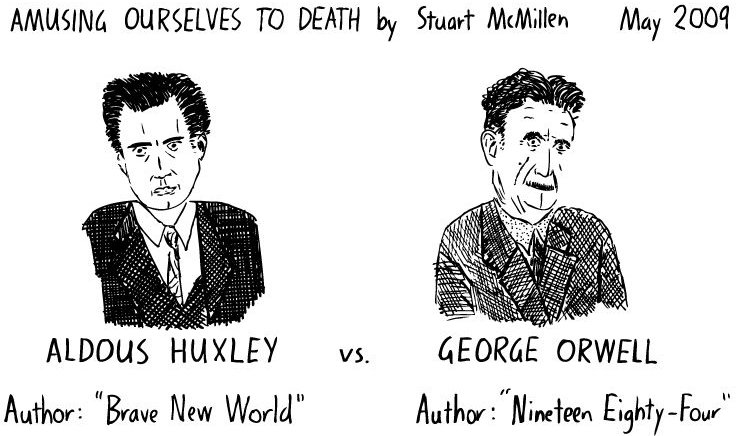
Orwell vs. Huxley

Filed under: Economics, Humour, Technology — Tags: , , — Nicholas @ 08:07

Victor sent me this link with the cryptic comment “Oh shit”:

Orwell_vs_Huxley

November 13, 2009

Veterans chase would-be robber out of Legion

Filed under: Cancon — Tags: , , — Nicholas @ 08:43

A Royal Canadian Legion branch was the target of an armed robbery. The would-be robber must have thought these old gaffers would be easy pickings, as he walked in while they were counting the cash from this year’s poppy drive. He was lucky to escape:

A would-be thief brandishing a gun likely wasn’t counting on an 84-year-old veteran and a fellow member of his Toronto legion putting up a fight when he tried to make off with their poppy money.

But police say that’s what happened Thursday when a man walked into a Royal Canadian Legion in the city’s east end as members were counting the money from this year’s poppy drive.

They refused to give up the cash and instead chased the suspect and tackled him.

However, they were unable to stop him from getting away.

John Dietsch, the 84-year-old Second World War veteran, says he thought of the veterans who served in the military – and the time they spent selling poppies – when he stood up to the man.

Red light cameras are great . . . for increasing traffic fine revenues

Filed under: Government, Law, Liberty, Technology — Tags: , — Nicholas @ 01:09

For driver safety, not so much:

In Los Angeles the LAPD claims accidents are down after they installed cameras, but are they telling the whole truth or just trying to make money off motorists?

We crunched the numbers and the results may surprise you.

“Your data is shocking to me,” Sherman Ellison said.

Ellison is a ticket attorney and part time judge, who believes the cameras are there for one reason.

“No question. Purely a revenue generating device,” Ellison said.

Is it money or safety? We wanted to know actual numbers of accidents at red light camera intersections to see if they really went down.

When we asked, the LAPD became very defensive. The sergeant in charge told me in an e-mail, “The city would hope that it is the goal of KCBS/KCAL to discuss the positive aspects of the photo red light program.”

So we filed a public records request. The department charged us more than $500 for a computer run. When we got the numbers back, they told a different story.

We looked at every accident at every red light camera intersection for six months of data before the cameras were installed and six months after.

The final figures? Twenty of the 32 intersections show accidents up after the cameras were installed! Three remained the same and only nine intersections showed accidents decreasing.

If the reason for installing red light cameras was to increase public safety, they’re a failure. If, however, the real reason for installing them is to increase municipal revenue streams, they’re a slam-dunk success.

November 11, 2009

Murdoch’s brilliant, evil master plan

Filed under: Economics, Humour, Media — Tags: , , — Nicholas @ 12:32

Lore Sjoberg has cracked the secret plan that Rupert Murdoch appears to be following:

The audiences for traditional newspapers are getting older, more crotchety and increasingly dead. Most people don’t want their news to come with such hassles as a cover price, ads or dissenting opinions. How to bring in a younger, hipper audience that’s willing to spend money just to prove that they have money?

Murdoch, that crazy mad genius, realizes that the only way to attract this lucrative demographic is to establish street cred. He’s going underground, reinventing news as an exclusive club that you can’t find just by entering a search term.

Presumably, Murdoch’s New York Post, for example, will be renamed to something hip and enigmatic, like Velocity or Unk. The new URL won’t be publicized. To get it, you’ll have to know somebody, or know somebody who knows somebody, or know somebody who knows somebody who knows somebody, or show a lot of cleavage. There will be a long line outside the website, just like an exclusive club or World of Warcraft right after an expansion release. A moderator will check out your online presence and won’t let you in unless you’re a mover, a shaker, a player, a spender or showing a lot of cleavage.

Once inside, the website will be dark, noisy and disorienting, just like an exclusive club or a MySpace page. There will be a two-drink minimum. I’m not sure how that will work, actually, but if anyone can force people to buy $10 beers while browsing the web, it’s my man Rupert. People will pretend to be reading stories about police standoffs and Knicks games, but they’ll actually be looking around to see who else made it in. And all that affectation and posing is like unto money in Murdoch’s pocket.

Reasons to avoid seeing Disney’s Christmas Carol

Filed under: Economics, Media — Tags: , , , , — Nicholas @ 12:11

Jim Carrey seems to be channelling his inner Friedrich Engels here:

Talking with the Chicago Tribune to promote A Christmas Carol a few days before the film’s release, Carrey released the following burst of political flatulence:

“I was thinking about it this morning, how this story ties into everything we’re going through,” says Carrey, who, thanks to the technology, plays Scrooge as well as the three ghosts haunting him. “Every construct we’ve built in American life is falling apart. Why? Because of personal greed and ambition. Capitalism without regulation can’t protect us against personal greed…”

Making certain that many people reading the interview will resolutely avoid seeing the film, Carrey describes the protagonist as follows:

“Scrooge is the ultimate example of self-loathing,” Carrey says, noting that, after playing the title character in Ron Howard’s “How the Grinch Stole Christmas,” he was merely “going to the source” in fleshing out Scrooge. “Beware the unloved, I always say,” Carrey continues. “They’re the ones that end up being the mean guys. It comes from that deep, spiritual acid reflux within them. With Scrooge it infects his whole being.”

Whereas Dickens presented a reasonably nuanced view of the issues the story brings up, and did so with an appropriate narrative tone, Carrey makes the latest film version sound like a ham-fisted socialist diatribe, hardly a strategy for drawing middle American families in great numbers.

November 9, 2009

QotD: Society must be protected

Filed under: Britain, Bureaucracy, Media, Quotations — Tags: , , — Nicholas @ 14:03

I think this does not go nearly far enough. Clearly the company behind Red Bull should be closely regulated as it is only a matter of time before someone drinks one and jumps off a building and falls to their death because contrary to their claims, Red Bull does not in fact ‘give you wings’.

In short, as people who are not ‘experts’ are moronic halfwits incapable of telling reality from advertising hype, we must simply turn over all aspects of our life to government approved self-important technocratic prigs qualified ‘experts’ who can determine what we are permitted to see.

We must ‘do it for the children’ of course.

Perry de Havilland, “All your images belong to us”, Samizdata, 2009-11-09

November 8, 2009

Over-exuberant celebrations

Filed under: Bureaucracy, Sports — Tags: , — Nicholas @ 18:51

Ticker tape? Heck, I’m just going to dump all these financial records out the window to celebrate the World Series:

Auditor Damian Salo attended the Manhattan parade honouring the baseball World Series championships. He tells The New York Post he found all sorts of personal financial documents in the mountains of shredded paper tossed from skyscrapers as the players rode up Broadway.

They included pay stubs, banking data, law firm memos and even some court files.

The founder of one financial firm, Alan Sarroff, says his company reprimanded one “overzealous” employee for throwing records out the window that should have been shredded.

November 5, 2009

Rick Mercer on Canada’s Economic Action Plan

Filed under: Cancon, Economics, Humour, Politics — Tags: , , , — Nicholas @ 12:40

« Newer PostsOlder Posts »

Powered by WordPress


