Quotulatiousness

November 30, 2010

Ireland’s debt problem

Filed under: Economics, Europe, Humour, Italy, Politics — Tags: , , , , — Nicholas @ 07:48

James Howard Kunstler looks at Ireland’s plight:

When you’re out of the country, as I was last week, it’s good to know that the home folks are keeping up with the Kardashians and bravely venturing into the blood-splattered chambers of cable TV’s latest hit, Bridal Plasty — where candidates for marriage are transformed from Holstein cows into inflatable sex toys by magic surgical technology — not to mention all those humble guardians of freedom who kept the parking lots of WalMart safe for consumerism in the wee small hours of Black Friday. These are, after all, perilous times.

Elsewhere, Ireland and the rest of Europe wore themselves out with soul-searching all week over how to handle national bankruptcy within a currency system that bears only a schematic relation to reality. Does the bankruptee go broke all at once, or is she recruited into permanent debt slavery so that the bond-holders of various banks can keep their loved ones in marzipan and Fauchon’s wonderful marrons glacés for one more holiday season? As of Monday morning, Ireland has been commanded to, er, bend over and pick up the soap, shall we say, for about a hundred billion euros in loans that will not be paid back until a mile-high ice-sheet covers Dublin (something that might happen sooner rather than later if the climate mavens are right).

We’ll see how this bail-out goes down with the French and German voters, too, who have to pay for it, after all, especially as Portugal, Spain, and Italy line up at the cash cage for their cheques (and bars of soap). Of course, a few more basis points in the interest rate spreads could prang the whole Euro soap opera — does anybody really believe this game of kick-the-can will go on after New Years? I’m not even sure it goes on past this Friday, but I am a notoriously nervous fellow.

This is almost as good as the (temporarily discontinued) daily Financial Briefings from Monty.

H/T to Terry Kinder for the link.
November 19, 2010

The A400M is a “Euro-wanking make-work project”

Filed under: Britain, Military, Politics — Tags: , , — Nicholas @ 10:32

Gotta love those unbridled opinions in British politics:

A peer and former defence minister has described the A400M military transport plane — which is being bought by the cash-strapped UK armed forces for a secret but outrageous amount of money — as a “Euro-wanking make-work project” in the written Parliamentary record.

The straight talk came from Lord Gilbert, who held various ministerial portfolios in the 1970s – including a defence one – and did another spell in the MoD as a peer in the first years of the Blair government. Last week he made the following remarks in the House of Lords:

I regard the decision on the A400M as the most bone-stupid in the 40 years that I have been at one end or other of this building. It is an absolutely idiotic decision. We have a military airlift fleet of C-17s and C-130s. We have total interoperability with the United States… six or seven countries altogether will be flying the A400M. Flying the C130, which it is intended to replace, are 60 countries, with 2,600 or so C130Js currently being used. That is the interoperability that we are losing…

September 28, 2010

Britain in the 70’s

Filed under: Books, Britain, Economics, History — Tags: , , , — Nicholas @ 07:38

A review of Dominic Sandbrook’s State of Emergency: The Way We Were. Britain, 1970–1974 sounds interesting:

As prime ministers, Edward Heath and Gordon Brown had quite a lot in common. Both were monstrously self-centred, permanently grumpy and capable of astonishing rudeness. Both of their relatively short-lived premierships ended in humiliating failure. In a recent poll of academics on Britain’s best and worst prime ministers since the second world war, Heath came ninth out of twelve and Mr Brown tenth. But that is where the similarities end. Whereas Mr Brown was largely the author of his own misfortunes (the banking crash apart), Heath, as Dominic Sandbrook reminds us in his splendidly readable new history of Britain during the four years from 1970, was faced with a set of problems whose intractability and nastiness would have overwhelmed even a far more gifted politician.

Heath both appals Mr Sandbrook and elicits his sympathy. Tory mythology still insists that many of Heath’s difficulties arose from his U-turn when he abandoned the free-market ideas with which he entered office and embraced an already discredited and peculiarly British form of corporatism the moment the going got rough. The truth is that although Heath had tried to present himself as the champion of ruthless neoliberalism, he was always at heart a “one nation” Tory with little appetite for the kind of confrontation his successor as Conservative Party leader, Margaret Thatcher, relished. His burning desire was to modernise Britain and to arrest its economic decline through efficiency, pragmatic problem-solving and, above all, by joining the European Community.

My family left Britain in 1967, which was a good time to go: the economy was still in post-war recovery, but opportunities abroad were still open to British workers. My first visit back was in 1979, which was a terrible shock to my system. I’d left, as a child, before the strikes-every-day era began, and my memories of the place were still golden-hued and happy. Going back to grey, dismal, cold, smelly, strike-bound Britain left me with a case of depression that lasted a long time. It didn’t help that the occasion of the visit was to attend my grandfather’s funeral: it was rather like the land itself had died and the only remaining activity was a form of national decomposition.

Some readers will find the way the author flits about tiresome, but given that he was born only in 1974 his almost pitch-perfect ability to recreate the mood and atmospherics of the time is remarkable. He does not lose sight of the fact that although the 1970s are now seen as a nadir in Britain’s post-war fortunes, for the majority of people it was nonetheless a time of growing affluence, widening horizons and personal liberation. Many of the positive developments that are associated with the supposedly wonderful 1960s did not gain traction until a decade later. Viewed from a distance, Britain in the 1970s looks ghastly — angry, decaying, on the skids. But that is not the whole story.

Mr Sandbrook compares this turbulent period with the four years between 1910 and 1914 described by George Dangerfield in “The Strange Death of Liberal England”. As he says: “Dangerfield’s story was one of political ferment and economic turmoil, of challenges to the moral order and rebellions against traditional gender roles, of Utopian socialism and Irish sectarianism — all rooted, like the challenges of the early 1970s, in profound historical trends that no government could possibly control.” Thankfully, the discontent of the 1970s did not end in world war, but continued, mostly unresolved, until the arrival of Lady Thatcher in 1979. That may pose a problem for Mr Sandbrook’s next book, which will be an account of the second half of the decade. In many ways it was more of the same, but without a central character as oddly compelling and sad as Heath.

I’m even more interested — in a grim sort of way — in the next book. It’ll be interesting to read an account of that time from a different perspective than my brief mid-winter visit provided.

September 15, 2010

The real results of Turkey’s referendum

Filed under: Europe, Government, History, Middle East, Politics — Tags: , , — Nicholas @ 07:50

Austin Bay is still hopeful for a secular Turkish government, but the results of the recent referendum don’t encourage quite as much hope:

Turkey’s leading political organizations both portray the choice between them as “either us or darkness.” This rhetorical demonization is typical of successful democracies. Ataturk deserves credit for establishing a democratic structure that survived his death in 1938 by 72 years.

Turkey’s actual circumstances, however, are much more complex and murky. Start with the referendum’s irony. The constitution had many undemocratic articles and was in fact imposed by the military after a coup in 1980. The European Union ruled that many of these elements did not meet EU membership standards. Thus the ironic situation of an Islamist political party promoting constitutional changes in order to meet Western European democratic standards. Aligning Turkey with Europe was one of Kemal Ataturk’s long-term goals.

Yet the judicial reforms approved this week may be an anti-democratic trap door, for they give the AKP the ability to limit systemic checks and balances on executive power. The AKP can pack the courts. The judiciary has protected the Turkish military. The AKP distrusts the military because it fears a coup, and with good reason. The military sees itself as the protector of the secular state and a bulwark against Muslim fundamentalist usurpation.

September 13, 2010

Sir Humphrey Appleby on Brussels

Filed under: Britain, Bureaucracy, Europe, Government, Humour, Politics — Tags: , — Nicholas @ 09:41

As long as they’re allowed, http://sirhumphreyappleby2010.blogspot.com/ will be posting some fascinating memos from Sir Humphrey Appleby KCB CVO on various topics of interest. If-and-when the Official Secrets Act is invoked, of course, we will be deprived of this wonderful insight into the real workings of modern parliamentary government.

For example, here is Sir Humphrey on the manifold advantages of Brussels:

Any attempt by this new government to weaken our ties with the European Union must be firmly resisted. Our membership has been a godsend. Since no cabinet minister is really au fait with all the provisions of the treaty of Rome, we can guide them towards our desired decisions by telling them there are obligations under the treaty, and deflect them from unwelcome actions by saying that the treaty prohibits them. In addition we can cite some of the myriad directives, which can be creatively adapted to our purposes by skilful translation from the original French. Since few of them have progressed beyond O level in any modern language, our version is unlikely to be challenged. And of course when we want to get rid of a minister for a few days we can always arrange an emergency meeting in Brussels, Strasburg or Luxembourg to give us a few days breathing space.

Brussels provides a model for modern government. Legislation can be brought forward only by officials, not by elected members. All important posts are filled by appointment, not election. Political ‘leadership’ is rotated every six months, to ensure that no one ever gets a real grip on the job. The proliferation of nations and languages gives officials endless scope for fomenting distrust, confusion and conflict between members. And there is no nonsense about financial constraints: the auditors have refused to approve the EU accounts for the past fourteen years, but they go on spending happily regardless.

Ministers in previous governments have occasionally expressed concern about this in their early months, but we have always found that after a few visits to Brussels and contingent exposure to the legendary Belgian hospitality, their opposition has cooled remarkably, and indeed they express enthusiasm for further visits, which of course we are more than happy to arrange.

June 24, 2010

It’s a “Failure of its systems for monitoring”

Filed under: Economics, Europe, Greece, Politics — Tags: , , , — Nicholas @ 10:45

Austin Bay thinks he’s identified the elephant in the European parlour:

Greece teeters on the edge. The Wall Street Journal‘s Paul Hannon wrote this week that “the failure of its (EU) systems for monitoring and controlling build-ups in government debt” are why the bailout loans given to Greece by the International Monetary Fund (IMF) and fiscally disciplined EU members like Germany became necessary.

He’s right. “Failure of its systems for monitoring,” however, is a euphemism — economic diplo-speak for a very difficult word: corruption. Greek governments cooked the books (its actual deficit is twice as high as officially reported), violated fiscal agreements and borrowed money they could not repay.

Corruption lies at the dirty core of the Euro-zone’s trouble. Governmental corruption and its cohort, illicit business practices, are a pervasive, multicultural, global affliction.

Corruption coupled with systemic lack of accountability — to include personal accountability, where managers and workers let lackadaisical and lazy work practices slide — eventually produces more than anger, cynicism and financial turmoil. Even among economies in the developed world, it stunts economic productivity, robs the future and sows the seeds of armed conflict. In the developing world it undermines aid efforts, manacles fragile economies and as a result condemns millions to poverty.

The big remaining question is no longer “Will the Euro fail?” but rather “Who’ll bail out first?”

June 21, 2010

China’s latest currency move

Filed under: China, Economics, USA — Tags: , , , , — Nicholas @ 10:31

The always entertaining Monty has a few thoughts that are worth considering:

BNP Paribas forecasts parity (and below!) for the poor, unloved Euro. The Euro is like the easy girl in every town: popular enough when she was young and cute, but now that she’s looking like nine miles of bad road, no one wants to be seen with her or has a kind word to say about her.

After insisting for months that they weren’t keeping the Yuan artificially devalued via the dollar-peg, the Chinese lift the peg, shout Squirrel!, and run away.

Meanwhile, a floating Yuan may not work out quite the way the US thinks it will. This happens to be my view — I think the export-driven Chinese economy is a lot weaker than they’re letting on (or may even realize themselves), and they have severe internal economic problems that the authoritarian government has been papering over for years. There will be a huge banking crisis in China at some point when the huge numbers of bad loans come to light — they can’t hide them forever. Further, the recent labor troubles in China may be only the leading edge of a big wave.

Of course, if you’ve been following Quotulatiousness for any time, you’ll know that I’m fully in agreement with Monty about the Chinese economy. In the long term, I’m quite hopeful about China and their ongoing liberalization and modernization, but in the short- to medium-term I think there are many problems that need to be resolved and that will cause a great deal of upheaval and disturbance.

Remember that even with the best good will in the world, China’s economy is still moving painfully from state-run to private enterprise, and the most common stop on that road is crony capitalism (that’s like capitalism without the rule of law but with private armies). The good news is that a greater proportion of the economy is adjusting to free(r) markets, but there’s still lots of zombie corporate entities set up and run by various branches of the government . . . and the army.

In the latest move, the exchange rate change may not be the panacea that too many American politicians are hoping for:

China’s decision to move away from its currency peg might mean the yuan weakens against the dollar instead of strengthens as Washington wants, Nouriel Roubini, one of Wall Street’s most closely followed economists, said Saturday.

China said Saturday it would gradually make the yuan more flexible after pegging it to the dollar for nearly two years, a move that the U.S. government and others around the world have long been calling for.

It won’t fix the underlying trade issues, even if the yuan moves in the “desired” direction, as the problem is much more rooted in American policy than in Chinese currency rates. As long as the American government insists on increasing the debt load, piling on additional regulatory regimes, and directly interfering in corporate decisions, the longer the economy will be unsettled. Stability is a key condition for economic recovery, yet the American government demonstrates a knee-jerk reaction against stability for every opportunity that arises.

Oh, and if you think the US banking system has bad loan issues, wait for the other shoe to drop:

China’s banking regulator warned Tuesday that the nation’s banking system faces risks from bad loans, particularly among those made to local governments and to the real-estate sector.

In its 2009 annual report, the China Banking Regulatory Commission urged banks to use cause and scientific risk analysis in their lending, and warned of dangers to the sector, both from lending in the past year and from development in the future.

May 11, 2010

A trillion dollars doesn’t buy as much as you’d expect

Filed under: Economics, Europe — Tags: , , , — Nicholas @ 07:54

It doesn’t, for example, buy exemption from the laws of economics:

European Union President Herman Van Rompuy said European governments need to consider pooling their national powers and create a joint economic government.

“We can’t have a monetary union without some form of economic and political union and that is our big task for the coming weeks and the coming months,” he said.

He said he would draft tougher rules for EU leaders to discuss in October that go beyond current EU limits on debt and deficit.

The core problem is near-zero economic growth, high unemployment and governments unwilling to take painful steps to get people to work more and longer.

Simon Tilford, an economist at the Center for European Reform think tank, warned that EU governments so far haven’t come up with anything “game changing.”

“What Europe needs is a growth pact because without growth, public finances aren’t going to be sustainable,” Tilford said. “The bond markets are going to be forcing them to make those kind of changes.”

Even EU president Van Rompuy warned that the bloc risks irrelevance and the end of its expensive welfare programs if it can’t speed up economic growth, forecast to expand by just 1 percent this year.

“With 1 percent growth we can’t finance our social model any more. With 1 percent structural growth we can’t play a role in the world,” he told the World Economic Forum in Brussels. “We need to double the economic growth potential that we now have.”

So even with a trillion dollar injection, you still can’t spend more than you make, year after year, and hope to carry on as if there wasn’t a problem. Who knew?

April 30, 2010

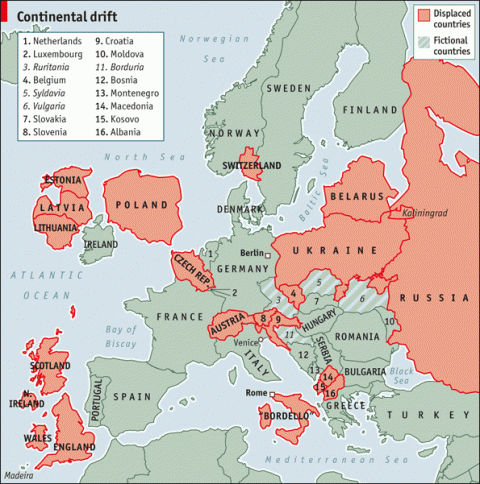
European map, rationalized

Filed under: Britain, Europe, Humour — Tags: , , — Nicholas @ 09:02

The Economist would like to redraw the map of Europe:

People who find their neighbours tiresome can move to another neighbourhood, whereas countries can’t. But suppose they could. Rejigging the map of Europe would make life more logical and friendlier.

Britain, which after its general election will have to confront its dire public finances, should move closer to the southern-European countries that find themselves in a similar position. It could be towed to a new position near the Azores. (If the journey proves a bumpy one, it might be a good opportunity to make Wales and Scotland into separate islands).

In Britain’s place should come Poland, which has suffered quite enough in its location between Russia and Germany and deserves a chance to enjoy the bracing winds of the North Atlantic and the security of sea water between it and any potential invaders.

April 13, 2010

It’s not quite “None of the above”, but it’s close

Filed under: Britain, Europe, Politics — Tags: , , , , , — Nicholas @ 09:26

The UK Independence Party (UKIP) says Sod the lot:

The UK Independence party said “sod the lot” today as it launched its manifesto, telling voters it was time to ditch the three main parties in favour of an alternative proposing no cuts at all.

The party’s new poster features the faces of Gordon Brown, David Cameron and Nick Clegg alongside the slogan “sod the lot”.

Lord Pearson of Rannoch, Ukip’s leader, said it was time for a new politics and argued that leaving the EU would save up to £120bn a year — with no jobs or trade lost from Britain.

Pearson also revealed that his party would put up billboards urging voters to back Labour and Conservative candidates who were “committed” Eurosceptics as part of its strategy to mobilise support for a referendum on Britain’s role in Europe.

The choice on offer to British voters is Gordon Brown, Gordon Brown Lite, and Gordon Brown Extra Lite: that is, there’s very little to choose amongst ’em except for party colours.

Come the next election, it’d be tempting to steal the notion and put Harper, Ignatieff, and Layton on the poster . . . but we don’t have a viable Canadian Independence Party at the moment.

November 12, 2009

Britain’s “choice” on Europe

Filed under: Britain, Bureaucracy, Europe, Government — Tags: , , — Nicholas @ 08:16

James Delingpole has problems with the headline on his post:

Kenneth Clarke is right about Europe

[. . .]

Look, don’t think it didn’t hurt me writing that headline. Just typing it felt like having my eyelids snipped off by scorpions and my eyeballs chewed by fire ants. But it’s true. Clarke was absolutely right to say, as he did in that maddeningly patronising, brown-suede-shoe-wearing, jazz-endorsing way of his, that Cameron’s allegedly bold new policies on Europe are nothing of the kind.

We’re in. We’re stuck there for the foreseeable future. And if you think Asino the donkey is a waste, wait till you see the extravaganza Brussels is planning for its EU Constitution ratification party.

Think a chorus of white rhinos singing Ode To Joy.

Think schools of blue whales doing synchronised swimming in a fish tank the size of Andorra.

Think of 27 planets being spray painted gold so that they look a bit more like the EU flag.

Think of whatever money-wasting scheme you like. If you don’t, you can be sure that somewhere out there, some bright-eyed Euro Stagiere is busily working on it already.

October 11, 2009

Will Cameron be the last PM of the United Kingdom?

Filed under: Britain, Europe, Politics — Tags: , , , , — Nicholas @ 11:05

Jackie Ashley (almost alone among British commentators, according to Charles Stross) examines the likely consequences of both the next British election and the promised-by-Tory-leader referendum on the European Union:

So the question facing the Tory leadership is quite clear: if, by next May, the Lisbon treaty has come into force and Europe has a new president, quite possibly Tony Blair, will Cameron keep his promise to hold a referendum? Yes or no? It’s a straightforward question. He knows that to do so would risk a huge row with the rest of Europe, and a fully operational treaty would be harder to unpick than one not yet signed. That’s why until now he has used the weaselly words that, if the treaty is signed, he would “not let matters rest there”.

Cameron also knows that many in his party, not least his would-be successor Boris Johnson, will push for a referendum and have the support of much of the media too. If Cameron appears to want to renege on his promise, he will provoke fury and rebellion on his own side. For now, his “wait and see” gambit is beginning to look indecisive. If he were Gordon Brown, he would undoubtedly be accused of dithering.

At the same time, Cameron is worrying about another referendum, one which may prove no less momentous for the future shape of Britain. He faces a two-sided constitutional struggle, looking south towards Europe — but also north towards the Scots.

The nightmare for Cameron is that, once George Osborne has revealed details of the cuts imposed by Tory Westminster on Scottish budgets, the SNP start to gain momentum for their proposed independence referendum. Alex Salmond, Scotland’s first minister and nobody’s fool, has been watching the Conservative agendas on cuts and on Europe with fascination.

The Scots will be having their own referendum on independence in 2011, and the Tories barely poll north of the River Tweed. Up in Scotland, it’s Labour and the Scottish Nationalist Party as the top two. Scotland is in an odd situation of having its own parliament, but also sending MPs to Westminster, where they can vote on issues affecting the rest of Britain, but non-Scottish MPs do not get to vote on Scottish issues.

Charles provides the odds:

The current government is a minority one (yes, we’ve got a hung parliament): the Scottish National Party are in charge, although they rely on other parties to get legislation passed. The SNP are formally in favour of outright independence for Scotland, as an EU member nation; and they’re committed to holding a referendum on independence in 2011, before the next election. (Labour and the Lib Dems oppose this. The Tories do too, but they’re so marginal that nobody pays any attention to them.)

Here’s the rub. As things stand, the SNP would lose a vote on independence at this point. But under a conservative government in Westminster — especially one that’s wielding the axe of public service cuts, which is going to happen whoever wins the election and which will disproportionately hit the less well off, which includes a lot of Scots — well, I’d handicap things by giving the pro-independence vote an automatic bonus of 10%.

A sensitive, caring, next-generation Conservative government will therefore be at pains to tread lightly north of the border, and to attempt to defuse nationalist sentiment. Or will it?

On the one hand, to give them their full title, they’re the Conservative and Unionist Party, dedicated to preserving the union. But if they cut Scotland loose, then, in a 650 seat parliamentary system, they lose 80 seats, 78 of which belong to their rivals. Leave aside the fact that Cameron is committed to reducing the number of constituency seats in the UK: the 10% of them elected by Scotland are overwhelmingly not conservative. Ditching them will give the Conservatives an electoral lift that will last for a generation.

That’s got to be a temptation, even to a leader who “loathes the idea of being the last ever prime minister of the United Kingdom”.

« Newer Posts

Powered by WordPress