
Quotulatiousness

August 24, 2013

Bradley Manning or Chelsea Manning

Filed under: Humour, Liberty, USA — Tags: , , , — Nicholas @ 09:34

In this week’s Goldberg File, Jonah Goldberg talks about Bradley Manning’s stated desire to transition to be Chelsea Manning:

What is the best time to announce that you want to be treated like a woman? Not wanting to be a woman myself, I can only speculate. But a few possibilities come to mind. First of all, if you are, in fact, a woman. Then there might be a whole panoply of times and situations when making such a request makes sense. Like when a bunch of steak-head dudes try to include you in their fart humor. Or when they challenge you to a chicken-wing-eating contest.

So I’m talking to you dudes right now. When would it make the most sense for a guy to ask to be treated like a woman? When you’re redeeming your coupon at a day spa, maybe? Certainly, if you’re the cowardly sort, when hostage-takers on your flight announce they will release the women and children. Maybe when you’re the only “man” in your Fifty Shades of Grey book club? Or perhaps when the testosterone in the air at BronyCon stings your nostrils. Again these are only guesses. And I’m just going out on a limb here — but my gut feeling is that one circumstance you can cross off your list, one moment when you don’t want to announce you want to be treated like a dame, is when you’re about to spend 35 years in a men’s prison.

Don’t get me wrong. Some dudes can pull it off. For example, this guy (Click it! It’s funny!). But Bradley Manning just doesn’t seem like the kind of fellah that could discriminate successfully among potential suitors and sundry other gentleman callers.

Let me be clear up front, if Bradley Manning wasn’t a treasonous buffoon who materially damaged the United States of America, I’d take it a little easier on him. In fact, I’m a little squishier on this stuff than Kevin Williamson is — and he’s a libertarian.

[…]

That said, I do think that such beliefs can be very, very strongly held. I also think that as we learn more about how humans develop in utero, gender-identity confusion can have a very hard-wired component. A man thinking he’s a woman — or thinking he was supposed to be born as a woman (or vice versa) — isn’t the same thing as dabbling in Marxism in college or thinking that Van Halen was better with Sammy Hagar. It is not purely a conscious choice or matter of taste. As such it deserves some sympathy, respect, and even a little social space.

But you know who else deserves space, sympathy, and respect? The majority of Americans who don’t think the factory installed their parts wrong. For instance, the push to make unisex bathrooms or let gender-confused girls use boy’s rooms and vice versa is quite simply madness.

The vast majority of Americans — straight, gay, black, white, young, old, Christian, Muslim, Jew, Jedi, and atheist — believe that the humans with the dangly bits should use the boys’ bathroom. And yet out in California, the DOJ just settled a suit saying that this very old arrangement must now be revised to accommodate a minority of one person.

Of course I believe in individual rights and liberties. I’ve always believed democracy without guaranteed individual rights is just a clever way to organize a mob (as I like to say, in a pure democracy, 51 percent of the people get to pee in the cornflakes of 49 percent of the people). But we’re talking about a civilization here, and in a civilization you don’t hold the entire culture hostage to the ever-changing whims and desires of a handful of people.

June 25, 2013

“You cannot have a functioning democratic republic when the laws are so voluminous no one can know what the law is”

Filed under: Law, Liberty, Politics, USA — Tags: , , , — Nicholas @ 08:28

I really did think they were kidding about needing to pass the law to be able to find out what was in it, but this appears to be the way US laws are made nowadays:

When a bill is amended in a sneaky manner, as this one has been, no responsible senator could just read 100 new pages. The amendments are interspersed thoughout the bill — it’s not like you could sit and read them as a unit, even if you had the time. Since the proponents are clearly trying to pull a fast one, prudence, as Senator Cruz pointed out, would dictate rereading every line of text, old and new, to search for insertions — and, indeed, news reports indicate that numerous new buy-offs and pot-sweeteners have been inserted.

But there is a larger point: no “important legislation” should be 100 pages long, much less 1,200 (or the even more mind-boggling girth of monstrosities like Obamacare). The United States Constitution is about 4,500 words long — outfits like Cato and Heritage publish it in small pamphlets that can be read in a few minutes. Nowadays, not only are the bills so gargantuan that no one could conceivably master them and predict their consequences; each page produces even more pages of regulations. They can’t even be lifted, much less digested.

You cannot have a functioning democratic republic when the laws are so voluminous no one can know what the law is. And that is especially the case when (a) the rationale for passing new laws — according to “reform” proponents like Senator Marco Rubio and Rep. Paul Ryan — is that we don’t enforce the laws currently on the books; (b) key parts of legislation consist of commitments to do what previously enacted law already commands; and (c) the president, notwithstanding his oath to take care that the laws are faithfully executed, claims the power to refrain from enforcing whatever laws he disapproves of. Washington has made a farce of the legislative process and of the once proud boast that we are ”a nation of laws not men.”

June 19, 2013

The press and Rand Paul

Filed under: Liberty, Media, Politics, USA — Tags: , , , , , — Nicholas @ 11:03

In The Atlantic, Conor Friedersdorf looks at the mainstream media’s obsession with Rand Paul’s (to borrow a time-worn term from Canadian politics) “hidden agenda”:

Critiques of democracy are as old as the excesses of the Athenian variety. Here’s a classic: The unmediated masses are as capable of doing an injustice as any aristocracy or tyrant. In America, it’s acceptable to say, as shorthand, that we’re living in a Western liberal democracy. But the fact is that we live in a federal, constitutional republic, because the Framers mistrusted democracy, and the vast majority of Americans retain a great part of that mistrust. We’ve extended the franchise, amended the Constitution to permit the direct election of senators, and we’re likely to eventually abandon the electoral college and elect presidents by the popular vote. But there is broad, deep support for anti-democratic features of our system, like the Bill of Rights.

All of this is totally uncontroversial — unless it is uttered by Senator Rand Paul, the national politician most likely to evoke irrational paranoia from the political press. Serial anti-libertarian Jonathan Chait is the latest to demonstrate this truth in an unintentionally revealing item at New York.

Here’s how he begins:

    The most unusual and interesting line in Julia Ioffe’s highly interesting profile of Rand Paul is Paul’s confession, “I’m not a firm believer in democracy. It gave us Jim Crow.” Of course, that’s an awfully strange way to condemn Jim Crow, which arose in the distinctly undemocratic Apartheid South (it was no coincidence that the dismantling of Jim Crow and the granting of democratic rights to African-Americans happened simultaneously).

This is an uncharitable beginning. If a scholar of political thought said of ancient Athens, “I’m not a firm believer in democracy — it required slavery, war, or both, to subsidize the lower classes while they carried out their civic duties,” no one would think that a strange formulation — it is perfectly coherent to talk about democracy in places that didn’t extend the franchise universally, given how the term has been used and understood for two thousand years of political history.

[. . .]

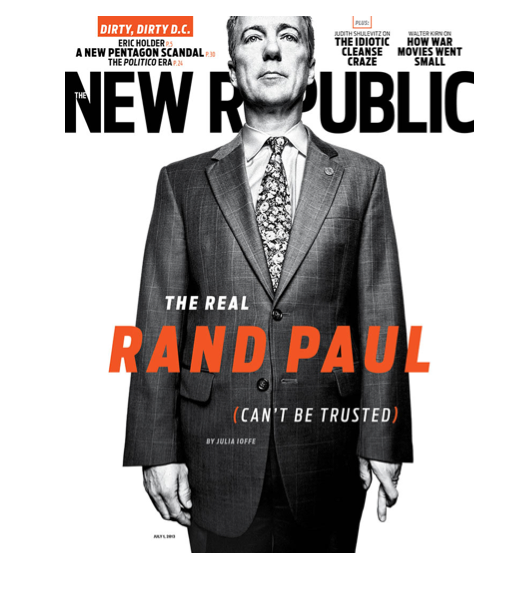
What Chait did is hardly unique. In the political press, it happens again and again: libertarian leaning folks are portrayed as if they’re radical, extremist ideologues, even when they’re expressing ideas that are widely held by Americans across the political spectrum. Here is the absurd cover The New Republic chose for the issue in which the Paul profile appears:

TNR Rand Paul cover

This would seem to imply that, relative to other politicians, the guy who went on Rachel Maddow to discuss the nuances of his take on the Civil Rights Act is the one hiding his “real” self from us. Remember the conservatives who kept saying, “Obama is hiding something — he’s not one of us”? That magazine cover is what it looks like when liberals cave to a similar pathology.

May 16, 2013

You don’t have to be a “Little Englander” to think the UK would be better off outside the EU

Filed under: Britain, Europe — Tags: , , , — Nicholas @ 08:03

In sp!ked, Rob Lyons explains that it’s not just the neanderthal throwback Tories who are questioning whether the UK should leave the European Union:

Over the past week, there has been the most serious discussion about Britain leaving the European Union since it first joined in 1973, and since the British electorate voted in its only referendum on EU membership, under Harold Wilson’s Labour government, in 1975. This discussion a good thing, because it really is time we made a collective dash for the exit from the EU.

[. . .]

The EU doesn’t only elevate technocrats in the economic sphere. More and more political and social policy is also effectively being guided from Brussels. Consider an opinion piece [in the] Guardian this week, by the head of policy at Friends of the Earth UK, Craig Bennett. Bennett argues that the ability of the EU to impose rules and regulations on Britain has improved our health and environment. To be explicit: Bennett thinks it is better that people outside Britain impose these things upon us, even over the heads of our elected representatives. Where a national government might have to balance costs and benefits, and take into consideration the stated desires and priorities of voters, regulations and directives from Brussels can be imposed free from such consequences and accountability. From the point of view of NGOs and lobbyists, this is great news. Why try to change popular opinion when you can simply get the green light from some unelected body of technocrats?

To be anti-EU does not mean being anti-Europe. True, there is a fair degree of parochialism and anti-immigrant sentiment among many of those in Britain who want out. But those of us who believe in having closer ties with Europe and greater freedom of movement across the continent should also be opposed to the EU. Because, thanks to its anti-democratic institutions and its imposition of draconian policies on unwilling citizens, the EU is now doing more harm than good for the cause of creating a sense of European common interest. It might be uniting national elites, allowing them to take refuge from their electorates in the citadels of Brussels, but it is disempowering and even dividing the peoples of Europe — Germans vs Greeks, for example, or enlightened Western Europeans against allegedly backward, racist Hungarians.

Despite the creation of the European Parliament in 1979, there is no meaningful European demos. But the ability to move and trade freely is a good thing — something we could surely retain without the bureaucratic honeypot of the EU’s institutions. It’s time for all Europeans to reimagine how we might live and work together — and Britain marking a sharp exit from the anti-democratic, pseudo-unifying mess that is the EU could be the perfect catalyst for that.

June 6, 2012

Europhiles and Euroskeptics have much in common

Filed under: Europe, Government, Media, Politics — Tags: , , , — Nicholas @ 08:57

Under all the noise and confusion, the fans of the EU and the foes of the EU are rather similar says Brendan O’Neill:

Over the past year, as the Euro crisis has intensified, there has been a really interesting revelation — which is that Europhiles and Eurosceptics are not that different from each other. In fact, Europhiles and Eurosceptics are driven by very similar impulses, by similar anti-democratic instincts.

Both of these groups seem keen to absolve national governments of responsibility, to absolve nation states of responsibility for political and economic chaos.

The Europhile does it by kowtowing to Brussels, calling upon EU institutions to do more to save Europe. And the Eurosceptic does it by blaming the EU for almost everything that goes wrong, treating Brussels as a kind of Death Star that has sucked decency from every inch of Europe.

The Europhile tends to have blind faith in the EU, seeing it as the solution to every problem, while the Eurosceptic has a blinkered dislike of the EU, seeing it as the cause of every problem. What they share in common is a belief that responsibility lies with the EU. Both the depiction of the EU as the saviour of Europe and the depiction of it as the destroyer of Europe are underpinned by an instinct to say: ‘National governments are not to blame for what has gone wrong.’

In answer to the question ‘Did the EU kill democracy?’, I would say ‘No, it didn’t’. The EU is better understood as the end product of the death of democracy in Europe, a creation of national governments that had given up on the ideas of sovereignty and democracy. The EU follows the demise of European democracy, rather than instigating it.

The real driving force behind the EU over the past 40 years was the cowardice and opportunism of national governments, not the sinister ambitions of Brussels or Berlin. National political leaders who felt increasingly estranged from their own populations fashioned a post-sovereign institution that they could effectively hide in.

April 19, 2012

The Bahrain Formula One: it’s just a car race

Filed under: Liberty, Media, Middle East, Politics — Tags: , , , , — Nicholas @ 08:58

Tim Black writes about the real reasons for protests against the Formula One race in Bahrain:

The way some politicians and commentators are talking, you would think that the fate of Bahrain hinged on whether or not this weekend’s Formula One (F1) grand prix goes ahead. Cancel it, and Bahrain’s repressive monarchs, the Al Khalifa family, will have to face up to the failings of their autocratic reign. But proceed with it and F1 might as well have crushed the Bahraini people’s democratic aspiration itself.

[. . .]

Ecclestone’s assessment of the state of Bahrain is certainly questionable. While life does go on for the 600,000 people of this tiny gulf state, there is little calm beneath the surface. Instead, the conflict between a politically and economically disenfranchised Shia majority and the ruling Sunni monarchy continues to simmer. Saudi troops may have helped Bahrain’s own security forces to quell the most explosive manifestation of this conflict last spring, but the arrests, torture and sometimes killing has continued. In the past fortnight alone, three teenagers were shot dead.

Yet as Panglossian as Ecclestone’s view of Bahraini society is, his larger point still stands: ‘it is not [F1’s] business running the country.’ And that’s the problem: too many commentators and politicians are so ‘wrapped up in their own bubble’, to quote Webber, that they believe that the question of whether or not a car race is staged in Bahrain is incredibly important; it is their business running the country. The grand prix is no longer just a car race: it has become a vehicle for exhibiting one’s moral credentials.

[. . .]

This seems to be the prevailing rationale behind the calls to cancel the grand prix: it is all about showing disapproval, striking a moral pose. Bahrain, a country increasingly seen, thanks to the press offices of Amnesty International and Human Rights Watch, as a photo-essay in state brutality, is little more than a convenient background against which to act righteous. Of course, the calls for F1 to boycott the Bahrain grand prix are not recognised for their essential vainglory; they are presented as compassionate. For the advocates of a Bahrain boycott, those willing for the grand prix to go ahead are the callous, self-interested ones. By staging the grand prix, they are tacitly approving of, and legitimating, the rule of the Al Khalifa family.

But who does this disapproval benefit? Who is this display of moral opprobrium for? It’s certainly not those in whose name the grand prix could be cancelled: the disenfranchised majority in Bahrain. After all, if the grand prix does go ahead, it won’t legitimate or validate the regime in their eyes. For those indulging in running-street battles, for those with no political freedom, for those who experience life under the al-Khalifa autocracy on a daily basis, the presence or absence of F1 will make little or no difference. Their lives will still be marked by a ruthlessly enforced unfreedom.

April 14, 2012

Recent immigrants didn’t come here because “Canada is diverse and signed the Kyoto Protocol”

Filed under: Cancon, Media, Politics — Tags: , , — Nicholas @ 11:43

An interesting aside in this Toronto Star article by Rondi Adamson:

However, what is most interesting about these stories is what they reveal about immigrants and Canadian politics. There was a time when the Liberal party could count on immigrant votes. For years, many immigrants who came to Canada under a Liberal government — which would cover much of the last century — reflexively voted Liberal. Part of this was out of gratitude and part of it because the Conservatives (or Progressive Conservatives) never bothered to court the immigrant vote.

[. . .]

Anyone who thinks people choose Canada because of multiculturalism or bicycle lanes in big cities would do well to remember our last municipal election, when Rob Ford received over 50 per cent of the votes of Torontonians born outside Canada. I can tell you my own tale — a couple of summers ago I taught ESL in a Toronto suburb. My students were teenagers new to Canada. I asked them why their parents came here. Almost down to a kid they said, “Because we couldn’t get into the States.” They did not say, “Because Canada is diverse and signed the Kyoto Protocol.” They did not have a Panglossian view of this country. They saw it as they saw the United States — free and fair — though not as powerful a draw.

It is nice when politicians attend cultural celebrations and clumsily do ethnic dances and don hats that make them look goofy. But new and old Canadians respond positively to substance in the form of sensible policy, as opposed to making a show of being inclusive. It was Chen’s case that brought about support for Bill C-26, intended to expand the right to defend one’s home and property. I am pleased that, since the Maroli case, no politician has proposed a correlated Spice Registry, which may have been their wont a decade ago.

H/T to Blazing Cat Fur for the link.

March 5, 2012

The European Court of Human “Rights”

Filed under: Europe, Liberty — Tags: , , , , — Nicholas @ 10:41

Luke Samuel thinks it’s time for people to declare themselves to be “human rights sceptics“:

You don’t have to be a little Englander, or even right wing, to recognise that it is an affront to democracy that unelected and completely unaccountable judges, who have absolutely no democratic mandate, are able to override the decisions of elected representatives. It is appalling that European judges can make significant political decisions over a body of citizens across Europe to whom they will never have to answer.

But there is a more fundamental reason that liberals should be sceptical of human-rights law: because it makes us all less free. Human rights are not ‘rights’ in a liberal sense at all. They bear no resemblance to the ‘rights’ fought for by the radical liberals of the English Civil War, or the French and American revolutions, which sought to limit the power of the state and protect the autonomy of citizens. Instead, human rights treat people as fundamentally vulnerable and in need of state protection. This view of human vulnerability, in the eyes of the human-rights lobby, justifies the granting of absolute power to the state to set the boundaries of freedom.

Take, for example, the ‘right to a private and family life’ protected under Article 8 of the European Convention on Human Rights. The courts will not consider a claim under Article 8 unless it is convinced in the courtroom that you have a ‘family life’ worth protecting. How the courts have defined ‘family life’ for the purposes of Article 8 is laughably antiquated. In 2002, the courts ruled that ‘family life’ does not exist where a relationship between parents and their grown-up children is ‘only emotional’, in that the children are no longer economically dependent on their parents. Neither are unmarried parents likely to be considered a family, unless they maintain sufficient levels of contact with their children. How can any ‘liberal’ support the idea that your family life is only worthwhile if it conforms to what the state decides a family should look like?

Or take Article 10, which purports to protect our freedom of expression. Of course, the very concept of ‘freedom of expression’ owes its existence to radical liberals like John Stuart Mill and Voltaire, who argued that there can be no exceptions to free speech, otherwise you do not have free speech at all. But human-rights lawyers will tell you that Article 10, along with most other human rights, is a ‘qualified right’ because there is a long list of conditions under which the state can interfere with it. This list includes where it is necessary in the ‘interests of public safety’ or for the ‘protection of health or morals’. Such broad qualifications mean that as a means of limiting state power, ‘qualified’ human rights are all but useless.

February 29, 2012

Ireland introduces the doomsday scenario: allowing voters to have a say on the Euro

Filed under: Europe, Government, Law — Tags: , , , , — Nicholas @ 09:33

The EU is not a democratic institution, and is actively hostile to any attempt to consult the people as it tries to become a super-state. Ireland just tossed a medium-sized spanner into the works:

Premier Enda Kenny said Dublin was acting on legal advice from Ireland’s attorney-general that “on balance” the fiscal compact requires a vote under the country’s constitution. “It gives the Irish people the opportunity to reaffirm Ireland’s commitment to membership of the euro,” he told ashen-faced members of the Dail.

All three major parties back the treaty but analysts say there is a high risk of rejection by angry voters in the current fractious mood. The compact gives the EU intrusive powers to police the budgets of debtor states, and has been denounced as feudal bondage by Sinn Fein and Ireland’s vociferous eurosceptics. The Irish voted “No” to both the Nice and Lisbon treaties before being made to vote again. Dublin has ruled out a second vote this time.

The Taoiseach’s announcement sent the euro into sharp dive against the dollar, though it rebounded later. Europe’s leaders thought they had tweaked the wording of the text just enough to avoid an Irish vote.

Note that last sentence closely. Avoiding consulting the very people who’ll be most affected is standard practice in the EU. Good for Ireland that they aren’t willing to be steamrolled yet again.

February 24, 2012

“[T]hose who pass for our leaders are largely anti-democratic, elitist and have little compunction about intruding into our private lives”

Filed under: Economics, Liberty, Media, Politics — Tags: , , , , — Nicholas @ 10:21

Daniel Ben-Ami at spiked! recommends reading Robert H Frank’s The Darwin Economy: not because it’s well-written (he says it’s not) but because it exposes the mindset of our would-be tyrants.

Everyone interested in contemporary society should read Robert H Frank’s The Darwin Economy or a book like it. It is not that it is amazingly astute or beautifully written. It is neither. But it does give readers an exceedingly important perspective: an inside view of how the current generation of politician-technocrats thinks.

Identifying some of the key themes of contemporary political debate is easy enough. A glance at the media reveals that those who pass for our leaders are largely anti-democratic, elitist and have little compunction about intruding into our private lives. Working out how they reach the conclusions they do, understanding the internal logic or their approach, is more difficult.

In many ways, economics is the discipline best suited to the technocratic mindset. This has nothing to do with its traditional subject matter. It is not about debating how to produce goods and services or how to distribute them. Instead, it relates to how economics has emerged as an approach that distances itself from democratic politics and provides little room for human agency.

[. . .]

Finally, the narrow vision embodied in technocratic approaches leads to a blinkered approach to problem-solving. For example, most economists discuss tackling climate change in terms of the optimum design of a market for carbon trading. There is little critical debate about the nature of the threat the world is facing or of the range of possible solutions. One alternative to tinkering with the demand for carbon might be to have a huge programme for building nuclear reactors. Such an initiative would also have the advantage of helping to tackle a vital but often forgotten problem: the need for massive amounts of additional energy to fuel economic development.

The technocratic approach to policymaking has become immensely influential and pernicious. Although it is often expressed in terms of economic arguments, it has an impact across the whole range of social life. It is anti-democratic, anti-political and anti-human. To counter the rise of technocracy, it is necessary to delve deep into how its arch-exponents think.

February 16, 2012

Getting rid of that messy, obstructive “democracy” thing in Europe

Filed under: Bureaucracy, Europe, Government, Greece, Liberty — Tags: , — Nicholas @ 10:40

Bruno Waterfield on the destruction of democracy in Greece and what it will mean for the rest of the European Union:

What happens in Greece will mark the opening of a new era in European politics. It is important therefore to understand what is and isn’t going on. The crisis is not, as many believe, being driven by ‘neoliberal’ economic policies. It isn’t caused by any Greek cultural propensity to fecklessness either. And, despite the protest graffiti and the timeless appeal of Nazi references, the Greek tragedy is not a plot to restore an explicit German hegemony in Europe. Angela Merkel is no Adolf Hitler.

What is happening in Greece is a crisis of European proportions because it is the sharpest expression of a destructive trend common to all countries in the EU: the twenty-first-century elite mission to place institutions, policy and statecraft above society. The Greek catastrophe, then, is an indicator of what happens when the question of interest or politics becomes the sole preserve of bureaucratic or state structures decoupled from, and increasingly defined against, the public.

Measures imposed on Greece are explicitly declared, even celebrated, as being in opposition to Greek society. Any attempt by political parties to uphold the democratic representation of Greek interests is met with aggressive hostility. Moreover, the EU-IMF programme, or so-called Memorandum of Understanding, for Greece is utterly divorced from economic reality. As documented in the Daily Telegraph, the Eurozone’s policies are pushing Greece into a ‘death spiral’ that defies any economic logic.

February 8, 2012

A spectre is haunting the EU elite: the spectre of democracy

Filed under: Bureaucracy, Europe, France, Greece, Politics — Tags: , , — Nicholas @ 10:25

Bruno Waterfield on the worries of the movers and shakers in the fancy office suites in Brussels:

The European Union is currently straining every sinew in a campaign to stifle outbreaks of politics across Europe.

For the EU oligarchs, democracy sucks. What if the Greeks — voting in elections this April — decide to tear up an austerity programme painstakingly hammered out by their betters in the EU and the IMF? Imagine — and the memory of all those lost referendums still smarts among Eurocrats — if a country should decide it has had enough of the economic mismanagement and diktat that has characterised the Eurozone’s handling of the economic crisis.

A spectre is indeed haunting the corridors of Brussels offices and it is real: a well-founded fear that voters will reject the ‘fiscal compacts’, ‘debt brakes’ and ‘golden rules’ aimed at securing the EU’s reign in de facto perpetuity.

[. . .]

Pierre Moscovici, the Socialist campaign manager, has further horrified the EU by hinting that a new French president could hold a referendum — a taboo in contemporary European politics. ‘I am convinced that we will find allies for a renegotiation aimed at a policy change to pull us out of this austerity spiral and recession. We don’t like the idea of a popular vote because we are pro-Europeans and we don’t want a “No”, but nor can we allow tensions to spill over’, he said last week.

January 9, 2012

What is really meant by the term “Deliberative democracy”

Filed under: Government, Liberty, Media, Politics — Tags: , , — Nicholas @ 10:21

Frank Furedi explains the intent of “consultations”, “public conversations”, and “deliberative democracy” — which are neither conversations nor democratic in nature:

In these situations, ‘consultation’ is turned into a tool of management masquerading as genuine deliberation. The demand for deliberation always comes from above, and the terms of these ‘public conversations’ are always set by professional consultants. The process of deliberation depends on ‘procedures, techniques and methods’ worked out by experts. The exercise itself is overseen by professional facilitators, whose rules are really designed to assist in the observation and management of the participants. These phoney conversations are not forums where the participants interact as equals — rather, skilled facilitators are employed to create the right kind of environment and desirable outcomes. One writer sings the praises of ‘citizens’ juries’ — a common form of deliberative democracy — by saying that such juries rely on ‘trained moderators’ who ensure ‘fair proceedings’. With zero self-consciousness, the writers endorses such a highly manipulative environment as being superior to ‘liberal institutions’, which apparently only encourage passivity amongst citizens. What we have is a pretence of deliberation and a reality of manipulation.

Deliberative democracy is neither deliberative nor democratic. Rather, it is about promoting propaganda through the pretence of having an open conversation. However, when it comes to manipulating the public imagination, ‘deliberative polling’ beats deliberative democracy to the finishing line. Deliberative polling stage-manages an allegedly open discussion on a controversial issue in order subliminally to alter people’s views and convictions. According to one of the advocates of deliberative polling, the beauty of this exercise is that ‘many participants changed their voting intentions as a result of the dialogue’. The author, Carne Ross, offers a scenario where, prior to an exercise in deliberative polling, 40 per cent of people surveyed said they would vote for mainstream centrist parties, 22 per cent for socialists, nine per cent for centrist liberals and eight per cent for greens. However, by carefully finessing the wording of the choices available to the participants, the deliberative manipulators successfully increased the number of participants who wanted to ‘emphasise the fight against climate change’ from 49 to 61 per cent.

Deliberative democrats are not shy about acknowledging that their support for conversational forums is contingent upon the participants reaching the ‘right’ decisions. Deliberative democracy is often promoted on the basis that it provides an environment conducive to changing people’s minds and having them adopt the ethos of the forum’s organisers. Deliberation is the preferred method of communication, because it can be a useful tool for transmitting the outlook of the organisers. To ensure that this objective is achieved, the group’s interpersonal dynamic is carefully controlled. To prevent the spontaneous emergence of informal group leaders, ‘most moderators are alert to the manner in which deliberations can be dominated by confident and outspoken individuals’, assures one assessment of deliberative democracy. It appears that deliberative democracy works best when ‘confident and outspoken individuals’ are put in their place.

The depiction of an exercise in brainwashing as a new form of democracy shows that political rhetoric is just that these days — empty rhetoric. It is a sign of the times that a procedure that could have come straight out of George Orwell’s Nineteen Eighty-Four can be presented as an enlightened alternative to representative democracy. The assumption that the professional facilitator has the moral authority to determine how people should think and emote speaks volumes about the patronising attitude of today’s ‘deliberators’.

December 15, 2011

Mick Hume: Dispelling Euro-myths

Filed under: Britain, Europe, France, Germany, Politics — Tags: , , , — Nicholas @ 08:49

In this post at Spiked, Mick Hume pours cold water on five Euro-myths:

Euro-myth No 1: ‘It was a triumph for Cameron — or Sarkozy’

Depending on who you listen to, either UK prime minister David Cameron bravely stood alone for Britain by rejecting a new EU treaty, or else he was beaten by the wily French president Nicolas Sarkozy who got what he wanted by the UK’s omission from the new deal around the Eurozone.

In fact, what the rupture showed was that both the six-footer Cameron and the diminutive Sarkozy are, to coin a phrase, pygmies in political terms. And so are German chancellor Angela Merkel and the rest of Europe’s political elite. Far from a triumph for anybody, it marked an embarrassing failure of basic diplomacy among substandard statesmen and women. There are always tensions and ructions at international summits. But in other times they would have been kept under control by careful diplomatic preparation and consultation beforehand – not left to break out in a schoolboy spat on the day, with Cameron and Sarkozy reportedly almost coming to blows. Even far more strident Eurosceptics such as Margaret Thatcher knew how to play the great power game without tripping over their own laces. Europe’s destiny is now in the hands of self-regarding pygmies who think more of their next headline than the shared future of the continent.

As for the notion that Cameron struck a noble blow for the British people and ‘our’ national sovereignty — come off it. Indeed, one of his main motives appears to have been to avoid giving the British people any kind of say on the matter, by dodging both the referendum that would be demanded if he accepted an amended EU treaty, and the general election that would follow if he went too far the other way and broke up his coalition with the EU-loving Liberal Democrats. The government would rather fall out with the French than risk the wrath of British voters.

December 7, 2011

Time to end the “forced march” to Fiskalunion?

Filed under: Europe, France, Germany, Government — Tags: , — Nicholas @ 09:40

Patrick Hayes outlines the way European national leaders and unelected EU officials are steadily blocking any democratic influence over the future of Europe:

Missing from this deal-making has been the European public, which has been held in complete disregard; whether such a ‘forced march’ is acceptable to the European populace is deemed utterly irrelevant, a triviality, in the face of impending doom. After all, as Merkel reminded us recently, ‘nobody should take for granted another 50 years of peace and prosperity in Europe’. The need for such fundamental changes to Europe’s government and economic system are deemed to be beyond debate.

Even when raising the importance of the national sovereignty of their countries, European leaders do so by pointing out too much economic and fiscal integration would get in the way of solving the short-term crisis. There is little discussion of sovereignty as a matter of principle, as the basis upon which voters can hold politicians and technocrats to account. Actually asking the people directly what they want, through national referenda on any new treaty, is regarded as an unnecessary distraction from the urgent task of saving the Euro, to be avoided at all costs.

[. . .]

Once again demonstrating who is actually wearing the trousers in the partnership between the two wealthiest Eurozone countries, Merkel largely got her way. Only last week, Sarkozy was calling for a return to greater democracy in the European Monetary Union: ‘The reform of Europe is not a march towards supra-nationality’, he said. However, Merkel also had to water down her desire to haul naughty countries before a supra-national authority such as the European Court of Justice or a ‘super commissioner’ in Brussels. Instead, sanctions for breaches of the new Eurozone rules would be enforced internally within countries, who would adopt new laws promising they will obey EU rules.

Despite this, as is evident by a leaked document being circulated by EU Council president Herman Van Rompuy and to be discussed by senior EU officials today, the full arsenal of punitive measures for rule-breaking Eurozone members remains on the table. Van Rompuy suggests that bailed-out countries could be temporarily deprived of political voting rights in EU councils; pension reforms, social security systems, labour-market policy and financial regulations could be ‘harmonised’ across EU countries; and there could be ‘more intrusive control of national budgetary policies by the EU’. Development aid for poorer EU countries could be cut, too.

[. . .]

Whatever gets decided at this week’s summit, and whether the fiscal rules are accepted by all 27 EU nations or just by the 17 Eurozone members, it’s clear that greater intrusion into member countries’ national sovereignty by EU officials is the way the wind is blowing. Should countries overspend and breach EU rules, they may no longer be allowed to decide how they set their taxes, how much they can borrow, even the make-up of their budgets. Such decisions, fundamental to a country’s sovereignty, get ripped from the hands of the people living in the countries and their elected representatives, with decisions instead being forcibly guided by European technocrats in Brussels.

« Newer PostsOlder Posts »

Powered by WordPress

