Quotulatiousness

September 7, 2014

Hong Kong’s chief executive – you can vote for anyone we nominate

Filed under: China — Tags: , , — Nicholas @ 11:20

Sara Hsu reports on the Chinese government’s plans for how Hong Kong’s chief executive will be elected:

Hong Kong is at a political crossroads, as the National People’s Congress (NPC) in Mainland China has proposed to allow universal suffrage in final selection of the Chief Executive, as long as a nominating committee chooses candidates approved by the Communist Party. The proposal is to be voted upon by the Legislative Council; if rejected, the 2017 will be by committee, as in the last election (of Chun-ying Leung). Mainland China’s involvement in Hong Kong’s elections has reduced the ability of Hong Kong residents to freely run for and elect a candidate of their choice for the most powerful government position of this Special Administrative Region. Does this constraint negatively or positively impact the economy?

Hong Kong’s market economy is to be maintained at least through 2047 according to the Basic Law. China and Hong Kong have strong interests in upholding their mutual economies, as Hong Kong is the largest source of inward investment for Mainland China, and also the largest recipient of foreign direct investment from the Mainland. The economies are intricately intertwined through trade and investment, so in these respects, interests are intertwined.

Nor has the movement against Beijing political involvement gained widespread popularity from an economic perspective. Hong Kong’s pro-democracy movement, Occupy Central with Love and Peace, has in fact been accused by some of putting Hong Kong’s economy at risk. Even though the movement has had little direct impact on the economy thus far, pro-Beijing groups worry that the pro-democracy movement will give rise to political instability and jeopardize the economic well-being of Hong Kong residents.

August 9, 2014

QotD: What is it that keeps democracies democratic?

Filed under: Government, Law, Liberty, Quotations, USA — Tags: , , , , — Nicholas @ 00:03

This is the only thing that keeps either party within a mile of good behavior — the understanding that if you deceive the public, or act with gross incompetence, that behavior is going to be politicized and used against you.

Consider the example of the various one-party cities in this nation.

Can there be any doubt that “politicization” of one’s errors or actual violations is, while annoying for the party who has erred, the only thing that restrains a party from wholesale violations of the public trust?

Besides the obvious salutary public policy effects, there is of course a more tangible reason why records should be retained and, when subpoenaed by Congress, disclosed to that body:

Because it’s the law.

And adherence to the Law is the only thing that keeps a society of feuding political parties from degenerating into a third-world system of coups and counter-coups.

If the party I oppose shows perfect contempt for following the law when it sees a political advantage in doing so, why should I not support the selfsame law-breaking when the party I support decides it might find some advantage in doing so?

The government’s basis for rule over the citizens is based on two things:

1. Sheer naked coercive power.

And:

2. Moral authority, and the notion that, while a citizen might not like the particular government serving at any particular time, that citizen values something more eternal than the temporary political circumstances of a four year period of time.

Namely, the idea that it is best for everyone to follow the law, because it’s more important to support a stable government without turmoil and violence than to violate the law to win on any immediate, ephemeral political point.

Note that it is far better for any society that the government’s power rests more on the second pillar than on the first. Because so long as that pillar, of moral authority, of general fairness, of a general sense that the longterm interests of America are better served by adherence to government than to rebellion against it, the government will rarely, if ever, have to resort to the ultimate pillar of authority, which is physical, violent coercion.

Ace, “Sure Why Not: HHS Emails Sought by Congress To Determine Why Healthcare.gov Was Such a Catastrophe Are, Get This, Missing”, Ace of Spades H.Q., 2014-08-08.

May 16, 2014

Narendra Modi wins in a landslide

Filed under: India, Politics — Tags: , — Nicholas @ 08:08

The Economist reports on the first election in India to produce a single-party majority since 1984:

“INDIA has won” tweeted Narendra Modi, on May 16th, his first public comment after official counting from India’s general election made it clear that he, and his Bharatiya Janata Party, had delivered a landslide victory beyond the expectations of almost everyone. The scale of the BJP win was remarkable. It swept entire states, including Rajasthan, Delhi, Gujarat, Himachal Pradesh, Uttarakhand. More importantly it made enormous strides in two crucial, and massive, northern states, Uttar Pradesh and Bihar. There not only did Congress do disastrously, regional parties were also badly walloped. As of lunch time, it appeared that the BJP and its closest allies (known as the NDA) would have 324 seats of the 543 parliament, with the BJP alone getting 275. BJP spokesmen called that, rightly, a “tectonic shift in the polity of India”. It is the first time since 1984 that a single party has enough seats to rule alone.

Much is made is the importance of Mr Modi as a leader, who inspired great enthusiasm among the voters, especially youngsters. Clearly, too, there is demand for a stronger economy and more development. So strong is his victory, it might be no other party has enough seats to serve automatically as the opposition, since to lead it in parliament you need at least 10% of the seats, and Congress’s total haul might include even fewer than that. The array of ministers and prominent figures in Congress who have lost their seats is impressive. Mr Modi will give speeches and enjoy victory parades, first in Gujarat (where he has already visited his mother to get her blessings), then on May 17th in Varanasi. He may be sworn in as prime minister on May 21st, though obviously he hardly need wait to start forming a government and picking his ministers.

So lopsided is the outcome that enormous expectations will now rest on the BJP and Mr Modi to start delivering changes quickly. The vote share claimed by the BJP, some 35% nationally, is enormous by Indian standards. Combined with an historically high turnout, at 64%, it gives Mr Modi a huge mandate for his rule. Nor does it seem that any other party can offer any serious opposition to him. Congress is in tatters and its leaders must think seriously about its future role in politics. Rahul Gandhi, despite early signs that he was behind in his own constituency, at least appeared able to hold on there. But his margin of victory appeared to be hugely reduced. The Aam Aadmi Party, born of an anti-corruption movement, has at least claimed one MP (and perhaps several) in Punjab.

Update: Dave Weigel reminds us about Rahul Gandhi’s “total implosion in the worst interview ever”.

The debut of John Oliver’s Last Week Tonight, an exciting moment for the Slate demo, spent a good while shaming American media for ignoring India’s election. This was just, and right, and true — lots of things are more interesting than Hillary Clinton’s set speeches at charity events, not least the fate of the world’s largest democracy. And Oliver got the gist of the election, which was that the charismatic Narendra Modi would lead a right-wing coalition into power over the ruling Congress Party. That happened.

My only quibble with Oliver was how he described Rahul Gandhi, the man who led Congress to defeat. To be fair, the party was doomed by corruption and slowing economic growth, and Gandhi was given… I was about to write “a poisoned chalice,” but that seems like a gauche analogy for a man whose father and grandmother were assassinated in office. But Oliver quickly described Rahul as an “Indian Han Solo” and a man with the “total political package.”

This was not the whole story. Gandhi was sort of a disaster, a groomed yet unprepared candidate who never recovered from a nightmare interview with TV host Arnab Goswami. The whole gruesome thing is online, and the transcript is here. Both offer their own flavors of cringe comedy, from the start, when Gandhi struggles to explain why he’s doing his first-ever TV interview after 10 years in office.

April 24, 2014

Reason.tv – Is Democracy Overrated? Q&A with Columnist David Harsanyi

Filed under: Books, Liberty, Politics, USA — Tags: , — Nicholas @ 08:51

Published on 22 Apr 2014

“I think the Founders weren’t wary enough of democracy,” says David Harsanyi, senior editor at The Federalist and a nationally syndicated columnist. “I think there are bigger problems with it.”

Harsanyi sat down with Reason TV‘s Nick Gillespie to discuss his new book, The People Have Spoken and They Are Wrong: The Case Against Democracy, why we put too much weight on voting, and why praising democracy is just celebrating mob rule.

“Democracy’s just a process that reflects the morals and ethics of the people who vote,” he said. “It doesn’t guarantee you freedom — just check out the Gaza Strip or Egypt or anywhere else.”

March 31, 2014

Trust is the key to civilization

Filed under: Government, Liberty, Media, Politics, USA — Tags: , , , , — Nicholas @ 00:01

Victor Davis Hanson explains why the drop in trust — specifically the peoples’ trust in government — is on a steep downward trajectory:

Transparency and truth are the fuels that run sophisticated civilizations. Without them, the state grinds to a halt. Lack of trust — not barbarians on the frontier, global warming or cooling, or even epidemics — doomed civilizations of the past, from imperial Rome to the former Soviet Union.

The United States can withstand the untruth of a particular presidential administration if the permanent government itself is honest. Dwight Eisenhower lied about the downed U-2 spy plane inside the Soviet Union. Almost nothing Richard Nixon said about Watergate was true. Intelligence reports of vast stockpiles of WMD in Iraq proved as accurate as Bill Clinton’s assertion that he never had sexual relations with Monica Lewinsky.

Presidents fib. The nation gets outraged. The independent media dig out the truth. And so the system of trust repairs itself.

What distinguishes democracies from tinhorn dictatorships and totalitarian monstrosities are our permanent meritocratic government bureaus that remain nonpartisan and honestly report the truth.

The Benghazi, Associated Press, and National Security Agency scandals are scary, but not as disturbing as growing doubts about the honesty of permanent government itself.

March 14, 2014

QotD: The nature of government

Filed under: Government, Quotations — Tags: , , — Nicholas @ 06:53

All government, in its essence, is a conspiracy against the superior man: Its one permanent object is to police him and cripple him. If it be aristocratic in organization, then it seeks to protect the man who is superior only in law against the man who is superior in fact; if it be democratic, then it seeks to protect the man who is inferior in every way against both. Thus one of its primary functions is to regiment men by force, to make them as much alike as possible and as dependent upon one another as possible, to search out and combat originality among them. All it can see in an original idea is potential change, and hence an invasion of its prerogatives.

H.L. Mencken, “Le Contrat Social”, Prejudices, Third Series, 1922

February 20, 2014

ESR examines the “Dark Enlightenment”

Filed under: Media, Politics — Tags: , , , , — Nicholas @ 10:10

Remember that “Dark Enlightenment” we’re all supposed to be terrified about? ESR is looking at the phenomenon (it’s not really a movement, or at least, it isn’t a single movement):

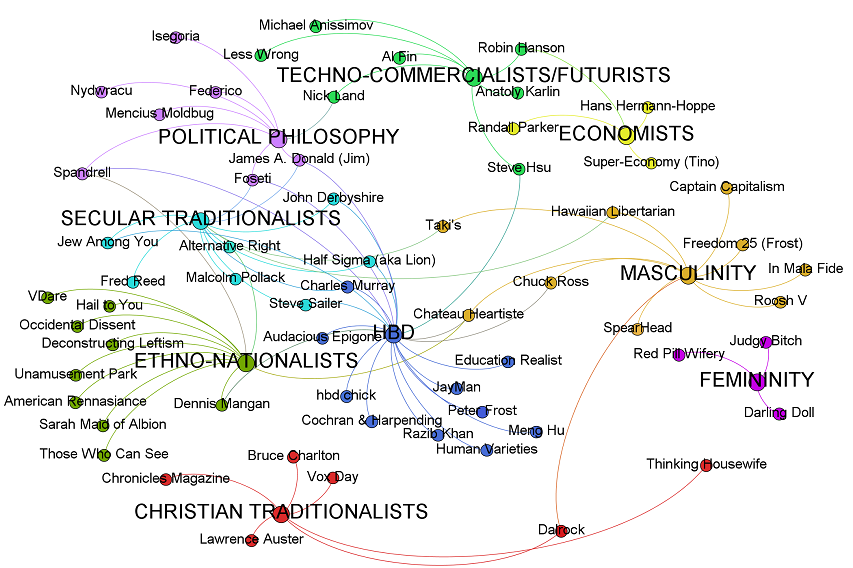
The Dark Enlightenment is, as I have previously noted, a large and messy phenomenon. It appears to me in part to be a granfalloon invented by Nick Land and certain others to make their own piece of it (the neoreactionaries) look larger and more influential than it actually is. The most detailed critiques of the DE so far (notably Scott Alexander’s Reactionary Philosophy in an Enormous, Planet-Sized Nutshell and Anti-Reactionary FAQ nod in the direction of other cliques on the map I reproduced but focus pretty strongly on the neoreactionaries.

This is the map ESR is referring to:

Scharlach's affinity diagram of the Dark Enlightenment movement, grouped according to their major themes

Scharlach’s affinity diagram of the Dark Enlightenment movement, grouped according to their major themes

Nevertheless, after we peel away clear outliers like the Techno-Commercial Futurists and the Christian Traditionalists, there remains a “core” Dark Enlightenment which shares a discernibly common set of complaints and concerns. In this post I’m going to enumerate these rather than dive deep into any of them. Development of and commentary on individual premises will be deferred to later blog posts.

(I will note the possibility that I may in summarizing the DE premises be inadvertently doing what Scott Alexander marvelously labels “steelmanning” – that is, reverse-strawmanning by representing them as more logical and coherent than they actually are. Readers should be cautious and check primary sources if in doubt.)

Complaint the first: We are all being lied to – massively, constantly, systematically – by an establishment that many DE writers call “the Cathedral”. Its power is maintained by inculcation in the masses of what a Marxist (but nobody in the DE, ever, except ironically) would call “false consciousness”. The Cathedral’s lies go far deeper than what most people think of as normal tactical political falsehoods or even conspiracy theories, down to the level of some of the core premises of post-Enlightenment civilization and widely cherished beliefs about the sustainability of racial equality, sexual equality, and democracy.

[…]

Complaint the second: “All men are created equal” is a pernicious lie. Human beings are created unequal, both as individuals and as breeding populations. Innate individual and group differences matter a lot. Denying this is one of the Cathedral’s largest and most damaging lies. The bad policies that proceed from it are corrosive of civilization and the cause of vast and needless misery.

[…]

Complaint the Third: Democracy is a failure. It has produced a race to the bottom in which politicians grow ever more venal, narrow interest groups ever more grasping, the function of government increasingly degenerates into subsidizing parasites at the expense of producers, and in general politics exhibits all the symptoms of what I have elsewhere called an accelerating Olsonian collapse (after Mancur Olson’s analysis in The Logic Of Collective Action).

February 9, 2014

Democracy and the media

Filed under: Government, Media, Politics — Tags: , , — Nicholas @ 11:13

Nigel Davies looks at the uncritical admiration of the form of democracy (while actively ignoring the actual practice) among Western media people:

It is interesting to look around the world at the moment and identify the failures of democracy, and to be amused by the Western media’s complete incomprehension of what is going on and why.

Time and time again you get headlines about how people should stand back and accept the ‘democratically elected government’, despite the fact that the democratic result was a fairly evil dictator keen on persecution, mass murder, civil war and ethnic cleansing.

This is because most ignorant Western journalists believe as an absolute truth that ‘democracy’ is a good thing, despite all the evidence that democracy is as bad, or even worse, than any other form of government. (Interestingly many non-western journalists treat democracy with considerable scepticism, which baffles Western journalists even more.)

Just to be clear Robespiere, Napoleon III, Mussolini and Adolf Hitler were in some form ‘democratically elected’ leaders, and every Communist dictator, ever, has regularly received about 97% of the popular vote in their countries.

[…]

Which brings us to unofficial one party states, like South Africa, where there is a popular vote which means virtually nothing. People get a say, but there is no chance of removing the party which — very largely through its dreadful economic and social policies — has kept the vast majority of the voters ignorant and poor (while flooding them with propaganda suggesting that result is an outside conspiracy, and only the people’s party can save them …) Actually some of you might recognise this more directly as being Mugabe’s very blunt approach, but the principal is the same when adopted by more weasely worded one party statists (for whom too many Western journalists have a romanticised and highly inaccurate perspective).

Most African (and many Asian and Middle Eastern … and Eastern European) ‘nations’ that pretend to democracy, are effectively one party states where the ‘opposition’ is never really going to be allowed to get anywhere.

A current example he points to is Egypt:

I am not just talking about people like Hitler who managed to manipulate 25-30% of the vote to dominate a chaotic parliament long enough to change all the rules and entrench their power. (Though that appears to be the default result for 90-95% of all Republics throughout all history, so perhaps it is worthy of some reflection.) No, I am more interested in places where a genuine majority of the population vote repeatedly for a leader who every educated and thinking (not the same thing unfortunately) person knows will lead them to disaster.

Effectively what we are talking about here is popularistic appeals to the ignorant peasantry who make up the majority of the population.

Egypt recently elected the Muslim Brotherhood. This was done by the majority votes of the ignorant peasants in the rural areas, and against the wishes of practically anyone who could be classed as educated, literate, liberal, or with an understanding of rule of law, or role of commerce and legal rights in a modern society. Ie: the traditional appeal to the ignorant to grab control of the ‘means of production’ and ‘distribute it more fairly’ — which always leads to the same results of poverty and persecution whether you call it a Fascist state (Nazi Germany) Communist state (People’s Republic), Theocratic state (Muslim republic, Hindu republic, North Korea), or just a kleptocracy.

Naturally the Western journalists believe the Muslim Brotherhood should be left to develop its ‘democratic’ course.

The inevitable result of letting the Muslim Brotherhood rewrite the constitution and entrench their powers while introducing a Muslim republic with proper Sharia laws, would be a particularly nasty form of dictatorship. Like Nazi Germany or Soviet Russia, future votes would have been ‘controlled’ and eventually pointless. So the intervention of the military to throw them out and try and redo the democratic project was necessary, and possibly the only (very slim) hope of making it work. However, like Fiji, it may be only the start of many interventions to stop backsliding, until the military and people give up in disgust and settle down to exactly the sort of dictatorship which, more or less, kept things together and slowly moving forward under their previous dictators.

January 23, 2014

QotD: The media, politicians, and moral panics

Filed under: Media, Politics, Quotations, USA — Tags: , , , , , , — Nicholas @ 10:45

No one who has given any study to the development and propagation of political doctrine in the United States can have failed to notice how the belief in issues among politicians tends to run in exact ratio to the popularity of those issues. Let the populace begin suddenly to swallow a new panacea or to take fright at a new bugaboo, and almost instantly nine-tenths of the master-minds of politics begin to believe that the panacea is a sure cure for all the malaises of the republic, and the bugaboo an immediate and unbearable menace to all law, order and domestic tranquillity. At the bottom of this singular intellectual resilience, of course, there is a good deal of hard calculation; a man must keep up with the procession of crazes, or his day is swiftly done. But in it there are also considerations a good deal more subtle, and maybe less discreditable. For one thing, a man devoted professionally to patriotism and the wisdom of the fathers is very apt to come to a resigned sort of acquiescence in all the doctrinaire rubbish that lies beneath the national scheme of things — to believe, let us say, if not that the plain people are gifted with an infallible sagacity, then at least that they have an inalienable right to see their follies executed. Poll-parroting nonsense as a matter of daily routine, the politician ends by assuming that it is sense, even though he doesn’t believe it. For another thing, there is the contagion of mob enthusiasm — a much underestimated murrain. We all saw what it could do during the war — college professors taking their tune from the yellow journals, the rev. clergy performing in the pulpit like so many Liberty Loan orators in five-cent moving-picture houses, hysteria grown epidemic like the influenza. No man is so remote and arctic that he is wholly safe from that contamination; it explains many extravagant phenomena of a democratic society; in particular, it explains why the mob leader is so often a victim to his mob.

H.L. Mencken, “Roosevelt: An Autopsy”, Prejudices, Second Series, 1920.

January 10, 2014

QotD: Teddy Roosevelt

Filed under: Books, History, Quotations, USA, WW1 — Tags: , , , — Nicholas @ 08:02

In the face of such acute military imbecility it is not surprising to discover that all of the existing biographies of the late Colonel Roosevelt — and they have been rolling off the presses at a dizzy rate since his death — are feeble, inaccurate, ignorant and preposterous. I have read, I suppose, at least ten of these tomes during the past year or so, and in all of them I have found vastly more gush than sense. Lawrence Abbott’s Impressions of Theodore Roosevelt and William Roscoe Thayer’s Theodore Roosevelt may well serve as specimens. Abbott’s book is the composition, not of an unbiased student of the man, but of a sort of groom of the hero. He is so extremely eager to prove that Roosevelt was the perfect right-thinker, according to the transient definitions of right-thinking, that he manages to get a flavor of dubiousness into his whole chronicle. I find myself doubting him even when I know that he is honest and suspect that he is right. As for Thayer, all he offers is a hasty and hollow pot-boiler — such a work as might have been well within the talents of, say, the late Murat Halstead or the editor of the New York Times. This Thayer has been heavily praised of late as the Leading American Biographer, and one constantly hears that some new university has made him Legum Doctor, or that he has been awarded a medal by this or that learned society, or that the post has brought him a new ribbon from some literary potentate in foreign parts. If, in fact, he is actually the cock of the walk in biography, then all I have said against American biographers is too mild and mellow. What one finds in his book is simply the third-rate correctness of a Boston colonial. Consider, for example, his frequent discussions of the war — a necessity in any work on Roosevelt. […]

Obviously, Roosevelt’s reaction to the war must occupy a large part of any adequate biography of him, for that reaction was probably more comprehensively typical of the man than any other business of his life. It displayed not only his whole stock of political principles, but also his whole stock of political tricks. It plumbed, on the one hand, the depths of his sagacity, and on the other hand the depths of his insincerity.

Fundamentally, I am convinced, he was quite out of sympathy with, and even quite unable to comprehend the body of doctrine upon which the Allies, and later the United States, based their case. To him it must have seemed insane when it was not hypocritical, and hypocritical when it was not insane. His instincts were profoundly against a new loosing of democratic fustian upon the world; he believed in strongly centralized states, founded upon power and devoted to enterprises far transcending mere internal government; he was an imperialist of the type of Cecil Rhodes, Treitschke and Delcasse. But the fortunes of domestic politics jockeyed him into the position of standing as the spokesman of an almost exactly contrary philosophy. The visible enemy before him was Wilson. What he wanted as a politician was something that he could get only by wresting it from Wilson, and Wilson was too cunning to yield it without making a tremendous fight, chiefly by chicane — whooping for peace while preparing for war, playing mob fear against mob fear, concealing all his genuine motives and desires beneath clouds of chautauqual rhetoric, leading a mad dance whose tune changed at every swing. Here was an opponent that more than once puzzled Roosevelt, and in the end flatly dismayed him. Here was a mob-master with a technique infinitely more subtle and effective than his own. So lured into an unequal combat, the Rough Rider got bogged in absurdities so immense that only the democratic anaesthesia to absurdity saved him. To make any progress at all he was forced into fighting against his own side. He passed from the scene bawling piteously for a cause that, at bottom, it is impossible to imagine him believing in, and in terms of a philosophy that was as foreign to his true faith as it was to the faith of Wilson. In the whole affair there was a colossal irony. Both contestants were intrinsically frauds.

H.L. Mencken, “Roosevelt: An Autopsy”, Prejudices, Second Series, 1920.

December 31, 2013

2013 in review

Filed under: Humour, Liberty, Politics — Tags: , , , — Nicholas @ 10:09

I nearly ran Steve Chapman‘s wonderful little squib as a QotD entry: “The course of freedom and democracy in the world is an evolutionary process, though sometimes it proceeds in the wrong direction. Wines have good years and bad years. If 2013 were a wine, you’d use it to kill weeds.”

Looking ahead to 2014, Radley Balko has some Dire Civil Liberties Predictions to ring in the new year:

As we come to the end of a year that saw revelations about massive government spying programs, horrifying stories of police abuse, and brazen violations of the Fourth Amendment, I thought I might offer my own grim predictions about where civil liberties are headed in the coming year. Sure, some of these may seem outlandish. But to borrow from H.L. Mencken, nobody ever went broke underestimating the grade and lubriciousness of the slippery slope.

On a less-depressing note, Nick Mediati rounds up the “top” memes of 2013, including the latest attempt to de-grammaticize the internet:

Doge meme of 2013

After years and years of cats dominating the Internet, dog lovers were finally thrown a bone in 2013 with the emergence of the Doge meme. The meme typically features photos of Shiba Inu dogs with internal thoughts overlaid in brightly colored Comic Sans. And it’s frickin’ awesome. You might find yourself spontaneously speaking in doge. Such language. So words. Very thought. Wow.

December 8, 2013

Mandela’s struggle was not the same as Gandhi’s

Filed under: Africa, History, India, Liberty — Tags: , , , , , — Nicholas @ 11:09

Salil Tripathi met Nelson Mandela and finds the frequent comparisons between Gandhi and Mandela to do less than justice to both men:

The South African freedom struggle was different from India’s, and the paths Mandela and Gandhi took were also different. That did not prevent many from comparing him with Gandhi. But the two were different; both made political choices appropriate to their time and the context in which they lived.

Gandhi’s life and struggle were political, but securing political freedom was the means to another end, spiritual salvation and moral advancement of India. Mandela was guided by a strong ethical core, and he was deeply committed to political change. At India’s independence, Gandhi wanted the Congress Party to be dissolved, and its members to dedicate themselves to serve the poor. But the Congress had other ideas. Mandela would not have wanted to dissolve his organization; he wanted to bring about the transformation South Africa needed, but he also wanted to heal his beloved country.

This is not to suggest that Gandhi wasn’t political. He was shrewd and he devised strategies to seek the moral high ground against his opponents — and among the British he found a colonial power susceptible to such pressures, because Britain had a domestic constituency which found colonialism repugnant, contrary to its values.

Mandela’s point was that he didn’t have the luxury of fighting the British — he was dealing with the National Party, with its Afrikaans base, which believed in a fight to finish, seeking inspiration from the teachings of the Dutch Reformed Church which established a hierarchy of different races, which led to the establishment of apartheid. “One kaffir one bullet,” said the Boer (the Afrikaans word for farmer, which many Afrikaans-speaking South Africans were); “One settler one bullet,” replied Umkhonto weSizwe, the militant arm of the ANC.

And yet Mandela’s lasting gift was his power of forgiveness and lack of bitterness. He showed exceptional humanity and magnanimity when he left his bitterness behind, on the hard, white limestone rocks of Robben Island that he was forced to break for years, the harsh reflected glare of those rocks causing permanent damage to his eyes. And yet, he came out, his fist raised, smiling, and he wrote in his memoir, Long Walk To Freedom, that unless he left his bitterness and hatred behind, “I would still be in prison.”

By refusing to seek revenge, by accepting the white South African as his brother, by agreeing to build a nation with people who wanted to see him dead, Mandela rose to a stature that is almost unparalleled.

[…]

Calling Mandela the Gandhi of our times does no favour to either. Gandhi probably anticipated the compromises he would have to make, which is why he shunned political office. Mandela estimated, correctly, that following the Gandhian path of non-violent resistance against the apartheid regime was going to be futile, since the apartheid regime did not play by any rules, except those it kept creating to deepen the divide between people.

H/T to Shikha Dalmia for the link.

October 2, 2013

“Saving” Greek democracy

Filed under: Europe, Greece, Politics — Tags: , , — Nicholas @ 08:44

The sweep of arrests among the elected members of the Greek far-right Golden Dawn party are being hailed as saving democracy, but as Brendan O’Neill points out, this kind of action is extremely undemocratic:

Why isn’t there more discomfort, or at least the asking of some awkward questions, about the arrest of Golden Dawn MPs in Greece? Yes, Golden Dawn is a profoundly unpleasant organisation. Virulently racist, anti-Semitic, allergic to the ideals of free speech and free movement, and supported by people who are quite happy to use violence against those they hate, especially immigrants, it makes our own British National Party look like a chapter of the Women’s Institute in comparison. Yet that doesn’t mean we should give a nod to, far less cheer, the Greek state’s incarceration of GD’s leaders and members of parliament, who were democratically elected. Any police sweep on elected politicians should make those of us who call ourselves democrats anxious; that Greece’s military-style assault on GD hasn’t is very worrying.

[…]

Far from asking critical questions about what is motivating the Greek state’s clampdown on Golden Dawn, sections of the Greek left and vast swathes of the European left are celebrating it as a victory for democracy. They echo Greece’s public order minister, Nikos Dendias, who described the sweeping-up of GD’s leaders as ‘a historic day for Greece and Europe’. Greek newspapers are competing to see who can be the most effusive in their support for the clampdown. The brilliant arrests are ‘Golden Dawn’s Holocaust’, said one, rather tastelessly. Another claimed that ‘democracy is knocking out the neo-Nazis’. A left-wing British magazine described the arrests as ‘a victory for democracy in Greece’ and demanded to know why the Greek state isn’t doing more to shut down GD. SYRIZA, the left-wing opposition party in Greece which numerous European leftists have excitably hailed as a radical voice against austerity, has stood shoulder-by-shoulder with the state against Golden Dawn, claiming the arrests show ‘that our democracy is standing firm and is healthy’.

These radical cheerleaders of a state clampdown on democratically elected politicians urgently need to look up the word democracy in a dictionary. To describe the arrest of politicians who were elected by the public, by masked, armed police who were not elected by the public, as a ‘victory for democracy’ is the most profound contradiction in terms. Some leftists are claiming that the militaristic clampdown on GD has nothing to do with its political beliefs and is just a straightforward investigation of some men involved in alleged criminal activity. It’s hard to know whether such naivety is touching or disturbing. If this is just a criminal case rather than a political war waged by agents of the state against ideological undesirables, then why are so many describing it as a ‘victory for democracy’, as opposed to a potential victory for justice, and why are so many hailing the ‘knocking out [of] neo-Nazi ideas’? No number of lists of the alleged weapons found in GD members’ homes (apparently the party’s leader owns three guns) can disguise the fact that what we are witnessing here is a state war on a party supported by a significant number of Greeks.

September 28, 2013

This is what democracy looks like – Indian voters can now vote “None of the above”

Filed under: Government, India — Tags: , , , — Nicholas @ 11:40

Alex Tabarrok links to a Wall Street Journal article (paywalled, unfortunately) about the Indian court decision that will allow Indian voters to cast their ballots against all the candidates on offer:

Excellent news. Bear in mind:

    Nearly a third of the members of the lower house of Parliament are facing criminal charges, according to the Association for Democratic Reforms, a New Delhi-based advocacy group for transparency in governance.

Even if that were not the case, however, one of the problems of democracy is that there is too little feedback and information transmission, due both to rational ignorance and the bundle nature of politics. Allowing for “none of the above” provides, not a panacea, but a little bit more feedback. Many people vote but have to hold their noses to do so. Many others don’t vote but do they not vote because they are satisfied or dissatisfied? None of the above gives the dissatisfied a chance to reveal their views and in so doing it may encourage more and better candidates.

At present, voting none of the above is just informational, i.e. none of the above is never “elected” even if it gets a majority, although the option to vote NOTA may change the outcome of the election. In the future a NOTA majority might signal a new election.

There have been a few elections here in Ontario I’d love to have had the option of voting “None of the above”.

August 31, 2013

The modern monarchy in Spain

Filed under: Europe — Tags: , , , — Nicholas @ 11:06

In an older post at the Guardian, Miguel-Anxo Murado looks at the place of the monarchy in Spanish society:

King Juan Carlos of Spain must be one of the most Shakespearian kings, ever. His grandfather was ousted from the throne like Richard II, and like Richard III, his brother was killed (though in Carlos’ case it was a tragic accident). Like Hamlet he had a difficult relationship with his father, and like Macbeth, he arrived at the crown by way of an evil creature (General Franco). It sounds inevitable that, like King Lear, in his old age he would be cursed with troublesome daughters. Now, one of them, Princess Cristina, has been summoned by a judge. She has to answer for allegations that, together with her husband the Duke of Palma, they misappropriated millions of euros in public funds. Some say this scandal, the latest in a long series of royal mishaps, threatens the very institution of monarchy in Spain. But is it so?

The rule of King Juan Carlos of Spain is a very interesting example of how the essence of monarchy is not history, but a story — and how tricky that is. The Spanish monarchy is a literary institution. It was born outside and above the law. Its legitimacy was based on symbols, metaphors and, first and foremost, on storytelling: a mostly imaginary tale of continuity and exceptionality. Modernity changed this a bit, but not by much. Like theatre, monarchy had begun like a religious cult and ended in a popular spectacle. That was all. In stable systems like the UK, this transition from statecraft to stagecraft could be done more or less effectively, but in Spain it was pushing the trick too far.

[…]

Like with all story-telling, there’s some truth in this fiction. Yes, the king did assist the transition to democracy, and he stood against the 1981 military coup. Yet the often overlooked fact here is that he had no alternative if he wanted to reign. It was true that he was not ostentatious, but he wasn’t austere either. It is true that he seems a likeable person, but not exemplary. He was a patron of the WWF, but he also loves hunting elephants. He needed not to be perfect, but now he has to, because that was the nature of the narrative his friends concocted.

« Newer PostsOlder Posts »

Powered by WordPress


