Quotulatiousness

November 27, 2018

Cutting back on ethanol makes financial and environmental sense

Craig Eyermann explains why President Trump’s push to expand the use of ethanol in cars is a bad call for many reasons:

For example, because ethanol packs less energy per gallon than gasoline does, vehicle owners can expect to get even lower fuel mileage from the expansion of E15 fuel (a blend of 15% ethanol with 85% gasoline) under the new mandate to include more ethanol in automotive fuels, which would be 4% to 5% less than they would achieve if they only filled their vehicles with 100% gasoline. Today’s vehicle owners already pay a fuel efficiency penalty of 3% to 4% lower gas mileage from the E10 ethanol-gasoline fuel blend mandated under the older ethanol content rules, where the new rules will require even more fill-ups.

Beyond that, to the extent that it diverts corn from food markets to fuel production, corn-based ethanol production also jacks up the price of food—the corn itself, plus everything that eats corn, like beef cattle. One review of multiple studies found that the U.S. government’s corn-based ethanol mandates added 14% to the cost of agricultural commodity prices from 2005 through 2015.

Last summer, the Environmental Protection Agency also found that burning increasing amounts of ethanol has made America’s air dirtier because it generates more ozone pollution, which contributes to smog formation. Worse, growing the additional corn to make more ethanol has also increased agricultural fertilizer runoff pollution in the nation’s rivers and waterways.

That runoff has been linked to the increased incidence of harmful algal blooms, which have been responsible for contaminating drinking water and contributing to red tide events in coastal regions, where fish and other aquatic organisms have been killed off.

There is a solution to these federal government-generated pollution problems: stop forcing corn-based ethanol to be used in the nation’s fuel supplies. There’s even a case study from Brazil, where the city of Sao Paulo found that its air became cleaner after it switched from ethanol-based fuels to gasoline in the years from 2009 to 2011.

October 31, 2018

Premier Ford’s promise to lower electricity rates in Ontario

Filed under: Business, Cancon, Government — Tags: , , , , — Nicholas @ 05:00

In the Financial Post, Lawrence Solomon says Doug Ford can’t risk abandoning his promises about Ontario electricity costs, despite his cabinet’s worries about provincial reputation damage:

Ford has every reason to return the power system to some semblance of economic sanity. Ontario is now burdened by some of the highest power rates of any jurisdiction in North America, throwing households into energy poverty and forcing industries to close shop or move to the U.S. The biggest reason by far for the power sector’s dysfunction is its renewables, which account for just seven per cent of Ontario’s electricity output but consume 40 per cent of the above-market fees consumers are forced to provide. Cancelling those contracts would lower residential rates by a whopping 24 per cent, making good on Ford’s promise to aid consumers.

[…]

To date, Ford has stopped renewable developments that haven’t been completed, which will prevent things from getting worse, but he has failed to tear up the egregious contracts of completed developments, which will prevent things from getting better. Based on conversations that I and others have had with government officials, it appears that Ford is inclined to cancel the contracts and honour his signature promise, but he is being thwarted by cabinet colleagues who fear that Ontario’s reputation will take a hit in the business community if they don’t play nice.

Except, there’s nothing nice about betraying a promise to the voters who democratically put you in power in order to avoid pressure from lobby groups who think governments are entitled to hand out sweetheart deals to their favoured cronies. There’s also nothing democratic about it. It is an axiom of parliamentary government that “no government can bind another.”

Canadian governments, including Ontario governments, have in the past torn up odious contracts, including those in the energy sector. When they did, upon passing binding legislation, they were able to reset the terms, offering as little or as much compensation as they wished. Outraged business lobbies’ claims that the reputation of governments would be affected were not borne out. Moreover, such rightings of political wrongs serve the interest of small government and free markets, because businesses have always understood that there’s an inherent risk in contracting with governments that are able to unilaterally rewrite contracts. To overcome that inherent risk, businesses add a risk premium when getting in bed with government, helping to explain the rich contracts the renewables developers demanded. That risk premium acts to make business-to-business dealings more economic than business-to-government dealings.

September 6, 2018

Trans-partisan planning

At Coyote Blog, Warren Meyer offers a plan to address man-made climate change, pitched to avoid being dismissed as “typical” of one or the other side:

While I am not deeply worried about man-made climate change, I am appalled at all the absolutely stupid, counter-productive things the government has implemented in the name of climate change, all of which have costly distorting effects on the economy while doing extremely little to affect man-made greenhouse gas production. For example:

  • Corn ethanol mandates and subsidies, which study after study have shown to have zero net effect on CO2 emissions, and which likely still exist only because the first Presidential primary is in Iowa. Even Koch Industries, who is one of the largest beneficiaries of this corporate welfare, has called for their abolition
  • Electric car subsidies, 90% of which go to the wealthy to help subsidize their virtue signalling, and which require more fossil fuels to power than an unsubsidized Prius or even than a SUV.
  • Wind subsidies, which are promoting the stupidist form for power ever, whose unpredictabilty means fossil fuel plants still have to be kept running on hot backup and whose blades are the single largest threat to endangered bird species.
  • Bad government technology bets like the massive public subsidies of failed Solyndra

Even when government programs do likely have an impact of CO2, they are seldom managed intelligently. For example, the government subsidizes solar panel installations, presumably to reduce their cost to consumers, but then imposes duties on imported panels to raise their price (indicating that the program has become more of a crony subsidy for US solar panel makers, which is typical of these types of government interventions). Obama’s coal power plan, also known as his war on coal, will certainly reduce some CO2 from electricity generation but at a very high cost to consumers and industries. Steps like this are taken without any idea of whether this is the lowest cost approach to reducing CO2 production — likely it is not given the arbitrary aspects of the program.

These policy mess is also an opportunity — it affords us the ability to substantially reduce CO2 production at almost no cost.

August 15, 2018

QotD: State economic intervention in theory and practice

The economic theory: the state intervenes in the economy in order to prevent free-riding – in order to internalize externalities – in order to better ensure that all private parties pay the full marginal costs of their activities, and that all private parties reap the full marginal benefits of their activities – in order to promote competition – in order to protect the weak from the strong.

The political reality: the state intervenes in the economy in order to promote free-riding – in order to externalize costs and benefits that the market has reasonably internalized – in order to better ensure that politically powerful private parties escape the full marginal costs of their activities, and that politically disfavored groups be stripped of much of the marginal benefits of their activities – in order to promote monopoly – in order to render some people weak who are then pillaged by the strong.

Don Boudreaux, “Economists’ Normative Case for Government Intervention is a Very Poor Positive Theory of that Intervention”, Café Hayek, 2016-09-26.

July 19, 2018

Crony capitalists of the military-industrial complex

Matthew D. Mitchell comments on some of the problems with government contractors and their all-too-cosy relationship with the government officials who hand out the public’s funds:

… as economist Luigi Zingales explains in his book, A Capitalism for the People, governments contracting with private interests has its own set of risks:

    The problem with many public-private partnerships is best captured by a comment that George Bernard Shaw once made to a beautiful ballerina. She had proposed that they have a child together so that the child could possess his brain and her beauty; Shaw replied that he feared the child would have her brain and his beauty. Similarly, public-private partnerships often wind up with the social goals of the private sector and the efficiency of the public one. In these partnerships, Republican and Democratic politicians and businesspeople frequently cooperate toward just one goal: their own profit.

When President Dwight Eisenhower warned against the “unwarranted influence” of the “military-industrial complex,” he was concerned that certain firms selling to the government might obtain untoward privilege, twisting public resources to serve private ends. It is telling that one of those contractors, Lockheed Aircraft, would become the first company to be bailed out by Congress in 1971.

For many observers, the George W. Bush administration’s “no-bid” contracts to Halliburton and Blackwater appeared to exemplify the sort of deals that Eisenhower had warned of. It is true that federal regulations explicitly permit contracts without open bidding in certain circumstances, such as when only one firm is capable of providing a certain service or when there is an unusual or compelling emergency. In any case, a report issued by the bipartisan Commission on Wartime Contracting in 2011 estimated that contractor fraud and abuse during operations in Afghanistan and Iraq cost taxpayers an estimated $31 to $60 billion. This includes, but is not limited to:

    requirements that were excessive when established and/or not adjusted in a timely fashion; poor performance by contractors that required costly rework; ill-conceived projects that did not fit the cultural, political, and economic mores of the society they were meant to serve; security and other costs that were not anticipated due to lack of proper planning; questionable and unsupported payments to contractors that take years to reconcile; ineffective government oversight; and losses through lack of competition.

Governments may also award contracts to perform a service that has more to do with serving a parochial interest than with providing a benefit to the paying public. For example, Congress may order the Pentagon to procure more tanks even though the Pentagon itself says the tanks aren’t needed. Paying General Dynamics hundreds of millions of dollars to produce unneeded tanks in order to protect jobs in particular congressional districts may be an abuse even if the underlying process by which the contract was awarded is legitimate.

July 7, 2018

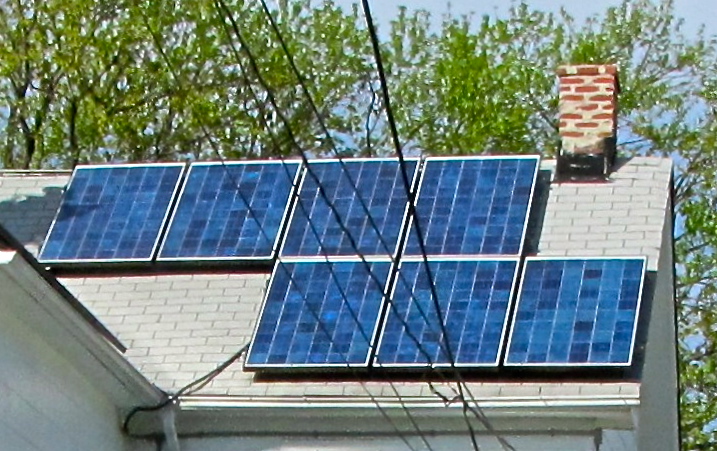
The bad economics of rooftop solar installations

Norman Rogers points out where the numbers don’t add up for many jurisdictions’ domestic solar power schemes:

Photovoltaic panels on a roof, 28 April, 2015.
Photo by Antonio Chaves, via Wikimedia Commons.

A modest proposal:

We’ve all heard about “shop local” and “get your food from local farmers, not distant corporate farms.” Lots of people have apple trees in their backyards. Often they can’t begin to eat or give away all the apples. In the meantime, big supermarkets sell corporate apples for one dollar a pound and up. I propose that people with backyard apples be able to take them to the supermarket and sell them to the supermarket for the same price at which the supermarket is selling apples. Furthermore, they should be able to take them at any time and receive payment. If the store gets too many local apples, it can reduce its purchase of corporate apples.

My apple proposal may seem ill advised, but that is exactly how rooftop solar power works. The homeowner gets to displace power from the power company, and if the homeowner has more power than he needs, the power company is obligated to purchase it, often for the same retail price at which it sells electricity. That policy is called net metering. In order to accommodate the homeowner’s electric power, the utility has to throttle down some other power plant that produces power at a lower wholesale price.

The exact arrangements for accepting rooftop solar vary by jurisdiction. In some places, net metering is restricted in one way or another.

A large-scale natural gas-generating plant can supply electricity for around 6 cents per kilowatt-hour. Rooftop solar electricity costs, without subsidies, around 30 cents per kilowatt-hour, or five times as much. Average retail rates for electricity in most places are between 8 cents and 16 cents per kilowatt-hour. Yet, paradoxically, the homeowner can often reduce this electric bill by installing rooftop solar.

It is actually worse than forcing the power company to take 30-cent electricity that it could get from a natural gas plant for 6 cents. When the company throttles down a natural gas plant to make room for rooftop electricity, it is not saving six cents, because it already has paid for the gas plant. All it saves is the marginal fuel that is saved when the plant is throttled down to make room for the rooftop electricity. The saving in fuel is about 2 cents per kilowatt-hour. So 30-cent electricity displaces grid electricity and saves two cents.

QotD: Crony rules

Filed under: Law, Quotations — Tags: , , — Nicholas @ 01:00

The direction [by government] of economic activity thus necessarily involves discrimination between persons, the creation of monopoly and privilege, while the aim of the Rule of Law is the abolition of all privilege, be it in favor of the strong or of the weak. And it is no less fatal to freedom if exemption from general legal rules is granted to the weak than when it is granted to the strong. Once the door is opened to differentiation on the ground of deserts or needs, it will be arbitrary will instead of objective rule which will govern men.

F.A. Hayek, “The Political Ideal of the Rule of Law”, 1955.

June 30, 2018

QotD: In government regulations, complexity is a subsidy to existing companies

One of the major themes of the book I’m working on should be familiar to longtime readers of this “news”letter. It boils down to a simple insight: Complexity is a subsidy. The more complex you make the rules, the more you reward people with the cognitive, material, or social resources necessary to get around them. Big corporations tend not to object to more burdensome regulations because they can afford to comply with them. Dodd-Frank was great for the “too big to fail” crowd. But it has been murder on community banks that don’t have the resources to comply. As Lloyd Blankfein, the CEO of Goldman Sachs, put it:

    It’s very hard for outside entrants to come in and disrupt our business simply because we’re so regulated. We hear people in our industry talk about the regulation, and they talk about it with a sigh about the burdensome of regulation. But in fact in some cases the burdensome regulation acts as a bit of a moat around our business.

But you’ve been hearing this stuff from me for years. Let’s get back to the arrogance thing. It seems to me a big part of the problem with progressive elites these days is that they lack self-awareness. That elites arrange affairs for their own self-interest is an insight that was already ancient when Robert Michels penned his Iron Law of Oligarchy. But ever since the progressives concocted their theories of “disinterestedness,” they’ve convinced themselves that they are not in fact a self-serving elite. Give feudal aristocrats their due: They were a self-dealing crop of rent-seekers and exploiters, but at least they were open about the fact that they believed they had a divine right to sit atop the social pyramid. Today’s progressive aristocracy is largely blind to the fact that their cult of expertise isn’t really about expertise; it’s about organizing society in a way that reinforces their status and power.

Well, most of them are blind to it. Occasionally the mask slips. Jonathan Gruber, one of the chief architects and financial beneficiaries of the health-care “reform,” told audiences that Obamacare was designed “in a tortured way” to hide the fact that “healthy people pay in and sick people get money.” They had to do it this way to get around the inconvenient “stupidity of the American voter.” A feudal lord who talked this way about his serfs wouldn’t get any grief for it. But in America such honesty gets you rendered an un-person.

Jonah Goldberg, “The Consequences of Overpromising on Obamacare”, National Review, 2016-10-08.

April 7, 2018

Car rental agencies look to government to quash upstart “personal vehicle sharing” companies

Filed under: Business, Government, USA — Tags: , , , , — Nicholas @ 03:00

Steven Greenhut discusses yet another entrenched industry trying to get the government to protect them from disruptive competitors:

Real capitalism is a tough sport where entrepreneurs risk their capital in hopes of winning customers.

The “crony” version of it involves politicians rigging the rules to assure that the “right” people are winners. We see this ugly process on high-profile national issues, such as when Donald Trump promotes tariffs to boost steel makers at the expense of companies that use steel products. But most of this nonsense proceeds quietly in legislative committees, without garnering any headlines or vocal opposition.

One awful but illustrative example popped up recently in the California state Capitol. Assembly Bill 2246, by Assemblywoman Laura Friedman, D-Glendale, apparently is part of a national effort by rental-car companies to snuff out a burgeoning industry that just happens to be threatening its business model. The bill would redefine “personal vehicle sharing” companies as “car rental companies” — and then slam them with reams of new regulations. Similar measures have been proposed in Idaho, New Hampshire, Maryland and Maine.

Rental-car companies are facing the same challenges as other established business models in this internet and app-based age. Capitalism — the real sort — is defined by “creative destruction,” as economist Joseph Schumpeter called it. New companies are free to offer better products and services that appeal to customers. This is creative as new ideas flourish and consumers get a broader choice and lower prices thanks to competition. But it’s also destructive. Complacent old companies suddenly are forced to improve their offerings or shut their doors. The consumer is king.

For example, I recently grabbed a taxicab rather than my usual Uber and noticed the oddest thing. The cabbie had a modern app-based system for taking my credit-card payment. Until recently, paying by credit card was a hassle because cab services didn’t really want to take your card. I’ve also noticed a fleet of nice new cabs around my city. And the cab I took even sent an email with a receipt and a rating system. Sound familiar?

March 28, 2018

QotD: Rent-seeking through “health concern” trolling

Filed under: Business, Economics, Food, Health, Quotations — Tags: , , — Nicholas @ 01:00

Producers too often shamelessly use whatever excuses are at hand to justify their prodding the state to prevent consumers from patronizing rival producers. Trumped-up health ‘concerns’ are a prominent set of easy excuses when the good in question is food or drink. “Those foods offered by our rivals are likely to kill or injure our beloved consumers!” cry rent-seeking producers, feigning an overriding concern for the health of the public. “For the health of our citizens, our rival producers must be stopped from selling their foul foods in our market!” Conveniently, of course, when such restrictions are implemented the favored producers no longer must compete as vigorously for consumers’ patronage. (Question: What does diminished competition do to producers’ incentives to maintain the safety of the foods they sell to the public?)

Anyway, here’s a history lesson: today’s expressed concerns about the safety of genetically modified foods and the calls for governments to restrict consumers’ freedom to buy these foods are, in their essence, nothing new. In the late-19th century similar ‘concerns’ over the safety of American beef and pork were used by some beef and pork producers to sic state restriction on rival beef and pork producers. European ranchers and farmers, disliking the competition from American ranchers and farmers, played the safety card as means of securing protection from their American rivals. Likewise within the U.S.: local butchers and local slaughterhouses throughout the U.S. played the same safety card as a means of securing protection from the upstart and wildly successful Chicago meatpackers such as Swift and Armour. That this safety card was illegitimate – that is, that charges of unsafe beef and pork were unwarranted – doesn’t matter if enough people believe the charges. The widely believed myth of dangerous foods enables the state to protect powerful producers from competition.

Cronyism and rent-seeking are nothing new. But they are perhaps becoming more widespread as the scope of state involvement in private affairs expands.

Don Boudreaux, “If Only We Could Be Protected From the Disease of Rent-Seeking”, Café Hayek, 2016-07-14.

March 2, 2018

QotD: Cronyism

… I would argue that we don’t have truly free trade or, increasingly, a free economy in the United States. The Progressives always look at the rising income inequality and maintain that it’s the inevitable result of capitalism. That’s hogwash, of course, and Proggies believe it because they’re dolts. But the problem in this country isn’t free trade — we have precious little of it — or unrestricted capitalism, since we have precious little of that as well. The issue behind rising income inequality isn’t capitalism, it’s cronyism. Income isn’t being redirected to the 1% because capitalism has failed, it’s happening because we abandoned capitalism in favor of the regulatory crony state and its de facto collusion between big business/banking interests and a government that directs capital to favored political clients, who become “too big to fail”. It doesn’t matter, for instance, whether the president is a Democrat or Republican, because we know the Treasury Secretary will be a former — and future — Goldman Sachs executive.

Indeed, what we call “free trade” nowadays isn’t the Theory of Comparative Advantage in action. It’s corporations being allowed to ship jobs to low wage countries overseas to offset the cost of regulatory burdens in the US that restrict competition from new entrants to the market. That works great for large corporations. Not only do they get to offset the regulatory costs by overseas production, but slower job growth in the US flattens domestic wages, too, and sends millions out of the labor force altogether. For working people, the biggest financial rewards from the current “free trade” regime seem mainly reaped by large business and banking interests. Again, people know if their own lives are better or worse than they used to be, and if the promises of elites have been born out by their own experience.

Dale Franks, “Vote Properly, You Virulent Racist!”, Questions and Observations, 2016-06-28.

January 9, 2018

The ongoing financial catastrophe that is the National Shipbuilding Procurement Strategy

Ted Campbell rounds up recent discussions of the Canadian government’s farcical National Shipbuilding Procurement Strategy (NSPS):

There is a somewhat biased but still very useful look at the successes of the National Shipbuilding Procurement Strategy (NSPS) in the Ottawa Citizen by Howie Smith who is the Past President of the Naval Association of Canada. Mr Smith is a retired Canadian naval officer who has provided consultancy services to several firms pursuing opportunities within the projects of the National Shipbuilding Strategy, which is why his article is somewhat biased. Mr Smith is responding to a recent report by Professor Michael Byers of the University of British Columbia, who is also a biased commentator on defence issues, which said that the NSPS “was flawed from the outset” and “According to Byers, the Liberal government should open-up the non-contractually-binding umbrella agreements with Irving and Seaspan, then cancel and restart the Canadian Surface Combatant and the Joint Support Ship procurement programs with fixed-price competitions involving completely ‘off the shelf’ designs.”

It is important, I believe, to understand why Canada needed something like the NSPS in the first place. The notion came in about the middle of the Harper government’s term in office – in around 2010. I think that two problems confronted the government:

  • The Canadian shipbuilding industry was, once again, “on the ropes;” Davie, Canada’s largest shipyard was in bankruptcy and the other yards were too reliant on government contracts; and
  • Both of the major federal fleets (the Royal Canadian Navy and the Canadian Coast Guard) were approaching “rust out,” again.

The solution to the first problem was to modernize the yards and make them internationally competitive … but that would cost money and private investment money is scarce ~ especially for shipbuilding, plus under the international trade rules to which Canada has agreed direct government subsidies to commercial shipyards are prohibited. The solution to shipyards that are too reliant on government contracts was ~ wait for it ~ another big government contract that would allow them to modernize themselves.

That indirect government subsidy is perfectly legal if the contracts are for navy and coast guard ships because “national security” is a big loophole in international trade law.

Both Professor Byers and Mr Smith have some good points … but neither is 100% correct. The NSPS was and remains a sound idea … the costs, which is the real crux of Professor Byers’ complaint, are not relevant because the defence and coast guard budgets are being (mis)used for industrial development ~ those are not the real costs of warships: they are the real costs of warships PLUS the cost of yard modernization.

The new surface combatant project is, as Mr Smith says, the biggest and costliest peacetime military procurement ever … and the NSPS is working just about a well as any “system” would at bringing it to fruition. At some point in the future a government will have to decide if Canada gets fewer ships than it needs or spends more more money than it wants … or, most likely, both.

That last sentence has always been the most likely outcome: the RCN will get fewer ships than it needs, and those ships will be significantly more expensive per hull than they need to be. The need for modern naval vessels isn’t the top priority … it’s probably not even in the top three priorities as far as the government is concerned (directing money to the “right” recipients, pandering to provincial sensibilities, lots of photo ops, and then maybe the actual needs of the RCN and CCG).

Update: Of course, it’s not like Canada is unique in the problems we have in military procurement … Australia is also struggling in a similar way:

The [Royal Australian] Navy’s program to replace the Collins Class submarines is known as SEA 1000. It involves modification of a French Barracuda Class submarine from nuclear to diesel-electric propulsion, plus other changes specific to Australia.

The 12 new submarines, to be known as Shortfin Barracudas, are intended to begin entering service in the early 2030s with construction extending to 2050. The program is estimated to cost $50 billion and will be the largest and most complex defence acquisition project in Australian history.

[…]

Then there’s the decision to build them in Australia. The Abbott government’s 2016 Defence White Paper only committed to building them in Australia if it could be done without compromising capability, cost or project schedule. That changed because of South Australian politics, and the new submarines could now be more appropriately described as the Xenophon class.

Even if all goes well, the cost of building warships in Australia will be 30 to 40 per cent more than if they were built overseas. However, the plan to build them in Adelaide at the Australian Submarine Corporation, the same group currently building the Air Warfare Destroyer, years late and a billion dollars over budget, adds to a sense of foreboding.

This follows the prize fiasco of the Collins Class submarine project. Their construction by the Australian Submarine Corporation ran years behind schedule, many millions over budget, and finally delivered a platform that the Navy has struggled to even keep operational.

And then there is the question of whether the new submarines will arrive before the Collins Class subs are retired, scheduled for 2026 to 2033. Even if delivery occurs on schedule, the first will not enter service until 2033. At best there will be one new submarine in service and a nine year gap between the retirement of the Collins Class and the introduction into service of the first six of the twelve new submarines.

Given this, the government has apparently committed an additional $15 billion to keep the 30 year old Collins submarines bobbing in the water. It’s like refurbishing a World War 2 German U-Boat for the mid-1990s.

The elements are all there for the submarine replacement program to become the procurement scandal of the century. Our Shortfin Barracudas will probably be the most expensive submarines ever built anywhere in the world.

For a lot less money, we could achieve a far more potent submarine capability. For example, off-the-shelf Japanese Soryu submarines cost only US$540 million. Modified to meet additional Navy requirements, they were quoted as costing A$750 million. If we simply bought twelve of those, the total cost to the taxpayer would be less than A$10 billion.

Equally, the existing nuclear Barracudas only cost $2 billion each, so we could get twelve of those for $24 billion.

For such an important defence capability, the government’s failure to guarantee Australia is protected by submarines is nothing less than gross negligence.

December 29, 2017

2017 wasn’t all doom and gloom and Trump tweet wars

Veronique de Rugy manages to find three things that 2017 produced that somehow didn’t kill millions of Americans (so far, as far as we know):

First, President Donald Trump just signed a historic reduction in the corporate income tax rate, from 35 percent — the highest of all industrialized nations — to 21 percent. And except for a one-time repatriation tax, the U.S. will no longer tax most profits made by businesses overseas.

Both changes should boost economic growth and American workers’ wages. Moreover, the reform removes many of the distortions that discourage companies from investing foreign-earned income in the United States and prompt them to use tax avoidance techniques.

Second, this was a very good year for deregulation. Cutting taxes isn’t the only way to boost growth and raise wages; innovation may matter even more. Getting rid of duplicative and outdated regulatory hurdles to innovation promises to have a real impact on our lives. That’s what the Trump administration, with the help of Congress, seems committed to doing.

When the president first got to the White House, for example, he froze many not-yet-implemented Obama-era regulations. These include the punishing overtime pay regulation, which would have increased the cost of employing workers and ultimately reduced their base compensation to offset the increase in overtime pay.

[…]

Last but not least are the sustained efforts by Sens. Pat Toomey, R-Pa., and Richard Shelby, R-Ala., to slow down the process that would restore the Export-Import Bank, a bastion of cronyism, to its full and former glory.

Appointing enough board members to give Ex-Im a full quorum would instantly restore the agency’s ability to sign off on deals above $10 million for the benefit of a handful of very large foreign and domestic corporations. By resisting, the two senators are fighting a lonely fight on behalf of the unseen victims of corporate welfare.

December 15, 2017

QotD: Crony capitalism

Filed under: Economics, History, Quotations — Tags: , , , , — Nicholas @ 01:00

First, we labor under a ubiquitous threat of being shackled by crony capitalists. [Adam] Smith wondered how internally stable a free market could be in the face of a tendency for its political infrastructure to decay into crony capitalism. (The phrase “crony capitalism” is not Smith’s. I use it to refer to various of Smith’s targets: mercantilists who lobby for tariffs and other trade barriers, monopolists who pay kings for a license to be free from competition altogether, and so on.) Partnerships between big business and big government lead to big subsidies, monopolistic licensing practices, and tariffs. These ways of compromising freedom have been and always will be touted as protecting the middle class, but their true purpose is (and almost always will be) to transfer wealth and power from ordinary citizens to well-connected elites.

David Schmidtz, “Adam Smith on Freedom” (published as Chapter 13 of Ryan Patrick Hanley’s Adam Smith: His Life, Thought, and Legacy, 2016).

November 7, 2017

QotD: Crony capitalism

Filed under: Politics, Quotations — Tags: , , , , — Nicholas @ 01:00

Fascism is actually an economic system, of which “crony capitalism”, an illegitimate partnership between government and business, is an excellent example. Known otherwise as corporate socialism or simply corporatism, other eras (Adam Smith‘s for instance, in his book Wealth of Nations) have called it Mercantilism.

L. Neil Smith, “The American Zone”, The Libertarian Enterprise, 2016-03-20.

« Newer PostsOlder Posts »

Powered by WordPress