John Miltimore discusses the findings of Jonathan Haidt on the differences in moral worldviews of conservative and liberal Americans which seem to explain why communication across the political “aisle” is so difficult:

Jonathan Haidt at the Miller Center of Public Affairs in Charlottesville, Virginia on 19 March, 2012.
Photo via Wikimedia Commons.
During a TED talk a number of years ago, Haidt shared his discovery that contrary to the idea that humans begin as a blank slate — “the worst idea in all psychology,” he says — humans are born with a “first draft” of moral knowledge. Essentially, Haidt argues, humans possess innate but malleable sets of values “organized in advance of experience.”
So if the slate is not blank, what’s on it?
To find out, Haidt and a colleague read the most current literature on anthropology, cultural variations, and evolutionary psychology to identify cross-cultural matches. They found five primary categories that serve as our moral foundation:
- Care/harm: This foundation is related to our long evolution as mammals with attachment systems and an ability to feel (and dislike) the pain of others. It underlies virtues of kindness, gentleness, and nurturance.
- Fairness/reciprocity: This foundation is related to the evolutionary process of reciprocal altruism. It generates ideas of justice, rights, and autonomy. [Note: In our original conception, Fairness included concerns about equality, which are more strongly endorsed by political liberals. However, as we reformulated the theory in 2011 based on new data, we emphasize proportionality, which is endorsed by everyone, but is more strongly endorsed by conservatives.]
- Loyalty/betrayal: This foundation is related to our long history as tribal creatures able to form shifting coalitions. It underlies virtues of patriotism and self-sacrifice for the group. It is active anytime people feel that it’s “one for all, and all for one.”
- Authority/subversion: This foundation was shaped by our long primate history of hierarchical social interactions. It underlies virtues of leadership and followership, including deference to legitimate authority and respect for traditions.
- Sanctity/degradation: This foundation was shaped by the psychology of disgust and contamination. It underlies religious notions of striving to live in an elevated, less carnal, more noble way. It underlies the widespread idea that the body is a temple which can be desecrated by immoral activities and contaminants (an idea not unique to religious traditions).
[…]
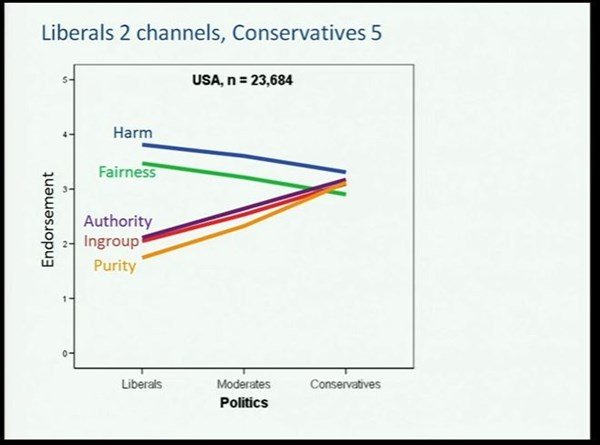
What Haidt found is that both conservatives and liberals recognize the Harm/Care and Fairness/Reciprocity values. Liberal-minded people, however, tend to reject the three remaining foundational values — Loyalty/betrayal, Authority/subversion, and Sanctity/degradation — while conservatives accept them. It’s an extraordinary difference, and it helps explain why many liberals and conservatives in America think “the other side” is bonkers.