
The Roman Republic spent its first two and a half centuries (or so) expanding fitfully through peninsular Italy (that is, Italy south of the Po River Valley, not including Sicily). This isn’t the place for a full discussion of the slow process of expanding Roman control (which wouldn’t be entirely completed until 272 with the surrender of Tarentum). The consensus position on the process is that it was one in which Rome exploited local rivalries to champion one side or the other making an ally of the one by intervening and the other by defeating and subjecting them (this view underlies the excellent M.P. Fronda, Between Rome and Carthage: Southern Italy During the Second Punic War (2010); E.T. Salmon, The Making of Roman Italy (1982) remains a valuable introduction to the topic). More recently, N. Terranato, The Early Roman Expansion into Italy (2019) has argued for something more based on horizontal elite networks and diplomacy, though this remains decidedly a minority opinion (I myself am rather closer to the consensus position, though Terranato has a point about the role of elite negotiation in the process).
The simple (and perhaps now increasingly dated) way I explain this to my students is that Rome follows the Goku Model of Imperialism: I beat you, therefore we are now friends. Defeated communities in Italy (the system is different outside of Italy) are made to join Rome’s alliance network as socii (“allies”), do not have tribute imposed on them, but must supply their soldiers to fight with Rome when Rome is at war, which is always.
It actually doesn’t matter for us how this expansion was accomplished; rather we’re interested in the sort of order the Romans set up when they did expand. The basic blueprint for how Rome interacted with the Italians may have emerged as early as 493 with the Foedus Cassianum, a peace treaty which ended a war between Rome and [the] Latin League (an alliance of ethnically Latin cities in Latium). To simplify quite a lot, the Roman “deal” with the communities of Italy which one by one came under Roman power went as follows:
- All subject communities in Italy became socii (“allies”). This was true if Rome actually intervened to help you as your ally, or if Rome intervened against you and conquered your community.
- The socii retained substantial internal autonomy (they kept their own laws, religions, language and customs), but could have no foreign policy except their alliance with Rome.
- Whenever Rome went to war, the socii were required to send soldiers to assist Rome’s armies; the number of socii in Rome’s armies ranged from around half to perhaps as much as two thirds at some points (though the socii outnumbered the Romans in Italy about 3-to-1 in 225, so the Romans made more strenuous manpower demands on themselves than their allies).
- Rome didn’t impose tribute on the socii, though the socii bore the cost of raising and paying their detachments of troops in war (except for food, which the Romans paid for, Plb. 6.39.14).
- Rome goes to war every year.
- No, seriously. Every. Year. From 509 to 31BC, the only exception was 241-235. That’s it. Six years of peace in 478 years of republic. The socii do not seem to have minded very much; they seem to have generally been as bellicose as the Romans and anyway …
- The spoils of Roman victory were split between Rome and the socii. Consequently, as one scholar memorably put it, the Roman alliance was akin to, “a criminal operation which compensates its victims by enrolling them in the gang and inviting them to share to proceeds of future robberies” (T. Cornell, The Beginnings of Rome (1995)).
- The alliance system included a ladder of potential relationships with Rome which the Romans might offer to loyal allies.
Now this isn’t a place for a long discussion of the Roman alliance system in Italy (that place is in the book I am writing), so I want us to focus more narrowly on the bolded points here and how they add up to significant changes in who counted as “Roman” over time. But I should note here that while I am calling this a Roman “alliance system” (because the Romans call these fellows socii, allies) this was by no means an equal arrangement: Rome declared the wars, commanded the armies and set the quotas for military service. The “allies” were thus allies in name only, but in practice subjects; nevertheless the Roman insistence on calling them allies and retaining the polite fiction that they were junior partners rather than subject communities, by doing things like sharing the loot and glory of victory, was a major contributor to Roman success (as we’ll see).
First, the Roman alliance system was split into what were essentially tiers of status. At the top were Roman citizens optimo iure (“full rights”, literally “with the best right”) often referred to on a community basis as civitas cum suffragio (“citizenship with the vote”). These were folks with the full benefits of Roman citizenship and the innermost core of the Roman polity, who could vote and (in theory, though for people of modest means, only in theory) run for office. Next were citizens non optimo iure, often referred to as having civitas sine suffragio (“citizenship without the vote”); they had all of the rights of Roman citizens except for political participation in Rome. This was almost always because they lived in communities well outside the city of Rome with their own local government (where they could vote); we’ll talk about how you get those communities in a second. That said, citizens without the vote still had the right to hold property in Roman territory and conduct business with the full protection of a Roman citizen (ius commercii) and the right to contract legal marriages with Roman citizens (ius conubii). They could do everything except for vote or run for offices in Rome itself.
Next down on the list were socii (allies) of Latin status (note this is a legal status and is entirely disconnected from Latin ethnicity; by the end of this post, Rome is going to be block-granting Latin status to Gauls in Cisalpine Gaul, for instance). Allies of Latin status got the benefits of the ius commercii, as well as the ability to move from one community with Latin status to another without losing their status. Unlike the citizens without the vote, they didn’t automatically get the right to contract legal marriages with Roman citizens, but in some cases the Romans granted that right to either individuals or entire communities (scholars differ on exactly how frequently those with Latin status would have conubium with Roman citizens; the traditional view is that this was a standard perk of Latin status, but see Roselaar, op. cit.). That said, the advantages of this status were considerable – particularly the ability to conduct business under Roman law rather than what the Romans called the “ius gentium” (“law of peoples”) which governed relations with foreigners (peregrini in Roman legal terms) and were less favorable (although free foreigners in Rome had somewhat better protections, on the whole, than free foreigners – like metics – in a Greek polis).
Finally, you had the socii who lacked these bells and whistles. That said, because their communities were allies of Rome in Italy (this system is not exported overseas), they were immune to tribute, Roman magistrates couldn’t make war on them and Roman armies would protect them in war – so they were still better off than a community that was purely of peregrini (or a community within one of Rome’s provinces; Italy was not a province, to be clear).
The key to this system is that socii who stayed loyal to Rome and dutifully supplied troops could be “upgraded” for their service, though in at least some cases, we know that socii opted not to accept Roman citizenship but instead chose to keep their status as their own community (the famous example of this were the allied soldiers of Praenesti, who refused Roman citizenship in 211, Liv. 23.20.2). Consequently, whole communities might inch closer to becoming Romans as a consequence of long service as Rome’s “allies” (most of whom, we must stress, were at one point or another, Rome’s Italian enemies who had been defeated and incorporated into Rome’s Italian alliance system).
But I mentioned spoils and everyone loves loot. When Rome beat you, in the moment after you lost, but before the Goku Model of Imperialism kicked in and you became friends, the Romans took your stuff. This might mean they very literally sacked your town and carried off objects of value, but it also – and for us more importantly – meant that the Romans seized land. That land would be added to the ager Romanus (the body of land in Italy held by Rome directly rather than belonging to one of Rome’s allies). But of course that land might be very far away from Rome which posed a problem – Rome was, after all, effectively a city-state; the whole point of having the socii-system is that Rome lacked both the means and the desire to directly govern far away communities. But the Romans didn’t want this land to stay vacant – they need the land to be full of farmers liable for conscription into Rome’s armies (there was a minimum property requirement for military service because you needed to be able to buy your own weapons so they had to be freeholding farmers, not enslaved workers). By the by, you can actually understand most of Rome’s decisions inside Italy if you just assume that the main objective of Roman aristocrats is to get bigger armies so they can win bigger battles and so burnish their political credentials back in Rome – that, and not general altruism (of which the Romans had fairly little), was the reason for Rome’s relatively generous alliance system.
The solution was for Rome to essentially plant little Mini-Me versions of itself on that newly taken land. This had some major advantages: first, it put farmers on that land who would be liable for conscription (typically placing them in carefully measured farming plots through a process known as centuriation), either as socii or as Roman citizens (typically without the vote). Second, it planted a loyal community in recently conquered territory which could act as a position of Roman control; notably, no Latin colony of this sort rebelled against Rome during the Second Punic War when Hannibal tried to get as many of the socii to cast off the Romans as he could.
What is important for what we are doing here is to note that the socii seem to have been permitted to contribute to the initial groups settling in these colonies and that these colonies were much more tightly tied to Rome, often having conubium – that right of intermarriage again – with Roman citizens. The consequence of this is that, by the late third century (when Rome is going to fight Carthage) the ager Romanus – the territory of Rome itself – comprises a big chunk of central Italy […] but the people who lived there as Roman citizens (with and without the vote) were not simply descendants of that initial Roman citizen body, but also a mix of people descended from communities of socii throughout Italy.
Bret Devereaux, “Collections: The Queen’s Latin or Who Were the Romans, Part II: Citizens and Allies”, A Collection of Unmitigated Pedantry, 2021-06-25.
January 12, 2024
QotD: Rome’s Italic “allies”
May 30, 2023
Ban all the words!
Chris Bray reflects on the historical context of literature bans:
Before the Civil War, Southern states banned abolitionist literature. That ban meant that postmasters (illegally!) searched the mail, seized anti-slavery tracts, and burned them. And it meant that people caught with abolitionist pamphlets faced the likelihood of arrest. The District of Columbia considered a ban, then didn’t pass the thing, but Reuben Crandall was still arrested and tried for seditious libel in 1833 when he was caught with abolitionist literature. He was acquitted, then died of illness from a brutal pre-trial detention. Seizure, destruction, arrest: abolitionist literature was banned.
The Soviet writer Yevgeny Zamyatin wrote a 1924 novel, We, depicting a world in which an all-powerful government minutely controlled every aspect of life for an enervated population, finding as an endpoint for their ideological project a surgery that destroyed the centers of the brain that allowed ordinary people to have will and imagination. The Soviet government banned Zamyatin’s work: They seized and destroyed all known copies, told editors and publishers the author was no longer to allowed to publish, and sent Zamyatin into exile, where he died without ever seeing his own country again. Seizure, destruction, exile: Yevgeny Zamyatin’s work was banned.
During World War I, the federal government banned literature that discouraged military service, including tracts that criticized conscription. Subsequently, “socialists Charles Schenck and Elizabeth Baer distributed leaflets declaring that the draft violated the Thirteenth Amendment prohibition against involuntary servitude”. They were arrested, convicted, and imprisoned. The Supreme Court upheld the conviction. Anti-conscription literature was banned: It was seized and destroyed, and people caught distributing it were sent to prison.
In 2023, the tedious midwit poet Amanda Gorman posted on Twitter that she was “gutted” — the standard emotion for tedious midwits — to discover that one of her poems had been “banned” by a school in Florida. The news media raced to proclaim that Florida schools are banning books, the leading edge of the Ron DeSantis fascist wave.
As others have already said, Gorman’s boring poem was moved from an elementary school library shelf to a middle school library shelf, without leaving the library

May 13, 2023
What was the First Modern War?
Real Time History
Published 12 May 2023The question about the first modern war has caused lively debates among historians and YouTube comment sections alike. In this video we take a look at a few candidates and some arguments why they are or aren’t modern wars.
(more…)
March 12, 2023
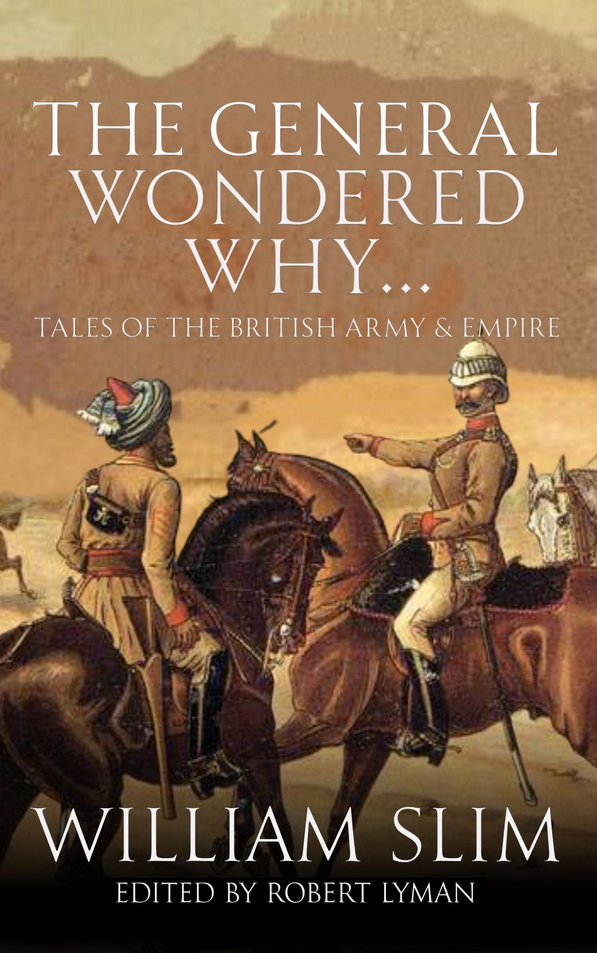
The young British officer’s attitude toward his men
Dr. Robert Lyman has been working on pulling together various newspaper and magazine articles written by Field Marshal William Slim before the Second World War, to be published later this year. I believe this will include everything he included (in shorter form in some cases) in his 1959 book Unofficial History plus many others. In this excerpt from “Private Richard Chuck, aka The Incorrigible Rogue”, Slim recounts taking command of a company of recent conscripts while recuperating from wounds received earlier in WW1:
“Light duty of a clerical nature,” announced the President of the Medical Board. Not too bad, I thought, as I struggled back into my shirt. “Light duty of a clerical nature” had a nice leisurely sound about it. I remembered a visit I had paid to a friend in one of the new government departments that were springing up all over London at the end of 1915. He had sat at a large desk dictating letters to an attractive young lady. When she got tired of taking down letters, she poured out tea for us. She did it very charmingly. Decidedly, light duty of a clerical nature might prove an agreeable change after a hectic year as a platoon commander and a rather grim six months in hospital. Alas, after a month in charge of the officers’ mess accounts of a reserve battalion, with no more assistant than an adenoidal “C” Class clerk, I had revised my opinion. My one idea was to escape from “light duty of a clerical nature” into something more active. Reserve battalions were like those reservoirs that haunted the arithmetic of our youth — the sort that were filled by two streams and emptied by one. Flowing in came the recovered men from hospitals and convalescent homes and the new enlistments; out went the drafts to battalions overseas. When the stream of voluntary recruits was reduced to a trickle the only way to restore the intake was by conscription, and this was my chance.
It had been decided to segregate the conscripts into a separate company as they arrived. I happened to be the senior subaltern at the moment and I applied for command of the new company. Rather to my surprise, for I was still nominally on light duty, I got it. The conscripts, about a hundred and twenty of them, duly arrived. They looked very much like any other civilians suddenly pushed into uniform, awkward, bewildered, and slightly sheepish, and I regarded them with some misgiving. After all, they were conscripts; I wondered if I should like them.
The young British officer commanding native troops is often asked if he likes his men. An absurd question, for there is only one answer. They are his men. Whether they are jet-black, brown, yellow, or café-au-lait, the young officer will tell you that his particular fellows possess a combination of military virtues denied to any other race. Good soldiers! He is prepared to back them against the Brigade of Guards itself! And not only does the young officer say this, but he most firmly believes it, and that is why, on a thousand battlefields, his men have justified his faith.
In a week I felt like that about my conscripts. I was a certain rise to any remark about one volunteer being worth three pressed men. Slackers? Not a bit of it! They all had good reasons for not joining up. How did I know? I would ask them. And I did. I had them, one by one, into the company office, without even an N.C.O. to see whether military etiquette was observed. They were quite frank. Most of them did have reasons — dependants who would suffer when they went, one-man businesses that would have to shut down. Underlying all the reasons of those who were husbands and fathers was the feeling that the young single men who had escaped into well-paid munitions jobs might have been combed out first.
[…]
We had now advanced far enough in our training to introduce the company to the mysteries of the Mills bomb. There is something about a bomb which is foreign to an Englishman’s nature. Some nations throw bombs as naturally as we kick footballs, but put a bomb into an unschooled Englishman’s hands and all his fingers become thumbs, an ague affects his limbs, and his wits desert him. If he does not fumble the beastly thing and drop it smoking at his — and your — feet, he will probably be so anxious to get rid of it that he will hurl it wildly into the shelter trench where his uneasy comrades cower for safety. It is therefore essential that the recruit should be led gently up to the nerve-racking ordeal of throwing his first live bomb; but as I demonstrated to squad after squad the bomb’s simple mechanism, I grew more and more tired with each until I could no longer resist the temptation to stage a little excitement. I fitted a dummy bomb, containing, of course, neither detonator nor explosive, with a live cap and fuse. Then for the twentieth time I began!
When you pull out the safety-pin you must keep your hand on the lever or it will fly off. If it does it will release the striker, which will hit the cap, which will set the fuse burning. Then in five seconds off goes your bomb. So when you pull out the pin don’t hold the bomb like this!’
I lifted my dummy, jerked out the pin, and let the lever fly off. There was a hiss, and a thin trail of smoke quavered upwards. For a second, until they realized its meaning, the squad blankly watched that tell-tale smoke. Then in a wild sauve qui peut they scattered, some into a nearby trench, others, too panic-stricken to remember this refuge, madly across country, I looked round, childishly pleased at my little joke, to find one figure still stolidly planted before me. Private Chuck alone held his ground, placidly regarding me, the smoking bomb, and his fleeing companions with equal nonchalance. This Casablanca act was, I felt, the final proof of mental deficiency — and yet the small eyes that for a moment met mine were perfectly sane and not a little amused.
“Well,” I said, rather piqued, “hy don’t you run with the others?” A slow grin passed over Chuck’s broad face.
“I reckon if it ‘ud been a real bomb you’d ‘ave got rid of it fast enough,” he said. Light dawned on me.
“After this, Chuck,” I answered, “you can give up pretending to be a fool; you won’t get your discharge that way!”
He looked at me rather startled, and then began to laugh. He laughed quietly, but his great shoulders shook, and when the squad came creeping back they found us both laughing. They found, too, although they may not have realized it at first, a new Chuck; not by any means the sergeant-major’s dream of a soldier, but one who accepted philosophically the irksome restrictions of army life and who even did a little more than the legal minimum.
September 29, 2022
Considering weird possible scenarios in Ukraine
In The Line, Matt Gurney walks through some until recently unimaginable outcomes of the Russian invasion of Ukraine:
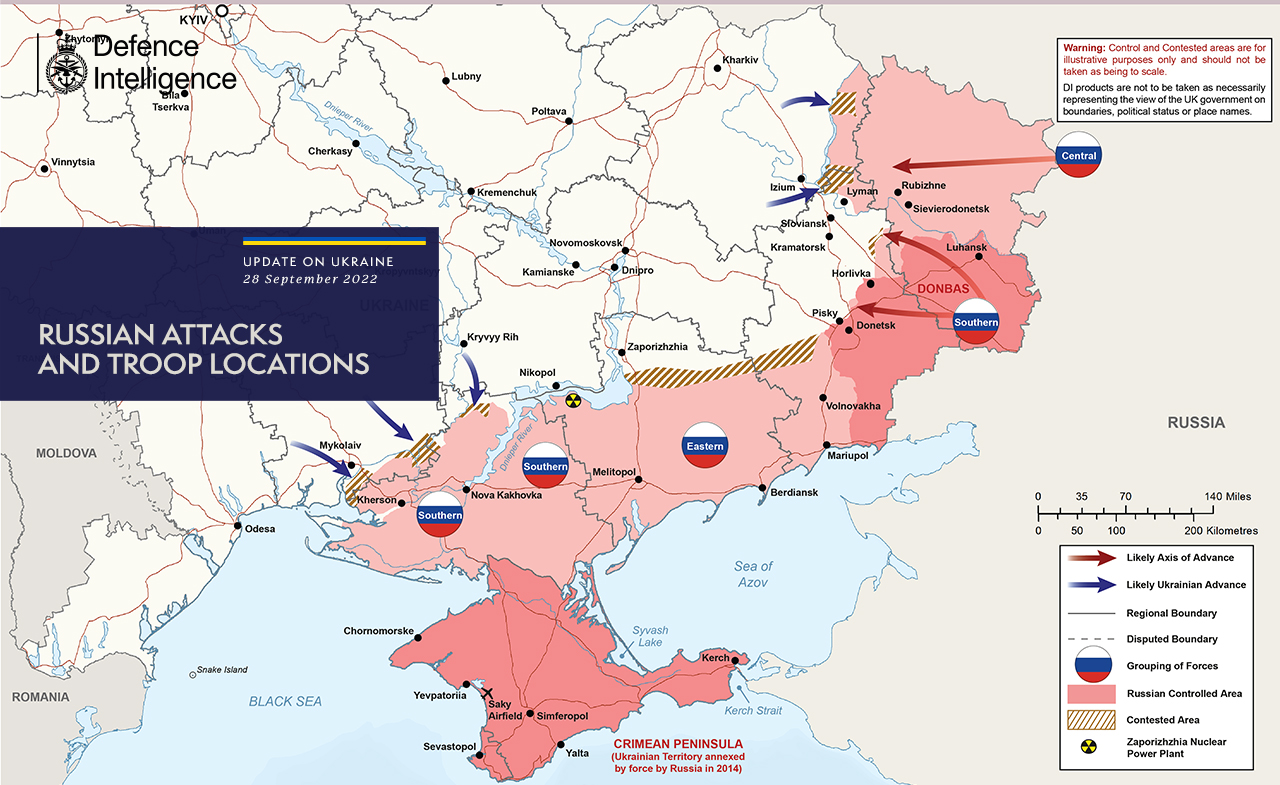
It’s probably time for us to start thinking through some weird possible scenarios for what’s happening in Russia. Because the spectrum of what could happen is a lot broader than it seemed only six months ago.
But let’s start with an important exercise in accountability. In previous commentary, I predicted a lot of things well: that Ukrainian resistance would be very effective, that Russia would have major logistics problems, that the Russians would use mass artillery fire against civilians in place of military advances. I was quick to grasp that Ukraine was overperforming and that Russia was struggling early in the conflict.
But getting some details right didn’t help me avoid blowing the conclusion: I thought Russia would win. Not a total victory, but I thought Russia would seize a lot more of the country before its logistical problems and Ukrainian resistance brought their offensives to a halt, leaving Ukraine with some kind of rump state in the west. I certainly didn’t believe in February that Russia could lose, and I never would have believed that Ukraine could actually win on the battlefield, as it now seems more than capable of doing.
I don’t know if I underestimated Ukrainian capabilities, per se. I always expected them to fight bravely and well, and understood the lethality of modern man-portable weapons against tanks and armoured vehicles. It’s probably closer to the mark to say that I overestimated Russia’s capabilities — I was a cynic on their military and expected it to perform badly, but it’s somehow fallen well short of my already low expectations. It is absolutely delightful to be wrong on this one, but readers deserve the truth: I expected Russia’s military to perform better and grab a much bigger chunk of Ukraine before having to stop in the face of logistical dysfunction and Ukrainian resistance. Part of me wonders if the Russians themselves are surprised by how hollowed out their military had become.
With that on the record, let’s flash forward to the present. As noted above, Ukraine now seems fully able to win the war. As I write this, Ukrainian forces are on the move again in the northeast, and seem to be encircling Russian positions in occupied Lyman. If able to complete this latest manoeuvre, Ukrainian forces will cut off a large force of Russian troops and will also seize control of an important local rail junction, threatening Russian logistics (such as they are) in the surrounding area. Perhaps more importantly to the overall conduct of the war, Russia’s effort to mobilize 300,000 men for the war is running into obvious challenges. Men of military age are fleeing the country. Reports from Russia reveal that the army has little in the way of equipment and weapons for the new draftees, and no system in place to train them. There have been comically bizarre stories of infirm old men getting call-up notices, and of draftees being sent to the front after only a day or two of training … at best.
This isn’t a solution to Putin’s problems. It’s a new problem being created in real time. Even if Putin can find 300,000 men, it seems unlikely he can equip them, and even less likely that he can train them. Whether or not he can transport what men he does round up into the battle area is an open question, as is whether or not he can supply them once they get there.
This is the long way of saying something I’ll now just state bluntly: Russia is losing. Putin’s latest actions reveal that he knows he’s losing. If the mobilization flops, as seems likely, he’ll be losing even worse than he was losing before, and he’ll have damn few options to turn that around.
And this is why we need to start thinking through some weird scenarios.
September 17, 2022
In the wake of the Russo-Ukrainian war, Europe’s cold winter looms ahead
Andrew Sullivan allows his views on the fighting in Ukraine to be a bit more optimistic after Ukrainian gains in the most recent counter-attacks on Russian-held territory around Kharkiv:
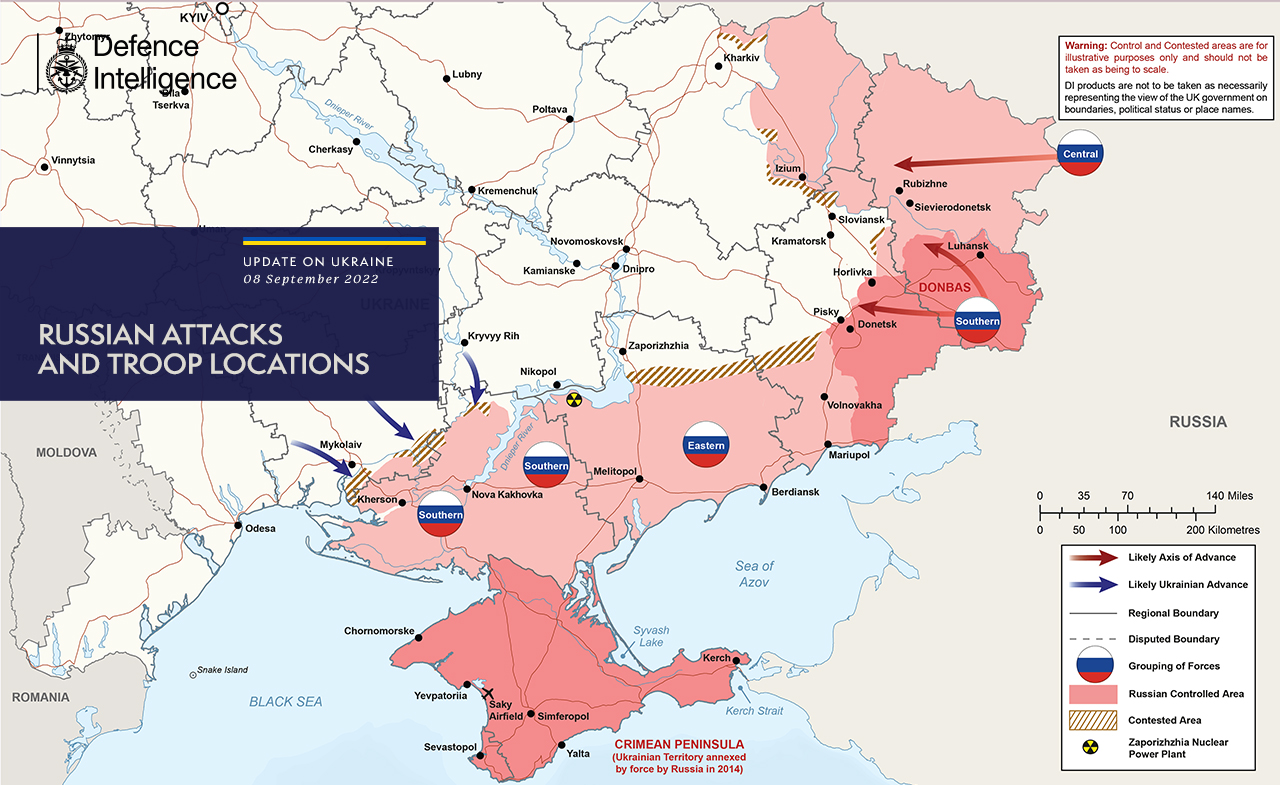
Approximate front-line positions just before the Ukrainian counter-attack east of Kharkiv in early September 2022. The MOD appears to have stopped posting these daily map updates sometime in the last month or so (this is the most recent as of Friday afternoon).
As we were going to press last week — I still don’t know a better web-era phrase for that process — Ukraine mounted its long-awaited initiative to break the military stalemate that had set in after Russia’s initial defeat in attempting a full-scale invasion. The Kharkiv advance was far more successful than anyone seems to have expected, including the Ukrainians. You’ve seen the maps of regained territory, but the psychological impact is surely more profound. Russian morale is in the toilet — and if it seems a bit premature to say that Ukraine will soon “win” the war, it’s harder and harder to see how Russia doesn’t lose it. By any measure, this is a wonderful development — made possible by Ukrainian courage and Western arms.
Does this change my gloomy assessment of Putin’s economic war on Europe, which will gain momentum as the winter drags on? Yes and no. Yes, it will help shore up nervous European governments who can now point to Ukraine’s success to justify the coming energy-driven recession. No, it will not make that recession any less intense or destabilizing. It may make it worse, as Putin lashes out.
More to the point, the Kharkiv euphoria will not last forever. September is not next February. Russia still has plenty of ammunition to throw Ukraine’s way (even if it has to scrounge some from North Korea); it is still occupying close to a fifth of the country; still enjoying record oil revenues; has yet to fully mobilize for a war; and still has China and much of the developing world in (very tepid) acquiescence. Putin is very much at bay. But he is not finished.
Europe’s scramble to prevent mass suffering this winter is made up of beefing up reserves (now 84 percent full, ahead of schedule), energy rationing, government pledges to cut gas and electricity use, nationalization of gas companies, and billions in aid to consumers and industry, with some of the money recouped by windfall taxes on energy suppliers. The record recently is cause for optimism:
The Swedish energy company Vattenfall AB said industrial demand for gas in France, the U.K., the Netherlands, Belgium and Italy is down about 15% annually.
But the use of gas by households is trivial in the summer in Europe compared with the winter — and subsidizing the cost doesn’t help conservation. Russia will now cut off all gas — which could send an economy like Italy’s to contract more than 5 percent in one year. There really is no way out of imminent, deep economic distress across the continent. Even countries with minimal dependence on Russia, like Britain, are locked into an energy market with soaring costs.
That will, in turn, strengthen some of the populist-right parties — see Italy and Sweden. The good news is that the new right in Sweden backs NATO, and Italy’s post-liberal darling, Georgia Meloni, who once stanned Putin, “now calls [him] an anti-Western aggressor and said she would ‘totally’ continue to send offensive arms to Ukraine”. The growing evidence of the Russian army’s war crimes — another mass grave was just discovered in Izyum — makes appeasement ever more morally repellent.
So what will Putin do now? That is the question. His military is incapable of recapturing lost territory anytime soon; he is desperate for allies; and mobilizing the entire country carries huge political risks. It’s striking to me that in a new piece, Aleksandr Dugin, the Russian right’s guru, is both apoplectic about the war’s direction and yet still rules out mass conscription:
Mobilization is inevitable. War affects everyone and everything, but mobilization does not mean forcibly sending conscripts to the front, this can be avoided, for example, by forming a fully-fledged volunteer movement, with the necessary benefits and state support. We must focus on veterans and special support for the Novorossian warriors.
This is weak sauce — especially given Dugin’s view that the West is bent on “a war of annihilation against us — the third world war”. It’s that scenario that could lead to a real and potentially catastrophic escalation — which may be why the German Chancellor remains leery of sending more tanks to Ukraine. The danger is a desperate Putin doing something, well, desperate.
I have no particular insight into intra-Russian arguments over mobilization, but there seems to be zero point (other than for propaganda … and that cuts both ways) to instituting a “Great Patriotic War”-style mass conscription drive at this point. The Russian army could absolutely be boosted to vast numbers through conscription. Vast numbers of untrained, unwilling young people with little military training and no particular passion to save the Rodina this time, despite constant regime callbacks to desperate struggle against Hitler in 1941-45. Pushing under- or untrained troops into battle against a Ukrainian army equipped with relatively modern western weaponry would be little more than deliberate slaughter and I can’t believe even Putin would be that reckless.
June 6, 2022
“I ask, sir, what is the militia? It is the whole people except for a few public officials”
George Mason, quoted in the title of this post, had a very expansive view of the US militia. Most Americans of the day did not seem to share this view, as Chris Bray explains:
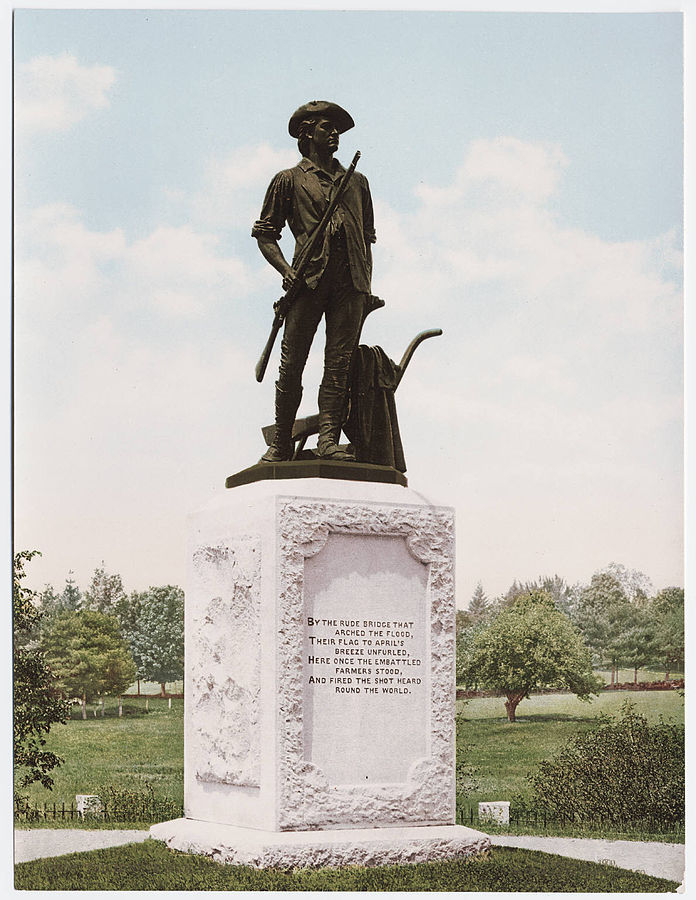
How Congress may have visualized the individual minutemen who would compose the militia of the United States after 1792.
Postcard image of French’s Concord Minuteman statue via Wikimedia Commons.
In the second Militia Act of 1792, Congress defined a uniform militia in all of the states:
That each and every free able-bodied white male citizen of the respective States, resident therein, who is or shall be of age of eighteen years, and under the age of forty-five years (except as is herein after excepted) shall severally and respectively be enrolled in the militia … That every citizen, so enrolled and notified, shall, within six months thereafter, provide himself with a good musket or firelock, a sufficient bayonet and belt, two spare flints, and a knapsack, a pouch, with a box therein, to contain not less than twenty four cartridges, suited to the bore of his musket or firelock, each cartridge to contain a proper quantity of powder and ball … and shall appear so armed, accoutred and provided, when called out to exercise or into service, except, that when called out on company days to exercise only, he may appear without a knapsack.
So, by federal law, every military-age white male in the country (except men who were exempted by the states, like clergymen) had to report to the local militia commander to be enrolled in their local company, and had to own a long list of equipment, and had to show up to train with that equipment when ordered.
They mostly didn’t. For decades, states reported their militia enrollment to the War Department, and it sometimes appeared that some states, by trying really hard, sometimes almost made it to something in the neighborhood of half participation. In 1826, the Barbour Board — named after Secretary of War James Barbour — evaluated the unmistakable failure of the federally defined uniform militia, and suggested trying again with a smaller group of select militiamen. The board’s report was universally ignored, because by 1826 the federal government, like, couldn’t even: Everyone knew the model of widely shared militia service had failed.
Historians have usually described the failure of universal white male militia service in the early republic as a top-down policy blunder in which political leaders didn’t try hard enough to make the thing work. But a marginal historian named Chris Bray, in a dissertation that generated no excitement of any kind in academia, argued that the universal white male militia obligation was doomed by something else: widespread irritation and popular resistance. The militia obligation reached into the lives of militiamen in ways they didn’t expect and wouldn’t tolerate, so they stopped showing up.
There are many different ways to tell this story, but let’s do it quickly.
September 29, 2021
If you squint carefully, you can pretend this is a “win” for equal rights …
In Tuesday’s NP Platformed newsletter, Colby Cosh “celebrates” the elimination of another barrier to American women achieving truly equal rights with American men:
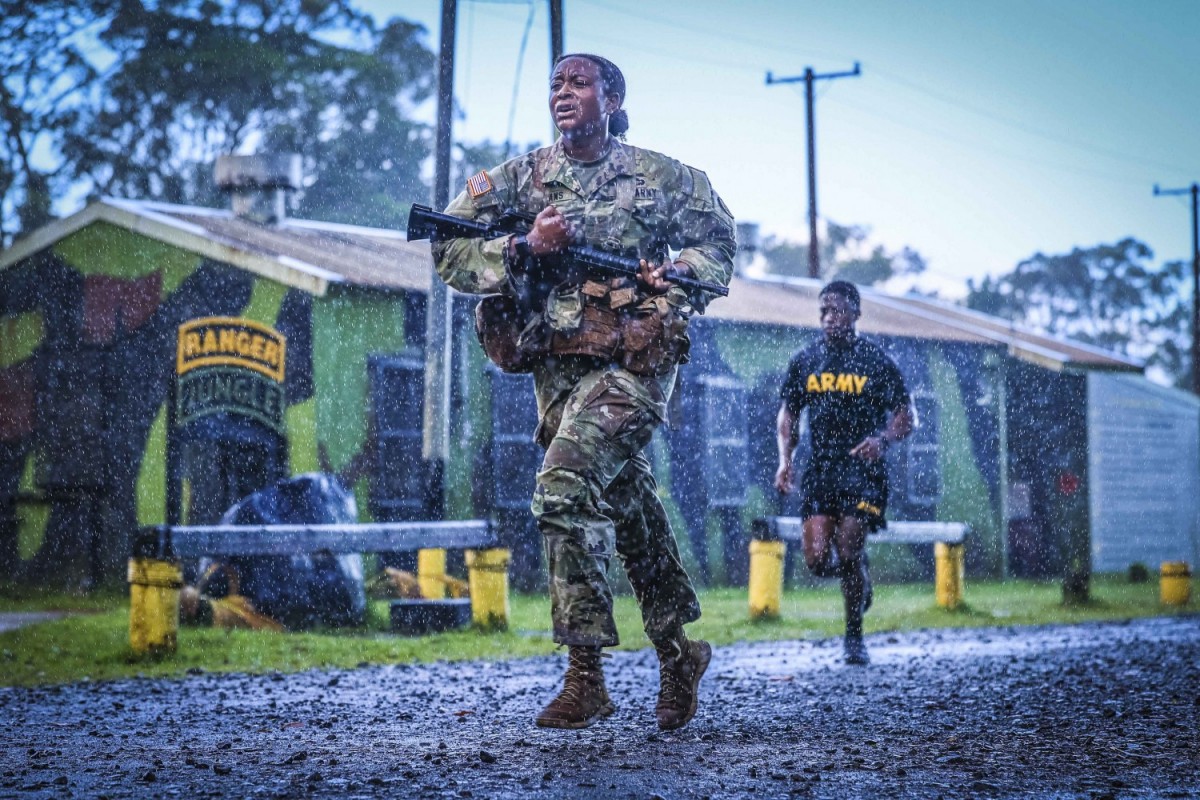
“Soldiers complete a 5K in preparation for a jungle operations training course at Schofield Barracks, Hawaii, May 12, 2021”
US Army photo by Spc. Jessica Scott.
Congratulations to the women of the United States, who took a big step toward full equality before the law last week. The punchline, if you want to call it that, is that this step was: “At long last, the ladies are eligible for military conscription.” Both houses of Congress have now passed versions of the annual military appropriations bill, which open the U.S. Selective Service System to females as well as males.
Conservative diehards on the Republican side were outnumbered nearly three to one in Thursday’s House vote, and while the House and Senate bills still have to be matched up for presentation to the president, the day of inverse liberation for young women seems imminent.
The whole thing is one of those mysteries of American tradition that naturally confuse citizens of other countries. Most of the European countries that require military service (or some substitute for conscientious objectors) are still unapologetically all-male. Israel, where military conscription is continuous and urgent and the armed services are perhaps the world’s most co-ed, actively drafts both sexes; the requirements are a touch more rigorous for the men. Norway registers both sexes for “mandatory” military service, but the instructional programs and the military generally are lightly funded at best, so only a fraction of the draftees are put to any trouble.
[…]
The minimum of debate that female draft registration has received is mostly concerned with the vague social implications of the hitherto existing one-sex policy. It’s perhaps a little awkward that boys have to undergo the weird rite of Selective Service passage — whether or not they are capable, physically or ethically, of fighting — and that girls don’t. Tough Republican-type women soldiers advocated for removing the sex discrimination because young females ought to know that they share responsibility for national defence and that the military is open to them. Oddly, no one (apart from Reason magazine) seems to concern themselves much with the social implications of the state being able to subject everybody to servitude and danger, and having a giant apparatus that exists to remind them of this subjection.
The way Reason magazine has been tacking hard to the left over the last five years means I’m actually mildly surprised that they bothered to point out the minor issue that conscription is a form of slavery …
Feeding the Meatgrinder – The Red Army – WW2 Special
World War Two
Published 28 Sep 2021What is left of the Red Army after the smashing offensives of Operation Barbarossa and Fall Blau, and what have Stavka done to rebuild it? As the war on the Eastern Front goes on, more men and materiel stream to the frontlines, stemming the onslaught of the Wehrmacht.
(more…)
August 18, 2021
The Conscripts and Conscientious Objectors of World War Two – WW2 Special
World War Two
Published 17 Aug 2021In keeping with their ideals of personal liberty, Britain and the United States have historically maintained relatively small armies made up of volunteer soldiers. When Germany and Japan mobilize huge numbers of well-trained conscripts and sweep across Europe and Asia, the democratic allies devote huge resources to closing the gap, while respecting the rights of those who object to fighting on moral grounds.
(more…)
May 28, 2021
QotD: Declaring war on college
Stop the thing where high schools refuse to let people graduate until they promise to go to college. End draft deferment for people who go to college — hopefully there won’t be a draft, but do it anyway, as a sign that studying at college isn’t any more important than the many other jobs people do that don’t confer draft exemptions. Make universities no longer tax-exempt — why should institutions serving primarily rich people, providing them with regattas and musical theater, and raking in billions of dollars a year, not have to pay taxes? Make the bill that does this very clearly earmark the extra tax money for things that help working-class people, like infrastructure or vocational schools or whatever.
Scott Alexander, “A Modest Proposal For Republicans: Use The Word ‘Class'”, Astral Codex Ten, 2021-02-26.
March 29, 2021
Requiring only men to register for the draft isn’t the real problem — the problem is the draft itself
Kerry McDonald fears that the current challenges to the gender inequality of the US draft may end up making the underlying problem worse:
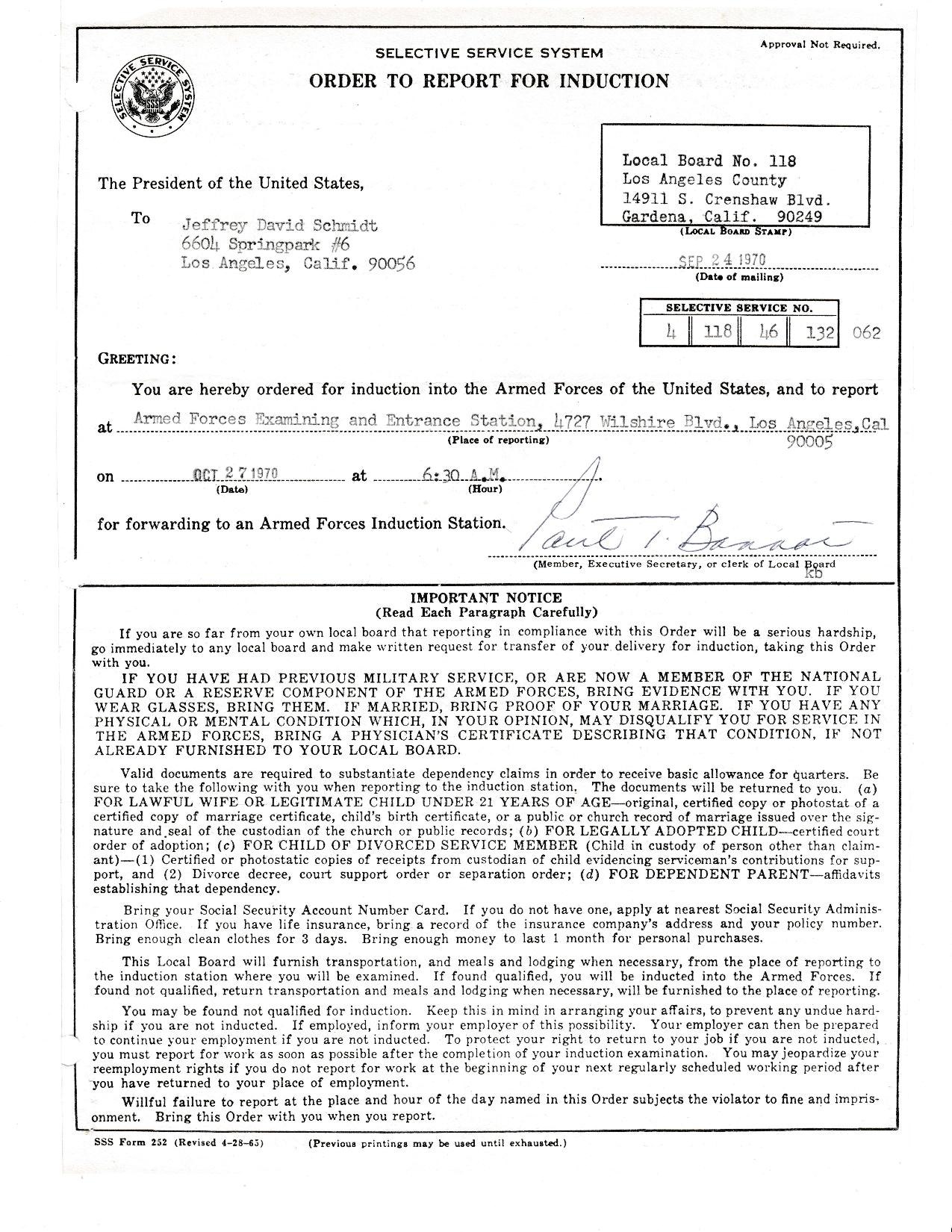
US Selective Service draft notice for J.D. Schmidt, dated 24 September, 1970.
Wikimedia Commons.
Currently, all American men are required to register for the draft through the Selective Service System when they turn 18, and could be forced into military service if the draft was activated. As a mom with young sons, I shudder at this prospect.
Lawyers with the American Civil Liberties Union (ACLU) have filed a petition asking the Supreme Court to rule the current military draft registration unconstitutional because it requires only men to register, not women. As a mom with young daughters, I shudder at this prospect.
While draft registration does involve unequal treatment of men and women, and women have been ably serving in the military for years, including in full combat, the larger issue is Selective Service registration itself. Current draft registration may be unconstitutional, but it shouldn’t exist at all.
Forcing citizens into any kind of non-voluntary work or action is antithetical to the principles of a free society.
Some contend that conscription is necessary to defend those principles if there were not enough volunteers to serve in a wartime effort, but is slavery ever justifiable? Who decides? If there are not enough soldiers to willingly fight a war, should the war be fought?
Nobel-Prize-winning economist Milton Friedman was one of the key figures who succeeded in persuading the US to move to an all-volunteer army in 1973, arguing against military conscription. Friedman wrote that “any system involving compulsion is basically inconsistent with a free society.” He went on to argue: “The continued use of compulsion is undesirable and unnecessary. We can and should man our armed forces with volunteers.”
In place of conscription, Friedman advocated for a voluntary military guided by free-market ideas. “The appropriate free market arrangement is volunteer military forces; which is to say, hiring men to serve,” Friedman wrote in his book, Capitalism and Freedom. “There is no justification for not paying whatever price is necessary to attract the required number of men. Present arrangements are inequitable and arbitrary, seriously interfere with the freedom of young men to shape their lives, and probably are even more costly than the market alternative.”
Friedman’s advocacy against conscription came to a climax in testimony with Army Chief of Staff, General William Westmoreland. The general disagreed with Friedman by claiming that the economist’s free-market approach would be akin to leading an army of mercenaries. Friedman replied: “General, would you rather command an army of slaves?”
April 15, 2020
Girls Armed With Pitchforks – The Women’s Land Army – On the Homefront 002
World War Two
Published 14 Apr 2020Now that the labour-needs and the availability of manpower has changed due to the outbreak of World War Two, Women are required to join the workforce. They’re put to work in the Women’s Land Army.
Join us on Patreon: https://www.patreon.com/TimeGhostHistory
Or join The TimeGhost Army directly at: https://timeghost.tvFollow WW2 day by day on Instagram @World_war_two_realtime https://www.instagram.com/world_war_t…
Between 2 Wars: https://www.youtube.com/playlist?list…
Source list: http://bit.ly/WW2sourcesHosted by: Anna Deinhard
Written by: Spartacus Olsson and Francis van Berkel
Produced and Directed by: Spartacus Olsson and Astrid Deinhard
Executive Producers: Bodo Rittenauer, Astrid Deinhard, Indy Neidell, Spartacus Olsson
Creative Producer: Joram Appel
Post-Production Director: Wieke Kapteijns
Research by: Tom Meaden
Edited by: Mikołaj Cackowski
Map animations: Eastory (https://www.youtube.com/c/eastory)Colorizations by:
Dememorabilia – https://www.instagram.com/dememorabilia/
Julius Jääskeläinen – https://www.facebook.com/JJcolorization/Sources:
IWM A 19891, Q 54607, Q 54601, Q 54602, D 8793, D 204, D 199, D 18050, D 8463, D 18062, D 20722, D 8833, D 2973, D 14123, D 115, D 11256, D 14090, D 8806, TR 911, D 21057, D 128, CH 4119, D 3324, TR 912, D 18057, IWM TR 1568, D 21958, D 8794, TR 913
Picture of Women’s Land Army memorial in Scotland, courtesy of IWM, Martin Briscoe (WMR-69248)
Library of Congress
Portrait of Hilda Gibson, taken 2008 at 10 Downing Street, courtesy BBC PM blog http://www.bbc.co.uk/blogs/pm/2008/07…Soundtracks from the Epidemic Sound:
Johannes Bornlof – “Deviation In Time”
Wendel Scherer – “Defeated”
Johannes Bornlof – “Magnificent March 3”
Reynard Seidel – “Deflection”
Max Anson – “Ancient Saga”
Johannes Bornlof – “The Inspector 4”
Christian Andersen – “Quiet Contemplation”Archive by Screenocean/Reuters https://www.screenocean.com.
A TimeGhost chronological documentary produced by OnLion Entertainment GmbH.
From the comments:
World War Two
22 minutes ago (edited)
This is the second instalment of our monthly ‘On the Homefront’ series and it’s about the Women’s Land Army. Now, with these series we’re planning to cover the events and cultural and social changes that occurred during World War Two, as well as the organisations and individuals that lived through them. As with the other specials, we want to cover all the homefronts, from all nations all across the world. If you have any good ideas for future episodes, please let us know in the comments!
Cheers and stay safe!
Joram
February 22, 2020
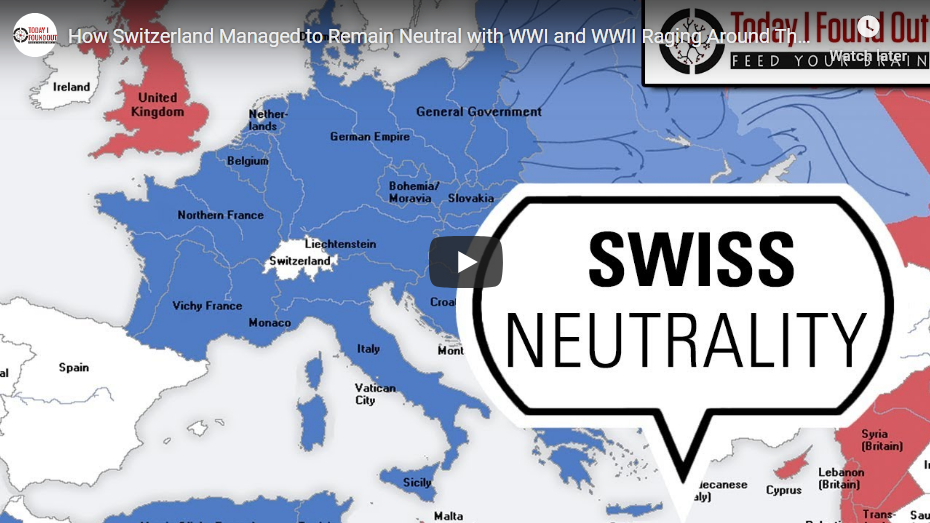
How Switzerland Managed to Remain Neutral with WWI and WWII Raging Around Them
Today I Found Out
Published 30 Apr 2018Signup for your FREE trial to The Great Courses Plus here: http://ow.ly/dCMa30hIugB
If you happen to like our videos and have a few bucks to spare to support our efforts, check out our Patreon page where we’ve got a variety of perks for our Patrons, including Simon’s voice on your GPS and the ever requested Simon Whistler whistling package: https://www.patreon.com/TodayIFoundOut
The Great Courses Plus is currently available to watch through a web browser to almost anyone in the world and optimized for the US, UK, and Australian markets. The Great Courses Plus is currently working to both optimize the product globally and accept credit card payments globally.
Never run out of things to say at the water cooler with TodayIFoundOut! Brand new videos 7 days a week!
In this video:
The tiny mountainous country of Switzerland has been in a state of “perpetual neutrality” since the major European powers of the time declared it as such during the Congress of Vienna after the end of the Napoleonic wars in 1815.
Want the text version?: http://www.todayifoundout.com/index.p…
December 16, 2018
Mackenzie King at war
Ted Campbell remembers Canada’s Second World War Prime Minister:
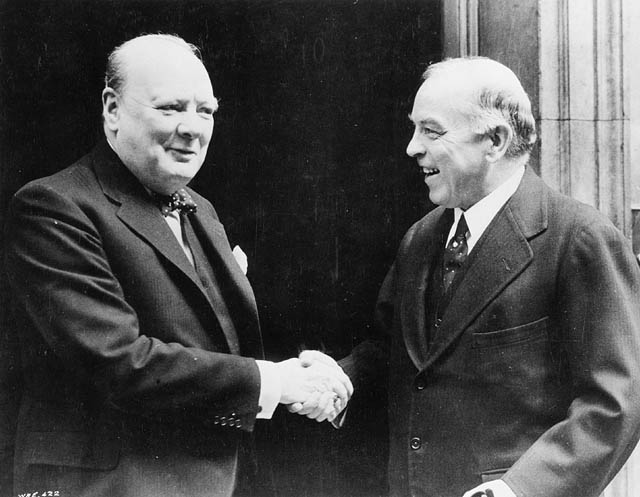
Prime Minister Winston Churchill greets Canadian PM William Lyon Mackenzie King, 1941.
Photo from Library and Archives Canada (reference number C-047565) via Wikimedia Commons.
I was born in 1942, William Lyon Mackenzie King was the prime minister; my mother often said that, in the 1940s, it seemed that he would never cease to be prime minister, and she thoroughly detested him; it wasn’t all of his policies she hated, it was, mainly, how he approached the war, and a few other things ~ she was, later, fond of the Canadian poet F.R. Scott’s rather bitter epitaph:
He seemed to be in the centre because we had no centre,
No vision to pierce the smoke-screen of his politics.Truly he will be remembered wherever men honour ingenuity,
Ambiguity, inactivity, and political longevity.Let us raise up a temple to the cult of mediocrity,
Do nothing by halves which can be done by quarters.Now, Canada fought a good war, we made four absolutely vital contributions:
- We were the true “breadbasket of the empire,” our farmers fed our large Army and much of Britain’s, too;
- We were a major part of the “arsenal of democracy,” our factories and shipyards turned out all of the things, from tanks and trucks and bombers and corvettes to Bren guns and grenades that were needed to help defeat the Axis powers;
- We managed the all important British Commonwealth Air Training Plan that was a key element in the allies’ eventual success; and
- We played a huge and a significant leadership role in the Battle of the Atlantic ~ the only battle Churchill said that he really feared losing.
But under King we did each with apparent reluctance, seemingly trying to never serve any vital interest if there was even a remote chance that any political constituency might be offended ~ something that reminds me of Justin Trudeau in 2018. Our large and entirely commendable war efforts were, in the main, directed, sometimes despite King, by the indefatigable C.D. Howe, and the national unity concerns were assuaged by recruiting the universally respected Louis St Laurent.
The King era was characterized by extraordinarily tepid leadership at the top but brilliant work by strong ministers in a small cabinet. It also began Phase 1 of a national political civil war. I think that in the First World War many Canadians had either understood or had been, largely, indifferent to Quebec’s objections to conscription. But in the 1940s we had better mass communications and many Canadians were less understanding of Quebec’s reluctance to participate in that war, especially as Canadian casualties mounted after Hong Kong and then in Italy and then in France, Belgium and Holland. Louis St Laurent did not try to explain French Quebec’s misgivings to English Canada, his job was to maintain, by force of his own stellar reputation and personality, just enough support in Quebec and, as he easily did, to “outclass” the vocal, crypto-fascist, French Canadian opponents to the war. But there was another division fomenting inside the Liberal Party of Canada: both Howe and St Laurent had a new vision for Canada in the post war world; both saw Canada as an important actor on the world stage; both were frustrated by King’s timid leadership; it is very probable that had St Laurent, the foreign minister, rather than King, [been] the prime minister, led Canada’s delegation to the UN’s founding conference in San Francisco in June of 1945 that Canada, not France, would have been the fifth member of the Security Council (or that it would have had only four members. as originally planned). St Laurent, especially, was known, liked and respected in both London and Washington; both he and Howe were highly regarded as leaders and as statesmen … King was not; Churchill distrusted him because he has actively supported Chamberlain’s appeasement policy and it seems to me that both Churchill and Roosevelt saw him as little more than an errand boy.


