
Real Time History
Published 20 Jun 2025On September 1, 1939, Germany invades Poland, setting off the Second World War. Two days later, Britain and France declare war on Germany. As the German army races towards Warsaw, many German generals are worried the French might simply walk into western Germany, and there’s not much the Wehrmacht can do about if they do. But instead of a powerful Allied counteroffensive, the French and British mostly sit back and wait during the so-called Phoney War – so why didn’t the Allies attack Germany in 1939?
(more…)
November 14, 2025
Why didn’t the Allies Attack Germany in 1939? (The Phoney War)
Comments Off on Why didn’t the Allies Attack Germany in 1939? (The Phoney War)
November 11, 2025
QotD: Moltke the Younger and the Schlieffen Plan
Helmuth von Moltke the Younger is a difficult character to uncover, but one essential to understanding the panoply of forces that produced WWI.1 Moltke died in 1916, providing him little opportunity to defend his tenure. His widow had intended to publish an exculpatory collection of evidence of the chaos of German war planning before 1914. However, by then it was 1919, and the documents were deemed harmful to Germany’s attempt to avoid the blame for the war and so not published. This would prove fateful; the documents would be destroyed in World War II.
Moltke therefore proved an ideal scapegoat for the “Schlieffen School”. For the Schlieffen School (mostly officers trained by Schlieffen), the Schlieffen Plan was a true recipe for victory bungled by incompetent execution. However, recent scholarship has shown a more nuanced picture. While Schlieffen did not fully approve of his successor, Moltke was a faithful student of Schlieffen’s concepts. The modifications he made to the plan were not because of a difference in opinion, but of circumstance. Following Schlieffen’s retirement, the French army became more aggressive, necessitating a stronger defense of the Rhine. Likewise, Russian strength and mobilization speed increased, necessitating a greater force allocated to the East. Moltke was also more realistic about the logistical limitations of the all-important right wing of the German offensive. While Schlieffen (allegedly with his dying breath) insisted “keep the right wing strong”, there were simply only so many divisions that could practically advance there. Moltke did his best to adapt the Schlieffen Plan to these changing circumstances, though with mounting fear that the strength of the Entente had placed victory beyond Germany’s strength.
Despite awareness of the long odds, officers continued to press for preventative war in succeeding European crises.3 The term “preventative war” did not mean “preempting the attack of hostile powers” but rather to initiate a war while the strategic balance was most favorable for Germany. While, as mentioned, they had their doubts about the surety of victory, they believed the odds would only get worse. The Schlieffen Plan had been designed for a one-front war against France (in 1905, the year of Schlieffen’s retirement, Russia was in the throes of revolution). Though adapted in later years, the plan remained tenable only so long as Germany had the chance to defeat France before Russian mobilization was completed. As the Russian army expanded and its rail system modernized, the General Staff saw the Schlieffen Plan nearing its expiration date.
The General Staff saw no alternative to Schlieffen’s concept because of its axiomatic focus on total victory. The kind of limited victory that the Elder Moltke had settled for in his later war plans had never entered the vocabulary of the General Staff. As such, the General Staff pressed strongly for war (which it believed was inevitable) to break out before the balance of power swung further against Germany.
The only alternative to this would have been to frankly state the perilous situation in which Germany stood militarily and admit that total military victory was out of reach and German diplomacy would need to be reoriented around this fact. Not only would this course of action been antithetical to the proud traditions of the officer corps, but it would also have been viewed as unacceptably political. What’s more, the Kaiser would have likely viewed such behavior as cowardly if not outright insubordinate. Once again, the Kaiser’s power over personnel decisions meant uncomfortable topics were not broached for fear of instant dismissal.
It is not entirely unjust to accuse German leaders of cowardice or careerism in avoiding these conversations. However, they — like so many who serve under capricious or incompetent heads of state — justified their silence and continued service under the logic of harm reduction. If they resigned (or clashed with the Kaiser leading to their dismissal) they knew they would be replaced by someone more compliant. The Kaiser’s power over personnel meant they understood clearly that they had no leverage.
The Chiefs of the General Staff, for all their influence, were incentivized to focus on the areas of their exclusive responsibility. Nevertheless, the younger Moltke was not passive in his efforts for war. He resumed contact with the Austro-Hungarian General Staff, assuring it of German support should Austria choose war in a crisis. As aforementioned, when crises came to Europe (some instigated by the German foreign ministry) he pressed the chancellor and Kaiser for a preventative war. Both, to their credit, while willing to risk war, would not choose it.
Perhaps most decisively, Moltke and his deputy, Erich von Ludendorff,4 made the decision to hinge the operational plan on an attack on the Belgian city of Liège (hosting a critical rail juncture) before the neutral country could mobilize.5 This modification was made because Moltke desired to avoid violating Dutch neutrality (as Schlieffen had called for). He wisely understood Germany could afford no more enemies and that invading the Netherlands would mean increasing the distance the German right wing would have to cover to gain the French flank, decreasing the odds of success. What’s more, Moltke hoped that Dutch neutrality would allow it to act as a “windpipe” in the event of a long war and a British blockade. However, avoiding Dutch territory complicated German logistics, necessitating the swift seizure of Liège to allow the offensive to meet its strict timetables.
This was a strictly operational decision, made on technical grounds. As such, neither the chancellor nor the Kaiser were informed of this detail of the plan (operational plans were kept strictly secret, with the prior year’s being systematically burned). However, as perceptive readers may have noticed, the need for a coup de main against a neutral country before it mobilized severely limited German strategic flexibility. There was only one deployment plan for war in the West (and only one at all after 1913). In a crisis, Germany was therefore bound to attack before the Belgians manned Liège’s fortifications. Yet this all-important point-of-no-return was unknown to the Kaiser, chancellor, and foreign minister. The General Staff had effectively stripped the Kaiser and civilian leaders of their “right to be wrong”.
Thus, the General Staff had drastically increased the likelihood of war in that the point-of-no-return was kept obscured from those who would be responsible for bring Germany to the brink. As would occur in 1914 during the July Crisis, the Kaiser and his minister could not understand why Moltke was pressing so strongly for war. As historian Annika Mombauer puts it, “Only Moltke knew that every hour counted”.6 The General Staff had — intentionally or not — engineered a situation in which political leadership would have to choose war or abandon its only operational plan. While political leadership was reticent to take this step (especially without the details of the plan) contributing to Moltke’s nervous breakdown, the General Staff ultimately got the war it so desired at the next crisis Germany found itself in. If the coup de main on Liège had been devised as a ploy to force political leadership to engage in a preventative war, it had succeeded.
Ultimately, the predominance of the military over German policy — both foreign and domestic — created an environment in which civilian leaders like Bethmann Hollweg were sidelined, and aggressive military strategies took precedence. This imbalance of prestige, coupled with the narrow, fatalistic worldview of military leaders, contributed to Germany’s march toward war, with little room to acknowledge alternative diplomatic or strategic approaches.
Kiran Pfitzner and Secretary of Defense Rock, “The Kaiser and His Men: Civil-Military Relations in Wilhelmine Germany”, Dead Carl and You, 2024-10-02.
- Helmuth von Moltke the Elder was his uncle.
- Mombauer, Moltke, 109.
- Better known for other work.
- Mombauer, 96.
- Mombauer, 219.
- Rosinski, “Scharnhorst to Schlieffen”, 99.
Comments Off on QotD: Moltke the Younger and the Schlieffen Plan
November 6, 2025
Lines of Fire: Operation Market Garden Part 1 of 2 – WW2 in Animated Maps
TimeGhost Cartographic
Published 5 Nov, 2025September, 1944. Soviet forces push ever westwards, slicing their way through Poland en route to Berlin. In the west, the Allies have made great strides after the invasion of Normandy, but now face a winter of relative stagnation as supply issues threaten to undercut their momentum. At this time, British Field Marshal Bernard Montgomery believes has a plan to carve a corridor through occupied Netherlands and get his forces into Germany within days, striking at the heart of the German war economy, and maybe, just maybe, ending this war before 1945 dawns. In Part 1 of 2, we look over the plan, the forces involved, and the colossal effort required to make Monty’s vision a reality.
00:00 Intro
01:12 Background
04:40 Planning
07:07 Disposition of Forces
09:05 Geographic Overview
11:30 Conclusion
(more…)
Comments Off on Lines of Fire: Operation Market Garden Part 1 of 2 – WW2 in Animated Maps
October 18, 2025
The Battle of Sedan: The Anatomy of Failure
World War Two
Published 17 Oct 2025In May 1940, a period of ten days flipped the world order on its head. France, the titan of the Great War, was carved apart by the armored fist of the Wehrmacht: Panzergruppe Kleist. Now, in this new feature-length production, we explore why it happened, whether this was ever avoidable, and whether France’s flaws stemmed from incompetence, or something far more sinister.
(more…)
Comments Off on The Battle of Sedan: The Anatomy of Failure
October 15, 2025
The Korean War Week 69: Conquered … But At What Cost? – October 14, 1951
The Korean War by Indy Neidell
Published 14 Oct 2025The Battle of Heartbreak Ridge ends with victory for the UN forces, though the casualty count is alarmingly high for both sides. One must wonder, is that sustainable? It’s a week of action, as Operation Commando continues further west. The Commonwealth Division takes Maryang-San, but taking it and holding it are two different things. A 9th Corps offensive kicks off as well, slowly grinding forward. There’s a breakthrough away from the battlefield, as both sides finally agree on a site for any future peace talks- Panmunjom.
Chapters
00:00 Intro
00:29 Recap
00:47 Operation Commando
03:01 Heartbreak Ridge Ends
07:44 Comparing the Two Ridges
10:25 9th Corps Attacks
11:24 The Belgians
12:17 Panmunjom
13:19 Summary
13:39 Conclusion
Comments Off on The Korean War Week 69: Conquered … But At What Cost? – October 14, 1951
September 7, 2025
The BEF and the German Sichelschnitt of May, 1940
Dr. Robert Lyman rebuts the common-since-the-1950s adulation of the Wehrmacht‘s attacks of May-June, 1940 through the Low Countries that drove the British Expeditionary Force off the continent and destroyed the flower of the French army prior to the surrender of France in June:
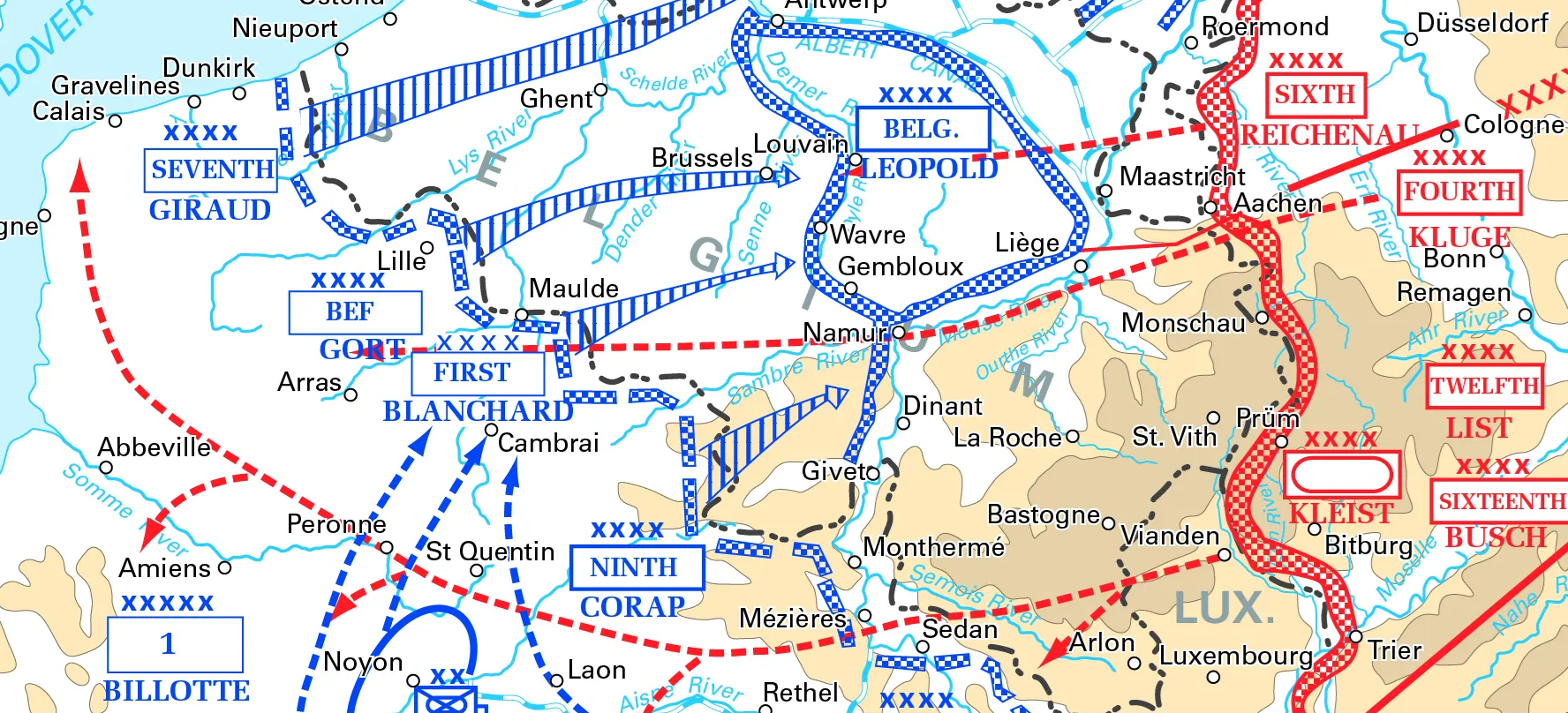
Detail from the West Point Military Atlas map of the “Campaign in the West, Disposition and Opposing Forces, 1940”
Full map.
The world has largely remembered Sichelschnitt as a brilliant German operation of war, but it was one that was fundamentally enabled by Allied ineptitude. Indeed, Blitzkrieg wasn’t particularly new, innovative or even a warfighting doctrine. It is best described, in the context of France 1940, as an event. It was simply the way that the Wehrmacht exerted its tactical and operational superiority over its more pedestrian enemies in 1940. In fact, it was the 1940 extension of what the German Army had first demonstrated in Flanders in March 1918, this time with tanks and Stukas. It was the Panzerwaffe (“tank force”) – combined with a tactical air force – which in 1940 would create the breakthrough that Ludendorff had been unable to achieve in 1918. Where it was applied, by Army Group A, it concentrated fast-moving armoured vanguards co-ordinated with tactical air power, such as 400 Ju 87 Stuka dive-bombers, to so overwhelm the enemy in both time and space that they were unable to respond quickly enough to the changing and challenging battlefield. In 1940 the panzer came into its own, the sound of clattering tracks on French cobblestones a new feature in the sound of battle and a key element in how France remembers its defeat in 1940.
It wasn’t the type of tank in the German inventory which mattered, but the way in which these tanks were employed. Only about 10 per cent of the army comprised tanks, the remainder relying on horse and wagons and the raw, painful feet of the marching infantry. Of the 2,539 tanks the Wehrmacht deployed in 1940, only 916, or 36 per cent were battleworthy, the remainder being clattering tin cans with machine guns (the obsolete Panzer Mark Is and Mark IIs). The only modern tanks were 683 Panzer Mark IIIs and Czech T38 tanks armed with a 37mm gun, and 278 of the larger Mark IVs with a short 75mm gun. But it was enough. The German operational strategy was to use this mass of armour not to fight a large confrontational tank battle, but to achieve breakthrough and breakout, bursting through the enemy’s linear defences. It was surprise and shock action that so discomforted the Allies, who had lazily and, given what we know of British failure to understand 1918, ignorantly assumed that the war would progress against a 1914 rather than a 1918 pattern. The armoured vanguard would surge through the outer skin of the enemy defences, concentrating heavy effort in one place, before driving hard into the heart of enemy territory. With an enemy intent on fighting a linear battle, the rear areas, behind this outer crust, would be weakly defended and full of rear-echelon, administrative and supply troops managing the lines of communication up to the front, not expecting to have to fight. It was by driving hard and fast behind the enemy front line, breaking the cycle of Allied battlefield decision-making, that Blitzkrieg was to achieve its psychological effect.
In contrast the Allies remained concerned about retaining the integrity of their defensive lines. The diaries of Major General Henry Pownall, for instance, are replete with concerns as the days spun past about the widening frontages on one defensive line or another. British concern was misplaced. It was to spread the ever-decreasing butter of the British infantry across ever-widening stretches of French and Belgian bread, without realising that the Germans were concerned not with rolling up a front line, but with driving hard to the rear. By so doing they would take risks with their flanks, but the discombobulatory effect on the enemy was considered to far outweigh any worry about the risk of counter- attack from an increasingly battered and disorganised enemy. Of course this operational concept was risky, but the risks taken were carefully calculated given what the German General Staff knew about British and French tactical doctrine, or the lack of it.
These German tactics were psychologically disconcerting for those not trained to expect them. As was demonstrated on the Meuse, artillery would batter a position in co-ordination with armoured columns bypassing fixed defences and attacking those it needed to clear from the flanks and the rear. The infantry accompanying the advancing armour – Panzergrenadiers (mechanised infantry) – arrived in tandem with the Stukas, which could drop their bombs from a screaming dive. Each Stuka seemed to those at the receiving end to be diving directly at them, personally. For untrained troops it was a terrifying experience. The panzers would sweep on while the truck-borne infantry would turn up to deal with survivors of this storm of fire and movement. By this time, of course, the disorientated French and British would now consider themselves cut off, behind their front line, with no prospect of being relieved. Surrender or a disorganised escape to the rear would seem to be a more sensible option than the forlorn hope of continued resistance when the surrounding fields were dotted with the grey-green uniforms and coal-scuttle helmets of their enemy. The psychological effect of Blitzkrieg was considerable. This wasn’t how their fathers had told them war was fought. How did the Germans manage to discomfort them on the battlefield so comprehensively? Were they inadequate soldiers, unable to meet the standards of campaigning set by the previous generation? Or was it that their tactics were simply not able to cope with the shock of a comprehensive assault by German infantry, armour and air power all descending on them at once? This was the battlefield that the British had entirely dominated, by virtue of their tactical innovations, in 1918. It was now Germany’s turn, a direct result of the failure of the British Army to develop its doctrine and approaches to warfighting at the end of the Great War. Brave men in 1940 did their duty, but against a battle-winning concept of their enemy, they were out-thought rather than out-fought. And critically, when an army thinks it is beaten, it is indeed beaten.
Comments Off on The BEF and the German Sichelschnitt of May, 1940
September 3, 2025
German Occupation FN High Power Pistols
Forgotten Weapons
Published 28 Apr 2025When Germany occupied Belgium in the summer of 1940, the took over the FN factory complex and ordered production of the High Power pistol to continue. It was put into German service as the Pistole 640(b), and nearly 325,000 of them were made between 1940 and 1944. The first ones were simply assembled from finished Belgian contact parts, and included all the features like shoulder stock slots and 500m tangent rear sights. As the war continued, however, production was simplified. The stock slots disappeared first, then the tangent sights, then the wooden grips (replaced by bakelite) and eventually even the magazine safety was omitted. Resistance among Belgian factory workers increased as well, with deliberate sabotage in the form of incorrect heat treating, errors in fine tolerance parts, and sometimes even spending lots of time to give a very fine surface finish instead of making more pistols.
These are a particularly popular subject of collecting, and there are a lot of nuances of the production and inspection marks that are worth understanding if you want to take them seriously. I highly recommend Anthony Vanderlinden’s 2-volume book FN Browning Pistols for very good detail on these, as well as other FN handguns: https://amzn.to/42Bc541
(more…)
Comments Off on German Occupation FN High Power Pistols
August 16, 2025
The First Poison Gas Attack of WW1: 2nd Battle of Ypres 1915
The Great War
Published 15 Aug 2025By April 1915, the Western Front was mired in trench warfare. Germany’s new Chief of Staff, General Erich von Falkenhayn, didn’t think his army could break the deadlock, and Germany needed to help struggling Austro-Hungarian forces in the East. Before the Germans turned against Russia though, they decided to attack in the West to keep the Allies off balance. They chose to strike at the vulnerable Ypres Salient – and they would support the coming offensive with a weapon their enemies had never seen.
(more…)
Comments Off on The First Poison Gas Attack of WW1: 2nd Battle of Ypres 1915
Stocked FN Model 1903
Forgotten Weapons
Published 26 Aug 2015The FN Model 1903 was a Belgian-made scaled-up version of John Browning’s model 1903 pocket hammerless pistol. The pocket hammerless was made in .32 ACP and .380 calibers for (primarily) the civilian market in the US by Colt, and the FN model was chambered for the more powerful 9x20mm Browning Long cartridge, with military and police contracts in mind. The most common source of the FN pistols in the US is from the Swedish contract for the guns, but they were sold to a number of other nations as well.
This example is from the Russian contract, which included shoulder stocks with the pistols. Many military automatic pistols from this time were offered with the option of combination holster/stock units, which could be used to provide improved accuracy to the shooter. The stock for the FN 1903 is a bit different than most, in that it requires the use of an extended 10-round magazine instead of the standard flush-fit 7-rounder. As with most such original guns, these have been specifically exempted from NFA regulation in the US.
Comments Off on Stocked FN Model 1903
August 4, 2025
Day Ten – German Victory in the Battle of France – Ten Days in Sedan
World War Two
Published 3 Aug 2025May 19, 1940. Ten days into Fall Gelb, Guderian’s panzers thunder toward the Channel, poised to slam a steel ring around nearly half a million Allied troops. In Paris, Paul Reynaud ousts Daladier and Gamelin, calling back Marshal Pétain and General Weygand as France’s last throw of the dice. The pocket is almost shut, yet the story is far from over. Is there time for one more twist? Keep watching as we follow the fight to its end and discuss the aftermath of this campaign.
(more…)
Comments Off on Day Ten – German Victory in the Battle of France – Ten Days in Sedan
July 27, 2025
Day Nine – Hitler’s Halt Order and Tragedy at La Ferté – Ten Days in Sedan
World War Two
Published 26 Jul 2025May 18, 1940. Our coverage of the German blitzkrieg in France continues. Today, we take a break from the panzers for a spot of old-fashioned siege warfare. At Ouvrage La Ferté, a small garrison of French troops makes a doomed last stand against overwhelming German firepower. We follow their final hours, the decisions that sealed their fate, and what their sacrifice meant for the collapsing French front.
(more…)
Comments Off on Day Nine – Hitler’s Halt Order and Tragedy at La Ferté – Ten Days in Sedan
July 14, 2025
Day Seven – Ghost Division! – Ten Days in Sedan
World War Two
Published 13 Jul 2025May 16 1940: Our WW2 Blitzkrieg documentary, Ten Days in Sedan, continues as Winston Churchill arrives in Paris. The Prime Minister still has hope but he’s shocked to see the French burning documents and preparing to evacuate. Meanwhile French and German tanks slug it out in Stonne, Guderian reaches Montcornet, and Rommel leads his Ghost Division far behind French lines.
Chapters
00:00 Intro
00:58 Recap
01:38 Stonne
03:05 Panzers Drive West
07:02 New French Plan
12:23 Rundstedt’s Halt Order
16:06 Ghost Division
21:53 Churchill in Paris
(more…)
Comments Off on Day Seven – Ghost Division! – Ten Days in Sedan
July 6, 2025
Day Six – Breakout – Ten Days in Sedan
World War Two
Published 5 Jul 2025May 15 1940 — Ten Days in Sedan, continues as our WW2 Blitzkrieg documentary follows Germany’s drive through France. Today French 2nd Army chief Charles Huntziger faces a pivotal choice: try and contain the German bridgeheads at Sedan, where Heinz Guderian is trying desperately to breakout, or pivot south to shield the Maginot forts he still trusts. His choice may just decide the fate of France.
(more…)
Comments Off on Day Six – Breakout – Ten Days in Sedan
June 27, 2025
India’s FAL: The 1A1 Inch/Metric Hybrid
Forgotten Weapons
Published 5 Feb 2025For political reasons, India decided to adopt the 7.62mm NATO cartridge when it needed to replace its No1 MkIII SMLE bolt action rifles with a modern self-loader. They chose the FN FAL as the rifle to adopt, but wanted a license to produce it domestically at the Ishapore rifle factory. FN insisted on the Indians buying Belgian tools as part of the agreement, which India was unwilling to do. So instead, Ishapore used the samples it had of both British L1A1 and Belgian FAL rifles to produce its own reverse-engineered drawings.
The resulting plans use a mixture of British (“inch”) and Belgian (“metric”) parts, and are not interchangeable with either standard pattern. As a result, the Indian 1A1 rifle is a clone of the FAL that is not actually parts compatible with the FAL. That did not prevent Ishapore from producing hundreds of thousands of them, with production apparently ending only in 2012.
Thanks to Sellier & Bellot for giving me access to this 1A1 example to film for you!
(more…)
Comments Off on India’s FAL: The 1A1 Inch/Metric Hybrid
June 22, 2025
Day Four – The Meuse Must Hold! – Ten Days in Sedan
World War Two
Published 21 Jun 2025May 13, 1940: In today’s episode of our WW2 documentary, Ten Days in Sedan, the German Blitzkrieg reaches its climax. Guderian’s Panzers launch a daring river assault as the Luftwaffe pounds French lines into chaos. Away from Sedan itself, Rommel and Reinhardt strike further north, opening new fronts. France scrambles to counterattack, but the German bridgeheads are growing fast.
00:00 Intro
00:48 French Defences, German Air Assault
04:13 Guderian Crosses The Meuse
08:25 Hartlieb’s Houx Crossing
11:28 Rommel Crosses At Dinant
16:04 Einhardt Crosses At Monthermé
19:15 Summary & Conclusion
(more…)
Comments Off on Day Four – The Meuse Must Hold! – Ten Days in Sedan


