
The advance of missile and rocket technology in the late 1950s started to change the strategic picture; the significance of Sputnik (launched in 1957) was always that if the USSR could orbit a small satellite around the Earth, they could do the same with a nuclear weapon. By 1959, both the USA and the USSR had mounted nuclear warheads on intercontinental ballistic missiles (ICBMs), fulfilling Brodie’s prophecy that nuclear weapons would accelerate the development of longer-range and harder to intercept platforms: now the platforms had effectively infinite range and were effectively impossible to intercept.
This also meant that a devastating nuclear “first strike” could now be delivered before an opponent would know it was coming, or at least on extremely short notice. A nuclear power could no longer count on having enough warning to get its nuclear weapons off before the enemy’s nuclear strike had arrived. Bernard Brodie grappled with these problems in Strategy in the Missile Age (1959) but let’s focus on a different theorist, Albert Wohlstetter, also with the RAND Corporation, who wrote The Delicate Balance of Terror (1958) the year prior.
Wohlstetter argued that deterrence was not assured, but was in fact fragile: any development which allowed one party to break the other’s nuclear strike capability (e.g. the ability to deliver your strike so powerfully that the enemy’s retaliation was impossible) would encourage that power to strike in the window of vulnerability. Wohstetter, writing in the post-Sputnik shock, saw the likelihood that the USSR’s momentary advantage in missile technology would create such a moment of vulnerability for the United States.
Like Brodie, Wohlstetter concluded that the only way to avoid being the victim of a nuclear first strike (that having the enemy hit you with their nukes) was being able to credibly deliver a second strike. This is an important distinction that is often misunderstood; there is a tendency to read these theorists (Dr. Strangelove does this to a degree and influences public perception on this point) as planning for a “winnable” nuclear war (and some did, just not these fellows here), but indeed the point is quite the opposite: they assume nuclear war is fundamentally unwinnable and to be avoided, but that the only way to avoid it successfully is through deterrence and deterrence can only be maintained if the second strike (that is, your retaliation after your opponent’s nuclear weapons have already gone off) can be assured. Consequently, planning for nuclear war is the only way to avoid nuclear war – a point we’ll come back to.
Wohlstetter identifies six hurdles that must be overcome in order to provide a durable, credible second strike system – and remember, it is the perception of the system, not its reality that matters (though reality may be the best way to create perception). Such systems need to be stable in peacetime (and Wohlstetter notes that stability is both in the sense of being able to work in the event after a period of peace, but also such that they do not cause unintended escalation; he thus warns against, for instance, just keeping lots of nuclear-armed bombers in the air all of the time), they must be able to survive the enemy’s initial nuclear strikes, it must be possible to decide to retaliate and communicate that to the units with the nuclear weapons, then they must be able to reach enemy territory, then they have to penetrate enemy defenses, and finally they have to be powerful enough to guarantee that whatever fraction do penetrate those defenses are powerful enough to inflict irrecoverable damage.
You can think of these hurdles as a series of filters. You start a conflict with a certain number of systems and then each hurdle filters some of them out. Some may not work in the event, some may be destroyed by the enemy attack, some may be out of communication, some may be intercepted by enemy defenses. You need enough at the end to do so much damage that it would never be worth it to sustain such damage.
This is the logic behind the otherwise preposterously large nuclear arsenals of the United States and the Russian Federation (inherited from the USSR). In order to sustain your nuclear deterrent, you need more weapons than you would need in the event because you are planning for scenarios in which some large number of weapons are lost in the enemy’s first strike. At the same time, as you overbuild nuclear weapons to counter this, you both look more like you are planning a first strike and your opponent has to estimate that a larger portion of their nuclear arsenal may be destroyed in that (theoretical) first strike, which means they too need more missiles.
What I want to note about this logic is that it neatly explains why nuclear disarmament is so hard: nuclear weapons are, in a deterrence scenario, both necessary and useless. Necessary, because your nuclear arsenal is the only thing which can deter an enemy with nuclear weapons, but that very deterrence renders the weapons useless in the sense that you are trying to avoid any scenario in which you use them. If one side unilaterally disarmed, nuclear weapons would suddenly become useful – if only one side has them, well, they are the “absolute” weapon, able to make up for essentially any deficiency in conventional strength – and once useful, they would be used. Humanity has never once developed a useful weapon they would not use in extremis; and war is the land of in extremis.
Thus the absurd-sounding conclusion to fairly solid chain of logic: to avoid the use of nuclear weapons, you have to build so many nuclear weapons that it is impossible for a nuclear-armed opponent to destroy them all in a first strike, ensuring your second-strike lands. You build extra missiles for the purpose of not having to fire them.
(I should note here that these concerns were not the only things driving the US and USSR’s buildup of nuclear weapons. Often politics and a lack of clear information contributed as well. In the 1960s, US fears of a “missile gap” – which were unfounded and which many of the politicians pushing them knew were unfounded – were used to push for more investment in the US’s nuclear arsenal despite the United States already having at that time a stronger position in terms of nuclear weapons. In the 1970s and 1980s, the push for the development of precision guidance systems – partly driven by inter-agency rivalry in the USA and not designed to make a first strike possible – played a role in the massive Soviet nuclear buildup in that period; the USSR feared that precision systems might be designed for a “counter-force” first strike (that is a first strike targeting Soviet nuclear weapons themselves) and so built up to try to have enough missiles to ensure survivable second strike capability. This buildup, driven by concerns beyond even deterrence did lead to absurdities: when the SIOP (“Single Integrated Operational Plan”) for a nuclear war was assessed by General George Lee Butler in 1991, he declared it, “the single most absurd and irresponsible document I had ever reviewed in my life”. Having more warheads than targets had lead to the assignment of absurd amounts of nuclear firepower on increasingly trivial targets.)
All of this theory eventually filtered into American policy making in the form of “mutually assured destruction” (initially phrased as “assured destruction” by Secretary of Defense Robert McNamara in 1964). The idea here was, as we have laid out, that US nuclear forces would be designed to withstand a first nuclear strike still able to launch a retaliatory second strike of such scale that the attacker would be utterly destroyed; by doing so it was hoped that one would avoid nuclear war in general. Because different kinds of systems would have different survivability capabilities, it also led to procurement focused on a nuclear “triad” with nuclear systems split between land-based ICBMs in hardened silos, forward-deployed long-range bombers operating from bases in Europe and nuclear-armed missiles launched from submarines which could lurk off an enemy coast undetected. The idea here is that with a triad it would be impossible for an enemy to assure themselves that they could neutralize all of these systems, which assures the second strike, which assures the destruction, which deters the nuclear war you don’t want to have in the first place.
It is worth noting that while the United States and the USSR both developed such a nuclear triad, other nuclear powers have often seen this sort of secure, absolute second-strike capability as not being essential to create deterrence. The People’s Republic of China, for instance, has generally focused their resources on a fewer number of systems, confident that even with a smaller number of bombs, the risk of any of them striking an enemy city (typically an American city) would be enough to deter an enemy. As I’ve heard it phrased informally by one western observer, a strategy of, “one bomb and we’ll be sure to get it to L.A.” though of course that requires more than one bomb and one doubts the PRC phrases their doctrine so glibly (note that China is, in theory committed to developing a triad, they just haven’t bothered to actually really do so).
Bret Devereaux, “Collections: Nuclear Deterrence 101”, A Collection of Unmitigated Pedantry, 2022-03-11.
February 28, 2026
QotD: The “Balance of Terror” in the missile age
January 13, 2026
Navies in the news
On the social media site formerly known as Twitter, John Konrad talks about the latest “OMG we’re all going to die!” pants-wetting over scary new hypersonic missiles as a threat to the navies of the west, especially the US Navy’s big carriers:
R.C. Maxwell @RCMaxw3ll
EXCLUSIVE: After Russia used hypersonics in western Ukraine, @RedState talked with senior executives from American startup @CastelionCorp, which is on the brink of finishing a comparable missile system that surpasses the capabilities of Russia & China.
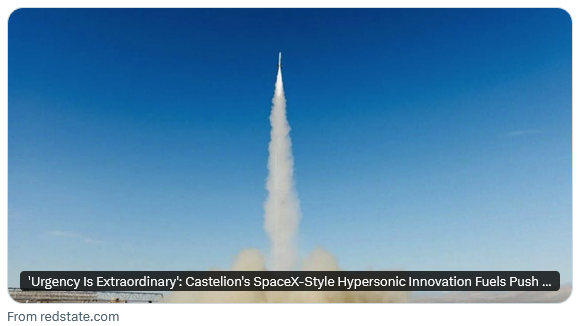
This is insane and it’s great news for the U.S. Navy.
All the worst people keep telling me Trump-class battleships are “obsolete” because of hypersonic missiles.
Then this drops:
“Blackbeard, engineered from a clean-sheet design by former SpaceX alumni, will not only match but decisively outpace foreign systems … rapid iteration and scalable production. We’re not just going to provide a comparable missile. We’re going to provide better missiles.”
A tiny startup just told Russia and China’s entire missile-industrial complex: we can beat you.
That’s the tell.
If hypersonics were the unstoppable carrier-killers people claim, you wouldn’t see startups leapfrogging them in a garage with venture capital. You’d see locked-in monopolies and terrified Western navies.
Here’s what the hype crowd misses:
1) Future battleships won’t be naked.
They will carry layered anti-hypersonic defenses, directed-energy weapons, decoys, and interceptors specifically designed to kill these things.2) Hitting a moving ship at hypersonic speed is brutally hard.
No nation has publicly demonstrated a successful hypersonic strike on a maneuvering warship. China hit a fake carrier sitting still in the desert. That proves almost nothing.
Think about the physics.
Flying a kamikaze plane into a carrier was hard but pilots had eyes, brains, and real-time judgment.
Now imagine doing that blind, with sensors the size of a soda can, while the target is jamming, maneuvering, spoofing, and throwing decoys.
Now imagine the Honey I Shrunk the Kids laser made you the size of an ant and you are told to steer a bullet into a weaving jet ski.
Russia can hit slow oil tankers. If they could reliably hit moving ships bringing supplies into Ukraine, they already would have.
3) Hypersonics are scarce and insanely expensive.
Even if it took 100 missiles to score a hit on a battleship, that’s 100 missiles that aren’t hitting ports, refineries, factories, air bases, and ammo depots.
Most of those targets don’t shoot back. None of them weave like a battleship.
Battleships change the economics of war.
They force the enemy to burn their most precious weapons just to try to hurt one ship.
That’s not vulnerability.
That’s deterrence.Stop black-pilling naval power. The physics, the economics, and now the tech sector are all pointing in the same direction.
Also on naval matters, Matt Gurney at The Line talks about his unfamiliar feelings of hope that the Canadian government’s promised spending boost for the Royal Canadian Navy will not only happen, but that the RCN may generate significantly improved capabilities as a result:
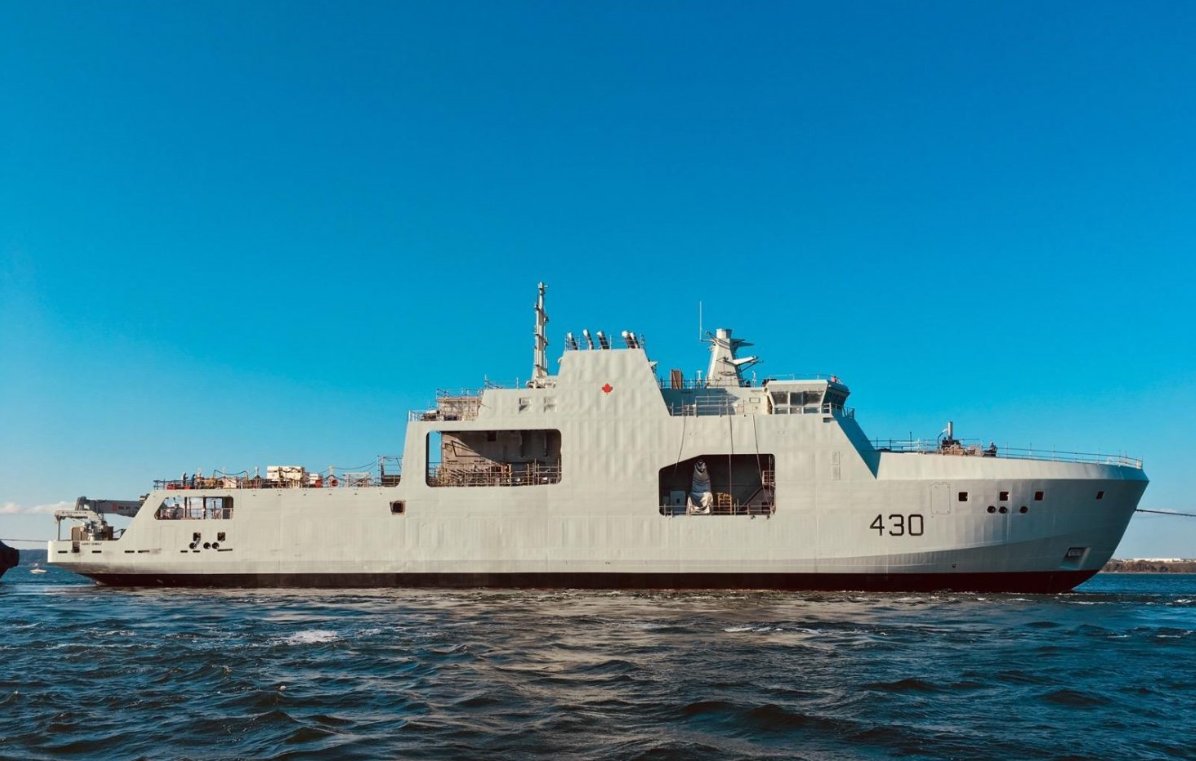
Arctic Offshore Patrol Ship HMCS Harry DeWolf shortly after launch in 2018. The ship was commissioned into the Royal Canadian Navy in June, 2021.
A day or two ago, I found myself thinking about the state of the Royal Canadian Navy. Because, I mean, hey — who doesn’t?
Anyone who has paid much attention to my work will be aware that I’m not exactly bullish on our country’s ability to get much done — especially on the file of military procurement. Yet, a day or two ago, I found myself thinking about the state of the Royal Canadian Navy and feeling something almost like … hope? Is this what hope feels like?
There is a lot going on in Canadian naval news, and that fits a broader pattern. There’s a lot going on on the seas globally, and, somewhat to my surprise, Canada seems to be doing a pretty good job — could be better, but could be worse — adapting to the new reality.
[…]
So let’s talk about seapower. The U.S. has it — not as much as it wants, but it’s got it. It wants more. Even if that ends up taking some pretty weird forms. And others are racing to catch up.
Including, intriguingly, Canada.
Last week, Canadian shipyard Seaspan announced that it had signed agreements with both Finland and American shipyards to licence its design for Multi-Purpose Icebreakers to the U.S. Coast Guard’s Arctic Security Cutter Program. And while the “Elbows Up” crowd may look askance at the prevalence of the word “American” in that sentence, this is damned interesting — not only are we continuing to show interest in the Arctic, but we’re also trying to sustain real shipbuilding in this country. The situation in the White House is so bizarre these days that it’s hard to take any announcement like this to the bank, but it was notable. If nothing else, it would be nice to see more efforts like this — whether the plans work will, alas, largely be out of our hands.
In addition to that, a few more stories came to mind. The first was this announcement from a few months ago: the Irving Shipyards have begun work on the final Arctic Offshore Patrol Ship of the Harry DeWolf class. Irving is also getting started on the next generation of Canada’s main warships, the River-class destroyers. Canada is actively seeking a replacement, in far greater numbers, of its current fleet of problematic submarines. And there’s also growing talk about a new smaller, mid-range class of Canadian warship, dubbed, for now, the Continental Defence Corvette. (Which I guess rolls off the tongue better than the See, Trump, We’re Spending On the Military Now Program.)
It’s easy to be a cynic on Canadian defence procurement — I am cynical about Canadian defence procurement. But then I looked at the ships being seized by U.S. forces. At Russia cutting cables, China ringing Taiwan with missiles and the U.S. throwing fleets around like Theodore Roosevelt has something to prove. And I look at a plan to not only replace Canada’s (too small) fleet of warships, but to considerably grow it … and it’s hard not to see the bigger picture.
Reverting to a pre-1945 geopolitical reality isn’t going to be an exercise in vibes. It’s going to be an exercise in power — or at least attempts to wield power. Air forces matter, cyber matters, drones matter and Lord knows armies matter. But they matter locally. True global power, or at least the ability to give a global power some pause before they decide to whisk your el jefe off to a Manhattan courtroom in a tracksuit, requires the ability to control your coasts and all the ocean approaches to them.
January 2, 2026
Nukes Put Man in Space – W2W 060
TimeGhost History
Published 31 Dec 2025In the 1950s, as the Cold War escalated, the same rockets designed to deliver nuclear annihilation across continents became powerful enough to break Earth’s gravity. Missiles built to destroy cities turned into launch vehicles that carried humanity into orbit.
This episode explores the dark origins of space travel — from intercontinental ballistic missiles and nuclear deterrence to Sputnik, the Space Race, and the moment the sky stopped being a safe boundary. At the center of the story stands Sergei Korolev, a Gulag survivor forced to build weapons for the Soviet regime, who nonetheless pushed humanity’s first steps into space.
Sputnik shocked the world, ignited fears of a “missile gap”, reshaped global politics, and triggered massive investments in science, education, and technology — on both sides of the Iron Curtain. The same systems built for global destruction would ultimately give us satellites, navigation, communication, and the modern world we rely on every day.
This is the paradox of the Space Age: Weapons first. Wonder second.
– Nuclear weapons and rocket technology
– The Cold War and the birth of ICBMs
– Sergei Korolev vs. Wernher von Braun
– Sputnik and the global shock of 1957
– The myth of the missile gap
– How fear reshaped science, education, and space exploration
(more…)
October 20, 2025
From Hitler’s Rockets to America’s Arsenal – W2W 049
TimeGhost History
Published 19 Oct 2025From the ashes of Nazi Germany to the launch pads of the American desert, the story of the nation’s first ballistic missile is one filled with contradiction. A man who once served the SS soon became a celebrated figure in the United States, and his weapon of war was transformed into a symbol of progress. Here, we will explore how this unlikely journey unfolded and what it reveals about science, power, and morality in the modern age.
(more…)
October 7, 2025
How a Myth Started the Nuclear Arms Race – W2W 47
TimeGhost History
Published 5 Oct 2025The Bomber Gap: a mid-1950s panic that convinced Washington the USSR was outproducing the U.S. in long-range strategic bombers — and triggered a massive nuclear buildup. This episode traces Eisenhower’s New Look, Curtis LeMay and SAC’s push for jets, the Dulles brothers’ influence, the M-4 “Bison” bluff, and the Symington hearings that turned bad intel into national policy. Learn how politics, optics, and deliberate Soviet deception combined to accelerate the arms race and reshape deterrence for decades.
[NR: At Dominion Review, Palmiro Campagna discusses the missile gap and how it impacted the decision to cancel the Avro Arrow.]
(more…)
February 24, 2025
Dawn of the Atomic Age – W2W 007
TimeGhost History
Published 23 Feb 2025In 1946, the world’s fate is rewritten in fire. The first peacetime nuclear tests shake the Pacific, while Stalin accelerates the Soviet push for the bomb. With the power to destroy the entire world now a reality, global leaders face a defining choice — will the bomb usher in the peace of our time, or lead to nuclear doom? The arms race has begun, and there’s no turning back.
(more…)
February 20, 2025
The Space Race Begins – W2W 006
TimeGhost History
Published 19 Feb 2025The Space Race has begun. As Stalin’s USSR and Truman’s U.S. compete for technological dominance, the Pentagon prepares for a future of missile warfare. Project Diana shatters barriers by bouncing radar off the Moon, proving space can be conquered — whether for exploration or war.
(more…)
December 4, 2024
Admirals belatedly realize it might be useful to be able to reload those fancy missiles at sea
CDR Salamander has been banging this drum for a long, long time, but it appears that the US Navy is finally acknowledging that being able to reload the (many) Vertical Launch System (VLS) missile cells on ships somewhere other than a fully functional naval base would be more than a nice-to-have capability:
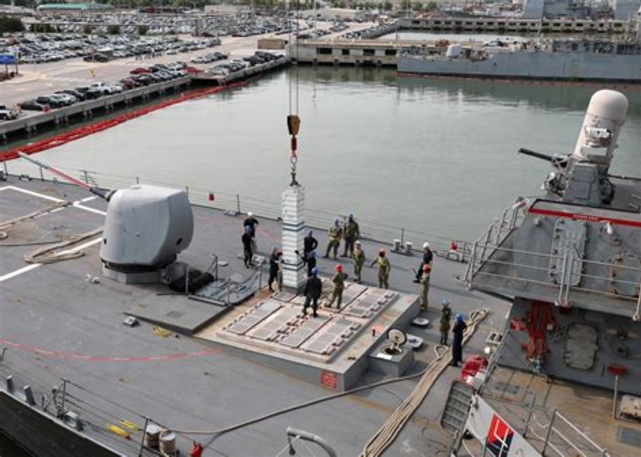
Reloading a VLS cell on a US Navy ship in port.
Photo attributed to defunct website defense-aerospace.com.
If you have made the horrible error of not reading every post here, over at the OG Blog and listening to every Midrats, then you may be new to the issue of being able to reload our warships’ VLS cells forward.
Slowly … a bit too slowly … Big Navy has decided that those people in the 1970s (who still remembered fighting a contested war at sea) might have been right all along. With SECNAV Del Toro’s encouragement, we continue to try to find a way to get the surface force a capability to reload forward.
There is plenty of room on the bandwagon and we’re glad to hoist everyone onboard the reload/rearm party-bus. If you need to catch up, the issue continues to break above the background noise, and WSJ has a very well produced article on it that requires your attention.
However, I got a little bit of an eye twitch at this pull-quote:
Until recently, the Navy didn’t feel much need for speed in rearming its biggest missile-firing warships. They only occasionally launched large numbers of Tomahawk cruise missiles or other pricey projectiles.
Now, Pentagon strategists worry that if fighting broke out in the western Pacific — potentially 5,000 miles from a secure Navy base — destroyers, cruisers and other big warships would run out of vital ammunition within days, or maybe hours.
Seeking to plug that supply gap, Del Toro tasked commanders and engineers with finding ways to reload the fleet’s launch systems at remote ports or even on the high seas. Otherwise, U.S. ships might need to sail back to bases in Hawaii or California to do so — putting them out of action for weeks.
Yes, I am going to do this, and you’re coming along for the ride.
In the name of great Neptune’s trident … THIS IS NOT A NEW REQUIREMENT!!!
My first “… shit, we need to be able to do this …” was during the DESERT FOX strikes against Iraq in 1998. I cannot remember if it were USS Stout (DDG 55) or USS Gonzalez (DDG 66) that we put Winchester on TLAM by the third day … but except for the ships we left on the other side of the Suez (who we would put to good use later), the rest of our TLAM ships and submarines were about done.
The fact we threw away an ability to reload/rearm forward was an old story inside the surface Navy when I picked it up in the last years of the previous century. We had a clunky erector set like contraption that was hard to use and took up VLS cell space, but instead of finding a better way, we just chunked the whole idea, slid in our Jesus Jones CD, and figured we had ownership of the seas until the crack of doom.
There is nothing “until recently” about this. Not to get off topic, but the real story here is why time and again this century’s senior leadership decided it was “too hard” or “too dangerous” while they were in full knowledge not just of the operational experience demanding this capability, but what we discovered over and over again in wargames.
November 25, 2024
Looking toward the first order effects of 47
At Postcards From Barsoom, John Carter is delighted that his pessimistic election forecast turned out to be wrong and considers what the incoming Trump administration will be doing in the short-term:
There are obvious parallels between the 2024 election, the 2016 election, and the Brexit vote, all of which are a bit awkward for elite theory maximalists. Their position, taken to its extreme, seems to be that only the elite can actually do things, that all political phenomena are ultimately a consequence of elite machinations. Which makes elite theory in many ways the highbrow version of conspiracy theory, the main difference being that they talk about the Cathedral’s systems of power instead of the Illuminati, the Freemasons, and smoky backrooms. And yet, the elite clearly don’t always get their way. In the case of Brexit, the elite were absolutely unanimous in their support for Remain … and the elite lost. Similarly in the case of the 2016 US election. Elite preferences carry an enormous amount of weight; it’s generally much better for a cause to have elite support than suffer elite opposition. But elites are not actually decisive. They can be beaten.
It’s obviously much too early to judge the 47th US presidency, which hasn’t started yet. Cynics expect a repeat of 2016: just as Trump’s promises to drain the swamp and build the wall came to, if not nothing, then very little, so will his promises to deport them all, replace the income tax with tariffs, reign in the universities by going after their accreditation and endowments, drain the swamp for real this time, and so on prove to be so much hot air. So far all we know are Trump’s cabinet picks and other appointments, which suggest that this cynicism might be premature. […]
The new Trump admin shows every sign of gearing up for a Dark MAGA rampage through the Beltway.
If you’re curious about where Dark MAGA came from, why yes it was memed into reality. Aristophanes
tells the wild saga: from in-joke to shitcoin to the hat on Elon Musk’s head.They aren’t going to just drain the swamp. They’re going to drain it, dry it, soak it in gasoline, and set it on fire. They are going to purge the US government of the useless, the incompetent, the subversive, and the criminal. At least, that seems to be the intention … and given the way the rats are scrambling to escape the ship before it sinks, the regime’s minions, at least, seem to think that plan has a good chance of succeeding. […]
Of course, a lot could happen between now and January. The Democrats might find some convoluted legal pathway to deprive The Insurrectionist of the Oval Office, as Tree of Woe suggested, which of course would initiate a constitutional crisis and probably a civil war. They could assassinate him, which would also probably start a civil war, and which is probably why Trump has been holed up in Mar-a-Lago since the election. Either of these outcomes would probably place JD Vance in the presidency, which is probably much worse for the regime than Trump: Vance is marine corps combat vet who reads Curtis Yarvin and is fluent enough in meme that he probably has a frog alt on Twitter.
[…]
News that suicides spiked after the election is apparently fake, though crisis call centres catering to the Pronoun Jugend did experience a massive increase, and one guy apparently unalived his entire family. They’re still in a state of shock: shaving their heads, vowing to start a sex strike, fleeing to Canada (I do not recommend).
The left are religious fanatics, and religious fanatics don’t give up just because it looks hopeless. It’s also worth recalling that the last time Trump won, the riots didn’t start until inauguration. There’s plenty of time yet, and there are a lot of very wealthy and very influential people who probably feel they have nothing to lose as their precious oxen are in danger of being lethally gored by Dark MAGA on the Washington Mall as a sacrifice to America’s Founding gods, after which they themselves will be hanged from Wotan’s Tree of Liberty. Note that it doesn’t matter if Trump will really follow through with all of this; what matters is if the other side thinks that he will. Ruling out a dramatic escalation in civil violence in the US is almost certainly hasty.
[…]
Another play the regime could make is to just start World War III before Trump takes office, either in order to justify a military coup d’etat, or just to dump a catastrophe in Trump’s lap so that he’ll be too busy dealing with that to drain the swamp. They definitely seem to be ramping things up in Ukraine, with the new strategy of long-distance missile strikes deep into Russian territory. The idea is probably to provoke the bear so badly that it starts mauling NATO countries directly, rather than just chewing through their exhausted national arsenals in the mud of the Donbass. That might work; then again, Putin knows full well that all he has to do is wait a couple months and he’ll be dealing with Trump directly, and Trump is on record as wanting to wind down hostilities as a top priority as soon as he’s in office. Vlad may be a bad man, but he is a very patient bad man.
Assuming that the regime is unsuccessful in baiting Russia into a direct attack on Europe, Trump’s victory probably has very big, tumultuous, and positive implications for European politics. Positive, at least, for anyone who doesn’t hate Europe … and therefore very bad implications for the people currently running the civilizational centre of the human species into the dirt.
The Germans, at least, seem to think so.
Yes, it’s real.
Chancellor Scholz’ unstable “traffic light” coalition disintegrated almost immediately after Trump was elected, sending Germany into its own election … in which the AfD is poised to do very well for itself, much to the consternation of Germany’s political class. eugyppius has been doing invaluable work covering Germany’s politics for the anglosphere audience; he provides an excellent overview of the reasons for the coalition’s collapse in this recent interview on the J Burden show.



November 24, 2024
“… if Russia were found to have had its own troops assemble a long-range missile and help launch it into the United States, do you think a US president would feel able to let it slide?”
It probably tightened a lot of already tight sphincters when it was announced that President Biden had authorized the Ukrainian government to use US-supplied long-range missiles to attack targets on Russian soil:
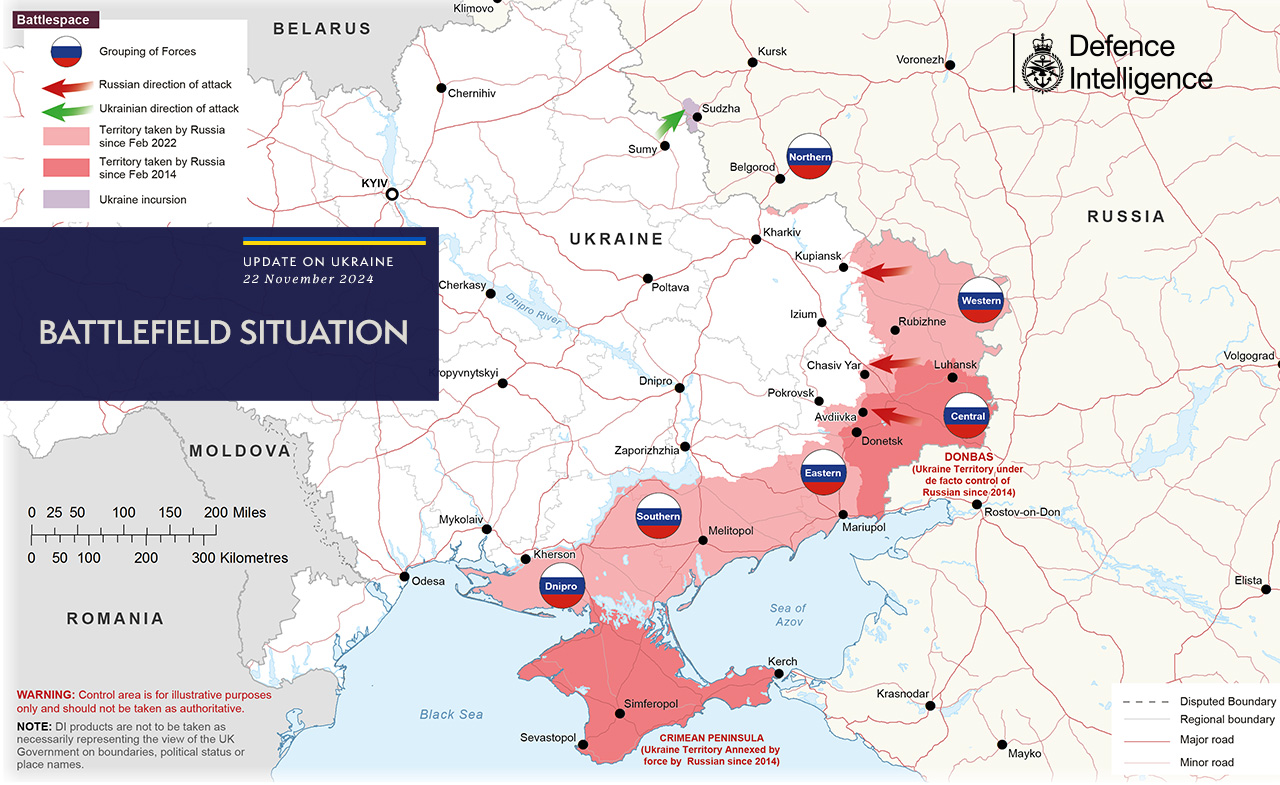
There was something truly surreal about President Biden suddenly changing course and agreeing to give Ukraine advanced long-range missiles to attack deep inside Russian territory in the last two months of his administration. There was no speech to the nation; no debate in the Senate; just a quiet demonstration of unilateral presidential fuck-you power. You know: the kind we’ve long worried about with Donald Trump. The missiles up the ante considerably against a nuclear power for a simple reason. As Putin noted:
experts are well aware, and the Russian side has repeatedly emphasized this, that it is it is impossible to use such weapons without the direct involvement of military specialists of the countries producing such weapons.
The tiny tsar continued:
We consider ourselves entitled to use our weapons against the military facilities of those countries that allow to use their weapons against our facilities. And in case of escalation of aggressive actions we will respond also decisively and mirrored.
And he looked on edge, bedraggled and belligerent, his arms and hands not moving a millimeter in what sure looks like AI.
There was a time when a NATO missile strike on Russian territory, followed by a Russian threat to attack NATO “military facilities” in response, would have caused the world to stop dead, paralyzed by the fear of nuclear armageddon. Yet here we are, blithely preoccupied by Pete Hegseth’s sexual exploits and Congressional bathrooms.
Others are not so sanguine. “I believe that in 2024 we can absolutely believe that the Third World War has begun,” Ukraine’s former military chief, Valery Zaluzhny, warned yesterday, noting both the new involvement of NATO troops and the involvement of North Korea. Our own president, having brought us much closer to the brink as a lame duck, seemed unconcerned. He was last seen wandering off-stage in the vague direction of the Brazilian rainforest. Not optimal.
The UK prime minister, Keir Starmer, was even punchier, and pledged to allow Ukraine to use British long-range missiles as well: “We need to double down. We need to make sure Ukraine has what is necessary for as long as necessary, because we cannot allow Putin to win this war”. When asked if he was prepared to risk the UK forces or Ukraine or a third country like Poland being nuked in response, as Putin has threatened, Starmer simply ignored the question.
Meanwhile, just to keep things from escalating, the deputy chief of the British defense staff told a parliamentary committee yesterday:
If the British Army was asked to fight tonight, it would fight tonight. I don’t think anybody in this room should be under any illusion that if the Russians invaded Eastern Europe tonight, then we would meet them in that fight.
There seems to be a general impression that Putin is of course bluffing, that NATO can keep lobbing missiles into Russian territory with minimal consequences, and nothing could possibly go wrong.
But Putin has responded by launching a long-range missile that could be used to carry a nuke but didn’t, as well as lowering the bar for the use of nukes in his military “doctrine“. And ask yourself: if Russia were found to have had its own troops assemble a long-range missile and help launch it into the United States, do you think a US president would feel able to let it slide? Here’s what the British missile, the Storm Shadow, did in hitting an underground military facility in Kursk, according to unverified Russia media sources:
[The strike] resulted in the Death of 18 Russian Officers, including a Senior Commander, as well as 3 North Korean Officers. In addition, a Dozen other Soldiers and Officers were Wounded in the Attack, including one of North Korea’s most Senior Generals.
I can’t verify that, but it’s perfectly possible. To have NATO’s fingers on the targeting and launch of that missile puts us in a whole new category of conflict.
The job of a president is to keep us far, far away from any risk of nuclear conflict, as Biden seemed to understand until now. And any student of history will know that blithe complacency as two sides trade military escalations is often exactly the precursor to something going very, very wrong. Accidents happen; misjudgments occur; the point of never getting to this point is that this point contains a host of unknowables, some of them globally existential.
I assume that this is all about strengthening Kyiv’s hand in what will be grueling negotiations to end the conflict once Donald Trump gets back into office. Or the intelligence is worse than we know and it’s about avoiding an Ukraine collapse before Biden leaves office — which, after Afghanistan, would be a final, damning verdict on his foreign policy. Or the intelligence is better than we know and the Russian economy is so weak and his military so depleted that NATO thinks this extra pressure will force Putin to crack. Or it’s a norm-defying attempt from an outgoing administration to derail any peace process the incoming one might want to start. The latter possibility — with Biden rolling the dice because he thinks someone else will have to face the music — is not a minimal risk.
February 28, 2024
V-2: Hitler’s Wunderwaffe
World War Two
Published 27 Feb 2024Hitler hopes that the V-2 rocket will turn the tide of the war. It’s cutting edge technology and impossible to intercept. Right now, the first long-range ballistic missile is raining death on London and Antwerp. But is it too little, too late? Find out the backstory to this powerful weapon.
(more…)
September 30, 2023
The Man Who Stole the Atomic Bomb
World War Two
Published 29 Sep 2023In the New Mexico desert, a secret team of scientists is working flat out to develop atomic bombs. It’s the most important American military project in history. But one of those scientists lives a double life. Klaus Fuchs has decided to betray his country and share America’s most secret technology with the Soviet Union. But is he the only person who has turned traitor?
(more…)
September 22, 2023
Is the Slovak Uprising Doomed to Fail? – War Against Humanity 115
World War Two
Published 21 Sep 2023Even as they battle an uprising in Slovakia, the Nazis see the opportunity to continue their racial realignment of Europe. The latest victims of this genocidal legacy are Anne Frank and her family, who arrive at Auschwitz. In Britain, the V-1 menace is defeated. But as London breathes a sigh of relief, the Nazis and their allies reduce Warsaw to rubble in a rampage of burning, looting, rape, and murder.
(more…)
September 21, 2023
A new paper on the cancellation of the Avro Arrow in 1959
The National Post republished a Canadian Press article about a new research paper by Alan Barnes in the Canadian Military History journal:
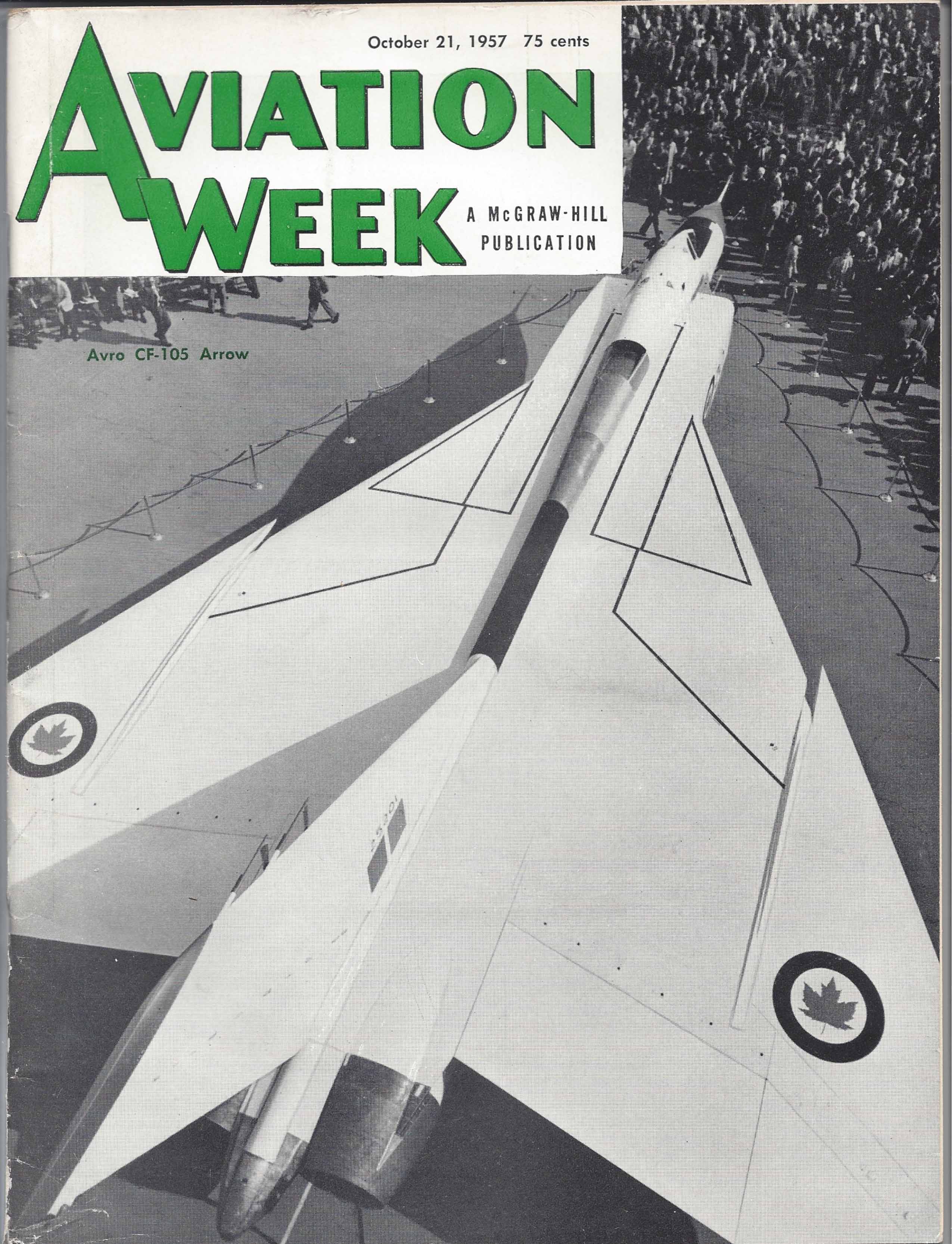
In the years after the Second World War, Canada developed its ability to prepare strategic intelligence assessments on defence and foreign policy, the paper notes. It would no longer have to rely entirely on assessments from the United States and Britain.
The analytic capability allowed Canada to fully participate in preparing the assessments on the Soviet threat to North America that would underpin joint Canada-U.S. planning for continental defence, Barnes notes.
“The CF-100 Canuck, a jet interceptor developed and manufactured in Canada, was just entering service, but there were already concerns that it might soon be outclassed by newer Soviet bombers operating at higher altitudes and faster speeds.”
In November 1952, the Royal Canadian Air Force called for an aircraft with a speed of Mach 2 and the ability to fly at 50,000 feet. “These demanding specifications contributed to the escalating costs and frequent delays in the CF-105 program.”
The Soviets would soon display a new long-range jet bomber, the Bison, at the 1954 May Day parade in Moscow. At an airshow the following year, a fly-past of 28 Bison seemed to indicate that the bomber had entered serial production, two years earlier than predicted, the paper says. In fact, only 18 prototype aircraft participated in the airshow, flying past several times to give the impression of larger numbers.
Even so, this display, along with the appearance of a new Soviet long-range turboprop bomber, the Tu-95 (dubbed the Bear), raised fears that the Soviet Union would soon outnumber the United States in intercontinental bombers, sparking a “Bomber Gap” controversy that figured prominently in American politics, the paper says.
[…]
A January 1958 assessment, “The Threat to North America, 1958-1967”, by Canada’s Joint Intelligence Committee, a co-ordinating body, ultimately had the greatest impact on decisions related to the Arrow, the paper says.
The assessment laid out clear judgments concerning the imminent transition from crewed bombers to ballistic missiles and described the limited size and capabilities of the Soviet bomber force, Barnes notes.
It observed that the Soviet ballistic missiles which were on the verge of being developed were likely to be markedly superior to the foreseeable defences, and concluded that missiles would progressively replace aircraft as the main threat to North America.
The assessment said this meant there would be little justification for the Soviet Union to increase the number of bombers, or to introduce new ones, after 1960.
“The (Joint Intelligence Committee)’s January 1958 assessment was correct in foreseeing Moscow’s shift from bombers to missiles over the subsequent decade,” Barnes writes.
He points out that following the Sputnik launch, Soviet leader Nikita Khrushchev came to see missiles as a panacea for a range of defence problems and as a cheaper alternative to conventional weapons. “With the Soviet bomber force now looking irrelevant and obsolete, it was relegated to a secondary position in Soviet military thinking.”
August 25, 2023
Fortress Britain with Alice Roberts S01E03
Fortress Britain with Alice Roberts
Published 16 Apr 2023


