
Because the generals on the attacking side – and it is worth remembering that Germany, Austria-Hungary, Britain, France and Italy all took their turns being the attacker on the narrower Western and Italian fronts defined by continuous unbroken trench-lines (the Eastern Front was somewhat more open) – were actively looking for ways out of the trench stalemate. We’ve already discussed one effort to get out, poison gas, and why it didn’t succeed. But there was a more immediate solution: after all, every field manual said the solution to weakening infantry positions on the field was artillery. Sure, trenches and dugouts made infantry resistant to artillery, but they didn’t make them immune to it. So what if we used more artillery?
So by the Second Battle of Artois (May, 1915), the barrage was four days long and included 293 heavy guns and 1,075 lighter pieces. At Verdun (February, 1916) the Germans brought in 1,201 guns, mostly heavy indirect fire artillery (of which the Germans had more than the French) with a shifting barrage that expected to fire 2 million shells in the first six days and 4 million during the first 18 days. At the Somme (1916) the British barrage lasted from the 24th of June to the attack on July 1 (so a seven-day barrage); a shorter barrage was proposed but could not be managed because the British didn’t have enough guns to throw enough shells in the shorter time frame. A longer barrage was also out: the British didn’t have the shells for it. By Passchendaele (1917) the British were deploying some 3,000 artillery pieces; one for every 15 yards of frontage they were attacking.
These efforts didn’t merely get to be more, but also more complex. It was recognized that if the infantry could start their advance while the shells were still falling, that would give them an advantage in the race to the parapet. The solution was the “creeping” barrage which slowly lifted, moving further towards the enemy’s rear. These could be run by carefully planned time-table (but disaster might strike if the infantry moved too slow or the barrage lifted too early) or, if you could guarantee observation by aircraft, be lifted based on your own movements (in as much as your aircraft pilots, with their MK1 eyeballs, could tell what was happening below them). […]
I find that most casual students of military history assume that these barrages generally failed. I suspect this has a lot to do with how certain attacks with ineffective barrages (e.g. the Somme generally, the ANZAC Corps’ attack at Passchendaele) have ended up as emblematic of the entire war (and in some cases, nationality-defining events) in the English-language discussion. And absolutely, sometimes the barrages just failed and attacks were stopped cold with terrible losses. But rather more frequently, the barrages worked: they inflicted tremendous casualties on defenders and allowed the attackers to win the race to the parapet which in turn meant the remaining defenders were likely to be swiftly grenaded or bayoneted. This is part of why WWI commanders continued to believe that they were “on the verge of a breakthrough”, that each attack had come so close, because initially there were often promising gains. They were wrong, of course, about being that close, but opening attacks regularly overran the initial enemy positions. Even the worst debacles of the war, like at the Somme, generally did so.
And at this point, you may be wondering if you’d been lied to, because you were always told this was a war where advances where measured in feet and meters instead of miles or kilometers and how can that be if initial attacks generally did, in fact, overrun the forward enemy positions? I’ll push this even further – typically, in the initial phases of these battles (the first few days) the casualty rates between attacker and defender were close to even, or favored the attacker. This is of course connected to the fact that the leading cause of battle deaths in the war was not rifle fire, machine guns, grenades, bayonets but in fact artillery fire and the attacker was the one blasting fixed positions with literal tons of artillery fire. So what is going on?
Because both sides quickly figured out that their forward positions were badly exposed to artillery barrages and began designing defenses in depth, with rear positions well out of the reach of all but the largest enemy artillery. For instance, most of the so-called “Hindenburg Line” (the Germans called it the Siegfriedstellung or “Siegfried Position”) was set in multiple lines […] The plan consisted of a thin initially defense which was assumed to fall in the event of an attack, but still featured channels made by heavy barbed wire and machine guns designed to inflict maximum casualties on an advancing force (and be dangerous enough to require the artillery barrage and planned assault). Then behind that was more open ground and then a second line of trenches, this time much more solid, with communications trenches cutting vertically and the battle positions horizontally, enabling reserves to be brought up through those trenches without being exposed to fire. Finally the reserves themselves were in a third line of trenches even further back, well outside of the enemy’s barrage (or indeed the range of all but their heaviest guns). Of course while your artillery is in the back, out of range of the enemy artillery, the enemy infantry is attacking into your artillery range. This keeps your artillery from being disabled into the initial barrage (you hope) so that it can be brought into action for the counter-attack.
And now the enemy of the attacker is friction (as we’ve discussed before with defense in depth). If everything possible goes right, you open with the barrage, your infantry sweeps forward, the creeping barrage lifts and you win the race to the parapet. The forward enemy defenders are either blasted apart by the barrage or butchered in their holes by your gas, grenades and bayonets. Great! Now you need to then attack again out of those enemy positions to get to the next line, but your forces are disorganized and disoriented, your troops are tired and your supplies, reinforcements and artillery (including many heavy guns that weigh many tons and shoot shells that also weigh 100+lbs a pop) have to get to you through the terrain the barrage created […]
So rapidly the power of your initial attack runs out. And then the counter-attacks, as inevitable as the rising sun, start. Your opponents can shell you from nice, prepared positions, while your artillery now has to move forward to support you. Their troops can ride railways to staging posts close to the front lines, advance through well-maintained communications trenches directly to you, while your troops have to advance over open group, under artillery fire, in order to support you. The brutal calculus begins to take its toll, you lose ground and the casualty ratios swings in favor of the “defender” (who to be clear, is now attacking positions he once held). Eventually your footholds are lost and both sides end up more or less where they started, minus a few hundreds or thousands of dead. This – not the popular image – this is the stalemate: the attacker frequently wins tactically, but operational conditions make it impossible to make victory stick.
The brutal irony of this “defensive” stalemate is that at any given moment in a battle that might last months and swing from offensive to defensive and back again that casualties typically favored the side which was attacking at any given moment. More ironic yet, the problem here is that the artillery itself is digging the hole you cannot climb out of, because it is the barrage that tears up the landscape, obliterating roads, making movement and communication nearly impossible for the attacker (but not for the defender). But without the barrage, there’s no way to suppress enemy artillery and machine guns to make it possible to cross no man’s land. Even with tanks, an attack without supporting artillery is suicide; enemy artillery will calmly knock out your tanks (which are quite slow; this is in 1918, not 1939).
The problem, for the attacker and the defender isn’t machine guns, it is artillery: the artillery that makes assaults possible in the first place makes actual victory – breaking through the enemy and restoring maneuver – impossible.
Bret Devereaux, “Collections: No Man’s Land, Part I: The Trench Stalemate”, A Collection of Unmitigated Pedantry, 2021-09-17.
July 1, 2023
QotD: The ever-increasing size and number of artillery pieces in WW1 trench battles
May 28, 2023
This Gun Could Reach Space
Real Engineering
Published 18 Feb 2023
(more…)
May 9, 2023
QotD: Changing German Panzer tactics in 1943
The following report, though obviously written in haste with little regard for elegance of expression, gives a good view of the changes in tank tactics which took place on the Eastern Front. This translation was made from a typed copy of the original and thus bears no signature. Nonetheless, there is good reason to believe that the author was the famous Fridolin von Senger und Etterlin, who commanded the 17th Armored Division at this time.
1. The tank tactics which led to the great successes of the years 1939, 1940, and 1941 must now be considered obsolete. Even if it were possible today to breakthrough an antitank front by means of the massive employment of concentrated waves of tanks, we would not be able to make use of these methods, which would once more lead to considerable losses, because of our [tank] production situation. These methods, often employed in rapid succession, would lead to such a quick reduction in tank strength that the character of an armored division would be fundamentally altered. This would lead to difficulties for the higher leadership.
The change in tank tactics is logical. The beginning successes of the weapon, the shock effect of which rested upon the technical achievement and overwhelming invincibility of the attacker, found at last its end in the development of appropriate defenses. From the point of view of production, the building of tanks could not keep pace with the building of antitank weapons. Apparently, a thousand antitank rifles, or dozens of antitank guns, can roll off the production lines for every tank.
The following are drawn from these insights.
2. The new tank tactics, which have already gained inevitable acceptance in the divisions, are outlined below.
The tank group no longer forms the nucleus of the armored division, about which other weapons are grouped as auxiliaries. The tank is a new arm acting in concert with and equal to the old arms. In cooperation with other weapons, it retains its power, even though its numbers are far below those called for by tables of organization.
Its meaning as a new arm is a function of the fact that it combines in itself a goodly portion of the two elements important to the attack: fire and maneuver. It derives these qualities from the fact that it is invulnerable, or less vulnerable, because of its armor.
Because the tank arm combines in itself firepower and mobility to a greater degree than other arms, it is the appropriate weapon for forming the main effort [Schwerpunkt].
The combat of the armored division is characterized by the fact that it is a mobile unit in all its parts and, as a result, the division commander is in a position, in the course of a battle, to chose and form a main effort [Schwerpunkt]. This principle excludes an irrevocable commitment of the tank group before an attack. Rigid employment within the framework of an already established battle plan is replaced by division commander himself holding [the tank group] in readiness and the flexibly employing it in the course of fighting against the required, or known to be appropriate, position.
The battle will begin with the infantry attack. The infantry attack provides the required foundation for the strength of the antitank front, for its length and depth. If the antitank front is known, then the tank attack can be ordered according to the classical principles for leading mobile units against the flanks or, if possible the rear, of an enemy defensive position. This attack should only be carried out exclusively by tanks when they can gain complete surprise. If surprise cannot be gained, then in this flank attack fire superiority must be fought for through the employment of artillery and, for the time being and to a certain extent the fire of the tanks themselves, until the enemy antitank front can be shaken or at least split up. If surprise can be gained, then a break-in against the flank of an antitank front can succeed without preparatory fire.
The attack against an enemy antitank front by means of a successful move against its flanks and rear cannot be carried out by tanks alone. It requires the support of artillery. In our experience, however, tank attacks carried out against the flanks and rear have outrun the artillery groups in direct support. Shifting fires by means of forward observers alone is not enough to ensure the shooting up of defensive fronts. What is needed here is thus the self-propelled batteries, which in the same manner as tanks themselves can quickly change their firing positions and thus attain the same mobility as the tank groups.
3. Now that these principles of the new tactics have been laid out, their use in practice will be explained.
a. The use of tanks as the first attack wave against a strongly fortified, deeply organized defensive position leads always to great losses and is thus false.
b. The use of tanks against deeply organized antitank positions is possible with the stipulation that it be commanded by an all-arms leader in close cooperation with other weapons after the formation of a main effort on the spot and that the further prosecution of the battle be steered by the same all-arms leader.
c. The employment of tanks leads to the greatest success when, sent into action and controlled by the all-arms leader, when they are used to strike the enemy in the flank, soon after the latter has begun an attack and before his antitank weapons have established firm antitank positions. Also in this last case, the attack must, with a view to direction and timing, be ordered by the all-arms leader on the spot. (With this last method the weak forces of the worn out 17th Armored Division annihilated one enemy division at Kuteinikowskaja on the 5th of January 1943 and another at Talowaja on the 27th of January, 1943.)
4. These new tactics are based upon the cooperation of the three main arms (infantry, tanks, and artillery) during the entire course of a battle. This cooperation can only be assured when the leader, that is to say, in all cases where the mass of the division is employed, the division commander himself, controls the cooperation of the arms on the spot throughout the entire battle. If, under the press of circumstance, as generally was the case during the battles between the Don and the Volga, widely separated battle groups [Kampfgruppen] of infantry, tanks and artillery had to be formed, it is essential that each of these battle groups be commanded by an all-arms leader, who is neither the commander of the tank element nor the infantry element of the battlegroup.
The all-arms leader’s means of command is the 10-watt radio built into a tank. With this equipment the leader is connected with the tank leaders as well as the leader of the infantry group, who, in case the proper radios are lacking, is provided with a tank. The all-arms commander is also in contact, by means of his armored personnel carrier, with battlegroups not forming part of the main effort and with his first general staff officer (Ia) working far to the rear.
The leader of the artillery group locates himself, according to the ordinary rules of command and control, with the all-arms leader. He is able, as was explained above, to give effective support only as the leader of an artillery group made up of self-propelled batteries. If he does not have access to some of these, there is always the danger the leader of the tank group would find his mobility limited by being bound to the less mobile towed artillery supporting him.
The place of the leader in combat is far forward, so that he can easily see the tank combat and, on the basis of these observations, can steer the course of the battle. He is sufficiently separated from the forward wave of tanks that he does not get involved in the tank-versus-tank and tank-versus-antitank battles, for this combat will focus his attention on the tanks fighting in the forward lines, to the point where tactical decisions which derive from the cooperation of all arms, can no longer be made.
The place of the leader can, however, rarely be chosen outside of the zone of enemy artillery fire. He can nevertheless remain mobile, thanks to the peculiar virtues of his means of command, namely voice radio. In the course of an attack in progress, he should be far enough forward to allow contact with the infantry group. Through it he can exert the leadership of a combined arms combat.
an armored personnel carrier used as a mobile command post in Russia in 1941From his location the leader should be in a position to himself assemble, according to the development of the situation and the requirements of the cooperation of arms, discrete tank groups.
Cooperation between discrete tank groups and infantry groups is possible if the all-arms leader remains in voice radio contact with the tank group in question. The attachment of tank groups to infantry groups is, as a matter of principle, always to be avoided. The infantry is not in a position to ensure the cooperation of infantry, heavy infantry weapons, and artillery as well as tanks because it is fully occupied with the conduct of the combat of other weapons. On this basis, the attachment of tanks to infantry divisions, which cannot be trained in the cooperation of the three arms, is, as a matter of principle, to be avoided.
The requirement to achieve success by the cooperation of all three arms does not exclude the concentration of all tanks in a single attack. This is still to be striven for. The concentration of tank power in the main effort [Schwerpunkt] will, however, not to striven for through systematic employment on the basis of an established plan, but rather in the course of the battle through the assembling of certain tank groups, in short, through the flexible combat leadership and formation of the main effort [Schwerpunkt] in the course of the battle through the all-arms leader himself.
This battle method, which aims at the close cooperation of the three main arms, cannot function without the formation of a special infantry group mounted in armored personnel carriers. Because it is essentially different, this group does not belong with the wheeled-vehicle mounted infantry of the division. They form, rather, an integrated part of the tank group. They can be attached to the later or will be employed according to the decision of the all-arms leader in accordance with the same principles that apply to the employment of tank waves.
The armored personnel carrier group of the infantry which is attached to the tank group corresponds closely to the self-propelled artillery. Both are special branches of their main arm, which work within the tank group itself and without which the cooperation of the tank group with the mass of the truck-mounted infantry and the towed artillery would not be possible.
5. The following deductions for the construction of tanks can be drawn from the aforementioned portrayal of the tactics and command techniques of the armored division. Because the race between tanks and anti-tank defenses can only be won by even heavier types and thus can not be guaranteed, the focus of effort [Schwerpunkt] in construction must be towards mobility and firepower.
The cooperation of arms can never be so close that artillery-infantry attacks alone can prepare an antitank front so that the tank attack can break through it in a rapid rollover. Instead, tanks must be an a position to use long-range fire to put anti-tank fronts out of action or at least so suppress them so as to make possible the further prosecution of the attack. They are only in a position to do this when they possess weapons of such a caliber that they can win superiority over immobile antitank weapons by means of fire and mobility.
According to this line of reasoning, great things can be expected from the creation of self-propelled artillery batteries. As unarmored fire units with greater range than tanks themselves they are in a position to attain that fire superiority which is necessary to gain the upper hand against the antitank defense.
During this winter’s fighting the best results were gained from assault gun battalions which, because of their great mobility and firepower, were employed and led in the same way as tanks. From the point of view of mobility, they outdid the tanks. Self- propelled guns were likewise successfully employed according to the same principles, to augment tank and assault gun groups, particularly by fire.
In contrast, the Tiger tanks, which were supposed to have fulfilled all three requirements, namely firepower, mobility, and heavy armor, were less successful, for their mobility was not sufficient for the elastic battle leadership outlined above. (In this experience it is important to take into account that the units sent fresh into battle were not at the height of their powers, especially where the use of radio was concerned. The impression of their lack of mobility, especially in rolling country with hard-frozen ground, however, would have been the same, even if the training of the personnel had been completed.)
These lessons of the more and more similar tactics of tanks, assault guns, and self-propelled artillery, which in more or less ad hoc arrangements establish the principle of fast-moving heavy firepower, causes one to wish that these weapons could be organized under a single leader with the goal of combining under him standardized training and well-schooled cooperation. This commander is the commander of the division’s tank group, that is to say, all more or less armored weapons mounted on tracked vehicles that are used for the fire battle. He must also have attached as an essential part an infantry group mounted in armored personnel carriers which should be made available according to a ratio of at least one infantry company for each three tank companies of whatever type.
The self-propelled artillery battalion should not be made an organic part of the tank group because of artillery training and the proposed design that will allow the guns to be dismounted. It should remain an organic part of the artillery regiment and be as- signed, on a case by case basis, to the commander of the tank group.
Unsigned report, probably authored by Fridolin von Senger und Etterlin, who commanded 17th Panzer Division at that time, via Bruce Gudmundsson’s Tactical Notebook, 2023-02-06.
April 29, 2023
What Was the Deadliest Day of the First World War?
The Great War
Published 28 Apr 2023What was the deadliest day of any nation in WW1? There are multiple candidates for that, but why should we even care? Well, the answer to this question highlights a challenge with popular memory that is often focused on the biggest battles of the war like the Somme or Verdun.
(more…)
April 21, 2023
Type 94 Japanese 37mm Antitank Gun on Guadalcanal
Forgotten Weapons
Published 30 Dec 2022The Type 94 was the standard infantry antitank gun of the Japanese Army during World Ware Two. It was developed in the early 1930s as tensions with the Soviet Union rose; there had not been much need for Japanese antitank weapons in China. However, high explosive ammunition was also made for the gun, and it was used in an infantry support role with HE in China as well as in the Pacific.
The Type 94 was small and light, and could be disassembled for transportation without vehicles — a very useful capability on islands like Guadalcanal. Against US M3 Stuart light tanks, the Type 94 was a reasonably potent weapon.
Note that the Japanese also had a Type 94 tank gun, which was not the same as this — and did not use the same 37mm cartridge.
(more…)
April 2, 2023
QotD: The (in-)effectiveness of chemical weapons against “Modern System” armies
But let’s put that in a real-world context. Five Japanese doomsday cultists used about five liters of sarin in a terror attack on a Tokyo Subway in 1995, deployed, in this case, in a contained area, packed full to the brim with people – a potential worst-case (from our point of view; “best” case from the attackers point of view) situation. But the attack killed only 12 people and injured about a thousand. Those are tragic, horrible numbers to be sure – but statistically insignificant in a battlefield situation. And no army could count on ever being given the kind of high-vulnerability environment like a subway station in an actual war.
In order to produce mass casualties in battlefield conditions, a chemical attacker has to deploy tons – and I mean that word literally – of this stuff. Chemical weapons barrages in the First World War involved thousands and tens of thousands of shells – and still didn’t produce a high fatality rate (though the deaths that did occur were terrible). But once you are talking about producing tens of thousands of tons of this stuff and distributing it to front-line combat units in the event of a war, you have introduced all sorts of other problems. One of the biggest is shelf-life: most nerve gasses (which tend to have very high lethality) are not only very expensive to produce in quantity, they have very short shelf-lives. The other option is mustard gas – cheaper, with a long shelf-life, but required in vast quantities (during WWII, when just about every power stockpiled the stuff, the stockpiles were typically in the many tens of thousands of tons range, to give a sense of how much it was thought would be required – and then think about delivering those munitions).
[…]
But that’s not the only problem – the other problem is doctrine. Remember that the modern system is all about fast movement. I don’t want to get too deep into maneuver-warfare doctrine (one of these days!) but in most of its modern forms (e.g. AirLand Battle, Deep Battle, etc) it aims to avoid the stalemate of static warfare by accelerating the tempo of the battle beyond the defender’s ability to cope with, eventually (it is hoped) leading the front to decompose as command and control breaks down.
And chemical weapons are just not great for this. Active use of chemical weapons – even by your own side – poses all sorts of issues to an army that is trying to move fast and break things. This problem actually emerged back in WWI: even if your chemical attack breaks the enemy front lines, the residue of the attack is now an obstruction for you. […] A modern system army, even if it is on the defensive operationally, is going to want to make a lot of tactical offensives (counterattacks, spoiling attacks). Turning the battle into a slow-moving mush of long-lasting chemical munitions (like mustard gas!) is counterproductive.
But that leaves the fast-dispersing nerve agents, like sarin. Which are very expensive, hard to store, hard to provision in quantity and – oh yes – still less effective than high explosives when facing another expensive, modern system army, which is likely to be very well protected against such munitions (for instance, most modern armored vehicles are designed to be functionally immune to chemical munitions assuming they are buttoned up).
This impression is borne out by the history of chemical weapons; for top-tier armies, just over a century of being a solution in search of a problem. The stalemate of WWI produced a frantic search for solutions – far from being stupidly complacent (as is often the pop-history version of WWI), many commanders were desperately searching for something, anything to break the bloody stalemate and restore mobility. We tend to remember the successful innovations – armor, infiltration tactics, airpower – because they shape subsequent warfare. But at the time, there were a host of efforts: highly planned bite-and-hold assaults, drawn out brutal et continu efforts, dirigibles, mining and sapping, ultra-massive artillery barrages (trying a wide variety of shell-types and weights). And, of course, gas. Gas sits in the second category: one more innovation which failed to break the trench stalemate. In the end, even in WWI, it wasn’t any more effective than an equivalent amount of high explosives (as the relative casualty figures attest). Tanks and infiltration tactics – that is to say, the modern system – succeeded where gas failed, in breaking the trench stalemate, with its superiority at the role demonstrated vividly in WWII.
Bret Devereaux, “Collections: Why Don’t We Use Chemical Weapons Anymore?”, A Collection of Unmitigated Pedantry, 2020-03-20.
March 29, 2023
The obscure Polish banker who foresaw the carnage and deadlock of the First World War
Jon Miltimore on one of the few people to realize the increased deadliness and growing size of modern armies foreclosed any possibility of a quick, glorious war that would have the troops “home for Christmas”:
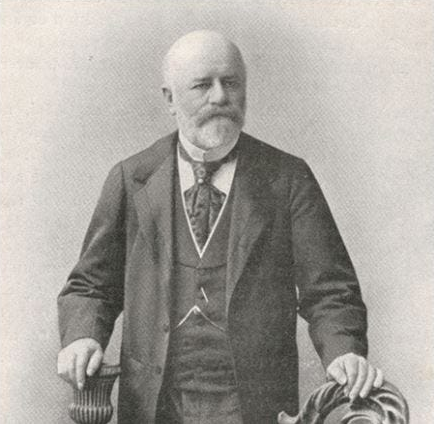
Jan Bloch, author of The War of the Future in its Technical, Economic and Political Relations (1898).
One man who did portend the carnage was Jan Bloch, a Polish banker and railroad baron who moonlighted as a military theorist. In 1898, Bloch published a little-noticed six-volume work titled The War of the Future in its Technical, Economic and Political Relations. The following year, the work was re-published in a single volume under a new title: Is War Now Impossible?
In the work, Bloch, who had closely studied Britain’s campaign in Africa during the Boer War, explained that modern weaponry had become so deadly that it had fundamentally changed warfare. Bayonet charges and cavalry flanking maneuvers were obsolete in an era defined by sophisticated earthworks and precision projectiles, he suggested.
Everybody will be entrenched in the next war. It will be a great war of entrenchments. The spade will be as indispensable to a soldier as his rifle. The first thing every man will have to do, if he cares for his life at all, will be to dig a hole in the ground. War, instead of being a hand-to-hand contest in which the combatants measure their physical and moral superiority, will become a kind of stalemate, in which neither army is able to get at the other, threatening each other, but never being able to deliver a final and decisive attack.
War would be “impossible” in the sense that it would be suicidal. Neither side would be able to gain a decisive advantage, battles along massive contiguous fronts would continue indefinitely.
Was Bloch suggesting that modern man had vanquished war by making it so deadly and terrible? Hardly. He argued that humans would be slow to realize the changes, and the results would be catastrophic.
At first there will be increased slaughter — increased slaughter on so terrible a scale as to render it impossible to get troops to push the battle to a decisive issue. They will try to, thinking that they are fighting under the old conditions, and they will learn such a lesson that they will abandon the attempt forever. Then, instead of war fought out to the bitter end in a series of decisive battles, we shall have as a substitute a long period of continually increasing strain upon the resources of the combatants. The war, instead of being a hand-to-hand contest, in which the combatants measure their physical and moral superiority, will become a kind of stalemate, in which neither army being willing to get at the other, both armies will be maintained in opposition to each other, threatening the other, but never being able to deliver a final and decisive attack …
That is the future of war — not fighting, but famine, not the slaying of men, but the bankruptcy of nations and the breakup of the whole social organization …
First World War generals don’t get much credit for their varied efforts to break the trench warfare deadlock, and later historians certainly piled on for the leaders’ collective failure to resolve the problem, but as Bret Devereaux pointed out, there was no easy solution. Artillery wasn’t the answer, nor were the famed German Stoßtruppen, nor the technical innovation of tanks, nor air power (either tactical or strategic). The technology of the day provide no one answer, but the leaders tried everything they could and the bleeding went on.
March 24, 2023
From “railway spine” to “shell shock” to PTSD
At Founding Questions, Severian discusses how our understanding of what we now label “Post-Traumatic Stress Disorder” evolved from how doctors visualized bodily ailments over a century ago:
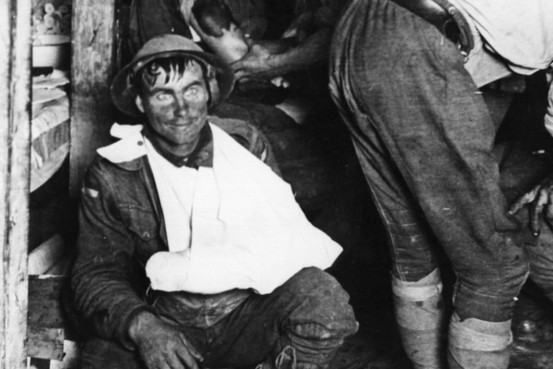
A shell-shocked and physically wounded soldier in the First World War.
I mentioned “shell shock” yesterday, so let’s start there. Medicine in 1914 was still devoted to the “Paris School,” which assumed nothing but organic etiology for all syndromes. Sort of a reverse Descartes — as Descartes (implicitly) “solved” the mind-body problem by disregarding the body, so the “Paris School” of medicine solved it by disregarding the mind. So when soldiers started coming back from the front with these bizarre illnesses, naturally doctors began searching for an organic cause. (That’s hardly unique to the Paris School, of course; I’m giving you the context to be fair to the 1914 medical establishment, whose resistance to psychological explanations otherwise seems so mulish to us).
They’d noticed something similar in the late 19th century, with industrial accidents and especially train crashes. When a train crashed, the people in the first few cars were killed outright, those in the next few wounded, but the ones in the back were often physically fine. But within a few hours to weeks, they started exhibiting all kinds of odd symptoms. Hopefully you’ve never been in a train crash, but if you’ve ever been in a fender-bender you’ve no doubt experienced a minor league version of this.I hit a deer on the highway once. Fortunately I was at highway speed, and hit it more or less dead on (it jumped out as if it were committing suicide), so it got thrown away from the car instead of coming through the windshield. The car’s front end was wrecked, naturally, but I was totally fine. I don’t think the seatbelt lock even engaged, much less the airbag, since I didn’t even have time to hit the brakes.
The next few hours to days were interesting, physiologically. It felt like my body was playing catch up. I had an “oh shit, I’m gonna crash!!!” reaction about 45 minutes after I’d pulled off to the side of the road, duct-taped the bumper back on as best I could, and continued to my destination. All the stuff I would have felt had I seen the deer coming came flooding in. Had I not already been where I was going, I would’ve needed to pull over, because that out of the blue adrenaline hit had my hands shaking, and my vision fuzzed out briefly.
The next morning I was sore. I had all kinds of weird aches, as if I’d just played a game of basketball or something. I assume part of it actually was the impact — it didn’t feel like much in the moment, but if it’s enough to crumple your car’s front end (and it was trashed), it’s enough to give you a pretty good jolt. That would explain soreness in the arms, elbows, and shoulders — a stiff-armed, white-knuckle grip on the steering wheel, followed by a big boom. But I was also just kinda sore all over, plus this generalized malaise. I felt not-quite-right for the next few days. Nothing big, no one symptom I can really put my finger on, but definitely off somehow — a little twitchy, a little jumpy, and really tired.
Having done my WWI reading, I knew what it was, and that’s when I really understood the doctors’ thought processes. I really did take some physical damage, because I really did receive a pretty good full-body whack. It just wasn’t obvious to the naked eye. And since everyone has experienced odd physical symptoms from being rattled around, or even sleeping on a couch or sprung mattress, it makes sense — the impact obviously jiggled my spine, which probably accounts for a great many of the physical symptoms. Hence, “railway spine”. And from there, “shell shock” — nothing rattles your back like standing in a trench or crouching in a dugout as thousands of pounds of high explosive go off around you. It must be like going through my car crash all day, every day.
Skip forward a few decades, and we now have a much better physiological understanding of what we now call (and I will henceforth call) Post-Traumatic Stress Disorder (PTSD). There’s a hypothesis that I personally believe, that “shell shock” is also a whole bunch of micro-concussions as well as “classic” PTSD, but let’s leave that aside for now. The modern understanding of PTSD is largely about chemistry. Cortisol and other stress chemicals really fuck you up. They have systemic physical and mental effects. If those chemicals don’t get a chance to flush out of your system — if you’re in a trench for weeks on end, let’s say — the effects are cumulative, indeed exponential.
Returning to my car crash: I was “off” for a few days because my body got a huge jolt of stress chemicals. That odd not-quite-right thing I felt was those chemicals flushing through. Had I gone to a shrink at that moment, he probably would’ve diagnosed me with PTSD. But I didn’t have PTSD. I had a perfectly normal physiological reaction to a big shot of stress chemicals. If I’d gotten into car crash after car crash, though, day in and day out, that would’ve been PTSD. I’d be having nightmares about that deer every night, instead of just the once. And all that would have cumulative, indeed exponential, effects.
He then goes on to cover similar physical reactions to stimuli in modern life, so I do recommend you RTWT.
January 26, 2023
Tank Chats #165 | Striker | The Tank Museum
The Tank Museum
Published 30 Sept 2022In this weeks video, David Fletcher discusses the development and features of Striker, another vehicle from the CVRT family.
(more…)
January 11, 2023
Repurposing Obsolete Rifles: The Lebel R35 Carbine
Forgotten Weapons
Published 19 Dec 2017The French military had investigated the possibility of a Lebel carbine in the 1880s, but by the 1930s a different set of priorities was in place. In an effort to make some use of the vast stockpiles of obsolete Lebel rifles France had, a plan was put in place to shorten then into carbines for auxiliary troops like artillery crews and engineers. These men needed some sort of rifle or carbine, but they did not need the best and newest weapons. By giving them shortened Lebel carbines, it would free up more modern rifles like the M34 Berthiers in 7.5mm and the new MAS-36 rifles to go to the front line infantry who needed them most.
The R35 conversion was developed by the Tulle arsenal and adopted in January of 1936. The French government ordered 100,000 to be made, and deliveries began in April of 1937. Production would accelerate and continue right up to the spring of 1940, with a total of about 45,000 being actually delivered before the armistice with Germany. The conversions were all assembled at Tulle, but four other factories manufactured barrels for them: Chatellerault (MAC), St Etienne (MAS), Société Alsacienne de Constructions Mécaniques (SACM), and Manufacture d’Armes de Paris (MAP). These barrels were 450mm long (17.7 inches), and with the similarly shortened magazine tube, the R35 carbines held just 3 rounds. Production would not continue after the liberation of France in 1944.
(more…)
December 14, 2022
QotD: The “tooth-to-tail ratio” in armies
The Roman legion, for instance, was essentially all tooth. While there was a designation for support troops, the immunes, so named because they were immune from having to do certain duties in camp, these fellows were still in the battle line when the legion fought. The immunes included engineers, catapult-operators, musicians, craftsmen, and other specialists. Of course legions were also followed around by civilian non-combatants – camp-followers, sutlers, etc. – but in the actual ranks, the “tail” was minimal.
You can see much the same in the organization of medieval “lances” – units formed around a single knight. The Burgundian “lance” of the late 1400s was composed of nine men, eight of which were combatants (the knight, a second horsemen, the coustillier, and then six support soldiers, three mounted and three on foot) and one, the page, was fully a non-combatant. A tooth-to-tail ratio of 8:1. That sort of “tooth-heavy” setup is common in pre-industrial armies.
The industrial revolution changes a lot, as warfare begins to revolve as much around mobilizing firepower, typically in the form of mass artillery firepower as in mobilizing men. We rarely in our fiction focus on artillery, but modern warfare – that is warfare since around 1900 – is dominated by artillery and other forms of [indirect] fires. Artillery, not tanks or machine guns, after all was the leading cause of combat death in both World Wars. Suddenly, instead of having each soldier carry perhaps 30-40kg of equipment and eat perhaps 1.5kg of food per day, the logistics concern is moving a 9-ton heavy field gun that might throw something like 14,000kg of shell per day during a barrage, for multiple days on end. Suddenly, you need a lot more personnel moving shells than you need firing artillery.
As armies motorized after WWI and especially after WWII, this got even worse, as a unit of motorized or mechanized infantry needed a small army of mechanics and logistics personnel handling spare parts in order to stay motorized. Consequently, tooth-to-tail ratios plummeted, inverted and then kept going. In the US Army in WWI, the ratio was 1:2.6 (note that we’ve flipped the pre-industrial ratio, that’s 2.6 non-combat troops for every front line combat solider), by WWII it was 1:4.3 and by 2005 it was 1:8.1. Now I should note there’s also a lot of variance here too, particularly during the Cold War, but the general trend has been for this figure to continue increasing as more complex, expensive and high-tech weaponry is added to warfare, because all of that new kit demands technicians and mechanics to maintain and supply it.
[NR: Early in WW2, British Prime Minister Winston Churchill frequently harassed his various North African generals for the disparity between the “ration strength” of their commands and the much-smaller number of combat troops deployed. If General Wavell had 250,000 drawing rations, Churchill (who last commanded troops in the field in mid-WW1) assumed that this meant close to 200,000 combat troops available to fight the Italians and (later) the Germans. This almost certainly contributed to the high wastage rate of British generals in the Western Desert.]
Bret Devereaux, “Fireside Friday, April 22, 2022”, A Collection of Unmitigated Pedantry, 2022-04-22.
November 11, 2022
QotD: WW1 was the first war where the artillery was destructive enough to change the landscape
This kind of terrain – with so much of the ground-cover blasted away – would turn into mud-soaked pits the moment it rained – particularly where water collected in the shell-holes.
That also explains why these post-battle scenes often lack any kind of local terrain features. Powerful explosive shells could annihilate terrain features like forests, roads, hedgerows, fences, fields – even hills and entire villages – with extended bombardments. And without any ground-cover left, almost any rain at all will then reduce the local terrain into a mud-soaked bog, especially if the local soil drains poorly (as it did so famously in Flanders).
The problem with depicting medieval, or even early modern battlefields this way is, of course, that these armies do not possess any weapons which can deliver this kind of destruction. Even as late as the American Civil War, field artillery – even massed field artillery – was simply not that powerful (although some heavy naval and siege guns were beginning to come close). Post-battle photography of Gettysburg – even in the approaches to Cemetery Ridge and around the Wheat Field – areas of fierce fighting – shows not only trees and ground-cover, but even fences and buildings largely intact.
Field artillery firing solid shot from 6 to 20lbs to is simply not strong enough to tear apart the terrain in the way that we often see in popular depictions of historical or fantasy battlefields; as pictured above, the guns doing that in WWI were often firing 1,000+ pound shells, 100 times the weight of shot of a normal ACW cannon (lighter artillery, like the famed French 75 (Matériel de 75mm Mle 1897) still fired lighter shells – the French 75 fired a c. 12lbs shell – but still had far more explosive power due to improvements in explosives; that said, the French 75, a capable field gun, was famously too light for ideal use in the trenches). Massed musketry won’t do it either and so massed arrow or crossbow fire, catapults or whatever else certainly won’t.
(This, as a side note, may go some distance to explaining why First World War commanders were so unprepared for the challenges the new terrain they were creating in turn inflicted on them. Doctrine said that the solution to well-entrenched infantry was to mass artillery against them – blast them out of position. It had never been the case before that such massed artillery would render the ground itself impassible, because the artillery had never before been powerful enough to do so.)
Bret Devereaux, “Collection: The Battlefield After the Battle”, A Collection of Unmitigated Pedantry, 2019-10-18.
November 1, 2022
Britain’s Final Assault – Falklands War
Historigraph
Published 29 Oct 2022In the closing days of May 1982, the British land campaign to recapture the Falkland Islands began, after an eight thousand mile voyage and weeks of battles at sea and in the air. With a beachhead established, British troops were now charged with rapidly defeating an Argentinian force that was more numerous and had spent weeks preparing defences. The Battle for the Falklands was about to begin.
(more…)
August 31, 2022
QotD: John Keegan’s The Face of Battle
Keegan’s first battle is Agincourt (1415). While famous for the place of the English longbow in it, at Agincourt the French advance (both mounted and dismounted) did reach the English lines; of this the sources for the battle are quite clear. And so the terror we are discussing is the terror of shock; not shock in the sense of a sudden shock or in the sense of a jolt of electricity, rather shock as the opposite of fire. Shock combat is the combat when two bodies of soldiers press into each other in mass hand-to-hand combat (which is, contrary to Hollywood, not so much a disorganized melee as a series of combats along the line of contact where the two formations meet). The advancing French had to will themselves forward into a terrifying shock encounter, while the English had to (like our hoplites above) hold themselves in place while watching the terrifying prospect of a shock engagement walk steadily towards them.
There is actually quite a bit of evidence that the terror of a shock engagement is something different from the other terrors of war (to be clear, not “better” or “worse”, merely different in important ways). There are numerous examples of units which could stand for extend periods under fire but which collapsed almost immediately at the potential of a shock engagement. To draw a much more recent example, at Bai Beche in 2001, a force of Taliban withstood two days of heavy bombing and had repulsed an infantry assault besides, but collapsed almost immediately when successfully surprised by a cavalry charge (yes, in 2001) in their rear (an incident noted in S. Biddle, “Afghanistan and the Future of Warfare”, Foreign Affairs 82.2 (2003)).
And so our sources for state-on-state pre-gunpowder warfare (which is where you tend to find more fully “shock” oriented combat systems) stress similar sequences of fear: the dread inspired by the sight of the enemy army drawing up before you (Greek literature is particularly replete with descriptions of teeth-chattering and trembling in those moments and it is not hard to imagine why), followed by the steady dread-anticipation as the armies advanced, each step bringing that moment of collision closer. Often in such engagements one side might break before contact as the fear not of what was happening, but what was about to happen built up. And only then the long anticipated not-so-sudden shock of the formations coming together – rarely for long given the overpowering human urge not to be near an enemy trying to stab you with a sharp stick. There is something, I think, quite fundamental in the human psyche that understands another human with a sharp point, or a huge horse rapidly closing on a deeper level than it understands bullets or arrows.
Which brings us to Keegan’s second battle, Waterloo (1815), defined in part by the ability of the British to manage to hold firm under extended fire from artillery and infantry. The French artillery in an 80-gun grand battery opened fire at 11:50am and kept it up for hours until the French cavalry advanced (hoping that the British troops were suitably “softened” by the guns to be dislodged) at 4pm. In contrast to Agincourt (or a hoplite battle) which may have ended in just a couple of hours and consisted mostly of grim anticipation, soldiers (on both sides) at Waterloo were forced to experience a rather different sort of terror: forced to stand in active harm for hours on end, as bullets and cannon shot whizzed overhead.
The difference of this is perhaps most clearly extreme if we move still forward to the Somme (1916) and bombardment. The British had prepared for their assault with a week long artillery barrage, in which British guns fired 1.5 million shells (that is about 148 shells fired a minute, every minute for a week). At the first sound of guns, soldiers (in this case, the Germans, but it had been the French’s turn just that February to be on the receiving end of a bombardment at Verdun) rushed into their dug-out bomb shelters at the base of their trench and then waited. Unlike the British at Waterloo, who might content themselves that, one way or another, the terror of fire would not last a day, the soldier of WWI had no way of knowing when the barrage would cease and the battle proper begin. Indeed, they could not see the battlefield at all, only sit under the ground as it shook around them and try to be ready, at any moment when the barrage stopped to rush back up to the lip of the trench to set up the machine guns – because if they were late to do it, they’d arrive to find British grenades and bayonets instead.
We will get into wounds, both physical and mental, next week, but it is striking to me that repeatedly there are reports after such barrages of soldiers so mentally broken by the strain of it that they wandered as if dazed or mindless, apparently driven mad by the bombardment. Reports of such immediate combat trauma are vanishingly rare in the pre-modern corpus (Hdt. 6.117 being the rare example). And it is not hard to see why the constant threat of sudden, unavoidable death hanging over you, day and night, for days or in some cases weeks on end produces a wholly different kind of terror.
And yet, to extend beyond Keegan’s three studies, in talking to contemporary veterans, it seems to me this terror of fire – being forced to stand (or hide) under long continuous fire – is not always quite the same as the terror of the modern battlefield. Of course I can only speak to this second hand (but what else can a historian generally do?), but there seems to be something different about a battlefield where everything might seem peaceful and fine and even a bit boring until suddenly the mortar siren sounds or a roadside IED goes off and the peril is immediate. The experience of such fear sometimes expresses itself in a sort of hypervigilance which seems entirely unknown to Greek or Roman writers (who in most cases could hardly have needed such vigilance; true surprise attacks were quite rare as it is extremely hard to sneak one entire army up on another) and doesn’t seem particularly prominent in the descriptions of “shell-shock” (which today we’d call PTSD) from the First World War, compared to the prominence of intense fatigue, the thousand-yard-stare and raw emotional exhaustion. I do wonder though if we might find something quite analogous looking into the trauma of having a village raided by surprise under the first system of war.
Bret Devereaux, “Collections: The Universal Warrior, Part IIa: The Many Faces of Battle”, A Collection of Unmitigated Pedantry, 2021-02-05.
August 30, 2022
A cynical (or realistic) view of the fighting in Ukraine
Severian put up a guest post at Founding Questions from “Pickle Rick” analyzing a recent article in the Marine Corps Gazette on the Russo-Ukrainian War so far:
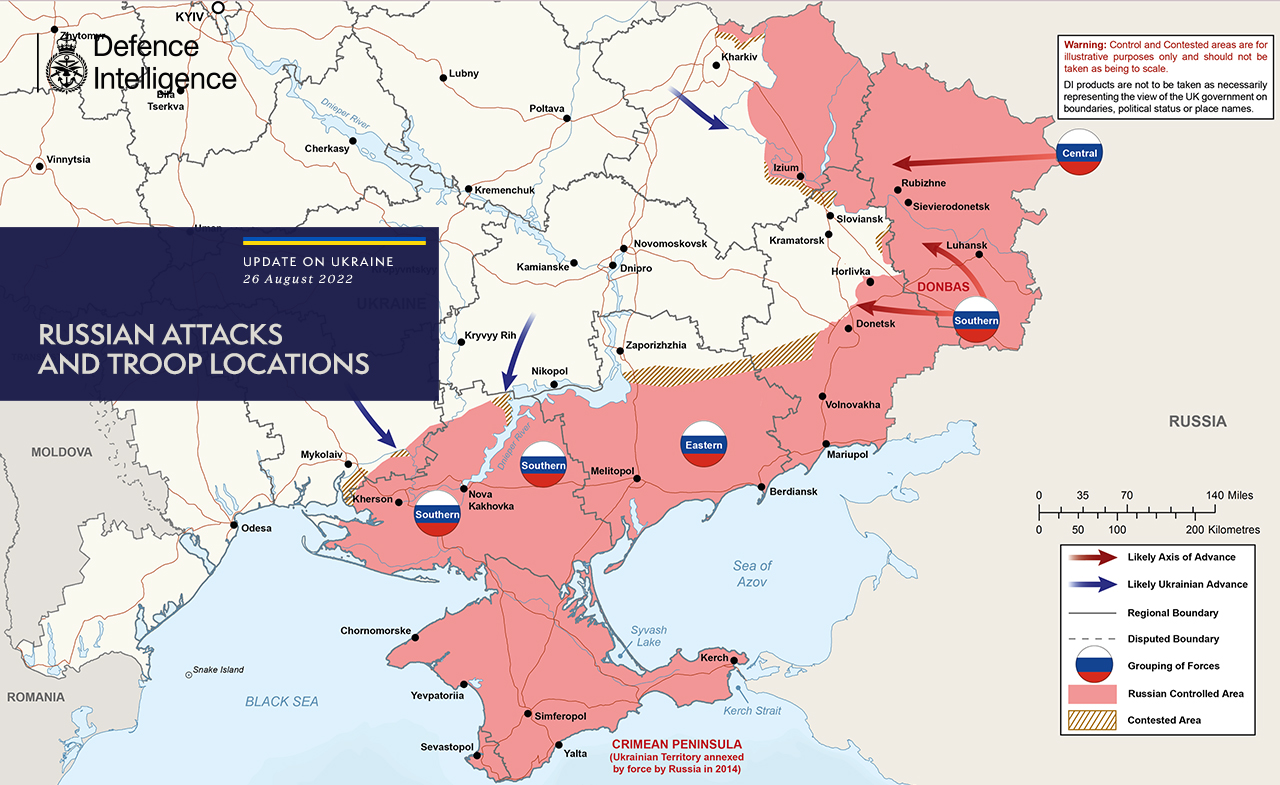
Marinus divides Russian operations, and operational goals, thus tactics, into three discrete geographic parts. Northern Raiding and feints realized through mobile warfare, Southern Occupation through clear and hold, and Central Attrition operations through artillery firepower.
1. Northern operation. Marinus’s central thesis is that the Northern operation was a giant raid, intended to fix Ukrainian commanders’ attention on the threat to Kiev, and prevent them from reinforcing their defenses in the south. In this, mobile warfare, using the battalion tactical group, was the main strategy used. Marinus posits that taking and holding Kiev was never a goal in this operation. Left unsaid in his assessment were two key points that go beyond his narrower operational focus.
First, I’m sure that the Ukrainian Army’s top command was likely not in complete control of defensive strategy or deployment. Zelensky, the Ukrainian Auto Parts King — (“I make politics for the Ukrainian working man, because that’s who I am, and that’s who I care about!”), and his American “advisors” were. Note that we have no idea who Ukrainian General Marshall is, who his Supreme Commander Eisenhower is, or his battlefield Patton is, even if one existed. I mean, we got fawning coverage of President Comedian, looking tough in his cammies on TV, a lot — by which I mean every fucking day, a mythical fighter ace, the “Ghost of Keeeeeev”, but nobody wanted to manufacture a real hero Uke general, steadfastly leading his troops with steely eyed resolve from the front?
C’mon, that’s Propaganda 101. Shit, even Big Red let Marshal Zhukov ride a white horse at the Victory Parade.
I don’t think that is inadvertent. The goons at State and the Clown Intelligence Agency, having engineered one coup, sure as fuck don’t want an actual no shit popular hero, ethnically Ukrainian general to be a viable political alternative to the UAPK they handpicked and installed after this clown folds the Big Top. (Francisco Franco, Kemal Ataturk, or Wladislaw Sikorski say hi from history!). To hear it from the Ministry of Propaganda, Zelensky is commanding the troops himself, and that’s for once likely not far from the truth. It’s Zelensky being “advised” by whatever retards from [Washington DC] who are actually commanding the Ukes, which brings me neatly into my next point — Putin and his generals initiated this feint to Kiev precisely because they correctly predicted that Zelensky and his American masters would expect it and react to it as they did, regardless of anything the Ukrainian generals said.
Why is that, you might ask? Because that is the only strategy that AINO’s Very Clever Boys, Girls and Trannies can conceive of, and the only way they conduct war. Send in the Air Force to blow up everything in an enemy capital, launch a blitzkrieg style invasion aimed at cutting off the enemy army, encircling it, forcing the unmotivated piss poor enemy conscripts to surrender in place or die trying to pull back, and driving on to the capital to pull down the statues of the recently deceased or deposed Dear Leader who was The Next Hitler, declare victory, then institute Regime Change and Operation Endless Occupation. Putin and the rest of his generals are just stupid vodka fueled gopnik Ivans, and couldn’t possibly be headfaking us and outsmarting us. We went to West Point and Harvard, and are automatically the Best and Brightest. Remember when the MoP and the Fistagon were squeeing like little girls at those incompetent Ivans floundering about within artillery range of Keeeev, and the 100 mile long convoy that everyone saw “stuck” on the road to the Sacred Capital, that was so visible and obvious you could see the fucker from space, that just sort of disappeared, along with the great and decisive Battle of Keeeeev that was going to be a bloody defeat for the evil Russians?
You’ll never hear anyone ever admit it, but they just got posterized because their hubris and arrogance was exactly the thing [Putin] used against them.
маскировка (Maskirovka), you stupid fucks, is a Russian MILITARY CONCEPT, and you forgot it. Check yo self before you wreck yo self, as von Clausewitz wrote. Master P didn’t fight your war, he fought a modern Kabinettskreige and that is fought for an entirely different set of objectives, as we will see below.
2.Southern operation. This is the forgotten stepchild of the war so far, but quietly could be the one front with the longest lasting strategic effects. Marinus disposes of this front relatively quickly, noting that it really is operationally the bread and butter of traditional warfare, take ground and hold ground, move on to the next objective. Strategically, this is different from ground taken in the northern front or even parts in the central, however.
The object here is permanent occupation and Russification to deny the rump state of Ukraine any coastline and landlock it. This, unlike territory in the north or even in the Donbass, is not a bargaining chip on the table at the peace talks. Denying this to the Ukrainians after the war prevents them from ever “inviting” any US Navy ships into the Black Sea to base themselves at a Ukrainian port and serve as a potential casus belli, hamstrings Ukraine from seaborne economic activity with Turkey across the Black Sea, thus making sure whatever left of Ukraine is unable to function without massive land route economic as well as military aid, making it a drain, not an asset, to Globohomo and AINO.
[…]
3. Central operation. Marinus here details the real decisive front in the war, calling it “Stalingrad in the East” (Clunky, since Stalingrad was a very different kind of battle, but it has name recognition as a byword for the Eastern Front and the Russian way of war). Honestly, it is far more like a giant Battle of Verdun, but only for one side.
Here is where I’m going to proclaim how happy my artilleryman’s heart is […] because Marinus says that in the Russian way of winning wars, you can’t spell PARTY without ARTY. Not Special Operations Operating Operationally, not drone warfare “fought” by fatass pimply nerds in some air conditioned room half a world out of danger, not bombs away from 30,000 feet, or armored divisions imitating Rommel. Fucking old school howitzers, chucking metric tons of high explosive on infantry, dropping regimental sized TOT and Shake and Bake when they get in the open. I predicted that here in the beginning of the war and a lot of you can look that shit up if you don’t believe me. Guess we ain’t obsolete anymore, assholes.
Everything the Russians are doing in the Donbass and Central front, operationally and tactically, hinges around artillery as the decisive arm, the fulcrum that the other arms orbit around, which is very, very different than the American way of war. Again, as in the north, the Americans “advising” the Ukes had never, literally never in living memory, faced an enemy with air superiority and firepower superiority, much less both combined. They have absolutely no answer for it.


