Logistics is more than just ensuring that the bullets and beans get sent forward to the infantry companies … it encompasses the whole business of manufacturing, stockpiling, shipping, handling and delivering everything the sailors, soldiers and air force members need, on time and to the right place. It is a complex science, and, when bombs are falling and bullets are whizzing about, a bit of an art, too. As I mentioned a couple of days ago, […] the administrative and logistics services are always “soft targets” for cuts when admirals and generals don’t want to cut their own pet components. The admirals and generals who always try to cut too much of the support “tail” before pulling a few teeth are always wrong.
When we consider logistics and training we should consider then both, together, as part of Support ~ with a capital S. Support also includes keeping facilities (barracks and training areas and workshops and supply depots) up to date.
Training is not just teaching selected skills; it involves planning on how many people will be needed, each with specific skill sets, to crew ships, to serve in regiments and battalions, to fly airplanes and to repair and maintain ships and tanks and trucks and aircraft over the long haul. Training also involves ensuring that teams know how to work together … training is how we prepare for war.
The capital S Support base […] must be properly staffed, properly funded (which means funding must be stable, over the years and decades) and properly organized and managed. Supporting our troops and fleets of ships, vehicles and aircraft requires a mix of civil and military people: some in uniform, some civil servants and some on contract from the private sector. There is no perfect model … most modern, Western states, including America, Australia, Britain, Canada, Denmark and so on, use a mix of military, civil service and contractor support service. each trying to get the right mix of operational effectiveness and economy. The key, as I mentioned above, is stability. The support system need to be properly staffed and funded year in and year out, decade after decade. Those elements ~ dockyards and depots and workshops and schools and agencies comprise the firm base upon which the nation’s war-fighting (combat) powers depend.
Ted Campbell, “My Plan (3)”, Ted Campbell’s Point of View, 2018-09-15.
April 19, 2021
QotD: Logistics and training
April 18, 2021
America Strikes Back – Tokyo in Flames – WW2 -138 – April 18 1942
World War Two
Published 17 Apr 2021The Doolittle Raid is just a little bombing raid over Tokyo that doesn’t do that much physical damage. It does, however, have big repercussions — partly in terms of future offensive plans for the Japanese fleet, and partly in terms of the thousands of Chinese lives taken in reprisals for allowing the US bombers to land in China. There is small scattered action on the Eastern Front, more Japanese advances in Burma, and a French VIP escapes captivity in Germany and heads for Switzerland and freedom.
Join us on Patreon: https://www.patreon.com/TimeGhostHistory
Or join The TimeGhost Army directly at: https://timeghost.tvFollow WW2 day by day on Instagram @ww2_day_by_day – https://www.instagram.com/ww2_day_by_day
Between 2 Wars: https://www.youtube.com/playlist?list…
Source list: http://bit.ly/WW2sourcesWritten and Hosted by: Indy Neidell
Director: Astrid Deinhard
Producers: Astrid Deinhard and Spartacus Olsson
Executive Producers: Astrid Deinhard, Indy Neidell, Spartacus Olsson, Bodo Rittenauer
Creative Producer: Maria Kyhle
Post-Production Director: Wieke Kapteijns
Research by: Indy Neidell
Edited by: Iryna Dulka
Sound design: Marek Kamiński
Map animations: Eastory (https://www.youtube.com/c/eastory)Colorizations by:
– Mikołaj Uchman
– Norman Stewart – https://oldtimesincolor.blogspot.com/Sources:
– Stan S. Katz
– IWM: IND 3595
– Image of ‘The Fortress of Königstein from the North-West’ by Bernardo Bellotto, © National Gallery of Art, WashingtonSoundtracks from the Epidemic Sound:
– Rannar Sillard – “Easy Target”
– Howard Harper-Barnes – “London”
– Jo Wandrini – “Dragon King”
– Dream Cave – “The Beast”
– Reynard Seidel – “Rush of Blood”
– Wendel Scherer – “Out the Window”
– Brightarm Orchestra – “On the Edge of Change”
– Gunnar Johnsen – “Not Safe Yet”
– Johan Hynynen – “Dark Beginning”
– Philip Ayers – “Trapped in a Maze”Archive by Screenocean/Reuters https://www.screenocean.com.
A TimeGhost chronological documentary produced by OnLion Entertainment GmbH.

April 16, 2021
The Bataan Death March Begins – WAH 032 – April 1942, Pt. 1
World War Two
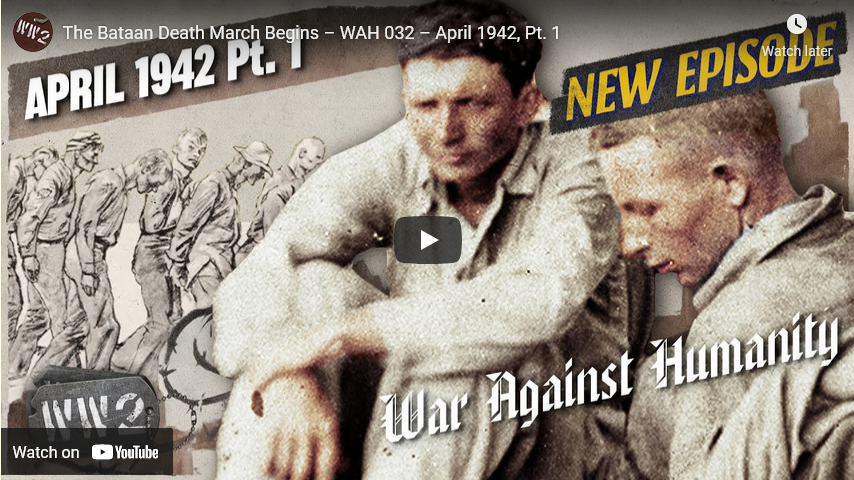
Published 15 Apr 2021Malta and British cities are victim to German bombs, while the Japanese advance in Burma causes a refugee crisis. In the Philippines, 80,000 Allied POWs walk the Bataan Death March.
Join us on Patreon: https://www.patreon.com/TimeGhostHistory
Or join The TimeGhost Army directly at: https://timeghost.tvFollow WW2 day by day on Instagram @ww2_day_by_day – https://www.instagram.com/ww2_day_by_day
Between 2 Wars: https://www.youtube.com/playlist?list…
Source list: http://bit.ly/WW2sourcesHosted by: Spartacus Olsson
Written by: Spartacus Olsson and Joram Appel
Director: Astrid Deinhard
Producers: Astrid Deinhard and Spartacus Olsson
Executive Producers: Astrid Deinhard, Indy Neidell, Spartacus Olsson, Bodo Rittenauer
Creative Producer: Maria Kyhle
Post-Production Director: Wieke Kapteijns
Research by: Joram Appel
Edited by: Miki Cackowski
Sound design: Marek Kamiński
Map animations: Miki Cackowski and Eastory (https://www.youtube.com/c/eastory)Colorizations by:
Mikołaj Uchman
Election1960 https://commons.wikimedia.org/wiki/Fi…Sources:
IWM C 4743, CL 2377
Bundesarchiv
From the Noun Project: Watchtower by EliriconSoundtracks from the Epidemic Sound:
Johan Hynynen – “Dark Beginning”
Fabien Tell – “Weapon of Choice”
Wendel Scherer – “Defeated”
Philip Ayers – “Trapped in a Maze”
Cobby Costa – “From the Past”
Cobby Costa – “Flight Path”
Wendel Scherer – “Growing Doubt”
Jon Bjork – “For the Many”Archive by Screenocean/Reuters https://www.screenocean.com.
A TimeGhost chronological documentary produced by OnLion Entertainment GmbH.
From the comments:
World War Two
3 days ago (edited)
Under our previous episode I told you about how YouTube has been age restricting these videos, effectively censoring them and turning the format into an echo chamber that doesn’t reach beyond the viewers who already know about it. As I explained we feel that it’s a great disservice to education and remembrance, and it has affected me deeply personally making me question why we do this. Two things happened:1. You collectively gave us the most amazing reception and reminded us of how important the work we do is. I can’t thank you enough for the amazing comments, many of them where kind, supportive, and motivating far beyond what I feel we deserve. You lifted my spirits and brought me out of the slump I was in, cementing, and confirming that what we do matters. In the name of the entire team: thank you so much, it is an immense honor to have you all with us.
2. YouTube did not age restrict the video, and even cleared it for monetization, leading to that it once again reached a viewership like before the string of age restrictions we were struck with. We haven’t heard any explanation from YouTube and we won’t. Furthermore, I am painfully aware that these decisions depend completely on the whims of the individuals at Google who review the videos. We also know that these individuals are different for every video, so I fear that that this state of affairs will not remain. Already, this video was judged as “not suitable for all advertisers” and will therefore be recommended to viewers less often in YouTube’s system. Hence, although it pains us, and is against the principles we stand for, we have also prepared a version of this video with all images documenting the atrocities we expose blurred out – we can only hope that we don’t need it.
I’d like to end with an anecdote out of my motivation to create this series. Many, many moons ago, when I was in senior high at boarding school in Sweden, Elie Wiesel – author, chronicler of the Holocaust, and survivor of Auschwitz and Buchenwald came to our school. It was in 1986, the same year that he received the Nobel Peace Prize for his work, and if I remember correctly he had connected a lecture tour to his reception of the award.
In any case — I had the privilege of speaking to Mr. Wiesel in a small group. He explained something that has stayed with me ever since. To him, his experiences were not defeating, the entire Holocaust was not a defeat, not only had humanity been victorious in the end, but he and others had survived to tell the tale — which to him was a special kind of victory that came with the responsibility of sharing and educating.
Mr. Wiesel, a kind, warm hearted man, full of humor and life despite the horrors he had lived, passed five years ago. It is for him, for the other survivors of every ethnicity faced by any kind or terror, and for those who didn’t make it through that we do this — to celebrate their life and continue turning their suffering from defeat into victory by remembering even after they are gone.
Yours,
Spartacus
April 10, 2021
Britain’s Only Repeating Enfield Trainer: the No7 Mk I
Forgotten Weapons
Published 12 Jun 2018http://www.forgottenweapons.com/brita…
http://www.patreon.com/ForgottenWeapons
Cool Forgotten Weapons merch! http://shop.bbtv.com/collections/forg…
Developed by BSA immediately after World War Two, the No7 MkI training rifle was the only one of the British Enfield trainers to use a magazine. Only 2500 of these rifles were produced, contracted by the Royal Air Force and delivered in 1948. Their magazine is a commercial BSA 5-round magazine modified slightly to latch into a housing inside a regular No4 Enfield magazine body. This makes them a particularly enjoyable rifle for range shooting, as well as one of the scarcest of the standard British trainers.Note that Canada also developed and adopted a No7 MkI .22 rimfire trainer, but that type is a single shot design, and does not share any parts with the British No7 MkI.
If you enjoy Forgotten Weapons, check out its sister channel, InRangeTV! http://www.youtube.com/InRangeTVShow
Contact:
Forgotten Weapons
6281 N Oracle #36270
Tucson, AZ 85704

April 4, 2021
The Carpet Bombing of Germany begins – WW2 – 136 – April 3, 1942
World War Two
Published 3 Apr 2021Britain’s campaign to firebomb the old towns of Germany where civilians reside begins in earnest this week. The British also destroy the port at St. Nazaire in commando action. In the Indian Ocean, however, they are avoiding contact with the Japanese, even while on land the Japanese advance in both Burma and New Guinea.
Check out Indy’s Tie Barn to get your own tie right here: https://www.youtube.com/c/IndysTieBar…
Join us on Patreon: https://www.patreon.com/TimeGhostHistory
Or join The TimeGhost Army directly at: https://timeghost.tvFollow WW2 day by day on Instagram @ww2_day_by_day – https://www.instagram.com/ww2_day_by_day
Between 2 Wars: https://www.youtube.com/playlist?list…
Source list: http://bit.ly/WW2sourcesWritten and Hosted by: Indy Neidell
Director: Astrid Deinhard
Producers: Astrid Deinhard and Spartacus Olsson
Executive Producers: Astrid Deinhard, Indy Neidell, Spartacus Olsson, Bodo Rittenauer
Creative Producer: Maria Kyhle
Post-Production Director: Wieke Kapteijns
Research by: Indy Neidell
Edited by: Iryna Dulka
Sound design: Marek Kamiński
Map animations: Eastory (https://www.youtube.com/c/eastory)Colorizations by:
– Daniel Weiss
– Carlos Ortega Pereira, BlauColorizations – https://www.instagram.com/blaucolorizations
– Election1960 from Wiki CommonsSources:
– Bundesarchiv – 101II-MW-3722-03
– IWM C 2351, A 11787, H_018753_1, R 1827Soundtracks from the Epidemic Sound:
– Rannar Sillard – “Easy Target”
– Edward Karl Hanson – “Spellbound”
– Phoenix Tail – “At the Front”
– Jo Wandrini – “Dragon King”
– Phoenix Tail – “Last Minute Reaction”
– Craft Case – “Secret Cargo”
– Fabien Tell – “Last Point of Safe Return”
– Howard Harper-Barnes – “Underlying Truth”
– Flouw – “A Far Cry”
– Fabien Tell – “Break Free”
– Wendel Scherer – “Time to Face Them”Archive by Screenocean/Reuters https://www.screenocean.com.
A TimeGhost chronological documentary produced by OnLion Entertainment GmbH.

March 26, 2021
Fifty Families Murdered Every Hour – WW2 – WAH 031 – March 1942, pt. 2
World War Two
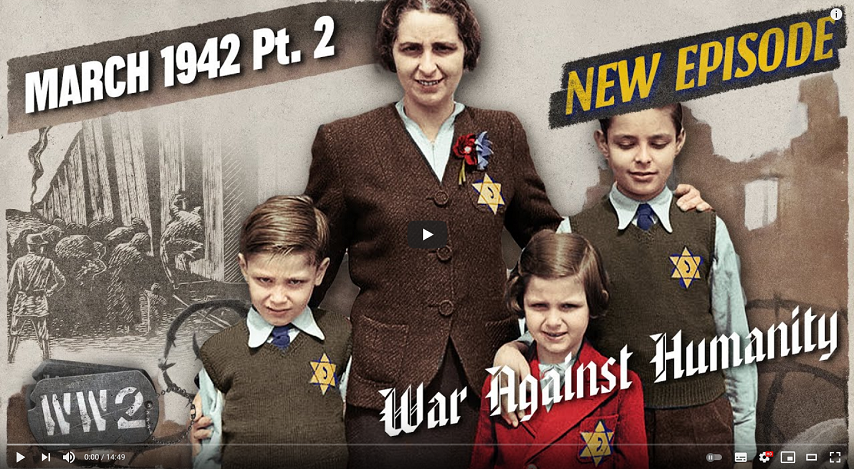
Published 25 Mar 2021A report on the effect of strategic bombing called the “Dehousing Paper” is spread to justify the targeting of the civilian population of Germany. In Poland, one by one, extermination camps are starting construction. This month, a new one is finished, named Belzec. Here, Jews and other minority undesirables from Poland are gassed.
Join us on Patreon: https://www.patreon.com/TimeGhostHistory
Or join The TimeGhost Army directly at: https://timeghost.tvFollow WW2 day by day on Instagram @ww2_day_by_day – https://www.instagram.com/ww2_day_by_day
Between 2 Wars: https://www.youtube.com/playlist?list…
Source list: http://bit.ly/WW2sourcesHosted by: Spartacus Olsson
Written by: Spartacus Olsson and Joram Appel
Director: Astrid Deinhard
Producers: Astrid Deinhard and Spartacus Olsson
Executive Producers: Astrid Deinhard, Indy Neidell, Spartacus Olsson, Bodo Rittenauer
Creative Producer: Maria Kyhle
Post-Production Director: Wieke Kapteijns
Research by: Joram Appel
Edited by: Miki Cackowski
Sound design: Marek Kamiński
Map animations: Miki Cackowski, Eastory (https://www.youtube.com/c/eastory)Colorizations by:
Mikołaj Uchman
Daniel Weiss
Dememorabilia – https://www.instagram.com/dememorabilia/
Julius Jääskeläinen – https://www.facebook.com/JJcolorization/Sources:
Yad Vashem 1935/15, 3016/2, 1137/217, 10094/1, A4613/1116, 3518/7,1554/1
IWM ART 15747 12, HU 56848, MH 24747, CL 2377, ME(RAF) 3703, HU 107752, C 2364, C 4748, C 4743, HU 74904
Bundesarchiv
Graphic of Vickers Wellington bomber, courtesy of Emoscopes https://commons.wikimedia.org/wiki/Fi…
Graphic of Short Stirling bomber, courtesy of Emoscopes https://commons.wikimedia.org/wiki/Fi…
www.auschwitz.org
www.deathcamps.org
USHMM
Picture of scratches on a wall of a gas chamber at Auschwitz, courtesy of Lasy https://commons.wikimedia.org/wiki/Fi…
from the Noun Project: Watchtower by EliriconSoundtracks from the Epidemic Sound:
Johan Hynynen – “Dark Beginning”
Wendel Scherer – “Growing Doubt”
Peter Sandberg – “Document This 1”
Jon Bjork – “Disposal”
Philip Ayers – “Trapped in a Maze”
Fabien Tell – “Never Forget”Archive by Screenocean/Reuters https://www.screenocean.com.
A TimeGhost chronological documentary produced by OnLion Entertainment GmbH.
From the comments:
World War Two
2 days agoOn the horrors of crafting this, on age restriction, and on covering Allied war crimes – by Spartacus
All episodes of War Against Humanity are difficult to make, but this was an especially harrowing episode to host. When I wrote the conclusion based on Joram’s initial draft, I was composed — it was an intellectual exercise still. That changed once I started giving the words a voice, and as you can see at the end of the episode I had difficulties keeping my composure — when I was done I cried bitterly. But that is how it is supposed to be — the totality of our creation is what brings it home, together with Joram I compile the knowledge, Miki or Karo put it into images under Wieke’s direction, and within all of that it is my job to express it in spoken language as best as I can.
Yes, it is difficult to make and it is difficult to watch — but we sincerely believe that none of us should look away lest we forget. We take upon ourselves to spend hours every week to sift through the minutiae of these events so that we can compress it into 15 minutes every two weeks. We do it not for money, not for fame, and not out of pleasure, but because it needs to be done so that others can spend less time on it than us and still see this time for what it was. It needs to be done by neither glossing over any events, nor the images as horrible as they are. This has two important purposes:
1. driving home that this really happened and
2. defeating any claims towards that we’re just making this up, or exaggerating.
Within that responsibility it is also our duty to report, without prejudice, on what the Allies did that was against human values and rights in this war. We don’t do that because there is an equivalence between events, or to create such an equivalence — we do it for the exact opposite purpose — to show the complete picture and preempt any calls for “what about the bombing of Germany and Hiroshima!?” We do it because we are dedicated to the facts, and the events must be permitted to speak for themselves.We’re doing all of this in a time when the horrors of WW2 are ever further away in the rearview mirror, when survey after survey shows that the younger generation have little or no knowledge of how earth-shattering this war was. An indication of a growing educational gap, and in many of the countries where you are watching it has long been decided that reporting on these atrocities is of especial importance. That includes decisions to also expose younger people to the reality of it despite the graphic nature of the content. In most places these images are purposefully excepted from age restrictions that befall content made for entertainment, that is to say they do not fall under an 18+ restriction. They are regulated as PG 16 or the equivalent, in some places even PG13.
It then troubles us deeply that YouTube chooses to go against the decisions made by democratically elected bodies and restrict this content to over 18 only. It troubles us even more when this leads to the inevitable result that our viewership has dropped by 50% since they started doing that. That is a drop far above the share of our viewers that are under age, because with the restriction comes a reduction in recommendation to view — users that are not logged in and age verified don’t get notified — the content can no longer be embedded on external sites — in some countries it is blocked entirely, regardless of your age — and all of that further decreases the value of the video in YouTube’s algorithms. The result is that the War Against Humanity videos are now an echo chamber where we only reach those that already know the content.
We have spoken to YouTube to remedy this fault, but we have had no success thus far. As a result we have decided to start making a censored version of the videos that we will upload if or when they get age restricted. We already upload all of our content to https://odysee.com/@WorldWarTwo:6 but that is not a place where anyone will find our content by chance. On that note we should point out that the videos only get age-restricted because they are reported to YouTube by the community as inappropriate, offensive, or false. We take umbrage at that, because in effect this means that YouTube is helping those who would like these events to be forgotten, or even deny that they ever happened. It’s a pity; even morally wrong in my viewpoint. It leaves me despondent and the last weeks have been extraordinarily difficult for me — I have questioned my purposes and wondered why I put myself and our team through all of this, if all we’re doing is preaching to the choir. At first it left me sad, but after YouTube’s glib, bureaucratic responses I got depressed. I considered throwing in the towel, but then I would be nothing else than a coward refusing to stand for those who no longer have a voice. So, I will continue, I will resist, and we will fight against anyone that tries to silence us and the dead — because we must not look away, we must never forget.
Spartacus
It is only because of the TimeGhost Army that we can go forward in this battle — join us at https://www.patreon.com/TimeGhostHistory or at Timeghost.tv
March 7, 2021
The Japanese Raid Australia and the British Raid France – WW2 – 132 – March 6, 1942
World War Two
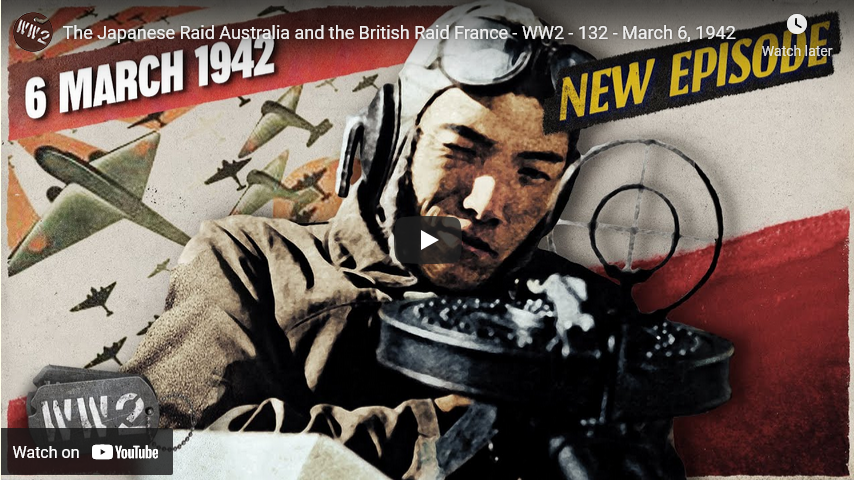
Published 6 Mar 2021The Japanese advance in Burma continues, threatening Rangoon, and also make landings on Java and New Guinea. They even go so far as an air raid on Broome, Australia. The British are making raids of their own this week, Operation Biting against Bruneval in German-occupied France. As for the Germans themselves, 100,000 of them are still surrounded by the Red Army at Demyansk, and Hitler is told that the Soviets might have enough reserves to defend against a renewed summer offensive.
Join us on Patreon: https://www.patreon.com/TimeGhostHistory
Or join The TimeGhost Army directly at: https://timeghost.tvFollow WW2 day by day on Instagram @ww2_day_by_day – https://www.instagram.com/ww2_day_by_day
Between 2 Wars: https://www.youtube.com/playlist?list…
Source list: http://bit.ly/WW2sourcesWritten and Hosted by: Indy Neidell
Director: Astrid Deinhard
Producers: Astrid Deinhard and Spartacus Olsson
Executive Producers: Astrid Deinhard, Indy Neidell, Spartacus Olsson, Bodo Rittenauer
Creative Producer: Maria Kyhle
Post-Production Director: Wieke Kapteijns
Research by: Indy Neidell
Edited by: Iryna Dulka
Sound design: Marek Kamiński
Map animations: Eastory (https://www.youtube.com/c/eastory)Colorizations by:
– Mikołaj Uchman
– Olga Shirnina, a.k.a. Klimbim – https://klimbim2014.wordpress.com/
– Cassowary Colorizations – https://www.cassowarycolor.com/
– Norman Stewart – https://oldtimesincolor.blogspot.com/Sources:
– IWM: O1962, CH 16518, IWM A 9580, IWM A 9584
– Arrow by 4B Icons from the Noun ProjectSoundtracks from the Epidemic Sound:
– Rannar Sillard – “Easy Target”
– Jo Wandrini – “Dragon King”
– Howard Harper-Barnes – “Underlying Truth”
– Fabien Tell – “Last Point of Safe Return”
– Phoenix Tail – “At the Front”
– Howard Harper-Barnes – “London”
– Flouw – “A Far Cry”
– Johan Hynynen – “Dark Beginning”
– Wendel Scherer – “Out the Window”Archive by Screenocean/Reuters https://www.screenocean.com.
A TimeGhost chronological documentary produced by OnLion Entertainment GmbH.
From the comments:
World War Two
3 days ago (edited)
CORRECTION: In this episode, Indy says that Franz Halder estimates German losses in the USSR to be up 1.5 million by March 1st. In actuality, Halder estimated them to be 1 million. A simple brain freeze when Indy was writing the script meant that he read out the incorrect statistics on the teleprompter. The vast majority of the time, our fact-checkers ensure this doesn’t happen — unfortunately, this one slipped through the cracks.MAIN COMMENT: The Japanese are still advancing seemingly everywhere, even raiding Australia. In Europe, the German death camp system sees new facilities open this month and kicks into a higher gear.
February 17, 2021
Communist Amazons – Women of the Red Army – WW2 Special
World War Two
Published 16 Feb 2021Hundreds of thousands of Soviet Women were deployed in the Red Army and Red Navy during World War Two. They served in a multitude of functions, from traditional roles like nurses to roles previously associated with men. They were pilots, snipers, tank-crews, and fought on the very front of the lines.
Join us on Patreon: https://www.patreon.com/TimeGhostHistory
Or join The TimeGhost Army directly at: https://timeghost.tvFollow WW2 day by day on Instagram @ww2_day_by_day – https://www.instagram.com/ww2_day_by_day
Between 2 Wars: https://www.youtube.com/playlist?list…
Source list: http://bit.ly/WW2sourcesHosted by: Indy Neidell
Written by: Joram Appel
Director: Astrid Deinhard
Producers: Astrid Deinhard and Spartacus Olsson
Executive Producers: Astrid Deinhard, Indy Neidell, Spartacus Olsson, Bodo Rittenauer
Creative Producer: Maria Kyhle
Post-Production Director: Wieke Kapteijns
Research by: Joram Appel
Edited by: Karolina Dołęga
Sound design: Marek KamińskiColorizations by:
– Klimbim
– Daniel WeissSources:
– National Archives NARA
– Woman and Man in 1930s Soviet Propaganda Poster courtesy of Adam Jones from Flickr
– Yad Vashem: 953
– Library of Congress
– RIA Novosti archive
– BundesarchivSoundtracks from Epidemic Sound:
– “The Inspector 4” – Johannes Bornlöf
– “London” – Howard Harper-Barnes
– “Dark Beginning” – Johan Hynynen
– “Other Sides of Glory” – Fabien Tell
– “Break Free” – Fabien Tell
– “Deviation In Time” – Johannes Bornlof
– “Ominous” – Philip Ayers
– “Moving to Disturbia” – ExperiaArchive by Screenocean/Reuters https://www.screenocean.com.
A TimeGhost chronological documentary produced by OnLion Entertainment GmbH.
From the comments:
World War Two
5 hours ago (edited)
Because of the pandemic, we have not been able to publish episodes of On the Homefront for a while. But don’t worry, we’re working on a new episode, which should arrive in your subscription box this spring. Now, we have made an On the Homefront episode which offers some great context to this episode on Women in the Soviet Armies. It is about (the myth of) Soviet Gender Equality, and you can watch it right here: https://youtu.be/zLcHbUrnl6Q

February 12, 2021
Britain Chooses War Crimes – RAF Strategic Bombing – WAH 028 – February 1942, Pt. 1
World War Two
Published 11 Feb 2021As the winter of 1942 continues, many Soviet civilians suffer under the German Siege of Leningrad. Meanwhile, the British are shifting their bombing strategy from targeting factories to targeting homes.
Join us on Patreon: https://www.patreon.com/TimeGhostHistory
Or join The TimeGhost Army directly at: https://timeghost.tvFollow WW2 day by day on Instagram @ww2_day_by_day – https://www.instagram.com/ww2_day_by_day
Between 2 Wars: https://www.youtube.com/playlist?list…
Source list: http://bit.ly/WW2sourcesHosted by: Spartacus Olsson
Written by: Joram Appel and Spartacus Olsson
Director: Astrid Deinhard
Producers: Astrid Deinhard and Spartacus Olsson
Executive Producers: Astrid Deinhard, Indy Neidell, Spartacus Olsson, Bodo Rittenauer
Creative Producer: Maria Kyhle
Post-Production Director: Wieke Kapteijns
Research by: Joram Appel
Edited by: Miki Cackowski
Sound design: Marek Kamiński
Map animations: Eastory (https://www.youtube.com/c/eastory)Colorizations by:
Norman Stewart – https://oldtimesincolor.blogspot.com/
Daniel WeissSources:
USHMM
Bundesarchiv
Yad Vashem 2695/7, 5761/12
IWM MH 24747
RIA Novosti archive, image #762, #244
from the Noun Project:
Skull by Muhamad UlumSoundtracks from the Epidemic Sound:
Reynard Seidel – “Deflection”
Fabien Tell – “Last Point of Safe Return”
Farrell Wooten – “Blunt Object”
Jo Wandrini – “Dawn Of Civilization”
Wendel Scherer – “Defeated”
Jon Bjork – “Icicles”
Gunnar Johnsen – “Not Safe Yet”
Peter Sandberg – “Document This 1”Archive by Screenocean/Reuters https://www.screenocean.com.
A TimeGhost chronological documentary produced by OnLion Entertainment GmbH.
From the comments:
World War Two
4 hours ago
We are covering the RAF’s bombing campaigns in the War Against Humanity series because it concerns warfare against the civilian population. On previous occasions, we have been accused of relativizing Nazi’s war-crimes by covering Allied atrocities in the same space, but we argue that for a fact-based reporting on how WW2 impacted the civilian population we need to be complete and unbiased.The facts speak for themselves, and we document those facts that by providing an exhaustive record with equal coverage of all events and parties. Covering one event doesn’t relativize or justify the other and vice versa. We will not tolerate any whataboutism in the comments.
We will also not tolerate a justification of these crimes based on pragmatism, or equal proportionality — on an absolute moral level the goal never justifies the means. In this case we look at our comment section from a 21st century perspective and hold ourselves and anyone using our forums to the modern standards laid down in the laws of war. Explaining, analyzing and discussing war crimes and crimes against humanity is fine, even desired — celebrating, hailing, or justifying them is not.
February 6, 2021
From an improbable 1930s “death ray” to the radar network that helped defeat the Blitz
In a story from a few years back, Tim Harford outlines how a British Air Ministry prize for developing a “death ray” to use against enemy aircraft eventually helped kick off the discovery of radar:

The Chain Home radar tower in Great Baddow Chelmsford.
Photo by Stuart166axe via Wikimedia Commons.
… sometimes inventions need other inventions to unlock their full potential.
For the aviation industry, that story starts with the invention of the death ray, or at least an attempt to design a death ray, back in 1935.
Officials in the British Air Ministry were worried about falling behind Nazi Germany in the technological arms race.
The death ray idea intrigued them: they had been offering a £1,000 prize for anyone who could zap a sheep at a hundred paces. So far, nobody had claimed it.
But should they fund more active research? Was a death ray even possible?
Unofficially, they sounded out Robert Watson Watt, of the Radio Research Station.
And he posed an abstract maths question to his colleague Skip Wilkins.
“Suppose, just suppose,” said Watson Watt to Wilkins, “that you had eight pints of water, 1km [3,000ft] above the ground.
“And suppose that water was at 98F [37C], and you wanted to heat it to 105F.
“How much radio frequency power would you require, from a distance of 5km?”
Skip Wilkins was no fool.
He knew that eight pints was the amount of blood in an adult human, 98F was normal body temperature and 105F was warm enough to kill you, or at least make you pass out, which — if you’re behind the controls of an aeroplane — amounts to much the same thing.
So Wilkins and Watson Watt understood each other, and they quickly agreed the death ray was hopeless: it would take too much power.
But they also saw an opportunity.
Clearly, the ministry had some cash to spend on research. Perhaps Watson Watt and Wilkins could propose some alternative way for them to spend it?
Wilkins pondered. It might be possible, he suggested, to transmit radio waves and detect — from the echoes — the location of oncoming aircraft long before they could be seen.
Watson Watt dashed off a memo to the Air Ministry’s newly formed Committee for the Scientific Survey of Air Defence. Would they be interested in pursuing such an idea? They would indeed.
What Skip Wilkins was describing became known as radar.
December 18, 2020
“Firestorm” – Strategic or Terror Bombing? – Sabaton History 098 [Official]
Sabaton History
Published 17 Dec 2020At the end of July 1943, Hamburg burned. A fleet of British heavy bombers had dropped thousands of incendiaries over the city, turning it into a hearth of unprecedented dimensions. Numerous major fires merged together into a single storm of fire. Structures combusted under the immense heat, as strong winds drove the inferno through the streets at rapid speed. Craving for more oxygen, the firestorm sucked human bodies into the flames and immediately incinerated or mummified them. Thousands of others died slowly of carbon monoxide poisoning in their shelters. By the end of the raid, 60% of Hamburg had been burned out and more than 35,000 of its inhabitants were dead. But while the Germans were shocked to disbelief, for the British the firestorm has worked as intended. And this was just the beginning.
Support Sabaton History on Patreon:
https://www.patreon.com/sabatonhistoryListen to “Firestorm” on the album The Art of War: https://music.sabaton.net/TheArtOfWar
Listen to Sabaton on Spotify: http://smarturl.it/SabatonSpotify
Official Sabaton Merchandise Shop: http://bit.ly/SabatonOfficialShopHosted by: Indy Neidell
Written by: Markus Linke and Indy Neidell
Directed by: Astrid Deinhard and Wieke Kapteijns
Produced by: Pär Sundström, Astrid Deinhard and Spartacus Olsson
Creative Producer: Maria Kyhle
Executive Producers: Pär Sundström, Joakim Brodén, Tomas Sunmo, Indy Neidell, Astrid Deinhard, and Spartacus Olsson
Community Manager: Maria Kyhle
Post-Production Director: Wieke Kapteijns
Editor: Karolina Dołęga
Sound Editor: Marek Kamiński
Maps by: Eastory – https://www.youtube.com/c/eastory
Archive: Reuters/Screenocean – https://www.screenocean.comColorized by:
Norman Stewart – https://oldtimesincolor.blogspot.com/Sources:
Imperial War Museums: C3677,HU 63075, HU 63089, MH 27517, CL3400, MH 24747,CL3395, MH 24764, CH 6386, CH 6386, CH 6275, CH 15879, C 3371, CH 18371, C 3918, C2367, HU44269, C 4748, PST 14359, C 4973,
Bundesarchiv
National Archives NARA
Icons from the Noun Project: Arrow by 4B Icons, Bomb by P Thanga Vignesh, fire building by dDara, Skull by Muhamad UlumAll music by: Sabaton
An OnLion Entertainment GmbH and Raging Beaver Publishing AB co-Production.
© Raging Beaver Publishing AB, 2019 – all rights reserved.
December 4, 2020
“The Red Baron Pt. 2” – Kings of the Sky – Sabaton History 096 [Official]
Sabaton History
Published 3 Dec 2020They were the Aces in the sky — proud knights who flew their planes into deadly combat. Loved by the public, feared by their enemies, the victorious pilots of the Great War rose to prominence as gallant heroes. But the personal stories of those celebrated pilots were also memories full of excruciating pain, of terrible loss, and inner struggle. Body and mind of those aces were broken by the constant danger of fighting in the air. Those who survived bore more than a few scars.
Support Sabaton History on Patreon: https://www.patreon.com/sabatonhistory
Listen to “The Red Baron” on the album The Great War: https://music.sabaton.net/TheGreatWar
Watch the Official Lyrics Video of “The Red Baron” here: https://www.youtube.com/watch?v=3PXzg…
Listen to Sabaton on Spotify: http://smarturl.it/SabatonSpotify
Official Sabaton Merchandise Shop: http://bit.ly/SabatonOfficialShopHosted by: Indy Neidell
Written by: Markus Linke and Indy Neidell
Directed by: Astrid Deinhard and Wieke Kapteijns
Produced by: Pär Sundström, Astrid Deinhard and Spartacus Olsson
Creative Producer: Maria Kyhle
Executive Producers: Pär Sundström, Joakim Brodén, Tomas Sunmo, Indy Neidell, Astrid Deinhard, and Spartacus Olsson
Community Manager: Maria Kyhle
Post-Production Director: Wieke Kapteijns
Editor: Karolina Dołęga
Sound Editor: Marek Kamiński
Maps by: Eastory – https://www.youtube.com/c/eastory
Archive: Reuters/Screenocean – https://www.screenocean.comSources:
– National Archives NARA
– Imperial War Museums: EB1911, Q33851, Q33725, Q33875, Q23897, Q 105765, ART 1611, Q 63852, Q 63850, Q 93660, Q 55479, Q 60799, Q 10331, Q 67114, Q 66540,
– Library of Congress
– The Board of Trustees of the Science Museum
– Wellcome Images
– Icons form The Nano Project: iron cross By Souvik Maity, IN ld Plane by LUTFI GANI AL ACHMAD,
– planes of World War 1 courtesy of 11Amanda on Wikimedia CommonsAll music by: Sabaton
An OnLion Entertainment GmbH and Raging Beaver Publishing AB co-Production.
© Raging Beaver Publishing AB, 2019 – all rights reserved.
November 11, 2020
In memoriam
A simple recognition of some of our family members who served in the First and Second World Wars:
The Great War
 Private William Penman, Scots Guards, died 16 May, 1915 at Le Touret, age 25
(Elizabeth’s great uncle)- Private Archibald Turner Mulholland, Argyll & Sutherland Highlanders, mortally wounded 25 September, 1915 at Loos, age 27
(Elizabeth’s great uncle) - Private David Buller, Highland Light Infantry, died 21 October, 1915 at Loos, age 35
(Elizabeth’s great grandfather) - Private Harold Edgar Brand, East Yorkshire Regiment. died 4 June, 1917 at Tournai.
(My first cousin, three times removed) - Private Walter Porteous, Durham Light Infantry, died 4 October, 1917 at Passchendaele, age 18
(my great uncle) - Corporal John Mulholland, Argyll & Sutherland Highlanders, wounded 2 September, 1914 (shortly before the First Battle of the Aisne), wounded again 29 June, 1918, lived through the war.
(Elizabeth’s great uncle)
The Second World War
- Flying Officer Richard Porteous, RAF, survived the defeat in Malaya and lived through the war
(my great uncle) - Able Seaman John Penman, RN, served in the Defensively Equipped Merchant fleet on the Murmansk Run (and other convoy routes), lived through the war
(Elizabeth’s father) - Private Archie Black (commissioned after the war and retired as a Major), Gordon Highlanders, captured at Singapore (aged 15) and survived a Japanese POW camp
(Elizabeth’s uncle) - Elizabeth Buller, “Lumberjill” in the Women’s Land Army in Scotland through the war.
(Elizabeth’s mother) - Trooper Leslie Taplan Russon, 3rd Royal Tank Regiment, died at Tobruk, 19 December, 1942 (aged 23).
Leslie was my father’s first cousin, once removed (and therefore my first cousin, twice removed).
For the curious, the Commonwealth War Graves Commission the Royal British Legion, and the Library and Archives Canada WW1 and WW2 records site provide search engines you can use to look up your family name. The RBL’s Every One Remembered site shows you everyone who died in the Great War in British or Empire service (Canadians, Australians, New Zealanders, South Africans and other Imperial countries). The CWGC site also includes those who died in the Second World War. Library and Archives Canada allows searches of the Canadian Expeditionary Force and the Royal Newfoundland Regiment for all who served during WW1, and including those who volunteered for the CEF but were not accepted.
In Flanders fields the poppies blow
Between the crosses row on row,
That mark our place; and in the sky
The larks, still bravely singing, fly
Scarce heard amid the guns below.We are the Dead. Short days ago
We lived, felt dawn, saw sunset glow,
Loved and were loved, and now we lie
In Flanders fields.Take up our quarrel with the foe:
To you from failing hands we throw
The torch; be yours to hold it high.
If ye break faith with us who die
We shall not sleep, though poppies grow
In Flanders fields.Lieutenant Colonel John McCrae, MD Canadian Army Medical Corps (1872-1918)
October 23, 2020
QotD: Every military organization
Robert A. Heinlein, Glory Road, 1963.
October 6, 2020
⚜ | The Great Tank Destruction Myth ft. The Chieftain
Military Aviation History
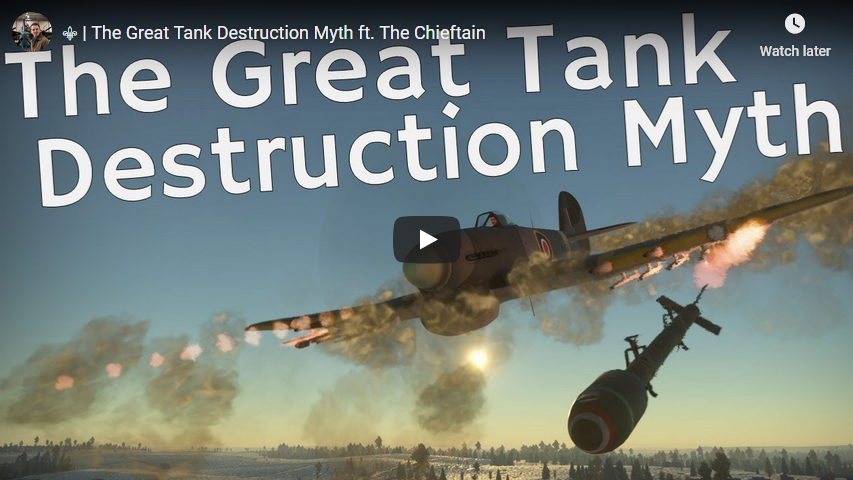
Published 24 May 2018Planes kill tanks in the thousands, Sir! Why, do they really? Lets find out.
You can support my Channel with Patreon: https://www.patreon.com/Bismarck
Get a tanker’s perspective from ‘The Chieftain’: https://www.youtube.com/watch?v=AirRX…
⚜ Official Merchanidizing ⚜
[Teepublic] Click here – https://goo.gl/e2PMXu⚜ Find Me On Social Media ⚜
– Twitch: http://www.twitch.tv/bis18marck70
– Twitter: https://twitter.com/Bis18marck70⚜ Sources ⚜
Ian Gooderson, Air Power at the Battlefield
Amazon US (Affiliate): https://amzn.to/2GLsRkR
Amazon UK (Affiliate): https://amzn.to/2IJc08gTank Encyclopedia.org,
Zeller, “Estimates concerning the effectiveness of some contemporary American fighters in
defeating a defended and undefended IS-III tank”,⚜ Music ⚜
Music and Sfx from Epidemic Sound⚜ DISCLAIMER ⚜
Amazon Associates Program (US): “Bismarck is a participant in the Amazon Services LLC Associates Program, an affiliate advertising program designed to provide a means for sites to earn advertising fees by advertising and linking to amazon.com.”Amazon Associates Program (UK): “Bismarck is a participant in the Amazon EU Associates Program, an affiliate advertising program designed to provide a means for sites to earn advertising fees by advertising and linking to amazon.co.uk.”
#CAS #GroundAttack #Typhoon