
Interesting Engineering
Published 3 May 2023The Carl Gustaf recoilless rifle, produced by Saab Bofors Dynamics, is an adaptable and portable weapon system designed for anti-tank and anti-structure operations. Its original design was widely adopted by European armies as a primary anti-tank weapon before being replaced by the superior Carl Gustaf M2 in 1964.
In the early 1990s, the U.S. Army took an interest in the M3 model due to its lightweight design, versatility, and powerful anti-tank and anti-structure capabilities. It was initially adopted by the Army’s Special Operations Command (USASOC) and gained popularity among soldiers for its ease of use, accuracy, and effectiveness against a range of targets.
Compared to other weapons like the AT-4 and the FGM-148 Javelin, the M3 offers the advantage of reloadability thanks to its rifled metal/carbon fiber launch tube. At 22 lbs (10 kg), it is more manageable than the Javelin’s 50 lbs (22.7 kg), allowing for faster engagement compared to waiting for mortar support. It is also more cost-effective than the Javelin and artillery shells when targeting enemies in hard cover.
Overall, the Carl Gustaf recoilless rifle is a powerful and effective weapon system that has been widely adopted by militaries around the world. Its continued development and advancement in technology ensure that it will remain an important tool in modern warfare for years to come.
(more…)
August 14, 2023
The Mighty Carl Gustaf MAAWS: A King Among Weapons
August 10, 2023
MOBAT, WOMBAT, CONBAT | Anti-Tank Chats
The Tank Museum
Published 5 May 2023Welcome to this episode of Anti-Tank Chats. Today, Chris will be discussing the variations of a lesser-known weapon, the British Army’s B.A.T. (Battalion Anti-Tank Gun).
(more…)
July 16, 2023
Cheap, Effective, Everywhere: The RPG-7
The Tank Museum
Published 7 Apr 2023Join Chris Copson as he presents our latest in Anti-Tank Chats. In this episode, we will delve into the fascinating history and practical applications of the RPG-7, a powerful anti-tank weapon.
(more…)
July 15, 2023
Sherman Firefly – What were those wavy lines for?
Armoured Archives
Published 8 Mar 2023This video is going to take a quick look at those wavy lines you might see on some tank barrels, what did they do, and why? And was this ever an officially sanctioned project?
(more…)
July 2, 2023
Tank Chats #170 | Sd. Kfz. 251 | The Tank Museum
The Tank Museum
Published 31 Mar 2023Curator David Willey is back with another Tank Chat. This time, he will be discussing the Sonderkraftfahrzeug 251, which is more commonly referred to as the Sd.Kfz. 251.
(more…)
June 15, 2023
See Inside King Tiger | Tank Chats Reloaded
The Tank Museum
Published 10 Mar 2023In this video, Chris Copson gives us a glimpse inside one of the most formidable German tanks of World War II – the King Tiger.
(more…)
June 14, 2023
Michael Wittmann: The Fascination with the Panzer Ace of Villers-Bocage
OTD Military History
Published 13 Jun 2023American historian, Carlo D’Este seemed to have an intense admiration for Michael Wittmann, the SS Panzer ace best known for his actions at Villers-Bocage in Normandy on June 13 1944. This video shows why this problematic and even misplaced.
(more…)
Battle Of The Rivers (1944)
British Pathé
Published 13 Apr 2014Title reads: “Battle of the Rivers”.
Allied Forces invasion of France.
Various shots of mechanised units of the British and Canadian army preparing for assault on the Rivers Odon and Orne. Infantry mount the Sherman tanks and they head along the dusty road. Various shots of Sherman flail tanks passing camera (not flailing). Road bank collapses and one tank rolls onto its side
Various shots of Lancaster bombers over industrial area of Vaucelles. Aerial shots of bombs dropping from planes. Night shot of coloured markers cascading down to light up target area. More aerial shots, including L/S of Lancaster bomber crashing in flames.
Various shots of heavy artillery in action in the fields. Various shots of Royal Engineers putting Bailey Bridge across the Caen Canal. L/S of tanks crossing the bridge. Various shots of badly damaged industrial area near Caen. L/S of Canadian tanks on the move over open countryside and tracks. We see a soldier extinguishing flames where a tank’s grass camouflage has caught fire. The tanks cross a railway line.
Various shots of Winston Churchill being greeted by American officers as he arrives by plane in the Cherbourg area. He then tours the peninsula, looking at structures that were supposed to be V2 sites. M/S of Churchill climbing into spotter plane (“flying jeep”), piloted by Air Vice Marshal Broadhurst. Various shots of Churchill driving around Caen in an open-topped car, with him are Field Marshal Bernard Montgomery (Monty) and General Dempsey. Various shots of Churchill posing with a group of soldiers, he then spends some time chatting to them.
(more…)
May 31, 2023
Improvised Weapons of WW2 | Anti-Tank Chats #8 | The Tank Museum
The Tank Museum
Published 10 Feb 2023Historian Stuart Wheeler is back with another Anti-Tank Chat. In this episode, he looks at the development and use of improvised, thrown and placed infantry anti-tank weapons, available to British and Commonwealth forces in World War II.
(more…)
May 16, 2023
See inside Little Willie | The Tank Museum
The Tank Museum
Published 3 Feb 2023In this episode of Tank Chats Reloaded, David Willey revisits the iconic Little Willie, the world’s first tank. David delves into the historical significance of this revolutionary invention, and we also get an exclusive look inside what’s left of Little Willie.
(more…)
May 9, 2023
QotD: Changing German Panzer tactics in 1943
Report of the Commanding General of the 17th Armored Division, 24 April, 1943
The following report, though obviously written in haste with little regard for elegance of expression, gives a good view of the changes in tank tactics which took place on the Eastern Front. This translation was made from a typed copy of the original and thus bears no signature. Nonetheless, there is good reason to believe that the author was the famous Fridolin von Senger und Etterlin, who commanded the 17th Armored Division at this time.
1. The tank tactics which led to the great successes of the years 1939, 1940, and 1941 must now be considered obsolete. Even if it were possible today to breakthrough an antitank front by means of the massive employment of concentrated waves of tanks, we would not be able to make use of these methods, which would once more lead to considerable losses, because of our [tank] production situation. These methods, often employed in rapid succession, would lead to such a quick reduction in tank strength that the character of an armored division would be fundamentally altered. This would lead to difficulties for the higher leadership.
The change in tank tactics is logical. The beginning successes of the weapon, the shock effect of which rested upon the technical achievement and overwhelming invincibility of the attacker, found at last its end in the development of appropriate defenses. From the point of view of production, the building of tanks could not keep pace with the building of antitank weapons. Apparently, a thousand antitank rifles, or dozens of antitank guns, can roll off the production lines for every tank.
The following are drawn from these insights.
2. The new tank tactics, which have already gained inevitable acceptance in the divisions, are outlined below.
The tank group no longer forms the nucleus of the armored division, about which other weapons are grouped as auxiliaries. The tank is a new arm acting in concert with and equal to the old arms. In cooperation with other weapons, it retains its power, even though its numbers are far below those called for by tables of organization.
Its meaning as a new arm is a function of the fact that it combines in itself a goodly portion of the two elements important to the attack: fire and maneuver. It derives these qualities from the fact that it is invulnerable, or less vulnerable, because of its armor.
Because the tank arm combines in itself firepower and mobility to a greater degree than other arms, it is the appropriate weapon for forming the main effort [Schwerpunkt].
The combat of the armored division is characterized by the fact that it is a mobile unit in all its parts and, as a result, the division commander is in a position, in the course of a battle, to chose and form a main effort [Schwerpunkt]. This principle excludes an irrevocable commitment of the tank group before an attack. Rigid employment within the framework of an already established battle plan is replaced by division commander himself holding [the tank group] in readiness and the flexibly employing it in the course of fighting against the required, or known to be appropriate, position.
The battle will begin with the infantry attack. The infantry attack provides the required foundation for the strength of the antitank front, for its length and depth. If the antitank front is known, then the tank attack can be ordered according to the classical principles for leading mobile units against the flanks or, if possible the rear, of an enemy defensive position. This attack should only be carried out exclusively by tanks when they can gain complete surprise. If surprise cannot be gained, then in this flank attack fire superiority must be fought for through the employment of artillery and, for the time being and to a certain extent the fire of the tanks themselves, until the enemy antitank front can be shaken or at least split up. If surprise can be gained, then a break-in against the flank of an antitank front can succeed without preparatory fire.
The attack against an enemy antitank front by means of a successful move against its flanks and rear cannot be carried out by tanks alone. It requires the support of artillery. In our experience, however, tank attacks carried out against the flanks and rear have outrun the artillery groups in direct support. Shifting fires by means of forward observers alone is not enough to ensure the shooting up of defensive fronts. What is needed here is thus the self-propelled batteries, which in the same manner as tanks themselves can quickly change their firing positions and thus attain the same mobility as the tank groups.
3. Now that these principles of the new tactics have been laid out, their use in practice will be explained.
a. The use of tanks as the first attack wave against a strongly fortified, deeply organized defensive position leads always to great losses and is thus false.
b. The use of tanks against deeply organized antitank positions is possible with the stipulation that it be commanded by an all-arms leader in close cooperation with other weapons after the formation of a main effort on the spot and that the further prosecution of the battle be steered by the same all-arms leader.
c. The employment of tanks leads to the greatest success when, sent into action and controlled by the all-arms leader, when they are used to strike the enemy in the flank, soon after the latter has begun an attack and before his antitank weapons have established firm antitank positions. Also in this last case, the attack must, with a view to direction and timing, be ordered by the all-arms leader on the spot. (With this last method the weak forces of the worn out 17th Armored Division annihilated one enemy division at Kuteinikowskaja on the 5th of January 1943 and another at Talowaja on the 27th of January, 1943.)
4. These new tactics are based upon the cooperation of the three main arms (infantry, tanks, and artillery) during the entire course of a battle. This cooperation can only be assured when the leader, that is to say, in all cases where the mass of the division is employed, the division commander himself, controls the cooperation of the arms on the spot throughout the entire battle. If, under the press of circumstance, as generally was the case during the battles between the Don and the Volga, widely separated battle groups [Kampfgruppen] of infantry, tanks and artillery had to be formed, it is essential that each of these battle groups be commanded by an all-arms leader, who is neither the commander of the tank element nor the infantry element of the battlegroup.
The all-arms leader’s means of command is the 10-watt radio built into a tank. With this equipment the leader is connected with the tank leaders as well as the leader of the infantry group, who, in case the proper radios are lacking, is provided with a tank. The all-arms commander is also in contact, by means of his armored personnel carrier, with battlegroups not forming part of the main effort and with his first general staff officer (Ia) working far to the rear.
The leader of the artillery group locates himself, according to the ordinary rules of command and control, with the all-arms leader. He is able, as was explained above, to give effective support only as the leader of an artillery group made up of self-propelled batteries. If he does not have access to some of these, there is always the danger the leader of the tank group would find his mobility limited by being bound to the less mobile towed artillery supporting him.
The place of the leader in combat is far forward, so that he can easily see the tank combat and, on the basis of these observations, can steer the course of the battle. He is sufficiently separated from the forward wave of tanks that he does not get involved in the tank-versus-tank and tank-versus-antitank battles, for this combat will focus his attention on the tanks fighting in the forward lines, to the point where tactical decisions which derive from the cooperation of all arms, can no longer be made.
The place of the leader can, however, rarely be chosen outside of the zone of enemy artillery fire. He can nevertheless remain mobile, thanks to the peculiar virtues of his means of command, namely voice radio. In the course of an attack in progress, he should be far enough forward to allow contact with the infantry group. Through it he can exert the leadership of a combined arms combat.
an armored personnel carrier used as a mobile command post in Russia in 1941From his location the leader should be in a position to himself assemble, according to the development of the situation and the requirements of the cooperation of arms, discrete tank groups.
Cooperation between discrete tank groups and infantry groups is possible if the all-arms leader remains in voice radio contact with the tank group in question. The attachment of tank groups to infantry groups is, as a matter of principle, always to be avoided. The infantry is not in a position to ensure the cooperation of infantry, heavy infantry weapons, and artillery as well as tanks because it is fully occupied with the conduct of the combat of other weapons. On this basis, the attachment of tanks to infantry divisions, which cannot be trained in the cooperation of the three arms, is, as a matter of principle, to be avoided.
The requirement to achieve success by the cooperation of all three arms does not exclude the concentration of all tanks in a single attack. This is still to be striven for. The concentration of tank power in the main effort [Schwerpunkt] will, however, not to striven for through systematic employment on the basis of an established plan, but rather in the course of the battle through the assembling of certain tank groups, in short, through the flexible combat leadership and formation of the main effort [Schwerpunkt] in the course of the battle through the all-arms leader himself.
This battle method, which aims at the close cooperation of the three main arms, cannot function without the formation of a special infantry group mounted in armored personnel carriers. Because it is essentially different, this group does not belong with the wheeled-vehicle mounted infantry of the division. They form, rather, an integrated part of the tank group. They can be attached to the later or will be employed according to the decision of the all-arms leader in accordance with the same principles that apply to the employment of tank waves.
The armored personnel carrier group of the infantry which is attached to the tank group corresponds closely to the self-propelled artillery. Both are special branches of their main arm, which work within the tank group itself and without which the cooperation of the tank group with the mass of the truck-mounted infantry and the towed artillery would not be possible.
5. The following deductions for the construction of tanks can be drawn from the aforementioned portrayal of the tactics and command techniques of the armored division. Because the race between tanks and anti-tank defenses can only be won by even heavier types and thus can not be guaranteed, the focus of effort [Schwerpunkt] in construction must be towards mobility and firepower.
The cooperation of arms can never be so close that artillery-infantry attacks alone can prepare an antitank front so that the tank attack can break through it in a rapid rollover. Instead, tanks must be an a position to use long-range fire to put anti-tank fronts out of action or at least so suppress them so as to make possible the further prosecution of the attack. They are only in a position to do this when they possess weapons of such a caliber that they can win superiority over immobile antitank weapons by means of fire and mobility.
According to this line of reasoning, great things can be expected from the creation of self-propelled artillery batteries. As unarmored fire units with greater range than tanks themselves they are in a position to attain that fire superiority which is necessary to gain the upper hand against the antitank defense.
During this winter’s fighting the best results were gained from assault gun battalions which, because of their great mobility and firepower, were employed and led in the same way as tanks. From the point of view of mobility, they outdid the tanks. Self- propelled guns were likewise successfully employed according to the same principles, to augment tank and assault gun groups, particularly by fire.
In contrast, the Tiger tanks, which were supposed to have fulfilled all three requirements, namely firepower, mobility, and heavy armor, were less successful, for their mobility was not sufficient for the elastic battle leadership outlined above. (In this experience it is important to take into account that the units sent fresh into battle were not at the height of their powers, especially where the use of radio was concerned. The impression of their lack of mobility, especially in rolling country with hard-frozen ground, however, would have been the same, even if the training of the personnel had been completed.)
These lessons of the more and more similar tactics of tanks, assault guns, and self-propelled artillery, which in more or less ad hoc arrangements establish the principle of fast-moving heavy firepower, causes one to wish that these weapons could be organized under a single leader with the goal of combining under him standardized training and well-schooled cooperation. This commander is the commander of the division’s tank group, that is to say, all more or less armored weapons mounted on tracked vehicles that are used for the fire battle. He must also have attached as an essential part an infantry group mounted in armored personnel carriers which should be made available according to a ratio of at least one infantry company for each three tank companies of whatever type.
The self-propelled artillery battalion should not be made an organic part of the tank group because of artillery training and the proposed design that will allow the guns to be dismounted. It should remain an organic part of the artillery regiment and be as- signed, on a case by case basis, to the commander of the tank group.
Unsigned report, probably authored by Fridolin von Senger und Etterlin, who commanded 17th Panzer Division at that time, via Bruce Gudmundsson’s Tactical Notebook, 2023-02-06.
May 7, 2023
Tank Chats Reloaded | S-Tank | The Tank Museum
The Tank Museum
Published 27 Jan 2023In this episode of Tank Chats Reloaded, we are delighted to be joined by Stefan Karlsson, the director and curator of The Swedish Tank Museum. He shares his remarkable journey with the S-Tank, from his first experience driving it at the age of nine, to his later service in the Swedish Army. Stefan’s passion for the S-Tank is evident, and his story is sure to captivate and inspire.
(more…)
April 29, 2023
Justin can’t let Joe steal his thunder on this critical issue!
Justin Trudeau’s love of the vastly expensive and utterly useless virtue signal is almost unmatched among western leaders, but as Bruce Gudmundsson relates here, some of Joe Biden’s lower-echelon cronies in the Pentagram Pentagon have put up a virtue signal that will be very hard for Justin to top:
In the United States, the president enjoys the privilege of appointing 4,000 of his supporters to positions within the Executive Branch. When the president is a Democrat, the best connected of these invariably prefer perches in the vast social service bureaucracy, there to reign (but rarely rule) over like-minded civil servants.* Those with the fewest friends, alas, end up in the Pentagon.
I’m honestly surprised that the number of direct appointees is so low … I’d have guessed at least ten times that number. I was vaguely aware that the formal “spoils” system was broken up late in the 19th century, but the US federal government and its various arms-length agencies are several orders of magnitude larger than they were back then.
The appointees who suffer the latter fate know nothing of the work they supposedly supervise. Indeed, having been raised in homes in which there were “no war toys for Christmas”, they cannot distinguish a sailor from an airman, let alone explain the difference between a soldier and a Marine. What is worse, like impoverished Regency belles, obliged to spend the Season wearing last year’s frocks, Defense Department Democrats live in constant fear of losing caste.
With this in mind, it is not surprising that the aforementioned appointees embrace, with great enthusiasm, projects of the sort they can discuss at Georgetown cocktail parties. During the Obama years (2009-2017), many of these bore the brand of “green energy”. (No doubt, the appointees in question made much of the double entendre.) As might be expected, many of these programs went into hibernation during the presidency of Donald Trump (2017-2021), only to spring back to life after the inauguration (in 2021) of Joseph Biden.
In a recent post on his Substack, the indispensable Igor Chudov lays bare the folly of one of these initiatives. Part of the Climate Strategy unveiled by the US Army in 2022, this plan calls for the progressive replacement, over the course of twenty-eight years, of petroleum dependent cars, trucks, and tanks with their battery-powered counterparts.
I mean, on the plus side, it would mean that wars could only take place on sunny days (for solar-powered tanks) or windy days (for wind-powered tanks). The sheer stupidity of the notion would be laughable, except they really seem to be serious about military combat vehicles running on batteries recharged with solar cells, windmills, or unicorn farts. I’d call it peak Clown World, but it’s a safe bet that they can get even crazier without working up a sweat.
Searching for an appropriate graphic to go with this article, I found this gem at Iowa Climate Change from back in 2021:
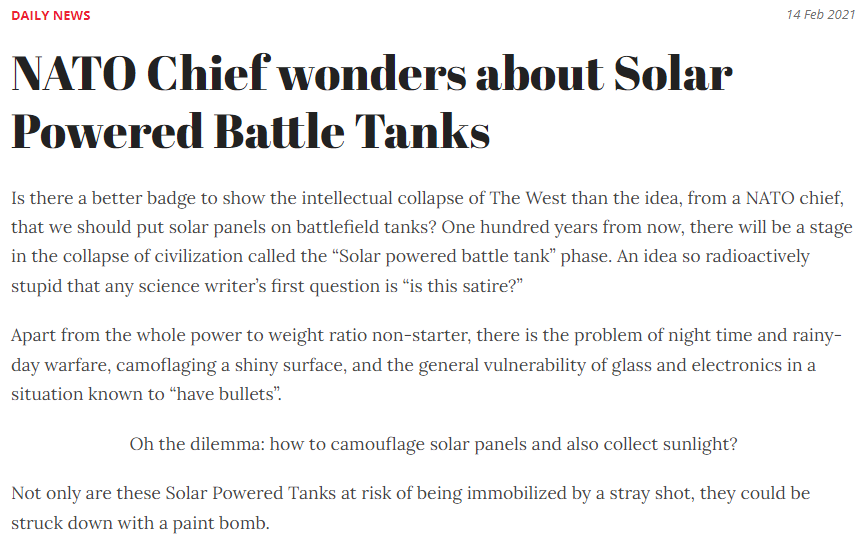
Screencap from Iowa Climate Science, 14 Feb 2021
https://iowaclimate.org/2021/02/14/nato-chief-wonders-about-solar-powered-battle-tanks/
* Lest you think, Gentle Reader, that this post serves a partisan political purpose, I will mention that am convinced that the one Republican political appointee with whom I am well-acquainted is a knucklehead of the first order. Indeed, if I ever manage to locate the proper forms, I intend to nominate him for a place of particular honor in the Knucklehead Hall of Fame.
April 26, 2023
Tanks Chats #169 | Scimitar Mark 1 & Scimitar Mark 2 | The Tank Museum
The Tank Museum
Published 20 Jan 2023In this week’s video, David Willey continues David Fletcher’s CVRT Tank Chats series, delving into the fascinating history of the Scimitar Mark 1 & Scimitar Mark 2. David provides an in-depth look at the development of these two iconic tracked vehicles, exploring their unique features and capabilities. He also examines how they have evolved over the years, and been used in various military operations.
(more…)
April 21, 2023
Type 94 Japanese 37mm Antitank Gun on Guadalcanal
Forgotten Weapons
Published 30 Dec 2022The Type 94 was the standard infantry antitank gun of the Japanese Army during World Ware Two. It was developed in the early 1930s as tensions with the Soviet Union rose; there had not been much need for Japanese antitank weapons in China. However, high explosive ammunition was also made for the gun, and it was used in an infantry support role with HE in China as well as in the Pacific.
The Type 94 was small and light, and could be disassembled for transportation without vehicles — a very useful capability on islands like Guadalcanal. Against US M3 Stuart light tanks, the Type 94 was a reasonably potent weapon.
Note that the Japanese also had a Type 94 tank gun, which was not the same as this — and did not use the same 37mm cartridge.
(more…)


