
Quotulatiousness

April 10, 2011

Canada’s peaceful submarines

Filed under: Britain, Cancon, Military, Technology, Weapons — Tags: , , — Nicholas @ 11:02

Apparently, the navy’s purchase of used British submarines has still not been completed: the boats are in our hands, but they’re still unarmed:

The country’s stock of second-hand submarines — already beleaguered with repairs and upgrades — is incapable of firing the MK-48 torpedoes they currently own.

When Canada purchased its current fleet of four submarines from Britain in 1998, they were fitted for British torpedoes. At the time, Canada was heavily invested with the modern MK-48 torpedo system and did not want to abandon it.

Like any shopper trying to justify a second-hand purchase in the face of an obstacle, they figured it was still a good deal. They “Canadianized” the submarines, but, 13 year later, they still haven’t got around to the “weaponization” part.

“The Canadian Forces has always intended for the Victoria Class submarines to carry and fire the Mark 48 torpedo,” wrote Denise LaViolette, the director of navy public affairs, in an email. “Initial weapons certification will be progressed early in 2012 in HMCS Victoria for Pacific operations followed that year by HMCS Windsor for Atlantic operations.”

I noted the lack of torpedo armament on the Canadian sub fleet back in 2004. I had no clue that they’d still be unarmed in 2011!

Later that same year, I said:

As I’ve said in other posts, I’m not a former Navy person, so my knowledge of the situation is neither broad nor deep. I’m moderately well-read on naval mattters, but that’s the limit. On that basis, I thought the purchase of the Upholder subs was a brilliant solution for both the Canadian and Royal Navies: we got a heck of a deal and they got the subs off their inventory. It really did look like a win-win, and both sides thought they’d gotten the better of the bargain.

In the long run, this may still turn out to be true. I certainly hope so.

As several others have noted, until we find out exactly what happened on HMCS Chicoutimi, we can’t make any determination about whether the subs are going to be safe and effective vessels for our navy. And, as Bruce R. pointed out the other day, if we want to retain any claims of sovereignty over the coastal waters of this huge country, we need those subs in the water now.

Well, the subs have been in the water for several years, but without torpedoes, they’re not fully functional.

Update, 12 April: Strategy Page has a useful summary of the history of the Upholder/Victoria class submarines:

It all began in the 1990s, when Canada wanted to replace its 1960s era diesel-electric subs. This did not seem possible, because the cost of new boats would have been about half a billion dollars each. Britain, however, had four slightly used Upholder class diesel-electric subs that it was willing to part with for $188 million each. Britain had built these boats in the late 1980s, put them in service between 1990 and 1993, but then mothballed them shortly thereafter when it decided to go with an all-nuclear submarine fleet.

So the deal was made in 1998, with delivery of the Upholders to begin in 2000. Canada decommissioned its Oberons in 2000, then discovered that the British boats needed more work (fixing flaws, installing Canadian equipment) than anticipated. It wasn’t until 2004 that the subs were ready, and that one year one of them was damaged by fire, while at sea. This boat is to be back in service next year. By the end of this year, three boats should be back in service. Maybe.

[. . .]

The problem is that the subs were bought without a through enough examination. It was later found that most major systems had problems and defects that had to be fixed (at considerable expense). Thus these boats have spent most of their time, during the last decade, undergoing repairs or upgrades. The final fix will be to get the torpedo tubes working. In any event, a Canadian [submarine] has never fired a torpedo in combat, mainly because the Canadian Navy did not get subs until the 1960s. Lots of Canadian surface ships have fired torpedoes in combat, but the last time that happened was in 1945. The sole operational Victoria class boat is on patrol in the Pacific, listening for trouble which, if found, will be reported to the proper authorities.

April 8, 2011

Swearing in soccer? Gasp! Shock! Horror!

Filed under: Britain, Media, Soccer — Tags: , — Nicholas @ 08:52

Duleep Allirajah wonders how the Football Association has managed to avoid hearing what soccer players say on the pitch until now:

Rooney swore? So f***ing what

Those fretting over the footballer’s anglo-saxon turn of phrase have clearly never been to a match before.

Wayne Rooney’s angry outburst was curious. What did it mean? Who was he addressing? In appearing to pick a fight with a TV camera, it immediately struck me as an homage to Robert De Niro’s famous ‘You talking to me?’ scene in Taxi Driver. But maybe I’m reading too much into it.

In a statement issued by his club, the player said: ‘Emotions were running high, and on reflection my heat-of-the-moment reaction was inappropriate. It was not aimed at anyone in particular.’ Maybe he was railing against his inner demons. Maybe there is no deeper meaning. Maybe it was a release of pent-up frustration after months of domestic strife and poor goal-scoring form.

But enough of my speculative interpretation, it’s the Football Association’s response that we should really be bothered about. The FA has banned Rooney for two matches for using ‘offensive, insulting and/or abusive language’. You don’t need to be a lipreader to work out that footballers swear quite a lot; every Saturday you’ll find them effing and blinding like proverbial troopers. But while disciplinary action for abusing match officials is nothing new, a ban for swearing per se is quite unprecedented.

March 31, 2011

Manga translator convicted under Swedish child-porn law

Filed under: Europe, Japan, Law, Media — Tags: , , , — Nicholas @ 12:13

It’s a telling result that someone who is paid to translate Japanese manga can fall afoul of child porn laws:

Last year, Lundström was convicted of possession of pornographic material after 50-odd Manga images stored on his hard drive were classified as child porn. The Swedish court of appeal later agreed that 39 of the illustrated images, none of which has been banned in Japan and none of which shows real people, fitted the definition of child porn. Lundström was fined 5,000 Swedish Crowns (£500). Meanwhile, his main employer, publisher Bonnier Carlsen, has stopped giving him translating commissions, and Lundström has been burdened with a reputation of traversing the biggest taboo of our time: getting off on kids. The case has now been appealed to the Supreme Court.

Cultural commentator Ulrika Knutson did not exaggerate when, earlier this week, she described the case as a ‘Swedish censorship scandal, perhaps the worst one in modern times’. As she points out, it should not simply be left to ‘other young cartoon nerds and Manga fans’ to defend Lundström against the legal and moral trials he has been subjected to since a note informing him that he was suspected of child pornography crimes was slipped through his home mailbox last summer. Instead, anyone who values freedom of speech must also defend the renowned Manga expert.

Whether you like or dislike Manga, it’s one of Japan’s biggest cultural exports. It may not be mainstream entertainment, but there are lots of fans in all western countries. If Sweden and other countries are going to retroactively decide that they are considered child porn, the courts are going to be very, very busy:

In other words, Swedes are not allowed to own or intentionally look at drawn images of non-real characters that a court could determine might to some people resemble child-like figures in situations that for some could be sexually arousing.

It’s an absurd situation: judges deliberating over the artistic merits of images, trying to determine what stage of puberty illustrated characters might be at and speculating over what kind of thoughts they might stimulate among adults. As for Lundström’s images, apparently the judges who convicted him felt that Manga comics, which are read and loved by millions around the world, violate children.

March 17, 2011

Rick Mercer on “the Harper Government”

Filed under: Cancon, Government, Humour, Politics — Tags: , — Nicholas @ 14:02

March 14, 2011

Canadian in Japan claims government “providing no help” to him

Filed under: Cancon, Government, Japan, Media — Tags: , , , , — Nicholas @ 09:13

Phillip Ilijevski is shocked that the Canadian government hasn’t been providing him with personalized information on what’s happening near him:

A Toronto man living in Japan says the federal government is “providing no help” to Canadians wanting to know if they should leave the earthquake and tsunami-ravaged country, especially given the nuclear threat.

Phillip Ilijevski teaches English in Takasaki, about 100 kilometres north of Tokyo. He called Canada’s Department of Foreign Affairs and International Trade to find out if it’s safe to stay in Japan, but says the only advice they gave him was to watch the news.

I have no idea why the Canadian government is expected to have better information on what’s happening in Japan in the aftermath of the earthquake and tsunami than the Japanese government, but it must be Stephen Harper’s fault, right?

If Mr. Ilijevski was in a third world nation with poor communications and little infrastructure, it might be reasonable to assume that Canadian officials would be in a better position to provide advice than local government, but in this case there’s no reason — Japan is better equipped to handle this kind of disaster (and public information flow) than just about any other nation on earth.

As jonkay said in a Twitter update: “As usual,when disaster strikes abroad, TStar’s #1 focus is finding a Canuck to bitch about how Ottawa isn’t helping him”

March 11, 2011

Another oddity of British law

Filed under: Britain, Law, Liberty — Tags: , , , , — Nicholas @ 17:19

I was unaware, until today, that it is possible to get a legal injunction that effectively prevents anyone from knowing that the injunction has been issued: a “super injunction“:

The existence of the draconian injunction — so strict it prevents $PERSON being identified as a $OCCUPATION — was disclosed by John Hemming, a back-bench Liberal Democrat MP, in a question during a business debate at the House on Thursday morning. His comments are protected by parliamentary privilege.

He said: “In a secret hearing $PERSON has obtained a super-injunction preventing him being identified as a $OCCUPATION.

“Will the government have a debate or a statement on freedom of speech and whether there’s one rule for the rich like $PERSON and one rule for the poor?”

Leader of the House Sir George Young said a forthcoming Westminster Hall debate would explore freedom of speech, adding: “I will raise with the appropriate minister the issue he has just raised.”

The terms of the injunction are so strict that the Daily Telegraph cannot reveal the nature of the information that $PERSON is attempting to protect.

Because I am not rich, I’ve chosen to avoid including any information which may fall under the strict terms of the injunction . . . others are not being as careful, so you can find out who the rich wanker is and what occupation he wants to prevent the public from discovering by reading the whole thing.

February 17, 2011

The Pirates of Oz

Filed under: Australia, Media, Technology — Tags: , , , , — Nicholas @ 07:15

According to a recent study, piracy in Australia has become the biggest industry: one third of all Australians are accused of piracy in the last twelve months.

The study, released by the Australian Federation Against Copyright Theft, claims that piracy sucks $A1.37bn out of the Australian economy.

Direct effects claimed by AFACT amounted to $A575m, the study claims — including $A225m attributed to “secondary piracy”, in which an individual either “views or borrows” pirated material (presumably whether or not the viewer knows the full legal status of what they’re watching).

[. . .]

The economic multiplier effects, for those willing to get past the press release, include reduced spending on recreation, clothing, housing and household goods. So, freetards, hang your heads in shame: not only were more than 6,000 jobs lost due to piracy, but the victims of your crime are now homeless, naked, hungry and bored.

February 14, 2011

The plod may not get around to protecting you, but you’ll be charged if the burglar is hurt while stealing your stuff

Filed under: Britain, Law, Liberty — Tags: , , — Nicholas @ 12:04

Ah, England. Land of green hills, picturesque village pubs, and absolutely daft law enforcement priorities:

A spate of thefts in several towns and villages in Kent and Surrey over the past few months led to many householders taking action to protect their property.

Some have been warned by police that using wire mesh to reinforce shed windows was ”dangerous’’ and could lead to criminals claiming compensation if they ”hurt themselves’’.

Thieves target sheds to steal lawnmowers, power drills, bicycles and a variety of DIY tools.

Thomas Cooper, of Tatsfield, Surrey, used wire mesh to protect three of his garden sheds after two break-ins over the past four years. He decided to take action after reports of a rise in garden raids in the area.

Mr Cooper said: “I reinforced my shed windows with wire mesh, but was told by the police I had to be very careful because thieves can actually sue you if they get hurt.

”It is ridiculous that the law protects them even though they are breaking it.”

It’s getting to the stage that I’m expecting to hear the police in some English town declare that locking your doors and windows will no longer be allowed because of the risks to burglars. That’s only a tiny bit more ridiculous than what they’re already saying.

H/T to Damian Penny for the link.

Update, 2 March: Eugene Volokh does a bit more digging on the original story:

Some readers expressed doubt about the accuracy of the news stories on which I relied, so I e-mailed the Surrey Police Department for more information. Here’s what I learned.

January 31, 2011

Shock! Horror! Wikipedia contributors are disproportionally male!

Filed under: Technology — Tags: , , , — Nicholas @ 08:24

Don’t worry, kids, the New York Times is on the case:

In 10 short years, Wikipedia has accomplished some remarkable goals. More than 3.5 million articles in English? Done. More than 250 languages? Sure.

But another number has proved to be an intractable obstacle for the online encyclopedia: surveys suggest that less than 15 percent of its hundreds of thousands of contributors are women.

About a year ago, the Wikimedia Foundation, the organization that runs Wikipedia, collaborated on a study of Wikipedia’s contributor base and discovered that it was barely 13 percent women; the average age of a contributor was in the mid-20s, according to the study by a joint center of the United Nations University and Maastricht University.

And this is clearly evidence of neo-patriarchal oppression, right? If so, the mechanism by which this form of oppression is accomplished is a bit less than crystalline: anyone can sign up to contribute to Wikipedia. If the NYT thinks that this is really a problem, then we can’t have that many serious problems.

With so many subjects represented — most everything has an article on Wikipedia — the gender disparity often shows up in terms of emphasis. A topic generally restricted to teenage girls, like friendship bracelets, can seem short at four paragraphs when compared with lengthy articles on something boys might favor, like, toy soldiers or baseball cards, whose voluminous entry includes a detailed chronological history of the subject.

Even the most famous fashion designers — Manolo Blahnik or Jimmy Choo — get but a handful of paragraphs. And consider the disparity between two popular series on HBO: The entry on “Sex and the City” includes only a brief summary of every episode, sometimes two or three sentences; the one on “The Sopranos” includes lengthy, detailed articles on each episode.

Is a category with five Mexican feminist writers impressive, or embarrassing when compared with the 45 articles on characters in “The Simpsons”?

Isn’t it normally considered positive that women are not as inclined to obsessive monomania as men are? Doesn’t this evidence rather support the notion that (some) men devote disproportional effort to topics of interest that (most) women would consider unhealthy?

January 27, 2011

New entrant into the “Security Theatre Kabuki Hall of Fame”

Filed under: Britain, Bureaucracy — Tags: , , , — Nicholas @ 12:54

Step forward, our first inductee for 2011, Gatwick Airport security staff:

Airport officials ordered a holidaymaker carrying a toy soldier onto a plane to remove its three-inch gun — because it was a safety threat.

Ken Lloyd was stunned when he was told he could not go on the plane with the nine-inch model soldier because it was carrying a ‘firearm’.

The Canadian tourist and his wife had bought the toy, which holds a replica SA80 rifle, during a visit to the Royal Signals Museum at Blandford Camp in Dorset.

Well caught, security super-heroes! Here’s the vicious piece of deadly weaponry they bravely prevented from being smuggled aboard the plane:

January 19, 2011

Dire Straits not suffering due to CBSC ban

Filed under: Bureaucracy, Cancon, Economics, Media — Tags: , , , — Nicholas @ 12:20

Dire Straits may need to send a nice gift basket to the Canadian Broadcast Standards Council after they banned the song Money for nothing:

Britney Spears’ return with “Hold It Against Me” say 37,000 downloads, which is the best-ever first week performance ever since SoundScan started tracking digital sales six years ago. Avril Lavigne also did all right with 16,000 downloads of “What the Hell.”

But here’s my favourite stat: what with all the hoopla of the Canadian Broadcast Standards Council ruling on the unworthiness of Dire Straits “Money for Nothing,” digital downloads of that track went from 167 last week to about 2,700 this week. That number represents a full 10% of all downloads of that song since tracking began in February 2005. Meanwhile, Brothers in Arms, the album from whence the song came, saw its digital sales spike 406%. It’s now the fifth-best selling catalogue album in the nation.

H/T to Paul “Inkless” Wells for the link.

January 17, 2011

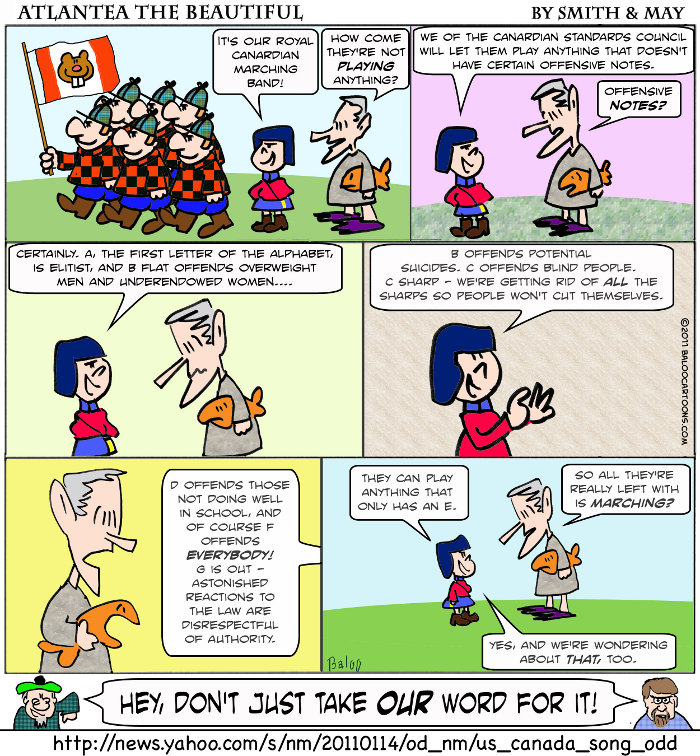
Smith and May illustrate the CBSC decision

Filed under: Bureaucracy, Cancon, Media — Tags: , , , , — Nicholas @ 08:37


Link to news.yahoo.com/s/nm/20110114/od_nm/us_canada_song_odd.

Cartoon from this week’s edition of Libertarian Enterprise.

January 16, 2011

Hey, aspiring fiction writers! Don’t enter this contest!

Filed under: Randomness — Tags: , — Nicholas @ 12:02

John Scalzi does you a big favour by pointing out how insane you’d need to be to want to enter this writing contest:

. . . from an outfit called First One Digital Publishing. Why? Because it costs $149 to enter, and because of this little gem in the contest fine print:

All submissions become sole property of Sponsor and will not be acknowledged or returned. By submitting an entry, all entrants grant Sponsor the absolute and unconditional right and authority to copy, edit, publish, promote, broadcast, or otherwise use, in whole or in part, their entries, in perpetuity, in any manner without further permission, notice or compensation. Entries that contain copyrighted material must include a release from the copyright holder.

So, to be clear: These people want you to sign away all the rights you have to your own work — and they want you to pay them to do it. That’s just very special.

You pay them to enter. You sign away all your rights to the work you submit (they can do whatever they like with it, including publishing it themselves). They agree to judge your work, but do not guarantee that any prizes will actually be awarded. Oh, and in submitting your piece, you also agree that you have no legal claim against them. Just breathtaking in its audacity.

January 13, 2011

Offensensitivity, the Canadian disease

Filed under: Bureaucracy, Cancon, Liberty, Media — Tags: , , , — Nicholas @ 14:46

Banned on the radio in Canada, but still (for the moment) legal on the internet:

Update, 14 January: I’ve been informed that this video isn’t playing for some, and it’s not working for me now either. I guess it’s another one of those content licensing issues. So I guess I’ll have to make this change:

Banned on the radio in Canada, but still (for the moment) legal on the internet. Banned on the radio in Canada, AND on the internet.

December 22, 2010

Bad Boy Fencing Star Implicated in Yet Another Jewel Heist

Filed under: Humour — Tags: , , — Nicholas @ 00:35

« Newer PostsOlder Posts »

Powered by WordPress


