
At The Wrong Side of History, Ed West reviews the autobiography of Lee Kuan Yew, the first prime minister of an independent Singapore and the man most responsible for its amazing economic success:
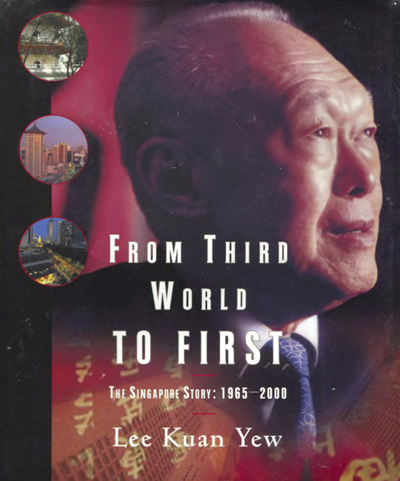
There are few political memoirs as readable as Lee Kuan Yew’s From Third World to First, but then there were few politicians like him. Arguably the greatest statesman of the post-war era, Lee led Singapore out of a failed federation with Malaysia, turning a poor and precarious little nation into a dazzling success story, now twice as rich as Britain, its former colonial ruler.
While many things have been written about Lee, the most interesting are by the man himself, with his early years covered in The Singapore Story, published in 1998. The sequel mixes memoir, analysis on international affairs, his own personal philosophy and a how-to guide to statecraft. As he puts it: “There are books to teach you how to build a house, how to repair engineers, how to write a book. But I have not seen a book on how to build a nation out of a disparate collection of immigrants from China, British India, and the Dutch East Indies …” It’s safe to say that he’s cornered that particular market.
It is a strangely cinematic story, almost fit for Hollywood: a man battling to save his small nation against the odds, who must feel that all is lost but struggles on and ultimately wins. Singapore’s identity, unlike that of most young countries, was not forged on the battlefield with swords and guns, but by markets, driven by a determined belief in economic growth, social order and hard work. Only these goals would allow it to overcome its severe demographic challenges, and avoid the violent fate of many post-colonial societies. Defying what experts thought was the direction of history, it became the most successful, and significant, city-state since the Renaissance.
The situation to start with was desperate, and Lee can be seen crying in black and white video footage from August 1965, when he announces that his city has been kicked out of Malaysia, a rare case of a state achieving independence against its will. As he puts it: “Some countries are born independent. Some achieve independence. Singapore had independence thrust upon it.”
Singapore was poor and cursed by its combustible demography. Twice the size of the Isle of Wight — and roughly the same shape — it nestles at the bottom of the Malay peninsula and to its south, just an hour’s ferry ride, is the giant of Indonesia. Neither neighbour was friendly, and Indonesia’s declared regional policy of Konfrontasi – Confrontation – was not reassuring.
Under Stamford Raffles in 1819, the British had founded Singapore as a trading post out of a collection of villages inhabited by Malays and a long-established community of overseas Chinese. Its position at a choke point was crucial for control of the sea lanes between the Far East and Indian Ocean, and under British rule it flourished as an entrepôt. Free trade was its foundational belief, and its hands-off rulers allowed the Chinese in particular to express their entrepreneurial skills; as its economy grew, Chinese migration increased, and by the time of independence they constituted about three-quarters of the population, with Malays accounting for 15 per cent and Indians the remainder.
Born in 1923 as the eldest of five, Lee was something of a father figure to his three brothers and sister, their actual father being a somewhat irresponsible and distant figure, and he certainly exemplified Adler’s birth-order theory, becoming the conscientious elder sibling to an entire nation.
The great-grandson of Hakka-speaking immigrants, Lee came from the somewhat Anglicised Straits Chinese elite. Often British in their mindset, Lee describes himself as “the last Victorian” and this worldview would shape Singapore’s history. He attended the English-speaking Raffles College, where he met his future wife, Kwa Geok Choo, another lawyer and a formidable individual in her own right; the two often finished first and second in exams.
Lee would have gone on to great things in any case, but he happened to come of age in a notably turbulent period. If worldviews are indeed shaped by the events of an individual’s twentieth year, for the budding young law student it was the fall of Singapore in February 1942, the British Empire’s greatest defeat and humiliation. Lee noted at the time that, whatever happened next, this was the end of European rule.


