
Prime Minister Mark Carney came to power promising that he was the best-qualified to deal with the US government on trade issues. Canadians assumed that this meant he’d be able to get as fair a trade deal with President Trump’s administration as possible. What he really meant was that he could do the most damage to cross-border trade relations in order to “pivot” to the EU and to China. He never intended to settle US-Canadian trade conditions, and his actions clearly show he was always putting the negotiations dead last in his priority list. And, thanks to the government’s generous subsidies to the relic media, instead of grilling him and his ministers for their blatant failures, they instead try to hold the opposition to account for things they have no control over.
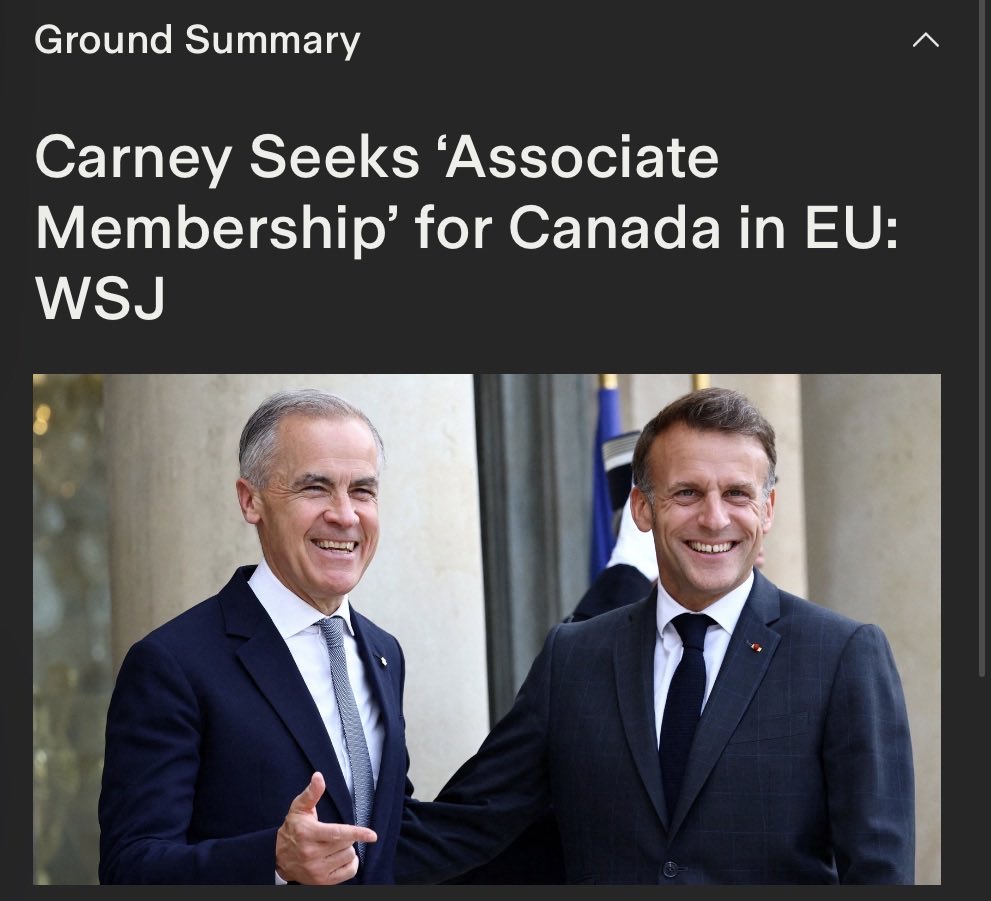
On the social media site formerly known as Twitter, L. Wayne Mathison points out that it makes no economic sense for Canada to become part of the European Union as Carney now says he’s working toward:
This strikes me as remarkably stupid economic strategy.
Diversifying Canadian trade makes sense. Pretending Europe can somehow replace the economic relationship we have with the United States does not.
The United States is next door. Our railways, pipelines, electricity grids, manufacturing supply chains and energy markets have been integrated for generations. Even after the trade fight intensified, 71.7% of Canadian merchandise exports still went to the United States in 2025.
And Canada already has CETA with the European Union. Roughly 98% of EU tariff lines on Canadian goods became duty-free when CETA took effect, eventually rising to about 99%. If Canadian companies see profitable opportunities in Europe, they already have extraordinarily good market access.
So what exactly do we gain from some invented “associate membership” beyond CETA?
Potentially European regulatory obligations, political entanglements, financial contributions and pressure to harmonize Canadian rules with decisions made in Brussels, all to sell more goods across an ocean to markets that cannot duplicate the geographic advantage of the United States.
Norway rejected EU membership twice. Iceland opened accession negotiations and eventually walked away without joining. Both understood that you can have close economic relations with Europe without surrendering unnecessary national autonomy.
Canada should trade aggressively with Europe, Asia and everyone else who wants our products. But our first priority should be fixing the relationship with our largest customer, removing our own interprovincial trade barriers, building pipelines and ports, and making Canada competitive again.
Picking a fight with the neighbour who buys most of your exports and then announcing that Brussels might become your new best friend isn’t economic sophistication.
It looks like desperation dressed up as grand strategy.


