Quotulatiousness

May 19, 2019

The German Breakthrough in the West – WW2 – 038 – May 18 1940

Filed under: Britain, Europe, France, Germany, History, Military, WW2 — Tags: , , , , — Nicholas @ 04:00

World War Two
Published on 18 May 2019

The German invasion of Western Europe has been going for over a week now, and the Neutral and Allied countries are in disarray. The Netherlands, despite putting up fierce resistance on some occasions, faces overwhelming powers while Belgium, France and the British feel the pressure from an organised and armoured assault from the Ardennes. And still, the German tanks, soldiers and aircraft are not all the Allies have to fear, as many of their losses are caused by their own command.

Join us on Patreon: https://www.patreon.com/TimeGhostHistory
Or join The TimeGhost Army directly at: https://timeghost.tv

Churchills ‘Blood, toil, tears and sweat’ speech: https://winstonchurchill.org/resource…

Follow WW2 day by day on Instagram @World_war_two_realtime https://www.instagram.com/world_war_t…
Join our Discord Server: https://discord.gg/D6D2aYN.
Between 2 Wars: https://www.youtube.com/playlist?list…
Source list: http://bit.ly/WW2sources

Written and Hosted by: Indy Neidell
Produced and Directed by: Spartacus Olsson and Astrid Deinhard
Executive Producers: Bodo Rittenauer, Astrid Deinhard, Indy Neidell, Spartacus Olsson
Creative Producer: Joram Appel
Research by: Indy Neidell
Post-Production Director: Wieke Kapteijns
Edited by: Iryna Dulka
Map animations: Eastory

Colorisations by Norman Stewart and Julius Jääskeläinen https://www.facebook.com/JJcolorization/

Eastory’s channel: https://www.youtube.com/channel/UCEly…
Archive by Screenocean/Reuters https://www.screenocean.com.

Sources:
– © IWM (C 1666)

A TimeGhost chronological documentary produced by OnLion Entertainment GmbH.

From the comments:

World War Two
This is the longest weekly episode of our World War Two series to this date, and boy are we proud. We made sure to make this the absolute best it could possibly be. After last week’s episode of WW2, it was hard to imagine that Eastory could surpass his efforts for that episode anytime soon, but it took him one week. Iryna, our editor in Warsaw, did an amazing job with putting together this episode. We hope you like it as much as we do. Thanks for your ongoing support and if you don’t already, please consider supporting us on Patreon.

By the way, we have an Instagram feed where we dedicate one post per day of the war, which allows us to give some topics a little more attention, like the invasion of the Netherlands. You can check them out here:
11 May 1940 – Germans attack Dutch positions on the Grebbeberg and the Grebbeline: https://www.instagram.com/p/BxVBQcwnHAs/
12 May 1940 – Three German Panzer divisions approach Sedan to Force a breakthrough into France: https://www.instagram.com/p/BxYS8XqHdTh/
13 May 1940 – The Battle of the Grebbeberg ends in a German victory, allowing them to push into Holland: https://www.instagram.com/p/Bxauq9HnqOW/
14 May 1940 – German bombers destroy the inner city of Rotterdam while peace talks are going on: https://www.instagram.com/p/Bxc7zreiXo8/
15 May 1940 – The French fight a successful but practically meaningless battle at Gembloux: https://www.instagram.com/p/BxfGP1qCzV9/
16 May 1940 – Guderian rapidly moves westward, showing the full potential of tank-warfare: https://www.instagram.com/p/BxhxvyDClbY/

Malcom McLean’s container shipping revolution

Filed under: Business, Economics, History, Railways, USA — Tags: , — Nicholas @ 03:00

At the Foundation for Economic Education, Alexander Hammond recounts the tale of a former truck driver who was instrumental in revolutionizing the way we ship products around the world:

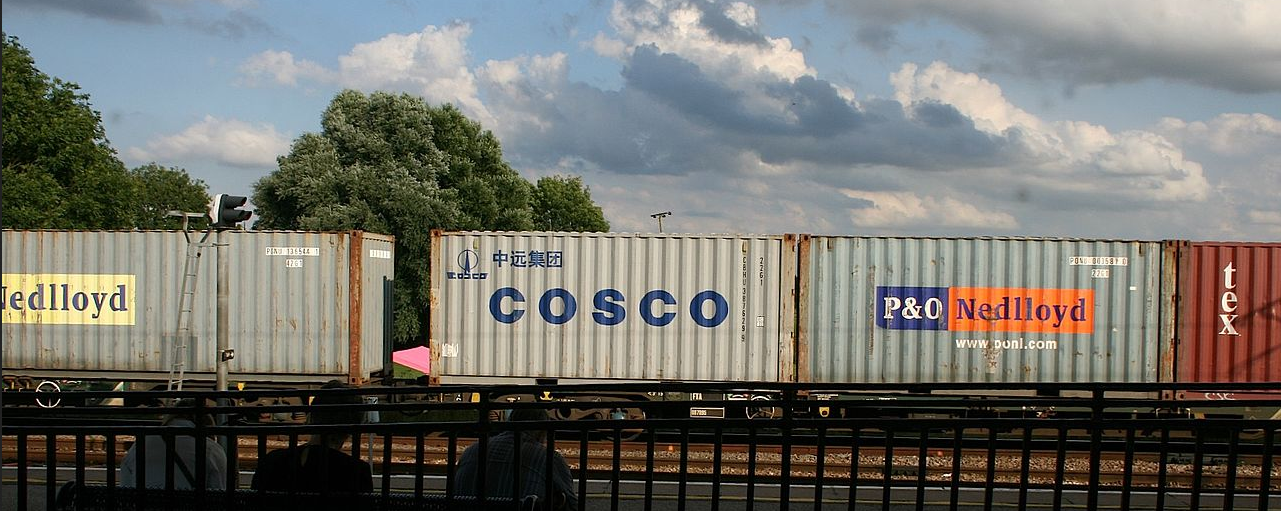
Deep-sea containers from China at Ely, Cambridgeshire
Via Wikimedia Commons.

In 1937, McLean made a routine delivery of cotton bales to a port in North Carolina for shipment to New Jersey. As McLean couldn’t leave until his cargo had been loaded onto the ship, he sat for hours watching dozens of dockhands load thousands of small packages onto the ship. McLean realized that the current loading process wasted enormous amounts of time and money, and he began to wonder if there could be a more productive alternative.

In 1952, McLean thought of loading entire trucks onboard a ship to be transported along the American Atlantic coast (i.e., from North Carolina to New York). Although this idea would dramatically reduce loading times, he soon realized that these “trailer ships” would not be very efficient due to the large amount of wasted cargo space.

Mclean modified his original design so that just the containers—and not the trucks’ chassis—were loaded onto the ship. He also developed a way for the containers to be stacked on top of one another. That was the origin of the modern-day shipping container.

In 1956, McLean secured a bank loan for $22 million. He used the money to buy two World War II tanker ships and convert them to carry his containers. Later that year, one of his two ships, the SS Ideal-X, was loaded with 58 containers and sailed from New Jersey to Houston, Texas. At the time, McLean’s shipping company offered transport prices that were 25 percent lower than those of his competitor as well as the ability to lock the containers in order to prevent cargo theft, which also appealed to many new customers.

By 1966, McLean launched his first transatlantic service and three years later, McLean had started a transpacific shipping line. As the advantages of McLean’s container system became clear, bigger ships, more sophisticated containers, and larger cranes to load cargo were developed.

Update 21 May: Here’s a breathtaking example of just how much McLean’s containers changed the world:

Samuel Pauly Invents the Cartridge in 1812

Filed under: Europe, History, Technology, Weapons — Tags: , , , — Nicholas @ 02:00

Forgotten Weapons
Published on 4 May 2019

(Video reuploaded to removed an allegedly copyrighted still image)

This Pauly shotgun (lot #1346) sold at Morphy’s April 2019 auction for $5,535.

Samuel Johannes Pauli was born outside Bern, Switzerland in 1766, and became an engineer of wide interests. Among them were bridge design, passenger-carrying balloons (he would work seriously on a 15-20 passenger balloon service between London and Paris later in life), and firearms. Only a few years after Forsyth’s invention of fulminate priming, Pauly would become the first to use it in a fully self-contained cartridge. He patented this invention in Paris in 1812, having moved there in 1802 in pursuit of financing for his many grand projects (going then by the name Jean Samuel Pauly).

Pauly’s cartridge was a multi-part affair with a rimmed brass base containing a fulminate powder, connected to a paper or cardboard cartridge body which held a charge of regular gunpowder and the shot or ball to be fired. It was an expensive system, but contained all the necessary elements of a modern cartridge.

Pauly would move to England in 1814 (then taking the name Samuel John Pauly) in pursuit of aviation inventions, although he continued to tinker on his firearms design and filed two additional patent improvements. He died in London in 1821, and his name and work became rather obscure. His former apprentices would carry on his legacy in their own work – Nicolaus Dreyse would produce the needle fire system of Dreyse rifles used by the Prussian military, and Casimir Lefaucheux would create the pinfire system based on Pauly’s designs. Lefaucheux in fact became owner of the company in 1827, and with his son would provide the most direct link between Pauly’s design and the modern metallic cartridge.

http://www.patreon.com/ForgottenWeapons

Cool Forgotten Weapons merch! http://shop.bbtv.com/collections/forg…

Contact:
Forgotten Weapons
PO Box 87647
Tucson, AZ 85754

QotD: The purpose of the corporation

Filed under: Business, Economics, Quotations — Tags: — Nicholas @ 01:00

The key is that the purpose of the firm is set by the folk who created it and those who own it. If it meets customers’ needs it will thrive, and if it doesn’t, it goes out of business. If you and I, dear reader, found a business to sell chocolate ice cream, at what point do we suddenly become “responsible” in some sense to “society” or “the environment” or “God” in how we run things unless we have expressly chosen to make those considerations part of our business mission?

It is crucial to be clear on this point. If a group of individuals band together to create a corporation that expressly states that it shall distribute 30 per cent of profits to a specific charity/cause, or that it will source its supplies from a particular group on ethical grounds, or hire as equal a balance of men and women as possible, regardless of other considerations, then anyone who becomes, say, a shareholder in that business cannot complain if things go wrong. And in fact there are more and more cases of firms that go out of their way to brandish their ethical principles, with varying levels of credibility or cant. Also it turns out that firms which are run by honest people, publish transparent accounts and don’t treat staff like crap tend, according to some metrics, to outperform their peers over the long term (see a study claiming this here). As Adam Smith might have noted, if people pursue their rational self-interest it tends to be the case that dealing with decent, honest people tends to work out better than dealing with shysters.

Johnathan Pearce, “Corporate social responsibility – is it socialism by the back door?”, Samizdata, 2019-04-18.

May 18, 2019

The Paul Sellers Plywood Workbench | Episode 7

Filed under: Woodworking — Tags: , — Nicholas @ 06:00

Paul Sellers
Published on 17 May 2019

The completion of any project should always be exciting but when it’s your workbench there is something really special and unique about it. In this episode Paul uses methods for installing and fitting the bench vise which he has developed to guarantee a rock solid fit. The vise is, of course, your third hand. You do not want one ounce of movement in it. The jaw liners too must match the vise and the workbench for solidity. It’s all lifetime stuff for living woodworkers with style.

Want to learn more about woodworking? See https://woodworkingmasterclasses.com or https://commonwoodworking.com for step-by-step videos, guides and tutorials. You can also follow Paul’s latest ventures on his woodworking blog at https://paulsellers.com/

Tim Worstall lists the benefits of a hard Brexit

Filed under: Britain, Economics, Europe — Tags: , , , , — Nicholas @ 05:00

In the Continental Telegraph, Tim Worstall responds to a demand for a list of the benefits of a hard Brexit:

1) How will you protect UK business from dumping?

We won’t. The aim, purpose and intention of trade is to gain access to those things which Johnny Foreigner makes better, cheaper, faster – pick any two of three – than our own domestic producers do. Given that the aim of an economy is to make the people, consumers, as well off as the constraints of the real world allow, we wouldn’t protect domestic producers from anything. Shape up or go bust.

As even the Treasury’s briefing on the costs and benefits of Brexit said, competition from trade is exactly what incentivises domestic producers to become more productive.

So, we don’t protect from dumping and the people of Britain become richer. The problem with this is?

2) What will you do for those who lose their jobs because the businesses that employ them are undermined by WTO rules?

Exactly the same as we do for anyone else who loses their job for any other reason. The economy destroys some 10% of all jobs every year – some 3 million – and another 10% are generated newly as well. That’s just what labour market churn is. We have a welfare system for the interim and people who lose jobs because of Brexit or WTO do exactly as everyone else, get another job with the welfare state as the backstop.

And it’s important to note how new job creation works. It isn’t that we must plan what those jobs are before the old disappear. It’s the availability of the newly employable labour which generates the testing of what should be done next.

3) What will you do on the Northern Ireland border?

Lie.

We have pointed this out before:

Our answer should be “Yes.” We agree that we are leaving, that we have put in place that hard border. Then we do absolutely nothing above what we already do. People come and go as they wish, carrying what goods they can, and we do nothing. Except, as we already do, we keep an eye on those moving things on an industrial scale and have our little customs and tax chats with them away from that line on the map.

What other people wish to do on their side of that line is entirely up to them. We will do, as we’ve always done when in our right minds, what is useful and beneficial to us. It’s somewhat unfashionable these days to talk of the empire but it’s still true that we had it. Often because we’re rather good at this lying, cheating and dissembling. We should carry on. So, there’s the border, as it is today. And?

The Maginot Line – WW2 on Location – France 1940 – 01

Filed under: Europe, France, History, Military, WW2 — Tags: , , — Nicholas @ 04:00

World War Two
Published on 16 May 2019

The Maginot Line was not the failure many think — in fact it was quite a remarkable feat — find out more in this video.

Guest Experts in order of appearance:
Mark Halter – Fortress Schoenenbourg http://www.lignemaginot.com/accueil/i…
Richard Tucker – Maginot Line Tours http://maginotlinetours.co.uk or https://www.tripadvisor.nl/Attraction…
Roland Müller – L’Abri de Hatten http://www.abrihatten.fr/index-en.html

Join us on Patreon: https://www.patreon.com/TimeGhostHistory
Or join The TimeGhost Army directly at: https://timeghost.tv

Follow WW2 day by day on Instagram @World_war_two_realtime https://www.instagram.com/world_war_t…
Join our Discord Server: https://discord.gg/D6D2aYN.
Between 2 Wars: https://www.youtube.com/playlist?list…
Source list: http://bit.ly/WW2sources

Hosted by: Indy Neidell
Written and Directed by: Spartacus Olsson
Produced by: Astrid Deinhard
Executive Producers: Bodo Rittenauer, Astrid Deinhard, Indy Neidell, Spartacus Olsson
Creative Producer: Joram Appel
Research by: Spartacus Olsson
Edited by: Wieke Kapteijns

Eastory’s channel: https://www.youtube.com/channel/UCEly…
Archive by Screenocean/Reuters https://www.screenocean.com.

A TimeGhost chronological documentary produced by OnLion Entertainment GmbH.

From the comments:

World War Two
In April, with the help of many of you fantastic people we went to France to visit some of the sites of the German invasion in 1940. This is the first of a series of specials that we recorded there. More will follow in May and June as the war in France proceeds. On Saturday we will come out with a double length episode about the German breakthrough in the West — we are exceedingly proud of that episode and we hope that you will enjoy it as much as we do. This video gives you some great background to that event. For us it was a revelation to visit the sites and talk to the experts you will meet in the video. Mark Halter of the amazingly well preserved Schoenenburg Fortress, Richard Tucker who gives fantastic tours around the Sedan area, and Roland Müller who has worked for decades to keep alive the memory of the men who served on the front. If you happen to be in the Alsace or Ardennes area, you need to go visit these places. Most of the Maginot museums are private initiatives that depend on their visitor income and financial contributions to continue existing — links are in the description.

Justin Trudeau expects more than just ordinary loyalty from civil servants

Filed under: Cancon, Government, Politics — Tags: , , , — Nicholas @ 03:00

In the Post Millennial, Mika Ryu summarizes Trudeau’s un-statesman-like behaviour through the Admiral Norman persecution — including his decision not to be in the house when a motion was passed apologizing to Norman — and offers an explanation for Trudeau’s oddities:

… according to a Globe and Mail report published around 6am on Friday by their Ottawa Bureau Chief Robert Fife, who also broke the SNC-Lavalin story in February of this year.

In the new bombshell report, Mr. Trudeau is alleged to have been furious about the leak that prevented the Liberal government from cancelling a massive ship building contract that was already well on its way to being executed.

The prime minister is alleged to have felt “betrayed” by the leak, after “all he had done” for the public service after a decade under Harper. This is very similar to the reason why he yelled at MP Celina Caesar-Chavannes when she told him that she would not run for re-election.

It is becoming clear that defeating Harper has turned Trudeau into a hero in his own mind, for which the entire country and all of its citizen owe him an infinite debt.

It was already known that the Privy Council Office had called in the RCMP to investigate the person behind the collapse of a would-be sweetheart deal for the well-connected “Rockefellers of Atlantic Canada”. This was a very unusual move, which was supported by alleged “Irving’s Boy”.

It continues to paint a troubling picture of the prime minister, a man who perhaps might not have “been so forward” with his corruption if he knew that the national newspapers would report on it, even in the face of the state’s increasing use of sinister carrots and sticks in the run-up to the election.

6 Wartime Foods | British Pathé

Filed under: Britain, Cancon, Food, History, USA, WW2 — Tags: — Nicholas @ 02:00

British Pathé
Published on 20 Sep 2016

BON APPETIT – FOOD MONTH ON BRITISH PATHÉ (SEPTEMBER 2016): 6 Wartime Foods.

War and postwar changed the perception of foods that we now may consider as ordinary and basic. Here is a list of 6 Wartime Foods.

Check the newsreels used to make this video here: https://www.youtube.com/playlist?list…

Music:
The Show Must Be Go (incompetech.com)
Licensed under Creative Commons: By Attribution 3.0 License
http://creativecommons.org/licenses/b…

A NEW THEME EVERY MONTH!
Each month, a range of new uploads and playlists tell the story of a particular topic through archive footage. Let us know what themes you’d like to see by leaving us a comment or connecting with us on social media.

BRITISH PATHÉ’S STORY
Before television, people came to movie theatres to watch the news. British Pathé was at the forefront of cinematic journalism, blending information with entertainment to popular effect. Over the course of a century, it documented everything from major armed conflicts and seismic political crises to the curious hobbies and eccentric lives of ordinary people. If it happened, British Pathé filmed it.

Now considered to be the finest newsreel archive in the world, British Pathé is a treasure trove of 85,000 films unrivalled in their historical and cultural significance.

ALL RIGHTS RESERVED

A VIDEO FROM BRITISH PATHÉ. EXPLORE OUR ONLINE CHANNEL, BRITISH PATHÉ TV. IT’S FULL OF GREAT DOCUMENTARIES, FASCINATING INTERVIEWS, AND CLASSIC MOVIES. http://www.britishpathe.tv/

FOR LICENSING ENQUIRIES VISIT http://www.britishpathe.com/

British Pathé also represents the Reuters historical collection, which includes more than 120,000 items from the news agencies Gaumont Graphic (1910-1932), Empire News Bulletin (1926-1930), British Paramount (1931-1957), and Gaumont British (1934-1959), as well as Visnews content from 1957 to the end of 1979. All footage can be viewed on the British Pathé website.

QotD: “Revenue neutral” tax cuts

Filed under: Economics, Politics, Quotations, USA — Tags: , — Nicholas @ 01:00

Real men (as well as pull-no-punches women) cut taxes. The lesser mortals that tend to inhabit Washington wring their hands and get all weak in the knees when it comes to cutting taxes. Rumors are President Trump will propose a real tax cut. I certainly hope so.

Once upon a time, most Republicans believed in tax cuts. Somewhere along the way, inside the beltway especially, Republicans forgot about the benefits of cutting taxes. Republicans became more concerned with government keeping “its” revenue than letting the people keep their money.

Too many Republican have become timid about tax cuts, often spouting the milquetoast line of “revenue neutral tax cuts.”

Let me translate that little bit of Washington-speak for you. “Revenue neutral” tax cuts aren’t really tax cuts. It’s more like tax shifting. Some will pay more. Some will pay less. And the net effect will be that government will collect the same amount of taxes.

If revenue neutral tax shifting is what Republicans stand for, maybe it’s time we re-evaluated what we really stand for.

What will “revenue neutral” tax cut mean to your business? Well, that may depend on how expensive your lobbyist is. Which side of the “revenue-neutral” ledger you wind up on may depend on how well the skids are greased, hardly, a pleasant scenario to anticipate.

I believe as John F. Kennedy and Ronald Reagan did, that the best way to stimulate our economy, promote job growth, and give our ailing middle class a raise is to cut taxes for all.

Rand Paul, “Real Men Cut Taxes”, Breitbart.com, 2016-04-25.

May 17, 2019

The Three Kingdoms – The Battle of Guandu – Extra History – #2

Filed under: Books, China, History, Military — Tags: , — Nicholas @ 06:00

Extra Credits
Published on 16 May 2019

This series is brought to you by Total War: THREE KINGDOMS, a brand new strategy game set during this time period. https://store.steampowered.com/app/77…

Yuan Shao’s forces cross the Yellow River, assaulting Cao’s fortifications. Yuan has 110,000 soldiers — including the runaway warlord Liu Bei — while Cao Cao has only twenty thousand. But things are about to go in a very unexpected, brutal twist for the next eight years…

Three kings ruled in China. Three kings, each dreaming of ruling all under heaven. Three kings who rallied their armies for battle. The empire, long divided, must unite; long united, must divide.

Thanks to Jordan Martin for the guest art! https://www.jordanwmartin.com/

Join us on Patreon! http://bit.ly/EHPatreon

The EU’s trade distortions harm African farmers in many ways

Filed under: Africa, Economics, Europe — Tags: , , , — Nicholas @ 05:00

One of the unifying themes of the European Union is its dedication to farm subsidies, which are very popular among some European farmers. EU farming subsidies and trade policies also do significant measurable harm to African farmers:

spiked: How does the EU harm African economies?

Sam Akaki: Thanks to the EU’s Common Agricultural Policy, which heavily subsidises EU farmers, Africa’s markets are flooded with their cheap excess produce. If you go to any African market, you can buy all kinds of European produce sold at very, very cheap prices. This is driving African farmers out of the market. At the same time, the EU imposes strict limitations on what African countries can export to the European market. In particular, African farmers cannot export value-added goods. So if a farmer in Ghana is producing cocoa, or a farmer in Kenya is producing coffee, they can perhaps get less than a dollar for their product as they have to export it raw. Only a fraction of the money you pay for a jar of coffee goes to an African farmer. The value-added goods, such as processed coffee, are then produced in Europe. Germany, especially, has been doing a lot of harm.

EU lobby groups and NGOs are not working in the interests of Africa and are opposed to African attempts to get themselves out of poverty. For instance, many African farmers work with genetically modified (GM) crops. One of the big issues about GM food is that Western companies sell GM seeds that don’t produce new seeds for the next season. Farmers have to go back to companies like Monsanto every year. In Uganda, at the Kawanda Agricultural Research Institute, scientists have been working on their own way of producing local GM seeds that will be reusable each year. Europe is against this and tries to stop it.

[…]

spiked: How have EU sanctions affected Africa?

Akaki: The clearest examples are Zimbabwe and Eritrea. Of course, these countries have human-rights issues. But human rights are a question of development. Countries go through developmental stages. There would have been enormous human-rights abuses in Europe 100 years ago. The UK and the EU use their influence selectively to impose economic and diplomatic sanctions on African countries. We should follow a consistent policy. We impose sanctions on African countries but we are happy to trade with other human-rights abusers like Saudi Arabia. One danger is that these sanctions are driving African countries closer and closer into the arms of the Chinese. This is a real own goal.

Sanctions are a blunt instrument. The leaders responsible for human-rights abuses are protected. They still have access to the best lifestyles money can buy. Their money is stashed away in British and other foreign banks. Sanctions don’t touch them at all. Instead, they hit the poorest hardest. Sanctions are directly contributing to poverty and mass migration. We should promote human rights, certainly, but we shouldn’t use human rights to punish the very poorest.

The Red Baron – The Great War – Sabaton History 015

Filed under: Germany, History, Media, Military, WW1 — Tags: , , , — Nicholas @ 04:00

Sabaton History
Published on 16 May 2019

The Red Baron is one of the, if not THE MOST iconic heroes of The Great War. He simultaneously embodies the mechanisation of modern war and a romanticised version of war with his individual skill and heroism. Indy goes beyond the legend to tell the history of Manfred von Richthofen, a.k.a The Red Baron, the latter of which also is the name of a Sabaton song that will feature on their upcoming album The Great War.

You can find the eight points of the Dicta Boelcke in the pinned comment.

Support Sabaton History on Patreon (and possibly get a History Channel special edition): https://www.patreon.com/sabatonhistory

Pre-order The Great War here: https://www.sabaton.net/pre-order-of-…

Check out the trailer for Sabaton’s new album ‘The Great War’ right here: https://www.youtube.com/watch?v=HCZP1…

Watch more videos on the Sabaton YouTube channel: https://www.youtube.com/user/Sabaton?…
Listen to Sabaton on Spotify: http://smarturl.it/SabatonSpotify
Official Sabaton Merchandise Shop: http://bit.ly/SabatonOfficialShop

Hosted by: Indy Neidell
Written by: Markus Linke and Indy Neidell
Directed by: Astrid Deinhard and Wieke Kapteijns
Produced by: Pär Sundström, Astrid Deinhard and Spartacus Olsson
Creative Producer: Joram Appel
Executive Producers: Pär Sundström, Joakim Broden, Tomas Sunmo, Indy Neidell, Astrid Deinhard, and Spartacus Olsson
Maps by: Eastory
Edited by: Iryna Dulka
Sound Editing by: Marek Kaminski

Eastory YouTube Channel: https://www.youtube.com/channel/UCEly…
Archive by: Reuters/Screenocean https://www.screenocean.com
Music by Sabaton.

Sources:
– © IWM: Q 66959, Q 105717, Q 73533, Q 67598, Q 50329, Q 50328, Q 42284, Q 111872, Q 54397, Q 63148, Q 63122, Q 3140, Q 57513 Q 58028, Q 52781, Q 63822, Q 50673, Q 72919, Q 12044, IWM 187, EPH 9001, Q 67832, IWM 1004, Q 63162, Q 67780, Q 58034, Q 63137, Q 63160
– © IWM Art: IWM ART 517, 1488, 517, 3071, 2659, 2660, 3199, 2754, 654
– Bendigo Soldiers Memorial Institute Military Museum: 2075P
– Klimbim Colorization
– James Miller Colorization

An OnLion Entertainment GmbH and Raging Beaver Publishing AB co-Production.

© Raging Beaver Publishing AB, 2019 – all rights reserved.

From the comments:

Sabaton History
This is the second episode of Sabaton History about one of the songs of the upcoming Sabaton album The Great War. By supporting us on Patreon, you can help us continue making these YouTube videos. You will also get some exclusive content – like a full version of Indy and Joakim talking about The Red Baron, which is live on our Patreon site right here: https://www.patreon.com/posts/full-length-red-26854763

Indy mentions the Dicta Boelcke in the video. These are the eight points that Boelcke and von Richthofen used in the skies (source: Werner, Johannes von, 1932):
1. Try to secure advantages before attacking. If possible, keep the sun behind you.
2. Always carry through an attack when you have started it.
3. Fire only at close range, and only when your opponent is properly in your sights.
4. Always keep your eye on your opponent, and never let yourself be deceived by ruses.
5. In any form of attack it is essential to assail your enemy from behind.
6. If your opponent dives on you, do not try to evade his onslaught, but fly to meet it.
7. When over the enemy’s lines never forget your own line of retreat.
8. For the Staffel (squadron): Attack on principle in groups of four or six. When the fight breaks up into a series of single combats, take care that several do not go for the same opponent.

Was Shakespeare really an illiterate illegal immigrant disabled asexual woman of colour?

Filed under: Britain, History, Media — Tags: , , , — Nicholas @ 03:00

Oliver Kamm discusses the most recent “Was Shakespeare really …?” article, this one published in The Atlantic by Elizabeth Winkler:

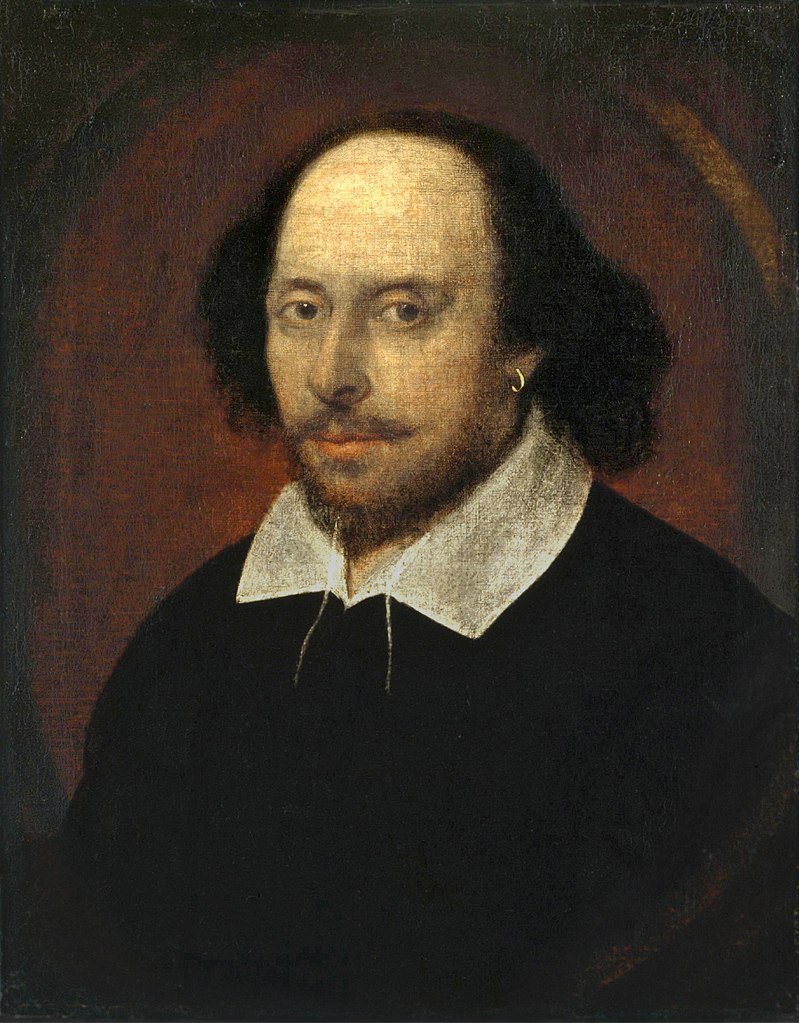
This was long thought to be the only portrait of William Shakespeare that had any claim to have been painted from life, until another possible life portrait, the Cobbe portrait, was revealed in 2009. The portrait is known as the “Chandos portrait” after a previous owner, James Brydges, 1st Duke of Chandos. It was the first portrait to be acquired by the National Portrait Gallery in 1856. The artist may be by a painter called John Taylor who was an important member of the Painter-Stainers’ Company.
National Portrait Gallery image via Wikimedia Commons.

[Winkler] accuses what she calls orthodox Shakespeare scholars of “a dogmatism of their own” on the issue, whereby “even to dabble in authorship questions is considered a sign of bad faith, a blinkered failure to countenance genius in a glover’s son.” Armed with this tendentious premise, along with the less contentious one that Shakespeare depicts female characters with unrivalled sympathy and insight, Winkler spins a hypothesis that Emilia Bassano, born in London in 1569 to Venetian immigrants, is a viable candidate for the true author.

Even as I read Winkler’s piece, I expected a denouement that it was all a piece of fiction, analogous to the enjoyable 2009 caper St Trinian’s 2: The Legend of Fritton’s Gold, which ends with buried treasure under the Globe Theatre and the discovery of Shakespeare’s true identity. It never came. The article was presented as a serious contribution to a debate in which Winkler has made a potentially historic discovery.

In British newspapers, there is a longstanding technique of obscuring a paucity of evidence in support of a preposterous thesis by posing it as a question. It’s been dubbed by the political commentator John Rentoul “Questions to Which the Answer is No” (QTWAIN). Winkler’s article employs the stratagem liberally. “Was Shakespeare’s name useful camouflage, allowing [Bassano] to publish what she otherwise couldn’t?” “Could Bassano have contributed [to literature] even more widely and directly?” In a moment of self-knowledge, Winkler asks: “Was I getting carried away, reinventing Shakespeare in the image of our age?” Yet she immediately supplies not the correct answer but yet another QTWAIN: “Or was I seeing past gendered assumptions to the woman who — like Shakespeare’s heroines — had fashioned herself a clever disguise?”

Feminist readings of Shakespeare have enriched literary criticism and scholarship in, among other areas, reconsidering genre distinctions and examining the effects of patriarchal structures on relations between the sexes. There is no decorous way of saying that Winkler’s article, by contrast, is a farrago that should never have been conceived, pitched, commissioned or published. Winkler credulously retails a series of purported mysteries about Shakespeare’s authorship that are no mystery at all, and repeats claims derived from Shakespeare denialists that any capable scholar would have been able to correct. She places particular stress on the work of a “meticulous scholar” Diana Price, who claims: “Writers in Elizabethan and Jacobean England left behind records of their professional activities. Shakespeare left behind documentation of his professional activities, but none is literary… He is the only alleged [emphasis added] writer of any consequence from the time period who left behind no personal evidence of his career as a professional writer.”

Price is neither meticulous nor a scholar (she designates herself “an independent scholar,” which should have caused Winkler greater wariness). As Alan Nelson of Berkeley University has put it, Price knows how to put a sentence together but she doesn’t know how to put an argument together.

We in fact have unimpeachable evidence of Shakespeare’s activities as a writer, far more than we do for, say, his fellow-dramatists John Webster or Cyril Tourneur, but by a series of rhetorical sleights-of-hand Price rules it all inadmissible. To give a single but weighty example: Shakespeare’s fellow actors John Heminge and Henry Condell assembled the First Folio of Shakespeare’s works, published in 1623, with Shakespeare’s name on the title page and his engraved image in the frontispiece, and with a laudatory poem by Ben Jonson referring to the author as “Sweet Swan of Avon.” Price dismisses this as evidence of authorship because it’s posthumous, coming seven years after Shakespeare’s death, even though the planning and publishing of the book must have taken years, and Heminge, Condell and Jonson all knew Shakespeare personally. This isn’t scholarship but sophistry.

A noteworthy example of Betteridge’s Law of Headlines. (As is, of course, the headline on this post.)

Convincing Children That Airfix Is Still Fun | James May’s Toy Stories | Spark

Filed under: History, Military, Randomness — Tags: , , , , , — Nicholas @ 02:00

Spark
Published on 6 Apr 2019

James May subjects traditional toys to spectacular, supersize challenges. Children have taken their attention by video games and mobile phones since they became heavily accesible, can they be convinced that outdated Airfix’s models are still fun?

Subscribe to Spark for more amazing science, tech and engineering videos – https://goo.gl/LIrlur

Content licensed from Plum Pictures to Little Dot Studios. Any queries, please contact us at: owned-enquiries@littledotstudios.com

#toys #Airfix #JamesMay #spark #sparkdocumentary #sciencedocumentary

« Newer PostsOlder Posts »

Powered by WordPress