Forgotten Weapons
Published on 19 Apr 2019This Hotchkiss machine gun and its tripod are lot #2027 in the upcoming April 2019 Morphy auction:
https://www.forgottenweapons.com/hotc…
The gun that became the Hotchkiss 1914 and served as the bulwark of French and American forces in World War One was actually first designed and patented by an Austrian officer; Adolph von Odkolek. He took his idea to the Hotchkiss company in Paris hoping to arrange for them to produce it under license. The design was inspected by Laurence Benet (chief engineer at Hotchkiss) and Henri Mercie (Benet’s assistant), and they concluded that the gun was not suitable for production. However, the core concept in the patent – Odkolek’s gas piston system – was a worthy one and would allow production of machine guns to compete with Maxim and Colt without violating their existing patents. So Benet arranged to simply buy the patent outright for a flat fee, and then Hotchkiss set about redesigning the gun to be much better.
The result was the model 1897, an air-cooled, strip-fed heavy machine gun that was sold to many different nations. It was improved in 1900, and between the two models sales were made to Japan, Mexico, Chile, Brazil, China, Spain, Ethiopia, Finland, Greece, Guatemala, Luxembough, Norway, Sweden, Turkey, Portugal, and Venezuela in a variety of calibers. The French government also purchased some Hotchkiss guns, primarily for colonial use. For the bulk of the metropolitan army, France opted to design its own gun in the state arsenals (which was the Modele 1907 St Etienne gun; which is suspiciously like a Hotchkiss with the operating direction of the parts reversed to avoid patent infringement).
When World War One broke out, and the need for vast quantities of machine guns became apparent, the Hotchkiss was finally adopted on a large scale by France. The commercial 1900 pattern was revised slightly (a better barrel-locking system and replacement of the shoulder stock with a D-ring rear handle) and some 45,000 would be produced by 1918. The Hotchkiss would supplant the 1907 St Etienne over the course of the war, as it was a more reliable and less expensive design. It would go on to serve the French military through the end of World War Two, gaining a reputation as a gun of unparalleled simplicity and reliability.
http://www.patreon.com/ForgottenWeapons
Cool Forgotten Weapons merch! http://shop.bbtv.com/collections/forg…
Contact:
Forgotten Weapons
PO Box 87647
Tucson, AZ 85754
May 22, 2019
Hotchkiss 1914: A French and American WWI Heavy MG
May 21, 2019
Armoured Vehicles of the Invasion of France 1940, by The Chieftain – WW2 Special
World War Two
Published on 20 May 2019The Chieftain takes you on an extensive walkthrough of the armoured vehicles used by both sides during the German invasion of France in 1940.
The Chieftain’s channel: https://www.youtube.com/user/TheChief…
The Brexit Party may be getting dirty foreign money! Call out the plod!
In the Guardian, totally neutral and disinterested journalists report on former Labour PM Gordon Brown’s call to investigate where the Brexit Party is getting its funding from:

The Electoral Commission is under mounting pressure to launch an investigation into the funding of Nigel Farage’s Brexit party because of concerns that its donation structure could allow foreign interference in British democracy.
Before Thursday’s crucial European elections, Gordon Brown has written to the Electoral Commission calling on it to urgently examine whether the party has sufficient safeguards on its website to prevent the contribution of “dirty money”.
The former Labour prime minister will use a speech in Glasgow on Monday to say an investigation into the Brexit party’s finances is urgent and essential.
“Nigel Farage says this election is about democracy. Democracy is fatally undermined if unexplained, unreported and thus undeclared and perhaps under the counter and underhand campaign finance – from whom and from where we do not know – is being used to influence the very elections that are at the heart of our democratic system,” he will say, according to pre-released extracts.
As Tim Worstall points out:
It’s actually an entire 13 paragraphs later that we get to the meat of the matter:
Only donations over £500 have to be declared under British law.
The Brexit Party is obeying every jot and tittle of electoral and fundraising law. This is the very system that the federast establishment set up itself. But, you know, the wrong people are succeeding under it so aspertions must be cast.
And guess what? The Electoral Commission isn’t going to get anything done by Thursday. Not even to be able to confirm that the law is being obeyed as it should be. But we’ve managed to get the propaganda out there that Nigel’s posse are bought by the Russians and that’s the point of it all anyway.
You might think me a little cynical here. But sadly I’m not. When I was working for Ukip the Times – Sam Coates it was – announced that we simply weren’t going to contest the next election. No reason given, no analysis performed, an apology of any prominence never was forthcoming. Just a bit of disinformation dropped into the public conversation there.
That’s how the federasts play and any governance system that has to play that way isn’t one we desire to be a part of, is it?
The Hell with the EU.
Of course, dirty anonymous foreign money sources can fund other groups too.
Warlocks and Warriors – Russian Myth – Extra Mythology
Extra Credits
Published on 20 May 2019Join the Patreon community! http://bit.ly/EMPatreon
When a soldier returns home from the battlefield, he finds the townspeople in fear of a warlock — but the solider wants to learn more about this fellow. And (un?)fortunately, the warlock is all too happy to tell…
Four “youths” vandalize model railway show
There don’t appear to be any details online about the four “youths” who were arrested then released, so I assume their anonymity is protected by a British equivalent of the “Young Offenders Act”. The Market Deeping Model Railway Club describes the crime on their website:
We were all immensely upset to discover that overnight the school where our show was to be held had been broken into and almost everything totally ruined. This has devastated not only our own members but those of other clubs and the traders who had already set up shop. In the circumstances we felt we had no option other than to cancel the show.
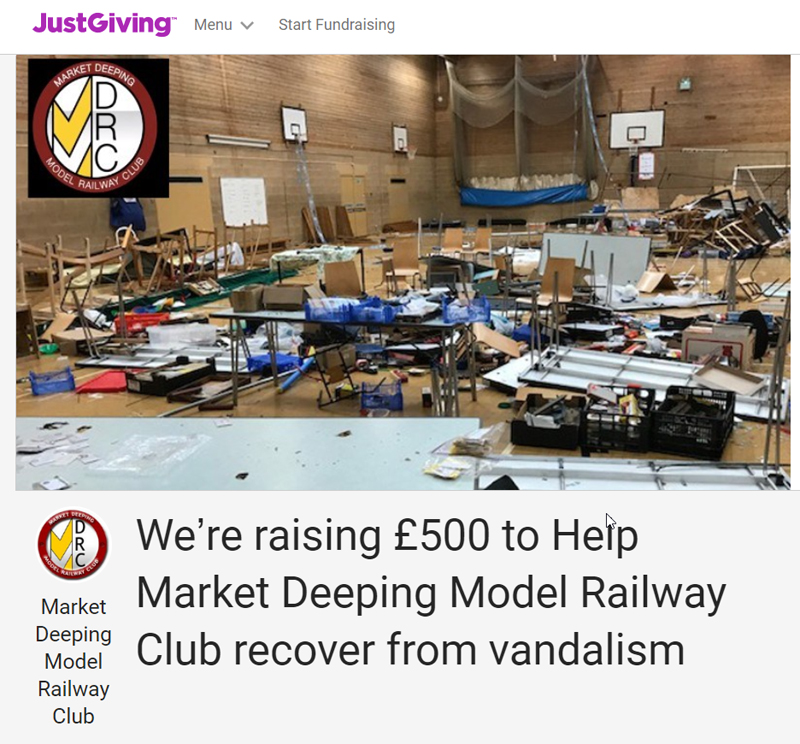
Some of the models destroyed were irreplaceable and while we will of course be seeking to replace and rebuild wherever possible, this will take time and money. We have been overwhelmed by the many messages of support we have received together with offers of financial assistance. Please do help raise funds via our Just Giving page.
Click the image to go to their Just Giving fundraising page.
More on the incident from Deepings Nub News:
Bill Sowerby, Market Deeping Model Railway Club exhibition manager, told Deepings Nub News: “I arrived at 7.30am to be met by one of our members who told me the terrible news.
“Four of the layouts were completely trashed – two of our club’s, one privately owned and one from St Neots club.
“Four demonstrator stands and one for Bourne U3A stall, which would have raised funds for their organisation, was also smashed.
“Fortunately five other layouts in another room were undamaged and we had nine more left to install early this morning.
“It’s really hurtful for us all, not just because of the thousands of pounds we have lost in income – we were expecting between 400 and 500 visitors – and have paid out a lot of money to put on what is the club’s main fundraising event. Demonstrators and trade stands have also lost income.
“But it’s also the time and effort that members put into building the layouts. The St Neots layout took 25 years to construct and our Woodcroft layout took 26 years and involved more than 100 people over those years spending thousands of hours.
“Woodcroft will be repaired, but it’s so sad because a large number of the people who dedicated their time to build it are no longer with us. It has real sentimental importance to the club.
“Although our Knowl End – a children’s layout – was completely destroyed.”
Tips for Cleaner Miter Saw Cuts
WoodworkersJournal
Published on 8 Oct 2015Eliminate tearout and take your saw’s cutting performance to the next level quickly and easily.
Visit our website for the best woodworking projects and lessons:
http://www.woodworkersjournal.com/
May 20, 2019
Britain’s InterCity 125 has run its last revenue miles
Tim Worstall explains why the withdrawal of the InterCity 125 has struck a chord in commuters and railfans alike:
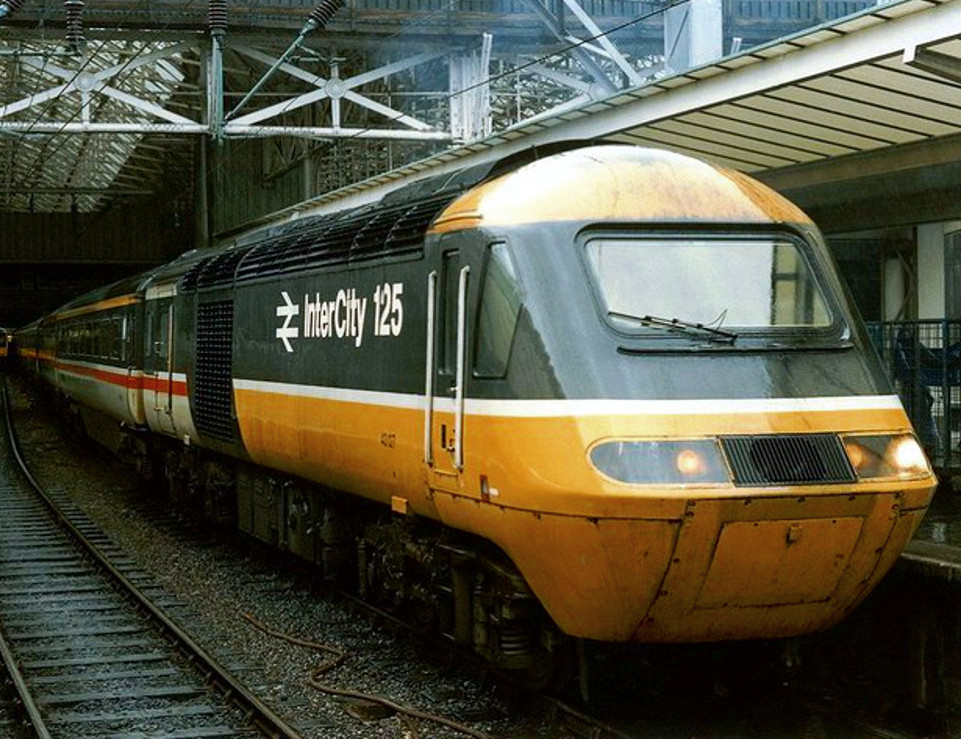
An InterCity 125 power car in British Rail livery at Manchester Piccadilly in October 1976.
Photo by Dave Hitchborne via Wikimedia Commons.
The last run was between London’s Paddington Station and Exeter St. Davids. There’s an amusing anecdote about the development and testing of the locomotives that I thought I’d blogged, but better late than never:
There’s something called the chicken gun. If you’ve a jet engine then you want to make sure that it doesn’t fall apart in a bird strike. Shards of sharp metal flying around at hundreds of miles an hour are not known to be good for aluminium skinned modes of transport hundreds or thousands of feet off the ground.
So, you set up a cannon, spin the jet engine up and fire a chicken into it. […] Great. So, bright sparks at British Rail noted that their train was going to be hurtling through the countryside at 125 miles per hour. There would be cuttings and embankments and birdies flying around and the possibility of bird strikes. Better test this out.
So, borrow the chicken gun. Load chicken, fire. The carcass goes straight through the reinforced glass, through the steel back of the driver’s seat and embeds itself in the back wall of the engine compartment.
Umm, is it supposed to do that? No, it bloody well isn’t.
So, long pondering, they enlist the help of the Americans they’d borrowed the chicken gun from. Big report finally arrives, hundreds of pages of analysis, tensor strengths, bits of Fortran coding, the lot.
On the first page it reads
“In order to use the chicken gun, first defrost your chicken”.
The Evolution Of Knightly Armour – 1066 – 1485
Metatron
Published on 16 May 2017A video full of details which took over 30 hours in the making. I hope you like it and you find the info in it useful 😀
Armour (spelled armor in the US) is a protective covering that is used to prevent damage from being inflicted to an object, individual, or vehicle by weapons or projectiles, usually during combat, or from damage caused by a potentially dangerous environment or action. The word “armour” began to appear in the Middle Ages as a derivative of Old French. It is dated from 1297 as a “mail, defensive covering worn in combat”. The word originates from the Old French armure, itself derived from the Latin armatura meaning “arms and/or equipment”, with the root armare meaning “arms or gear”.
Armour has been used throughout recorded history. It has been made from a variety of materials, beginning with rudimentary leather protection and evolving through mail and metal plate into today’s modern composites.
Significant factors in the development of armour include the economic and technological necessities of its production. For instance, plate armour first appeared in Medieval Europe when water-powered trip hammers made the formation of plates faster and cheaper.Well-known armour types in European history include the lorica hamata, lorica squamata, and lorica segmentata of the Roman legions, the mail hauberk of the early medieval age, and the full steel plate harness worn by later medieval and renaissance knights, and breast and back plates worn by heavy cavalry in several European countries until the first year of World War I (1914–15). The samurai warriors of feudal Japan utilised many types of armour for hundreds of years up to the 19th century.
Plate armour became cheaper than mail by the 15th century as it required less labour, labour that had become more expensive after the Black Death, though it did require larger furnaces to produce larger blooms. Mail continued to be used to protect those joints which could not be adequately protected by plate.
The small skull cap evolved into a bigger helmet, the bascinet. Several new forms of fully enclosed helmets were introduced in the late 14th century.By about 1400 the full plate armour had been developed in armouries of Lombardy. Heavy cavalry dominated the battlefield for centuries in part because of their armour.
Probably the most recognised style of armour in the World became the plate armour associated with the knights of the European Late Middle Ages.
A “cutting-edge mediaeval Catholic” view of the modern economy
David Warren explains some of his disquietude about our modern world:
Gentle reader may object that none of these entities is a government department, except insofar as it is the subject of taxes and regulations, and as it grows larger, an ever more formidable force in lobbying for subsidies and legislation favourable to itself. Objection sustained. Verily, this is just my point.
Each entity made its way until the gobbling by means of mass consumer advertising, in which morally illegitimate methods of persuasion — principally hype, actual lies, irrelevant claims and endorsements — are instrumental to sales success. Honest advertising (e.g. catalogues with exact descriptions) is theoretically possible but practically extinct; campaigns are based on the tawdry manipulation of human “perceptions” — behaviourist psychology at the level of Ivan Petrovich Pavlov, but elaborately quantified, with financial and pricing arrangements factored in.
Indeed, one may link most disastrous marketing decisions to the decline of intuitive reasoning, as statistical reasoning takes its place. The manager who knows in his gut, from experience, what might work and what won’t, or can’t, is displaced by the young analyst with computer modelling skills and all the jargon of “science” to express the platitudes he was drip-fed in school.
But here, too, “private” and “public” enterprise are fully integrated. Both are adapted to the “planning” paradigm, and each is utterly dependent on the other, in what is misleadingly called “the mixed economy.” The critics of abstract Capitalism, on the one side, and abstract Socialism, on the other, draw a false contrast between two administrative orders, when they are both bureaucratic in nature, inhumanly oversized, and habitually dedicated to the pursuit of monopoly.
Several of the readers with whom I correspond are under the immovable impression that I am against making money, or improvements in technology, per se. In fact my outlook is cutting-edge mediaeval Catholic. The moral questions are instead such as, How is the money made? And, for what are the improvements to be used? As I must remind e.g. my Chief Texas Correspondent, I am not against electricity or indoor plumbing. But I am against worshipping such things, or making them the criteria for high civilization.
A Guide to Dark Age British Politics
History With Hilbert
Published on 26 Sep 2017A beginner’s guide to the politics of Dark Age Britain, from the southern Celts to the Anglo-Saxon kingdoms and the Pictish north.
QotD: Victoria Day
Happy Victoria Day, the day we honour an old queen by giving her not a moment’s thought. A year or two back, some professor thought we should change Victoria Day to Heritage Day to “strengthen our heritage.” We strengthen our heritage by obliterating it, apparently. … She was our first wholly constitutional monarch, and thus a critical figure at a critical time: She embodies the principle of peaceful evolution that distinguishes the Britannic world from … well, pretty much everywhere else, come to think of it.
Mark Steyn, “Victoria Day”, The National Post, 2002-05-20.
May 19, 2019
Siege of Vienna & Queen Nzinga – Lies – Extra History
Extra Credits
Published on 18 May 2019Writer Rob Rath talks about all the cool stories and facts we didn’t get to cover in our two special short series on the Siege of Vienna, and the life of Queen Nzinga.
Join us on Patreon! http://bit.ly/EHPatreon
From the comments:
Extra Credits
Timestamps:
2:00 – Demonetization sucks. THANK YOU PATRONS!
7:15 – Istanbul was Constantinople now it’s Istanbul not Constantinople been a long time gone oh Constantinople
11:07 – the arrival of the Winged Hussars wasn’t exactly the same as Rohan answering Gondor’s call for aid
16:20 – Nzinga’s controversial role in slavery
19:25 – what’s next on Extra History?
21:02 – SIX DEGREES OF WALPOLERecommended reading:
The Enemy at the Gate: Habsburgs, Ottomans, and the Battle for Europe by Andrew Wheatcroft
The Siege of Vienna: The Last Great Trial Between Cross & Crescent by John Stoye
Hispanics and the Civil War: From Battlefield to Homefront by the National Park ServiceMusic videos:
Queen Nzinga: https://www.youtube.com/watch?v=N94H6F0WObcSiege of Vienna: https://www.youtube.com/watch?v=jQ_HV57cgbg
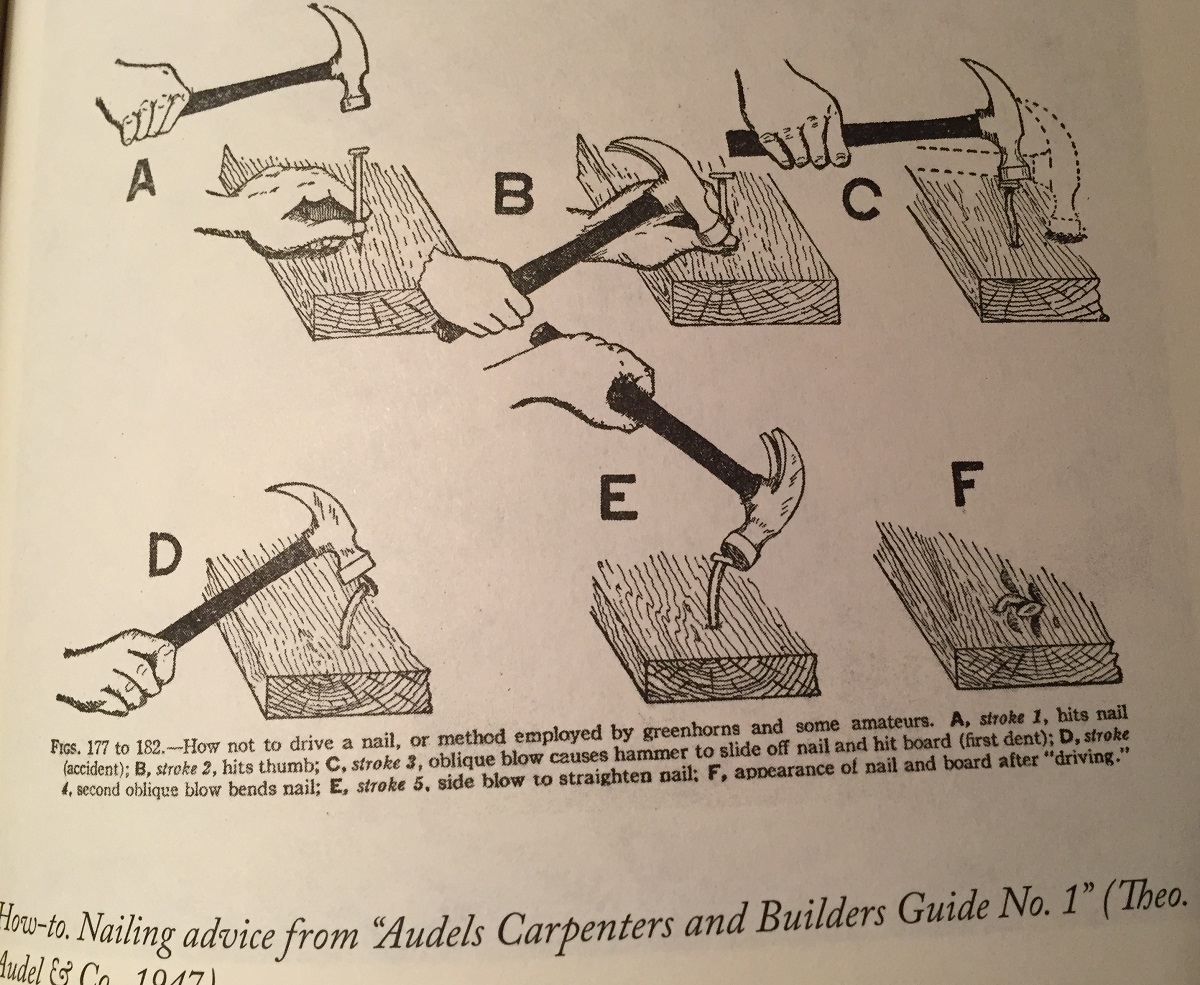
How not to drive a nail
In Christopher Schwarz’s recent The Anarchist’s Design Book, he includes a set of illustrations from a 1947 publication, which appear to still be 100% accurate: