
Marginal Revolution University
Published on 21 Nov 2017Many economic downturns throughout human history can be explained by real business cycle (RBC) theory. So what makes this theory “real” and what are its drawbacks? We’ll cover both in this five-minute tour of RBC.
May 25, 2019
Game of Theories: Real Business Cycle
Comments Off on Game of Theories: Real Business Cycle
May 24, 2019
Making a DRILL PRESS TABLE (Part 1)
Matt Estlea
Published on 23 May 2019As a little interlude project I decided that my drill press table needed an upgrade using a UJK Track and Stop Kit. Let’s get going!
_Support what I do by becoming a Patron! This will help fund new tools, equipment and cover my overheads. Meaning I can continue to bring you regular, high quality, free content. Thank you so much for your support! https://www.patreon.com/mattestlea
_See what tools I use here: https://kit.com/MattEstlea
My Website: http://www.mattestlea.com
_My name is Matt Estlea, I’m a 23 year old Woodworker from Basingstoke in England and my aim is to make your woodworking less s***.
I come from 5 years tuition at Rycotewood Furniture Centre with a further 1 year working as an Artist in Residence at the Sylva Foundation. I now teach City and Guilds Furniture Making at Rycotewood as of September 2018.
I also had 5 years of experience working at Axminster Tools and Machinery where I helped customers with purchasing tools, demonstrated in stores and events, and gained extensive knowledge about a variety of tools and brands.
During the week, I film woodworking projects, tutorials, reviews and a viewer favourite ‘Tool Duel’ where I compare two competitive manufacturers tools against one another to find out which is best.
I like to have a laugh and my videos are quite fast paced BUT you will learn a lot, I assure you.
Lets go make a mess.
Comments Off on Making a DRILL PRESS TABLE (Part 1)
Ontario universities’ “quarter-million dollar club”
Being a tenured university professor is generally a well-paid job, even in Canada. But thanks to an unintended interaction between pension legislation and retirement policies, older tenured professors are required to draw their pensions (which are pretty damned good by themselves) and their salaries from the university, which boosts many of them well into the quarter-million a year range:
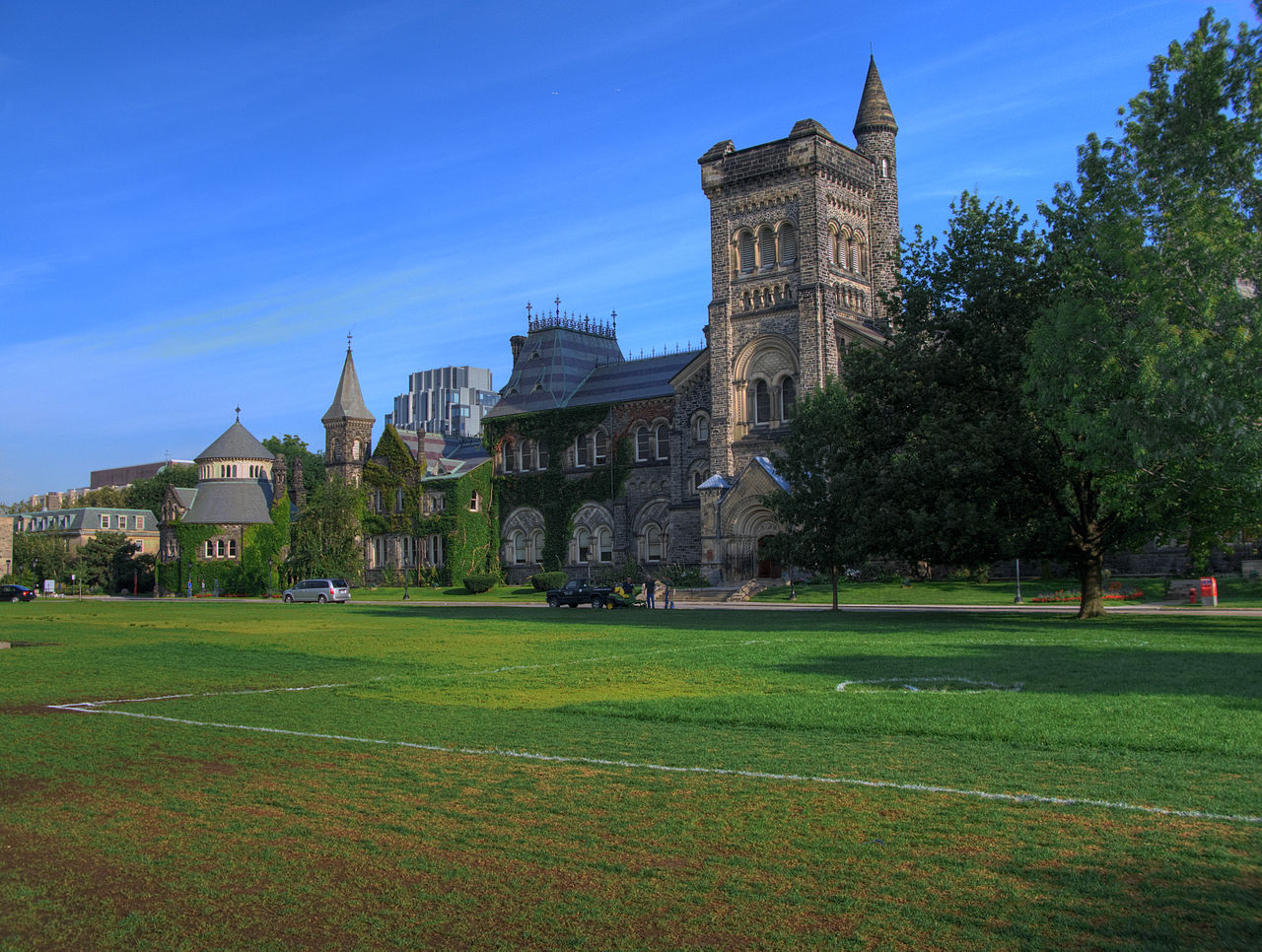
University College, University of Toronto, 31 July, 2008.
Photo by “SurlyDuff” via Wikimedia Commons.
Ontario is a weird place sometimes. One month ago, the government announced that it was implementing a performance-based funding plan which – if you took the government’s half-thought-out comments seriously – raised the possibility that hundreds of millions or perhaps even billions of dollars currently projected to be spent on institutions might be snatched away if institutions failed to hit some ill-defined targets in a type of contract-based funding system. You’d think this would be a big deal, something people would want to talk about and discuss.
But no. Somehow, this is not what is currently obsessing the Ontario university sector. Instead, apparently, we need to talk about how it’s a human rights violation for professors to be asked to enjoy their retirement on a six-figure annual pension.
Crazy? Well, yes. Here’s the deal. Time used to be that universities could tell professors to retire at age 65 or 67 or whenever. Over the course of the 2000s, provinces gradually got rid of mandatory retirement; in Ontario this occurred in 2006, when the provincial government amended the Human Rights Code to that effect. It should have surprised absolutely no one that more and more full professors, who towards the end of their career routinely make over $180,000 per year, decided to delay retirement not just past 65 but pretty much forever. In 2011, only 6.7% of professors were over 65 and 0.9% 70 or over. Just five years later in 2016, that was up to 10.2% and 3.3% respectively. At the time, I estimated that the compensation costs for the over-65s amounted to $1.3 billion, or enough to hire about 10,000 new junior faculty. The share of that going to the 70-pluses would amount to a little north of $400 million.
But here’s the thing: federal pension legislation requires individuals to start drawing down their pensions at age 71. You can’t opt-out. And so as a result you get individuals who are in what Carleton University economist Frances Woolley recently called the “quarter-million dollar club” (do read Frances’ piece – everything she does on higher education is excellent, but she is extra-excellent on this one). Even if you understand the legislative path that led us here, you probably – rightly – think this is an outrageous sum, particularly in light of the fact that research productivity tends to decline over time and teaching loads among full professors are not all that onerous.
On the other side of the pond, a recent tribunal ruling at Oxford’s St. John’s College points in a very different direction:
Oxford and Cambridge universities can force old professors to retire in order to boost diversity, a tribunal ruling suggests.
Prof John Pitcher, a leading Shakespeare scholar and fellow at St John’s College at Oxford, claimed that he had been unfairly pushed out at age 67 to make way for younger and more ethnically diverse academics.
He sued the College and university for age discrimination and unfair dismissal, claiming loss of earnings of £100,000 – but Judge Bedeau dismissed both claims.
Comments Off on Ontario universities’ “quarter-million dollar club”
“No Bullets Fly” – Charlie Brown and Franz Stigler – Sabaton History 016
Sabaton History
Published on 23 May 2019Heroism isn’t always measured in blood or danger. Sometimes, to spare your foe is the honourable thing to do. A dramatic example comes in the shape of the American Charlie Brown and German Franz Stigler. Brown was flying his heavily damaged B17 “Flying Fortress” bomber home after a demanding bombing run on Bremen when Franz Stigler in his fighter plane caught sight of its tail. This story is about the encounter between the two enemies and the song that Sabaton wrote about it, called “No Bullets Fly” (on the Heroes album).
Support Sabaton History on Patreon: https://www.patreon.com/sabatonhistory
Find A Higher Call, the book that inspired “No Bullets Fly” here: https://www.valorstudios.com/a-higher…
Check out the trailer for Sabaton’s new album The Great War right here: https://www.youtube.com/watch?v=HCZP1…
Listen to Sabaton on Spotify: http://smarturl.it/SabatonSpotify
Official Sabaton Merchandise Shop: http://bit.ly/SabatonOfficialShopHosted by: Indy Neidell
Written by: Markus Linke and Indy Neidell
Directed by: Astrid Deinhard and Wieke Kapteijns
Produced by: Pär Sundström, Astrid Deinhard and Spartacus Olsson
Creative Producer: Joram Appel
Executive Producers: Pär Sundström, Joakim Broden, Tomas Sunmo, Indy Neidell, Astrid Deinhard, and Spartacus Olsson
Maps by: Eastory
Edited by: Iryna Dulka
Sound Editing by: Marek Kaminski
Eastory YouTube Channel: https://www.youtube.com/channel/UCEly…
Archive by: Reuters/Screenocean https://www.screenocean.com
Music by Sabaton.Sources:
IWM: CL 3395
Plane drawing by EmoscopesAn OnLion Entertainment GmbH and Raging Beaver Publishing AB co-Production.
© Raging Beaver Publishing AB, 2019 – all rights reserved.
Comments Off on “No Bullets Fly” – Charlie Brown and Franz Stigler – Sabaton History 016
Ottawa chooses boring names for their new light rail trains
OC Transpo, the Ottawa area transit authority, ran a contest for children to suggest names for their new light rail trains. Being bureaucrats, they carefully avoided choosing some rather clever names the kids suggested:

Ottawa O-Train leaving St.Laurent Station tunnel, January 2018
Photo by “Saboteurest” via Wikimedia Commons.
When commuters and tourists finally do step on to the $2.1 billion light-rail system – already more than two years behind schedule – they’ll ride Maple Taffy, Snowbird or Northern Lights, when they could’ve boarded Shania Train or Roberta Bondcar, a witty nod to Canada’s first female astronaut.
Culled from entries restricted to children 16 and under, winning selections that consisted largely of Canadian clichés favoured by the City of Ottawa, was not due to a lack of overall creativity from the youth who participated.
Zooming Poutine, The Queensway Cruise and Sir Chuggsalot were overlooked for winning selections Poppy, Totem and Tundra. Galloping Goose, Tunnel Beaver and The Speed Beaver were also overlooked by judges, who preferred The Canada Goose, Majestic Moose and Nanuq/Polar Bear.
Even Ottawa professional sports teams and fan-favourites like former Senators’ stars Daniel Alfreddson and Erik Karlsson – The Alfie and Karlsson Express – didn’t make the cut, while Rocket Richard, the Montreal Canadiens legend, will rub this in at every stop his train makes.
[…]
But perhaps the most glaringly overlooked multiple-entry from the more historically-minded youth was Thomas Ahearn, a local inventor and founder of the Ottawa Electric Railway Company which built the city’s original streetcar system.
Judges also denied Justin Traindeau and The Jimmy Wagon (a wink at current Ottawa Mayor Jim Watson), and weren’t keen on Sorry, NIMBY Express, Taxed To Death and Da Sink Hole from the more politically sardonic kids; the latter a jab at the huge pit rail construction opened up on Rideau Street.
Comments Off on Ottawa chooses boring names for their new light rail trains
Game of Theories: The Monetarists
Marginal Revolution University
Published on 14 Nov 2017Meet the monetarists! This business cycle theory emphasizes the effect of the money supply and the central bank on the economy. Formulated by Nobel Laureate Milton Friedman, it’s a “goldilocks” theory that argues for a steady rate of fairly low inflation to keep the economy on track.
Comments Off on Game of Theories: The Monetarists
QotD: Politics and culture
… sometimes Mark Steyn seems like the only conservative you can discuss these issues with, because most Republicans think popular culture is beside the point, if not downright dangerous. Steyn, on the other hand, has performed “Kung Fu Fighting” before thousands of people in civic auditoria more accustomed to Mary Kay Cosmetics conventions, so he gets it.
“Social conservatives are always editing pop culture,” says Steyn, “and it’s completely pathetic. Conservatives play to the caricature. Mention a French movie and the crowd turns on you. It’s a reductive view of the world. There are ideological enforcers casting aside works of art because they contain bad words or uncomfortable associations. It’s one of the biggest abdications of the American right. Who gives a crap about who gets elected to the Congressional district in Ohio? — that’s not going to change the culture. It’s movies that move the culture. And if you abdicate that space, you lose. Jeb Bush spent a billion dollars to get 2.8 per cent of the vote in Iowa. Mitt Romney and people like him who have a billion dollars — don’t spend it on politics, buy a TV network! Theatre, movies, music, that’s where the battles are fought. They’ve abdicated that space in the schools. As a result, my kid had to sit through Al Gore’s lousy movie three times. All effective storytelling is inherently conservative — because your choices have consequences. For the Left, nothing has consequences. But the trends are all in the Left’s direction, because the Right got out of the game — they chose to make themselves culturally irrelevant. If you’re not in the same room, having the conversation, there’s not gonna be a solution.”
Mark Steyn, interviewed by John Bloom, “Mark Steyn, Cole Porter and Free Speech”, Quadrant, 2017-05-11.
Comments Off on QotD: Politics and culture
May 23, 2019
Those “theories of history”
At Rotten Chestnuts, Severian starts off talking great-man versus vast-impersonal-forces-of-history then segues into passivity (not Severian’s, but the widespread use of the passive voice):
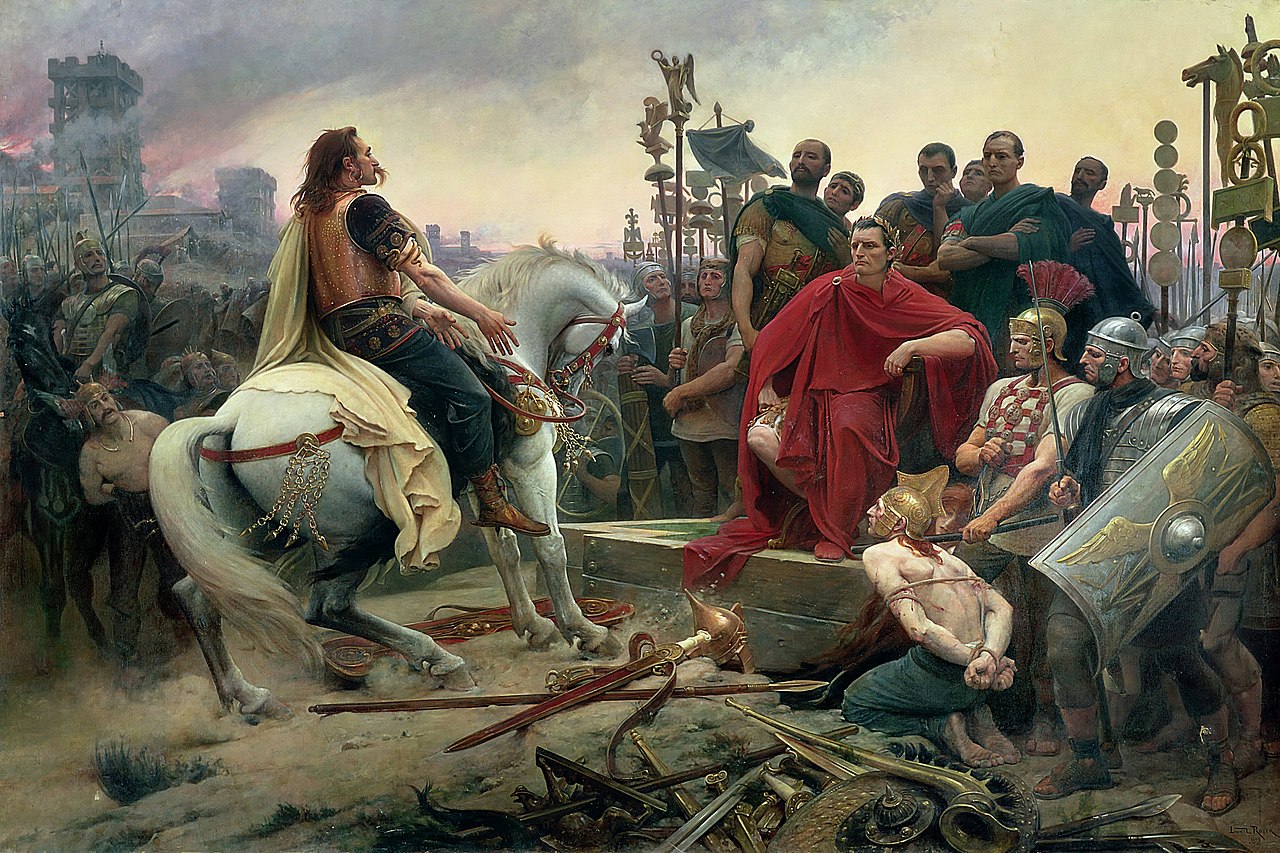
Lionel Royer (1852-1926). Vercingetorix jette ses armes aux pieds de Jules César (Vercingetorix throws down his arms at the feet of Julius Caesar)
The painting depicts the surrender of the Gallic chieftain after the Battle of Alesia (52 BC). The depiction of Gauls with long hair and mustaches is also called into question today. The horse is a Percheron, although at this time this breed was not in Gaul. The rectangular shield also does not accord with the time when they were mostly oval.
Musée CROZATIER du Puy-en-Velay. — http://www.mairie-le-puy-en-velay.fr/ via Wikimedia Commons.
Academics, of course, are all in on “social” explanations of historical phenomena. Being weak, ineffective people themselves, with no experience of life, the very idea of a Caesar frightens and repels them… so they construct theories of History in which it is impossible for a Caesar to exist. On this view, “social forces” (what they used to call “the relations of the means of production”) tore the Roman Republic apart; the Empire was its inevitable next stage. Assign whatever name you like to the Imperator — whether Caesar, Marius, Sulla, or Miles Gloriosus, he’s just the temporary face of the vast, impersonal social forces that control our fate. None of this “History is just the biographies of great men” for them!
The eggheads have a point, though, albeit not the one they think they’re making. The Roman elite’s social system was designed to produce a certain type of man. Whether Gaius Julius Caesar was personally the embodiment of that system, or a perversion of it, is irrelevant — the system was designed to produce men like Caesar, fellows with a very particular set of skills. Eggheads have never seen one, but anyone who has kicked around the world outside the ivory tower for a bit has met that type of guy. The skills themselves are fairly common, at least in embryo. Whether a potential Caesar becomes actual might well be merely a question of opportunity and scale.
A terrifying notion, that, when you look around the modern West. The one characteristic all effective elites have in common is the self-knowledge that they are the elite. The British, for instance, thought nothing of sending some 19 year old kid, whose slim formal education was mostly Latin and Greek, off to govern the Punjab. It worked, largely because that kid, whatever his defects of intellect and ability, had character, of the kind you just don’t get without a pedigree stretching back to Hastings.
Again, if you’ve ever met one of the horsey set you know what I’m talking about. If you haven’t, the most accessible American equivalents are the sons and grandsons of career army officers. Think of Lieutenant Dan in Forrest Gump, as played by Gary Sinise in the movie. That kind of guy always completes the mission, or dies trying, because it’s simply unthinkable that he won’t. After five generations, West Point is in his DNA…
Comments Off on Those “theories of history”
The early days of the S.A.S.
Lindybeige
Published on 31 Oct 2017One of the world’s most famous regiments was nearly disbanded after one disastrous mission.
Support me on Patreon: https://www.patreon.com/LindybeigeI forgot to say that David Stirling was twenty-five years old when recovering from his injury and dreaming up the future SAS. Within two years, all the major airfields within 300 miles of the front had been raided by the SAS, some of them up to four times.
The camouflage used on the vehicles of the LRDG, and later the SAS, was rose pink and olive green, and by all accounts it worked very well.
Main sources: SAS Rogue Heroes by Ben Macintyre, Eastern Approaches by Fitzroy Maclean.
Lindybeige: a channel of archaeology, ancient and medieval warfare, rants, swing dance, travelogues, evolution, and whatever else occurs to me to make.
▼ Follow me…
Twitter: https://twitter.com/Lindybeige I may have some drivel to contribute to the Twittersphere, plus you get notice of uploads.
website: http://www.LloydianAspects.co.uk
Comments Off on The early days of the S.A.S.
The Supreme Court of Canada goes on a roadtrip
John Carpay explains why the Supreme Court’s junket in September isn’t a good idea:
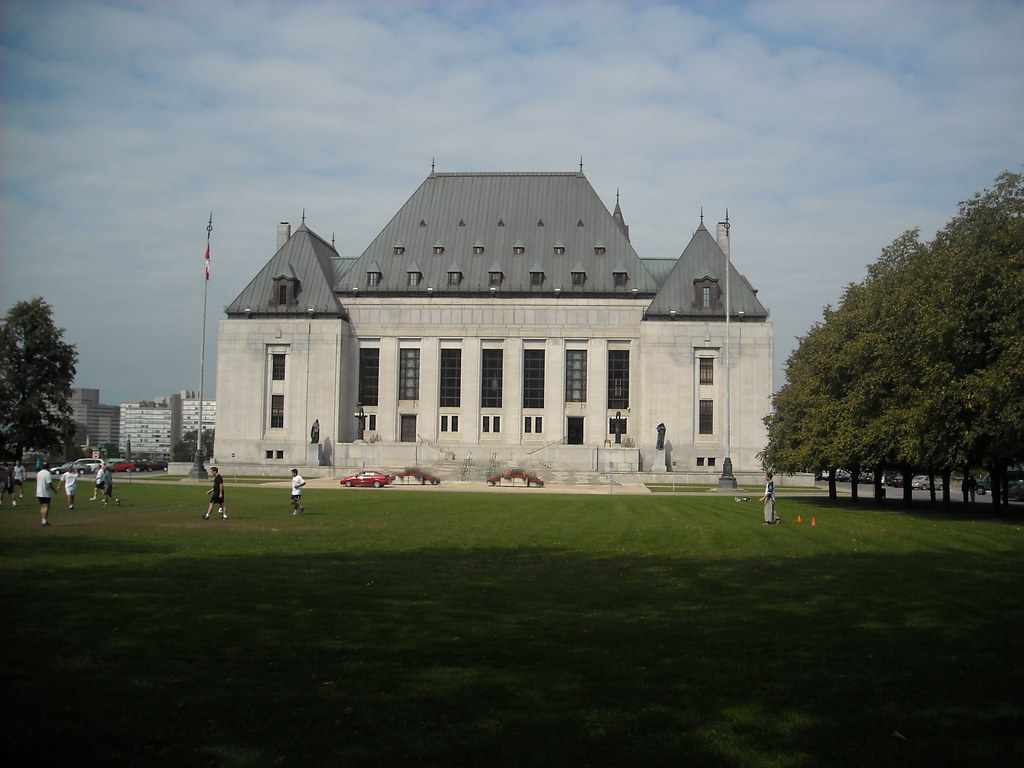
“Supreme Court of Canada, Ottawa”by daniel0685 is licensed under CC BY 2.0

While hearing two cases in Winnipeg rather than Ottawa is a friendly gesture, the Court’s choice of which groups to meet with – and not meet with – in Winnipeg is necessarily a political choice. If you thought the Court would meet with Ukrainians and Germans (Manitoba’s two largest non-English ethnic communities), prisoners, seniors, taxpayer groups and English language rights activists opposed to official bilingualism, you would be wrong.
In fact, the Court has announced that it will meet with “indigenous communities, the francophone community, the legal community, and students.” What message does this send to the Canadian public, which wants an impartial court deciding on aboriginal claims? What does meeting with the francophone community in Winnipeg say in relation to the Court hearing a case about minority language educational rights? And what if university tuition payments were at the heart of a case that came before the SCC, with its Justices having met only with students, but not with taxpayers?
As Canadians, the Supreme Court judges already interact with the public in their private lives, in Ottawa and elsewhere. One could reasonably assume that the nine lawyers appointed to this Court each meet individually with various people regularly, on the basis of friendship, shared interests, or family obligations. The people with whom any one judge meets over the course of a year would likely not form a perfect microcosm of Canadian society, in terms of race, religion, political views, income, and level of education. This is to be expected, and there is nothing wrong with it, because the personal connections formed by any one judge are not publicly endorsed by the Court. Not so for these meetings of “the Court” as a whole in Winnipeg, which is what makes the Court’s exclusion of many groups worrisome.
Chief Justice Wagner would no doubt respond to the above by saying that he and his colleagues will do their very best to decide all cases impartially, regardless of which groups they chose to meet with (and not meet with) in Winnipeg. And he would be right.
But that doesn’t solve the problem. The Court has made a political decision to meet with francophones, not English language rights activists; lawyers not prisoners; students not seniors; aboriginals not Germans or Ukrainians. In view of the ancient and centrally important legal maxim, “Not only must justice be done; justice must be seen to be done,” the Court should not be making these political decisions in the first place, in order to avoid even the appearance of possible bias.
It’s bad enough that the Prime Minister is seen to be putting a thumb on the scales of justice, but much worse if the highest court in the land is perceived to be doing the same thing.
Comments Off on The Supreme Court of Canada goes on a roadtrip
Game of Theories: The Keynesians
Marginal Revolution University
Published on 7 Nov 2017When the economy is going through a recession, what should be done to ease the pain? And why do recessions happen in the first place? We’ll take a look at one of four major economic theories to find possible answers – and show why no theory provides a silver bullet.
Comments Off on Game of Theories: The Keynesians
QotD: “Prestige” TV shows
Just a bugaboo of mine: These “Prestige” TV show seem to think that a bore-you-to-tears pacing is a de facto marker of “quality writing and deep characterization,” and most TV critics aren’t hip enough to get the con. A lot of these shows’ very slow pace suggests to me they are being written with a target audience of people “multitasking” on the computer as they half-watch in mind. I guess when you’re mostly reading Instagram while the TV is on, you maybe don’t notice that nothing has happened in the past three minutes. And I guess if you’re one of the one-eye-on-tv-one-eye-on-twitter crowd, you need nothing to happen for long stretches, or else you’ll be missing important stuff.
Ace, “Does ‘Prestige TV’ Just Mean Slow, Tedious, Unpleasant and Dimly-Lit?”, Ace of Spades H.Q., 2017-05-15.
Comments Off on QotD: “Prestige” TV shows
May 22, 2019
Making a Hexagonal Bowl | Turning Tuesday
Matt Estlea
Published on 21 May 2019In this video, I have a go at making a hexagonal bowl and inadvertently end up making a lethal weapon.
________________________________________________________________Support what I do by becoming a Patron! This will help fund new tools, equipment and cover my overheads. Meaning I can continue to bring you regular, high quality, free content. Thank you so much for your support! https://www.patreon.com/mattestlea
________________________________________________________________See what tools I use here: https://kit.com/MattEstlea
My Website: http://www.mattestlea.com
________________________________________________________________My name is Matt Estlea, I’m a 23 year old Woodworker from Basingstoke in England and my aim is to make your woodworking less s***.
I come from 5 years tuition at Rycotewood Furniture Centre with a further 1 year working as an Artist in Residence at the Sylva Foundation. I now teach City and Guilds Furniture Making at Rycotewood as of September 2018.
I also had 5 years of experience working at Axminster Tools and Machinery where I helped customers with purchasing tools, demonstrated in stores and events, and gained extensive knowledge about a variety of tools and brands.
During the week, I film woodworking projects, tutorials, reviews and a viewer favourite ‘Tool Duel’ where I compare two competitive manufacturers tools against one another to find out which is best.
I like to have a laugh and my videos are quite fast paced BUT you will learn a lot, I assure you.
Lets go make a mess.
Comments Off on Making a Hexagonal Bowl | Turning Tuesday
Climate change, no, climate crisis, no, climate catastrophe, no, we mean climate APOCALYPSE!!!
The official marching orders for journalists now insist that the language to use around what was formerly “global warming” or “climate change” will now be described in starker, more frightening terms. Canada’s Liberal Party, under Justin Trudeau, has been virtue signalling for pretty much its entire term in office on the climate issue and with a fall election coming into view, the rhetoric will become more extreme and shrill. Jay Currie discusses climate change and the Canadian election:
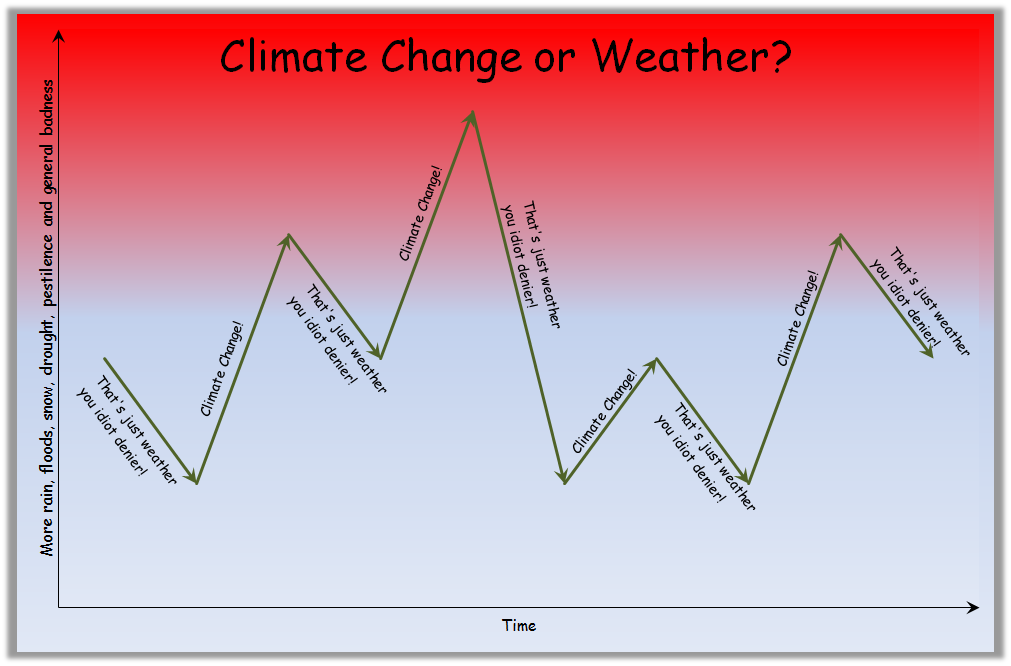
I suspect this divide between people who think “doing something” about climate change (no matter how futile) and people who do not accept the urgency of dealing with something they really don’t believe in will inform politics in the West for the next few years. Most particularly, it will inform the next Canadian federal election.
The Liberal Party of Canada has been going all in on its “tax on carbon pollution” (a fine bit of wordsmithing managing to attach “carbon” to “pollution”). Led by the remarkably scolding Catherine McKenna, the Libs seem to think that purporting to “do something” about climate change is a vote winner. So McKenna tours the country speaking to uncritical school children and assorted environmentalists about how important having a “carbon tax” is. The Liberals tax will save the planet, ensure sea level rise stops (easy because sea level is not actually rising), save the Arctic ice cap (already saving itself, thank you), keep polar bears from extinction (also easy because virtually all polar bear populations are growing) and reduce or eliminate climate change “caused” weather events. Plus, Canada will honour its Paris Accord commitments (we won’t) and serve as a beacon to lesser nations like China and India in their efforts to combat climate change (as if).
The Liberals think that the fact that a carbon dioxide tax in Canada will have a rounding error effect on worldwide emissions and no detectable effect on world temperature does not matter politically. What matters politically is that the Liberals believe that there is a large constituency out there which urgently wants to “do something”.
The NDP is fully on board and, of course, the Greens have been banging the climate change drum forever. Andrew Scheer’s Conservatives seem to be on the fence. Like the Coalition in Australia, the Conservatives endorse the “climate change is a problem” line and very few are willing to challenge the underlying science or economics for fear of being branded uncool “climate change deniers”. But the Conservatives seem to be, prudently in my view, dragging their feet on “doing something” about CO2.
Political virtue signalling on the climate file is the easy part. All that is really required is the abandonment of any sort of scientific judgement (easy when you are told that all the scientists agree that climate change is real and primarily human caused) and policy skepticism (we don’t need a cost benefit analysis, this is an emergency!). The hard part occurs when you try to “do something”. Because doing something means that people are going to see their expenses rise without actually seeing (in any tangible way) any actual benefit. In fact, as Ontario’s wonderfully disastrous adventure in wind energy demonstrated, tax dollars can be wasted and consumer prices increased all without making any difference at all to the climate.
Comments Off on Climate change, no, climate crisis, no, climate catastrophe, no, we mean climate APOCALYPSE!!!


