It’s a common observation that teenage boys’ teams can compete — and beat — professional or national competitive womens’ teams in many sports. I’d always assumed that greater male muscle mass and overall strength were the primary reason for this, but Lorenzo Warby points out that strength differences do not completely explain the competitive disparity:

Babylon Bee pokes fun at the US Women’s Team
Social media provides the technology to strongly increase the social signalling and the shunning and shaming that moralises disagreement in service of shared status games. To put it another way, social media upscales social/relational aggression that attacks people’s social standing on the basis of ostentatious moral or social concern.
Because believing X is such performative way of grading people, believing-X makes you a good person creates purity-spirals as people up-the-ante to make their signal — their moral piety display — more salient and reduce competition for positions. It also attracts and empowers the personality disordered — specifically Cluster B’s — as believing-X makes you a good person requires so little to join the status game and advantages those who are manipulatively unrestrained. In other words, it acts as a negative character test, that selects for people of bad moral character.
The inability to admit ever being wrong goes with the moralising of disagreement and identity-through-belief.
Social media does not enable the up-scaling of physical aggression, although it does enable the transmission of threats of such. By contrast, social media — with its electronic mobbing — is a very effective medium for emotional or relational aggression. As women, the physically weaker sex, are particularly inclined to be quite protectively self-deceptive about their own aggression — it is “just” moral or social concern — that leads to both intense aggression and denial of its existence: “there is no such thing as cancel culture”/”it is just a shift in moral, in social, concern”.
Screenshot
Social media can be particularly toxic for adolescent girls. Adolescents often lack a settled or robust sense of self, tend to be very wrapped up in how other people see them, and have a weak sense of their effect on others. All this is even more so for people-focused adolescent girls, who are both particularly prone to engage in — and be vulnerable to — emotional or relational aggression and to seek socially-protective identities. It is plausible that growing up with the excesses of social media increases support for control of speech, including making hate speech a live issue.
More things-focused boys are much more likely to retreat into playing games (both online or physical games) or some other physical activity. The greater female focus on people makes adolescent girls more vulnerable to social media-generated aggression, identity confusion and comforting cognitive refuges and conformism; the greater male focus on things creates a divergence between young male and female perspectives, aggravated by the strong female social preference for other females.
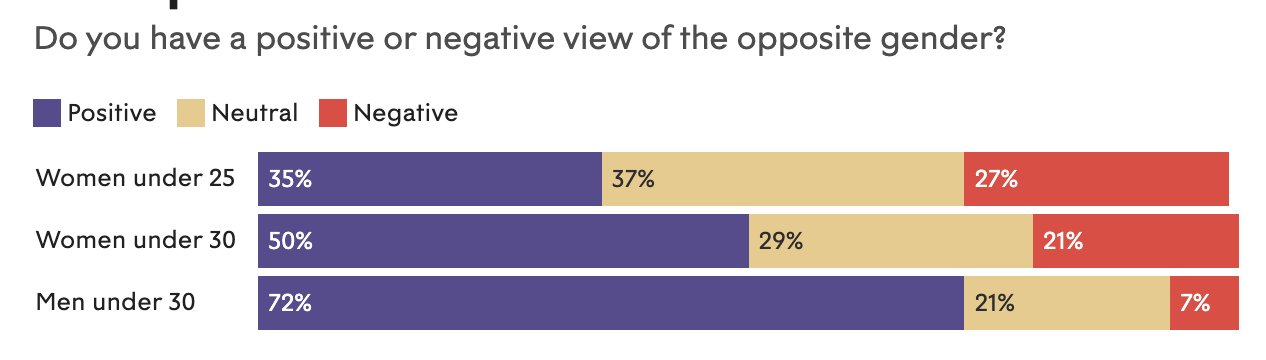
Survey of British women done for The New Statesman.
Due to strong, even at times intense, sex-differentiated selection pressures, in human evolution, human males are systematically better at forming and operating teams than women. Among women, it is the most masculinised personalities — lesbians and tomboys — who tend to be better at teams and teamwork, though they are still generally not as good at it as men.
The operating principle is that men are more likely to suppress their emotions to perform their designated role (in a team, in an organisation). Women are more likely to subordinate their designated role (in a team, in an organisation) to their emotions. Hence, for example, women and girls are more likely to be aggressive towards fellow team members during a game than are men and boys. Hence also — as we will see — male-dominated institutions have been better at catering for women and girls than female-dominated institutions have been at catering for men and boys.
It is not strength difference that leads schoolboy teams to regularly beat women’s national sporting teams. From adolescence on, boys and men are systematically stronger than girls and women of the same age: but even a fit 14 year old boy is not likely to be stronger than a fit, athletic 21 year old sportswoman. It is difference in male and female cognitive and behaviour patterns that leads to teenage boys sporting teams beating national women’s teams.
Institutions — to be functional — generally have to been scaled-up teams. That women are systematically worse at teams than men means that the feminisation of institutions and organisations tends to degrade their functionality. For example, female “emotions-as-threat” tone-policing makes it harder to generate trust, as people curate their interactions. Men and boys make outrageous jokes and rib and insult each other to test whether the others will fold under pressure. The social flattening of tone policing generates much more uncertainty, because it produces far less revealing information, so less trust.
The more differences of opinion are seen as threat, insult or moral failure, the more destructively conformist the institution or organisation is likely to be. This both acts to block feedback and enable the entrenchment of structures of conformist not-noticing.
One way out of this is to have strong standards in favour of truth and robust use of evidence. This, in turn, requires willingness to enforce such standards, which many women find emotionally confronting to do, as they are far more primed to read emotions as threat. Retreating from enforcing standards and boundaries on the grounds of being “inclusive” gives emotional — and so moral — cowardice a warm inner glow via a patina of self-righteousness. An emotionally-comforting retreat from enforcing standards then aids the entrenchment of emotionally-comforting opinion conformities.
That women tend to be self-deceptive about their own aggression — passing it off as moral or social concern — can be highly corrosive to the internal operation of an organisation or institution. In particular, it can be an effective way to block inconvenient information or concerns. All of this makes an information-restricting conformity likely to develop, and become entrenched, within an organisation as it becomes more female-dominated while making it less functional in enforcing standards, so delivering services.
Women are much less likely than men to have friends of lower socio-economic standing — as those of lower social standing are generally not a good social return on the emotional investment that female friendships are based on. Given the biological expense of human children, focusing on getting a good social return for one’s emotional investment was a successful reproductive advantage. For more team-oriented men, one never knows when someone of lower socio-economic status might be useful on your team.
Feminisation — that is, the increasing pervasiveness of more female-typical behaviour patterns — thus raises issues of weakening social solidarity. One of the striking things about contemporary Western societies is how little active concern that female university graduates show for people, including other women, of lower socio-economic status within their own societies. They have very little sense of how very different the experience of women in very different social milieus can be, and they do not socialise with such women to find out.