
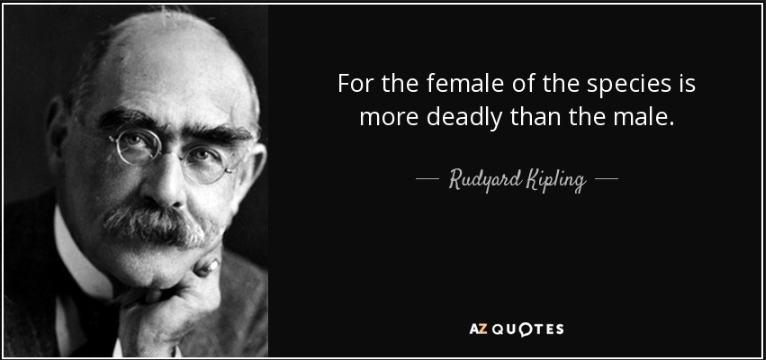
A few weeks back, John C. Wright contemplates how he initially understood what Rudyard Kipling was saying in his poem “The Female of the Species” and how he realized he’d been mistaken:
So it comes that Man, the coward,
when he gathers to confer
With his fellow-braves in council,
dare not leave a place for her
Where, at war with Life and Conscience,
he uplifts his erring hands
To some God of Abstract Justice –
which no woman understands.And Man knows it! Knows, moreover,
that the Woman that God gave him
Must command but may not govern –
shall enthrall but not enslave him.
And She knows, because She warns him,
and Her instincts never fail,
That the Female of Her Species is more
deadly than the Male.The argument runs that woman’s nature, by its nature, requires her to be uncompromising and ferocious to defend her children. Hence the political logic of compromise, half-measures and horse-trading (universally required for masculine teamwork with friends or détente with enemies) ought to be and is alien to the female instinct.
The poet here, with tongue in cheek, calls these masculine traits of professionalism toward allies and military courtesy toward enemies as prompted by folly or fear. The woman is described as if she were a battleship “armed and engined” and launched for one sole purpose.
The poet then cautions that this maternal instinct, so right and necessary for the survival of the race (“lest the generations fail”), becomes fanatical and destructive when used to support political policies, which become, in effect, to her, her children.
In law school, I was told that a prisoner on death row, after all other souls on earth were convinced he was a murderer, would still have his mother writing letters to the governor petitioning for a pardon. The maternal instinct never parlays, never ceases, never surrenders, never listens to reason.
Hence, or so Kipling warns, the female of the species must be kept away from the seats of power, that is, the ballot box and public office (“when he gathers to confer with his fellow-braves in council”) and he ends by warning that she herself knows this and warns of it.
One jest in particular that flew over my head was the line about femme and baron. In law, man and mate are treated as one person by coverture, and in heraldry her coat of arms and his are two halves of one: here, the poet is implying that she is usurping his rights without surrendering any of her own (As when a female can vote for war but is immune from the draft.)
Yesterday, I linked to a Lorenzo Warby essay that considered some of the same aspects in a non-poetic context.



I consider myself a friend of John’s wife, and would never, ever, want to get on her bad side.
Comment by Clayton Barnett — August 21, 2026 @ 06:45