Not content with reading history backwards to find fault with historic figures based on the most progressive views of the modern world, the same approach is now taken with fine art:
For a discipline devoted to art, contemporary art history can seem remarkably contemptuous about the object of its study. In the 1970s “new art history” began to revolutionise a discipline that was hitherto focused on the connoisseurship of the Western canon.
It became instead a subject that used artworks as artefacts for social and political critique. John Berger, the pioneer of the new approach, questioned the very permissibility of having a “love of art”, dismissing it as “a useful concept to the European ruling classes”.
New art historians have since continued this crusade, with different “lenses”, each now well known, encompassing such topics as the “feminist turn”, the “de-colonialist turn”, the “LGBTQ+ turn”, and so on.
As critics such as Lola Salem and Pierre d’Alancaisez have argued in this magazine, this tendency now extends beyond academic fashion: the assumptions through which art is studied have migrated into museums, funding bodies and cultural institutions, where they shape what is exhibited, how it should be interpreted, and what socioeconomic purposes art is expected to serve.
The old question, “Is this good art, and what does it tell us about the civilisation that made it?” has acquired a formidable set of competitors: “What makes this work and its creator suspect, what depravity does is its supposed beauty trying to hide?”
In Depraved: The Story of Dangerous Art, Daisy Dixon’s sense of contempt is made plain in the very first line: “When I was a teenager, I hated the painter Paul Gauguin.” As assistant professor of Philosophy at Cardiff, Dr Dixon has built a social media platform as an outspoken critic of historical and contemporary visual media. Not even Miriam Margolyes is spared her rancour.
In a world now dominated by AI, Dixon tackled the very real issue of deepfake pornography, where this new technology was abused by perverts to create pornographic images of victims (mostly women) without their consent. Whilst Dixon’s criticism of this sinister practice was laudable and justified, the extension of her criticism to art is misguided and regrettable.
The indignant chapter titles of her book — Obscenity, Criminality, Oppression, Malevolence, Cruelty, Iconoclasm, Reparation — read more like the call-to-arms of the culture wars than a work of fair and rigorous academic analysis. At the heart of her book lies the accusation that art with an erotic element by the likes of Titian, Velázquez or Giulio Romano should be considered “high-class pornography” and “hate speech”.
To support her argument, Dixon begins outside the confines of art with a work of literature: Marquis de Sade’s The 120 Days of Sodom. Using the indisputable “depravity” of De Sade, she aims to justify her accusation that those paintings were motivated by the same male and depraved roots in Western culture.
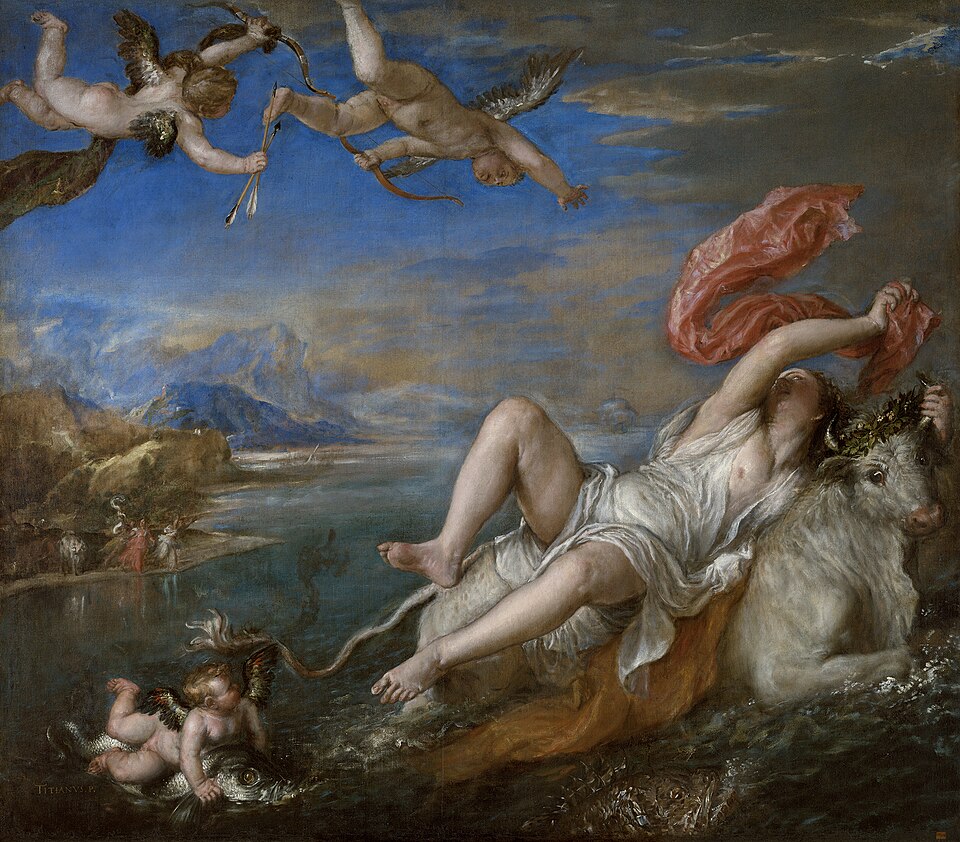
Her greatest ire however is reserved for Titian’s Rape of Europa, which she considers “just a portrayal of an immoral act”. The failure to consider any alternative meaning to the picture is indicative of the reductive and misleading nature of her approach.
Titian’s The Rape of Europa, c. 1560-62.
Wikimedia Commons.
Without delving further into the many other readings of the Rape of Europa, suffice it to say that the reductive conclusions drawn by Dixon impede us from a deeper understanding that might call her assumptions into question.
Although I read Art History at one of the most renowned institutes in Britain, I can confirm that students are taught this superficial understanding and contempt. I remember a senior lecturer singling out the experience of finding a group of Oxford postgrads discussing Titian’s Diana and Actaeon as a scene worthy of ridicule. “I was shocked,” the lecturer opined, “how they were so busily discussing which translation of Ovid that Titian consulted, when they completely ignored that there was a black slave girl in the picture.”
The girl depicted was one of the handmaidens of Diana, something the lecturer would have known had she even the most elementary knowledge of the story. More distressing was the sight of a senior academic masquerading assumptions as fact.