Quotulatiousness

June 26, 2025

NATO members “commit” to a new 5% defence spending target

Filed under: Cancon, Europe, Military, USA — Tags: , , , , , , — Nicholas @ 03:00

As many predicted, just as Canada finally gets around to at least pretending to meet the 2% defence spending target we agreed to over a decade ago, those goalposts get moved:

So today the leaders of Nato convene for a landmark summit:

NATO countries agree to increase defence spending to 5%

That headline isn’t strictly accurate. Member states have apparently agreed to commit to a target of 5% by 2035, to mark the start of the fourteenth anniversary of the Ukraine war. Which means that, as always with Nato, they’ll all look butch at the photo-op, and then they’ll do bugger all. Even the “commitment” to a “target” is too much for Spain, which has secured an opt-out.

But hang on a minute: Nato has been at war — or at proxy-war — with Russia for three-and-a-half years now. So it’s been on a war-footing, supposedly, for seven-eighths of the length of the First World War. How’s that war-footing going? Per Nato’s head honcho, Mark Rutte (the woeful former Dutch PM — ask our pal Eva Vlaardingerbroek), earlier this month:

    The Russian army is developing its war capabilities by multiple times more than that of NATO despite having an economy 25 times smaller, NATO’s secretary general has warned …

    “The Russians, as we speak are reconstituting themselves at a rapid pace and producing four times more ammunition in three months than the whole of NATO in a year,” said Rutte.

That’s a rather confusing way of putting it; what he means is: the Russians (who, as Mark Levin assures us, “scare nobody”) produce more ammunition in three weeks than the whole of Nato does in a year. Can even Nato be that worthless?

Taking the Secretary-General at his word, if you’re wondering why the Pentagon has to divert ammo marked for Israel to Ukraine and then divert it back from Ukraine to Israel … well, let’s do what everybody else does and dredge up the only historical analogy anybody knows — not the First World War, but the Second (see Levin’s “Iranian Nazi regime”): We’re asked to believe that Nato needs longer than the US was in the Second World War for to move to a war-production footing.

To be sure, supply chains are always difficult: Iran’s threat to close the Strait of Hormuz could have seriously impacted McDonald’s need to recall the hash browns it sent to Montenegro and divert them to Kiribati.

Trump gets something very basic: Flying the highest of high-tech weaponry seven thousand miles to drop down a ventilation shaft opening the size of a dishwasher is the kind of brilliant, dazzling one-off only the United States can do. But what next? Almost all geopolitical conflicts start with a bit of shock-&-awe (Pearl Harbor, even the assassination of the Archduke) and then dwindle down to old-school wars of attrition – as the United States should certainly know after taking twenty years to lose to goatherds with fertiliser, and three years to lose to “a gas station masquerading as a country” (thank you, John McCain). In wars of attrition, old-fashioned unglamorous things become important, like the ability to manufacture bullets in a timely manner. The basic arithmetical calculations are not complex: Don’t get into a long war with an enemy whose stock of long-range ballistic missiles outnumbers your surface-to-air missiles.

So Trump had the narrowest window of opportunity, and used it.

On the other side, the last week-and-a-half mostly revealed the shallowness of the War Party. You’ll recall, for example, that Ted Cruz got into a spat with Tucker over the actual population of Iran. Last week, a UK podcast had a brief discussion on The US Army-Marine Corps Counter-Insurgency Field Manual, which notes the following (foot of page xxvi):

    The troop demands are significant. The manual’s recommendation is a minimum of twenty counterinsurgents per 1,000 residents.

That’s roughly what the British had in Malaya. Which they won, by the way. Twenty-two years ago, a couple of weeks after the fall of Saddam, I stopped on the shoulder of the main western highway from Jordan to Baghdad to fill up from an enterprising Iraqi who’d retrieved some supplies from a looted petrol station and was anxious to sell them to any passing Canadian tourists. As he was topping off, I asked him how agreeable he found the western soldiery. He grinned a big toothless grin and pointed to a chopper that had just come up over the horizon to hover above our heads. Then he said: “Americans only in the sky.”

We did not win that one, you’ll recall. Instead, we created an Iranian client-state.

That’s why Ted Cruz’s breezy indifference when Tucker asked him the population of Iran was so revealing. The senator told Tucker that it doesn’t matter whether the population of Iran is eighty million or a hundred million. Really?

Because, per the Pentagon’s own field manual, the latter figure would require finding an extra 400,000 troops. Oh, wait. If it’s a Nato mission, the other members could muster 127 guys between them, so it would only require 399,873 extra Americans.

Even if the public were minded to put one-and-a-half million pairs of boots on the ground, it couldn’t do it. “Americans only in the sky” equals what an Australian prime minister told me, after a flying visit to the troops in Afghanistan, was “the Crusader fort mentality”.

It doesn’t work. The political divide in America is between, crudely, Trumpians and neocons. The former are anti-war; the latter are pro-war … but a way of war that doesn’t work.


QotD: Credentialism versus meritocracy

Filed under: Bureaucracy, Education, Government, Quotations, USA — Tags: , , , , , — Nicholas @ 01:00

Returning briefly to the running theme of Vietnam, what all the “happy little hotdogs” had in common was: They were all Harvard men. Kennedy was a Harvard graduate. McGeorge Bundy had been a Dean at Harvard. McNamara was a Harvard b-school grad. John McNaughton was a Harvard professor. Maxwell Taylor was a West Pointer, but all the other happy little hotdogs said “he was the kind of general Harvard would produce”; they could think of no higher compliment.

Harvard’s motto is “Veritas” — truth — but it ought to be “ludificationes pertinet“, which the internet informs me is how you say “delusions of competence” in Latin. I meant it when I said that the “Ministry of Talent”, as these jerkoffs unironically called themselves, actually had some serious brainpower and real accomplishments … but the Peter Principle is also true, and though they had some real brains and actual accomplishments, neither their brains nor their accomplishments at Harvard translated to anything out in the real world, any more than some Late Republic social climber’s “experience” as curule aedile translated to anything real in their world.

Just as the Roman Senate had no idea how to deal with a Julius Caesar, then, despite it all, so no American “leader” had any idea how to deal with a guy like Ho Chi Minh, even though he, like Caesar, had always been perfectly open and forthright about what he was doing and why. It never occurred to “the best and brightest” to even ask the question “What does Ho Chi Minh want?”, because after all, Ho Chi Minh wasn’t a Harvard man.

And all this was 60 years ago. These days, the AINO cursus honorum is so widespread that every kid who manages to fill out a college app has a resume that would give McGeorge Bundy an erection lasting more than four hours. You’ll have to trust me on this, I guess, but I wouldn’t be surprised to learn that Flyover State — which is respectable but rinky-dink; the kind of outfit where you see their team losing a late December bowl game and you think “Gosh, I guess that state has a third college in it” — had several hundred student organizations …

… all of which seem to exist for no other reason than to have “officers”, to which these little social climbers can be “elected”, the better to pad their law, med, and grad school apps. By the end of my career, probably 3/4 of the students who ever sent me an email had an auto-signature on it, and that auto-signature was longer than my entire CV. President of this, Vice-Treasurer of that, Assistant Grand Poobah (junior grade) of the other thing. Grandpa Simpson was a piker compared to these kids:

    I’m an Elk, a Mason, a Communist. I’m the president of the Gay and Lesbian Alliance for some reason. Ah, here it is. The Stonecutters!

Instead of giving potential movers and shakers some practical experience, our modern cursus honorum casts the widest possible net for sociopathy. McGeorge Bundy is your absolute best case scenario. He wasn’t actively evil; he was just a goofy egghead who thought he was way smarter and more accomplished than he actually was, because he’d never been in a position to find out otherwise. (An anecdote that tells you everything you need to know, courtesy of Wikipedia: “When applying to Yale, Bundy wrote on the entrance exam ‘This question is silly. If I were giving the test, this is the question I would ask, and this is my answer.’ Despite this, he was still admitted to Yale as he was awarded a perfect score on his entrance exam”).

Think about that the next time you go to the doctor. Even if your MD — or, much more likely these days, PA — isn’t a prize graduate of Bollywood Upstairs Medical College, xzhey most likely spent xzheyr college years as an Elk, a Mason, a Communist …

Your worst case scenario is, of course, another Caesar. A fake and gay one, it goes without saying — this being Clown World — but a fake and gay Caesar can still do tremendous damage, because they’re the worst of both worlds: Bundy-level goofs, and angry ethnic sociopaths with huge chips on their shoulders. These are the kids who have been “team leads” doing “original research” since about age 12. Not only have they never failed, they’ve never been exposed to the merest hint of the possibility of failure. All their “success” is theirs by right. They have Caesar’s vaulting ambition, his utter disregard for tradition, his absolute cutthroat ruthlessness … and none of his experience, to say nothing of his competence.

Severian, “Cursus Honorum”, Founding Questions, 2021-12-27.

June 25, 2025

The Korean War Week 53 – Moscow Says ‘End the War!’ – June 24, 1951

The Korean War by Indy Neidell
Published 24 Jun 2025

Soviet Ambassador Jacob Malik speaks to the world on UN radio, saying that the Soviet position on Korea is that ceasefire talks should begin among the belligerents. The Americans are thinking of how they can bring in more non-American UN units, even as South Korean President Syngman Rhee denounces the British and Commonwealth forces and says they should go home.

00:00 Intro
00:41 Recap
01:07 Jacob Malik Speaks
02:02 Chinese Change Plans
03:19 10th Corps Advances
05:37 More Non-American UN Units
07:52 Rhee Denounces his Allies
12:17 Summary
12:40 Conclusion
14:15 Call to action
(more…)

June 24, 2025

Political violence increases as the power of the state increases

Filed under: Government, Media, Politics, USA — Tags: , , , , — Nicholas @ 05:00

Many people note that they don’t remember political conflicts being quite so nasty in years past as they are now, but the more power that accretes to the state the higher the perceived — and actual — risk of allowing the state to fall into the hands of your opponents. We’d be far better off if partisans would consider the possibility that the latest addition to state power they support will be used by their political opponents after the next partisan shift in electoral fortunes … if you fear this power in the hands of a Trump, you shouldn’t put it in the hands of a Biden.

As should be obvious to anybody following news about riots, assassinations, and arson attacks, politics have become far too important in America. With government large, growing, and reaching into every nook and cranny of our lives, Americans perceive politics as too much of a high-stakes game to lose. And so, they have divided into hostile camps to make sure their side comes out on top — and some turn ideological conflict into literal war.

A Surge in Political Violence

That point came home to me after Israel launched its preemptive attacks against Iran’s nuclear facilities. My wife’s rabbi (she’s Jewish and I’m not) called me and asked if I was willing to work security during services on Saturday. “No Kings” protests were planned across the country for the day, with the potential to turn nasty at the hands of people who insist anybody wearing a Star of David bears responsibility for the Israeli government’s actions. Tensions were already high after the Molotov cocktail attack on Jews in Boulder, the murder of two Israeli embassy staffers in Washington, D.C., and the firebombing of Pennsylvania Gov. Josh Shapiro’s official residence on the first night of Passover.

So, I spent much of Saturday standing in front of the synagogue, wearing a ballistic vest, with a pistol holstered on one hip and pepper spray on the other.

Underlining the point was that two Minnesota state lawmakers were targeted by an assassin the same Saturday — fatally in the case of one legislator and her husband. The day’s protests were predominantly, but not entirely, peaceful. That’s better than we’ve seen at recent protests against immigration enforcement that turned violent in Los Angeles and Portland, and at some pro-Palestine demonstrations.

That’s all recent. If we go back in time just a little, there’s the bombing of a fertility clinic by an “anti-natalist”; attacks on Tesla cars, dealerships, chargers, and owners by people opposed to Elon Musk’s temporary role in the Trump administration; and, notably, the murder of Brian Thompson, the CEO of UnitedHealthcare. The alleged assassin, Luigi Mangione, has become something of a celebrity.

“Targeted violence is becoming normalized online and in the real world,” warned a December 2024 report from the Network Contagion Research Institute, affiliated with Rutgers University. “Memes, viral content, gamification and the lionization of Luigi Mangione are constructing frameworks that endorse and legitimize violence, encouraging harassment and further acts of violence against corporate figures.”

The report added that “the spread and scope of justifications for murder have significantly eroded what was once a barrier between mainstream society and fringe online communities that supported violence and glorified killers.”

June 23, 2025

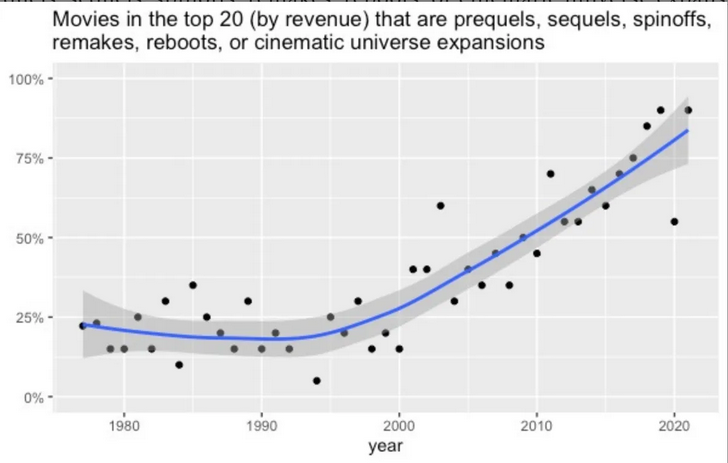
80% of top-grossing movies are prequels, sequels, spin-offs, remakes or reboots

Filed under: Business, Media, USA — Tags: , , , , — Nicholas @ 05:00

Ted Gioia on the death of creativity in the movie business, which also seems to be tracking almost exactly with the trend in music business profits:

I’m not shocked when I look in the mirror. Yeah, the Honest Broker isn’t getting any younger. But that’s the human condition.

Maybe I should start using a moisturizer. What do y’all think?

Nah. I’ll just let this aging thing play out.

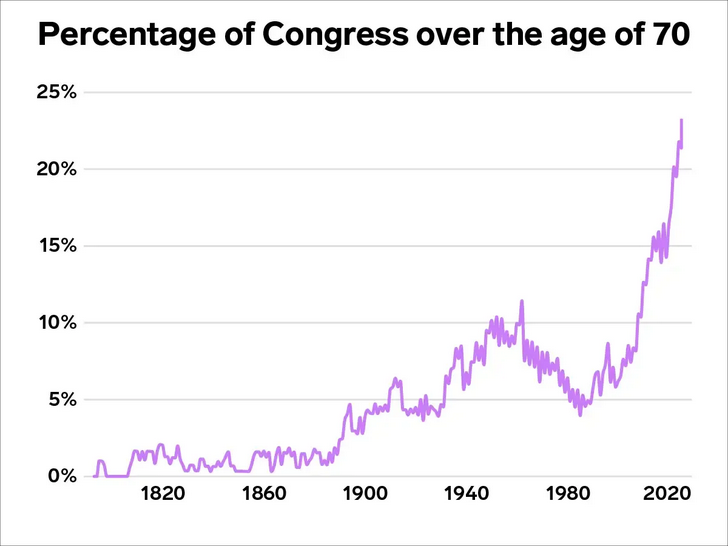
On the other hand, I’m dumbfounded at everything in public life getting older — even older than me! Consider the current political landscape.

With each passing year, the US Congress looks more like the College of Cardinals (average age =78) or the Rolling Stones (average age = also 78).

We’re gonna need a lot of moisturizer.

But Congress is young and spry compared to Hollywood.

Back in 2000, 80% of movie revenues came from original ideas. But this has now totally flip-flopped.

Today 80% of the movie business is built on old ideas — remakes, and spin-offs, and various other brand extensions. And we went from 80% new to 80% old in just a few years.

[…]

Look at music — and you see the same thing.

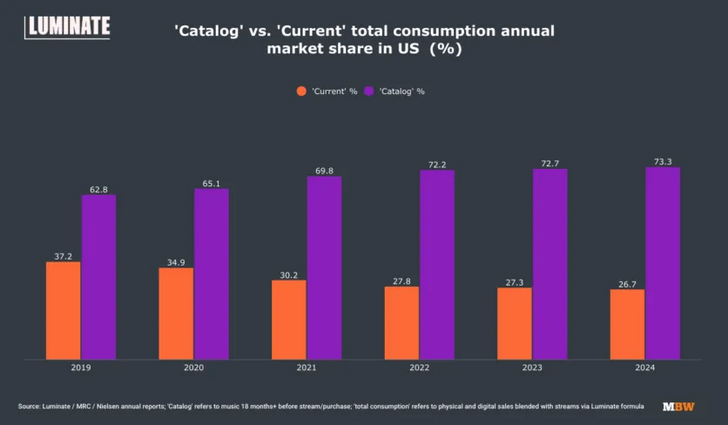
The share of old songs on streaming will soon reach 80%. It’s not quite there yet — the latest figures are 73%. But it was at 63% back in 2019. So it’s just a matter of time.

In 2000, streaming didn’t exist, so we looked to the Billboard chart to gauge a song’s success. And new music made up more than 80% of charted songs. So here — just like the movies — we’re flip-flopping from 80% new to 80% old over the course of a few years.

I don’t have good figures on publishing. But I’m pretty sure that AI-generated books and articles will soon represent 80% of the marketplace. Maybe we’ve already reached that threshold.

AI is deliberately designed to cut-and-paste, rehashing past work as its modus operandi. And it will do this to every field — replacing originality with repetition and regurgitation.

This is the new 80% rule.

Just imagine if traditional businesses operated this way.

  • “Welcome to our restaurant, 80% of the food is leftovers.”
  • “Welcome to our boutique, 80% of clothing is secondhand.”
  • “Welcome to our dating service, 80% of the choices are your ex-girlfriends (or ex-boyfriends).”

None of that sounds very appetizing.

How Sex in War Breeds Boys – W2W 33

Filed under: Europe, Health, History, USA, WW2 — Tags: , , , , — Nicholas @ 04:00

TimeGhost History
Published 22 Jun 2025

That prolonged war triggers an increase in male baby births had been ordered since at least 250 years. This “returning soldier effect” happens again during WW2 and right after. How this happens is a mystery, but research in the past decades might provide some answers.
(more…)

US strikes against Iranian nuclear facilities

Filed under: Media, Middle East, Military, Politics, USA — Tags: , , , , , — Nicholas @ 03:00

One of the most frustrating aspects of internet culture today is the need for instantaneous “analysis” of military events. We all understand the desire for such insight, but the accuracy of information available in the immediate aftermath of any event is highly variable. Between the need to control the narrative on the part of the participant powers, the propaganda value of being “first” to report, and the impossibility of accurate damage assessment, it’s a wise move to discount almost everything you hear about a big event for some time. Chris Bray suggests that the old “72 hours rule” may be insufficient for something like the US bunker busting strikes against Iranian nuclear research facilities:

First, wait a while. Sean Hannity just announced that “a source” told him the attack was a complete success, and all of Iran’s nuclear sites were fully destroyed. I’d hesitate to believe that, is the gentle way to put it. I’d also hesitate to believe the stories being told from the other direction, and don’t forget that Trump’s attack on Qasem Soleimani produced a full week of OH NO WORLD WAR III JUST BEGAN stories in the establishment media. The likelihood is that none of what you’re hearing this week is fully true. Wait and watch. I hope that Iran and the US are backchanneling while engaging in belligerent public posturing, but by definition we’re not going to see the backchanneling. We’ll see. The 72 Hour Rule is in effect, here, at the very least.

Second, the ludicrous story in which Trump is violating law and political norms with unilateral military action is, as always, a deliberate performance of political amnesia. These are our political norms, for crying out loud.

We should probably fix that. But the people who tolerated an American war in Libya without direct congressional authorization, and who tolerated an American war in Yemen without direct congressional authorization, and who tolerated an American war in Syria without direct congressional authorization, aren’t actually going to impeach a president over military strikes in the Middle East undertaken without direct congressional authorization. It’s a show. The More Than a Week Rule requires us to view this action in the longer and generally quite unfortunate context of American foreign policy, and the politicians who are outraged by unilateral military action in the Middle East have zero standing on that score.

Third, and related, the 2001 Authorization to Use Military Force is still in effect, and still being stretched and massaged beyond its intent and meaning, but note that Congress still hasn’t repealed it. A Congress that wished to restrain presidential military action in the Middle East would probably start there, and they haven’t.

Glenn “Instapundit” Reynolds has a few thoughts on the matter:

People have been singing about it since 1980, but yesterday’s bombing raids on Iranian nuclear facilities were the first bombing attack since the 1979 hostage seizure.

Despite numerous calls for action against the Islamic Republic, Operation Midnight Hammer was the first U.S. military action against important Iranian assets on Iranian territory. The bombs fell less than 24 hours ago, but here are a few preliminary takes.

Competence. The most striking thing about the attacks was the extreme competence displayed by the Air Force, the Defense Department under Secretary Pete Hegseth, the various intelligence assets involved, the State Department, and the entire administration. There were no leaks. (How did they avoid leaks? Basically, they didn’t tell any Democrats what was coming. Take note.)

Not only were there no leaks, but President Trump and the diplomatic apparatus kept the Iranians in the dark, giving the impression of waffling in the White House even as things were being lined up. They received unintentional help in this from Sen. Charles Schumer, who had been for some time pushing the “TACO” acronym — Trump Always Chickens Out — in the service of a storyline that Trump was all bluster and no follow-through. The Iranians, apparently dumb enough to believe Democrats and the mainstream news media (but I repeat myself) were snookered.

New Diplomacy: In dealing with the Iranians in the 1980s, Donald Regan told President Reagan that America had been repeatedly “snookered” by a bunch of “rug merchants”. The Iranians were in fact very good at leading Americans down the garden path, invoking (often imaginary) splits between “hard-line” and “moderate” Islamists in their government as excuses for delay and backtracking.

In truth, as Henry Kissinger once said, “An Iranian moderate is one who has run out of ammunition“. After these raids, and the many Israeli attacks that led up to them, all of Iran is out of ammunition.

June 22, 2025

Delaying Mark Carney’s next book

Filed under: Books, Business, Cancon, Politics, USA — Tags: , , , — Nicholas @ 03:00

In the latest SHuSH newsletter, Ken Whyte outlines the various oddities of Mark Carney’s next book to market:

Three years ago, long before he declared himself a politician, Mark Carney published Value(s), his attempt at solving some of the world’s biggest problems: income inequality, climate change, systemic racism, etc. The book was reasonably well received. It sold well. A sequel was in order.

Announced last year, The Hinge: Time to Build an Even Better Canada was ostensibly Carney’s attempt to address Canada’s biggest issues, and perhaps to position himself as our future leader. The book was set for release in May 2025. Events interceded and Carney was elected prime minister on a far tighter timeline than anyone, including his publisher, could have imagined. Publication of The Hinge was delayed. An anonymous source told the Toronto Star Carney was too busy politicking to finish the final edits on the book. I heard the delay had more to do with campaign finance rules that would consider a book publicized or released in election season as political advertising. Anyway, a new release date was set for July 1. Amazon now has The Hinge coming next January.

Carney’s political opponents have been enjoying the delay. Critics both left and right have attributed it to the difficulty of squaring positions taken by Carney a year or two ago with positions he espoused during the campaign and, more recently, as prime minister.

I don’t doubt that Carney’s politics have moved over the last six months. And I wouldn’t be surprised if his second book is being rewritten in whole or in part. I don’t have a problem with that. Much has happened, both in Canada and south of the border. We’ve all been reconsidering our positions.

My problem with Carney’s conduct is not that he’s revising his manuscript, if he is, but that he’s not revising his publishing contract.

The Hinge is set to be published by Signal. Signal is a division of McClelland & Stewart. M&S is a division of Penguin Random House Canada. PRHC is a division of Penguin Random House LLC, corporate headquarters at 1745 Broadway, 3rd Floor, New York, New York, 10019.

Penguin Random House LLC is owned by Bertelsmann, a media conglomerate in Gütersloh, Germany, but legally and operationally, it is a US company. Its executive leadership, including CEO Nihar Malaviya, works out of the above address. Strategy and publishing priorities are set in New York, and profits in PRH’s many far-flung international divisions flow to New York. So the prime minister of Canada is publishing his book with the Canadian branch plant of a US company.

Other recent prime ministers have done the same. Justin Trudeau published Common Ground with HarperCollins. Steven Harper published Right Here, Right Now with Signal, and his forthcoming memoir sits there, too. Jean Chretien released My Stories, My Time with Random House Canada. Most of our politicians have published with branch plants of American firms.

I should add that many of our best writers publish at these same branch plants, if not directly with US publishers. (Even middling scribblers like me have published directly in the US.)

But, again, the world has changed. To quote no less an authority than Mark Carney, Canada’s old relationship with the US, “based on deepening integration of our economies and tight security and military cooperation, is over”. We need to “fundamentally reimagine our economy”, “retool” our industry, and enhance our self-sufficiency.

He sees our cultural relationship with the US as part of this project. From the Liberal platform: “In this time of crisis, protecting Canada means protecting our culture, our journalism, our perspectives. The Americans have threatened our sovereignty and issued inflammatory statements about our economy; we need to be able to tell a story that fights back.”

Right under the cultural section of the platform was a “Buy Canadian” plank. “At a time when our economy is under threat, consumers want to do their part as patriotic Canadians, buying things that are truly made here.” Team Carney promised to make it easier to determine what is and isn’t a Canadian product and prioritize made-in-Canada suppliers in every sector of the economy, limiting bidders from foreign suppliers, and so on.

So it’s “eLbOwS uP!” for the voters, but carry on publishing your next book through a US-owned subsidiary, eh? You have to admit they wear their hypocrisy proudly.

June 20, 2025

QotD: The innate appeal of socialism

Filed under: Economics, History, Quotations, USA — Tags: , , , — Nicholas @ 01:00

It’s easy to understand Socialism’s emotional appeal. It’s undiminished, even now, despite it all, because it touches something deep — something good — in the human soul. Read Oliver Twist and you’ll see it right away. Or if Dickens isn’t your thing, do an image search for Jacob Riis’s How the Other Half Lives. It’ll break your heart. No matter if their parents are gutter drunks […] no child deserves to live like that.

And the material side of Socialism is technically feasible. Obviously so, and indeed it was obvious by 1865. Consider what the Union Army had to do to keep one million men in the field, simultaneously, spread over hundreds of thousands of square miles. This was not without its problems, of course — soldiers finally receiving their back pay spurred a minor economic boom in 1865-6 — but it was not just possible, but an everyday occurrence, for hundreds of thousands of men, dispersed over a huge geographic area, to receive their entire subsistence from the government. Clothes, shoes, food — the stuff Riis’s “street Arabs” would’ve killed for — all at public expense, delivered with clockwork efficiency.

If Socialism were just that, then indeed we could’ve “built Socialism”, as the Bolsheviks would have it, by the end of the 19th century. And cheaply, too — by the late 1880s, the US Treasury’s massive surplus was a major campaign issue for both parties. The “Yankee Leviathan“, as political historian Richard Bensel put it, was as close to actual Fascism as has ever been put into practice (alas, the term hadn’t been invented yet), and it was just aces at delivering the material goods. (It’s Alanis-level ironic that the Confederacy was even more actual capital-F Fascistic than the Union, given the whole “states’ rights” thing, but that’s what happens in totaler Krieg — win first, sort the theory out later).

Severian, “Purpose”, Founding Questions, 2021-12-06.

June 19, 2025

The Guns of the South: Checkmate, Alt-Hist Plausibility Sticklers

Filed under: Africa, Books, History, Military, USA, Weapons — Tags: , , , , , — Nicholas @ 02:00

Feral Historian
Published 24 Jan 2025

Harry Turtledove’s The Guns of the South gives us a look at a victorious Confederate States as they grapple with the consequences of slavery, war, and the challenges of building a new nation. It also skewers a favorite activity of alt-history readers, the nitpicking of plausibility in the points of divergence, by dropping South African time travelers with AKs into the middle of the Civil War.

00:00 Intro
02:08 America Will Break
04:49 Right and Left
05:36 CSA at odds with AWB
08:08 Forrest
10:16 Technology
13:16 “Why then …”

June 18, 2025

The Korean War Week 52 – MacArthur Fades, Ceasefire Hopes Rise – June 17 , 1951

Filed under: China, History, Military, USA — Tags: , , , , , — Nicholas @ 04:00

The Korean War by Indy Neidell
Published 17 Jun 2025

The UN troops continue their advance to the Kansas Line, meeting no resistance at Pynoggang, but heavy resistance beyond it inside the Iron Triangle. 8th Army Commander Jim Van Fleet does not want to advance much beyond where they are now, though, since territory further north would be tougher to defend, should ceasefire talks begin. And Douglas MacArthur continues to tour the states, but to ever smaller crowds.
(more…)

QotD: The “doctrine of media untruth”

Filed under: Media, Politics, Quotations, USA — Tags: , , , — Nicholas @ 01:00

As a general rule, when the New York Times, the Washington Post, National Public Radio, Public Broadcasting Service, NBC, CBS, ABC, MSNBC, and CNN begin to parrot a narrative, the truth often is found in simply believing just the opposite.

Put another way, the media’s “truth” is a good guide to what is abjectly false. Perhaps we can call the lesson of this valuable service, the media’s inadvertent ability to convey truth by disguising it with transparent bias and falsehood, the “Doctrine of Media Untruth”.

Victor Davis Hanson, “The Doctrine of Media Untruth”, American Greatness, 2020-05-24.

June 15, 2025

America’s Forgotten SMG: The Hyde/Marlin M2

Filed under: History, Military, USA, Weapons, WW2 — Tags: , , , , , — Nicholas @ 02:00

Forgotten Weapons
Published 4 Oct 2019 #36270

The United States went into World War Two with the Thompson submachine gun — a weapon far too heavy and too expensive for its role. The British went to the other extreme with the Sten and while the US did not want a gun quite that crude, the Sten did spur a desire for something cheaper than the Thompson. George Hyde (then working for the Inland Division of GM) had worked on submachine gun designs in the 1930s, and he put together a weapon that would fit US needs. It was much cheaper than the Thompson and weighed in a full 2 pounds lighter. At tests in the spring of 1942, it also proved to be much more accurate in automatic firing, as it had a much more ergonomic stock design than the Thompson. The weapon was approved as the M2 submachine gun in 1942, and a contract went to Marlin to produce it (Inland had no extra production capacity at the time).

The receiver of the M2 was made through a metal sintering process, and Marlin had trouble getting this properly tooled up. The first gun delivery didn’t actually happen until May of 1943, and by that time Hyde had finished designing the M3 “Grease Gun”, which was cheaper still, and more attractive to the military. The contract for the M2 was cancelled in June of 1943, with only 400 guns delivered. There are only six known surviving examples today, split between private collections, museums, and military institutions.
(more…)

June 14, 2025

QotD: University students or NPCs?

Filed under: Education, Quotations, USA — Tags: , , , , — Nicholas @ 01:00

When I first started teaching, for instance, I had to constantly remind myself that my charges were just teenagers. At most they were 21, 22 tops, which is basically the same thing. So much of the crap they pulled, then, was just typical teenager stuff. All they really needed to straighten themselves out was two good head knocks and a swift kick in the ass, which life would soon provide. I did exactly the same sort of dumb stuff back in my own undergrad days – maybe not as bad, but it was a difference of degree, not kind. They’d be ok in a few years.

A few semesters on, and that no longer applied. Sure, sure, they were still teenagers, and still pulled typical teenager capers … but a new set of behaviors crept in. I can’t describe them exactly, in detail, but the overall impression was: here’s someone doing a pretty good impersonation of a teenager. Most every kid goes through the faux-sophisticate stage, usually somewhere around age 12, and this kinda looked like that — young kids pretending to be a lot older — but it also looked a lot like the opposite end of the spectrum. Not quite “hello, fellow teens!” — not yet — but there was something like that going on, too. It was weird, but I figured it was mostly in my head — I’ve always been a grouchy old man, but now I was actually chronologically old enough to let my freak flag fly, so I assumed that’s what I was doing. They’re not changing, I am

Fast forward a few more semesters, and nope, it’s definitely them. The kids at the tail end of my career still looked like bargain basement Rich Littles, doing impersonations of teenagers, but their act was terrible. Remember a few years back, when Facebook or Twitter or whoever tried to make an AI chat bot, and it immediately turned super racist? Not that these kids were racists — they were the furthest thing from that — but they all seemed to have a small stock of crowdsourced responses. And that’s ALL they had, so no matter what the situation, they’d shoehorn it in to one of their canned affects, because that’s all they had.

By the very end, interacting with them was like playing one of those old text-adventure games from the very dawn of the personal computer, like Zork. They’d respond to commands, but only the right commands, in the exact word order. No deviations allowed, and of course their responses were equally programmed.

Severian, “Terminators”, Founding Questions, 2021-12-04.

June 13, 2025

QotD: The Subaru BRAT

Filed under: Business, Government, History, Japan, Quotations, USA — Tags: , , , — Nicholas @ 01:00

Imagine, if you can, a truck with factory-mounted seats in the bed — and spotlights the size of a 747’s landing lights mounted on its T-topped roof.

If you know this truck, you also know why it’s no longer available.

Such fun things are no longer allowed.

They are not saaaaaaaaaaaaaaaaafe! “Moms” are “concerned”!

But in 1977, the Safety Cult — which ended such fun things — was still a backwater aberration, like dancing with rattlesnakes — and most people still esteemed fun over fear. There were roofless Broncos and K5 Blazers — and cars with beds.

You could buy all kinds of different stuff back when America was still a fairly free country — and the Subaru BRAT was as different as it got.

BRAT — all caps — was short for Bi-Drive Recreational All-Terrain Transporter. It was superficially similar to other small import pickups of the ’70s, such as the Datsun 620 and similar models from Toyota (SR5), Mazda (B210), and Chevy (via Isuzu) Luv.

But unlike them, it was a four seater — with two of the four in the bed, facing the other way. The seats were made of all-weather plastic and far from the most comfortable — but the view was spectacular. Watching the world recede as you progressed is another one of many freedoms denied today in the name of “safety”.

Subaru wasn’t “unconcerned” about “safety”. Grab handles — to keep passengers from bouncing out of the bed — were included. Though holding onto them made it harder to reach for a cold one in the cooler. That was another fun thing people did in pickups back in the day — before the Safety Cult put the kibosh on that, too.

The seats were actually a dodge — of a federal fatwa known as the “chicken tax”, which was a retaliatory tariff of 25 percent applied to import-brand pickups manufactured outside the United States as tit-for-tat for tariffs applied by foreign countries to American chicken exported outside the United States.

The “chicken tax” hit trucks with just two seats — at the time almost exclusively the small import models, which didn’t offer the extended and crew cab configurations that are commonplace today.

By adding the extra seats in the bed, BRAT qualified as a passenger vehicle rather than a “light truck”, and thus Subaru evaded the chicken tax on a happy technicality — and was also able to sell the BRAT for less than two-seater rivals that had the cost of the tax folded into their MSRP.

Eric Peters, “Doomed: Subaru BRAT (1977-87)”, The American Spectator, 2020-04-26.

« Newer PostsOlder Posts »

Powered by WordPress