
Polyus
Published 31 Aug 2018The Black Brant series of sounding rockets was a great success and a proud contribution to the global race for space. While not as glamorous as an orbital rocket, the Black Brants helped scientists from around the globe research and better understand the Aurora and the Earth’s ionosphere.
(more…)
June 24, 2023
The Most Reliable and Versatile Sub-orbital Rockets Ever Made; the Black Brant Sounding Rockets
Comments Off on The Most Reliable and Versatile Sub-orbital Rockets Ever Made; the Black Brant Sounding Rockets
June 23, 2023
The Combat Engineers of D-Day – WW2 Special Documentary
World War Two
Published 22 Jun 2023How do you blast through the obstacles and minefields on the beaches of Normandy? How do you get thousands of tonnes of tanks, guns, and men into the fight? And what about reopening the shattered French ports? You need men who are as skilled in construction as they are destruction. You need the engineers.
(more…)
Comments Off on The Combat Engineers of D-Day – WW2 Special Documentary
From Operation Barbarossa in 1941 to the disinformation and cover-up over the origins of the Wuhan Coronavirus
Chris Bray outlines the utterly amazing situation between the Soviet Union and Nazi Germany on the eve of Hitler launching Operation Barbarossa — where Stalin refused to believe that Hitler would attack Russia despite overwhelming evidence from many sources — to the parallel situation over Covid:
Several sources quite specifically reported to the Soviet government that the Germans would invade around dawn on June 22. Their reports can be found in the Soviet archives in a “folder of dubious and misleading reports”. Then, shortly before dawn on June 22, Germany invaded the Soviet Union. Military leaders on the border called in reports of the invasion, and the people they talked to in Moscow declined to believe them. Soviet border troops held their fire, seeing Germans while being ordered to understand that no true invasion could possibly be underway. Stalin knew better, and contradicting Josef Stalin was known to be a fatal mistake. Achieving an entirely avoidable surprise, the Germans destroyed much of the Soviet air force on the ground, parked wingtip-to-wingtip for the convenience of the invader’s bombers.
[…]
An invasion that could have been met with brutal severity from the first moment instead achieved considerable initial success against a supine nation because the Soviet leader, and the chain of subordinates beneath him who were forced to adopt his conception of facts and truth, assumed that things they didn’t wish to believe constituted disinformation. Millions of lives were wasted for that illusion. A society that categorizes inconvenient truths in this way is committing a form of suicide, hiding from hard facts that demand acknowledgment.
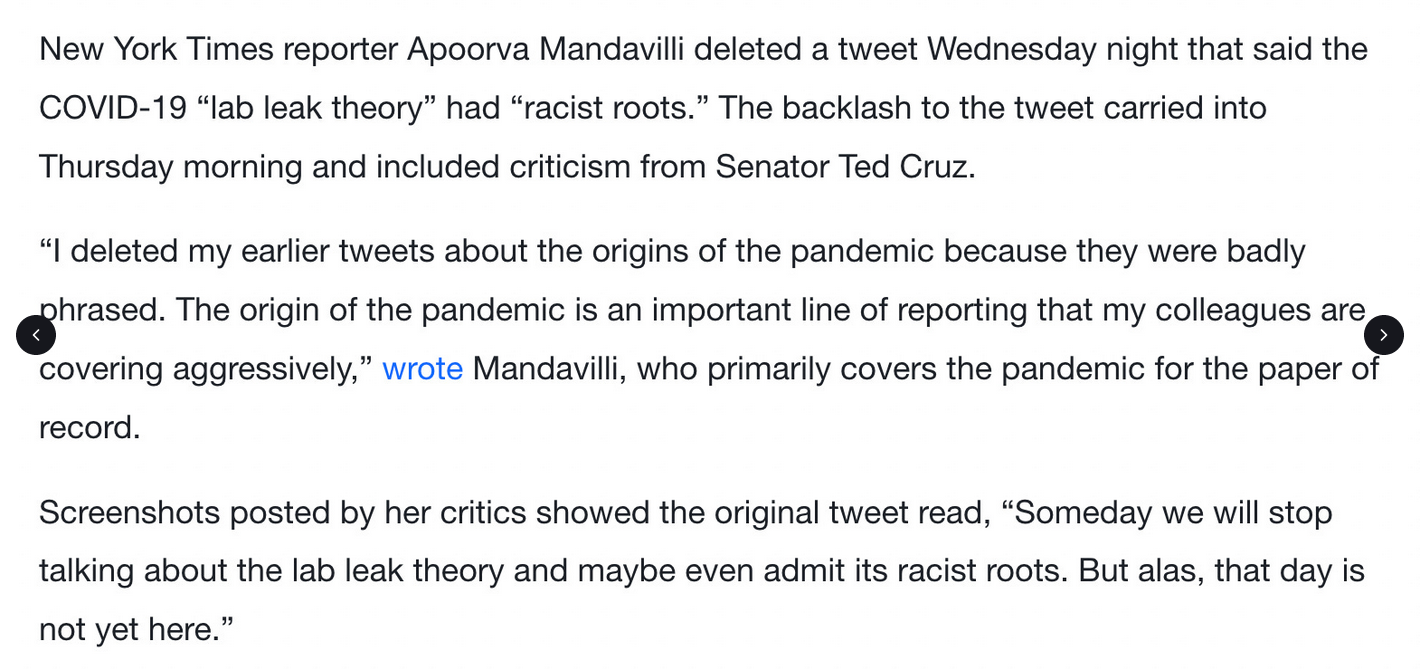
Now: In 2021, the lab leak theory was a disgusting lie with “racist roots”.
In June of 2023, the, uh, first people who got sick with Covid turn out to have been, uh, scientists at the lab in Wuhan. BUT THEY PROBABLY HAD SOME BAT SOUP AT THE WET MARKET, IS WHY, or something.
Stupid conspiracy theorists, you people are such MORONS, do you actually bel— okay, that one’s true too.
We’ve somehow developed an industry of professional information barriers, dimwitted parasitical human garbage whose sole function in life is to prevent understanding by pasting “disinformation” stickers on things that you’re not supposed to know.

Comments Off on From Operation Barbarossa in 1941 to the disinformation and cover-up over the origins of the Wuhan Coronavirus
June 22, 2023
CDR Salamander’s proposal to “encourage” NATO countries to meet or exceed their agreed defence targets
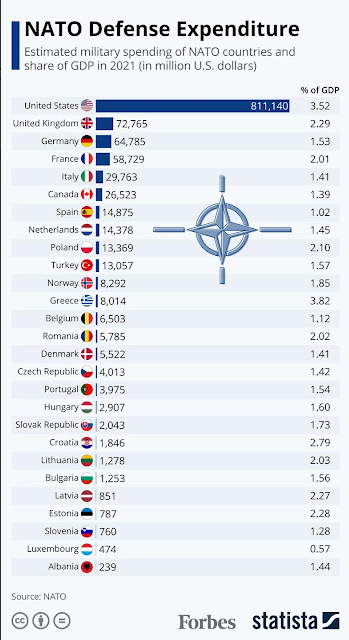
 Canada has been a notorious defence freeloader since the first Trudeau government took office in 1968. Every Canadian government since then — until the current government started telling our allies we had no intention of meeting our treaty commitments — has made more-or-less sincere noises about getting back to the 2% of GDP minimum defence budget and none have done much to make it happen (we’re around 1.39% at the moment). Several years ago, CDR Salamander proposed a new way to allocate NATO leadership roles according to how close to the minimum each member country has managed to get, and it’s surprising that something of the sort hasn’t already been implemented:
It should bring to the front that NATO can no longer allow unserious nations to play like they are anything but security free-riders. They need to contribute their fair share or pay some consequence. Alliances have benefits and responsibilities. You should not have one without the other.
While percentage of GDP is an imperfect measure of contribution, it is better than all the other ones. It is as simple benchmark of national effort.
As these are the best numbers we have, let’s look at 2021 and then forward.
It is amazing that after all Russia has shown Western Europe — both of its nature and the nature of modern warfare — that so many of our NATO allies continue to slow walk defense spending, doing the very minimum to be a full and fair partner in the alliance.
Russian victory — however they define it — or Russian defeat — however Ukraine defines it – will not change the geography or nature of Russia. She is not going anywhere.
[…]
There is so much deferred spending from our free-riding European allies.
Between 1999 and 2021, EU combined defence spending increased by 20%, according to reports by the European Defence Agency. That compares with a 66% increase by the US, and 292% by Russia and 592% by China, over the same period.
“Out years” are where dragons live, so anyone not on guide-slope to 2%+ by the end of 2023 — when one way or another the Russo-Ukrainian War should be over — will find someway to not get there in a wave of excuses and bluffing.
We should call their bluff.
As such, and this is generous, we need to finally pursue PLAN SALAMANDER for NATO “Flags-to-Post” that I first proposed almost six years ago.
In NATO, General and Flag Officer billets are distributed amongst nations in a rather complicated way, but this formula is controlled by NATO – and as such – can be changed.
Entering argument: take the present formula for “fair distribution” and multiply by .75 any nation that spends 1.5% to 1.99% GDP on defense. Multiply by .5 any nation that spends between 1.25% to 1.499%. Multiply by .25 1.0% to 1.240%. If you fall below 1%, you get nothing and your OF5 (Col./Capt) billets are halved.
1.25x for 2.01%-2.25%. 1.5X for 2.26%-2.75%; 1.75x for 2.76% -3.0%. 2x for +3.01%.
The math gets funky when a lot of people get over 2%, but we can refine it later. Doesn’t cost a penny and will unquestionably get the attention of those nations. Trust me on this. By January 1st, 2024 no more excuses. A small and symbolic punishment, but a good start that may be all that is needed. This is not the second half of the 20th Century any more.
Comments Off on CDR Salamander’s proposal to “encourage” NATO countries to meet or exceed their agreed defence targets
Any news about weather or climate is bad news
The transition of weather from merely reporting on weather conditions and relaying (somewhat) authoritative forecasts is pretty much complete, as now every change in the weather pretty much has to be linked to the dreaded anthropogenic climate change. New York City’s recent poor air quality due to Canadian wildfires highlights a change they haven’t been pushing — how much better air quality in major cities has become:
Earlier this month, as wildfires ravaged Canada, the Northeastern United States experienced heavy air pollution problems from the smoke.
The out of control fires and subsequent pollution is a tragedy, certainly. But the fact that a low-visibility New York City was national news highlights how much things have changed.
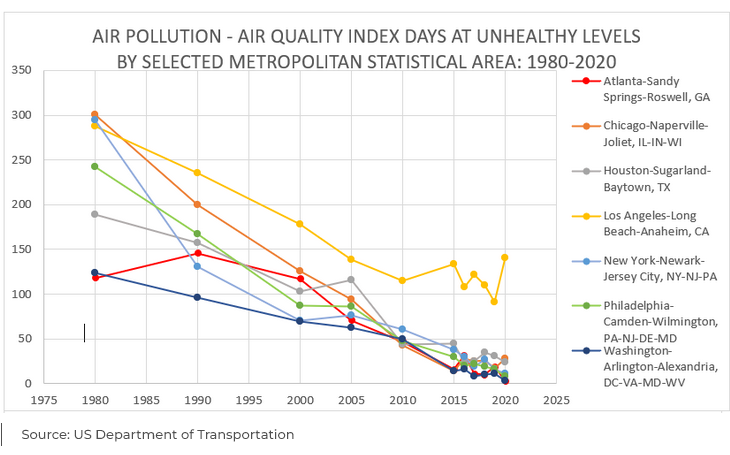
Pollution has dramatically declined over the past few decades. To get a clear picture of how much, look at this graph.
This shows the number of days air quality is considered to be at “unhealthy levels” by the US government in seven major metros in the U.S.
All seven metros have improved their air quality since 1980. This is good news!
In the NYC metro, nearly 300 days in 1980 had unhealthy air quality. Today it’s less than 50.
So what’s going on here? Well, some might argue regulation is the primary source. It’s certainly possible that environmental regulations in the end of the 20th century resulted in less pollution. As our technology has improved, we’ve gained the ability to police people polluting the air of their neighbors. But this isn’t the full story.
Comments Off on Any news about weather or climate is bad news
QotD: Nuclear non-proliferation and the Russo-Ukraine war
The failure of the earlier League of Nations was crucial to preparing the way for the Second World War. Today, we see none of this, with most participants — excepting North Korea and Iran — still playing by the rules. This is where we return to Nevil Shute. Twice, using his technical expertise, Shute attempted to predict future war in a novel, and twice he got it wrong. With On the Beach, the author wrote of a 37-day war that “had flared all around the northern hemisphere”. Albania had dropped a “cobalt bomb” on Naples, which escalated into wider conflicts and eventually a Russo-Chinese exchange.
As one of Shute’s characters, a scientist, explained, “The trouble is, the damn things got too cheap. The original uranium bomb cost about fifty thousand quid towards the end. Every little pipsqueak country like Albania had a stockpile of them, and every little country that had that, thought it could defeat the major countries in a surprise attack”. Significantly, Shute’s future war, set in 1963, wasn’t triggered by the usual NATO-Warsaw Pact arsenals of nuclear weapons, but the proliferation of them elsewhere. Then, as now, it is not Russian or Chinese aggression that should worry those with nightmares of nuclear cataclysm, but that of other countries. Thanks to the NPT, IAEA and the UN, these possibilities are contained. Today, the world’s weapons of mass destruction stand at one tenth of their number during the Cold War.
Indeed, the very origins of the current Ukraine crisis illustrate how the international order has managed to contain potential proliferation. When the Soviet Union disintegrated in 1991, Ukraine possessed the world’s third largest nuclear arsenal, greater than those of Britain, France and China combined. Kyiv soon realised it couldn’t afford to maintain the warheads and remain a credible nuclear military power. A solution was found, whereby the weapons would be destroyed, but only in exchange for security assurances that the United States and Russia would respect Ukraine’s independence, sovereignty and territorial integrity.
What Ukraine signed on 5 December 1994 was the Budapest Memorandum of Security Assurances, in which Bill Clinton for the United States, Boris Yeltsin for Russia and John Major for Great Britain promised to protect Ukraine and its territorial integrity in recognition of Kyiv surrendering the protection of its nuclear arsenal. There was no mention of military guarantees, which Ukraine assumed were implied. Additionally, Kyiv promised to adhere to the Non-Proliferation Treaty (NPT).
After the annexation of Crimea by Russia in 2014, the G7 nations complained that Russia had breached the Budapest Memorandum. Vladimir Putin replied evasively that since, in his view, a new regime had seized power from Ukraine’s previously pro-Moscow premier Viktor Yanukovych, “Russia has not signed any obligatory documents with this new state”. Since then, Russia has lied and prevaricated over its betrayal of Budapest. In 2016, Sergey Lavrov went so far as to claim, “Russia never violated Budapest memorandum. It contained only one obligation, not to attack Ukraine with nukes” — a gross distortion of the Memorandum’s many obligations.
However, the West responded in 2014 only with mild economic sanctions. Arguably, the apathy of the anti-interventionist Barack Obama and David Cameron, influenced by a London awash with Russian money, emboldened Vladimir Putin. Few experts disagree that had the West responded in 2014 as they did in 2022, Russia’s expansionist ambitions into Ukraine would have ended long ago. Yet, there is plenty of room for optimism. The Russo-Ukraine conflict has not spread because of the international order and its treaties. Apart from North Korea and Iran, neither of whom have quite perfected their devilish devices, nuclear proliferation of third parties has been held in check.
The Kremlin shows no sign of taking steps to escalate to a nuclear level. It is not in its interests, or those of its allies, to do so. None of the 32 nations who recently abstained from condemning Russia in the 24 February UN vote would welcome Vladimir Putin and his cronies flinging nukes around. The qualified support of major powers like China, India and Pakistan is attached to the cheap oil and arms procurements they have negotiated with Moscow. Any hint of Tsar Vladimir “going nuclear” would see their abstentions morph into support for the West. Putin, for all his rhetoric, cannot afford to go it alone with just the six who voted with him at the UN. In military terms, they offer nothing.
The world’s various international arms treaties provide plenty of optimism that this will remain a regional war. So far, Putin’s threats have melted away as the morning mist. The scenario he implies, akin that in On the Beach and other nuclear-war-scare novels and films, is so unlikely as to be discounted. They and all the rest of the post-apocalyptic genre are written as nail-biting entertainment, not history or current affairs.
Peter Caddick-Adams, “Putin, Shute and nukes”, The Critic, 2023-03-09.
Comments Off on QotD: Nuclear non-proliferation and the Russo-Ukraine war
June 21, 2023
Was Starship’s Stage Zero a Bad Pad?
Practical Engineering
Published 20 Jun 2023Launchpads are incredible feats of engineering. Let’s cover some of the basics!
Unlike NASA, which spends years in planning and engineering, SpaceX uses rapid development cycles and full-scale tests to work toward its eventual goals. They push their hardware to the limit to learn as much as possible, and we get to follow along. They’re betting it will pay off to develop fast instead of carefully. This video compares the Stage 0 launch pad to the historic pad 39A.
(more…)
Comments Off on Was Starship’s Stage Zero a Bad Pad?
QotD: Working online
[…]
For lots of people, the office was their only social outlet. Coffee breaks, water cooler chatter, happy hours … for lots of people, that was pretty much it, socially. “Work/life balance” was always a joke, because all your friends are work friends, so even if you’re “socializing” and not “working”, it’s with the same people from the office, talking about office stuff. And the longer you stayed in the same job, the higher up the corporate ladder you got, the more specialized your position, the worse it got – your rookie customer service reps still had buddies from college to hang out with, but junior managers tended to hang out exclusively with other junior managers, etc. The “professions”, of course, are famously clannish — the only ways to talk to a lawyer or doctor are to hire one, or be one.
Severian, “More Scattered Thoughts”, Rotten Chestnuts, 2020-10-13.
June 20, 2023
MAC Operational Briefcase (the H&K We Have at Home)
Forgotten Weapons
Published 3 Mar 2023Note: This video was proactively deleted to avoid a channel strike when YouTube went nuts over suppressors. I am reposting it today since they have rolled back those policy changes.
If a swanky outfit like H&K can make an “Operational Briefcase” with a submachine gun hidden inside it, then you can bet Military Armament Corporation is going to do the same! MAC made these briefcases for both the M10 and M11 submachine guns, and made a shortened suppressor for the M10 pattern guns to fit. They actually have a distinct advantage over the H&K type by fitting a gun with suppressor — but a distinct disadvantage in the exposed trigger bar on the bottom of the case, with no safety device of any kind.
Note: Possession of the briefcase with a semiauto MAC-type pistol that fits it is potentially seen as constructive possession of an AOW. A machine gun can be legally fitted in the case, but a semiauto pistol in it is considered a disguised weapon, and thus requires registration as an AOW.
(more…)
Comments Off on MAC Operational Briefcase (the H&K We Have at Home)
June 19, 2023
Patterns of incompetence
In Palladium, Harold Robertson says that complex systems that we all depend on will not have the resilience to survive our society-wide failure of competence:

Graphic for Rhode Island College’s Office of Diversity, Equity and Inclusion.
At a casual glance, the recent cascades of American disasters might seem unrelated. In a span of fewer than six months in 2017, three U.S. Naval warships experienced three separate collisions resulting in 17 deaths. A year later, powerlines owned by PG&E started a wildfire that killed 85 people. The pipeline carrying almost half of the East Coast’s gasoline shut down due to a ransomware attack. Almost half a million intermodal containers sat on cargo ships unable to dock at Los Angeles ports. A train carrying thousands of tons of hazardous and flammable chemicals derailed near East Palestine, Ohio. Air Traffic Control cleared a FedEx plane to land on a runway occupied by a Southwest plane preparing to take off. Eye drops contaminated with antibiotic-resistant bacteria killed four and blinded fourteen.
While disasters like these are often front-page news, the broader connection between the disasters barely elicits any mention. America must be understood as a system of interwoven systems; the healthcare system sends a bill to a patient using the postal system, and that patient uses the mobile phone system to pay the bill with a credit card issued by the banking system. All these systems must be assumed to work for anyone to make even simple decisions. But the failure of one system has cascading consequences for all of the adjacent systems. As a consequence of escalating rates of failure, America’s complex systems are slowly collapsing.
The core issue is that changing political mores have established the systematic promotion of the unqualified and sidelining of the competent. This has continually weakened our society’s ability to manage modern systems. At its inception, it represented a break from the trend of the 1920s to the 1960s, when the direct meritocratic evaluation of competence became the norm across vast swaths of American society.
In the first decades of the twentieth century, the idea that individuals should be systematically evaluated and selected based on their ability rather than wealth, class, or political connections, led to significant changes in selection techniques at all levels of American society. The Scholastic Aptitude Test (SAT) revolutionized college admissions by allowing elite universities to find and recruit talented students from beyond the boarding schools of New England. Following the adoption of the SAT, aptitude tests such as Wonderlic (1936), Graduate Record Examination (1936), Army General Classification Test (1941), and Law School Admission Test (1948) swept the United States. Spurred on by the demands of two world wars, this system of institutional management electrified the Tennessee Valley, created the first atom bomb, invented the transistor, and put a man on the moon.
By the 1960s, the systematic selection for competence came into direct conflict with the political imperatives of the civil rights movement. During the period from 1961 to 1972, a series of Supreme Court rulings, executive orders, and laws — most critically, the Civil Rights Act of 1964 — put meritocracy and the new political imperative of protected-group diversity on a collision course. Administrative law judges have accepted statistically observable disparities in outcomes between groups as prima facie evidence of illegal discrimination. The result has been clear: any time meritocracy and diversity come into direct conflict, diversity must take priority.
The resulting norms have steadily eroded institutional competency, causing America’s complex systems to fail with increasing regularity. In the language of a systems theorist, by decreasing the competency of the actors within the system, formerly stable systems have begun to experience normal accidents at a rate that is faster than the system can adapt. The prognosis is harsh but clear: either selection for competence will return or America will experience devolution to more primitive forms of civilization and loss of geopolitical power.
H/T to Theophilus Chilton for the link.
Comments Off on Patterns of incompetence
June 18, 2023
Titanic Clash Looms In Pacific – WW2 – Week 251 – June 17, 1944
World War Two
Published 17 Jun 2023Japanese and American navies are heading for a showdown in the Philippine Sea, even as American forces land on Saipan in the Marianas in force. The Japanese have Changsha under siege in China, the Allies advance in both Normandy and Italy, the Soviets advance in Finland, and the massive Soviet summer operation is coming together and will begin in a matter of days.
(more…)
Comments Off on Titanic Clash Looms In Pacific – WW2 – Week 251 – June 17, 1944
Don’t Drop your Tools in Space
Real Engineering
Published 11 Mar 2023
(more…)
Comments Off on Don’t Drop your Tools in Space
June 17, 2023
Why Rommel Lost the Battle for North Africa
Real Time History
Published 16 Jun 2023The North African campaign of WW2 is one of the most famous ones. The almost mythical story of the British “Desert Rats” defeating Erwin Rommel’s Afrika Korps. But why did Rommel lose in North Africa?
(more…)
China’s long-term revenge for the Opium Wars
In Quillette, Aaron Sarin discusses what he calls the “Reverse Opium War” with Chinese drugs flooding the US street drug culture:
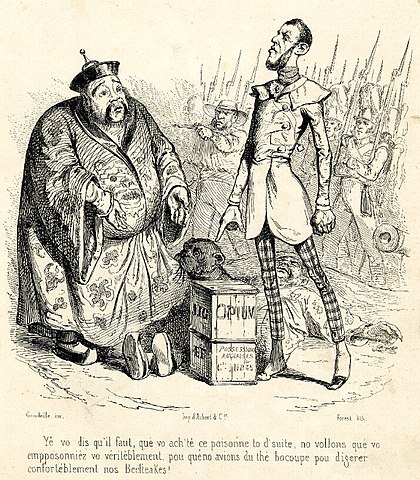
Jean-Jacques Grandville cartoon originally published in Charivari in 1840. “I tell you to immediately buy the gift here. We want you to poison yourself completely, because we need a lot of tea in order to digest our beefsteaks.”
Image and translated caption from Wikimedia Commons.
An epidemic is stalking American cities. Every day, men and women die on sidewalks, in bus shelters, on park benches. Some die sprawled in crowded plazas at midday; others die slumped in the corners of lonely gas station bathrooms. Internally, however, the circumstances are the same. They all end their lives swimming in the warm amniotic dream of a lethally dangerous opioid. When it comes, the moment of death is imperceptible: coaxed by the drug further and further from shore, the user simply floats out too far, passing some unmarked point of no return. The heartbeat weakens, the breathing slows and shallows. As soft an end as anyone might wish for.
This is the fentanyl crisis. It may seem strange to connect a very modern and very American phenomenon to a brace of wars waged 200 years ago by the British Empire on the last of the Chinese dynasties. But so the rhetoric runs: we are witnessing a Reverse Opium War; a belated Sinic revenge.
The Communist Party teaches schoolchildren that China was once a glorious superpower, until it was brought low by that subtlest and most devious of British weapons: Lachryma papaveris (poppy tears). Opium sapped the nation’s strength, and when the Chinese authorities banned it, then Britain went to war — twice.
Those wars crippled the Qing and heralded a “century of humiliation” for China — multiple military defeats and lopsided treaties, the Anglo-French looting and burning of the Emperor’s Summer Palace, the Japanese Rape of Nanking and lethal human experimentation by Unit 731 — ending only with the liberating forces of Marxism-Leninism in 1949. Now some commentators are telling us that history has inverted, that karma has kicked in.
Before examining this idea, we should remind ourselves of the American predicament. Ten years ago, fentanyl began its steady flow from China to the United States. Within just three years the drug had surpassed heroin to become the most frequent cause of American overdose deaths. Fentanyl is many times more powerful than heroin, and so there should be no surprise that lethality has spiked since the great Chinese flow began: in 2012, heroin topped the list with 6,155 deaths; by 2016, fentanyl was proving three times as deadly, with 18,335 deaths. The opioid’s influence seeps into all corners of the narcotics market, due to dealers hiding it in cocaine, heroin, and ecstasy. And it leaks across social strata, killing the homeless but also the rock star Prince, who passed away in an elevator at his Paisley Park estate after ingesting fentanyl disguised as Vicodin.
Under American pressure, the Chinese authorities agreed to regulate fentanyl analogs and two fentanyl precursor chemicals, but it soon turned out that shipments were being rerouted via Mexico. With this new arrangement, the crisis only deepened: between 2019 and 2021, the opioid killed 200 Americans a day. Last year alone, the DEA seized quantities of the drug equivalent to 410 million lethal doses. That’s enough to kill everyone in the US. Even a pandemic couldn’t stem the flow for long: in fact, Wuhan is one of the world’s most reliable suppliers of fentanyl precursors (a role it played both before and after starring at the eye of the COVID storm).
The booming fentanyl trade does not appear to rely on traditional criminal organisations, in the way that East Asian methamphetamine trafficking depends on the Triads. Instead, it turns out to be small family-based groups and legitimate businesses who manufacture and move the drug. Usually located on China’s south-eastern seaboard — Zhejiang, Fujian, Guangdong — these groups use the cover of the vast Chinese chemical industry to channel ingredients into the manufacture of fentanyl-class drugs and their precursors.
Comments Off on China’s long-term revenge for the Opium Wars
QotD: Civil War 2: Electric Boogaloo
The Right, meanwhile (and again, strictly for convenience), had an equally impossible fantasy, since however it manifested itself — CivNat, BoomerCon, Normie, pick your Internet-speak — it was predicated on the “Left” being physically capable of leaving well enough alone. Alas, “the motherfucker” which the Left feels compelled to burn down includes institutions, infrastructure, the foundations of empirical knowledge, along with the idea of “knowledge” itself — in short, ambient civilization. It’s not that they won’t leave you alone, gang, it’s that they can’t, since whatever is, is wrong.
Will it be a nicely organized civil war, with Ordinances of Secession and neato-looking battle flags and stirring speeches and truly excellent beards on all the general officers? Doubtful. See above. The whole “secession” schmear takes some doing, and we’re living in a world where the mere ability to walk slightly faster than a reanimated corpse is an appealing-enough fantasy to keep a tv series running for over a decade. But people these days absolutely loathe each other, to the point that, when someone finally does pull the trigger — and someone will — the killing won’t stop for a long, long, long time, McDonald’s be damned.
Severian, “Random Thoughts”, Rotten Chestnuts, 2020-12-17.
Comments Off on QotD: Civil War 2: Electric Boogaloo


