According to a tweet passed along by Tim Harford, the Dragon flight is a huge bargain:
RT @dcurtis: SpaceX’s entire history, incl. rocket design, testing, and launch operations, has cost less than Facebook paid for Instagram.

According to a tweet passed along by Tim Harford, the Dragon flight is a huge bargain:
RT @dcurtis: SpaceX’s entire history, incl. rocket design, testing, and launch operations, has cost less than Facebook paid for Instagram.
Brid-Aine Parnell at The Register on today’s successful rendezvous with the ISS:
Elon Musk’s SpaceX has just made history with the first ever commercial cargoship to be captured by the International Space Station’s robotic arm.
Image from NASA TVFlying above northwestern Australia, flight engineer Don Pettit aboard the ISS reached out with the Canadarm and grabbed the Dragon at 9.56am EDT, 14.56 GMT.
Reg staff are not sure if astronauts are given cheesy lines to say at these big moments, but Pettit had a great one ready.
“Looks like we’ve got a dragon by the tail,” he announced to Mission Control Centre in Houston.
“Looks like this sim went really well, we’re ready to turn it around and do it for real,” he joked.
Lewis Page at The Register on the successful Dragon fly-by of the ISS:
It’s another moment of truth for upstart space startup SpaceX as once again the company attempts to do something that has only ever been accomplished to date by major government space agencies: docking one spacecraft to another in orbit and transferring cargo.
Having launched its new Dragon spacecraft on Tuesday — on only its second flight — SpaceX is now seeking to bring the ship to a docking with the International Space Station on Friday. Many boxes must be ticked before this can happen, however: but today the first was checked off as the Dragon made a close pass within 1.5 miles of the station, and ‘nauts aboard the orbiting outpost confirmed that their remote-control console was able to command the new ship. This was done by ordering the Dragon to illuminate its strobe lights as it flew by the Station.
In fact the station’s crew — the Dragon tests were handled by André Kuipers of the ESA and NASA’s Don Pettit — couldn’t see that the lights were on owing to bright sunlight illuminating the still quite distant Dragon. However telemetry confirmed that the capsule had received the radio command from the ISS and activated its lights, and viewers of NASA TV were treated to video of the Dragon as it gradually overhauled the station from beneath, passing above South Africa and the Indian Ocean as it did so.
ESR on what might be the “beginning of the end” for patent warfare:
It’s all over the net today. As I repeatedly predicted, the patent claims in the Oracle-vs.-Java lawsuit over Android have completely fizzled. Oracle’s only shred of hope at this point is that Judge Alsup will rule that APIs can be copyrighted, and given the extent of cluefulness Alsup has displayed (he mentioned in court having done some programming himself) this seems rather unlikely.
Copyright damages, if any, will almost certainly be limited to statutory levels. There is no longer a plausible scenario in which Oracle gets a slice of Android’s profits or an injunction against Android devices shipping.
This makes Oracle’s lawsuit a spectacular failure. The $300,000 they might get for statutory damages is nothing compared to the huge amounts of money they’ve sunk into this trial, and they’re not even likely to get that. In effect, Oracle has burned up millions of dollars in lawyers’ fees to look like a laughingstock.
Of course, even if this is the beginning of the end, there will be lots of lawyers encouraging their clients to go down this route, as even if it’s not successful, it can be a very lucrative journey for the lawyers.
Brid-Aine Parnell reports on today’s launch of the SpaceX Dragon:
History is just days away from being made as SpaceX’ Dragon cargoship finally blasted off successfully on its Falcon 9 rocket this morning on its way to a rendezvous with the International Space Station.
Elon Musk’s private space firm has had a number of setbacks with the latest test flight of the Dragon, delaying again and again to make sure the software that will put it within spitting distance of the ISS was working properly. And just when it seemed there was no stopping the takeoff last Saturday, the computer held the ship on the ground.
The engines were already firing when the computer “saw a parameter it didn’t like” and aborted the trip. SpaceX engineers later replaced a faulty pressure valve.
However this morning at 08:44 UK time (03:44 US Eastern) there were no problems and the Falcon 9 rocket lifted off on schedule to place the Dragon capsule into an orbit which will carry it to a rendezvous with the station on Friday if all goes to plan.
The first hurdle in the commercial company’s maiden berthing with the ISS has been jumped, with the Dragon out of Earth’s atmosphere, but there’s still a lot to prove before Houston will give the go to attempt a docking.
An interview with Matt Welch and Nick Gillespie in Salon gets the garble-for-comedy-gold treatment through Google Translate and Contentbot:
Chips Gillespie and Matt Welch, the writers of your primary libertarian distribution&Number160Reason, see pray for their many other People in the usa raising disenchantment while using governmental process. For their new publication &Promise of Independents: How Libertarian State policies Can Fix Whats Inappropriate With North america, they realize that independents now account for the best bloc of voters near your vicinity and craving far more defections from the two significant events. Only by taking apart this hierarchical process of electric power, they retain, will any of us achieve true deregulation of authorities-manage solutions, that will result in elevated shopper decision and a far more carefully democratized contemporary society.
Say what you want to about libertarian reasons, but they will be constantly entertaining to go about. So that we sat all the way down with Gillespie and Welch the 2009 weeks time and talked about their beliefs over the sushi the afternoon meal:
Your publication cravings the United states consumer to embrace an unregulated market free from authorities management. However you also have a quotation from Julian Assange, a self applied-described libertarian, stating that &a complimentary market results as being a monopoly if you do not power it to be free. You to get, some alternative entire body has to are available so that the liberty of an market &Number8212 doesn’t that imply that free financial markets are inextricable from some sort of authorities management?
H/T to Nick Gillespie for the link.
Lewis Page at The Register on the scrubbed launch this morning:
The Falcon 9 rocket from private space company SpaceX, intended to launch this morning and send a Dragon capsule loaded with supplies to the International Space Station, has failed to take off. The rocket’s computer aborted the launch automatically at almost the final possible moment, when its engines had already ignited but the vehicle had not yet been released from the pad.
“The computer saw a parameter it didn’t like,” commented launch controllers after the abort, which saw the Falcon’s 9 main engines flare briefly into life as the countdown reached zero before cutting out again.
The rocket is not thought to have been damaged by the aborted launch, and controllers announced a provisional plan to check the craft, refuel it and make another launch attempt on Tuesday morning at 03:44 AM local time (08:44 UK time).
At The Register, Brid-Aine Parnell gets all conspiracy theorized:
Just to add some icing to the SpaceX Dragon launch cake, the cargoship may be carrying a secret payload that nobody knows about.
The first ever commercial spacecraft to dock with the International Space Station, due to go up tomorrow, will already be carrying nonessential food, student science projects, clothes and other supplies for the ISS crew, but Elon Musk’s firm has also hinted there could be something else aboard.
On the last test flight of the Dragon, the craft carried a Top Secret cargo SpaceX refused to reveal to anyone until after mission, which turned out to be a lovely big wheel of cheese in an homage to the classic Monty Python sketch in the cheese shop.
On a slightly more serious level, Jonathan Amos has this report at the BBC News site:
Although billed as a demonstration, the mission has major significance because it marks a big change in the way the US wants to conduct its space operations.
Both SpaceX and another private firm, Orbital Sciences Corp, have been given billion-dollar contracts to keep the space station stocked with food and equipment. Orbital hopes to make its first visit to the manned outpost with its Antares/Cygnus system in the coming year.
Lift-off for the Falcon is timed for 04:55 EDT (08:55 GMT; 09:55 BST). It is going up from Cape Canaveral Air Force Station.
The ascent phase should last a little under 10 minutes, with the Dragon capsule being ejected just over 300km (185 miles) above the Earth.
The conical spaceship will then deploy its solar panels and check out its guidance and navigation systems before firing its thrusters to chase down the station.
A practice rendezvous is planned for Monday when Dragon will move to within 2.5km (1.5 miles) of the station.
If Nasa and SpaceX are satisfied that the vehicle is performing well, it will be commanded to fly up and over the outpost in preparation for close-in manoeuvres on Tuesday.
As if the F-22 hadn’t already had enough issues, there’s a new concern called the “Raptor cough” (acceleration atelectasis) showing up among F-22 pilots:
Increasingly desperate to find out what is causing its F-22 (“Raptor”) fighter pilots to get disoriented while in the air, the U.S. Air Force is now investigating what appears to be excessive coughing by F-22 pilots. It’s being called “Raptor Cough” and is actually a known condition (acceleration atelectasis) for pilots who have just completed a high speed maneuver. But it appears to be showing up more frequently among F-22 pilots. That may be the result of months of tension over the reliability and safety of the aircraft. The F-22 pilots are perplexed and a bit nervous about their expensive and highly capable jets.
The air force believes that something, as yet unknown, is getting into the pilot air supply and causing problems. Despite this, the air force continues flying its F-22s. The decision to keep flying was made because the air supply problems have not killed anyone yet and they are rare (once every 10,000 sorties).
The 14 incidents so far were all cases of F-22 pilots apparently experiencing problems. The term “apparently” is appropriate because the pilots did not black out and a thorough check of the air supply system and the aircraft found nothing wrong. There have been nearly 30 of these “dizziness or disorientation” incidents in the last four years, with only 14 of them serious enough to be called real incidents. Only one F-22 has been lost to an accident so far and, while that did involve an air supply issue, it was caused by pilot error, not equipment failure.
Naval warfare has seen several revolutions as new technology disrupts the status quo. The pace of innovation has meant shorter spans of time between revolutionary developments, and this is a serious problem for naval powers as ships take so long to build and have to serve for lengthy periods of time.
Last year, I posted an article about how the Royal Navy had attempted to ride the technological changes during the Victorian era, with varying levels of success:
Fifty years later, the stasis is being broken technologically. Wind power is giving way to steam. Solid shell cannon are starting to give way to both larger and more complex weapons. Iron is starting to supplant oak as the material of choice for shipbuilding. The renowned duel between USS Monitor and CSS Virginia (formerly the USS Merrimac) sets all the major navies of the world busy considering how to protect their existing fleets and merchant vessels against the new threat of the ironclad.
The English government is suddenly faced with the stark reality that their entire fleet has become or is about to become obsolete. Neither Monitor nor Virginia are ocean-going ships, but the message is clear that no wooden vessel has a prayer of survival against the modern steam-powered ironclad. And even the greatest economic power in the world can’t replace an entire fleet overnight.
The Admiralty couldn’t depend on past experience for guidance, as everything they’d done for hundreds of years was now undecided: what kind of ships do you need to build? How will they be armed? How will they be armoured? How will they be propelled? Bureaucracies are, by nature, not well equipped to face challenges like this. The Royal Navy, from the late 1860′s until the late 1880′s struggled with finding the correct answer, or combination of answers, to meet the needs of the day.
It’s not just a single change — like the switch from sail to steam power — it’s multiple changes, each with their own array of materials, training, support, and maintenance changes that force organizations to adapt. This runs directly into the problem that it takes years to design, build, arm, equip, and crew a new ship. The pace of change was so brisk in that period that ships could literally be obsolete before they were commissioned into the fleet. And bureaucracies are by their very nature, ill-suited to cope with disruptive change: they thrive on routine and predictability.
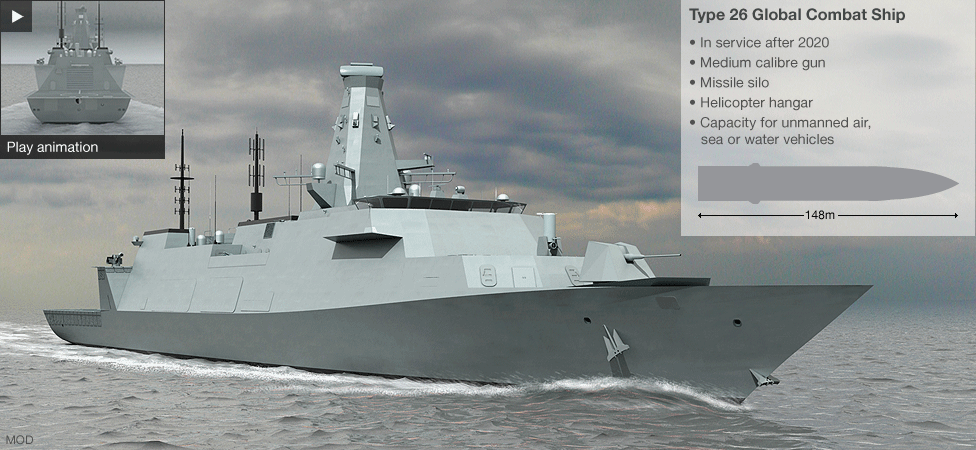
Today, the US Navy finds itself in the same relative situation as the Royal Navy of Queen Victoria: the most powerful fleet in the world, but facing uncertainty due to technological changes. Strategy Page has a brief run-down of the potentially disruptive developments we may see in the near future:
The 21st century is barely underway, and much unknown technology is yet to be invented. Many of the key warship technologies were unknown in 1912. But we can already see some new stuff which is leading revolutionary changes in how navies will operate this century. Here some of the more obvious ones.
Unmanned vehicles. Unlike aircraft, which were a new vehicle, UAVs (Unmanned Aerial Vehicles), UUVs (Unmanned Underwater Vehicles) and USVs (Unmanned Surface Vehicles) are radically new technologies. There are already examples of all three in service. There will be more and they will change everything by incorporating more powerful AI and new weapons. That said, UUVs were first developed in the 19th century (the modern torpedo) and 20th (guided missiles). But these two weapons were not flexible enough to change as many aspects of naval warfare as unmanned vehicles will be doing.
Super Sensors. Sonar (using sound to detect objects underwater) appeared during World War I (1914-18) while radar (using radio signals to detect objects in the air) was developed during the 1930s and widely used during World War II (1939-45). Widely recognized as the first electronic sensors (although the earliest sonars were all-acoustic), their 21st century descendants are much more capable. More powerful computers and transmitting technology has since produced several generations of cheaper, more reliable and more powerful sensors. This is continuing and the power of new sensors will make it much more difficult to hide. Stealth is still important for spoiling the aim of long range guided weapons. But the super sensors make it much more difficult to achieve surprise by coming out of nowhere.
Other items on this list include artificial intelligence (AI), all-electric ships, stealth technology, networking, composite materials, space-based services, nanotech, and laser weapons. Lots of ways for admirals to lose sleep over the next few years.
Cory Doctorow in the Guardian on the current state of “nerd politics:
In the aftermath of the Sopa fight, as top Eurocrats are declaring the imminent demise of Acta, as the Trans-Pacific Partnership begins to founder, as the German Pirate party takes seats in a third German regional election, it’s worth taking stock of “nerd politics” and see where we’ve been and where we’re headed.
Since the earliest days of the information wars, people who care about freedom and technology have struggled with two ideological traps: nerd determinism and nerd fatalism. Both are dangerously attractive to people who love technology.
In “nerd determinism,” technologists dismiss dangerous and stupid political, legal and regulatory proposals on the grounds that they are technologically infeasible. Geeks who care about privacy dismiss broad wiretapping laws, easy lawful interception standards, and other networked surveillance on the grounds that they themselves can evade this surveillance. For example, US and EU police agencies demand that network carriers include backdoors for criminal investigations, and geeks snort derisively and say that none of that will work on smart people who use good cryptography in their email and web sessions.
But, while it’s true that geeks can get around this sort of thing — and other bad network policies, such as network-level censorship, or vendor locks on our tablets, phones, consoles, and computers — this isn’t enough to protect us, let alone the world. It doesn’t matter how good your email provider is, or how secure your messages are, if 95% of the people you correspond with use a free webmail service with a lawful interception backdoor, and if none of those people can figure out how to use crypto, then nearly all your email will be within reach of spooks and control-freaks and cops on fishing expeditions.
[. . .]
If people who understand technology don’t claim positions that defend the positive uses of technology, if we don’t operate within the realm of traditional power and politics, if we don’t speak out for the rights of our technically unsophisticated friends and neighbours, then we will also be lost. Technology lets us organise and work together in new ways, and to build new kinds of institutions and groups, but these will always be in the wider world, not above it.
Brid-Aine Parnell at The Reg updates us on the SpaceX flight schedule:
The flight of the Falcon 9 has once more been rescheduled, with a new launch date of 19 May, as Elon Musk’s SpaceX decided to tweak the software one more time.
The first commercial craft to restock the International Space Station, a Dragon capsule strapped to a Falcon 9 rocket, has seen more than its fair share of push-backs for the test flight, but it will all pay off if the cargo ship can dock with the station.
SpaceX has already shown it can release and retrieve the Dragon, but getting it to motor alongside the fast-moving ISS and accurately berth with it is no mean feat and the firm has tested and retested the necessary software in the hopes it won’t end up with egg on its face.
[. . .]
Providing this test flight is successful, the Dragon will start to fulfil the contract for a minimum of 12 flights to resupply the ISS. Since the ship is reusable, it will be the only spacecraft capable of bringing cargo back with it as well. And, ultimately, SpaceX hopes that a version of the Dragon will be its first manned spaceship as well.
Strategy Page on what’s weighing down American infantrymen now:
There is a rebellion brewing in the U.S. Army and Marine Corps. It’s all about the protective vest. This lifesaving bit of equipment has saved thousands of lives in the last two decades, but has, because of political grandstanding and media distortions, become too heavy and restrictive. The troops want lighter body armor, even if it does increase vulnerability to bullets. Marine and army experts point out that the drive (created mainly by politicians and the media) for “better” body armor resulted in heavier and more restrictive (to battlefield mobility) models. This has more than doubled the minimum weight you could carry into combat.
Until the 1980s, you could strip down (for actual fighting) to your helmet, weapon (assault rifle and knife), ammo (hanging from webbing on your chest, along with grenades), canteen and first aid kit on your belt, and your combat uniform. Total load was 13-14 kg (about 30 pounds). You could move freely and quickly like this, and you quickly found that speed and agility was a lifesaver in combat. But now the minimum load carried is twice as much (27 kg) and, worse yet, more restrictive.
While troops complained about the new protective vests, they valued it in combat. The current generation of vests will stop rifle bullets, a first in the history of warfare. And this was after nearly a century of trying to develop protective vests that were worth the hassle of wearing. It wasn’t until the 1980s that it was possible to make truly bullet proof vests using metallic inserts. But the inserts were heavy and so were the vests (about 11.3 kg/25 pounds). Great for SWAT teams, but not much use for the infantry. But in the 1990s, additional research produced lighter bullet proof ceramic materials. By 1999, the U.S. Army began distributing a 7.3 kg (16 pound) “Interceptor” vest that provided fragment and bullet protection. This, plus the 1.5 kg (3.3 pound) Kevlar helmet (available since the 1980s), gave the infantry the best combination of protection and mobility. And just in time.
The United States Postal Service has announced that they will no longer allow shipments that include lithium batteries, as of May 16th:
If you want to send an iPad, a Kindle Fire, an iPhone, a laptop, or a similar device overseas, now is the time to send it, because as of next week, the U.S. Postal Service will be banning all electronic gadgets that contain a lithium battery.
The reason? Those lithium batteries can potentially explode or catch fire when devices are shipped with a full charge, improperly stored, or improperly packed. Lithium battery related fire incidents have occurred 17 times on passenger flights since 2004, and have been implicated in at least one major crash of a UPS plane.
As a result of the ban, people who want to ship electronic devices to troops or to family overseas will have to use a private delivery service, such as UPS, DHL, and FedEx, which are pricy alternatives.
[. . .]
USPS’s refusal to ship devices with lithium batteries will have the greatest impact on military serving overseas (DHL and UPS do not deliver to APO or FPO boxes) and commercial resellers, who will have to increase shipping costs and rely on FedEx, DHL, and UPS, which still have challenges in countries like Russia.
Powered by WordPress