
Sex differences are a distribution, not a hard, bright line. For example, the women’s world record in the hundred-meter dash is slower than the U.S. high school boys’ record. Men on average are faster than women. But the women at the top of the distribution — those Olympians — are still faster than most men. It would be absurd to say that a woman can’t run the hundred meter in 11 seconds, just because most women can’t. It would be equally absurd to say that men are not, on average, faster than women.
So it’s possible that the distribution of nurturing traits is skewed enough that fewer men will be good at the difficult and emotionally taxing job of providing intimate care for sick and needy people. While there are plenty of health care jobs that don’t require so much direct human interaction, they tend to require more training. And the ability to sit in a classroom and absorb material from a textbook is also a human trait that is unevenly and unfairly distributed. It’s not that no men can succeed in transitioning from old-style “manly” jobs to the pink-collar professions, but that fewer men may be able to do so than we’d like to think.
Megan McArdle, “Some Blue-Collar Workers Probably Shouldn’t Do Pink Jobs”, Bloomberg View, 2017-01-06.
November 21, 2018
QotD: Occupations and sex differences
November 20, 2018
QotD: Why do we drink?
Alcoholic beverages, like agriculture, were invented independently many different times, likely on every continent save Antarctica. Over the millennia nearly every plant with some sugar or starch has been pressed into service for fermentation: agave and apples, birch tree sap and bananas, cocoa and cassavas, corn and cacti, molle berries, rice, sweet potatoes, peach palms, pineapples, pumpkins, persimmons, and wild grapes. As if to prove that the desire for alcohol knows no bounds, the nomads of Central Asia make up for the lack of fruit and grain on their steppes by fermenting horse milk. The result, koumiss, is a tangy drink with the alcohol content of a weak beer.
Alcohol may afford psychic pleasures and spiritual insight, but that’s not enough to explain its universality in the ancient world. People drank the stuff for the same reason primates ate fermented fruit: because it was good for them. Yeasts produce ethanol as a form of chemical warfare — it’s toxic to other microbes that compete with them for sugar inside a fruit. That antimicrobial effect benefits the drinker. It explains why beer, wine, and other fermented beverages were, at least until the rise of modern sanitation, often healthier to drink than water.
What’s more, in fermenting sugar, yeasts make more than ethanol. They produce all kinds of nutrients, including such B vitamins as folic acid, niacin, thiamine, and riboflavin. Those nutrients would have been more present in ancient brews than in our modern filtered and pasteurized varieties. In the ancient Near East at least, beer was a sort of enriched liquid bread, providing calories, hydration, and essential vitamins.
[…]
Indirectly, we may have the nutritional benefits of beer to thank for the invention of writing, and some of the world’s earliest cities — for the dawn of history, in other words. Adelheid Otto, an archaeologist at Ludwig-Maximilians University in Munich who co-directs excavations at Tall Bazi, thinks the nutrients that fermenting added to early grain made Mesopotamian civilization viable, providing basic vitamins missing from what was otherwise a depressingly bad diet. “They had bread and barley porridge, plus maybe some meat at feasts. Nutrition was very bad,” she says. “But as soon as you have beer, you have everything you need to develop really well. I’m convinced this is why the first high culture arose in the Near East.”
Andrew Curry, “Our 9,000-Year Love Affair With Booze”, National Geographic, 2017-02.
November 19, 2018
“You call someplace paradise/kiss it goodbye”
The Eagles song “The Last Resort” references a generic paradise, not the California town of that name, yet it fits disturbingly well, as Gerard Vanderleun describes:
Paradise is not a town on some flat land out on the prairies or deep in the desert. Paradise is a series of cleared areas and roads superimposed on an extremely rugged terrain composed of deep, narrow ravines and high and densely wood ridges. The Skyway is fed by hundreds of paved and unpaved roads that twist and turn and rise and dip and then, at their OFFICIAL ends, run deeper still and far off the grid. If you live in Paradise you know there are hundreds of people living back up in those ravines and ridges that would be hard to find before the fire. In those places, the poor are lodged tighter than ticks.
I’ve seen, before the fire this time, people in the outback of Paradise so abidingly poor they were living in trailers from the 70s resting on cinder blocks and at most only two winters away from a pile of rust. These people would have had no warning of a fire, no warning at all. Instead of “sheltering in place” they would have been “incinerated in place.”
In the ravines and forests of Paradise, cell reception was so spotty that AT&T gave me my own personal internet driven cell-phone tower. If those off the grid in Paradise actually owned cell phones they would have been lucky to get an alert. But most of those did not own cell phones, and landlines didn’t run that deep in the woods. When the fire closed over them they would have had no warning. No warning until the trailer melted around them. And then there was, out behind but still close to their trailer, their large propane tank.
November 18, 2018
New research shows 536AD to have been the true annus horribilis
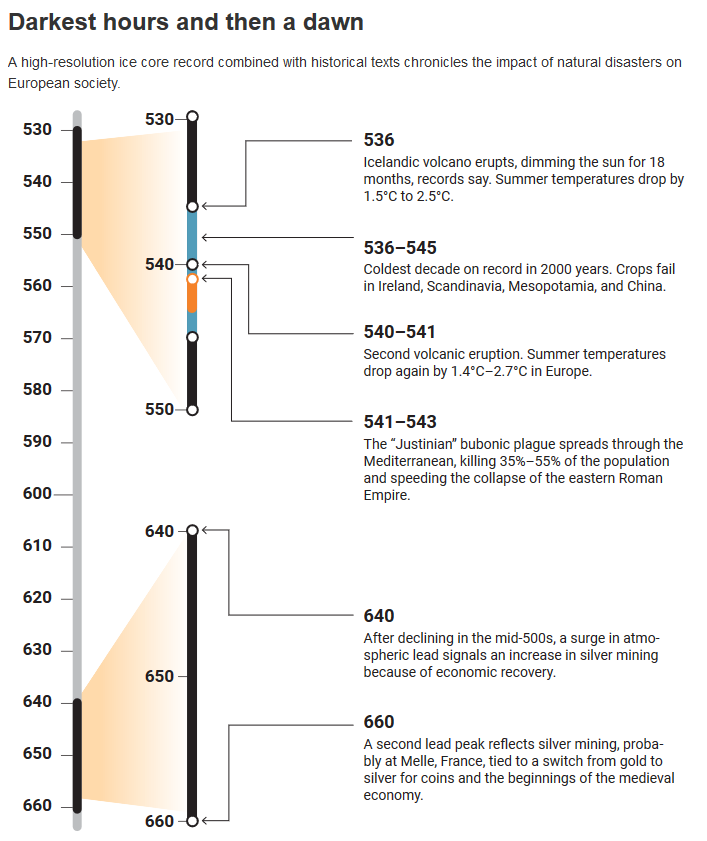
There have been bad years in human history. There have been worse days in human history. But according to a recent study summarized in Science magazine, the worst year in recorded history was 536AD:
Ask medieval historian Michael McCormick what year was the worst to be alive, and he’s got an answer: “536.” Not 1349, when the Black Death wiped out half of Europe. Not 1918, when the flu killed 50 million to 100 million people, mostly young adults. But 536. In Europe, “It was the beginning of one of the worst periods to be alive, if not the worst year,” says McCormick, a historian and archaeologist who chairs the Harvard University Initiative for the Science of the Human Past.
A mysterious fog plunged Europe, the Middle East, and parts of Asia into darkness, day and night — for 18 months. “For the sun gave forth its light without brightness, like the moon, during the whole year,” wrote Byzantine historian Procopius. Temperatures in the summer of 536 fell 1.5°C to 2.5°C, initiating the coldest decade in the past 2300 years. Snow fell that summer in China; crops failed; people starved. The Irish chronicles record “a failure of bread from the years 536–539.” Then, in 541, bubonic plague struck the Roman port of Pelusium, in Egypt. What came to be called the Plague of Justinian spread rapidly, wiping out one-third to one-half of the population of the eastern Roman Empire and hastening its collapse, McCormick says.
Historians have long known that the middle of the sixth century was a dark hour in what used to be called the Dark Ages, but the source of the mysterious clouds has long been a puzzle. Now, an ultraprecise analysis of ice from a Swiss glacier by a team led by McCormick and glaciologist Paul Mayewski at the Climate Change Institute of The University of Maine (UM) in Orono has fingered a culprit. At a workshop at Harvard this week, the team reported that a cataclysmic volcanic eruption in Iceland spewed ash across the Northern Hemisphere early in 536. Two other massive eruptions followed, in 540 and 547. The repeated blows, followed by plague, plunged Europe into economic stagnation that lasted until 640, when another signal in the ice — a spike in airborne lead — marks a resurgence of silver mining, as the team reports in Antiquity this week.
H/T to Blazing Cat Fur for the link.
QotD: “Sexist” toys
As a female journalist who writes mostly about traditionally “male areas” such as economics and business, I should perhaps be expected to endorse a “blank slate” theory of male and female gender roles, where the preference for certain kinds of activities is driven by sexist socialization and discrimination, not innate ability. The problem is that this doesn’t necessarily match up with the evidence. Human children show gender-driven preferences for toys, as can be attested by those faultlessly progressive parents who have seen their boys turn their hands into a gun while their daughters make a doll out of an ear of corn. These preferences show up even in children too young to have gotten much socialization; they turn up even in rhesus monkeys, as males show a marked preference for wheeled toys over soft plush animals. I certainly believe that human society has a lot of sexist hangovers from its past. I draw the line at believing that this hangover is influencing rhesus monkey infants.
Megan McArdle, “Some Blue-Collar Workers Probably Shouldn’t Do Pink Jobs”, Bloomberg View, 2017-01-06.
November 16, 2018
The political wrangles ahead over the federal carbon tax
Andrew Coyne — for once not beating the drum for electoral reform — discusses the challenge facing the federal government in the wake of provincial resistance to their carbon tax plans:
But the real test, of course, is yet to come. The provinces cannot stop the tax on their own. The court challenges are likely to fail. Provinces that refuse to implement carbon pricing will simply find the federal “backstop” tax imposed in its place. It is the election that will decide the issue, not duelling governments. Or so Conservatives hope.
Certainly there are abundant grounds to doubt the political wisdom of the Liberal plan. A tax, or anything that resembles it, would be a hard enough sell on its own. But a tax in aid of a vast international plan to save the earth from a scourge that remains imperceptible to most voters, to which Canada has contributed little and against which Canada can have little impact, while countries whose actions would be decisive remain inert? Good luck.
What seems clear is that voters’ support for carbon pricing is shallow and tentative. The Conservative strategist who chortled to the National Post that the Liberals are asking Canadians “to vote with their hearts, not their wallets” — an impossibility, he meant — was correctly cynical. Just because people want to save the planet doesn’t mean they want to pay for it.
The best way to read the public’s mood is in the positions of the political parties, who are in their various ways each trying to assure them that it won’t cost them a dime. The Liberal version of this is to promise to rebate the extra cost of the federal tax to consumers — indeed, they pledge, 70 per cent of households will make a profit on the exchange.
The Conservatives have been less forthcoming, but it would appear their plan is to hide the cost, substituting regulations, whose effects are largely invisible to consumers, for the all-too-visible tax at the pump. Here, too, I suspect they may have a better (i.e. more cynical) read on popular opinion. The public often prefer to have the costs of government hidden from them, even if they know they are paying them — even if they know they are paying more this way, as indeed they are in this case. Do what you want to us, they seem to say, just don’t rub our faces in it.
So I would be skeptical about polls showing majority support for the federal plan: 54 per cent, according to Angus Reid, while Abacus finds 75 per cent would either support or at least accept it (versus 24 per cent opposed). These were taken shortly after the announcement of the federal rebates. Yet it is far from evident the rebates will still register with people a year from now. Indeed, the Conservatives barely paused to acknowledge them as inadequate before going on to pretend they had never been mentioned.
The Origin of Quantum Mechanics (feat. Neil Turok)
minutephysics
Published on Oct 14, 2012Check out the Massey Lectures with Neil Turok: http://www.cbc.ca/radio/ideas/the-201…
Perimeter Institute for Theoretical Physics: http://pitp.caMinute Physics provides an energetic and entertaining view of old and new problems in physics — all in a minute!
Music by Nathaniel Schroeder: http://www.soundcloud.com/drschroeder
Thanks to Nima Doroud and Bruno LeFloch for contributions and to Perimeter Institute for support.
http://www.perimeterinstitute.caProduced in association with the 2012 Massey Lecture Series http://dft.ba/-massey Created by Henry Reich
H/T to Aeon:
The physics revolution that started with the flicker of a lightbulb
The discovery of quantum mechanics at the start of the 20th century shook the very foundations of physics, forcing scientists and philosophers to reexamine everything from particles upward. But as this short animation from MinutePhysics explains, the quantum revolution was jumpstarted by a rather unremarkable question. As the German government asked the theoretical physicist Max Planck: how can lightbulbs be made more efficient? To help solve the problem, Planck tried to account for the changing colour of light based on temperature, which he eventually realised couldn’t be explained by classical Newtonian physics. Working backwards from his data in ‘an act of despair’, Planck found that light wasn’t emitted continuously, but rather in discrete packets that he referred to as ‘quanta’. And the rest is the illusory arrow of time that we call history.
November 6, 2018
An alternative explanation for the population explosion of the “land whales”
Tim Worstall suggests that the real reason for our collective expanding waistlines isn’t evil capitalist exploiters pushing us to eat unhealthy fast food:
We don’t, for example, eat more than our forefathers did. Sure, we can all play games with how much people lie on those self-reported surveys about calorie intake. True, to make sense of it being lies we’d have to assume that people lie more now than they used to. So, instead, let’s look at official guidance. In WW1 the aim was, for the Army, to stuff some 4,300 calories a day into each frontline soldier out there in the trenches. Something they largely achieved too. In WWII rationing peeps started to worry that diets of less than 2,900 calories a day would lead to weight loss. Today official guidance is that 2,500 a day for men, 2,000 for women. Well, that’s the last one I recall at least.
I suspect that people actually do lie more on self-reporting surveys of that kind than they once did, if only because we’ve had several decades of prissy lecturing about what we should consume … the temptation to shade the answers in the “right” direction I’m sure plays some part, but not enough to explain the obesity crisis. If you doubt that this happens, remember that a significant number of people vote for the party they expect to win rather than the party that best represents their interests or desires. Sucking up to teacher is a very common psychological trait.
However, back to the swelling obesity numbers:
Actually, 40 years ago is about when central heating became a commonplace in Britain. Anyone of my maturity in years – which includes G. Monbiot – and even those from thoroughly upper middle class backgrounds – both me and G. Monbiot – will recall ice on the inside of bedroom windows in winter. Houses simply were not fully heated throughout. Actually, pretty much the entire country was in what we’d now call fuel poverty. That fuel poverty that we have standards for these days, you should be able to heat the entire house to such and such a temperature on less than 10% of income. A standard which just about no one pre-1950 reached, few pre-1970 did.
America had that heating rather earlier than we did. Americans also became land whales that little bit earlier than we did. Anecdata I know but a move to the US in 1981 was marked with an observation of how warm Americans kept their houses in winter.
We do actually spend quite a lot on all this public health stuff these days. It might be worth someone doing a little study of correlations. Different nations became lardbuckets at different times. Different nations adopted central heating as a commonplace at different times. Why don’t we go see what the correlation between those two is?
After all, the idea that mammals use some significant portion of their energy intake for body temperature regulation isn’t exactly fringe science, is it?
November 4, 2018
QotD: LEED indulgences
I am not religious but am fascinated by the comparisons at times between religion and environmentalism. Here is the LEED process applied to religion:
- 1 point: Buy indulgence for $25
- 1 point: Say 10 Our Fathers
- 1 point: Light candle in church
- 3 points: Behave well all the time, act charitably, never lie, etc.
It takes 3 points to get to heaven. Which path do you chose?
Warren Meyer, “When Sustainability is not Sustainable”, Coyote Blog, 2013-07-30.
November 2, 2018
QotD: Modern men are “the sorriest cohort of masculine Homo sapiens to ever walk the planet”
A new book claims even modern athletes could not run as fast, jump as high, or have been nearly as strong as our predecessors.
The book, Manthropology: The Science of the Inadequate Modern Male, by Australian anthropologist Peter McAllister, describes many examples of the inadequacy of the modern male, calling them as a class, “the sorriest cohort of masculine Homo sapiens to ever walk the planet.”
Given spiked running shoes, Indigenous Australians of 20,000 years ago could have beaten today’s world record for running 100 and 200 meters. As recently as last century, some Tutsi males in Rwanda could have easily beaten the current high jump world record, and bodybuilders such as Arnold Schwarzenegger would have been no match in an arm wrestle with a Neanderthal woman.
Twenty thousand years ago six male Australian Aborigines chasing prey left footprints in a muddy lake shore that became fossilized. Analysis of the footprints shows one of them was running at 37 kph (23 mph), only 5 kph slower than Usain Bolt was traveling at when he ran the 100 meters in world record time of 9.69 seconds in Beijing last year. But Bolt had been the recipient of modern training, and had the benefits of spiked running shoes and a rubberized track, whereas the Aboriginal man was running barefoot in soft mud. Given the modern conditions, the man, dubbed T8, could have reached speeds of 45 kph, according to McAllister.
McAllister also presents as evidence of his thesis photographs taken by a German anthropologist early in the twentieth century. The photographs showed Tutsi initiation ceremonies in which young men had to jump their own height in order to be accepted as men. Some of them jumped as high as 2.52 meters, which is higher than the current world record of 2.45 meters.
Lin Edwards, “Modern men are wimps, according to new book”, Phys.org, 2009-10-21.
November 1, 2018
QotD: Game theory
“Guys,” he writes. “It’s time for some game theory.” Game theory, for the uninitiated, is a branch of mathematics that uses computational models to predict the behavior of human beings in potentially conflictual situations. It’s complex, involves a lot of formal logic and algebra, and is mostly useless. Game theory models human actions on the presumption that everyone is constantly trying to maximize their potential gain against everyone around them; this is why its most famous example concerns prisoners — isolated people, cut off from all the noncompetitive ties that constitute society. One of its most important theoreticians, John Nash, was also a paranoid schizophrenic, who believed himself to be the target of a vast Russian conspiracy.
Sam Kriss, “The Rise of the Alt-Center: Why did establishment liberals fall in love with a deranged Twitter thread? It’s time for some game theory”, Slate, 2016-12-16.
October 28, 2018
The actual science behind the “leaves on the line” excuse for late trains
While it doesn’t explain the “wrong type of snow” excuse also deployed by announcers when Britain’s trains run inexplicably slow in winter, here’s the scientific facts about the “leaves on the line” excuse:
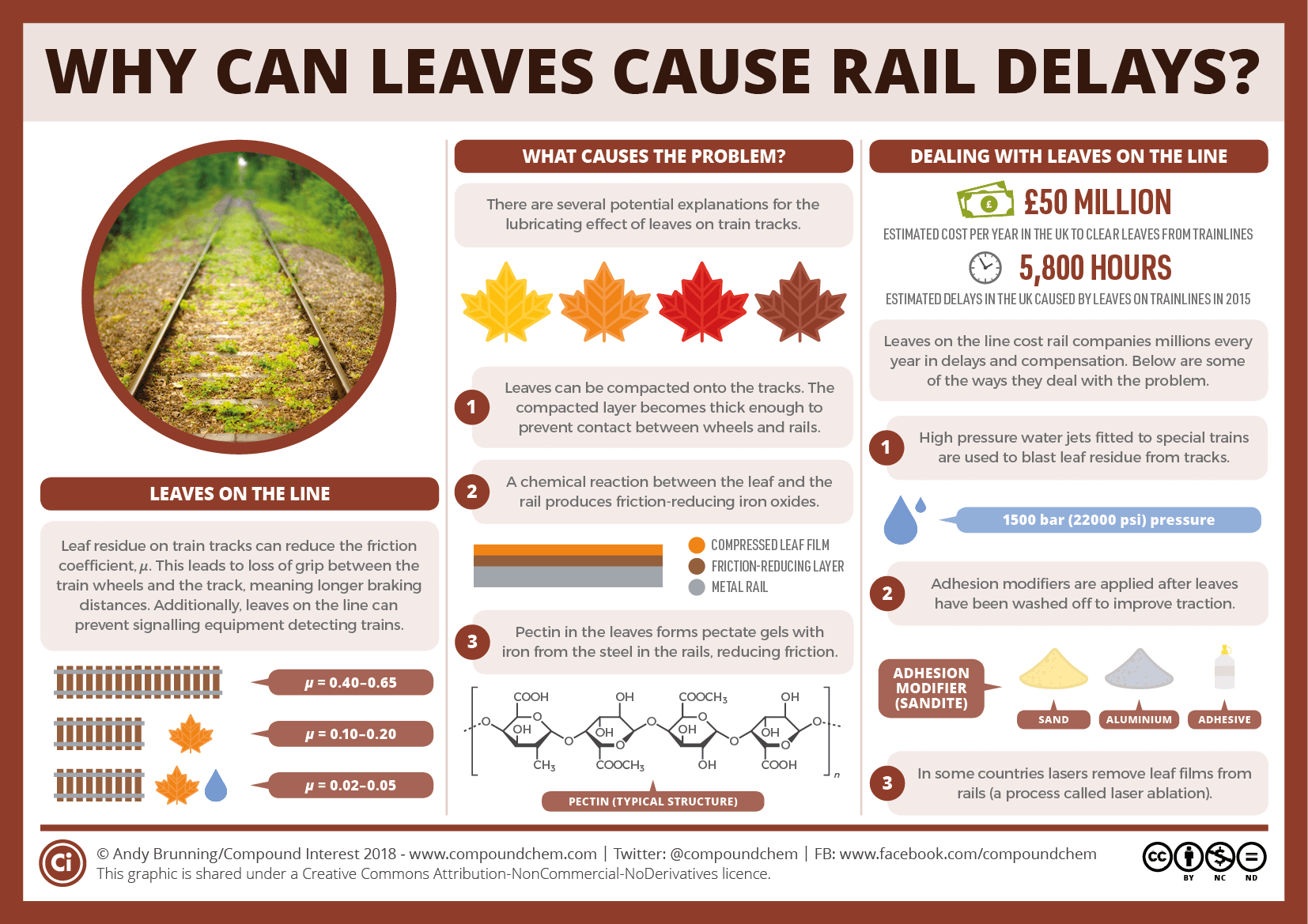
Autumn is here, and for most of us, it’s a time of beauty as the leaves cascade through an array of hues before pirouetting down from the trees. If you have to travel by train, however, you might tire of ‘leaves on the line’ being the supposed cause of train delays. It turns out to be more than just a flimsy excuse – and particular chemical reactions are partly to blame.
We’ve previously looked at the chemical cause of the colours of autumn leaves. By the time they make their descent from trees to the ground, most of these colours have passed. What remains is a brown husk, mainly made up of cellulose. Cellulose is the biological polymer that is the main component of plant cell walls.
Once leaves have fallen from trees, they simply decompose over time. Their presence isn’t usually a problem until it comes to the train network. When leaves fall on train lines, they can reduce the grip between the train wheels and the track. This, in turn, can lead to longer braking distances for trains. By disrupting the contact between the train wheels and the track, the leaves also prevent signalling equipment detecting trains. This can then cause train delays.
What makes leaves affect train tracks in this way? Scientists have a few suggestions, and it’s likely that they all contribute to the problem to some extent.
October 27, 2018
The Progressive case for Americans to pay higher drug prices than the rest of the world
Tim Worstall carefully explains — in full compliance with Progressive philosophy and pointing out that Trump is wrong (which is extra bonus Progressive points) — why Americans should continue to pay more for drugs that are cheaper in other countries:
Working out which drugs work and how is expensive. There’s then another expensive in actually proving this well enough to gain a licence. All in costs are in the $1 to $2 billion range dependent upon who you want to listen to. Unfortunately, once you’ve done all that and paid all that anyone could just come along and copy your drug. Which means you don’t make your $2 billion back – that in turn meaning that no one does spend $2 billion, we don’t get new drugs and we all die in ditches.
This is a classic public goods problem and the solution we use – not the only one, not even the only viable one – is patents. You get about 10 years, the time between approval and patent expiry, to make your $2 billion back. Then anyone can copy it and we all get cheap copy drugs.
For this system to work it is not necessary that everyone pay these high patent protected prices. There’s no point in trying to charge some farm worker in S Africa $10,000 a year for HIV retrovirals anyway, they don’t have the cash and demanding it will gain nothing except their death. We just need some group to pay the high prices so that drug development still happens. Everyone else can get drugs at some margin above their manufacturing, not development, costs.
So, who is it who should be carrying this cost of producing this public good? Good progressive principles tell us that it should be the rich folk. Imagine that we used some other system of drug development, maybe taxpayers cough up for it all. It’ll still be the rich doing the paying, right? So, patents, where the rich pay full freight for drugs, the poor don’t, this meets our equity criterion.
And who are the rich in this global sense, for we’re talking about a global public good here? That would be the citizens of the richest large nation, the largest rich nation, the United States of America. So, yes, Americans should be paying high prices for drugs and the rest of us shouldn’t.
Do note that we’ve used impeccable redistributionist logic to reach this conclusion. It’s only if you think the rich shouldn’t be paying to benefit the poor that this is a bad idea. Which might be why Trump is agin it but it still puzzles as to why the progressives would be.
October 26, 2018
Economist Jack Mintz dis-claims credit for the Liberals’ carbon tax scheme
Everybody likes to be recognized for their work, but Jack Mintz wants to delineate where his original plan and the actual carbon tax scheme implemented by the federal government diverge:
I continue to maintain, as I have all these years, that the best way to implement carbon taxes is to use the revenues to reduce harmful corporate and personal taxes (I’ve since added land-transfer taxes to the original list). This includes removing anti-competitive levies while also providing support for low-income households to cope with higher electricity, heating and transportation costs.
However, what was unveiled Tuesday by the federal Liberal government in its carbon-pricing plan fails to achieve what I would have argued to be an ideal carbon policy. What is being advertised as a climate plan for provinces that fail to follow Ottawa’s carbon-tax directives — currently New Brunswick, Ontario, Manitoba and Saskatchewan, but they’ll likely be joined by others — instead comes across as a grand redistribution scheme administered by an expanding government bureaucracy.
While the federal carbon tax is almost uniform (electricity is not yet included), it provides special exemptions for certain sectors such as farmers, fishers, aviation, power producers in the North and greenhouse operators, although not the ones growing recreational cannabis.
But the departure from uniformity is marginal and not nearly as concerning as the Trudeau government’s continuing commitment to existing and even new regulations and subsidies to promote “clean energy,” each with their implicit carbon price. While economists repeatedly argue for a carbon tax precisely because it means we can forgo these high-cost interventions, somehow that has all been lost. While plenty of the economists behind the carbon-tax lobby were cheering Prime Minister Justin Trudeau’s new plan yesterday, I somehow missed their demands that we now must eliminate clean fuel and renewable electricity standards, subsidies for electric vehicles and ethanol — all of which have carbon costs well in excess of the $50-a-tonne carbon tax planned for 2022.
Another failure of the federal plan is to pass on carbon taxes in the form of Justin Bucks — or, to use the more laborious official name for these tax rebates: Climate Action Incentive Payments. So, rather than include carbon taxation as part of a comprehensive tax reform to make the tax system simpler, less distorting and fair, these Justin Bucks will be paid to households, small businesses, municipalities, universities, colleges, hospitals, non-profit and Indigenous populations.
A fatal flaw in federal pricing plan is a major shift in taxes from individuals to businesses. The average per household rebate — $1,161 in Saskatchewan in 2022 for example — is more than the cost per household of $946 (not including GST or HST on any energy bills). Even though the document states that business taxes are fully shifted forward to households, something is amiss here. How can household rebates average more than costs?
October 25, 2018
It’s not a “bribe” … it’s an “incentive”!
Terence Corcoran explains why the federal government’s promised “incentive” isn’t in any way, shape, or form any kind of bribe:
Step right up, ladies and gentlemen. Welcome aboard the all-new Canadian Cynical Circular Carbon Circus, the amazing Liberal climate control spectacle that will send you on a great environmental ride into the future.
Come on in! We will pay you to not consume fossil fuels — as individuals and as industries. It’s an economic revolution that takes us beyond blockchain and cryptocurrencies and cannabis into a brave new universe in which money goes round and round and everybody wins. We will pay Canadians with their own money — more than $20 billion over five years in carbon taxes that will raise the price of gasoline by 11 cents a litre by 2022, and ever higher thereafter if not sooner. Everybody pays and everybody wins, except for those who don’t. And some people win more than they pay. It’s better than a lottery!
For the people of Ontario, Saskatchewan, Manitoba and New Brunswick, the federal carbon circus cash comes via a new “Climate Action Incentive Payment.” An Ontario family of four will receive $307 for this year, the amount to be claimed on 2018 income tax returns. A Saskatchewan family will get a Climate Action Incentive Payment of $609.
What’s the Climate Action Incentive Payment for? The Liberal plan unveiled by Prime Minister Justin Trudeau and Environment Minister Catherine McKenna Tuesday doesn’t specify. What are taxpayers in the four provinces being incented to do, exactly, with this new wad of free cash? There is only one explanation: Vote Liberal in 2019!
The payments are based on a 2019 carbon price of $20 a tonne, rising to $50 by 2022. As the carbon tax goes up, Ontario families will receive $718 in 2022 and Saskatchewan families $1,459. And there will be more to come, presumably, since the latest doomsday scenario from the UN Intergovernmental Panel on Climate Change — the font of all speculation and data manipulation on climate issues — warned that by 2030 (only 12 years from now) a carbon price of somewhere between $135 to $5,500 per tonne would be needed to keep global warming below 1.5 degrees Celsius.


