
Natural organically-evolved cities tend to be densely-packed mixtures of dark alleys, tiny shops, and overcrowded streets. Modern scientific rationalists came up with a better idea: an evenly-spaced rectangular grid of identical giant Brutalist apartment buildings separated by wide boulevards, with everything separated into carefully-zoned districts. Yet for some reason, whenever these new rational cities were built, people hated them and did everything they could to move out into more organic suburbs. And again, for some reason the urban planners got promoted, became famous, and spread their destructive techniques around the world.
Ye olde organically-evolved peasant villages tended to be complicated confusions of everybody trying to raise fifty different crops at the same time on awkwardly shaped cramped parcels of land. Modern scientific rationalists came up with a better idea: giant collective mechanized farms growing purpose-bred high-yield crops and arranged in (say it with me) evenly-spaced rectangular grids. Yet for some reason, these giant collective farms had lower yields per acre than the old traditional methods, and wherever they arose famine and mass starvation followed. And again, for some reason governments continued to push the more “modern” methods, whether it was socialist collectives in the USSR, big agricultural corporations in the US, or sprawling banana plantations in the Third World.
Traditional lifestyles of many East African natives were nomadic, involving slash-and-burn agriculture in complicated jungle terrain according to a bewildering variety of ad-hoc rules. Modern scientific rationalists in African governments (both colonial and independent) came up with a better idea – resettlment of the natives into villages, where they could have modern amenities like schools, wells, electricity, and evenly-spaced rectangular grids. Yet for some reason, these villages kept failing: their crops died, their economies collapsed, and their native inhabitants disappeared back into the jungle. And again, for some reason the African governments kept trying to bring the natives back and make them stay, even if they had to blur the lines between villages and concentration camps to make it work.
Why did all of these schemes fail? And more importantly, why were they celebrated, rewarded, and continued, even when the fact of their failure became too obvious to ignore? Scott gives a two part answer.
The first part of the story is High Modernism, an aesthetic taste masquerading as a scientific philosophy. The High Modernists claimed to be about figuring out the most efficient and high-tech way of doing things, but most of them knew little relevant math or science and were basically just LARPing being rational by placing things in evenly-spaced rectangular grids.
But the High Modernists were pawns in service of a deeper motive: the centralized state wanted the world to be “legible”, ie arranged in a way that made it easy to monitor and control. An intact forest might be more productive than an evenly-spaced rectangular grid of Norway spruce, but it was harder to legislate rules for, or assess taxes on.
The state promoted the High Modernists’ platitudes about The Greater Good as cover, in order to implement the totalitarian schemes they wanted to implement anyway. The resulting experiments were usually failures by the humanitarian goals of the Modernists, but resounding successes by the command-and-control goals of the state. And so we gradually transitioned from systems that were messy but full of fine-tuned hidden order, to ones that were barely-functional but really easy to tax.
Scott Alexander, “Book Review: Seeing Like a State”, Slate Star Codex, 2017-03-16.
March 9, 2019
QotD: “Scientific” urban planning versus messy, unscientific, evolved town growth
March 6, 2019
The “grandmother hypothesis”
Jonathan Lambert on the theory for why, almost alone among species, human females live on well past their reproductive years:
Killer whales, Japanese aphids and Homo sapiens — they’re among the few organisms whose females live on long past the age of reproduction.
Since the name of the evolutionary game is survival and reproduction, the phenomenon begs explanation — why live longer than you can reproduce? In the 1960s, researchers came up with the “grandmother hypothesis” to explain the human side of things. The hypothesis is that the help of grandmothers enables mothers to have more children. So women who had the genetic makeup for longer living would ultimately have more grandchildren carrying their longevity genes. (Sorry, grandfathers, you’re not included in this picture.)
Two studies published Thursday in Current Biology take another look at this hypothesis and add new insights into the role grandmothers play.
The first hard evidence for the grandmother hypothesis was gathered by Kristen Hawkes, an anthropologist at the University of Utah who was studying the Hadza people, a group of hunter-gatherers in northern Tanzania. Hawkes was struck by “how productive these old ladies were” at foraging for food, and she later documented how their help allowed mothers to have more children.
If our long post-reproductive lives evolved because of grandmothers, we should be able to find fingerprints of the benefits of grandmothering in many cultures. But the circumstances of modern life differ drastically from those we faced at the beginning of our evolutionary story.
The studies in Current Biology turned to the detailed records of two preindustrial populations, one in what is now Quebec and the other in Finland. The researchers mined these rich databases to quantify the reproductive boost that grandmothers provide and to help us better understand the limits of their help.
H/T to Claire Lehmann for the link.
QotD: Teaching evolution in the “Bible Belt”
I teach college in a small city in Arkansas, deep in the American Bible Belt. I am a historian of Africa and in my department that means that I also teach a world history survey. I always start with the expansion of modern humans out of Africa and their encounter with other types of humans: Neanderthals, Homo erectus, Denesovians and what seems like an ever-growing list of newly discovered human-like creatures. It’s less the case now, but when I started twenty years ago this part of the course was initially met with polite but firm resistance, which gradually gave way to a sort of furtive curiosity. I eventually realized that even my cleverest students knew very little about human evolution except that it was false and that they were supposed to reject it. They came to the university having been taught that evolution was part of a larger attack on their faith and values, but they had never really been exposed to anything but a sort of parody version of it. A small number of them accepted evolutionary theory, but being a Darwinian in rural Arkansas was usually more about youthful rebellion and non-conformity than it was about informed, rational consideration of evidence.
Once we got past the denunciation or acceptance of evolutionary theory as a form of tribal affiliation, I found students to be deeply curious about it. It was such a taboo subject that their high school teachers had only skimmed over it and often with some careful personal distancing from the material. So the opportunity to delve into the details of this forbidden knowledge was intellectually thrilling for them. Despite the excitement engendered by the topic only a few changed their minds; most did not.
My students had grown up in communities where evolutionary theory was so wrong, so contrary to the accepted worldview of all decent people, that the only acceptable way to talk about it was to denounce it or reject it. The result was that most of my students rejected evolution, but getting a chance to learn about it was profoundly exciting, even if most of them were too conformist (these were Honors students after all) to change their positions.
Erik Gilbert, “Liberal Orthodoxy and the New Heresy”, Quillette, 2019-02-04.
March 1, 2019
Dune – Wandering in the Desert – Extra Sci Fi – #3
Extra Credits
Published on 26 Feb 2019Dune is an ecological novel. Nature isn’t just the background setting, but firmly integrated into the science and systems of the world. Frank Herbert explores big ideas around environmental conservation, through the spice that must flow.
QotD: Toxic masculinity
Thanks to the new guidelines from the American Psychological Association (APA) for practice with men and boys, male psychology is no longer a mystery and mental health professionals are now equipped with the tools they need to combat the worst forms of it. According to the APA, boys and men are at risk of suffering from traditional masculinity which is on the whole unhealthy. Turns out, the traditional masculinity that drives many of us men to be confident, assertive, adventurous, stoic, and willing to take risks for our goals, the people we love, and sometimes even complete strangers are bad for us and society.
Who knew?
Biologists, philosophers, theologians, physicians, parents, and really almost all regular folk have long believed that there are meaningful and biologically-based psychological differences between males and females. Fortunately for us mere mortals, the APA is setting the record straight. It is an oppressive patriarchy, not biology, that has shaped our psychology. Gender and the masculine traits associated with being male are social constructs. The APA obviously isn’t denying that evolution is true. They aren’t some kind of silly group of religious fundamentalists. But like most educated progressives, they understand that evolution stopped at the neck.
There is this odd group of evolutionary psychologists who seem hell-bent on holding onto antiquated views about human mental and social life. It seems pretty clear that these individuals are the academic wing of the alt-right. Don’t be fooled by surveys suggesting the majority of evolutionary psychologists self-identify as liberal. We can’t trust people to self-report their own politics. Only the most enlightened are in a position to tell everyone else what they really think. I would laugh at how ridiculous the academics are who continue to insist that males and females are distinct in any meaningful way, but I now know that comedy is a form of oppression.
Perhaps the saddest part of reading the new APA guidelines is realizing just how many American boys and men suffer from traditional masculinity and don’t even realize it, and how many mothers and wives tolerate and even promote this sickness. There are millions of couples and families across the United States who are living lives imprisoned by traditional gender roles and on the surface appear to be happy and flourishing. I especially feel for all the conservatives and devout Christians who are most vulnerable to this illness. It doesn’t help when alt-right institutions such as Harvard publish research suggesting that children may benefit from being raised in such traditionally religious homes.
Clay Routledge, “Thank you, APA”, Quillette, 2019-01-22.
February 25, 2019
Modern parenting – too many helicopters yield lots of snowflakes
It’s a commonplace assertion that children today have less unscheduled, unsupervised opportunities for play and exploration, and parents have been indoctrinated into the belief that the world has become a much more dangerous place and their kids need 24/7 protection from those myriad dangers. “Helicopter” parenting is a rational response to this indoctrination, but it comes with costs to the growth and maturity of the next generation. More than a decade ago, I posted this graphic showing how each generation has been more protective of their own children than their parents had been for them:
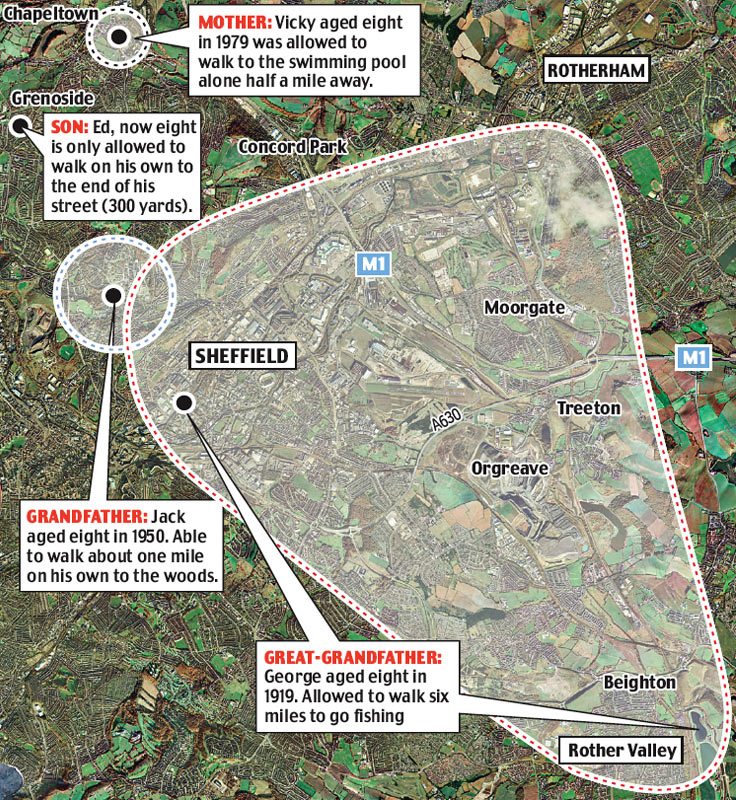
The problem has been getting worse over time, as Rob Creasy and Fiona Corby describe:
Children growing up in the UK are said to be some of the unhappiest in the industrialised world. The UK now has the highest rates of self harm in Europe. And the NSPCC’s ChildLine Annual Review lists it as one of the top reasons why children contact the charity.
Children’s mental health has becomes one of British society’s most pressing issues. A recent report from the Prince’s Trust highlights how increasing numbers of children and young people are unhappy with their lives, sometimes with tragic consequences.
This is a generation of young people that has been labelled as “snowflakes” – unable to handle stress and more prone to taking offence. They are also said to have less psychological resilience than previous generations. And are thought to be too emotionally vulnerable to cope with views that challenge their own.
[…]
Children’s lives are being stifled. No longer are children able to spend time with friends unsupervised, explore their community or hang around in groups without being viewed with suspicion. Very little unsupervised play and activity occurs for children in public spaces or even in homes – and a children’s spare time is often eaten up by homework or organised activity.
This is further impacted by the way children are taught in schools and how pressure to succeed has led to a taming of education. But if children are never challenged, if they don’t ever experience adversity, or face risks then it is not surprising they will lack resilience.
QotD: Defining mineral reserves
The European chemists organisation – EuChemS – has just added to the torrent of environmental drivel with their new periodic table. They’re trying to tell us which elements are going to run out when and thus tell us all that we’ve got to recycle. The entire process is bunkum because they’ve not understood the first thing about the supply of minerals. They simply do not know the meaning of mineral reserve that is.
Just for the edification of anyone who does drool when contemplating their own nasal effluvia – you know, a member of Greenpeace, that sort of person – a mineral reserve is something we’ve proven, yes proven, that we can extract from using today’s technology, at today’s prices, and make a profit. It costs a lot of money to prove these facts. Thus we only prove for what we’re likely to use in the next few decades. Mineral reserves are, to a reasonable level of accuracy, just the working stock of current mines.
There is no relationship, no relationship at all, between our mineral reserves and how much of that element or mineral is available to us to use. Really do grasp this point. It’s not that the amount is larger. It’s not that the multiple is high. It’s that there is no relationship at all. There are, for example, absolutely no mineral reserves of hafnium anywhere on the planet. Nothing, absolutely nada. At current rates of usage we might run out some few billion years after the Sun goes Red Giant. The European Chemical Society tries to tell us that there’s a serious risk of running short of Hafnium in the next 100 years. This is so gibberingly stupid that it would get a laugh from German geologists – I know because I told some this once and they giggled. Seriously, German – German – geologists, giggling.
Tim Worstall, “More Environmental Drivel With New Periodic Table – We’re Going To Run Out Of Helium”, Continental Telegraph, 2019-01-23.
February 23, 2019
How a statistical error became the key argument in the “everyone must turn vegan” movement
At The Conversation, Frank M. Mitloehner explains how a flawed statistic — comparing numbers derived from non-parallel bases — evolved into one of the most widely quoted arguments for governments forcing people to give up meat in their diet:
As the scale and impacts of climate change become increasingly alarming, meat is a popular target for action. Advocates urge the public to eat less meat to save the environment. Some activists have called for taxing meat to reduce consumption of it.
A key claim underlying these arguments holds that globally, meat production generates more greenhouse gases than the entire transportation sector. However, this claim is demonstrably wrong, as I will show. And its persistence has led to false assumptions about the linkage between meat and climate change.
[…]
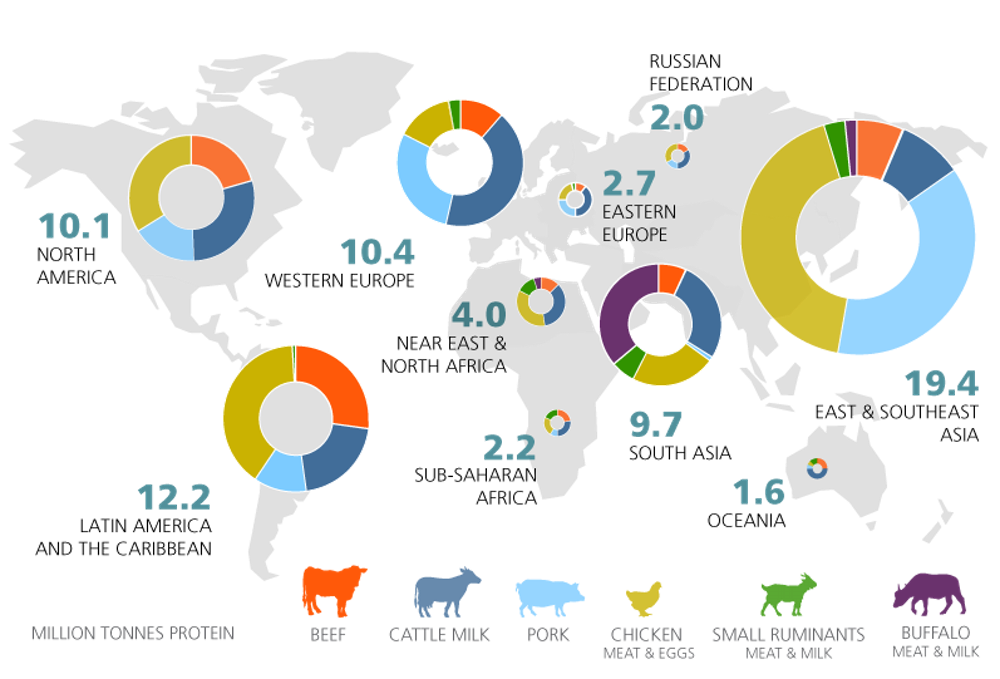
Global livestock production by region (milk and eggs expressed in protein terms).
Source: United Nations Food and Agriculture Organization.Setting the record straight on meat and greenhouse gases
A healthy portion of meat’s bad rap centers on the assertion that livestock is the largest source of greenhouse gases worldwide. For example, a 2009 analysis published by the Washington, D.C.-based Worldwatch Institute asserted that 51 percent of global GHG emissions come from rearing and processing livestock.According to the U.S. Environmental Protection Agency, the largest sources of U.S. GHG emissions in 2016 were electricity production (28 percent of total emissions), transportation (28 percent) and industry (22 percent). All of agriculture accounted for a total of 9 percent. All of animal agriculture contributes less than half of this amount, representing 3.9 percent of total U.S. greenhouse gas emissions. That’s very different from claiming livestock represents as much or more than transportation.
Why the misconception? In 2006 the United Nations Food and Agriculture Organization published a study titled “Livestock’s Long Shadow,” which received widespread international attention. It stated that livestock produced a staggering 18 percent of the world’s greenhouse gas emissions. The agency drew a startling conclusion: Livestock was doing more to harm the climate than all modes of transportation combined.
This latter claim was wrong, and has since been corrected by Henning Steinfeld, the report’s senior author. The problem was that FAO analysts used a comprehensive life-cycle assessment to study the climate impact of livestock, but a different method when they analyzed transportation.
For livestock, they considered every factor associated with producing meat. This included emissions from fertilizer production, converting land from forests to pastures, growing feed, and direct emissions from animals (belching and manure) from birth to death.
However, when they looked at transportation’s carbon footprint, they ignored impacts on the climate from manufacturing vehicle materials and parts, assembling vehicles and maintaining roads, bridges and airports. Instead, they only considered the exhaust emitted by finished cars, trucks, trains and planes. As a result, the FAO’s comparison of greenhouse gas emissions from livestock to those from transportation was greatly distorted.
No matter which “global crisis” they cry up, their answer is always “more government”
Alex Noble on the remarkable consistency of the proffered solution to any and all “global” problems:
Climatechangers are really just watermelons – green on the outside but red on the inside. You’ll notice that none of their ideas about how to prevent climate change involve anything other than bigger government.
For them, climate change is just a pretext – an irrefutable argument (“if you disagree that we need to save the planet you must want people to die!”) that enables them to demand more taxes and more power for them and their friends so they can set the world to rights.
And out here in the real world, they have their army of useful innocents – voters fearful of tackling the real world on their own without help from a cosseting State, all too ready to swallow any argument for bigger government.
Climate change largely consists of menacing them with stories about rising water and melting ice and starving polar bears, so they will allow our civil rights to be ridden over to keep us all safe. They demand it, in fact.
As H.L Mencken said, “The whole aim of practical politics is to keep the populace alarmed (and hence clamorous to be led to safety) by menacing it with an endless series of hobgoblins, all of them imaginary”
February 21, 2019
Food rituals and observances among the very woke
Americans in the 21st century are far less religious than their parents’ or grandparents’ generations, at least as far as formal, organized, traditional religion is concerned. In the place of old-fashioned religion, many have adopted a replacement that functions very much as religion used to:
Muslims eat halal. Jews eat kosher. Devout Catholics and Orthodox Christians abstain from meat on Friday and certain holy days. Hindus are vegetarian. But you will never see food practices take on religious intensity like they do in the more politically blue/left-wing bastions of the United States. This food intensity has been a gold mine of joke material for comedians like JP Sears.
Spend some time with vegan, gluten-free, and paleo devotees and you will realize that a fish filet on Friday can never match the cultlike seriousness these food fads take on. (And if you should ever be trapped at a restaurant table with somebody who is both vegan and gluten-free, run like the wind.)
Studies show left-leaning individuals are less likely to identify themselves as religious. But the truth is they have merely replaced well-known western religious traditions with more rigid ones. If you move to a politically blue part of the country, you will experience the cultural shift the minute your kids enter preschool. School picnics, snack time and birthday parties can become an anxiety-inducing strain as you try to determine what you can bring that all the children can eat. The parents are generally nice people who would never expect you to consider their dietary rules, but you will nonetheless feel a twinge of guilt if you bring that batch of traditionally-made cupcakes and accidentally feed it to a kid who is not allowed to experience it.
[…]
The popular food fetishes of these cultural enclaves often go hand-in-glove with a neo-pagan mishmash of Gaia-worship, 4th century Gnosticism, and rejuvenated new age/occult practices. Every religion has its food rituals. The left is no exception.
Now I know there are valid reasons to be concerned with the mistreatment of animals on factory farms and there are legitimate medical reasons that some must reduce gluten. Paleo eaters can have points about unnecessary additives in contemporary foods. But the reality remains that the food habits of contemporary leftists have the ritualistic feel of dogma, with many of its followers being far more rigid than the most fundamentalist religious believer.
We tend to have a lot of gluten-free meals here, but it’s a medical necessity, not a food-religion observance, as two of the three of us suffer from gluten-intolerance. One outcome of the “fashionability” of gluten-free dining, there has been a substantial increase in the availability of gluten-free foods which has been welcome. Unfortunately, as a lot of the demand has been due to fashion rather than necessity, some restaurants have been remarkably casual when gluten-free dishes are ordered, where the main dish may be safe, but it’s been covered with a sauce or glaze that isn’t gluten-free.
February 19, 2019
Judging a book by its cover (or people by their appearance)
In the latest Libertarian Enterprise, Sean Gabb reviews How to Judge People by What They Look Like, by Edward Dutton:
This short book is equally naughty and entertaining. It bounces along, making its points in a light-hearted and generally a witty manner. It is naughty so far as it is a flat challenge to many of the pieties of our age.
We are told never to judge a book by its cover — that the substance of a person, this being character and intelligence, have no measurable relationship to his external form, this being his physical appearance. At the extreme, of looking at correlations between race and intelligence, you can get into serious trouble for disputing this piety. Even moderate dissent earns hostility or just ridicule. Look, for example, at the relevant textbooks. The phlogiston theory is covered as an early theory of combustion, superseded by the truth. Phrenology is denounced as barely short of a moral and intellectual failing. No one thinks ill of Lamarck for this theory of inherited characteristics. Lombroso and his measurement of criminal heads are seen as steps on the road to Auschwitz.
The author of this book takes aim at every one of these pieties. He begins with the easy targets. Within ethnic groups, he goes over the increasingly rehabilitated claim that intelligence is largely inherited — about 80 per cent. He adds the other increasingly rehabilitated claim that there are differences of average intelligence between groups—that the peaks of each distribution curve occur at different points along the scale.
[…]
Now, what follows from all this? The answer is that all truth is important — so far as this is the truth; and I do lack the statistical grounding and the time or inclination to check the author’s scholarship. Even when a particular truth has no practical value, a regard for truth is a generally useful prejudice. But there are certain conclusions that appear to follow.
First, there is has been a progressively greater diversity of external form since the industrial revolution. The stated reason for this is that the harsh conditions of a traditional society, in which about 40 per cent of children died, and the higher classes had more surviving offspring, created a strong bias towards the survival of the intelligent and conscientious. Since then, the fall of infant mortality towards zero has thrown this process into reverse. That may explain the growing fall in genius or just high intellectual quality as a fraction of modern populations. It may also explain the decay — and the author says nothing of this — of free institutions, and their replacement by less complex and more maternal forms of government. Old England was free because its people were capable of being free. Modern England is unfree because the people have changed.
February 17, 2019
QotD: Nanotechnology and quantum computing
When I say Quantum Computing is a bullshit field, I don’t mean everything in the field is bullshit, though to first order, this appears to be approximately true. I don’t have a mathematical proof that Quantum Computing isn’t at least theoretically possible. I also do not have a mathematical proof that we can make the artificial bacteria of K. Eric Drexler’s nanotech fantasies. Yet, I know both fields are bullshit. Both fields involve forming new kinds of matter that we haven’t the slightest idea how to construct. Neither field has a sane ‘first step’ to make their large claims true.
Drexler and the “nanotechnologists” who followed him, they assume because we know about the Schroedinger equation we can make artificial forms of life out of arbitrary forms of matter. This is nonsense; nobody understands enough about matter in detail or life in particular to do this. There are also reasonable thermodynamic, chemical and physical arguments against this sort of thing. I have opined on this at length, and at this point, I am so obviously correct on the nanotech front, there is nobody left to argue with me. A generation of people who probably would have made first rate chemists or materials scientists wasted their early, creative careers following this over hyped and completely worthless woo. Billions of dollars squandered down a rat hole of rubbish and wishful thinking. Legal wankers wrote legal reviews of regulatory regimes to protect us from this nonexistent technology. We even had congressional hearings on this nonsense topic back in 2003 and again in 2005 (and probably some other times I forgot about). Russians built a nanotech park to cash in on the nanopocalyptic trillion dollar nanotech economy which was supposed to happen by now.
Similarly, “quantum computing” enthusiasts expect you to overlook the fact that they haven’t a clue as to how to build and manipulate quantum coherent forms of matter necessary to achieve quantum computation. A quantum computer capable of truly factoring the number 21 is missing in action. In fact, the factoring of the number 15 into 3 and 5 is a bit of a parlour trick, as they design the experiment while knowing the answer, thus leaving out the gates required if we didn’t know how to factor 15. The actual number of gates needed to factor a n-bit number is 72 * n^3; so for 15, it’s 4 bits, 4608 gates; not happening any time soon.
It’s been almost 25 years since Peter Shor had his big idea, and we are no closer to factoring large numbers than we were … 15 years ago when we were also able to kinda sorta vaguely factor the number 15 using NMR ‘quantum computers.’
I had this conversation talking with a pal at … a nice restaurant near one of America’s great centers of learning. Our waiter was amazed and shared with us the fact that he had done a Ph.D. thesis on the subject of quantum computing. My pal was convinced by this that my skepticism is justified; in fact he accused me of arranging this. I didn’t, but am motivated to write to prevent future Ivy League Ph.D. level talent having to make a living by bringing a couple of finance nerds their steaks.
Scott Locklin, “Quantum computing as a field is obvious bullshit”, Locklin on Science, 2019-01-15.
February 12, 2019
QotD: Weather
[W]ho wants to be foretold the weather? It is bad enough when it comes, without our having the misery of knowing about it beforehand.
Jerome K. Jerome, Three Men in a Boat (To Say Nothing of the Dog), 1889.
February 11, 2019
Tuberculosis – A Ten-Thousand Year Battle – Extra History – #2
Extra Credits
Published on 7 Feb 2019Tuberculosis couldn’t be cured and eliminated by just one person like Dr. Robert Koch, but thanks to the collective efforts of the medical community since Koch’s time — including public health initiatives and the introduction of randomized clinical trials — TB is steadily being wiped out.
Join us on Patreon! http://bit.ly/EHPatreon
February 9, 2019
The price tag for Alexandria Ocasio-Cortez’s renewable energy dream
At Reason, Ronald Bailey looks at how much it would cost to implement Alexandria Ocasio-Cortez’s post-fossil-fuel plans:
There’s a lot to consider in this resolution, but let’s for the time being focus on the goal of “meeting 100 percent of the power demand in the United States through clean, renewable, and zero-emission energy sources” by 2030. The resolution is light on fiscal details, so let’s consider the question of how achieving this goal would cost.
As it happens, a team of Stanford engineers led by Mark Jacobson outlined just such a plan back in 2015. Jacobson’s repowering plan would involve installing 335,000 onshore wind turbines; 154,000 offshore wind turbines; 75 million residential photovoltaic systems; 2.75 million commercial photovoltaic systems; 46,000 utility-scale photovoltaic facilities; 3,600 concentrated solar power facilities with onsite heat storage; and an extensive array of underground thermal storage facilities.
Assuming steep declines in the costs of each form of renewable electric power generation, just running the electrical grid using only renewable power would still cost roughly $7 trillion by 2030. The Information Technology and Innovation Foundation calculated that the total cost of an earlier version of Jacobson’s scheme would amount to $13 trillion. And based on how fast it has taken to install energy generation infrastructure in the past, Jacobson’s repowering plan would require a sustained installation rate that is more than 14 times the U.S. average over the last 55 years and more than six times the peak rate.
The cost — $7 trillion — would be spent to save … how much?
..global warming at or above 2 degrees Celsius beyond preindustrialized levels will cause— (A) mass migration from the regions most affected by climate change; (B) more than $500,000,000,000 in lost annual economic output in the United States by the year 2100;
$500 billion a year isn’t a lot in the context of the US economy. It’s currently around $20 trillion in size, so we’re talking about 2.5% of the economy being lost. But of course we’re also predicting that the economy will grow between now and then. Actually, we think the US economy will be about $100 trillion a year by 2100. So we’re talking about 0.5% of that economy. Or about the change in size of the US economy between September and December last year. Think how much richer we did feel over those few months. And how much poorer we’d be if it hadn’t happened, that growth.
Oh, and to avoid that loss AOC is suggesting that we spend $7 trillion now? That just doesn’t pass the cost benefit test. It doesn’t even pass at the Stern Review’s special discount rate.
Which is, of course, what all the economists have been trying to tell us all about dealing with climate change. Don’t do it by central planning, do it by using market incentives. Have a carbon tax. Don’t try and do it too quickly – William Nordhaus gained his Nobel in part for saying this – but do it more gradually over time. Don’t junk what we’ve got that already works, instead when the normal time comes to replace it then make sure it’s non-carbon emitting. Finally, don’t do it the expensive way, do it the cheap way. For the cheaper we make it to solve it then the more of the problem we’ll solve. You know, humans usually doing less of the expensive things and more of the cheap?
The most bizarre passage in the Green New Deal is the admission that after they've junked every car in America, replaced every power plant, and renovated every single building within the space of a decade, they might not get around to slaughtering all the cows by their deadline.
— Megan McArdle (@asymmetricinfo) February 7, 2019


