
What’s happening to pop culture is a reflection of our age. We’ve been turned into Pandas by a smothering, soft totalitarianism. The feminization of the culture means we’re ruled by mothers, who refuse to ever let us wander from the nest, physically, spiritually, creatively or intellectually. That has had all sorts of effects, like the drop in sperm counts and the collapse of popular culture. A deracinated people, kept in adult daycare centers and tended to by belligerent spinsters is not going to have a lot to celebrate or live for.
“The Z Man”, “The Soundtrack Of This Age”, The Z Blog, 2018-03-15.
June 18, 2020
QotD: The feminization of culture
Comments Off on QotD: The feminization of culture
June 17, 2020
“We don’t need no stinkin’ badges!”
Theodore Dalrymple on the use of badges within the NHS to virtue signal and compel compliance in the unwilling:
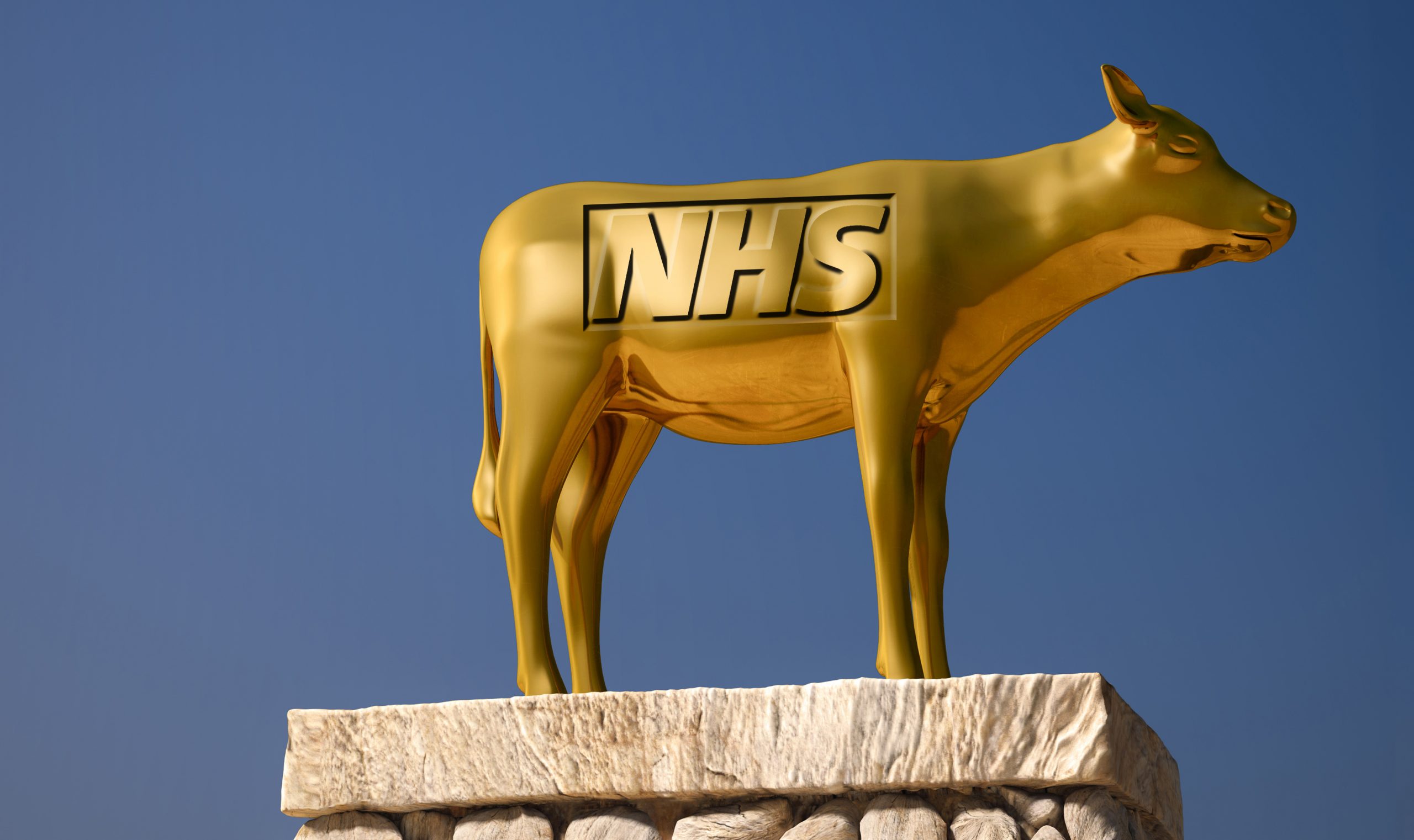
Not actually the official symbol of Britain’s National Health Services … probably.
In Britain’s highly-centralized, almost Soviet-style healthcare system, the National Health Service, staff are being encouraged all over the country to wear little rainbow-coloured metal badges to show that they are homosexual, bisexual, and transsexual-friendly, and do not discriminate against them. The wearing of these badges is voluntary, but about 3,000 of the staff of Guy’s and St Thomas’ Hospitals, for example, now wear them. The self-congratulatory website of those ancient hospitals — St. Thomas’ is over 800 years old and Guy’s was founded in 1721, now combined into one administrative unit — says:
The badges are just one way to show that Guy’s and St Thomas’ is an open, non-judgmental and inclusive place for people that identify as LGBT+ [which] stands for lesbian, gay, bisexual and transgender). The + simply means we are inclusive of all identities, regardless of how people identify themselves.
This language, which combines the unctuous with the bureaucratic, is typical of the way British hospital administrators express themselves nowadays. And if, as Buffon said, the style is the man himself, we may justly fear for a semi-totalitarian future.
By implication, the badges bully the staff, for if any of them refuse to wear one, their refusal is likely to be taken to mean that their minds are closed, judgmental (in the sense of being censorious, for even the attempt to avoid making judgments is itself based on a judgment), and exclusionary. It is to imply that they would deliberately treat any patients in the above mentioned categories differently and worse from all other patients. Wear the badge or declare yourself to be a bigot.
This is an insult to all those people who worked before the advent of the badges (or who now refuse to wear them) who strove and continue to strive always to treat patients to the best of their ability, irrespective of the many categories into which any individual patient falls. In my experience, the great majority of doctors have always tried to do this.
Let me give an example. Working as I did as a doctor in prison, I met many men who had done terrible things. I treated them, as a matter of course, to the best of my ability. I remember, for example, a man who had strangled three children and then impaled them on railings. Though I did not think he was a good man, and in that sense passed a judgment on him within the privacy of my mind, I treated him for his bronchitis exactly as I would have treated anyone else with bronchitis. I did not find this difficult in the least and do not claim any special merit for having done so, for it is only what all my colleagues in the profession did — as a matter not only of course, but of principle.
A couple of years ago, I read the diary of one of Marshal Pétain’s doctors during the latter’s imprisonment after World War II. The doctor had been a member of the Resistance and had no reason to love Pétain, to say the least: Pétain’s supporters would have had not a second thought about killing him if he had fallen into their power. Yet, as the diary makes clear, the doctor treated Pétain, who by then was demented, with the greatest humanity. Moreover, the doctor refused to publish his diary, despite the financial advantage of doing so, because he thought that publishing it would be to break patient confidentiality. It was only after his death, and more than half a century after Pétain’s, that the diary was published. The doctor’s adherence to his medical ethics was impressive, and he needed no badge to proclaim his virtue.
Comments Off on “We don’t need no stinkin’ badges!”
June 16, 2020
Plague and the Bronze Age Collapse ~ Dr. Louise Hitchcock
The Study of Antiquity and the Middle Ages
Published 16 May 2020Ladies and Gentlemen, welcome to the series NAUE II SWORDS, GERMS, & IRON brought to us by none other than Dr. Louise Hitchcock and this episode is going to be about plague and the Bronze Age collapse. This episode will also be drawing on modern parallels such as “What Covid-19 Can Tell Us About the Bronze Age (12th cent) Collapse?”
It will dive into the Bronze Age and discuss was plague a contributing factor in decline of the Bronze Age and the birth of the Iron Age? How familiar were the ancient peoples with plague and epidemics and what do the ancient literary sources tell us? From discussing plague in ancient Mesopotamia to the Philistine Plague to a Hittite King who falls prey to a deadly disease we explore new thoughts, theories and research involving a period that we all love and a subject that could not be more relevant and that is plague.
Check out the awesome work of Dr. Hitchcock at these links below!
Academia profile where you can access her work that is free to the public. https://unimelb.academia.edu/LouiseHi…
Get her books here!
Aegean Art and Architecture: https://global.oup.com/ukhe/product/a…
Minoan Architecture: A Contextual Analysis: http://www.astromeditions.com/books/b…
Theory for Classics: https://www.routledge.com/Theory-for-…
DAIS: The Aegean Feast https://www.peeters-leuven.be/detail….
Tell It In Gath: Studies in the History and Archaeology of Israel. Essays in Honor of Aren M. Maeir on the Occasion of his Sixtieth Birthday https://www.zaphon.de/epages/83179382…Follow her on Twitter: https://twitter.com/ashlarblocks
To support the channel, become a patron and make history matter!
Patreon: https://www.patreon.com/the_study_of_…
Donate directly to paypal: https://paypal.me/nickbarksdale
Enjoy history merchandise? Check out our affiliate link to spqr emporium! http://spqr-emporium.com?aff=3
*disclaimer, the link above is an affiliate link which means we will earn a generous commission from your magnificent purchase, just another way to help out the channel! join our community!twitter: https://twitter.com/nickbarksdale
instagram: https://www.instagram.com/study_of_an…Image credits: Manna Nader, Gabana Studios Cairo
Hittite 3D City and intro footage credits: 3D reconstruction of Imperial Hittite Karkemish by Giampaolo Luglio, Turco-Italian Archaeological Expedition to Karkemish directed by Nicolò Marchetti (University of Boologna)
KARKEMISH (Carchemish) 1300 BC (3D) – The Southern Capital of the Empire Hittite https://youtu.be/RsTdoY__F4U
Music Attribution: Herknungr – Megaliths | Dark Neolithic Meditive Shamanic Ambient Music https://youtu.be/oc8FQwNjPu0
Footage of Ugarit Credit goes to Ruptly. Video Title : Syria: Ancient city of Ugarit freed from Islamic State control https://youtu.be/XKzbk0PFvg0
Comments Off on Plague and the Bronze Age Collapse ~ Dr. Louise Hitchcock
June 15, 2020
African History Disproves Guns Germs and Steel by Jared Diamond
The Cynical Historian
Published 26 Oct 2019There’s a question in the history profession that if sufficiently answered could not only reshape how we conceive ourselves, but reveal the best course of action for politics around the world. What makes the West strong? While there are many answers, the most popular of these has been Jared Diamond’s Guns Germs and Steel. You’ll see his argument all over the place, including a NatGeo documentary. But of course it has its detractors, to the point that some historians consider it pseudo-history. Now I think that’s going too far, but there are enough problems with his thesis that we can’t take it as the final answer to these questions. So let’s talk about that.
————————————————————
errata
10:32 – not “Blaut’s theory” but “Diamond’s theory” (thx PunkSci)
————————————————————references:
James M. Blaut, Eight Eurocentric Historians: The Colonizer’s Model of the World, Volume Two (New York: The Guilford Press, 2000), 149-172. https://amzn.to/2YFt0iQMichael C. Campbell and Sarah A. Tishkoff, “African Genetic Diversity: Implications for Human Demographic History, Modern Human Origins, and Complex Disease Mapping,” Annual Review of Genomics and Human Genetics 9 (22 September 2008): 403-433.
Jared Diamond, Guns Germs and Steel: The Fates of Human Societies (New York: WW Norton, 1997). https://amzn.to/2GK6AqI
Martin W. Lewis and Karen E. Wigen, The Myth of Continents: A Critique of Metageography (Berkeley: University of California Press, 1997). https://amzn.to/2H0ylv7
Richard York and Philip Mancus, “Diamond in the Rough: Reflections on Guns, Germs, and Steel,” Human Ecology Review 14, no. 2 (2007): 157-162.
https://thetruesize.com
————————————————————
Support the channel through PATREON: https://www.patreon.com/CynicalHistorianLET’S CONNECT:
Subreddit: https://www.reddit.com/r/CynicalHistory/
Discord: https://discord.gg/Ukthk4U
Twitter: https://twitter.com/Cynical_History

Comments Off on African History Disproves Guns Germs and Steel by Jared Diamond
Canada’s ongoing experiment with Justin Trudeau’s “basic dictatorship”
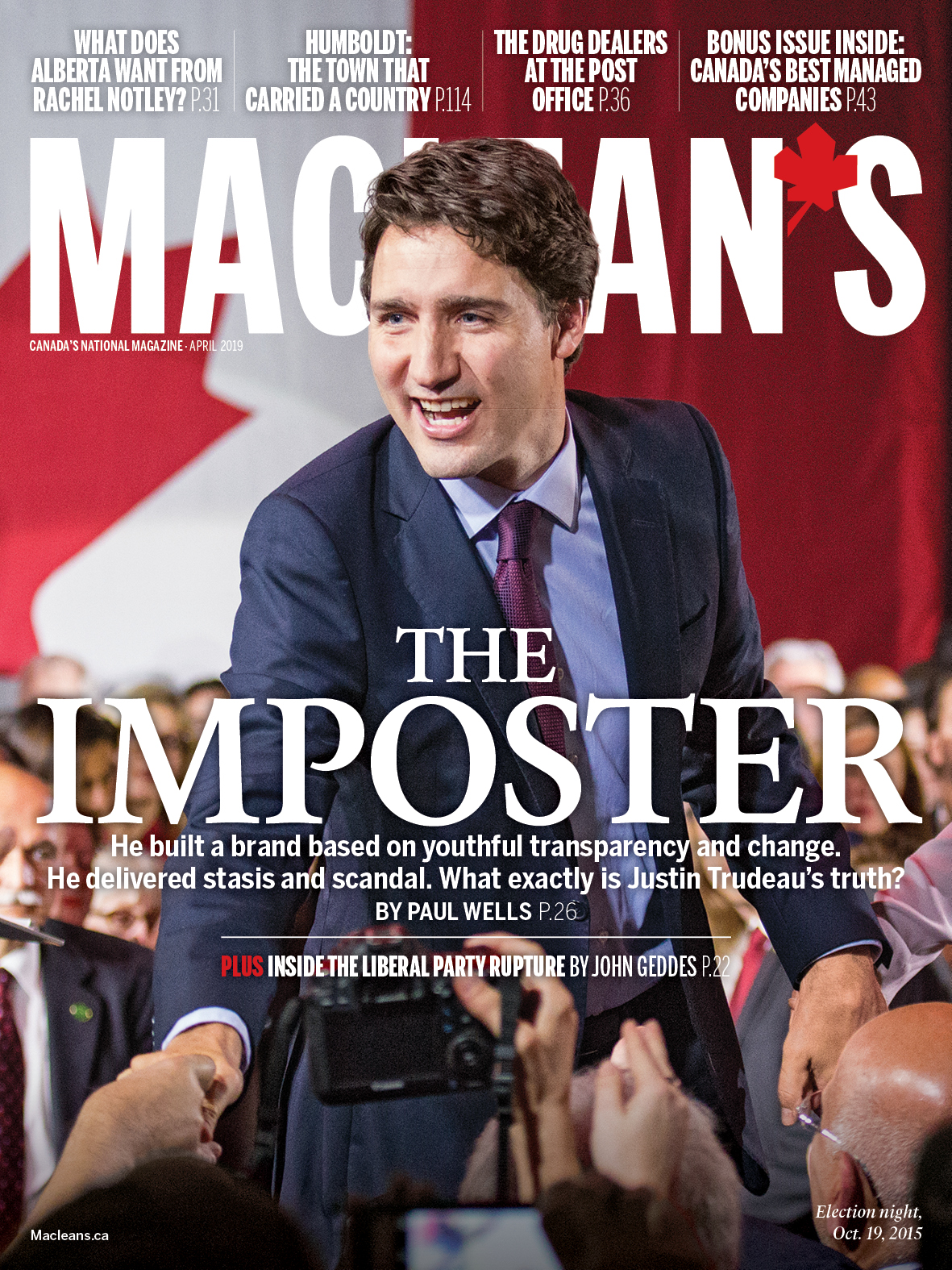
Ted Campbell outlines the development of the concept of “rights” from Saxon England through Magna Carta and how a bad king finally triggered a rebellion that forced him to grant the Great Charter which still acts as a foundation for British (and Canadian) law. Justin Trudeau may be the modern day version of the bad king:
A few hundred years later, one of liberalism‘s and democracy’s greatest voices told us that we have three absolutely fundamental, natural rights: to life, to liberty and to property. These rights were not and still are not unlimited. There were and are ways to lawfully and properly deprive a person of his property and his liberty and, in some countries, even his life. A few centuries after John Locke another philosopher wanted to do away with the right to property: “From each according to his ability, to each according to his need,” Karl Marx wrote, and many, far too many, believed. The only real problem with Marx’s notion is that it requires that humans are perfect … and most of us know how rare that is. Here in Canada, especially since the early years of the 20th century, we have had far too much Marx and far too little Locke.
Now, in 2020, we even have a new version of King John: a vain and foolish prime minister who seems to believe that he has been sent to rule over us. Justin Trudeau is profoundly ignorant about both liberalism and democracy. He is, actually, more of a puppet than a ruler but it is less easy than it should be to determine just who is pulling on which strings. He does not appear to have the mental capacity to pull more than a couple of ideas together at any one time.
Because we have been panicked by the coronavirus pandemic we have
decidedaccepted that more government is thebestleast bad answer. To give us more and more government, Justin Trudeau’s handlers suspended parliament until September … they wanted to have that “basic dictatorship” thing.Democracy is in peril in Canada … it’s not because Justin Trudeau is an evil dictator, it’s because we, as a people, are too complacent. We have come to believe that democracy is, somehow, automatic, that it is natural. It’s not. It needed to be carefully built, brick-by-brick, over many centuries. We needed to fight for democracy: we needed to win it and then defend it, too. It doesn’t renew itself, it is not the natural order of things, and, In Canada, in 2020, it is in peril. Parliament needs to be recalled, soon, before September. Parliament needs to tend to its ancient rights, duties and powers. The Trudeau regime needs to be called to account and then replaced by a new, better, government.
Comments Off on Canada’s ongoing experiment with Justin Trudeau’s “basic dictatorship”
June 14, 2020
Healthcare is a provincial responsibility … thank goodness
Chris Selley reminds us that despite all the attention the media pays to every twitch of the federal government, it’s the provinces that are actually responsible for the healthcare systems in their territory:
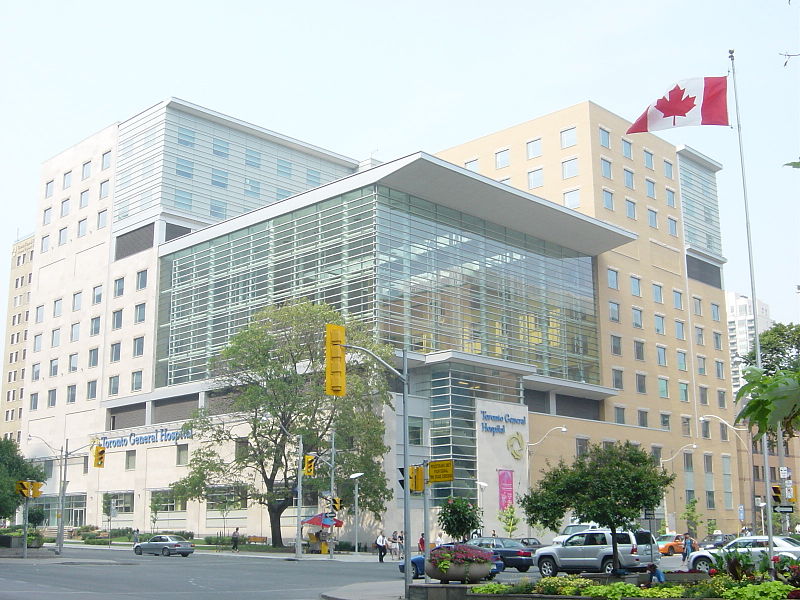
Front view of Toronto General Hospital.
Photo via Wikimedia Commons.
Here in Canada, however, astonishing scenes continue. On Thursday the Toronto Transit Commission announced it intends to make masks mandatory for riders — no word of a lie — in three weeks, on July 2. That’s assuming the commission approves the measure … next Wednesday. TTC CEO Rick Leary was at pains to stress the rule would never be enforced.
Meanwhile Theresa Tam, Canada’s chief public health officer, could not appear more reluctant to endorse mask wearing unless she advised against wearing them altogether — which was, famously, her original position. On Wednesday, she unveiled a four-bullet-point plan for getting safely back to semi-normal under the moniker “out smart.” The word “masks” does not appear. Supplementary text only concedes they “can be used … when you can’t maintain physical distance of two metres.”
This is a strange qualification: The official federal advice stresses you shouldn’t touch your mask except to take it off at home and immediately wash your hands. You shouldn’t be taking it on and off while you’re out and about, when social distancing suddenly becomes impossible. But it’s not as strange as the qualification Tam offered on her Twitter account, where she offered a link to an instructional video but only “if it is safe for you to wear a non-medical mask or face covering (not everyone can).”
It is true that some people with asthma or severe allergies have trouble wearing masks. Presumably they know who they are, and would not risk suffocating themselves when mask-wearing isn’t even strongly recommended, let alone mandatory. Blind people will struggle to keep two metres’ distance from others. People with aquagenic urticaria can’t wash their hands with water. People without arms can’t cough into their sleeves. Those “out smart” recommendations aren’t qualified, because that would be silly — as is the qualification on masks.
I would be lying if I said I had any idea what the hell is going on. But this never-ending weirdness is doing us a favour, in a way. The fact is, we have been paying far too much attention to the feds throughout this ordeal. Canada’s COVID-19 experience was always much too different from region to region to justify everyone taking their cues from a single public health agency — let alone one that comprehensively botched something as simple as issuing self-isolation advice to returning foreign travellers.
Canada is a federation by design, not by accident, and thank goodness for that: Far better that most provinces’ authorities did a good job knocking down COVID-19 than that a single one screwed it up for the whole country. It’s something Liberals and New Democrats should bear in mind next time they find themselves demanding yet another “national strategy” in a provincial jurisdiction.
Comments Off on Healthcare is a provincial responsibility … thank goodness
June 13, 2020
“1648” Pt. 2 – War and Disease – Sabaton History 071 [Official]
Sabaton History
Published 12 Jun 2020War and Plague. Just two horsemen of the apocalypse but never really far away from each other. Where armies march, disease usually follows. From the earliest records of time to modern day, epidemics and contagious diseases are the cause of uncountable deaths. Pandemics like the Spanish Flu or the Bubonic Plague killed millions of people around the world. To survive, mankind had resort to quarantines and plague houses, and put its trust to physicians and the evolution of modern medicine.
Support Sabaton History on Patreon: https://www.patreon.com/sabatonhistory
Listen to “1648” on the album Carolus Rex:
CD: http://bit.ly/CarolusRexStore
Spotify: http://bit.ly/CarolusRexSpotify
Apple Music: http://bit.ly/CarolusRexAppleMusic
iTunes: http://bit.ly/CarolusRexiTunes
Amazon: http://bit.ly/CarolusRexAmz
Google Play: http://bit.ly/CarolusRexGooglePlayListen to Sabaton on Spotify: http://smarturl.it/SabatonSpotify
Official Sabaton Merchandise Shop: http://bit.ly/SabatonOfficialShopHosted by: Indy Neidell
Written by: Markus Linke and Indy Neidell
Directed by: Astrid Deinhard and Wieke Kapteijns
Produced by: Pär Sundström, Astrid Deinhard and Spartacus Olsson
Creative Producer: Joram Appel
Community Manager: Maria Kyhle
Executive Producers: Pär Sundström, Joakim Broden, Tomas Sunmo, Indy Neidell, Astrid Deinhard, and Spartacus Olsson
Post-Production Director: Wieke Kapteijns
Edited by: Karolina Dołęga
Sound Editing by: Marek Kaminski
Maps by: Ryan Weatherby, Karolina DołęgaEastory YouTube Channel: https://www.youtube.com/channel/UCEly…
Archive by: Reuters/Screenocean https://www.screenocean.com
Music by Sabaton.Sources:
– Welcome Images
– National Library of Scotland
– IMW: Q 10378,
– National Museum of Health and Medicine
– National Archives
– Icons from The Noun Project by: Muhamad Ulum & Adrien CoquetAn OnLion Entertainment GmbH and Raging Beaver Publishing AB co-Production.
© Raging Beaver Publishing AB, 2019 – all rights reserved.
Comments Off on “1648” Pt. 2 – War and Disease – Sabaton History 071 [Official]
Is Invisibility Possible? | James May’s Q&A (Ep 1) | Head Squeeze
BBC Earth Lab
Published 10 Jan 2013James May answers the question as to whether or not invisibility is possible. James draws upon quite a few interesting theories during this discussion.
Outtakes from this video: https://www.youtube.com/watch?v=6Fy1Xkx5VFc
James May’s Q&A:
With his own unique spin, James May asks and answers the oddball questions that we’ve all wondered about from ‘What exactly is one second?’ to ‘Is invisibility possible?’
Comments Off on Is Invisibility Possible? | James May’s Q&A (Ep 1) | Head Squeeze
June 12, 2020
J.K. Rowling on her most recent “cancellation”
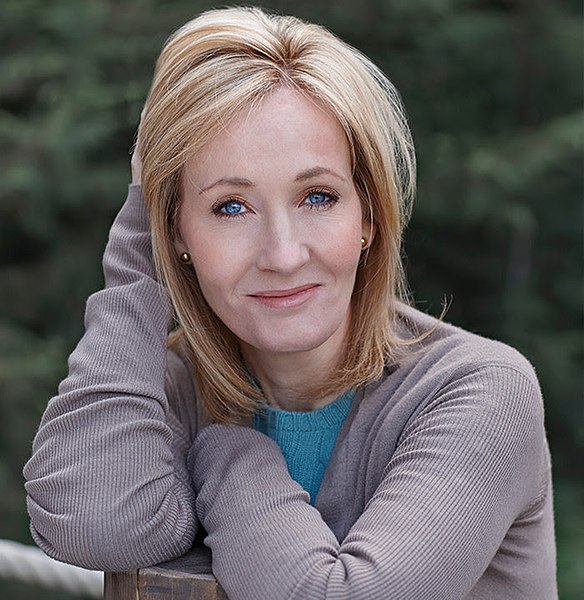
I know a lot of Harry Potter fans are upset with their formerly favourite author for her stance on transgenderism … or what they’ve heard about her stance … or what their friends have said about her stance … so J.K. Rowling has posted an essay on her own site explaining what happened and how she has been coping with being “cancelled” so many times:
… as a much-banned author, I’m interested in freedom of speech and have publicly defended it, even unto Donald Trump.
The fourth is where things start to get truly personal. I’m concerned about the huge explosion in young women wishing to transition and also about the increasing numbers who seem to be detransitioning (returning to their original sex), because they regret taking steps that have, in some cases, altered their bodies irrevocably, and taken away their fertility. Some say they decided to transition after realising they were same-sex attracted, and that transitioning was partly driven by homophobia, either in society or in their families.
Most people probably aren’t aware – I certainly wasn’t, until I started researching this issue properly – that ten years ago, the majority of people wanting to transition to the opposite sex were male. That ratio has now reversed. The UK has experienced a 4400% increase in girls being referred for transitioning treatment. Autistic girls are hugely overrepresented in their numbers.
The same phenomenon has been seen in the US. In 2018, American physician and researcher Lisa Littman set out to explore it. In an interview, she said:
“Parents online were describing a very unusual pattern of transgender-identification where multiple friends and even entire friend groups became transgender-identified at the same time. I would have been remiss had I not considered social contagion and peer influences as potential factors.”
Littman mentioned Tumblr, Reddit, Instagram and YouTube as contributing factors to Rapid Onset Gender Dysphoria, where she believes that in the realm of transgender identification “youth have created particularly insular echo chambers.”
Her paper caused a furore. She was accused of bias and of spreading misinformation about transgender people, subjected to a tsunami of abuse and a concerted campaign to discredit both her and her work. The journal took the paper offline and re-reviewed it before republishing it. However, her career took a similar hit to that suffered by Maya Forstater. Lisa Littman had dared challenge one of the central tenets of trans activism, which is that a person’s gender identity is innate, like sexual orientation. Nobody, the activists insisted, could ever be persuaded into being trans.
The argument of many current trans activists is that if you don’t let a gender dysphoric teenager transition, they will kill themselves. In an article explaining why he resigned from the Tavistock (an NHS gender clinic in England) psychiatrist Marcus Evans stated that claims that children will kill themselves if not permitted to transition do not “align substantially with any robust data or studies in this area. Nor do they align with the cases I have encountered over decades as a psychotherapist.”
The writings of young trans men reveal a group of notably sensitive and clever people. The more of their accounts of gender dysphoria I’ve read, with their insightful descriptions of anxiety, dissociation, eating disorders, self-harm and self-hatred, the more I’ve wondered whether, if I’d been born 30 years later, I too might have tried to transition. The allure of escaping womanhood would have been huge. I struggled with severe OCD as a teenager. If I’d found community and sympathy online that I couldn’t find in my immediate environment, I believe I could have been persuaded to turn myself into the son my father had openly said he’d have preferred.
When I read about the theory of gender identity, I remember how mentally sexless I felt in youth. I remember Colette’s description of herself as a “mental hermaphrodite” and Simone de Beauvoir’s words: “It is perfectly natural for the future woman to feel indignant at the limitations posed upon her by her sex. The real question is not why she should reject them: the problem is rather to understand why she accepts them.”
As I didn’t have a realistic possibility of becoming a man back in the 1980s, it had to be books and music that got me through both my mental health issues and the sexualised scrutiny and judgement that sets so many girls to war against their bodies in their teens. Fortunately for me, I found my own sense of otherness, and my ambivalence about being a woman, reflected in the work of female writers and musicians who reassured me that, in spite of everything a sexist world tries to throw at the female-bodied, it’s fine not to feel pink, frilly and compliant inside your own head; it’s OK to feel confused, dark, both sexual and non-sexual, unsure of what or who you are.
I want to be very clear here: I know transition will be a solution for some gender dysphoric people, although I’m also aware through extensive research that studies have consistently shown that between 60-90% of gender dysphoric teens will grow out of their dysphoria. Again and again I’ve been told to “just meet some trans people.” I have: in addition to a few younger people, who were all adorable, I happen to know a self-described transsexual woman who’s older than I am and wonderful. Although she’s open about her past as a gay man, I’ve always found it hard to think of her as anything other than a woman, and I believe (and certainly hope) she’s completely happy to have transitioned. Being older, though, she went through a long and rigorous process of evaluation, psychotherapy and staged transformation. The current explosion of trans activism is urging a removal of almost all the robust systems through which candidates for sex reassignment were once required to pass. A man who intends to have no surgery and take no hormones may now secure himself a Gender Recognition Certificate and be a woman in the sight of the law. Many people aren’t aware of this.
Comments Off on J.K. Rowling on her most recent “cancellation”
QotD: Homelessness in America
90% of the homeless in America and the hard core ones are people with mental health issues, people with drug abuse issues and people who have found they can live without having to do anything for it, and can be “free” and outside society. I’ve overheard conversations in the park, and I suppose that most of the people who “dropped out” in the sixties are dead, but a lot of them are alive and going from soup kitchen to free clinic, with a bit of begging in between.
Yes, there are entire families in this system, including homeless children – but for them to stay in it, the parents need to have some sort of serious issue. Otherwise, even if they can’t find work, there is assistance available to get them at least into public housing, which, nightmarish though it is, is not living in the park.
I’m not going to pretend this doesn’t happen to normal families too – see where I came very close to that level and more than once too – but normal families usually tend to bounce back. They go through a few months of mess and horror, and then they claw back to some semblance of normalcy. (This might change as our economy dives and programs of necessity get cut. The ones for the DESERVING poor will be cut first, of course, since they rarely riot.)
The problem with this is that when people get appalled at the conditions the homeless live in and start offering “homeless services” there is an entire network, not just of homeless but of social workers who direct the homeless to the cities with better services.
I swear to you and I’m not even joking that right now there are plenty more homeless on Colorado Springs streets than in Denver, despite the Springs being much smaller.
The Springs also has its soup kitchens and other services downtown and within easy walking distance of each other.
This means downtown businesses are closing, except for bars and restaurants which can control access. And that the library is of course a place to camp in the cool/warm during the day.
It means more than that. We moved within easy driving distance of downtown, because when we lived downtown when we first came to Colorado Springs, I used to take walks every day. When we moved to our little mountain village, without these, I gained ten pounds a year. I used to love walking downtown, dropping by the deli and the three bookstores (only one left, and it’s MOSTLY a restaurant now) checking out the other little shops which ranged from yarn to weird import crafts.
Now those are gone. Worse – the last two times I walked downtown alone (i.e. without commanding the muscle, aka older son to go with me) someone FOLLOWED me and I had to employ stuff from my childhood to lose them. Once it was a large and addled looking male, and yes, he was following me. And once it was TWO large and addled looking males. For the icing on the cake – not related to this, but from a blog entry – I clicked on the sex offenders registry. Yes, I know, a lot of people there are there because someone accused them and was never proven. Our local one at least has notes on whether it’s accusation, trial or conviction and also whether the crime was against children or adults.
The downtown zipcode is FULL of registered sex offenders who’ve done hard time and who have committed their crimes against adults. The faces are very familiar from my walks, and yep, one was the guy who tried to follow me.
Sarah Hoyt, “Of Books, Compassion And Cruelty A Blast From The Past From June 2013”, According to Hoyt, 2020-03-10.
Comments Off on QotD: Homelessness in America
June 11, 2020
Black Death Mystery Solved – Not Bubonic Plague – Pandemic History 02
TimeGhost History
Published 10 Jun 2020From the day the Black Death starts to ravage humanity in 1347, there will be speculation about what it is. It will take until 2017 for science to give us a conclusive answer to the riddle how so many people could die so fast all over Europe, Africa, and Asia in only five years.
Join us on Patreon: https://www.patreon.com/TimeGhostHistory
Hosted by: Indy Neidell and Spartacus Olsson
Written by: Indy Neidell and Spartacus Olsson
Directed by: Astrid Deinhard
Executive Producers: Astrid Deinhard, Indy Neidell, Spartacus Olsson, Bodo Rittenauer
Creative Producer: Joram Appel
Post-Production Director: Wieke Kapteijns
Research by: Spartacus Olsson, Indy Neidell, and James Currie
Edited by: Karolina Dołęga
Sound Engineer: Marek Kamiński
Graphic Design: Ryan WeatherbyVisual Sources:
Welcome Images
Mark and Delwen from Flickr: https://www.flickr.com/photos/markand…
Smarteeee from Wiki CommonsIcons from The Noun Project by: arif fajar yulianto, James, Maxim Kulikov, Jejen Juliansyah Nur Agung, Gan Khoon Lay, Alfonso Melolonta Urbán
Laymik, parkjisun, Eucalyp, Adrien Coquet & Mahmure Alp.Music:
“Barrel” – Christian Andersen
“Symphony of the Cold-Blooded” – Christian Andersen
“Potential Redemption” – Max Anson
“Moving to Disturbia” – Experia
“Superior” – Silver Maple
“Please Hear Me Out” – Philip Ayers
“Guilty Shadows 4” – Andreas Jamsheree
“Deadline” – Marten Moses
“Endlessness” – Flouw
“Moving to Disturbia” – ExperiaArchive by Screenocean/Reuters https://www.screenocean.com.
Research Sources:
Quinto Tiberio Angelerio and New Measures for Controlling Plague in 16th-Century Alghero, Sardinia, Raffaella Bianucci, Ole Jørgen Benedictow, Gino Fornaciari, and Valentina Giuffra
“The Path to Pistoia: Urban Hygiene Before the Black Death”, G. Geltner, Past & Present, Volume 246, Issue 1, February 2020, Pages 3–33
Encyclopedia of the Black Death, Joseph Patrick Byrne
“Epidemiological characteristics of an urban plague epidemic in Madagascar, August–November, 2017: an outbreak report”, The Lancet, Rindra Randremanana, PhD *Voahangy Andrianaivoarimanana, PhD Birgit Nikolay, PhD Beza Ramasindrazana, PhD Juliette Paireau, PhD, Quirine Astrid ten Bosch, PhD et al
“Yersinia pestis, the cause of plague, is a recently emerged clone of Yersinia pseudotuberculosis” Mark Achtman, Kerstin Zurth, Giovanna Morelli, Gabriela Torrea, Annie Guiyoule, and Elisabeth Carniel
“Insights into the evolution of Yersinia pestis through whole-genome comparison with Yersinia pseudotuberculosis“, P.S.G. Chain, E. Carniel, F.W. Larimer, J. Lamerdin, P.O. Stoutland, W.M. Regala, A.M. Georgescu, L.M. Vergez, M.L. Land, V.L. Motin, R.R. Brubaker, J. Fowler, J. Hinnebusch, M. Marceau, C. Medigue, M. Simonet, V. Chenal-Francisque, B. Souza, D. Dacheux, J.M. Elliott, A. Derbise, L.J. Hauser, and E. Garcia
“Distinct Clones of Yersinia pestis Caused the Black Death”, Stephanie Haensch, Raffaella Bianucci, Michel Signoli, Minoarisoa Rajerison, Michael Schultz, Sacha Kacki, Marco Vermunt, Darlene A. Weston, Derek Hurst, Mark Achtman, Elisabeth Carniel, Barbara BramantiA TimeGhost chronological documentary produced by OnLion Entertainment GmbH.
From the comments:
TimeGhost History
2 days ago
There is much we can learn from history and as you will see in the next two episodes of our impromptu pandemics series it takes a long time for us to make these learnings. Many of the mistakes made during the outbreak of the Black Death are still an issue as we respond to COVID-19 almost 700 years later. This episode was also a very personal learning experience for us, Indy and Spartacus. Both of us read and studied a lot about the plague when we were younger in the 1980s, Indy even did his BA paper in history on the plague. Back then there was a lot of speculation about what the Black Death actually was (although the general consensus was that it must have been bubonic plague based on the findings made in the 20th century, after the discovery of the Yersinia Pestis bacteria). But that conclusion was a bit problematic — the Black Death was too lethal, spread too fast, and killed people too quickly for bubonic plague. Until we started researching these episodes we hadn’t spent much thought on the topic, so imagine our surprise when we discovered that bacteriologists, epidemiologists, and archeologists had come together to solve the mystery after two chance occurrences of unusual plague outbreaks in 2014 and 2017. To paraphrase Lord Marlborough: if you want to truly learn something about a topic, there’s no better way than to make a video about it.

Comments Off on Black Death Mystery Solved – Not Bubonic Plague – Pandemic History 02
June 4, 2020
Performance, Plague, and Politics in Shakespeare’s London
Atun-Shei Films
Published 27 Mar 2020Help us make the first feature film ever made (that we know of) spoken entirely in Original Pronunciation, the accent of Shakespeare: https://igg.me/at/sudburydevil/x/1502…
Did William Shakespeare write King Lear under quarantine? That is the question. In this video I introduce you to the actor’s process in Elizabethan theater; dive deep into first-hand accounts of the bubonic plague epidemics that Shakespeare lived through; explore the politics of late 16th and early 17th century England, onstage and off; and discuss OP, Original Early Modern English Pronunciation, the accent and dialect in which the Bard’s plays were originally performed.
The rest is silence.
Support Atun-Shei Films on Patreon ► https://www.patreon.com/atunsheifilms
#English #Theater #History
Watch our film ALIEN, BABY! free with Prime ► http://a.co/d/3QjqOWv
Reddit ► https://www.reddit.com/r/atunsheifilms
Twitter ► https://twitter.com/atun_shei
Instagram ► https://www.instagram.com/atunsheifilms
Merch ► https://atun-sheifilms.bandcamp.com
From the comments:
Atun-Shei Films
1 month ago
CORRECTION: The Great Vowel Shift was a SEPARATE linguistic trend to the R-dropping in 18th century English. My mistake, sorry!
Comments Off on Performance, Plague, and Politics in Shakespeare’s London
June 3, 2020
Fanatics gonna fanatic … they can’t help it
It’s funny that no matter what the claimed crisis, the answers always go in the same direction, as Kristian Niemietz points out with the demands to turn our still unending lockdown toward “protecting the environment”:
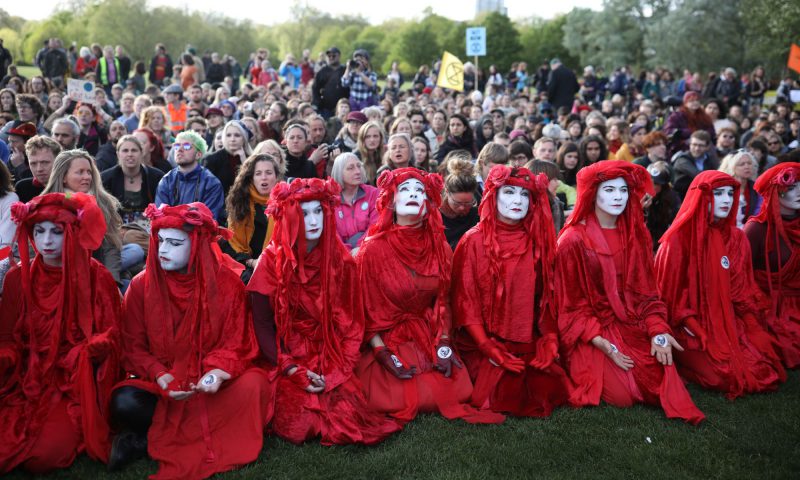
The change, superficially, is to encourage “a safe return to work” allowing more social distancing between pedestrians, but more substantially in order to preserve the cleaner air that has resulted from the lockdown.
The health and safety excuse for the policy change can be largely dismissed. The simple truth of the pandemic and national policy is that if social distancing matters, the centre of London is not safe to return to work. It is too densely populated and almost entirely reliant on mass transit which cannot operate above 10-15% capacity with 2m exclusion rules. With average commutes over 9 miles each way, substitution effects to walking and cycling will be extremely limited and temporary.
It is then hard to see then how the policy’s architects imagine the streets will fill up to the extent urgent measures are needed. Conversely, if social distancing does not matter (and it will cease to matter eventually), then a policy to enable more social distancing outside by widening the pedestrian streetscape is redundant. If it is safe to sit on a crowded train, it is safe to walk on a crowded pavement. It is not hard then to cut through the pandemic packaging to note that the motive for this policy is opportunistic, to accelerate a pedestrianisation plan that is the dream of many an urban planner.
Many will see this as self-evidently a good thing. Removing vehicle traffic from densely populated narrow streets will reduce air pollution, congestion and road traffic accidents. As a policy it will have more supporters than opponents; very few people drive into the centre of London to commute and there is very little capacity for parking. London’s leaders are not wrong to think that this is the future, the question is really one of timing and how they go about it, which is far more difficult and does not have anything to do with managing a coronavirus.
What the pandemic allows is the ability to use emergency powers for something that is not an emergency. This matters, in normal times it took several years to close one dangerous junction at Bank to most traffic, and this under a hail of protests from local businesses and taxi drivers. The same result can now be achieved in a few weeks across many streets. The democratic checks and balances that differentiate the UK from authoritarian states can be ditched and London officialdom granted extraordinary powers to do as they please. If the protestors don’t like it this time, they should note the right to protest has also been suspended, at least for now.
Comments Off on Fanatics gonna fanatic … they can’t help it
May 30, 2020
The Spanish Flu Influenza Pandemic 1918 – 1920 I THE GREAT WAR 1920
The Great War
Published 29 May 2020Sign up for Curiosity Stream and get Nebula bundled in: https://curiositystream.com/thegreatwar
It was far deadlier than even the global war that had preceded it: The Influenza pandemic or Spanish Flu that hit the world between 1918 and 1920 in multiple waves.
» SUPPORT THE CHANNEL
Patreon: https://www.patreon.com/thegreatwar
Merchandise: https://shop.spreadshirt.de/thegreatwar/» SOURCES
Barry, John M. The Great Influenza: The Story of the Deadliest Pandemic in History, (New York : Penguin Books, 2018)
Byerly, Carol R. ‘The U.S. Military and the Influenza Pandemic of 1918–1919’ Public Health Reports; 125 Supplement 3 (Apr. 2010)
Crosby, Alfred W, America’s forgotten pandemic : the influenza of 1918, (Cambridge : Cambridge University Press, 2003)
Hoover, Irwin Hood, Forty-two years in the White House, (New York : Houghton Mifflin Co., 1934)
Killingray, David & Phillips, Howard, (eds.) The Spanish Influenza Pandemic of 1918-19: New Perspectives, (London : Routledge, 2011)
Johnson, NP & Mueller J, ‘Updating the accounts: global mortality of the 1918-1920 “Spanish” influenza pandemic’ Bulletin of the History of Medicine. 76(1) (Spring 2002)
Dock, Lavinia et al., History of American Red Cross Nursing (1922)
Macdonald L. The Roses of No Man’s Land. (London : Penguin Books, 1993)
Robertson, John Dill, ‘Spanish Influenza — The Flu’ The Public Health Journal Vol. 9, No. 10 (Oct 1918)
Rosner, David, ‘”Spanish flu, or whatever it is…”: The paradox of public health in a time of crisis’ Public Health Reports, 125 Supplement 3, (Apr. 2010)
Stanford University, ‘The Influenza Pandemic of 1918’ https://virus.stanford.edu/uda/
“Surgeon General’s Advice to Avoid Influenza”: Washington Evening Star, (Sept. 22, 1918)
Wever, Peter C & van Bergen, Leo, ‘Death from 1918 pandemic influenza during the First World War: a perspective from personal and anecdotal evidence’ Influenza Other Respiratory Viruses, 8(5), (Sept 2014)
https://www.lefigaro.fr/livres/2008/1…» SOCIAL MEDIA
Instagram: https://instagram.com/the_great_war
Twitter: https://twitter.com/WW1_Series
Reddit: https://reddit.com/r/TheGreatWarChannel»CREDITS
Presented by: Jesse Alexander
Written by: Jesse Alexander
Director: Toni Steller & Florian Wittig
Director of Photography: Toni Steller
Sound: Toni Steller
Editing: Toni Steller
Mixing, Mastering & Sound Design: http://above-zero.com
Maps: Daniel Kogosov (https://www.patreon.com/Zalezsky)
Research by: Jesse Alexander
Fact checking: Florian WittigChannel Design: Alexander Clark
Original Logo: David van StepholdA Mediakraft Networks Original Channel
Contains licensed material by getty images
All rights reserved – Real Time History GmbH 2020

Comments Off on The Spanish Flu Influenza Pandemic 1918 – 1920 I THE GREAT WAR 1920
David Warren reports from “the High Doganate” (Parkdale, Toronto)
I haven’t lived in Toronto for many years now, but as David Warren highlights in his Essays in Idleness posts, things haven’t changed much in all that time:
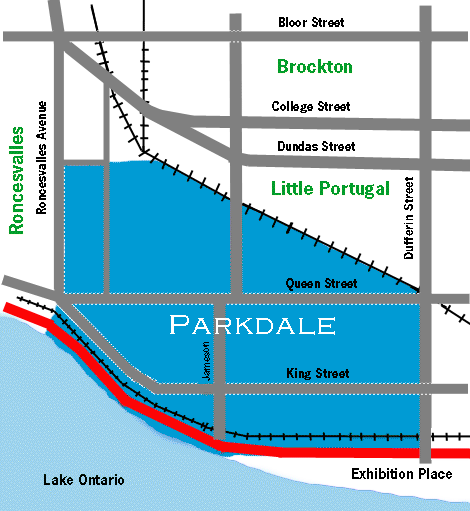
The Parkdale neighbourhood of Toronto.
Map by Alaney2k via Wikimedia Commons.
We continue to be well-as-can-be-expected, up here in the High Doganate, though stir-crazy, and over-informed about the Batflu (also known as the Kung Flu, or Peking Pox). The housefinches on our balconata persist in their social distancing, and at street level, the dogs continue to walk their masters. The brave, without a dog, may go out, without a mask, if they can stand up to the Virtue Signallers (or as I prefer to call them, the Smugly Foocklings). But that is in the respectable parts of town, at least three miles away, where designer masks are now de rigueur. There are plenty of trolleys, but they travel mostly empty. This is because the transit authorities are “committed to keeping customers and staff safe.” Knowing that most of the public health measures are fraudulent, and/or counter-productive, is not helpful to one’s peace of mind.
These measures would include the vast public doles which our guvmints have been generating, electronically. It could be taken as pay, for those who’d otherwise riot. Eventually, the guvmints hope to electronically rake it back, both from those who were paid and those who were not, in the form of much extended taxes. To understand the Batflu response, is to understand the welcome it gave to bureaucrats and their patrons, wherever the Left won the last election. They do not surrender such powers lightly.
Most of the people I hang out with are their particular targets — from freelance giguers to flea marketeers to those with religious vocations. Such people naturally resist the Kafkaesque arrangements our progressives relish and demand. The Batflu “crisis” put as many as possible of these statistically inconvenient people out of work. (Many are compulsive tax-evaders, after all!) These “little people,” especially those trying to support uncool, old-fashioned, frankly heterosexual families, are the ones for whom I most pray, as they and their children face the “green” future, which will exclude them in the name of “diversity.”
But also I think of the vast slave armies, in the “service economy,” with their idiotizing jobs, from flipping hamburgers to humping boxes in the Amazon warehouse — pinned to their minimum wages until their functions can be mechanized. (When they unionize, this happens faster.)
The “professional classes,” who can work from home, because they do nothing of value, needn’t go months without revenue, while their debts are piling up. They sneer at those who oppose a lockdown, that is perfectly comfortable for the professional classes, who at worst save money by dining in, or must order what they want through Amazon.
Comments Off on David Warren reports from “the High Doganate” (Parkdale, Toronto)


