Quotulatiousness

October 21, 2020

Aryan invasion, migration theory (Truth or fiction) India documentary

Filed under: History, India, Science — Tags: , , , , — Nicholas @ 02:00

Epimetheus
Published 24 Jan 2018

Aryan invasion, migration theory (Truth or fiction) India documentary

Epimetheus on Patreon
https://www.patreon.com/Epimetheus1776

David Frawley Aryan invasion videos
https://www.youtube.com/watch?v=qych3…
https://www.youtube.com/watch?v=jyz_S…

Tags:
Aryan invasion india, india history, indian history, documentary, history of india, india,history, india documentary, hindi, 2018, ancient india, indus valley civilization, 5,000 Years History of India documentary, Aryan migration theory, Aryan invasion theory, indo-aryan, indo Aryan migration

October 19, 2020

Sarah Hoyt – “… I’ve been feeling like I’m at the end of a Bond movie, and the villain is telling me his big master plan and how Western Civilization is tied to the train tracks and can’t escape”

In the latest Libertarian Enterprise, Sarah Hoyt explains why she’s not expecting the US federal election next month to resolve anything, at least not in a positive way:

At this point I hold about a 10% chance the Democrats/Socialists/Communists (interchangeable now that the masks are off) don’t fraud their way into full power, pack the court and rip our system apart, to install (yet again) a form of communism. This is complicated by the fact that a lot of them are in China’s pockets. Or rather, China has been filling their pockets for a long while. We might find ourselves working for racist, hegemonic overlords, besides suffering all the ills of a descent into communism. (By the way, they’ve already been doing this to some extent to the less fortunate countries, including most African countries. The left in the US and Europe believes this is benevolence. And that Chinese aren’t racist. I wouldn’t believe it, if it hadn’t been said to me over and over.)

There is maybe another 25% of chance we’ll find ourselves in CW II, now with even more foreign interference. What comes out of that, G-d only knows, and I’m not Him. Which is good, because I have trouble enough being me.

And there is a very strong chance that even if Trump wins the White House, besides continuing to have to drive a car where the wheel is disconnected (the extent of which I wasn’t even fully sure of until this month) he won’t do more than delay the crash.

Sometimes here, and particularly at insty, because I tend to do that really late at night when I’m exhausted and less able to control my moods, you’ll catch a hint of how hopeless I feel our situation to be.

In fact since the lockdown, I’ve been feeling we were screwed. That the lockdown was imposed all over the world on such flimsy evidence, that countries and churches, and every cultural institution not only submitted to it but kept telling the people how much it was needed sent me into a deep depression from which I haven’t fully recovered. (Again, the evidence that this virus was MAYBE as bad as the flu has been before our eyes since the beginning. You don’t need special equipment to see it. The homeless were congregating and not dying in droves. The people in slums in the third world weren’t dying at a higher rate than usual. And there were the numbers from the Diamond Princess. Which some idiot here tried to justify with “but they got the best treatment.” In a floating petri dish. With no special equipment. May G-d have mercy on the soul of every idiot who bought that bullshit.).

This last week, on the other hand, I’ve been feeling like I’m at the end of a Bond movie, and the villain is telling me his big master plan and how Western Civilization is tied to the train tracks and can’t escape.

Oh, not the massive corruption of the Biden crime family. I mean seriously. Any of you who didn’t know already that Crackhead McStripperbang wasn’t being paid for foreign countries for his services must have been living under a rock.

Not even the ridiculous, immediate coordination with which our tech overlords moved to clamp down on that information and preventing it from reaching the virgin ears of most of our willfully and willingly ignorant countrymen.

No, what discouraged me most was the “sexual preference” suddenly becoming a slur and Webster dictionary falling in line. (Seriously, guys, sexual preference goes way beyond orientation. For instance, my sexual preference is monogamous and with someone I love. If you think that there’s no preference involved, you must think people have absolutely no control over their impulses.) Because that bullshit couldn’t happen, even in the most totalitarian of conspiracies.

And that’s the terrifying thought. These people are no more conspiring than your breaklines being cut are a conspiracy not to stop the car.

They are a result of deep inlaid propaganda and misseducation which cause a lot of people to try to fall into line with the “word from above” and be “right” with those they view as the smart people and the masters of society.

October 11, 2020

QotD: Britain’s National Health Service cult

The NHS has not served the nation well, if international comparison is the criterion by which it should be judged. For example, when the NHS was founded (when British healthcare was among the best rather than the worst in Europe) the population of France had a life expectancy six years lower than that of Britain; it is now two years higher. The health of the population in Spain improved more under Franco than that of the British under the NHS in the same years. Of course, there are determinants of life expectancy other than healthcare systems, but at the very least the comparisons do not suggest any particular virtue to the NHS.

Survival from many serious illnesses such as cancer, heart attacks and strokes is lower in Britain than in most European countries. Publicity is sometimes given to these statistics but they are not immediately apparent to patients or their relatives, and in any case the NHS is immune to criticism because its deficiencies are assumed to be departures from its essential goodness or the result of inadequate funding.

No number of scandals, such as that of Mid Staffs in which hundreds of patients were neglected to a degree that often defied belief, all in plain sight of a large bureaucracy supposedly devoted to ensuring the quality of patient care, can dent faith in the NHS. Staff committed, and management connived at, acts of cruelty that would have made Mrs Gamp blush. Mr Cameron’s government, anxious not to seem an enemy of the NHS, which would have been politically damaging, swept the scandal under the carpet.

A system whose justification for its nationalisation of healthcare was egalitarianism has failed even in the matter of equality. If anything, the difference between the health of the richest and poorest sections of the population has increased rather than decreased under the NHS.

The gap between the life expectancy of unskilled workers and that of the upper echelons, which had been stable for decades before the foundation of the NHS, began to widen afterwards and is now far wider than it ever was. Again, there are reasons for inequality in health other than the deficiencies of healthcare, the prevalence of smoking and obesity, for example; but if systems are to be judged by their effects, the NHS has failed in its initial goal.

Theodore Dalrymple, “Empire of conformists”, The Critic, 2020-04-29.

October 9, 2020

Speaking in code and public health

Filed under: Government, Health, Technology, USA — Tags: , , , , , , , — Nicholas @ 03:00

In The Line, Joshua Hind relates the tragedy that forced US emergency services to wean themselves off their many confusing (and sometimes conflicting) spoken codes and use plain language to help reduce tragic misunderstandings among different emergency response organizations:

“First responders on site of the Lac-Megantic train derailment” by TSBCanada is licensed under CC BY-NC-ND 2.0

In the beginning, it was standardized, and the best-known codes, like “10-4,” were consistent from town to town or state to state. But it didn’t take long for newer codes to emerge, which often meant different things depending on where you were. Efforts to reorganize the codes every 20 years or so only compounded the problem. On a local level, in any one town, it wasn’t a problem. But when cops or firefighters from different towns had to work together it could lead to disaster.

In 1970, a particularly severe wildfire season in California killed 16 people in a 13-day period and laid bare the cost of bad interagency communication. The rat’s nest of codes, abbreviations, and jargon prevented firefighters from different towns from communicating with the speed and clarity a major disaster demands. To address the problem, the U.S. Forest Service created FIRESCOPE, the first complete system for organizing and managing major incidents. One of the primary principles of this new system was to “develop standard terminology.”

Despite this effort, which later went national and then international (the province of Ontario has its own version, the “Incident Management System”) coded language continued to proliferate. Nearly 30 years after FIRESCOPE was launched, on September 11th, incompatible technology, lack of protocols, and a refusal to harmonize terminology likely contributed to the deaths of 121 firefighters who were caught in the collapse of the North Tower because they either didn’t hear or couldn’t understand the warnings that the building was about to fail.

Which brings us back to 2006, and FEMA’s notice to first responders. After decades of asking agencies to stop using coded language, the federal government made funding contingent on compliance. “The use of plain language in emergency response is a matter of public safety,” the memo’s introduction read. “There simply is little or no room for misunderstanding in an emergency situation.” From that point forward, all interdepartmental communication would have to be un-coded. A fire would be called “fire.” A shooting would be “a shooting.” And if you needed help, you’d say “HELP!”

Police, fire departments and paramedics slowly but surely got on board and started using some form of the incident management system which included plain language. As use of the system spread, other sectors, like large music festivals and other live events, began adopting the concepts to better synchronize public safety programs with the first responders who support them. Today it’s not unusual for producers, technicians and event security staff to attend training at the police college right next to fire captains and police officers.

Then COVID-19 happened, and we realized that no one had told Public Health.

QotD: How to analyze complex multivariate systems for the popular press

Filed under: Media, Quotations, Science — Tags: , , , , — Nicholas @ 01:00

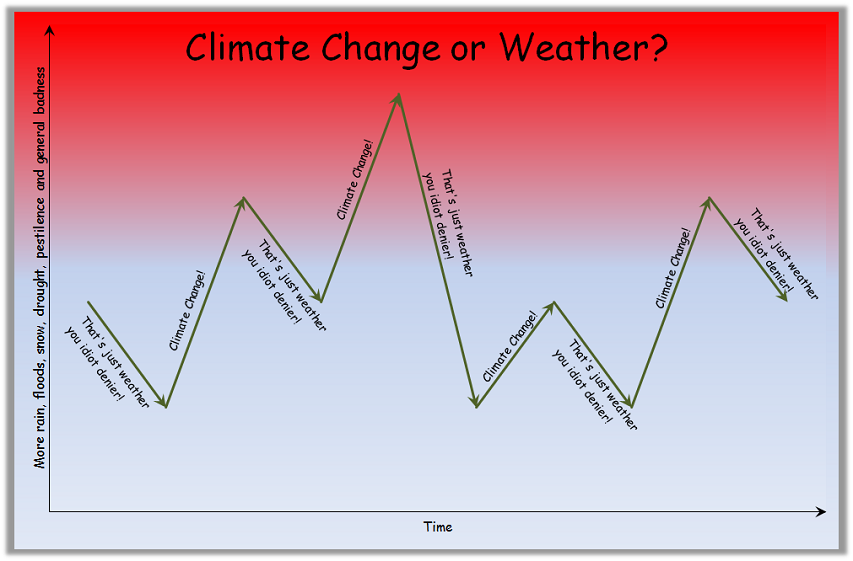
  1. Choose a complex and chaotic system that is characterized by thousands or millions of variables changing simultaneously (e.g. climate, the US economy)
  2. Pick one single output variable to summarize the workings of that system (e.g. temperature, GDP)
  3. Blame (or credit) any changes to your selected output variable on one single pet variable (e.g. capitalism, a President from the other party)
  4. Pick a news outlet aligned with your political tribe and send them a press release
  5. Done! You are now a famous scientist. Congratulations.

Warren Meyer, “Modern Guide to Analyzing Complex Multivariate Systems”, Coyote Blog, 2018-06-25.


September 30, 2020

The feds go trampling all over provincial responsibilities again

Filed under: Cancon, Government, Health, Law — Tags: , , , — Nicholas @ 03:00

Ted Campbell suggests that even a cursory reading of the constitution does not give the federal government the power to trespass (again) in what is clearly, legally, a provincial government area of responsibility:

“The Fathers of Confederation”
The original painting by Robert Harris (1884) was destroyed in the 1916 Parliament Building fire, and this image for the “Gallery of Canadian History” series of lithographs by Confederation Life Insurance Company is based on a photograph by James Ashfield (1885).
Libraries and Archives Canada item ID number 3013194. http://central.bac-lac.gc.ca/.redirect?app=fonandcol&id=3013194&lang=eng

[T]he Parliament of Canada should look to §91. Here is what the Constitution says are the areas of national government’s concern: The Public Debt and Property; The Regulation of Trade and Commerce; Unemployment insurance; The raising of Money by any Mode or System of Taxation; The borrowing of Money on the Public Credit; Postal Service; The Census and Statistics; Militia, Military and Naval Service, and Defence; The fixing of and providing for the Salaries and Allowances of Civil and other Officers of the Government of Canada; Beacons, Buoys, Lighthouses, and Sable Island; Navigation and Shipping; Quarantine and the Establishment and Maintenance of Marine Hospitals; Sea Coast and Inland Fisheries; Ferries between a Province and any British or Foreign Country or between Two Provinces; Currency and Coinage; Banking, Incorporation of Banks, and the Issue of Paper Money; Savings Banks; Weights and Measures; Bills of Exchange and Promissory Notes; Interest; Legal Tender; Bankruptcy and Insolvency; Patents of Invention and Discovery; Copyrights; Indians, and Lands reserved for the Indians; Naturalization and Aliens; Marriage and Divorce; The Criminal Law, except the Constitution of Courts of Criminal Jurisdiction, but including the Procedure in Criminal Matters; The Establishment, Maintenance, and Management of Penitentiaries; and Such Classes of Subjects as are expressly excepted in the Enumeration of the Classes of Subjects by this Act assigned exclusively to the Legislatures of the Provinces.

In that looooong list I can find more than adequate justifications for ministers and government departments that are responsible for: finance and revenue; industry, trade, and commerce; defence; foreign affairs; transport; fisheries and oceans; citizenship and immigration; health; and for independent agencies like the Bank of Canada, Canada Post and Statistics Canada. I cannot find anything that says we need a Minister for Women and Gender Equality, nor one for Diversity, Inclusion and Youth nor, especially, Ministers for Canadian Heritage and Middle Class Prosperity.

A lot of things have changed since 1867; the telegraph was still fairly new and innovative, a practical telephone wouldn’t be invented until ten years after confederation and the first useful long-haul radio transmission and reception, from Britain to Signal Hill in St John’s didn’t come until the dawn of the 20th century, thus ideas like the CBC, the Internet, Netflix, air traffic control and the North Warning System were far beyond the imagination of the men ~ they were pretty much all men, working in government, back in the 1860s, weren’t they? ~ who drafted the Canadian Constitution.

What was clear to them, based on the United States experiences, was that §90 to §95 which spell out “who does what to whom” were important to the functioning of a federal state, especially to one in which traditional provincial rights and diverse cultures were well established. Now, it is important to remember that in Canada’s long and rich history there were instances, especially during great wars, when the provinces agreed to federal intrusions into their areas of responsibility; this is not one long story of federal bullying. But what seems perfectly clear to me ~ and I suspect to e.g. John Horgan, Jason Kenney, Doug Ford, François Legault and the other premiers is that last week’s Throne Speech marks another major and quite unjustified federal assault on their jurisdictions. What’s happened, according to Manitoba Premier Brian Pallister, is that the provinces have all the health care delivery problems but, thanks, in some part, to tax decisions made in 1942, the feds have all the money. The solution is blindingly obvious: transfer tax “points” as some experts call them, to the provinces so that they, not Justin Trudeau, who have the problems of too few physicians, too few nurses and too few hospital beds also have the money to solve them.

September 29, 2020

Was it actually a “Plandemic”?

Filed under: Books, Britain, Government, Health — Tags: , , , , — Nicholas @ 03:00

Sean Gabb recently published a collection of essays written during the lockdown for Wuhan Coronavirus. This excerpt is from the introduction to “Plandemic” or The Hand of God?:

My general argument is that the Coronavirus Panic should be divided under two headings. The first is the Virus itself as a medical fact and the immediate responses. The second is a set of changes already evident and sometimes advanced before the March of 2020, but that have now been greatly accelerated. Of these, the second is by far the more important. The first, even so, is of interest in its own right.

The Virus has not been all that we were told it would be. Last March, much of the world was ordered into indefinite lockdown on the grounds that we faced the greatest pandemic since the Spanish Flu of a century ago. For weeks in my own country, the BBC filled the television screens with statements by scared, sweating politicians, and lifted all restraint from its own hyperventilating staff. Now, as I write in the middle of September, we can be sure that it killed no more people than a seasonal influenza, and that most of its victims were very old or had been already weakened by some other condition. We can be sure it killed no more than seasonal influenza. Given the questionable definition of Coronavirus deaths, it may have killed many fewer.

I know that pandemic infections often come in several waves, and second waves can be more deadly than the first. But the second wave we are now said to be entering is evidenced by infections rather than deaths, and these infections are counted and published in ways more questionable than the counting and publishing of the earlier alleged deaths. I do not know what will have happened by Christmas. I suspect, however, that nothing much will have happened.

I have no fixed idea of what caused the panic. I am told that the Coronavirus was a bioweapon that escaped from a government laboratory. If it was, I can imagine that political leaders all across the world were taken aside by their own scientists, who were working on something similar, and told of the coming apocalypse. I lack the scientific understanding to judge the truth of this claim. But, if true, it would explain the panic. It would also justify the panic, so far as no one might have known for sure how infectious and how deadly this bioweapon was.

I am more inclined, though, to believe that the panic was a universal hysteria just waiting to be realised. The world at the beginning of this year was in a similar moral state to the world in 1914. There had been a generation of rising prosperity and of rising discontent. Some groups had benefitted out of proportion to their numbers and believed merit. If only relatively, others had fallen behind. Some believed the progress had not been fast enough, and that it could be hastened by various institutional changes, others that it was bad in its effects, and that it should be at least slowed. In 1914, all these discordant energies were channelled – both by deliberate policy and by popular enthusiasm – into a catastrophic war. This year, they found their outlet in the Coronavirus. Since I am making the same point, I might as well quote Marx:

    Hegel remarks somewhere that all great world-historic facts and personages appear, so to speak, twice. He forgot to add: the first time as tragedy, the second time as farce.

I will only add that, on the real stage of world affairs, farce is always preferable to tragedy. Facemasks are better than gasmasks. Better the statistical mirage of last spring than the genuine casualties of Verdun and the Somme.

September 27, 2020

“It is a Chestertonian paradox which Chesterton himself never wrote: a government changing the nature of the state successfully and without opposition because nobody can believe what they are seeing, and so everybody politely ignores it.”

In The Critic, Peter Hitchens on the many civil institutions that have been seriously wounded — not so much by the Wuhan Coronavirus, but by government responses to it:

David Icke about to speak at Piers Corbyn’s 20 August anti-masking demonstration in Trafalgar Square.
Screencap from YouTube video – https://www.youtube.com/watch?v=DOZQ58uTWdw

The long retreat of law, reason and freedom has now turned into a rout. It was caused by many things: the mob hysteria which flowered after the death of Princess Diana; the evisceration of education; the spread of intolerant speech codes designed to impose a single opinion on the academy and journalism; the incessant state-sponsored panics over terror; the collapse and decay of institutions and traditions.

These have all at last flowed together into a single force, and we seem powerless against it. Absurdly, the moment at which they have achieved maximum power is accidental, a wild, out of-proportion panic response to a real but limited epidemic.

Outside total war and its obscenities, we have not seen what we are living through now. To list the constitutional events of the last few months is to ask the complacent chattering classes of Britain what it reminds them of: the neutering of parliament into a rubber stamp controlled by the executive; the death of political pluralism; the introduction of government by decree; the disappearance of the last traces of an independent civil service; the silence in the face of these events of media and courts; the subjection of the police to state edicts rather than to law.

[…]

Documents of this kind are not supposed to get out. In better times than these, with active and critical media, this particular passage — with its clear implication that it was the task of the state to scare us into compliance — might have led to the fall of the government. As it is, you will struggle to find mentions of it in the British national press. They are there, but they are hard to find and not on any daily front pages. This is not because of censorship or because of any kind of collective action.

It is because most people, having lived all their lives in relaxed freedom, are quite unable to believe what is in front of their eyes. It is a Chestertonian paradox which Chesterton himself never wrote: a government changing the nature of the state successfully and without opposition because nobody can believe what they are seeing, and so everybody politely ignores it.

This could not have happened, in my view, 60 years ago. Rigorous education, especially of the elite, had at that time created a significant class of people who knew how to think, and how to assess evidence. There would always have been someone, whether it was a Tam Dalyell or a Churchill, to point out the true direction of events and warn against them, prominently. Much of the press would have given this dissent house room, rather than obediently conforming (in order to #ProtectOurNHS). But in the intervening years such rigorous schooling has been replaced by an egalitarian education system which teaches its students what to think, not how to think. Criticism of the past is obligatory, but any cold-eyed assessment of the present — in which new ideas benevolently rule — is disliked and ignored.

As well as this, there have been the various spasms of panic and emotion which convulsed the country after the Cold War ended. These were profound attacks on reason. They were also attacks on limited government and the rule of law, which rest largely on the power of reason. Most people quite like being afraid of something, and many dislike freedom and the responsibility that comes with it. The honest among us all admit it.

Once, before Charles Darwin, Ypres and the Somme, the Christian religion answered those needs. The Fear of the Lord was the Beginning of Wisdom, and the devoted service of Christ was perfect freedom. Faith offered eternal life and helped people to accept temporal death as normal. This belief helped to sustain earthly liberty because, as Edmund Burke pointed out, the man who truly fears God will fear nothing else. No despot can get very far if there are such men around in any number.

September 24, 2020

That Prometheus dude has a lot to answer for…

Filed under: Australia, Environment, USA — Tags: , , — Nicholas @ 05:00

Arthur Chrenkoff on the surprisingly high percentage of wildfires that don’t have a natural origin:

The Green Wattle Creek bushfire moves towards the Southern Highlands township of Yanderra as police evacuate residents from Yanderra Road, 21 December, 2019.
Photo by Helitak430 via Wikimedia Commons

Whatever your position on climate change – majority of experts believe that higher temperatures and drier conditions exacerbate wildfires, both in Australia and America – there is no immediate solution to be found on the global level. If you agree that man-made emissions are driving up temperatures, there is no course of action that will in any substantial way change the climatic conditions for the better over the next few decades (the most ambitious climate change plans talk in terms of slowing down temperature increases, not reversing the trend). Shut down the whole industrial civilisation tomorrow, and the present climate would still lag behind. Talking about wildfires and climate change (as Pelosi, Newsom and many others do) might be a good propaganda for climate action, but it will do nothing for this or any future fiery disasters.

Fortunately, there are much more immediate factors and solutions than shutting down coal and transitioning to renewable energy (themselves decades-long projects). Wildfires are almost exclusively man-made calamities, but not in the way the climate change activists think. Changing climate might indeed be making fires more difficult to contain and extinguish, but it neither starts nor fuels them. We do. Herein, therefore, lie the opportunities to mitigate such disasters as we are witnessing at the moment.

Almost all fires are started by humans

Forests don’t spontaneously combust. And while lightning can often set trees on fire, this accounts for only a very small proportion of all fires.

In Australia, it has been estimated that 87 per cent of 113,000 fires that occurred “in nature” between 1997 and 2009 have been man-made.

In the United States, the latest study from the University of Colorado at Boulder calculates that 97 per cent of fires between 1992 and 2015 that threatened homes (i.e. those happening in the so called “wildland-urban interface”) were started by humans (as were 85 per cent of all fires in “very-low-density housing” areas and 59% of all wildfires in the wild).

A word of caution: man-made does not automatically mean intentional. The scenarios range from broken glass acting as lenses for sun rays or sparks from power lines and machinery, through carelessly discarded cigarette butts and incompletely extinguished bonfires, to amateur back burn attempts getting out of control and – yes – deliberate arson.

During the Australian bushfire crises, I have compiled media reports of around 200 individuals who have been arrested and/or charged in connection with starting fires – many, though not all, on purpose.

In the United States, the cases of arsonists caught by the authorities are mounting, though nowhere near the Australian numbers yet. In Portland, a man was arrested for starting a fire, released, and started another six fires – at this rate, the US might quickly catch up to Down Under.

September 18, 2020

Was the Wuhan Coronavirus (aka Covid-19) created in a Chinese lab?

Filed under: China, Health, Science — Tags: , , , , , , — Nicholas @ 03:00

Rowan Jacobsen profiles the scientist who believes, based on her own research, that the Wuhan Coronavirus was not a naturally occurring mutation and was instead deliberately created in a Chinese government lab:

It wasn’t long before she came across an article about the remarkable stability of the virus, whose genome had barely changed from the earliest human cases, despite trillions of replications. This perplexed Chan. Like many emerging infectious diseases, COVID-19 was thought to be zoonotic — it originated in animals, then somehow found its way into people. At the time, the Chinese government and most scientists insisted the jump had happened at Wuhan’s seafood market, but that didn’t make sense to Chan. If the virus had leapt from animals to humans in the market, it should have immediately started evolving to life inside its new human hosts. But it hadn’t.

On a hunch, she decided to look at the literature on the 2003 SARS virus, which had jumped from civets to people. Bingo. A few papers mentioned its rapid evolution in its first months of existence. Chan felt the familiar surge of puzzle endorphins. The new virus really wasn’t behaving like it should. Chan knew that delving further into this puzzle would require some deep genetic analysis, and she knew just the person for the task. She opened Google Chat and fired off a message to Shing Hei Zhan. He was an old friend from her days at the University of British Columbia and, more important, he was a computational god.

“Do you want to partner on a very unusual paper?” she wrote.

Sure, he replied.

One thing Chan noticed about the original SARS was that the virus in the first human cases was subtly different — a few dozen letters of genetic code — from the one in the civets. That meant it had immediately morphed. She asked Zhan to pull up the genomes for the coronaviruses that had been found on surfaces in the Wuhan seafood market. Were they at all different from the earliest documented cases in humans?

Zhan ran the analysis. Nope, they were 100 percent the same. Definitely from humans, not animals. The seafood-market theory, which Chinese health officials and the World Health Organization espoused in the early days of the pandemic, was wrong. Chan’s puzzle detectors pulsed again. “Shing,” she messaged Zhan, “this paper is going to be insane.”

In the coming weeks, as the spring sun chased shadows across her kitchen floor, Chan stood at her counter and pounded out her paper, barely pausing to eat or sleep. It was clear that the first SARS evolved rapidly during its first three months of existence, constantly fine-tuning its ability to infect humans, and settling down only during the later stages of the epidemic. In contrast, the new virus looked a lot more like late-stage SARS. “It’s almost as if we’re missing the early phase,” Chan marveled to Zhan. Or, as she put it in their paper, as if “it was already well adapted for human transmission.”

That was a profoundly provocative line. Chan was implying that the virus was already familiar with human physiology when it had its coming-out party in Wuhan in late 2019. If so, there were three possible explanations.

For the record, my strong suspicion is that she is correct about the origins of the virus, but I don’t think it was deliberately released by the Chinese government. I think if it had been deliberate, it would have been much more directly “weaponized” in both delivery mechanism and targeting.

September 17, 2020

Why Does Road Construction Take So Long?

Filed under: Environment, Technology — Tags: , , — Nicholas @ 02:00

Practical Engineering
Published 3 Jun 2020

Explaining how earthwork works, and why road construction often takes so long.

Sign up for Brilliant for free at www.brilliant.org/PracticalEngineering and get 20% the annual premium subscription!

Like it or not, roads are part of the fabric of society. Travel is a fundamental part of life for nearly everyone. Unfortunately, that means road construction is too. But, I hope I can give you a little more appreciation for what’s going on behind the orange cones.

-Patreon: http://patreon.com/PracticalEngineering
-Website: http://practical.engineering

Writing/Editing/Production: Grady Hillhouse
Editing and Direction Help: Wesley Crump

This video is sponsored by Brilliant.

September 16, 2020

Lockdown justification theories

In the most recent Libertarian Enterprise, Sean Gabb reports on a demonstration last month in London organized by Piers Corbyn which resulted in Corbyn being almost instantly fined £10,000 despite other, larger and more violent demonstrations not drawing any kind of judicial sanctions:

David Icke about to speak at Piers Corbyn’s 20 August anti-masking demonstration in Trafalgar Square.
Screencap from YouTube video – https://www.youtube.com/watch?v=DOZQ58uTWdw

The consensus at the demonstration appears to have been that the Coronavirus is some kind of fraud, and that the laws to stop its spread are really intended to carry us into a nightmarish New World Order tyranny. I disagree with this view. I believe instead that, looking back from one or two years, the Coronavirus Panic will be seen as a disaster for at least the British ruling class, and as somewhere between a blessing and nothing very bad for the majority of everyone else.

For the avoidance of doubt, I have no belief in the goodness of our ruling class. The Labour Party represents a new and hegemonic Establishment. The project of this Establishment is to bring about changes that are meant to be fatal to the traditional peoples of my country, and that will not be to the advantage of the groups they are supposed to raise up. Whether this project is evil or deluded is beside my present point, though it is probably something of both. There are two possible views of the Conservative Party. It may be worth supporting because, though willing to see it roll forward of its own momentum, the leaders do not want to hurry the project forward, but are mainly interested in personal enrichment. Or it may be a Potemkin opposition — gathering votes from the discontented, while self-consciously making sure those votes are wasted. Again, the exact truth is beside my present point. What does matter is that we go into every election less free and less at home in our country than at the previous election.

This being admitted, there is a loose connection between me and the speakers and attendees at Mr Corbyn’s demonstration. At the same time, there is a difference between cynicism and paranoia. As a cynic, I do not believe that everything untoward that happens is there to hurry the project of change. I do not believe that our ruling class is in charge of everything. I do not believe that it understands everything. Whatever its origin, the Coronavirus appears to have driven our various rulers into a genuine panic. Yes, Boris Johnson is a fool, and there is an army of the powerful who wanted an excuse to stop our final departure from the European Union. Yes, the Democrats were looking to upstage Donald Trump in time for the next American election. But this has not been a panic in just two countries. The Japanese cancelled their Olympic Games — losing them for the second time in eighty years. The Chinese brought four decades of economic growth to an end. The Indians and South Africans panicked. So did most of the Europeans. The panic was joined by ruling classes with no visible interest in putting the dreams of the Frankfurt School into practice.

Focussing on my own country, what ruling class institution has benefitted from the Coronavirus Panic? Look beyond the propaganda, and it is plain that the response of the National Health Service was a disgrace. Myriads of diagnoses and treatments were cancelled without good reason. We still have no dentistry. The public sector as a whole went on paid leave for six months. The schools closed and the teachers vanished — no great loss there, of course. Even if none goes bankrupt, dozens of universities will need to downsize — no loss there either. The police behaved throughout like fascist goons. Every institution set up or adapted to advance the project of change has emerged from the past six months revealed as broken and covered in ridicule. What sort of a planned crisis is it that ends in magnified cynicism and in paranoia that can fill Trafalgar Square on a Bank Holiday weekend? The general mood in this country is approaching what you see at the end of a lost war.

Or what associated commercial interests have benefitted? The politicised entertainment media is flat on its back. The commercial property sector is entering a melt-down. House prices in all the nice parts of London are going into a downward spiral. Public finances will be squeezed for years to come; and, given a choice between projects of change and a liveable dole, the electors are likely to make their wishes undeniable. Globalised patterns of trade have been disrupted, raising question marks over all the presiding global institutions. The last thing financial services needed was another big shock. As for the commercial beneficiaries, these are libertarian by default. For all that can be said against them, Jeff Bezos and Mark Zuckerberg have opened the media to anyone who knows how to use a computer keyboard. Their turn to corporate censorship has, at every step, been a response to outside pressure. Every one of these turns has been half-hearted and driven by a natural, if not always creditable, desire to continue growing richer. There is no particular benefit for the American and British ruling classes if Mr Bezos becomes a trillionaire and Richard Branson ceases to be a billionaire.

On a related note, Jay Currie points out that the media’s current laser-intense focus on reporting Wuhan Coronavirus cases allows the narrative to continue relatively undisturbed and which might be totally overthrown if they reported instead on deaths from the Chinese Batflu (H/T to David Warren for that useful epithet):

In the UK, France, Ontario and various other jurisdictions COVID case counts have risen at an alarming rate in the past few weeks. Unfortunately, mandatory masking and strict lockdowns seem to be the only tools governments feel they have in the face of case count surges.

It can be argued that the increasing case counts may be an artifact of more testing. Or a product of the sensitivity of the tests themselves; but the actual case numbers keep going up.

Our media, God bless them, at a national level seem to be entirely focused on case counts to the point where, in this CBC story on Ontario’s numbers, there is simply no mention of the “death count”.

Why could this be? Well, take a look at these two graphs from Ontario:

If you look at the top graph the sky is falling and masks, social distance, lockdowns, school closures and “stay at home” all make a lot of sense. If you look at the bottom graph, COVID is over.

In Montreal over this last weekend up to 100,000 people marched against mandatory masks. The mainstream media downplayed the turnout and suggested that there were all sorts of conspiracy theorists, Qanon believers, far right and Trump supporters marching. There probably were. But I suspect the vast majority of the marchers were responding to the disproportionate response of the Quebec government to graphs which look very much like Ontario’s.

People are more than willing to go along with governmental measures they can see the point of. “14 days to flatten the curve and prevent hospitals from being overwhelmed” made sense back in April. And the measures taken then may well have worked. But it is mid-September and the hospitals and their ICUs are not even slightly overtaxed.

September 12, 2020

“‘Lovable’ Boris Johnson is currently presiding over the biggest assault on the British people’s freedoms since Cromwell’s Commonwealth”

Filed under: Britain, Government, Health, Liberty — Tags: , , , — Nicholas @ 05:00

James Delingpole has had it with Boris Johnson’s proto-fascist approach to dealing with the Wuhan Coronavirus:

Boris Johnson on 15 February 2018.
Photo by Velislav Nikolov via Wikimedia Commons.

… ask yourself how you’d have felt a year ago — or even six months ago — if you’d been told a British government was planning to institute a 10pm curfew, ban gatherings of more than six people, impose daily immunity tests before you were allowed to go about your business, employ Stasi-like volunteer “marshals” to ensure public compliance and warning that it might even have to cancel Christmas?

Your first reaction would have been: “Impossible. This is the kind of thing that excitable foreigners engage in. Never the phlegmatic, rational British – and certainly, never, ever, EVER so long as there’s a Conservative government in power.”

Your second reaction would have been: “Oh, I get it. It’s a joke, right? You’re telling me the plotline of some new dystopian graphic novel on the lines of Watchmen currently being adapted for Amazon Prime or Netflix, yeah?”

I still can’t quite believe it myself.

[…]

It’s possible that Boris’’s brush with death earlier this year — his excessive weight, unfortunately, put him in the Covid at-risk category — may have stolen his mojo and left him a dried-out husk entirely unfit for public office.

Or it may just be that Boris was always going to be exposed for the chancer he is, sooner or later: all that was needed was the crisis which would cruelly reveal just how useless he is — at least where statesmanship is concerned — at rising to the occasion.

Either way, “lovable” Boris Johnson is currently presiding over the biggest assault on the British people’s freedoms since Cromwell’s Commonwealth (which was the last occasion on which Christmas was more or less banned).

But maybe the most shocking part of the tyranny Boris is currently imposing on Britain is the lack of justification for it.

If Covid-19 really were a version, say, of the Black Death — which wiped out 60 per cent of Europe’s population — most of us would probably agree to sacrifice our freedoms in order to reduce the risk of dying in agony with pustulous buboes while vomiting black blood. Back in the 14th century, there might possibly have been a place for a Boris Johnson, or a Matt Hancock or a Chris Whitty — and if only someone could build a time machine, sharpish, maybe we could facilitate this.

And if that wasn’t enough, check out this graph!

Andrew Sullivan on a “genetic case for communism”

Filed under: Books, Education, Politics, Science, USA — Tags: , , , , , — Nicholas @ 03:00

Actually, this isn’t the case Sullivan himself is making, but he’s summarizing a recent book by Fredrik deBoer, The Cult of Smart: How our broken education system perpetuates social injustice:

There aren’t many books out there these days by revolutionary communists who are into the genetics of intelligence. But then there aren’t many writers like Freddie DeBoer. He’s an insistently quirky thinker who has managed to resist the snark, cynicism and moral preening of so many others in his generation — and write from his often-broken heart. And the core of his new book, The Cult of Smart, is a moral case for those with less natural intelligence than others — the ultimate losers in our democratic meritocracy, a system both the mainstream right and left have defended for decades now, and that, DeBoer argues, gives short shrift to far too many.

This isn’t a merely abstract question for him. He has grappled with it directly. As a school teacher he encountered the simple, unavoidable fact that some humans are more academically gifted than others, and there’s nothing much anyone can do about it. He recalls his effort to teach long division to a boy who had managed to come a long way socially (he’d gone from being a hell-raiser to a good student) but who still struggled with something as elemental as long division: “At one point he broke into tears, as he had several times before … I exhaled slowly and felt myself give up, though of course I would never tell him so. I tried to console him, once again, and he said, ‘I just can’t do it.’ And it struck me, with unusual force, that he was right.”

What DeBoer tries to do is explain how our current culture and political system is geared to torment, distress and punish this kid for no fault of his own. “This is the cult of smart,” DeBoer proclaims. “It is the notion that academic value is the only value, and intelligence the only true measure of human worth. It is pernicious, it is cruel, and it must change.” It has become un-American — or perhaps it always was? — to say that an individual has natural limits, that, even with extremely hard work, he won’t always be able to realize his dreams. And this is not because of anything he has done or failed to do — but simply because of his draw in the genetic lottery of life. The very American cult of education is supposed to end this injustice — except that it doesn’t, because it can’t, and its brutal logic actually exposes and entrenches the least defensible inequality of all, the inequality of nature.

This genetic reality — in fact, the very idea of nature existing at all — is currently a taboo topic on the left. In the most ludicrously untrue and yet suffocatingly omnipresent orthodoxy of our time, critical theory leftists insist that everything on earth is entirely socially constructed, that all inequality is a function of “oppressive systems”, and that human nature itself is what John Locke called a “white paper, void of all characters” — the famous blank slate. Freddie begs to differ: “Human behavioral traits, such as IQ, are profoundly shaped by genetic parentage, and this genetic influence plays a larger role in determining human outcomes than the family and home environment.”

People are not just born unequally and unfairly into class, and culture, and place, they are inherently unequal in various ways in their very nature: “not everyone has the same ability to do calculus; not everyone has the same grasp of grammar and mechanics … we can continue to beat our heads against the wall, trying to force an equality that just won’t come. Or we can face facts and start to grapple with a world where everyone simply can’t be made equal.” And this is not a counsel of despair. What Freddie is arguing is that, far from treating genetic inequality as a taboo, the left should actually lean into it to argue for a more radical re-ordering of society. They shouldn’t ignore genetics, or treat it as unmentionable, or go into paroxysms of fear and alarm over “eugenics” whenever the subject comes up. They should accept that inequality is natural, and construct a politics radical enough to counter it.

[…]

This genetic case for communism can leave a reader a little disoriented, I have to say, if only for its novelty. But it is more coherent, it seems to me, than a leftism that assumes that genes are irrelevant to humans and society, that the ultimate goal is to be as smart and thereby wealthy as possible, and that we can set up an educational system where everyone, regardless of their genetic inheritance, can succeed or fail by their own efforts. What sounds like a meritocratic dream is, in practice, a brutal and unforgiving formula for most who can’t achieve it — and has obviously failed if its task is to foster equality. In fact, mass education appears to have increased the gulf between rich and poor. As Freddie notes, “education is not a weapon against inequality; it is an engine of inequality.”

September 9, 2020

How have you enjoyed your six-month visit to Neil deGrasse Tyson’s “Rationalia” (rule by experts)?

Filed under: Bureaucracy, Government, Health, Media, Science, USA — Tags: , , , — Nicholas @ 03:00

Tabitha Alloway clearly isn’t a fan of technocratic “experts” running our lives — and who can blame her?

Cropped photo of Neil deGrasse Tyson on stage with Richard Dawkins at Howard University in Washington D.C. on 28 September 2010.
Photo by Bruce F. Press via Wikimedia Commons.

Expert advice has ping-ponged on COVID-19 like a bead in a pinball machine. Even the medical literature itself has been rife with contradictions and retractions. Lawmakers have tripped over themselves trying to outdo one another in creating the most laws and regulations during the lockdowns in response to the nebulous (and ever-changing) “science” of the coronavirus.

Meanwhile, suicides, domestic violence, hunger and starvation, and economic difficulty have been on the rise. The Nobel Prize-winning Michael Levitt has said, “There is no doubt in my mind that when we come to look back on this, the damage done by lockdown will exceed any saving of lives by a huge factor.” Stacey Lennox, writing for PJ Media said, “COVID-19 may go down as history’s most devastating example of expert arrogance and media malfeasance.”

[…]

A few years ago Neil deGrasse Tyson made waves with his “Rationalia” government proposal: Create a world in which all policies are based on “weight of evidence.” Let science rule us.

This utopian proposal was quickly criticized by a number of voices. Popular Science charged that such a misguided idea would lead to “vast human suffering,” and pointed out some obvious problems:

    “Scientists study what they want, and they study what they can get paid to study, so the work of science is not free from the pressures of money, nor interaction with the business world … In a hypothetical world where a single person (let’s call him ‘Neil’) decided policy based on precisely measuring the weight of evidence, how that person selected evidence would matter a great deal, and would likely come down to values.”

But of course.

The idea that science could be wholly objectively applied, free from the biases, personal values, and limited understanding of the expert legislating (or proposing) it is a childish fantasy. While Tyson dreams of an unerring scientific principle formulated as a rule for society, his Rationalia proposal makes no room for human error, passion, and prejudice. Our application of science is necessarily limited by our ever-changing understanding of it. And while science can tell us what happens when X meets Y, it cannot tell us if it is moral and good for X to meet Y.

We have more than a little evidence from history that science (or what was accepted at the time as science) has most certainly caused “vast human suffering” when wielded by unscrupulous men and fascist dictators. From the murder of Aboriginal Australians to the forced sterilizations in America, eugenics, genocide, and racism have sprung from (or found their apology in) social Darwinism. As Robert F. Graboyes noted in U.S. News & World Report, “Nazi Deputy Fuhrer Rudolf Hess stated — probably sincerely — that ‘National Socialism is nothing but applied biology.'”

Bumbling do-gooders and their victims are not immune to unintended consequences either, as we have so lately observed.

« Newer PostsOlder Posts »

Powered by WordPress