
True absinthe (the name is from a Greek word meaning “undrinkable”) has been illegal in most places for a long time. It is, or was, flavoured with the herb wormwood, which, as the French authorities noticed after years of using absinthe in their army to combat fever, “acts powerfully on the nerve-centres, and causes delirium and hallucinations, followed in some cases by idiocy” (Encyclopaedia Britannica). The perfectly wholesome successors to absinthe are flavoured with anise, or aniseed. The result always reminds me, not unpleasantly, of those paregoric cough-sweets children ate before the war, and I see that paregoric does contain aniseed, but throws in opium, camphor and benzoic acid as well, so I am probably just being nostalgic. Anyway, when recipes call for absinthe, as they can still do if their compilers and revisers have been too ignorant or lazy to make the change, use Pernod or Ricard instead.
Kingsley Amis, Everyday Drinking: The Distilled Kingsley Amis, 2008.
July 28, 2014
QotD: Absinthe
July 23, 2014
In statistical studies, the size of the data sample matters
In the ongoing investigation into why Westerners — especially North Americans — became obese, some of the early studies are being reconsidered. For example, I’ve mentioned the name of Dr. Ancel Keys a couple of times recently: he was the champion of the low-fat diet and his work was highly influential in persuading government health authorities to demonize fat in pursuit of better health outcomes. He was so successful as an advocate for this idea that his study became one of the most frequently cited in medical science. A brilliant success … that unfortunately flew far ahead of its statistical evidence:
So Keys had food records, although that coding and summarizing part sounds a little fishy. Then he followed the health of 13,000 men so he could find associations between diet and heart disease. So we can assume he had dietary records for all 13,000 of them, right?
Uh … no. That wouldn’t be the case.
The poster-boys for his hypothesis about dietary fat and heart disease were the men from the Greek island of Crete. They supposedly ate the diet Keys recommended: low-fat, olive oil instead of saturated animal fats and all that, you see. Keys tracked more than 300 middle-aged men from Crete as part of his study population, and lo and behold, few of them suffered heart attacks. Hypothesis supported, case closed.
So guess how many of those 300-plus men were actually surveyed about their eating habits? Go on, guess. I’ll wait …
…
And the answer is: 31.
Yup, 31. And that’s about the size of the dataset from each of the seven countries: somewhere between 25 and 50 men. It’s right there in the paper’s data tables. That’s a ridiculously small number of men to survey if the goal is to accurately compare diets and heart disease in seven countries.
[…]
Getting the picture? Keys followed the health of more than 300 men from Crete. But he only surveyed 31 of them, with one of those surveys taken during the meat-abstinence month of Lent. Oh, and the original seven-day food-recall records weren’t available later, so he swapped in data from an earlier paper. Then to determine fruit and vegetable intake, he used data sheets about food availability in Greece during a four-year period.
And from this mess, he concluded that high-fat diets cause heart attacks and low-fat diets prevent them.
Keep in mind, this is one of the most-cited studies in all of medical science. It’s one of the pillars of the Diet-Heart hypothesis. It helped to convince the USDA, the AHA, doctors, nutritionists, media health writers, your parents, etc., that saturated fat clogs our arteries and kills us, so we all need to be on low-fat diets – even kids.
Yup, Ancel Keys had a tiny one … but he sure managed to screw a lot of people with it.
H/T to Amy Alkon for the link.
July 21, 2014
NASA’s “random mode”
Robert Zubrin identifies two different modes of operation practiced by NASA since 1961:
Over the course of its life, NASA has employed two distinct modes of operation. The first prevailed during the period from 1961 to 1973, and may therefore be called the Apollo Mode. The second, prevailing since 1974, may usefully be called the Random Mode.
In the Apollo Mode, business is conducted as follows. First, a destination for human space flight is chosen. Then a plan is developed to achieve the objective. Following this, technologies and designs are developed to implement the plan. These designs are then built, after which the mission is flown.
The Random Mode operates entirely differently. In this mode, technologies and hardware elements are developed in accord with the wishes of various technical communities. These projects are then justified by arguments that they might prove useful at some time in the future when grand flight projects are once again initiated.
Contrasting these two approaches, we see that the Apollo Mode is destination-driven, while the Random Mode pretends to be technology-driven but is actually constituency-driven. In the Apollo Mode, technology development is done for mission-directed reasons. In the Random Mode, projects are undertaken on behalf of various internal and external technical-community pressure groups and then defended using rationales (not reasons). In the Apollo Mode, the space agency’s efforts are focused and directed. In the Random Mode, NASA’s efforts are scatterbrained and entropic.
Imagine two couples, each planning to build their own house. The first couple decides what kind of house they want, hires an architect to design it in detail, then acquires the appropriate materials to build it. That is the Apollo Mode. The second couple canvasses their neighbors each month for different spare house-parts they would like to sell, and buys them all, hoping to eventually accumulate enough stuff to build a house. When their relatives inquire as to why they are accumulating so much junk, they hire an architect to compose a house design that employs all the miscellaneous items they have purchased. The house is never built, but an adequate excuse is generated to justify each purchase, thereby avoiding embarrassment. That is the Random Mode.
NASA had an overriding mission from 1961 to 1974: the moon program. Almost all of its resources were devoted to that goal, and it was achieved. Then bureausclerosis set in, politics took over, and we left the moon (so far, for good). If the future of mankind is in space, it’s unlikely that NASA will be a significant part of that future (unless you count its role in working to hold back private enterprise from getting involved on NASA’s “turf” (can I call it “astroturf” in this context?)).
A few mitigating words for the late Senator Proxmire
Many of you won’t even remember the heyday of Senator William Proxmire’s Golden Fleece awards: his personal choices for the worst public spending boondoggles each year. Most space enthusiasts remember him for his adamant opposition to NASA (for which he could never possibly be forgiven). As an early supporter of the space program, I thought Proxmire was a terrible man and that we’ve have had a much bigger, better space program without him. He left the senate in 1989 and died in 2005, so I’d almost completely forgotten about him until I saw this article in the latest Libertarian Enterprise by Jeff Fullerton:
The things I discover while googling for things. Such as in my efforts to substantiate that Senator Proxmire quote: Not a penny for this nutty fantasy for my previous article. Found an online version of the newsletter of the old L5 Society [PDF]; a space colony advocate group that was around back in the late 70s. Which was sort of a trip down Memory Lane. Remember seeing them on Phil Donahue’s show circa 1980. It’s kind of sad when you look at something like this on the boulevard of broken dreams. But also at times amusing.
Darth Proxmire?
The man space enthusiasts loved to hate like J.R. from Dallas! He was definitely the sort of villain that could grow on you!
The name Proxmire sounds Germanic — but he was no Werner Von Braun — his mindset was typical for the down to Earth culture of the Midlands and being a Wisconsin democrat, he surely had solid connections in Madison — the regional snake pit of Progressivism. Yet he was a conservative democrat — as in fiscal conservative being he gave his “Golden Fleece Awards” to many federal projects that really were an atrocious waste of tax dollars. His disdain for the space program may have stemmed in part from populist disdain for technology — I remember SF writers like Ben Bova and others calling him a Luddite — and that sort of thing was politically fashionable in those days (often referred to as a knee-jerk reaction) so part of his reason for jumping onto the anti-space bandwagon may have been a political calculation. Some of it was probably born of a zero sum mentality that was also vogue at the time. A few space advocates wrote funny editorials about converting Proxmire to supporting space exploration and colonization by finding a way to turn butter into rocket fuel — being that the Senator’s primary constituency were Wisconsin dairy farmers!
[…]
As for William Proxmire — I can’t be too hard on him anymore. Especially when you consider all that NASA has done to thwart any hope of establishing human settlements beyond Earth. At best a lack of vision being the space agency had long ago lost its mojo and is nothing like it was in its early days when could actually meet the challenge of JFK’s vision of putting boots on the moon in a decade — as opposed to shrugging and saying “maybe in three decades”? At best they are slow walking because NASA is much like the establishment of the Republican Party that sometimes talks “small government” but is in no hurry to deliver on it. And worst of all — NASA seems to have an ideological agenda aimed at preventing the colonization of space deeply entrenched within the bureaucracy and the story is the same within most other federal agencies and institutions.
Wikipedia (not traditionally staffed by fans of small government) has this to say about Proxmire’s legislative career:
He was an early, outspoken critic of the Vietnam War. He frequently criticized Presidents Lyndon Johnson and Richard Nixon for their conduct of the war and foreign policy decisions. He used his seat on the Senate Armed Services Committee to spotlight wasteful military spending and was instrumental in stopping frequent military pork barrel projects. His Golden Fleece Award was created to focus media attention on projects he felt were self-serving and wasted taxpayer dollars. He was also head of the campaign to cancel the American supersonic transport. Despite his support of budgetary restraint in other areas, he normally sided with dairy interests and was a proponent of dairy price supports.
[…]
Proxmire was famous for issuing his Golden Fleece Award, which identified what he considered wasteful government spending, between 1975 and 1988. The first was awarded in 1975 to the National Science Foundation, for funding an $84,000 study on why people fall in love. Other Golden Fleece awards over the years were “awarded” to the Justice Department for conducting a study on why prisoners wanted to get out of jail, the National Institute of Mental Health to study a Peruvian brothel (“The researchers said they made repeated visits in the interests of accuracy,” reported the New York Times), and the Federal Aviation Administration, for studying “the physical measurements of 432 airline stewardesses, paying special attention to the ‘length of the buttocks.'” Proxmire stopped numerous science and academic projects which were, in his opinion, of dubious value.
Proxmire’s critics claimed that some of his awards went to basic science projects that led to important breakthroughs, such as the Aspen Movie Map (though the Aspen Movie Map project did not receive the award). For example, Proxmire was criticized in 1987 for the Aspen Movie Map incident by author Stewart Brand, who accused Proxmire of recklessly attacking legitimate research for the crass purpose of furthering his own political career, with gross indifference as to whether his assertions were true or false as well as the long-term effects on American science and technology policy. Proxmire later apologized for several of those, including SETI.
[…]
Proxmire earned the unending enmity of space advocates and science fiction fandom for his opposition to space colonization, ultimately eliminating spending on said research from NASA’s budget. In response to a segment about space colonies run by the CBS program 60 Minutes, Proxmire stated that; “it’s the best argument yet for chopping NASA’s funding to the bone …. I say not a penny for this nutty fantasy”. Arthur C. Clarke and Larry Niven retaliated by writing the award-winning stories Death and the Senator, Fallen Angels, and The Return of William Proxmire. In a number of circles his name has become a verb, meaning to unfairly obstruct scientific research for political gain, as in “the project has been proxmired”.
July 20, 2014
Apollo 11 moon landing anniversary
The first men walked on the moon on this day in 1969:

Astronaut Buzz Aldrin, lunar module pilot, stands on the surface of the moon near the leg of the lunar module, Eagle, during the Apollo 11 moonwalk. Astronaut Neil Armstrong, mission commander, took this photograph with a 70mm lunar surface camera. While Armstrong and Aldrin descended in the lunar module to explore the Sea of Tranquility, astronaut Michael Collins, command module pilot, remained in lunar orbit with the Command and Service Module, Columbia. *This is the actual photograph as exposed on the moon by Armstrong. He held the camera slightly rotated so that the camera frame did not include the top of Aldrin’s portable life support system (“backpack”). A communications antenna mounted on top of the backpack is also cut off in this picture. When the image was released to the public, it was rotated clockwise to restore the astronaut to vertical for a more harmonious composition, and a black area was added above his head to recreate the missing black lunar “sky”. The edited version is the one most commonly reproduced and known to the public, but the original version, above, is the authentic exposure.
I didn’t realize that almost all the Apollo 11 photographs of astronauts are of Buzz Aldrin. For some reason, Neil Armstrong appears in only a few of them, and The Atlantic‘s Rebecca Rosen wonders why:

Bootprint in lunar dust created and photographed by Buzz Aldrin for the boot penetration (soil mechanics) task during the Apollo 11 moon walk.
If there is one thing everybody knows about Neil Armstrong, it is this: “One small step for [a] man, one giant leap for mankind.” This quotation, in my mind at least, appears illustrated, conjuring the image above of an imprint left by a human boot upon the dusty lunar surface.
Except that’s not the first step, nor was it left by Armstrong. It’s a footprint made by Buzz Aldrin, the second man to walk on the moon.
[…]
The explanation for this paucity is murky at best, prone to the uncharitable reading that Aldrin was getting “Armstrong back by taking no photographs of him on the Moon” in retribution for Armstrong getting the honor of first to set foot on the lunar surface.
But this is speculation at best. Aldrin, at least, has always said that the lapse was inadvertant, the result of Armstrong carrying the camera most of the time, a picture of Armstrong not appearing on the bucket list of things to do while on the moon, and Armstrong never stopping to ask for one. According to Aldrin, he was about to take a picture of Armstrong at the flag ceremony when President Nixon called, distracting them from the task.
[…]
Later, Aldrin expressed regret about the oversight. “When I got back and someone said, ‘There’s not any of Neil,’ I thought, ‘What in the hell can I do now?’ I felt so bad about that. And then to have somebody say that might have been intentional…. How do you come up with a nonconfrontational argument against that? I mean, that was just such a divisive observation, and Neil and I were never in the least divisive. We really were intimidated by the situation we found ourselves in on the Moon, hesitant and with an unclear idea of what to do next.”
Hansen’s book includes a handful of divergent opinions from different NASA administrators, theorizing as to how this, what Hansen calls “one of the minor tragedies of Apollo 11,” could have happened. Was it mere oversight or petty payback? Men sticking close to the plan or men sticking too close to the plan?
H/T to Colby Cosh:
This quirk of history is usually covered as if it were, or even could have been, the astronauts’ fault. It’s a bit unfortunate.
— Colby Cosh (@colbycosh) July 20, 2014
July 17, 2014
Peer review fraud – the tip of the iceberg?
Robert Tracinski points out that the recent discovery of a “peer review and citation ring” for mere monetary gain illustrates that when much is at stake, the temptation to pervert the system can become overwhelming:
The Journal of Vibration and Control — not as titillating as it sounds; it’s an engineering journal devoted to how to control dangerous vibrations in machines and structures — just retracted 60 published papers because “a ‘peer review and citation ring’ was apparently rigging the review process to get articles published.”
The motive here is ordinary corruption. Employment and prestige in academia is usually based on the number of papers a professor has published in peer-reviewed journals. It’s a very rough gauge of whether a scientist is doing important research, and it’s the kind of criterion that appeals to administrators who don’t want to stick their noses out by using their own judgment. But it is obviously open to manipulation. In this case, a scientist in Taiwan led a ring that created fake online reviewers to lend their approval to each others’ articles and pump up their career prospects.
But if this is what happens when the motive is individual corruption, imagine how much greater the incentive is when there is also a wider ideological motive. Imagine what happens when a group of academics are promoting a scientific theory that not only advances their individual careers in the universities, but which is also a source of billions of dollars in government funding, a key claim for an entire ideological world view, an entrenched dogma for one side of the national political debate, and a quasi-religious item of faith whose advocates believe they are literally saving the world?
July 15, 2014
The attraction (and danger) of computer-based models
Warren Meyer explains why computer models can be incredibly useful tools, but they are not the same thing as an actual proof:
Among the objections, including one from Green Party politician Chit Chong, were that Lawson’s views were not supported by evidence from computer modeling.
I see this all the time. A lot of things astound me in the climate debate, but perhaps the most astounding has been to be accused of being “anti-science” by people who have such a poor grasp of the scientific process.
Computer models and their output are not evidence of anything. Computer models are extremely useful when we have hypotheses about complex, multi-variable systems. It may not be immediately obvious how to test these hypotheses, so computer models can take these hypothesized formulas and generate predicted values of measurable variables that can then be used to compare to actual physical observations.
[…]
The other problem with computer models, besides the fact that they are not and cannot constitute evidence in and of themselves, is that their results are often sensitive to small changes in tuning or setting of variables, and that these decisions about tuning are often totally opaque to outsiders.
I did computer modelling for years, though of markets and economics rather than climate. But the techniques are substantially the same. And the pitfalls.
Confession time. In my very early days as a consultant, I did something I am not proud of. I was responsible for a complex market model based on a lot of market research and customer service data. Less than a day before the big presentation, and with all the charts and conclusions made, I found a mistake that skewed the results. In later years I would have the moral courage and confidence to cry foul and halt the process, but at the time I ended up tweaking a few key variables to make the model continue to spit out results consistent with our conclusion. It is embarrassing enough I have trouble writing this for public consumption 25 years later.
But it was so easy. A few tweaks to assumptions and I could get the answer I wanted. And no one would ever know. Someone could stare at the model for an hour and not recognize the tuning.
July 12, 2014
Sriracha factory dispute – “THIS PROBLEM NEEDS TO BE TAKEN CARE OF NOW, NOT LATER!!!!!”
 Sriracha fans were relieved when the Huy Fong plant in California was allowed to re-open after a farcical ‘elf-and-safety’ shakedown (original story here). Reason‘s Zenon Evans has more on the behind-the-scenes bullshit that triggered the near-national panic among hot sauce consumers:
The public just got some new insight into one of the last year’s spiciest (and fishiest) political kerfuffles: the push by the city council of Irwindale, California to shut down Huy Fong Foods, the makers of Sriracha hot sauce. The tireless freedom-of-information requesters at MuckRock yesterday published internal council documents, revealing theatrically furious communication among the local government officials and a desire to exploit regulations to force the company into submission.
[…]
The newly revealed memos and emails show that some members of government were actually “happy to report the scent of chilies” emanating when production began in 2012, but, a year later Ortiz and Councilman David Fuentes, who also lived near the factory (and also ultimately recused himself from the matter), saw a total shutdown as the first and only appropriate course of action.
“I just received notice that the odor at this place is very strong. We must proceed with SHUT DOWN immediately,” demanded Ortiz in an email, despite the fact that he had previously applauded how much safer that part of town had become since the $80 million business moved in.
Fuentes was even more adamant. “THIS PROBLEM NEEDS TO BE TAKEN CARE OF NOW, NOT LATER!!!!!,” he emailed his fellow council members in October. Notably, he also suggested that “if we need to shut them down for non compliance, then let’s do what we have to do.”
Although it’s not clear exactly what Fuentes meant by “non compliance” or if the council made moves based on his plot, the city did sue Huy Fong and got a judge to order a partial shutdown in November, even though that the judge acknowledged a “lack of credible evidence” regarding the health risk claims. Likewise, California’s health regulators stepped in and changed their own food rules in December as they demanded a 30-day hold on operations, which created fear of a national Sriracha shortage.
July 11, 2014
DSM-5 turns “everyday anxiety, eccentricity, forgetting and bad eating habits into mental disorders”
Helene Guldberg reviews Saving Normal: An Insider’s Revolt Against Out-of-Control Psychiatric Diagnosis, DSM-5, Big Pharma, and the Medicalization of Ordinary Life by Allen Frances.
Frances’ arguments about the dangers of inflating psychiatric conditions and psychiatric diagnosis are persuasive — maybe more so because he honestly admits to his own role in developing such an inflation. He is keenly aware of the risks of diagnostic inflation ‘because of painful firsthand experience’, he writes. ‘Despite our efforts to tame excessive diagnostic exuberance, DSM-IV had since been misused to blow up the diagnostic bubble’. He is particularly concerned about the exponential increase in the diagnosis of psychiatric conditions in children, writing: ‘We failed to predict or prevent three new false epidemics of mental disorder in children — autism, attention deficit, and childhood bipolar disorder. And we did nothing to contain the rampant diagnostic inflation that was already expanding the boundary of psychiatry far beyond its competence.’
Take Attention Deficit Hyperactivity Disorder (ADHD), which is ‘spreading like wildfire’. This diagnosis is applied so promiscuously that ‘an amazing 10 per cent of kids now qualify’, Frances writes. He points out that in the US, boys born in January are 70 per cent more likely to be diagnosed with ADHD than boys born in December. The reason diagnosing ADHD is so problematic is that it essentially is a description of immaturity, including symptoms such as ‘lack of impulse control’, ‘hyperactivity’ or ‘inattention’. Boys born in January are the youngest in their school year group (in the US) and thus they are more likely to be immature; in the UK, the youngest children in a school classroom are born in August, and so here, August-born kids are more likely to be diagnosed with ADHD. We have medicalised immaturity.
[…]
Until 1980, the DSMs were ‘deservedly obscure little books that no one much cared about or read’. DSM-I (published in 1952) and DSM-II (published in 1968) were ‘unread, unloved and unused’. Now, says Frances, this ‘bible’ of psychiatry ‘determines all sorts of important things that have an enormous impact on people’s lives — like who is considered well and who sick; what treatment is offered; who pays for it; who gets disability benefit; who is eligible for mental health, school vocational and other services; who gets to be hired for a job, can adopt a child, or pilot a plane, or qualifies for life insurance; whether a murderer is a criminal or mental patient; what should be the damages awarded in lawsuits; and much, much more’.
Today, as a result of various trends, including the impact of the DSMs, many human behaviours, quirks, eccentricities and woes which in the past would have been seen as parts of the rich tapestry of life are now branded mental disorders.
July 7, 2014
The BBC losing its balance over climate reporting
Matt Ridley on the BBC’s loss of balance:
The BBC’s behaviour grows ever more bizarre. Committed by charter to balanced reporting, it has now decided formally that it was wrong to allow balance in a debate between rival guesses about the future. In rebuking itself for having had the gall to interview Nigel Lawson on the Today programme about climate change earlier this year, it issued a statement containing this gem: “Lord Lawson’s views are not supported by the evidence from computer modelling and scientific research.”
The evidence from computer modelling? The phrase is an oxymoron. A model cannot, by definition, provide evidence: it can provide a prediction to test against real evidence. In the debate in question, Lord Lawson said two things: it was not possible to attribute last winter’s heavy rain to climate change with any certainty, and the global surface temperature has not warmed in the past 15 to 17 years. He was right about both, as his debate opponent, Sir Brian Hoskins, confirmed.
As for the models, here is what Dr Vicky Pope of the Met Office said in 2007 about what their models predicted: “By 2014, we’re predicting that we’ll be 0.3 degrees warmer than 2004. Now just to put that into context, the warming over the past century and a half has only been 0.7 degrees, globally … So 0.3 degrees, over the next ten years, is pretty significant … These are very strong statements about what will happen over the next ten years.”
In fact, global surface temperature, far from accelerating upwards, has cooled slightly in the ten years since 2004 on most measures. The Met Office model was out by a country mile. But the BBC thinks that it was wrong even to allow somebody to challenge the models, even somebody who has written a bestselling book on climate policy, held one of the highest offices of state and founded a think-tank devoted to climate change policy. The BBC regrets even staging a live debate between him and somebody who disagrees with him, in which he was robustly challenged by the excellent Justin Webb (of these pages).
And why, pray, does the BBC think this? Because it had a complaint from a man it coyly describes as a “low-energy expert”, Mr Chit Chong, who accused Lord Lawson of saying on the programme that climate change was “all a conspiracy”.
Lawson said nothing of the kind, as a transcript shows. Mr Chong’s own curriculum vitae boasts that he “has been active in the Green party for 25 years and was the first Green councillor to be elected in London”, and that he “has a draught-proofing and insulation business in Dorset and also works as an environmental consultant”.
So let’s recap. On the inaccurate word of an activist politician with a vested financial and party interest, the BBC has decided that henceforth nobody must be allowed to criticise predictions of the future on which costly policies are based.
July 3, 2014
Skeptical reading should be the rule for health news
We’ve all seen many examples of health news stories where the headline promised much more than the article delivered: this is why stories have headlines in the first place — to get you to read the rest of the article. This sometimes means the headline writer (except on blogs, the person writing the headline isn’t the person who wrote the story), knowing less of what went into writing the story, grabs a few key statements to come up with an appealing (or appalling) headline.
This is especially true with science and health reporting, where the writer may not be as fully informed on the subject and the headline writer almost certainly doesn’t have a scientific background. The correct way to read any kind of health report in the mainstream media is to read skeptically — and knowing a few things about how scientific research is (or should be) conducted will help you to determine whether a reported finding is worth paying attention to:
Does the article support its claims with scientific research?
Your first concern should be the research behind the news article. If an article touts a treatment or some aspect of your lifestyle that is supposed to prevent or cause a disease, but doesn’t give any information about the scientific research behind it, then treat it with a lot of caution. The same applies to research that has yet to be published.
Is the article based on a conference abstract?
Another area for caution is if the news article is based on a conference abstract. Research presented at conferences is often at a preliminary stage and usually hasn’t been scrutinised by experts in the field. Also, conference abstracts rarely provide full details about methods, making it difficult to judge how well the research was conducted. For these reasons, articles based on conference abstracts should be no cause for alarm. Don’t panic or rush off to your GP.
Was the research in humans?
Quite often, the ‘miracle cure’ in the headline turns out to have only been tested on cells in the laboratory or on animals. These stories are regularly accompanied by pictures of humans, which creates the illusion that the miracle cure came from human studies. Studies in cells and animals are crucial first steps and should not be undervalued. However, many drugs that show promising results in cells in laboratories don’t work in animals, and many drugs that show promising results in animals don’t work in humans. If you read a headline about a drug or food ‘curing’ rats, there is a chance it might cure humans in the future, but unfortunately a larger chance that it won’t. So there is no need to start eating large amounts of the ‘wonder food’ featured in the article.
How many people did the research study include?
In general, the larger a study the more you can trust its results. Small studies may miss important differences because they lack statistical “power”, and are also more susceptible to finding things (including things that are wrong) purely by chance.
[…]
Did the study have a control group?
There are many different types of studies appropriate for answering different types of questions. If the question being asked is about whether a treatment or exposure has an effect or not, then the study needs to have a control group. A control group allows the researchers to compare what happens to people who have the treatment/exposure with what happens to people who don’t. If the study doesn’t have a control group, then it’s difficult to attribute results to the treatment or exposure with any level of certainty.
Also, it’s important that the control group is as similar to the treated/exposed group as possible. The best way to achieve this is to randomly assign some people to be in the treated/exposed group and some people to be in the control group. This is what happens in a randomised controlled trial (RCT) and is why RCTs are considered the ‘gold standard’ for testing the effects of treatments and exposures. So when reading about a drug, food or treatment that is supposed to have an effect, you want to look for evidence of a control group and, ideally, evidence that the study was an RCT. Without either, retain some healthy scepticism.
June 30, 2014
Emperor penguins at risk
A somewhat confusing report from BBC News says that due to warming in the Antarctic, there is now record ice extent, which means Emperor penguins have to travel much further to find open water. The warming (which has created all the extra ice) is expected to get much worse and is predicted to cut the penguin population by up to a third by the end of the century.
The main threat to the penguins comes from changes to sea-ice cover in the Antarctic, which will affect their breeding and feeding.
Dynamics will differ between penguin colonies, but all are expected to be in decline by the end of the century.
Details are published in Nature Climate Change journal.
The US, British and Dutch researchers urge governments to list the birds as endangered. Such a listing could impose restrictions on tourism and fishing.
The team, led by Stephanie Jenouvrier of the Woods Hole Oceanographic Institution, said the global population of emperor penguins would probably decline by between 19 and 33% from current levels.
[…]
“There is a goldilocks point for ice and emperor penguins,” Phil Trathan, an expert at the British Antarctic Survey (Bas), told Reuters.
Mr Trathan said it was unclear if the ungainly birds could adapt by climbing on to land or higher ice. Four emperor penguin colonies had recently been found on ice shelves, above sea level where glaciers spill off the land.
Satellite measurements of Antarctic sea-ice extent show winter coverage to be at record levels. However, climate computer modelling expects this trend to be reversed in the future, as conditions in the Antarctic warm.
Anyone else remember this French TV commercial?
Update, 2 July: Blinded by Beliefs: The Straight Poop on Emperor Penguins.
Two recent press releases concerning the Emperor Penguin’s fate illustrate contrasting forces that will either advance or suppress trustworthy conservation science. The first study reminds me of Mark Twain’s quip, “Education consists mainly in what we have unlearned.” Embodying that truism is a paper by lead author Dr. Michelle LaRue who reports new advances in reading the Emperor Penguin’s fecal stains on Antarctic sea ice that are visible in satellite pictures. Two years ago the fecal stain method identified several large, hitherto unknown colonies and nearly doubled our estimate of the world’s Emperor Penguins. That didn’t mean climate change had necessarily increased penguin numbers, but a larger more robust population meant Emperor Penguins were far more resilient to any form of change.
June 29, 2014
NFL Films may have key evidence in the concussion dispute
At Viking Update, John Holler says an old NFL Films product may become very important in the ongoing dispute between the league and former players over concussions:
The ongoing concussion lawsuit that appears to be close to being settled out of court is making progress to be finalized. The bottom line is that players needing help will get significantly more assistance than they have in the past because the spotlight is on and both sides are compelled to try to reach a mutually-agreed upon decision.
But, if the case remains unsettled, the NFL equivalent to the Zapruder film may well already be in possession of the NFL.
Many of the former players who are seeking reparations for the injuries they sustained during their playing days played the sport at a much different time. They weren’t just Old School. They played in the school that was replaced by the school now referred to as Old School.
Over the weekend, thanks to the good people at Netflix, I watched a three-disc NFL Films series called “Inside the Vault.” The series highlighted the NFL of the 1960s and early 1970s and, while used as a promotional tool, gave unprecedented access to what actually happened on the sidelines of games when injured players were being treated and, at times, sent back into action.
The footage contained on the DVDs was both fascinating and troubling. At the time the “vault” was opened in 2003, NFL Films was getting involved in the new medium of marketing and selling itself. The DVD market of the time created “The Vault.”
What the NFL Films set portrayed was a testament to the bravado of the NFL and the players, coaches and sideline personnel involved. Ed Sabol founded NFL Films and, in the “Vault” collection, he was interviewed and quoted as saying that he instructed his camera crews not to unnecessarily throw away any film that wasn’t spoiled in developing.
June 28, 2014
Autism and vaccines infographic
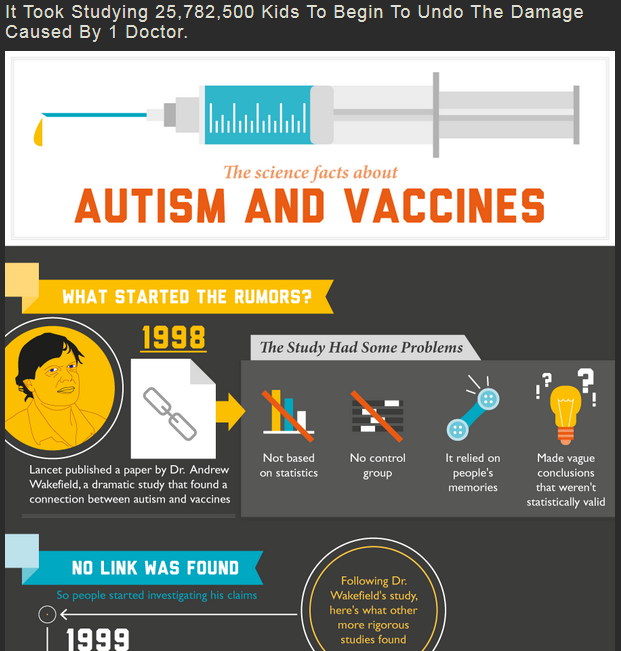
Click to see full infographic
H/T to Nils Werner for the link.
It Took Studying 25,782,500 Kids To Begin To Undo The Damage Caused By 1 Doctor. – Imgur http://t.co/tCouiaPmip #vaccines
— Nils Werner (@iNils) June 28, 2014


