
You know, I love science as much as anyone, maybe more, but I have grown to dread the phrase “…according to the research”.
They say that “Confronting triggers, not avoiding them, is the best way to overcome PTSD”. They point out that “exposure therapy” is the best treatment for trauma survivors, including rape victims. And that this involves reliving the trauma and exposing yourself to traumatic stimuli, exactly what trigger warnings are intended to prevent. All this is true. But I feel like they are missing a very important point.
YOU DO NOT GIVE PSYCHOTHERAPY TO PEOPLE WITHOUT THEIR CONSENT.
Psychotherapists treat arachnophobia with exposure therapy, too. They expose people first to cute, little spiders behind a glass cage. Then bigger spiders. Then they take them out of the cage. Finally, in a carefully controlled environment with their very supportive therapist standing by, they make people experience their worst fear, like having a big tarantula crawl all over them. It usually works pretty well.
Finding an arachnophobic person, and throwing a bucket full of tarantulas at them while shouting “I’M HELPING! I’M HELPING!” works less well.
And this seems to be the arachnophobe’s equivalent of the PTSD “advice” in the Pacific Standard. There are two problems with its approach. The first is that it avoids the carefully controlled, anxiety-minimizing setup of psychotherapy.
The second is that YOU DO NOT GIVE PSYCHOTHERAPY TO PEOPLE WITHOUT THEIR CONSENT.
If a person with post-traumatic stress disorder or some other trigger-related problem doesn’t want psychotherapy, then even as a trained psychiatrist I am forbidden to override that decision unless they become an immediate danger to themselves or others.
And if they do want psychotherapy, then very likely they want to do it on their own terms. I try to read things that challenge my biases and may even insult or trigger me, but I do it when I feel like it and not a moment before. When I am feeling adventurous and want to become stronger in some way, I will set myself some strenuous self-improvement task, whether it be going on a long run or reading material I know will be unpleasant. But at the end of a really long and exasperating day when I’m at my wit’s end and just want to relax, I don’t want you chasing me with a sword and making me run for my life, and I don’t want you forcing traumatic material at me.
Scott Alexander, “The Wonderful Thing About Triggers”, Slate Star Codex, 2014-05-30.
April 4, 2015
QotD: DO NOT GIVE PSYCHOTHERAPY TO PEOPLE WITHOUT THEIR CONSENT
April 3, 2015
Updating the old saying “where there’s muck, there’s money”
According to this story in the Guardian, a typical city of one million people poops out $13 million in (potentially recoverable) precious metals every year:
Sewage sludge contains traces of gold, silver and platinum at levels that would be seen as commercially viable by traditional prospectors. “The gold we found was at the level of a minimal mineral deposit,” said Kathleen Smith, of the US Geological Survey.
Smith and her colleagues argue that extracting metals from waste could also help limit the release of harmful metals, such as lead, into the environment in fertilisers and reduce the amount of toxic sewage that has to be buried or burnt.
“If you can get rid of some of the nuisance metals that currently limit how much of these biosolids we can use on fields and forests, and at the same time recover valuable metals and other elements, that’s a win-win,” she said.
A previous study, by Arizona State University, estimated that a city of 1 million inhabitants flushed about $13m (£8.7m) worth of precious metals down toilets and sewer drains each year.
The task of sifting sewage for microscopic quantities of gold may sound grim, but it could have a variety of unexpected benefits over traditional gold mining. The use of powerful chemicals, called leachates, used by the industry to pull metals out of rock is controversial, because these chemicals can be devastating to ecosystems when they leak into the environment. In the controlled setting of a sewage plant, the chemicals could be used liberally without the ecological risks.
Perhaps the New York Times needs to back away from science coverage
Alex B. Berezow makes a case for the venerable New York Times to not cover science stories:
What has gone so wrong for the NYT? Many things are to blame. The paper’s leftish editorial page is out of step with a large portion of the American public. A high-profile scandal, in which journalist Jayson Blair was caught fabricating articles, damaged its credibility. The biggest factor, however, is the rise of credible challengers — both print and digital — that simply do better journalism. There is little incentive to spend money to read the NYT when superior news coverage (and more sensible editorializing) can be found elsewhere.
The NYT‘s science coverage is particularly galling. While the paper does employ a staff of decent journalists (including several excellent writers, such as Carl Zimmer and John Tierney), its overall science coverage is trite. Other outlets cover the same stories (and many more), in ways that are both more in-depth and more interesting. (They are also usually free to read.) Worst of all, too much of NYT‘s science journalism is egregiously wrong.
[…]
Reliance on fringe, pseudoscientific sources has become something of a trend at the NYT. Its most deplorable reportage involves the science of food, particularly GMOs. Henry Miller, the former founding director of the FDA’s Office of Biotechnology, reprimands anti-GMO foodie Mark Bittman for “journalistic sloppiness” and “negligence” in his “[inability] to find reliable sources.”
Furthermore, in a damning exposé, Jon Entine reveals that Michael Pollan, a food activist and frequent NYT contributor, “has a history of promoting discredited studies and alarmist claims about GMOs.” Even worse, Mr. Entine writes that Mr. Pollan “candidly says he manipulated the credulous editors at the New York Times… by presenting only one side of food and agriculture stories.” Mr. Pollan was also chided by plant scientist Steve Savage for disseminating inaccurate information on potato agriculture and fearmongering about McDonald’s French fries.
On many matters concerning nutrition or health, the NYT endorses the unscientific side of the debate. For instance, The Atlantic criticized a New York Times Magazine essay on the supposed toxicity of sugar. At Science 2.0, Hank Campbell mocked an NYT writer’s endorsement of gluten-free diets, and chemist Josh Bloom dismantled a painfully inaccurate editorial on painkillers.
April 2, 2015
“… women think about their bodies in much more complicated ways than men do”
Amanda Smith on some of the reasons why human male and female shapes are so different from one another, unlike most mammals:
“It just seems that women think about their bodies in much more complicated ways than men do, and that’s kind of bewildering when you’re a man,” he says.
Apart from mere curiosity, Bainbridge has a professional interest: “I’d always thought it was strange that humans are the one species where our females are curvy — you don’t really see that in other species”.
He addresses that question in his book: Curvology: The Origins and Power of Female Body Shape.
At birth, he writes, human babies are around 12 per cent fat by weight. Throughout childhood that average fat level remains consistent between boys and girls. However, by the end of puberty girls of average weight will have have a body composition of 24 to 30 per cent fat, while boys hardly change at all.
“There is a very spectacular stacking on of adipose tissue during those years, and of course that’s what makes women such a distinctive shape compared to men,” says Bainbridge. “Men have got the same as most animals, it’s women that are absolutely exceptional.”
April 1, 2015
Fossil fuels are not going away anytime soon
Matt Ridley on the piously hoped-for breakthroughs in renewable energy sources … that still seem as distant as they did decades ago:
The environmental movement has advanced three arguments in recent years for giving up fossil fuels: (1) that we will soon run out of them anyway; (2) that alternative sources of energy will price them out of the marketplace; and (3) that we cannot afford the climate consequences of burning them.
These days, not one of the three arguments is looking very healthy. In fact, a more realistic assessment of our energy and environmental situation suggests that, for decades to come, we will continue to rely overwhelmingly on the fossil fuels that have contributed so dramatically to the world’s prosperity and progress.
In 2013, about 87% of the energy that the world consumed came from fossil fuels, a figure that — remarkably — was unchanged from 10 years before. This roughly divides into three categories of fuel and three categories of use: oil used mainly for transport, gas used mainly for heating, and coal used mainly for electricity.
[…]
So those who predict the imminent exhaustion of fossil fuels are merely repeating the mistakes of the U.S. presidential commission that opined in 1922 that “already the output of gas has begun to wane. Production of oil cannot long maintain its present rate.” Or President Jimmy Carter when he announced on television in 1977 that “we could use up all the proven reserves of oil in the entire world by the end of the next decade.”
That fossil fuels are finite is a red herring. The Atlantic Ocean is finite, but that does not mean that you risk bumping into France if you row out of a harbor in Maine. The buffalo of the American West were infinite, in the sense that they could breed, yet they came close to extinction. It is an ironic truth that no nonrenewable resource has ever run dry, while renewable resources — whales, cod, forests, passenger pigeons — have frequently done so.
[…]
As for renewable energy, hydroelectric is the biggest and cheapest supplier, but it has the least capacity for expansion. Technologies that tap the energy of waves and tides remain unaffordable and impractical, and most experts think that this won’t change in a hurry. Geothermal is a minor player for now. And bioenergy — that is, wood, ethanol made from corn or sugar cane, or diesel made from palm oil — is proving an ecological disaster: It encourages deforestation and food-price hikes that cause devastation among the world’s poor, and per unit of energy produced, it creates even more carbon dioxide than coal.
Wind power, for all the public money spent on its expansion, has inched up to — wait for it — 1% of world energy consumption in 2013. Solar, for all the hype, has not even managed that: If we round to the nearest whole number, it accounts for 0% of world energy consumption.
March 30, 2015
About that giant island of plastic out in the ocean…
… it’s a myth.
Have you heard of the giant plastic island in the Pacific Ocean? Several times in casual conversation, I’ve been told that mankind is ruining the oceans to such an extent that there are now entire islands of plastic waste. Daily Kos tells us that this “island” is twice the size of Texas!
This struck me as incredible, in the most literal sense of the word, so I decided to look into the claim.
First, we can do a quick feasibility calculation. The mass of polyethylene terephthalate (PET), the plastic from which most water bottles are made, required to create a two-Texas-sized island just one foot thick is 9 trillion pounds. That’s 15 times more [PDF] than the world’s annual production of plastic. Even if a year’s worth of the world’s spent plastic bottles could be airlifted out over the ocean and directly dropped in one spot, this island could not be made.
[…]
So, here are the facts. Much of the ocean contains little to no plastic at all. In the smaller ocean gyres, there is roughly one bottle cap of plastic per 50 Olympic swimming pools’ worth of water. In the worst spot on earth, there is about two plastic caps’ worth of plastic per swimming pool of ocean. The majority of the plastic is ground into tiny grains or small thin films, interspersed with occasional fishing debris such as monofilament line or netting. Nothing remotely like a large island exists.
Clearly, the scale and magnitude of this problem is vastly exaggerated by environmental groups and media reports. Some researchers in the field agree, explicitly pointing out that these scare-stories “undermine the credibility of scientists.”
QotD: Political beliefs and reality
Political beliefs affect what one wants to be true. People are pretty good at persuading themselves that what they want to be true is true.
That works in both directions in the context of arguments about climate change. People who share my political views are suspicious of government regulation, CAGW (Catastrophic Anthropogenic Global Warming) provides an argument in favor of more government regulation and is used as such an argument at present, so we naturally want to look for arguments against CAGW.
On the other side, it’s my experience that people who think global warming is a terrible problem that must be dealt with are also, by some odd coincidence, people who think the things that need to be done to deal with it are things most of which ought to be done anyway, that the real cost is low or negative. They are likely to put that point in terms of creating a cleaner, more sustainable world. From their standpoint, CAGW provides arguments to persuade people to do things they want done, so they naturally want to look for arguments in favor of CAGW.
David D. Friedman, “Global Warming and Wishful Thinking”, Ideas, 2014-06-09.
March 20, 2015
Epigenetic researchers – “We can double the size of these bugs!” Everyone else – “No, thanks. We’re good.”
Science can be a great source of fascinating experiments. Doubling the size of insects is perhaps not the best way to advertise your particular speciality, however:
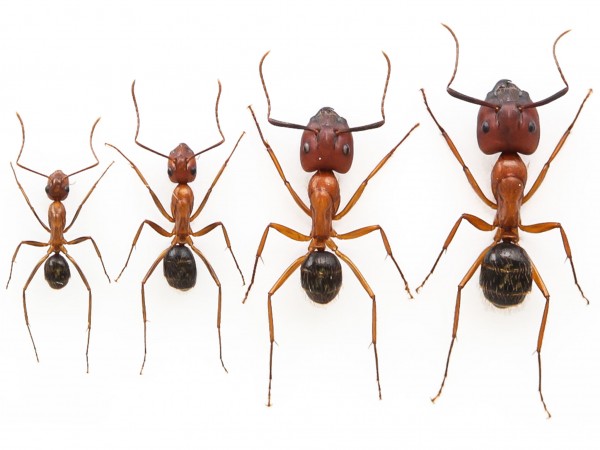
Researchers have changed the size of a handful of Florida ants by chemically modifying their DNA, rather than by changing its encoded information. The work is the latest advance from a field known as epigenetics and may help explain how the insects — despite their high degree of genetic similarity — grow into the different varieties of workers needed in a colony.
This discovery “takes the field leaps and bounds forward,” says entomologist Andrew Suarez of the University of Illinois, Urbana-Champaign, who wasn’t connected to the study. “It’s providing a better understanding of how genes interact with the environment to generate diversity.”
Ant nests have division of labor down pat. The queen spends her time pumping out eggs, and the workers, which are genetically similar sisters, perform all the other jobs necessary to keep the colony thriving, such as tending the young, gathering food, and excavating tunnels. Workers in many ant species specialize even further, forming so-called subcastes that look different and have different roles. In Florida carpenter ants (Camponotus floridanus), for example, workers tend to fall into two groups. Minor workers, which can be less than 6 mm long, rear the young and forage for food. Major workers, which can be almost twice as long, use their large jaws to protect the colony from predators.
A team from McGill University in Montreal, Canada, suspected that the mechanism involves DNA methylation: the addition of a chemical to DNA. Genome sequencing and other methods suggest that these physical differences don’t usually stem from genetic differences between individual ants. Instead, environmental factors help push workers to become majors or minors — specifically, the amount of food and coddling that young ants receive. But just how do these factors change the size of ants?
QotD: Power in sexual relationships
The reproductive instinct (sex instinct) and the nurturing instinct (caring for the brood) are social drives, as we have said, in contrast to the instinct of self-preservation, which focuses on one’s own person, while the two first-named, focusing on another person, make us dependent upon that person and vice versa. The reproductive instinct and the nurturing instinct, therefore, are the key to power and powerlessness.
Power consists in making oneself the goal of another person’s social instincts, without seeking to satisfy one’s own social instincts through him. The other then does everything one asks. Powerlessness consists in wanting or having to satisfy one’s social instincts through another person whose social instincts one has not succeeded in concentrating on oneself — one then does everything the other asks. According to whether one has made someone dependent upon oneself for the satisfaction of one or both instincts, one controls that person partially or wholly, has partial or absolute power over him. (We are referring to biologically determined power; psychologically conditioned power will be dealt with later on.)
To know which of two people has the upper hand, then, one merely needs to know which member of the couple is in a position to manipulate the sex or nurturing instinct of the other. The same is true for the relationship between groups, classes, races, religious communities, generations and clans. It is whichever has the leverage, the favorable starting point or whatever it takes to concentrate the other’s social instincts upon himself, while remaining emotionally uncommitted. Since the most important social instincts involve sex or nurturing the brood, sex and parentage are the basic areas in which the question of power arises. Real power over another person — paradoxical as it may sound — is held by protégés and sex objects only. There is also the kind of power that depends on force, or physical strength. Where there is superior force, I serve under constraint; where there is power, I serve willingly. An adult of my own sex, a social class, an alien race, a political body can at most force me to submit i.e. only by superior physical pressure. But real power is held by whomever I want or need to satisfy my basic social instincts, even if that person is incomparably weaker than I am — I would be bound to do willingly whatever he/she asks. To rule effectively, it is power we need; force is second rate by comparison and far from equally compelling.
Esther Vilar, The Polygamous Sex, 1976.
March 17, 2015
BAHFest East 2014 – Barbara Vreede: Alternative Medicine
Published on 9 Mar 2015
Dr. Barbara Vreede sheds light on the evolutionary mechanisms behind alternative medicine.
BAHFest is the Festival of Bad Ad Hoc Hypotheses, a celebration of well-researched, logically explained, and clearly wrong evolutionary theory.
March 16, 2015
Yes, men and women do have “conflicting strategies” in relationship-seeking
Amy Alkon responds to a recent Guardian piece lamenting men’s choices in (younger) women:
Evolutionary psychologists David Buss and David Schmitt theorized that men and women have “conflicting strategies” in seeking romantic partners, emerging from our differing physiologies and the ensuing differences in what sex can cost us.
Because a woman can get pregnant from a single sex act and be stuck with a kid to drag around and feed, women evolved to care a lot less about a man’s looks than his ability and willingness to be a “provider.” A veritable mountain of research suggests Buss and Schmitt’s theory is right.
For example, anthropologist John Marshall Townsend and psychologist Gary Levy showed women photos of an ugly guy in a Rolex and business attire and a handsome guy in a Burger King uniform. Women overwhelmingly went for the business lizard over the burger stud.
But back to the guys. Ancestral men could just walk away after sex and still pass on their genes. So men evolved to want to have sex with as many of the most healthy, fertile women they could. And what does health and fertility look like? Well, female beauty: Youth, clear skin, symmetrical features (reflecting health and no icky parasites); long, shiny hair; and a figure that’s more hourglass than beer vat.
The difference in what men and women prioritize in partners is best summed up by my friend Walter Moore. A guy complained to him that women are only attracted to wealthy men. Walter joked back, “That’s so unfair because we don’t expect them to be wealthy; all we ask is that they look like models.”
March 10, 2015
March 8, 2015
Every generation thinks they invented (non-vanilla) sex
Maggie McNeill can definitely confirm that your great-grandparents knew more about sex than you give them credit for:
Every generation thinks it invented sex, or at least non-vanilla sex. And I don’t just mean teenagers who are squicked out by the idea of their parents shagging, either; among vanilla folk and/or those outside the demimonde, the delusion seems to persist through life that nearly everybody who lived before a moving line (hovering like a will-o-the-wisp exactly at the year the believer reached puberty) only had missionary-position sex for the purpose of procreation. Even if the individual is familiar with the Kama Sutra, knows about classical Greek pederasty or has seen the menu of a Victorian brothel, these are likely to be dismissed as islands of kink in a vast sea of unsweetened vanilla custard stretching back into prehistory. Even doctors quoted in newspaper articles are wont to make incredibly stupid, totally wrong statements like “the concept of having oral sex is something that seems less obscure to you than it did to your parents or grandparents.” Well, my dears, I’m old enough to have given birth to many of you reading this, and I can assure you that oral sex was not remotely “obscure” to us in those long-ago and far-off days of the early ‘80s; nor was it “obscure” to any of the older men I trysted with in my late teens, many of whom are now old enough to be your grandfathers; nor was it “obscure” to my own grandparents’ generation, who came of age in the Roaring Twenties; nor to the 5.5% or more of the female population who worked as whores in every large city of the world in the 19th century, nor the 70% or more of the male population who had enjoyed their company at least once; nor to any of the long procession of harlots and clients stretching back to before busybodies invented the idea of policing other peoples’ sexuality. Know what else wasn’t “obscure” to them? Anal sex. BDSM. Role-playing. Exhibitionism & voyeurism. Homosexuality. Cuckolding. I could go on and on, but I think you get the idea. Here’s a hint: most lawmakers have always been pompous ignoramuses too obsessed with telling other people what to do to actually have normal lives, so by the time they get around to banning something it’s a pretty safe bet the majority of everybody else in that culture over the age of 16 already knows about it, and many of them are doing it.
Chief among the popular sex acts that modern mythology pretends were “obscure” is masturbation, at least for women. The common delusion is that because a culture didn’t like to talk about something, it must not have existed; accordingly, the idea has arisen that Victorian girls were somehow so carefully controlled that they never discovered that touching oneself between the legs (or riding rocking horses) feels good. And because many women have difficulty reaching orgasm without some form of masturbation, that must mean that pre-20th century women all went around in a perpetual state of sexual frustration. In the past few years, the ridiculous myth has arisen that Victorian doctors actually gave women orgasms without knowing what they were, and that the vibrator was invented to speed up what they viewed as an odious task.

March 5, 2015
In search of healthy eating
At Mother Jones, Kevin Drum talks about all the things we’ve been told about healthy eating … that just ain’t so:
For several years now I’ve been following the controversy over whether the dietary guidelines that have developed over the the past 70 years might be all wrong. And I’ve become tentatively convinced that, in fact, they are wrong. For most people — not all! — salt isn’t a big killer; cholesterol isn’t harmful; and red meat and saturated fat are perfectly OK. Healthy, even. Sugar, on the other hand, really needs to be watched.
Before I go on, a great big caveat: I’m not even an educated amateur on this subject. I’ve read a fair amount about it, but I’ve never dived into it systematically. And the plain truth is that firm proof is hard to come by when it comes to diet. It’s really, really hard to conduct the kinds of experiments that would give us concrete proof that one diet is better than another, and the studies that have been done almost all have defects of some kind.
Emphasis mine.
Randomized trials are the gold standard of dietary studies, but as I said above, they’re really, really hard to conduct properly. You have to find a stable population of people. You have to pick half of them randomly and get them to change their diets. You have to trust them to actually do it. You have to follow them for years, not months. Virtually no trial can ever truly meet this standard.
Nonetheless, as Carroll says, the randomized trials we do have suggest that red meat and saturated fat have little effect on cardiovascular health — and might actually have a positive effect on cancer outcomes.
At the same time, increased consumption of sugars and carbohydrates might be actively bad for us. At the very least they contribute to obesity and diabetes, and there’s some evidence that they aren’t so great for your heart either.
So where does this leave us? As Carroll says, the literature as a whole suggests that we simply don’t know. We’ve been convinced of a lot of things for a long time, and it’s turned out that a lot of what we believed was never really backed by solid evidence in the first place. So now the dietary ship is turning. Slowly, but it’s turning.
His primary take-away from all this: moderation is probably your safest bet, unless you have a condition that requires you to avoid certain foods or types of foods. Oh, and avoid over-indulging in packaged food that uses lots of preservatives. This is certainly one area where the science sure didn’t turn out to be settled, after all.
March 4, 2015
How many colours do you see?

On LinkedIn, Professor Diana Derval posted this image with an explanation why different people will see significantly different numbers of colours:
You see less than 20 color nuances: you are a dichromats, like dogs, which means you have 2 types of cones only. You are likely to wear black, beige, and blue. 25% of the population is dichromat.
You see between 20 and 32 color nuances: you are a trichromat, you have 3 types of cones (in the purple/blue, green and red area). You enjoy different colors as you can appreciate them. 50% of the population is trichromat.
You see between 33 and 39 colors: you are a tetrachromat, like bees, and have 4 types of cones (in the purple/blue, green, red plus yellow area). You are irritated by yellow, so this color will be nowhere to be found in your wardrobe. 25% of the population is tetrachromat.
You see more than 39 color nuances: come on, you are making up things! there are only 39 different colors in the test and probably only 35 are properly translated by your computer screen anyway 🙂
It is highly probable that people who have an additional 4th cone do not get tricked by blue/black or white/gold dresses, no matter the background light 😉
H/T to ESR for the link.


