
It’s hard to convey just how overwhelming spiritual life was in the late Middle Ages, but I’ll try. If you can find a copy for cheap (or have access to a university library), browse around a bit in Eamon Duffy’s The Stripping of the Altars. I can’t recommend it wholeheartedly, not least because I never managed to finish it myself — it’s dense. This is not because Duffy is a bad writer or meager scholar. He’s a titan in his field, and his prose is pretty engaging (as far as academic writing goes). It’s just that the world he describes is mind numbing.
Everything is bound by ritual. Hardly a day goes by without a formal religious ceremony happening — over and above daily mass, that is — and even when there isn’t, folk rituals fill the day. Communal life is almost entirely religious. Not just in the lay brotherhoods and sisterhoods that are literally everywhere — every settlement of any size has at least one — but in the sense that the Church, as a corporate entity, owns something like 30-50% of all the land. In a world where feudal obligations are very real, having a monastery in the vicinity shapes your entire life.
And the folk rituals! The cult of the saints, for instance — reformers, both Lutheran and Erasmian, deride it as crudely mechanical. There’s St. Apollonia for toothache (she had her teeth pulled out as part of her martyrdom); St. Anthony for skin rashes; St. Guinefort, who was a dog (no, really), and so on. The reformers called all of this gross superstition, and it takes a far more subtle theologian than me to say they’re wrong. But the point is, they were there — so much so that hardly any life activity didn’t have its little ritual, its own saint.
And yet, as suffused with religion as daily life was, the Church — the corporate entity — was unimaginably remote, and unfathomably corrupt. Your local point of contact with the edifice was of course your priest, who was usually a political appointee (second sons went into the Church), and, well … you know. They probably weren’t all as bad as Chaucer et al made them out to be (simply because I don’t think it’s humanly possible for all of them to be as bad as Chaucer et al made them out to be), but imagine having your immortal soul in the hands of a guy who’s part lawyer, part used car salesman, part hippy-dippy community college professor, and part SJW Twitter slacktivist (with extra corruption, but minus even the minimal work ethic).
Severian, “Reformation”, Founding Questions, 2022-03-07.
October 13, 2025
QotD: Christian observance in the late Middle Ages
October 12, 2025
Inventing boring Sundays – a British innovation
Ed West ruminates on the phenomenon of boring British Sundays and explains how they got that way:

Nietzsche thought that this was the whole idea, that the English designed Sundays that way in order to encourage people to appreciate the working week. In Beyond Good and Evil, he described how “The industrious races complain a great deal about having to tolerate idleness: it was a masterpiece of the English instinct to make Sunday so holy and so tedious, a form of cleverly invented and shrewdly introduced fasting, that the Englishman, without being aware of the fact, became eager again for weekdays and workdays.”
There may be some truth in this, so that before the Industrial Revolution there was the “Industriousness Revolution”, with a new emphasis on work rather than leisure. This is something which Joseph Henrich noted from studying reports from the Old Bailey between 1748 to 1803, and “spot-checks” observations about what Londoners were doing at a particular moment:
The data suggest that the workweek lengthened by 40 percent over the second half of the 18th century. This occurred as people stretched their working time by about 30 minutes per day, stopped taking “Saint Mondays” off (working every day except Sunday), and started working on some of the 46 holy days found on the annual calendar. The upshot was that by the start of the 19th century, people were working about 1,000 hours more per year, or about an extra 19 hours per week.
Before the Industriousness Revolution it was common for people to enjoy a number of saints’ days as holidays, including the three-day weekends offered by these “Saint Mondays”. That all changed with the arrival of Protestantism, with its scepticism towards saints’ days, William Tyndale arguing that these were only celebrated by convention and that there wasn’t anything special about them.
While they were keen to abolish holidays, the reformers also believed in making the Sabbath more godly, and so the Boring English Sunday was invented. This followed from a growing sense that leisure time was wasted time, but it was also the case that many of the Protestant reformers just didn’t like people having fun. In God is an Englishman, Bijan Omrani noted how “From the end of the 1500s, Puritan preachers condemned the way people generally spent their Sundays: ‘full heathenishly, in taverning, tippling, gaming, playing and beholding bear-baitings and stage-plays, to the utter dishonour of God'”.
Theologian William Perkins believed that Sunday “should be a day set apart for the worship of God and the increase in duties of religion”. Lincolnshire cleric John Cotton said in 1614 that it should be unlawful to pass Sunday without hearing at least two sermons; the idea of going to church twice would have filled my ten-year-old self with intense horror.
Hugh Latimer asked: “What doth the people do on these holidays? Do they give themselves to godliness, or else ungodliness … God seeth all the whole holidays to be spent miserably in drunkenness, in glossing, in strife, in envy, in dancing, dicing, idleness, and gluttony”.
Latimer also disliked holidays for quite modern-sounding reasons related to social inequality, noting that “in so many holidays rich and wealthy persons … flow in delicates, and men that live by their travail, poor men … lack necessary meat and drink for their wives and their children, and … they cannot labour upon the holidays, except they will be cited, and brought before our officials”.
The reverse argument is now made against allowing supermarkets to drop Sunday trading hours – that it pressures working people into excessive toil so that Waitrose shoppers don’t suffer any inconvenience. Although, reading Latimer, I can’t help but suspect that his real objection was to people having fun.
The reformers won, and English Sundays became notably dull. Banjani quoted children’s writer Alison Uttley, who said of Sundays that “Nobody ever read a newspaper or whistled a tune except hymns”.
October 10, 2025
Feeding the Papal Conclave
Tasting History with Max Miller
Published 6 May 2025Marinated baby back ribs served with a garlic and sapa sauce and roasted onions
City/Region: Italy
Time Period: 1570We actually know a fair bit about what was served at the 1549 papal conclave thanks to one of the first celebrity chefs, Bartolomeo Scappi, who was in charge of the food. In his incredible book, Opera dell’arte del cucinare, or Opera di Bartolomeo Scappi, he includes not only recipes that would have been served to the cardinals, but illustrations showing the many steps for preparing and transporting the food.
Dishes like these ribs would have been tested for poison, inspected for secret messages, put in special containers, and delivered via a sort of turntable.
A lot of hassle, but these ribs would be worth it. They’re so tender and the flavors of the rub and sauce are complex and delicious. It’s not as sweet as a modern barbecue sauce, but strikes a lovely balance between the sweetness of the sapa (reduced grape must) and the sharp and savory flavors of the vinegar, garlic, and coriander seeds. You could certainly make more sauce, but I think this amount is really nice.
Different ways to cook the back ribs of a domestic pig
If the pig is young, the ribs can be roasted on the spit with the rind, or without, and with onions split in the pan, which are cooked with the fat that drips from the meat as it cooks … and before it is put on the spit, it is sprinkled with salt and ground coriander seed. You could also let the ribs stand in a marinade of vinegar, grape must syrup, garlic cloves and coriander, and then cook it on the spit in the above way, serving it hot with a sauce on top made of the same seasoning …”
— Opera di Bartolomeo Scappi, 1570
October 1, 2025
“Sean Fraser, the current minister of justice and attorney general, has made two major mistakes of late”
If you’re at all interested in Canadian affairs, you should subscribe to The Line … even a free subscription will definitely provide you with some excellent non-propagandistic coverage of what is happening in the dysfunctional dominion. For instance, last weekend’s weekly post from the editors included this segment about Sean Fraser, who is perhaps the worst of Mark Carney’s cabinet (and that takes some doing):

Sean Fraser, as Minister of Immigration, Refugees & Citizenship, during day one of Collision 2023 at Enercare Centre in Toronto, Canada.
Photo by Vaughn Ridley via Wikimedia Commons
We at The Line contend that Sean Fraser, the current minister of justice and attorney general, has made two major mistakes of late.
The first was in deciding not to rescind his decision to spend more time with his friends and family when it became clear that Justin Trudeau was no longer an anchor on his electoral chances. After failing to fix Canada’s housing problem and proving himself integral to blowing apart a pan-partisan consensus on immigration that was once the envy of the world, the man had a real opportunity to leave office on a high note. But, no.
Instead, after hitching his bloated baggage to Mark Carney’s trunk, Fraser decided that Canada needed more of him.
And so, as justice minister, instead of addressing petty stuff like, oh, bail reform, or fixing prisons, or getting crime under control, he turned his attention to … Section 33 of the Charter of Rights and Freedoms. The notwithstanding clause.
You may recall that Quebec’s contentious Bill 21 — which prohibits public-service employees in positions of authority, and teachers, from wearing religious symbols while on the job — is currently before the Supreme Court of Canada. Despite numerous mixed rulings on the law, Quebec moved forward with its stance on secularism by invoking Section 33, which allows parliaments to temporarily override judicial rulings.
Section 33 was placed in the Charter for precisely this kind of situation; one in which the courts and parliament disagree about governance. As we still live in a democracy, and are still nominally governed by representatives we elect, the clause was always a bit of a compromise gesture intended to preserve parliamentary supremacy after granting the courts broad powers to basically reinterpret law according to an expansive and ever-expanding understanding of both their jurisdiction, and of the concept of “rights” writ large.
Section 33, nonetheless, has maintained a heavy odour about it, which has generally limited its application, especially outside Quebec. Among the Sean Fraser set, and the largely Liberal collection of lawyers who will insist that the Supreme Court isn’t remotely political, and how dare we entertain the thought, Section 33 was only ever intended as a symbolic right.
But as the definitely-not-political Supreme Court has edged ever deeper into the territory of override and governance, so too have provincial parliaments responded with a very not-symbolic application of the clause.
We do think there’s some blame to be placed at everyone’s door, here. But we also never really took much issue with Section 33. That’s because, at heart, we at The Line believe in, well, democracy. We believe that the people we elect should be able to decide our laws; and we believe that while the Supreme Court of Canada serves as an important check on Parliamentary power, that power doesn’t and should never override the will of the people.
And that’s basically where we part ways with Fraser and many of his — dare we say it? — Laurentian Consensus ilk. Because the unstated critique of the use of Section 33 is basically always the same: these people dislike the application of the clause because they think politics is icky, and that politicians fundamentally cannot be trusted.
In other words, these people don’t actually want a democracy.
They want a technocracy. One in which the smartest and ablest individuals (as defined by them, of course) are the ones who actually get to set the rules and guardrails for society writ large. One in which parliament really is as theatrical, symbolic and pointless as it often regards itself.
There’s an obvious illogical inconsistency here — Fraser and his colleagues are politicians. We aren’t sure if this desire to go out and limit the ability of he and his fellow parliamentarians to do the best jobs they can for the citizens reflects mere self-loathing, or a particular brand of Liberal blindspot, one that leads them to believe that they alone among politicians are exempt from anything as crass political considerations and/or motivations. Those moral failures are apparently for the other guys. But in any case, we have an elected official making the case that unelected courts should have the ability to override legislators, and that the legislators should have no recourse. However Fraser rationalizes this to himself, it’s where we are.
We think the people who have issues with Section 33 are generally not being honest with themselves in that regard; we also think that their instinctual aversion to politics (or their exemption of themselves from it) tends to make them naive. If you vest all the real power of governance in a “non-partisan” Supreme Court, what you’ll get is not a dispassionate government, but rather a heavily politicized Supreme Court. We need only look at what has happened in the U.S. over the past 30 years to see how that pans out in the long run.
Look, we at The Line don’t like Bill 21. It’s a bad law. It needlessly tramples on minority rights. But there’s a very obvious way to get that law repealed that doesn’t involve flirting with a full-blown constitutional crisis in the midst of, you know, all of the other crises going on right now.
Elect a government that will repeal that law.
That’s what democracies do.
To me, one of the most puzzling things about the Carney government’s recent actions is the overall incoherence of them. They are going ahead with one of the worst policies inherited from the Trudeau years with the “gun buyback” program that the minister responsible has openly admitted is almost completely a sop to voters in Quebec. Okay, that makes cynical sense as the Liberal vote is about as “efficient” as it possibly can be so losing just a few seats in Quebec would make it impossible for the Liberals to get re-elected. Fine. Scummy as hell, but fine. Yet the challenge to Section 33 is guaranteed to piss off far more Quebec voters — and stir up controversy across the country to boot — and you’re going to stage a pitched battle against pretty much all the provinces before the Supreme Court? Are you sure about that?
QotD: The Indian Mutiny of 1857
This is a near-perfect synecdoche for the Raj’s problems. British Army officers weren’t stupid — lots of them commented on the issue. But they were isolated. For one thing, lots of them weren’t regular army — they were attached to the East India Company army, a separate formation, and within the Company’s army were different formations with different service requirements. And the army — whichever army — was deeply isolated from the civilian administration. For one thing, India’s huge, and there were never more than about 200,000 British in the whole place. The army was mostly on the frontier; the Government hung around primarily in a few big cities: Bombay, Calcutta, the summer capital at Simla (way up in the Himalayas).
So stop me if this sounds familiar: The civilian administration didn’t really know anything about the group upon which their peace, their security, their very lives depended. Actively despised them, in fact — oh, those wogs and their silly customs. But also look at it from the bottom up: What could the civilian administration really have done, with the best will and deepest knowledge in the world? […]
What could the leadership really have done at that point? Send a select group of brahmins and imams to tour the grease factory? The rumor would be that the British set up a Potemkin factory just for them; the real factory was using cow and pig fat. Reissue the old rifle? Recall that they already changed their drill — a pretty big deal in any army; a huge deal in a mid-19th century one — and that just added to the paranoia. Anyone who has ever been on the Internet knows how these things work once they get started: Evidence of an evil conspiracy is evidence of an evil conspiracy, but no evidence of an evil conspiracy is even more evidence of an evil conspiracy!
The root cause of the Mutiny, in other words, wasn’t political or economic (despite what Karl Marx said). It wasn’t even “cultural” in a lot of senses, and you can tell by the actions of the mutineers — or, rather, the non-actions. They simply had no idea what to do. They had no leadership (though some of them tried to install one of the remaining Mughal rulers in Delhi as an expedient; there’s a great book about it). The “Mutiny” was really just generalized beefing and score-settling on a continent-wide scale. They all had grief with the British, of course, and that was a convenient rallying cry. Once the British were gone — and see above, there were never very many of them — the guys down south quickly realized they had nothing in common with the guys up north. Ditto the guys on the east coast, the west coast, the hill country, the jungles …
Again, stop me if this sounds familiar: Stuffing a bunch of alien groups together inside artificial boundaries under a capricious, purposefully out-of-touch “government” that obviously hates every single one of those alien groups more than each one of the groups hates all the others, is kind of a bad idea. With the exception, of course, of that capricious government’s goon squad, the one group they obviously favor because that group can be counted on to knock heads on all the other groups whenever the government lets them off the chain (I’m talking about the Sikhs, obviously).
It doesn’t matter, in other words, what the rifle cartridges were greased with, or if they were greased at all. In this historical timeline, the precipitating cause of the Sepoy Rebellion was “the Enfield Rifle”. In the next timeline over, it’s something else — something equally minor — but the rebellion still happens, at pretty much the same time and in pretty much the same way.
In other words: It’s not that the British were alien to their subjects. Most groups in most places have been ruled by aliens, and trust me, the brahmin caste is far, far more alien to the castes below it than the British were to all of them combined. Nor was it that the British were high-handed administrators, as incompetent as they were arrogant. They were actually pretty good administrators, all things considered — “government competence” is always one of life’s lower bars, but the Raj cleared it easily. The guys running the “princely states” that made up the majority of the “British” Raj were every bit as alien to “their” people as the British, and in general spectacularly incompetent too.
Severian, “The Ruling Caste”, Founding Questions, 2022-03-09.
September 23, 2025
QotD: “Bye, Phoenicia”
The long-distance trade of the Bronze Age had been dominated by large state actors. The ships were probably built and crewed by men from the Levantine coast, but the cargo was purchased and shipped by local representatives of the Great (and lesser) Powers of the age: luxury goods were an integral part of high-level diplomacy, so most trade was a virtual monopoly centrally directed from the palaces. When these polities were weakened (or in some dramatic cases like Ugarit completely destroyed) in the Collapse, they left behind a vacuum that independent Phoenician traders, operating without centralized control and serving only profit rather than the demands of empire, rapidly filled.
By the tenth century BC, the Phoenicians were importing silver from Spain, copper from Cyprus and Sardinia, and cinnamon from southeast Asia. They exported timber (the much-vaunted “Cedars of Lebanon”)1 and the valuable purple dye extracted from the murex sea snail, as well as a wide variety of finished luxury and quotidian goods they produced at home from raw materials obtained abroad. They founded colonies throughout the Mediterranean. And perhaps most importantly for the future of “the West”, they introduced the alphabet,2 which enabled the return of literacy to Greece and its far wider adoption than had ever been possible with Linear B.3
By the time the ascendant Neo-Assyrians began to encroach on their territory, the Phoenician city-states were so rich and economically well-connected that they were more valuable as semi-autonomous tributaries and middlemen than as conquered subjects. In fact, it was the Assyrian demands for metal (especially silver) that drove Phoenician colonization in the western Mediterranean: they founded Cadiz (Phoenician Gadir) to access the rich silver mines in the Spanish interior, as well as dozens of other smaller entrepôts along the sailing routes to and from the Levantine coast. Eventually they removed so much silver from Spanish mountains that its value in Assyria collapsed, inflated away by oversupply, just like Peruvian silver would destabilize the Spanish economy two thousand years later — but with the roles flipped. I enjoy these echoes.
It’s worth pointing out here that Phoenicians never called themselves Phoenicians: it’s a Greek word, deriving from a Mycenaean era (e.g., pre-Collapse) term for purple dye. In fact, they didn’t even have a term that clearly limned what the Greeks meant by “Phoenician” (essentially, “Levantine traders with really good ships who speak a related set of Semitic languages”). Instead, they sometimes referred to themselves more narrowly by reference to their native cities (Sidonian, Tyrian, Byblian, etc.) and other times more broadly as “Canaanite”, because of the cultural heritage they shared with the other survivors of Bronze Age Canaan. But even if they never employed it themselves, “Phoenician” is a terribly useful word, because these particular city-states had a lot in common with one another but diverged sharply from their Canaanite kin to both north and south.
Bronze Age Canaan had been relatively culturally homogenous, though the cities in the north came into the Hittites’ sphere of influence and those in the south the Egyptians’. After the Collapse, though, the city-states of northern Canaan (modern Syria), like their Neo-Hittite neighbors, seem to have continued more or less as they had been. Those in southern Canaan were not so lucky: weakened by the invading Sea Peoples and the withdrawal of Egyptian hegemony, the southern Canaanites were displaced by (or assimilated to) the new Semitic kingdoms in the region, including Israel, Judah, Edom, and Ammon. And the central Canaanites became the Phoenicians: master sailors and traders, they had seized their opportunity and so thoroughly transformed themselves that we join the Greeks in identifying them by a new name.
Most of the larger cities of the central Levant are buried beneath their modern equivalents, and Lebanon has not been a particularly salubrious place to excavate for the last few decades, so it’s hard to say a great deal about Phoenician continuity with their Bronze Age ancestors. There was obviously some, certainly genealogically but also linguistically and in terms of material culture. However, we also know that their lifestyles changed dramatically as their economic reach expanded and their cities became centers not only of exchange but of manufacturing. We know their commercial firms were organized around extended families, and that they began to settle foreign lands both as colonists in their own new cities and elsewhere as resident merchants with their own dedicated enclaves. And we know that as their city-states grew more powerful, they increasingly directed worship away from the traditional Canaanite pantheon, led by El, and towards the tutelary deity of each individual city. (The story that King Hiram of Tyre actually tore down the temples of El and Baal to make room for a magnificent new temple of his patron, Melqart,4 is probably an exaggeration, but points to the scale of the break with the past.)5
Jane Psmith, “REVIEW: After 1177 B.C., by Eric H. Cline”, Mr. and Mrs. Psmith’s Bookshelf, 2024-07-08.
- For a very funny story about an Iron Age Egyptian attempt to buy some, which I simply could not fit into this review, see the “Story of Wenamun“. Bonus points for imagining how it would have played out under the New Kingdom.
- Okay, the Phoenician “alphabet” is actually an abjad — it contains no symbols for vowels — but the Greeks quickly added those.
- It is much, much easier to learn to write with an alphabet than with a logosyllabic system like Linear B or cuneiform.
- Melqart is also the patron of the Tyrian colony of Carthage, and his name contributes one element to that of Hamilcar Barca. The –bal in Hannibal, Hasdrubal, etc., is of course from Baal.
- Cline doesn’t give a ton of detail on Phoenician culture; in this section I am also drawing heavily on the opening chapter of Richard Miles’s Carthage Must Be Destroyed: The Rise and Fall of an Ancient Civilization, which sentiment I fully endorse even though I haven’t finished the book yet.
September 21, 2025
From Eat Pray Love to plotting a murder
On Substack, Elizabeth Nickson charts the career of Elizabeth Gilbert who wrote Eat Pray Love and more recently a memoir of her life up to the point where she planned to murder her “once in a million year” partner:

Gilbert, you certainly know, wrote Eat Pray Love which was a massive international bestseller made into a film with Julia Roberts, which was also very successful. During the Pray portion, Gilbert retreated to an ashram in India to worship a living sub-deity called The Mother. At the time I was still tangentially aware of life in the world of moderately successful upscale arty women from the mega-cities and I’d heard of the Mother and her clinging clanging worship sessions — Siddha Yoga — going round the Pilates and yoga studios and the upscale self-help programs. The Mother’s satsangs were guaranteed to put you into an ecstatic state where you fused with the divine. And then you’d heal. From the abuse of the Patriarchy.
During the Pray section, Gilbert had a series of intense moments, which &mddash; coupled with an earlier session on the bathroom floor where God told her to wash her face and go to bed — meant, to her, a great deal. Her “God” gave her direction and purpose, where before she was caught in an unhappy marriage, being apparently the breadwinner in that marriage with a husband who a) didn’t work, b) wanted her to buy more and more stuff and c) have a child.
This seems a poor choice for a husband, but never mind. Gilbert was successful in the New York world of publishing and magazines and much occupied with that pursuit, a business which I now suspect is financed by the drug trade and used to launder money. In that world where success is one in ten thousand, one hundred thousand, and where Gilbert experienced perhaps the biggest literary success of her generation. She became universally, ridiculously, excessively loved.
And embrace it she did. For the past 15 years, Gilbert has traveled the world, usually with a woman companion to keep her on the rails, dishing out nostrums and platitudes with relish meant to show you how to “find yourself” and “live your truth” to women searching for purpose. “Creativity” or “art” is now substituted for what women in the before times used to call service to their communities and families, which is now called slavery to the patriarchy.
The following is the progression of “evolving” for modern left-of-center women, for whom finding a meaningful work is the number one priority, children being the last, as the below illustrates.
When the recognition of slim to no talent or at least un-sellable talent, is made and a future of grinding for multinationals is revealed, and spiritual enlightenment or Kundalini awakening seems out of reach, the desperation moves onto Democrat politics, and ends in middle-aged and elderly woman on the streets, face contorted in rage. Those women, a full 40% of whom are childless and family-less, spend their lives slogging away in some corporate or health or educational structure, becoming semi-insane. As an aside note, in my years-long investigation of voter fraud, many of the operators are women just like these below: middle-aged, put together, well dressed, polite, fully criminal.
In searching for your creativity — the highest good — you have to become fully aligned with your child self, your spiritual self, and that self becomes the most cherished part of you. Your intelligence, your executive function is demoted. Your creativity, your spirituality, then becomes fused to others whom you perceive being as weak as that child self you have elevated as spiritually superior. Women, it seems hardwired, must have people to care about. In the absence of family, it is the helpless to whom you assign your life.
Gilbert’s once-in-a-million-years love was a gay Syrian immigrant hairdresser with a history of heroin addiction and incarceration. No more victimish victim can be found.
For Gilbert’s millions of acolytes, spiritual worth, meaning,creative power is found in allyship with the weak, with whom they fully identify. And meaning is also found in hysterical advocacy and fury on behalf of the weak. There is no thinking attached to any of this, no analysis, no study. Just intense emotionality.


September 11, 2025
The Archbishop of York misunderstands a recent child poverty report
Tim Worstall knows that it’s unrealistic to expect a prelate of the Church of England to believe in anything, but in this case His Grace Stephen Cottrell, the Most Reverend and Right Honourable Archbishop of York appears to believe that child poverty in Britain is a very serious problem:

His Grace Stephen Cottrell, Archbishop of York since July, 2020.
Photo 2014 via Wikipedia Commons.
So we’ve the Archbishop of York here telling us all how it should be. Of course, given that that prelacy is Church of England he doesn’t actually believe anything, of course not. But he does roll out what he considers to be facts. Which, sadly, are not.
With all children across the UK back in school as of this week, I am reminded that almost one in three are in poverty. That statistic is shocking enough – but behind every number is a child, and what this statistic means is children arriving at school hungry, living in insecure housing, and missing out on the activities that help them thrive.
Well, no. His near one in three comes from this JRF report. Which is not measuring poverty at all. It’s measuring inequality — the number of people living in a household on less than 60% of median household income. Which is not, in fact, poverty.
No, think on it. If we doubled the — real — income of everyone in the country then clearly we’d have less poverty. But by this measure, the one of inequality of incomes, the number in poverty would change by not one single person nor child. Equally, if we halved everyone’s incomes — real incomes that it — there would be a lot more poverty. But by this measure there would be no change at all.
There’s also this:
I visited a school in the north-east of England a couple of years ago where many of the pupils turned up with empty lunchboxes. There was a breakfast club that fed them on arrival. They were eligible for free school meals, so got a hot lunch. After school, trestle tables were set up in the playground laden with food donated from the local food bank. As they went home, they filled up their lunchboxes so that they could have some tea.
I have rarely been so shocked. This is the reality of child poverty.
Kids are packed to the gunwales with food and this is a sign of poverty? Eh? Sure, sure, I know consubstantiation is pretty heady stuff but really, a little contact with reality please? Kids get two full meals and tuck to take home. This is all free. So, logically, their parents send them to school with empty tuck boxes so that they get two free meals and stuff to take home. I mean, free stuff, who wouldn’t?
Who goes to the pub to pay £7 a pint when booze is flowing free from the town fountain?
Update, 12 September: Welcome, Instapundit readers! Please do have a look around at some of my other posts you may find of interest. I send out a daily summary of posts here through my Substack – https://substack.com/@nicholasrusson that you can subscribe to if you’d like to be informed of new posts in the future.
September 1, 2025
How did the Egyptians forget Hieroglyphs?
toldinstone
Published 25 Apr 2025Chapters:
0:00 Introduction
0:53 Introducing hieroglyphs
2:15 Hieroglyphs in Roman Egypt
3:10 The great temples
3:53 Decline of the temples
5:04 FlexiSpot
6:28 Vanishing hieroglyphs
7:40 Roman ignorance of hieroglyphs
8:44 Hieroglyphica
9:28 Mysterious or powerless
August 19, 2025
Roman Hellenism
In his post “A Pagan Confession“, Fortissax provides an explanation of Roman Hellenism, the most widespread religious system in Europe before Christianity:
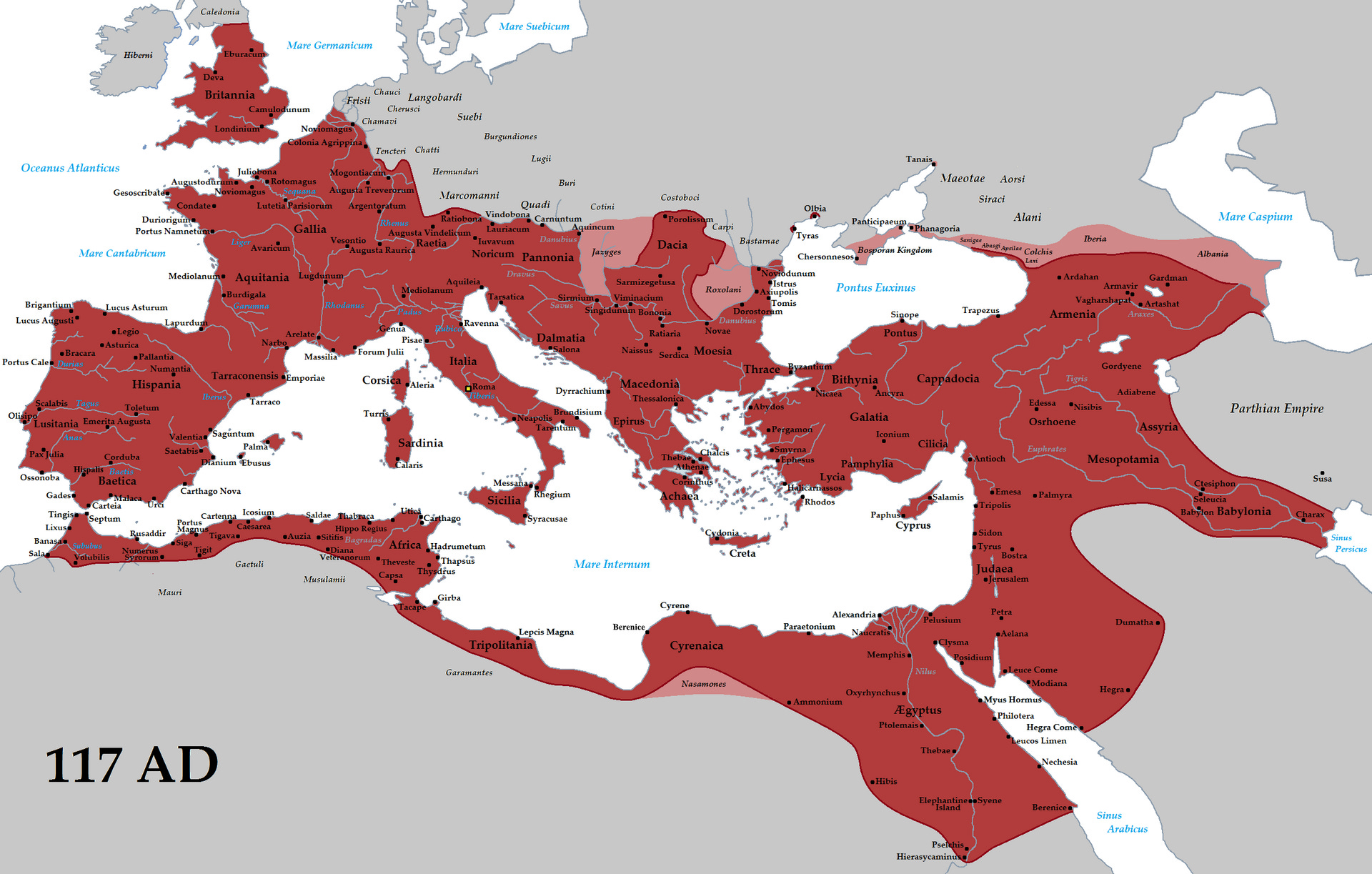
The Roman Empire at its maximum extent
The closest term that would describe me is “Roman Hellenist”.
Roman Hellenism was the largest religion in the Western world prior to the rise of Christianity. It was followed from Britain to Greece, from Spain to Romania, and was the first civilization-wide faith for Europeans.
At its height under the Roman Empire, Hellenism was a vast and adaptable religious tradition that united Greek mythology, Roman state religion and cults, household rites, and philosophical schools into a coherent spiritual world. As the organized state religion, the Dii Consentes were worshipped in every corner of the empire under both Latin and Greek names. Jupiter, Mars, Venus, Apollo, Minerva, and others were honoured through public festivals, imperial temples, military devotions, and local folk religion. This civic devotion was shaped by writers such as Cicero, Livy, and Plutarch, who emphasized the importance of piety, order, and divine ancestry.
Hellenism offered more than just myth or folklore. It provided a structured understanding of the cosmos, where the gods represented natural and moral forces, and where religion was interwoven with daily life, civic duty, and personal virtue. Mystery cults such as those of Dionysus and the Eleusinian rites offered deeper initiatory experiences, described by authors like Herodotus and Euripides. Philosophers such as Plato, Plotinus, Porphyry, Iamblichus, Proclus, Damascius, and Hierocles were considered divinely inspired and were often trained by the augurs, or in the College of Pontiffs, established in 400 B.C., and the inspiration for the College of Cardinals. These were priests within the state religion.
They built the theology of the faith. These philosophers were not monotheists or atheists, but pagans, and their theology came from Hellenism. Ordinary people prayed, sacrificed, and kept sacred fires at home. This marks the distinction between the folk religion of the everyman and the theological work of the priestly and philosophical elite, though they formed a whole, similar to Christian folk religion compared to the sophistication of the clergy. Hellenism in the Roman world was participation in a divine order that shaped identity, politics, culture, and destiny.
It had a core, but it was a dynamic tapestry. It often accommodated or incorporated local and regional gods of subject peoples throughout the empire, including other Europeans. It was normal to find shrines or temples dedicated to syncretic deities where Roman and provincial traditions were blended. This reflected a deeper truth shared by many Indo-European peoples. Across vast distances, from the Celts and Germans to the Greeks and Romans, there was a common spiritual grammar. Their gods often held similar roles, attributes, and origins. Rather than destroy or suppress local belief, Roman Hellenism often absorbed and integrated it within a universal metaphysical framework, though one without too strict of a dogma, which allowed spiritual continuity across cultures.
The Romans referred to this process as interpretatio graeca, the identification of foreign gods with Greek ones, and interpretatio romana, the application of Roman names and attributes. In Gaul and Germania, local deities such as Lugh or Wodan were equated with Hermes or Mercury. Camulos and Tyr equated with Mars, Taranis with Jupiter through interpretatio gallica and interpretatio germanica.
These interpretive traditions allowed theological bridges across linguistic and ethnic boundaries, fostering religious continuity and civic unity. Writers like Varro, Tacitus, and Strabo observed this continuity, noting that while names and symbols differed, the gods themselves were one in essence. This interpretive unity was ritualized practically in temple, altar, hymn, and law.
This faith, was shaped by the Iliad and the Aeneid, the rituals of Rome and the hymns of Orpheus, the Chaldean Oracles, the laws of the Twelve Tables and the meditations of Aurelius. It spoke through the Sibyl and the Stoic, the philosopher and the priest, the hearth and the polis. It is the soul of the West in its first religious form, a religion of cosmic order, virtue, memory, and return. Its path leads from the One to the many, and back again through sacrifice, contemplation, and union.
To be a Hellenist, in this fuller sense, is to honour the gods as real beings and divine intelligences who participate in the life of the soul and the order of the cosmos. It is to seek harmony with this order through philosophy, ritual, moral striving, and ancestral memory. It is a way of life, rooted in reason and reverence.
August 15, 2025
QotD: American Puritanism
H.L. Mencken, “Puritanism As a Literary Force”, A Book of Prefaces, 1917.
August 2, 2025
QotD: The path to salvation
The following is not a theological argument, it’s an observation about human nature: Both faith and works are necessary, because by their fruits ye shall know them. If one has faith, then the works will follow — naturally, as it were. But works without faith are mere mumbo-jumbo, no different than the crudest magic spell. The kind of guy who does what David French does — performs the works solely to be seen performing the works — is what Jesus called a “whited sepulcher”, which indeed appear beautiful outward, but are within full of dead men’s bones, and of all uncleanness.
Again, you don’t have to be a Biblical scholar to observe that Jesus commanded what the parlance our times calls “tough love”. Just as you can’t save a sinner by taking away all his opportunities to sin — we are ALL guilty; we are ALL fallen; that alone is sufficient to damn us — so you can’t “save” a drunk, or an illegal alien, or a criminal, or whatever by enabling his lifestyle. The reason I’m not in church today is because the church is exactly like that gaggle of Karens in Starbucks — they talk a good game about renouncing the wiles of this world, but they bend over backwards to enable every possible social dysfunction.
No, Jesus did NOT command us to patch up the gutter addict every time he OD’s, so that he can go out and OD again. He did NOT command us to provide all kinds of food and shelter and medical care to every Squatemalan who broke the very first American law he had the opportunity to break by coming here. No, He did NOT command us to tolerate deviance — there are two clauses in “love the sinner, hate the sin”, and we must obey both.
The only route to salvation starts by admitting that everyone is fallen. You can take that in whatever sense you like, because it’s not theology, it’s just an obvious fact about human nature. Alas, it’s one you have to learn by age 12, or you’ll never learn it at all. That’s the greatest trick the Devil ever pulled.
Severian, “On Being Bad”, Founding Questions, 2021-12-12.
July 27, 2025
I’m sure I would never have heard of Sean Feucht until they tried to silence him
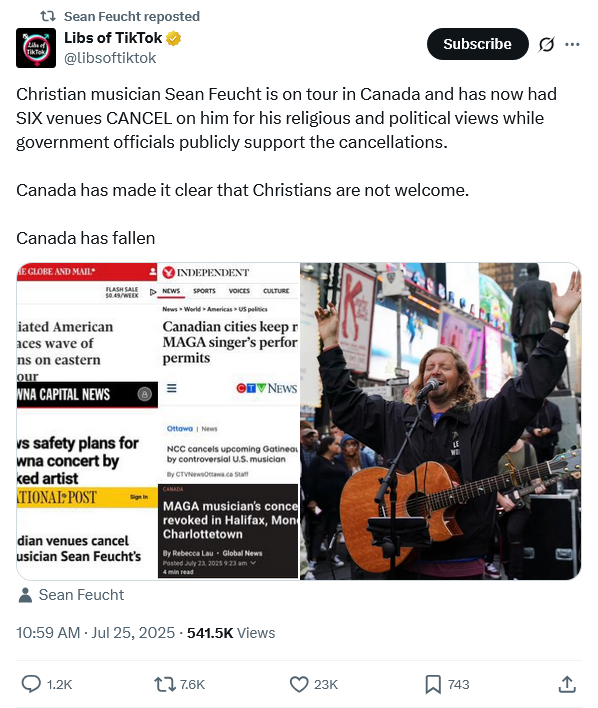
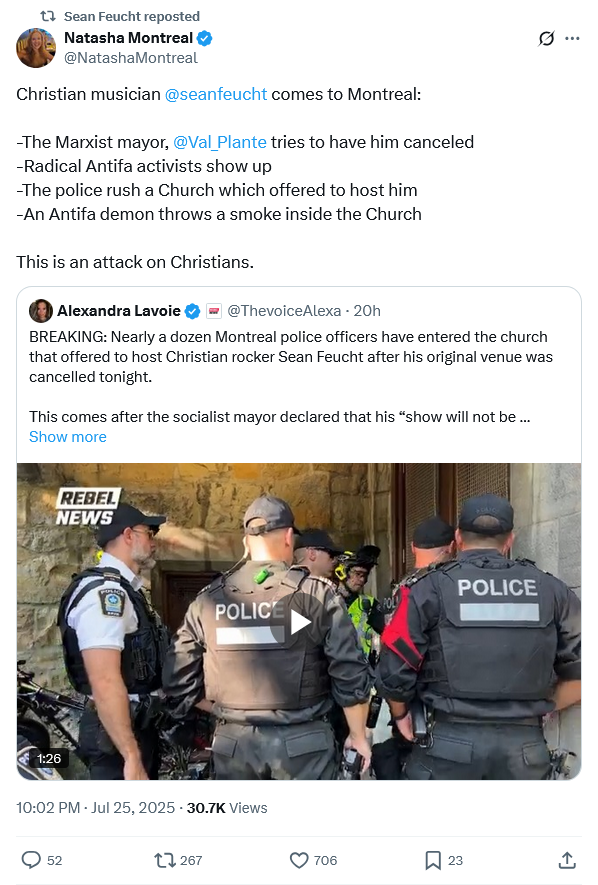
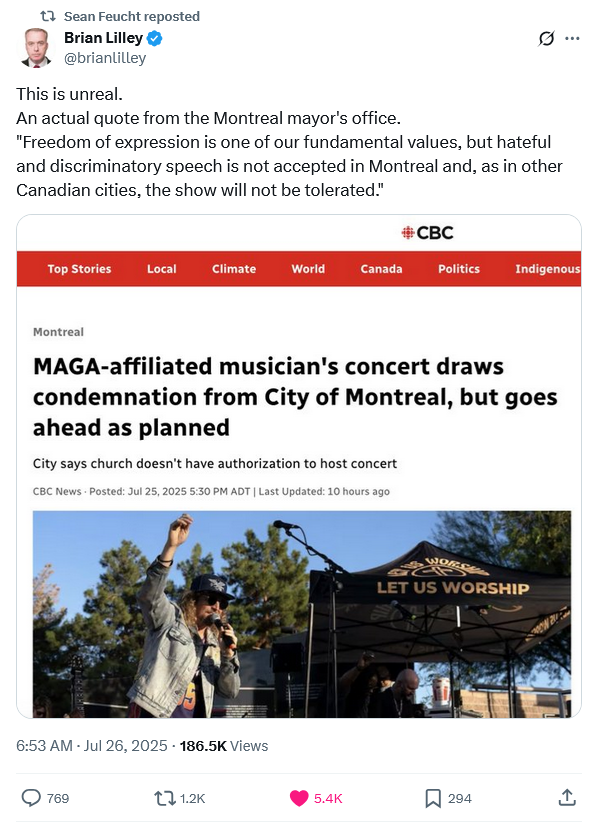
It’s hard to believe how Canadian municipal and provincial authorities deal so gently with disruptive pro-Hamas protests that regularly threaten the lives and property of Canadian Jews compared with the positively authoritarian way they are reacting to “MAGA” Christian performer Sean Feucht‘s concerts:
July 24, 2025
When tolerance becomes a fatal flaw
At The Crescent and the Guillotine, Paul Friesen explains why too much tolerance leads to the eventual collapse of social order and perhaps even the culture itself:

It is difficult to know what people are thinking when they endorse the importation of people who want to kill them for their lifestyle choices.
It was Karl Popper who warned that a tolerant society must be intolerant of intolerance, or it would cease to be tolerant at all.1 A delicious paradox, too often quoted and too rarely heeded. For we have taken the first half of the dictum — the imperative to tolerate — and chiseled it into law, into policy, into university mission statements and NGO pamphlets. But the second half — the requirement to draw a line, to say “no further” — has been treated like garlic in a vampire movie: an antique, anathema, unfashionable.
And so, the paradox has become pathology.
Our courts allow sharia arbitration councils to function in British cities, adjudicating matters of family and inheritance with standards that would make a 12th-century canon lawyer flinch. Our schools include faith-based curricula that require hijabs for seven-year-olds and teach that homosexuality is satanic filth. Our public broadcasters will air a documentary about the importance of free speech, followed immediately by a segment about why cartoons of Muhammad are “unhelpful”.
This is not multiculturalism. It is masochism. It is the belief that liberalism must be so open-minded that its own brains are spilled onto the prayer mat. It is the fetishization of identity at the expense of liberty. It is the ideological pacifism of a society too terrified to assert its own values, lest it be accused of “racism” by those who mistake ideology for ethnicity.
We have enshrined the rights of the theocrat while criminalizing the instincts of the secularist. The result is not harmony — it is humiliation.
[…]
The West’s greatest achievement is not democracy, nor capitalism, nor even the separation of powers. It is the separation of truth from tribalism — the idea that individuals are not to be judged by their creeds, but by their conduct. That women are not property. That speech is not violence. That blasphemy is a right, not a crime.
These are not Western values. They are universal values, discovered in the West by accident of history and preserved through blood, rebellion, and satire. They are the principles that allowed Jews, heretics, atheists, and apostates to live not just safely, but freely. And they are now under threat — from within.
The real problem is not Islam. It is the Western inability to demand anything of those who import their gods and their grievances into liberal society. We treat every imported superstition as sacrosanct and every local tradition as suspect. We require ex-Muslims to whisper their fears while we amplify the complaints of veiled Islamists who denounce our culture from our own podiums.
We are not being pluralistic. We are being duped.
And the cost of this self-deception is measured not just in freedoms surrendered, but in lives lost.
Lives like that of Yameen Rasheed, the secular Maldivian blogger who thought he could use satire to push back against theocracy — stabbed to death in his own hallway. Lives like that of Farkhunda Malikzada, beaten and burned in the streets of Kabul by a mob of men — because someone thought she burned a Qur’an. Lives like that of Samuel Paty, beheaded outside a French school by a refugee he welcomed — because he dared to show a cartoon in a civics class.
These are not random tragedies. They are the predictable outcomes of an ideological toxin given immunity in the bloodstream of liberal society.
What do all these victims have in common? They did not die at the hands of misunderstood minorities or “oppressed voices” who simply needed better integration programs. They died at the hands of men who were indoctrinated — sometimes abroad, often at home — with the idea that God’s honor is more valuable than human life, and that dissent is not to be debated but extinguished.
And more damning still: they died in environments that should have protected them. Environments that instead prioritized sensitivity over security, dialogue over clarity, understanding over justice. Environments where the ever-watchful eye of diversity officers and DEI consultants was trained, not on the assailants, but on the tone of the victims.
We have created a culture where courage is pathologized, clarity is punished, and moral equivalence is the new orthodoxy. When Islamist mobs swarm the streets chanting slogans that would make the Inquisition blush, we are told to “listen to their anger”. When feminists protest the veiling of children, they are told to “respect cultural differences”. When Jews complain about chants of “From the River to the Sea”, they are informed that they are “overreacting”, “weaponizing trauma”, or — most insultingly of all — “confusing Zionism with antisemitism”.
This is not inclusivity. It is assisted suicide.
1. I refer here to Karl Popper’s 1945 work The Open Society and Its Enemies, specifically in Volume 1: The Spell of Plato, Note 4 to Chapter 7. Here’s the relevant passage, paraphrased for clarity:
“Unlimited tolerance must lead to the disappearance of tolerance. If we extend unlimited tolerance even to those who are intolerant … then the tolerant will be destroyed, and tolerance with them.”
Popper argues that a tolerant society has the right — not to suppress opinions — but to defend itself against those who would destroy tolerance itself, especially if such groups refuse to engage in rational discourse and instead promote violence or coercion. It’s often called “the paradox of tolerance“.
July 18, 2025
QotD: Christianity destroyed the ancient Graeco-Roman culture
Consider celibacy: Fustel de Coulanges examines several ancient legal codes and finds that in all of them the deliberate refusal to procreate was a crime that carried severe punishments. This makes total sense in light of all you’ve said — a man does not belong to himself, he belongs to his family, a diachronic (or transtemporal?) entity that lives in and through and above individuals. Deliberate celibacy would be like your hand or your kidney refusing to perform its assigned function and trying to murder you instead. Cancer, in other words. And the solution to cancer is to cut it out and destroy it.
Now imagine a religion praising cancer and vaunting the tumor as the highest form of biological life, and maybe we can feel a sliver of the horror that the ancients must have felt towards Christianity. And it wasn’t just celibacy either — in area after area Christianity emancipated individuals from the dense, ancient web of obligations, loyalties, and client-patron relationships. Loyalty to the city and loyalty to the family were both such incomparably important qualities for the ancients that Sophocles got several tragedies out of the collisions when they came into conflict, but Christianity in its most radical form says that both are ephemeral and contingent, and must be subordinated to a higher loyalty — fidelity to the Truth. To the ancients I bet this didn’t just seem like antisocial behavior, I bet it seemed like the apocalypse. No wonder there were so many martyrs. No wonder so many of them were martyred by their closest relations.
I’m almost tempted to say that that old snake Gibbon was right, it was Christianity that destroyed the Roman Empire, destroyed the entire ancient Mediterranean civilization that had lasted for a millennium or more, first bit-by-bit then all at once. But of course that isn’t quite right either. By the time Pentecost occurred, the dissolution was already well underway. Christianity massively accelerated a process that was inexorable by then, and changed the shape of what was to come after it, but the collapse was baked in.
Read any of the Roman authors from either shortly before or shortly after the Lord’s birth — Virgil, Cicero, Pliny, Suetonius — all of them, in one way or another, are obsessed with the unraveling of the matrix of tribal and familial relationships that Fustel de Coulanges describes. There were a lot of reasons for it, including but not limited to: mass migration to the cities, economic rationalization that replaced freehold farming with massive latifundia (plantations), and just the accumulated stresses from centuries of continuous warfare and expansion. The cumulative effect of all this was that a society formerly governed by ritual, familial and civic piety, tribe, and clan was transformed into an ocean of atomized and deracinated individuals engaging in mass politics.1
One of my favorite passages in Gibbon’s Decline and Fall2 is in the intro to the chapter on Alaric’s invasion of Italy. Gibbon contrasts this with Hannibal’s invasion 700 years earlier, and goes on this beautiful riff about how on paper, the Rome of the 5th century AD looks incomparably stronger than that of the 3rd century BC — it had a massively larger population, greater wealth, a greater technological edge over its opponents, etc. And yet when it came to a responsibility as basic as that of defense against a foreign invasion, all the GDP and technology in the world wasn’t able to make up for a lack of asabiyyah. When Hannibal annihilated the legions at the Battle of Cannae, something like 20% of the entire adult male population of Rome was killed, including most of her military and political leadership, to which the Romans simply gritted their teeth and raised a few more armies. The descendants of those heroes, despite having a vastly larger population to draw from, weren’t able to muster a single legion or a single capable commander, and surrendered their city to the Visigoths almost without a fight.
Rome was a rocket that soared into the sky and then came crashing back down, and it’s easiest to see it right at the apogee, the point midway between the first and the last great invasions of Italy. The first century glory days of Rome, the time that we moderns consider the height of her power, were actually a moment of deep institutional and social decay. Like an exothermic reaction — a bonfire or an explosion or a fireworks display — what we notice immediately is the ebullient, magnificent blaze. But it’s easier to miss all the fuel that’s being consumed: solidarity, economic resilience, social technology, all of it woven through with the tight bands of ancient law and custom that Fustel de Coulanges documents. Just as the Greek philosophy we love was an uncharacteristic flash in the pan, an evanescent moment that subverted and destroyed the culture that had given rise to it; so too the Roman imperial achievement was an engine fueled by a society and a citizen-soldiery that it quickly burned to cinders.
I wonder if every civilizational golden age would turn out to have this unsustainable character if you inspected it closely. If so it would explain a historical mystery, which is why these epochs are rare, and why they never last long. From this angle history looks a bit like a 2-stage cyclic phenomenon wherein the long “dark ages” are actually epochs of patient stewardship of economic, cultural, and demographic resources, whilst the short “golden ages” are a kind of manic civilizational fire sale of the accumulated inheritance. Maybe we need a new historiography founded on the idea that what we have heretofore considered dark ages are the true golden ages, and vice versa. This transvaluation of values would be like a temporal version of James Scott’s attempted reversal of civilization and barbarism.
Alas, while peasants could vote with their feet and migrate across the imperial frontier, our options for time travel are a bit more limited. Would we prefer to live in the cozy but constricting deep prehistory of a civilization, or in the wild glory of its last days? No doubt it would depend a lot on who we imagine being in each of these phases, but at the end of the day it doesn’t matter, because we don’t have a choice. May as well sit back and enjoy watching the blaze. It will be beautiful and exhilarating while it lasts.
Jane and John Psmith, “JOINT REVIEW: The Ancient City, by Numa Denis Fustel de Coulanges”, Mr. and Mrs. Psmith’s Bookshelf, 2023-02-20.
1. If this sounds familiar, it should. Whenever I read about first century Rome I always come away with a weirdly twentieth century vibe.
2. Yes, I’ve read the whole thing cover-to-cover. What? Why are you looking at me like that? There was a pandemic happening, okay?


