
H/T to “JtMc” for the link.
March 10, 2011
March 7, 2011
Bullet train sports big nose to cure big noise
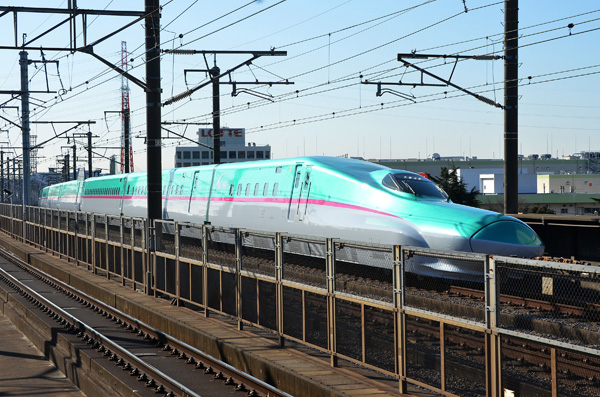
It looks rather odd, but there’s method to its ugliness:
The nose of the E5 Series, at 15 metres, is a massive 9 metres longer than the previous incarnation of the bullet train (shinkansen), the E2 Series. This, according to its designers at JR East, will help eliminate the phenomena of “tunnel boom”.
Japan’s rail tunnels are somewhat narrower than their European counterparts, so when the shinkansen enters a tunnel at speeds above 200 kilometres per hour, the sudden increase in air pressure can cause a loud “boom” at the other end of the tunnel. In some cases, such shock waves are thought to have damaged tunnels in Japan, ripping chunks of material from tunnel ceilings.
The shape of the front car has evolved gradually to combat this danger, and the striking “Long Nose” design of the E5 Series is the result.
Comments Off on Bullet train sports big nose to cure big noise
February 26, 2011
The increasing length of freight trains in Canada
Some eye-opening statistics on the length of freight trains being run by Canadian National (CN) and Canadian Pacific (CP) these days:
Transport Canada launched a six-part study into the long-train strategies at the country’s largest railways this month with an eye on developing policies for how these longer, heavier trains are assembled and run. The goal of the two-year study is to develop science-based regulations that will hopefully reduce the number of derailments in the country.
Despite the concern from regulators, these longer, heavier trains in recent years have been a godsend for North American railways, which swear by their safety. Not only do they improve the efficiency of the rails by reducing the number of trains required to transport goods, but they in turn reduce the crews needed and the fuel used to move their shipments.
If properly built, they can also reduce wear and tear on the trains and the tracks themselves by cutting down on in-train forces, lowering maintenance costs substantially over time.
The cynic in my asks why, if CN (for example) actually managed to reduce the number of rail accidents to an all-time low last year, the regulators are now launching the investigation. Fewer accidents now equals a point of serious concern on the part of the regulators? Why?
Up until the 1990s, the average freight train in Canada was about 5,000 feet (1.54 kilometres) long and weighed 7,000 tons. But it is now not uncommon to see these trains stretch to 12,000 feet, sometimes as much as 14,000 feet (more than four kilometres), weighing up to 18,000 tons.
While CN is comfortable sticking with the size of its longest trains now, about 12,000 feet, CP continues to push the boundaries of how long it can build its trains by developing some of the industry’s most cutting-edge technology in recent years to help it do so.
The benefits are clear. CP estimates, for example, that the labour costs alone on a typical transcontinental train are now 30% lower than they would be if it was using smaller trains.
So, the trains are longer, carry far more freight, cost less to run, and customers are happy. The government must act!
Comments Off on The increasing length of freight trains in Canada
Views of a future that didn’t arrive
The Future That Wasn’t: Failure to Perceive Hidden Costs and Risks
Two other entangled obstacles to technological inevitability must also be considered: unappreciated psychosocial reservations and genuine, but unappreciated hazards that either slow, or virtually inhibit the adoption of what would otherwise be hugely transforming technological advances.
As a child, I was told about what my future would be like and how much better it would be in almost every way, technologically, from the world I then inhabited. I was, literally, a child of the atomic age, and the molecules in the DNA of my brain still bear the 14Carbon isotope signature of the open-air nuclear testing era, just as surely as my bones, made radioactive in my infancy and childhood by the Strontium 90 (90Sr) in the milk I drank are still, ever so slightly, more radioactive today, than are those of people born before, or after, the era of atmospheric nuclear weapons testing.
But beyond these physical stigmata of the atomic age, my mind bears the stigmata of a world promised, but never delivered. Scientists and laymen alike were quick to understand the truly staggering potential benefits of what we now call nuclear power. Countless pronouncements were made that the arrival of an era of cheap, clean, safe, and virtually unlimited electric power was at hand. Electricity generated by ‘atomic power’ and nuclear fusion, we were told, would be so inexpensive to produce that it would not even be worth the expense of metering its use to bill the customer for. People would simply play a flat rate for the service, as is the case for long distance or computer telephony today. In a speech given by Lewis L. Strauss (1896-1974), Chairman of the U.S. Atomic Energy Commission to the National Association of Science Writers, in New York City on September 16th, 1954, Strauss commented on how scientific research then underway would transform life for the next generation of Americans, the generation that would be born in then and in the coming decade, my generation:
“Our children will enjoy in their homes electrical energy too cheap to meter…will travel effortlessly over the seas and under them and through the air with a minimum of danger and at great speeds, and will experience a lifespan far longer than ours, as disease yields and man comes to understand what causes him to age.”
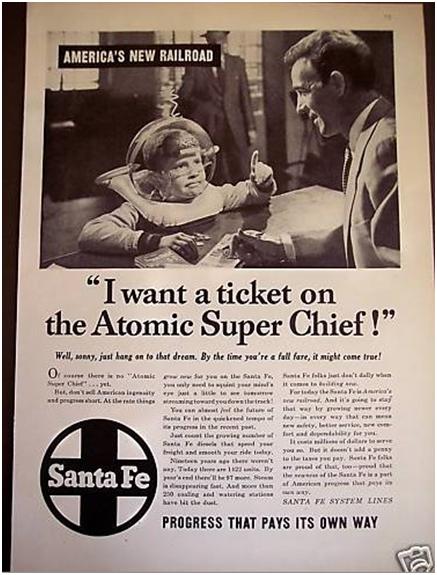
The Santa Fe Railroad, then as commercially important and as technologically credible as Apple or Microsoft are today, anticipated fission reactor powered trains within 20 years, and ran ads in national magazines featuring a youngster only a few years older than me, asking to buy a ticket on an atomic powered version of the Super Chief which was then the preeminent way to travel across the country from Chicago to Los Angeles, in both speed and comfort.
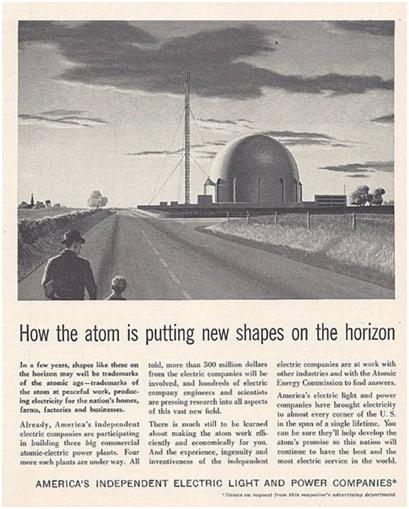
An excerpt from Cryonics and Technological Inevitability.
H/T to Andrew Coyne for the link.
Comments Off on Views of a future that didn’t arrive
February 12, 2011
Is it a movie or will it magically turn into a 14-hour monologue?
More information at http://www.atlasshruggedpart1.com/.
Comments Off on Is it a movie or will it magically turn into a 14-hour monologue?
January 17, 2011
Another report from Brisbane
My friend Roger is doing well (having been outside the worst of the flooding), and sent this update on the rail and transportation situation in Queensland:
A couple of pictures of the western rail line from Brisbane to Toowoomba. The line, mostly double-track has been extensively damaged and willl probably be out of commission for over three months.
This shows flood debris, and a bull, lodged on one bridge. Some 20 people in the area are also missing so there may well be bodies in the debris as well. It is being carefully checked but there is a huge amount. One body was found in her house which had already been searched twice before.
Part of the Moura coal line in Central Queensland. There could be some delays here as well.
Meanwhile, in muddy Brisbane, in an effort to keep cars off the roads all public transport is free for the next few days. The railways parked their electric commuter trains on some tracks that were well above flood level. Unfortunately, graffiti artists, using Facebook and Twatter, called up every idiot on the East Cost that had a can of spray paint. Some even came from Melbourne. About half the train fleet was so badly overpainted that the sets could not be run. Cost estimates are in the order of a couple of million to clean.
The cops can now read Facebook etc. and feel they have enough evidence to throw at least some of the perps in the slammer. Hopefully with their private parts painted a bright blue.


Update: It’s not just flooding in Queensland . . . there’s also now flooding in Victoria. There are always idiots who try to do stupid things, especially around flooded rivers:
A bizarre decision to ride an inflatable doll down a flood-swollen Yarra River blew up in a woman’s face yesterday when she lost her latex playmate in a rough patch.
The incident prompted a warning from police that blow-up sex toys are “not recognised flotation devices’’.
Police and a State Emergency Services crew were called to the rescue when the woman and a man, both 19, struck trouble at Warrandyte North about 4.30pm yesterday.
They were floating down the river on two inflatable dolls and had just passed the Pound Bend Tunnel when the woman lost her toy in turbulent water.
Comments Off on Another report from Brisbane
December 21, 2010
December 13, 2010
December 8, 2010
Worried about your upcoming citizenship test? Publius has the answers for you
Publius has done all the hard work for you so you can ace the new citizenship test:
So from the mouth of well meaning ignorance, how would a typical Canadian fare on Mr Kenney’s new immigration test? Thanks to the vast resources of this blog, and its network of agents and correspondents through out the Dominion, we have located the typical Canadian. He’s a male in his late thirties and lives in Kenora. Which I think is in Alberta. But from Toronto it’s hard to tell. We brought the typical Canadian to our high-tech testing center at the corner of Center St and Universe Ave, in downtown Toronto. Here is the test. And here is the typical Canadian’s answers:
– Identify four (4) rights that Canadians enjoy.
The right to complain about the weather. The right to complain about how taxes are too high. The right to complain that the government isn’t spending enough money on me or my community. The right to stand in the middle of the cookie aisle at Loblaws and block everybody’s way (I know who you are).
-Name four (4) fundamental freedoms that Canadians enjoy.
The freedom to speak, unless it offends a politically influential minority group. The freedom to own property, unless it offends a politically influential environmental group. The freedom to protest, unless it offends visiting dignitaries. The freedom to bitch about the weather, unless it offends a co-worker who is a ski-nut.
[. . .]
-What did the Canadian Pacific Railway symbolize?
That graft, corruption, political manipulation, juvenile anti-Americanism, and screwing over people who don’t live in Ontario and Quebec, has been a Canadian tradition since the beginning.
-What does Confederation mean?
Like federation but with more “con” in it. Like transfer payments.
[. . .]
-What is the role of the courts in Canada?
To uphold the laws of Canada, unless it conflicts with their personal political beliefs. At that point they just make stuff up, and then use some latin terms to cover their tracks.
-In Canada, are you allowed to question the police about their service or conduct?
Yes, but not during the APEC conference, the G20, or if you’re living in Caledonia.
Comments Off on Worried about your upcoming citizenship test? Publius has the answers for you
December 7, 2010
Chinese official acknowledged that official data is unreliable
I’ve been saying this for years now: China’s official GDP and associated economic numbers are just not reliable:
A senior Chinese official said in 2007 that much of the country’s local economic data are unreliable, according to a leaked diplomatic cable published by the WikiLeaks website.
The official, Li Keqiang, was at the time Communist Party secretary of the northeastern province of Liaoning, and has since been promoted to vice premier. Since landing that position, he has overseen many of the central government’s efforts to improve the quality of its economic statistics, which continue to face many questions over their accuracy and consistency.
[. . .]
China’s Foreign Ministry has said it will not comment on the content of the diplomatic cables published by WikiLeaks. The leaked cable reports comments Mr. Li made in a dinner in Beijing with then-U.S. Ambassador Clark Randt on March 12, 2007. His remarks focused on the challenges of administering the province of Liaoning, which because of its legacy of failed state-owned enterprises was burdened with a large number of unemployed workers.
“When evaluating Liaoning’s economy, he focuses on three figures: 1) electricity consumption, which was up 10% in Liaoning last year; 2) volume of rail cargo, which is fairly accurate because fees are charged for each unit of weight; and 3) amount of loans disbursed, which also tends to be accurate given the interest fees charged,” the cable says.
“By looking at these three figures, Li said he can measure with relative accuracy the speed of economic growth. All other figures, especially GDP statistics, are ‘for reference only,’ he said smiling,” the cable reads. “GDP figures are ‘man-made’ and therefore unreliable,” the cable paraphrases Mr. Li as saying.
As I said back in February, the reason for the made up numbers is inherent in the Chinese system:
In this way, the PLA stopped being just the customer/end user. They cut out the middleman and absorbed the entire supply chain. The PLA became a significant economic player in the Chinese industrial economy . . . and this is still true today. The generals aren’t formally in charge, but they own the companies that do military production.
So what? So let’s look at how a civilian corporation’s incentives differ from one owned directly by the army. In a civilian corporation, the CEO runs the business with an eye to generating the largest profit possible while staying (for the most part) within the law. A CEO who deviates from this to ride a favourite hobby horse will eventually face the wrath of the stockholders who want that maximized profit. There are natural limits on how much freedom to invest in uneconomic activity any CEO will be given. Sensible stockholders don’t try to micromanage the firm, but do raise questions if too much of the company’s efforts are devoted to things clearly not related to the company’s long term benefit. Company accounts can be rigged, for a time, to show misleading results, but eventually (Enron, Worldcom, etc.) the truth will out.
A Chinese firm that’s owned by the army? Profit may be nice, but the “CEO” reports to a different master: the guys with the guns. The company accounts will show exactly what the guys with the guns want them to show . . . and the oversight and auditing committee members carry submachine guns. You’re told that your target is 10% growth? Don’t you think that the reported result will be at least 10%? Because your life may depend on the reported results being acceptable.
As my former virtual landlord says, this is one of my hobbyhorses:
- August, 2004 – Rant: “The Chinese Economy”
- October, 2004 – More Economic Voodoo — or is that Feng Shui?
- April, 2007 – The Chinese economy
- May 2008 – Those untrustworthy Chinese economic numbers
- January, 2009 – China’s economic situation
- May, 2009 – Official Chinese statistics
- November, 2009 – Contrarian investment strategy: short Chinese stocks
- February, 2010 – Crying “Wolf!” about China
- March, 2010 – Superbubble?
Comments Off on Chinese official acknowledged that official data is unreliable
December 5, 2010
More on California’s High Speed Boondoggle
Tim Cavanaugh has more information on the high speed (high cost) train to nowhere:
California’s high speed rail project could be shaping up as the awesomest catastrogeddon of 2011.
The California High Speed Rail Authority is committed to breaking ground on a leg of the train that will serve passengers between the unincorporated town of Borden and the half-incarcerated town of Corcoran.
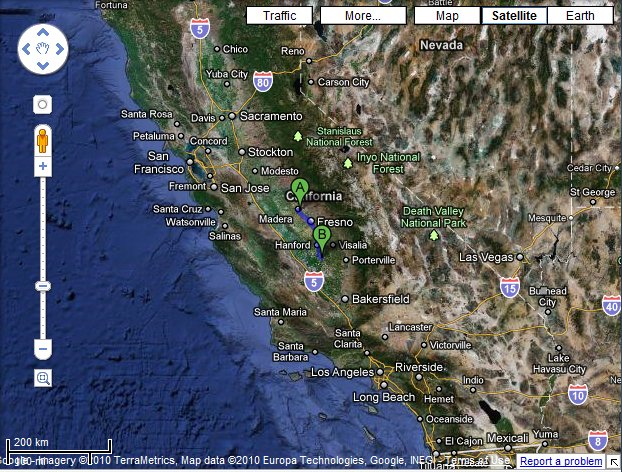
Even saying it will “serve” passengers between the two arbitrary spots on the map is an overstatement: there will be no actual service along this route until after connecting segments are completed and some engines and coaches are purchased.
Background: The CHSRA needs to break ground by September 2012 or lose $2.25 billion in federal funds. The U.S. Department of Transportation has for reasons of its own favored the sparsely populated Central Valley for this first leg of the thinly imagined high speed rail project. Although Golden State Democrats would prefer to start off by connecting San Francisco to Los Angeles or L.A. to Anaheim, they have generally accepted the humiliation rather than lose the funding and miss another start for the nearly 15-year-old project. The recent dedication of a high-speed terminal in San Francisco by outgoing Democratic House Speaker Rep. Nancy Pelosi was for show purposes only.
Geography buffs are invited to try and make any sense out of the CHSRA’s proposed alignment. Not only does the authority plan to incur all the financial and public relations costs of driving a 150-mph train down the heavily populated and extremely wealthy San Francisco-to-San Jose corridor; but it then plans to sacrifice the only goal that could possibly make that trouble worthwhile: a direct San Fran-L.A. run.
Comments Off on More on California’s High Speed Boondoggle
Worst Autumn snowfall in Britain since 1963
Roger Henry sent me this link earlier this year, but it seems even more appropriate now:
I wonder how many budding documentarians will try to replicate the 1963 effort?
H/T to Ghost of a Flea for the reminder.
Comments Off on Worst Autumn snowfall in Britain since 1963
December 4, 2010
California gambles on risky High Speed Rail ploy
The board of the California High Speed Rail Authority voted to build the first segment of the planned HSR trackage from nowhere to nowhere, and will carry no passengers:
Citing a need for jobs and fast approaching federal deadlines for funding, the California High Speed Rail Authority board Thursday unanimously approved construction of the first leg of the state’s proposed bullet train — a 65-mile section in the Central Valley that would not carry passengers until more of the system is built.
Costing at least $4.15 billion, the segment would run from the tiny town of Borden to Corcoran, an area hit so hard by the recession and agriculture declines that it has been dubbed the New Appalachia. Stations would be built in Fresno and Hanford.
Included in the plan are tracks, station platforms, bridges and viaducts, which would elevate the line through urban areas. The initial section, however, would not be equipped with maintenance facilities, locomotives, passenger cars or an electrical system necessary to power high-speed trains.
The board clearly believes that the state and the federal government will be forced to build the connecting segments in order to “save” the $4+ billion in sunk costs for this initial project (costs almost always balloon on major projects like this . . . final figure may well be double the headline number). In other words, they’re deliberately planning to blackmail the money out of future governments.
Comments Off on California gambles on risky High Speed Rail ploy
November 25, 2010
Even China may not be able to afford their High Speed Rail network
By way of Hit and Run, a brief note of caution about the headlong pace of construction of China’s High Speed Rail:
The Chinese Academy of Sciences (CAS) reported to the State Council recently, urging the large-scale high-speed railway construction projects in China to be re-evaluated. The CAS worries that China may not be able to afford such a large-scale construction of high-speed rail, and such a large scale high-speed rail network may not be practical.
[. . .] Under the current plan, the central government has approved to build, by 2020, 16,000 km of high speed rail providing access to about 90% of the Chinese population.
[. . .]
The report submitted by the Chinese Academy of Sciences said China’s high-speed rail construction has caused debt that has already reached unsustainable levels; particularly since the end of 2008, the government introduced a stimulus plan to fight the global economic crisis and the size of local government borrowing is already very high
As Ronald Bailey points out, China is now occupying the same position in American thoughts that Japan did thirty years ago — the economic juggernaut that is poised to crush weak and defenceless American business. The recent gushing about how wonderful China’s HSR system is and how America should build one too are really just echoes of the 1980’s lament on how Japan’s economic model worked so much better than messy US mixed-market capitalism.
Back in the 1980s, I was a producer for a national weekly PBS foreign policy show called American Interests. We ran a lot of nifty programs on various aspects of the Cold War. Another abiding obsession of the chattering classes was the coming triumph of Japan Inc. over a hapless America. We regularly broadcast shows featuring the likes of Robert Reich, Chalmers Johnson (see H&R obit from yesterday), and Clyde Prestowitz predicting that the wise bureaucrats at the helm of Japan’s Ministry of International Trade and Industry deftly deploying their industrial policy jujitsu would soon bury us Yanks. As evidence, critics of undirected American capitalism pointed out that Japan’s economy was growing at 6 to 8 percent per year. Japan was exporting its way to prosperity and the U.S. was running a huge trade deficit with the East Asian powerhouse. Japan could do no wrong and America could do no right. Then the Japanese bubble burst.
Twenty years later, the new meme of would-be industrial policy mavens is China Inc. Promoters include Thomas Friedman and Clyde Prestowitz. China is growing at a blistering pace of 10 percent per year and exporting its way to prosperity. Once again, we are told that East Asian capitalism directed from the top by wise bureaucrats is going to outcompete the United States and toss us into the dustbin of histoy.
Comments Off on Even China may not be able to afford their High Speed Rail network
November 13, 2010
Train movies, and movies with trains
Donald Liebenson at Armchair Commentary has a large (but probably not complete) list of films about or featuring trains:
“Everybody loves the sound of a train in the distance,” Paul Simon sings, “Everybody thinks it’s true.” There’s nothing truer. Nothing pierces the heart like a lonesome train whistle. Nothing holds the promise of mystery, romance, and adventure like a train bound for somewhere. That thundering locomotive in the kick-ass trailer for Unstoppable looks like it’s bound for trouble. While waiting to see if Denzel Washington and Chris Pine can avert disasters in their path, let’s take a scenic journey aboard some of the most memorable movies in which trains played scene-stealing roles. (The Polar Express is not on this list. Those dead-eyed children give me the creeps).
H/T to Jeff Shultz for the link.
Comments Off on Train movies, and movies with trains


