Quotulatiousness

February 21, 2010

It sounds like the correct answer to the legal question

Filed under: Law, Railways, Technology — Tags: , , , — Nicholas @ 19:07

It’s surprising that a dispute over the use of open source software in a model railway application would be the one to set the legal precedent, but that is what happened here:

Although some people viewed it as a tempest in a teapot, the long-running legal case Jacobsen v. Katzer stirred up some seminal open source issues. We first reported on the dust-up all the way back in August of 2008, noting that the dispute centered around — of all things — model train software.

Specifically, Jacobsen had developed JMRI, the Java Model Railroad Interface project. When Katzer built the code for the project into proprietary model train software, deleting existing copyright notices within the code, Jacobsen filed suit. Now, settlement documents are available online, and the end of the dispute points to a final victory for open source licenses.

The settlement documents show that Katzer will pay Jacobsen $100,000 over 18 months, cease using the JMRI code, and not attempt to register domains using the JMRI name. Previously, the legal dispute had gone all the way to the United States Court of Appeals for the Federal Circuit, which is the last legal stop before the Supreme Court. As Lawrence Lessig noted in a post, when the Court of Appeals upheld the Artistic License that governed the use of JMRI, it was “an important victory” for free licenses. Lessig noted that the decision had broad implications for many open source licenses.

Just because someone allows the use of source code freely does not mean you can, in effect, file off the serial numbers and pretend that it’s all your own work . . .

H/T to Craig Zeni for the link.

February 5, 2010

Amtrak’s odd pricing policies

Filed under: Economics, Railways, USA — Tags: , , — Nicholas @ 13:09

Jason Ciastko sent this tale to one of the mailing lists I’m subscribed to:

Go to www.amtrak.com

One way ticket from Erie PA (ERI) to Elkhart IN (EKH)… One adult passenger, no discounts or anything else… The day I picked happened to be tomorrow, but it should not matter….

Now your options should be train 49 (Lake Shore Limited) that departs Erie at 0136 and arrives in Elkhart at 0825 or train 449 (Lake Shore Limited again) that departs Erie at 0136 and arrives at 0825… Those observant will notice this is the same train… 49 is the New York to Chicago section and 449 is the Boston to Chicago section… They are combined into the same train in Albany New York (well before Erie PA…

The riddle is I got a ticket cost of $47 for train 49, and $59 for 449… Probably be in the same seat…

One heck of a way to run a railroad…

I’m sure there’s a rational explanation for this . . . but I can’t come up with one.

January 8, 2010

Snow, 1963

Filed under: Britain, Railways — Tags: , , — Nicholas @ 09:21

What would happen if you took a typical Canadian snowfall and dumped it on Britain? In 1963, this is what happened. As you can see, it must have been the “right kind of snow”.

H/T to Roger Henry for the link.

December 23, 2009

Tornado to the rescue!

Filed under: Britain, Railways, Technology — Tags: , — Nicholas @ 12:44

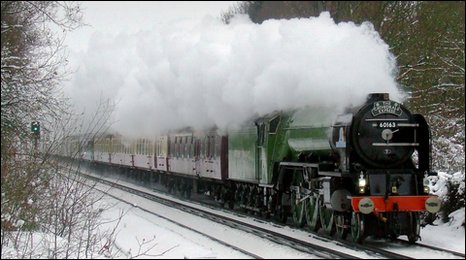
With all the winter weather in England this week, the railways are struggling to cope. One of the newest locomotives didn’t have any problems with the snow and ice:

TornadoInSnow_22Dec09

Passengers were rescued by a steam locomotive after modern rail services were brought to a halt by the snowy conditions in south-east England.

Trains between Ashford and Dover were suspended on Monday when cold weather disabled the electric rail.

Some commuters at London Victoria faced lengthy delays until Tornado — Britain’s first mainline steam engine in 50 years — offered them a lift.

They were taken home “in style”, said the Darlington-built engine’s owners.

December 14, 2009

Shock! Horror! Children’s book series from 1940’s has “conservative values”!

Filed under: Books, Britain, Media, Railways — Tags: , — Nicholas @ 09:38

I guess it must have been a slow news week, if this makes the news:

Thomas the Tank Engine attacked for ‘conservative political ideology’
Children’s favourite Thomas the Tank Engine has been attacked by a Canadian academic for its “conservative political ideology” and failure to adequately represent women.

The show’s right-wing politics shows the colourful steam engines punished if they show initiative or oppose change, the researcher found.

She also highlighted the class divide which sees the downtrodden workers in the form of Thomas and his friends at the bottom of the social ladder and the wealthy Fat Controller, Sir Topham Hatt, at the top.

[. . .]

She was critical of the fact the show only has eight female characters out of the 49 who feature.

“The female characters weren’t necessarily portrayed any more negatively than the male characters or the male trains, but they did tend to play more secondary roles and they’re often portrayed as being bossy or know-it-alls,” she said.

Let’s see, a series of stories, written for children starting in the 1940’s. Conformist? Check. Sexist? Check. Reinforces class-based stereotypes? Check. By God, she’s right! Call out the Human Rights pitbulls!

File this one under “Obvious”.

December 6, 2009

Farewell to the Orient Express

Filed under: Economics, Europe, Railways — Tags: — Nicholas @ 00:32

Economic times are hard on non-essential services, and the luxury train called the Orient Express faces cancellation:

Its name evokes images of glamour and mystery and has provided authors including Agatha Christie and Ian Fleming with perfect backgrounds for their tales of intrigue and suspense.

But now the Orient Express is to be cut from Europe’s rail timetables. Next weekend, the service — which runs only between Strasbourg and Vienna — will be scrapped, a victim of high-speed railways and cut-price flights.

“The name the Orient Express will disappear from the official timetables before the year is out, after more than 125 years,” says Mark Smith, the rail expert who runs The Man in Seat Sixty-One website.

Only travellers who can afford lavish private trains — such as the Venice Simplon-Orient-Express and the Danube Express’s Istanbul Odyssey — will be able to enjoy the service’s former glory.

Of course, it’s hard to believe that Vienna qualifed as an “oriental” destination . . .

October 29, 2009

Amtrak: still losing $32 per passenger on every trip

Filed under: Economics, Government, Railways, USA — Tags: , , , — Nicholas @ 12:52

Amtrak would not survive without federal government subsidy, as most people already know. What you may not have realized is just how much taxpayers subsidize every rider:

The Pew Charitable Trusts SubsidyScope Project has just released a new report that finds 41 out of Amtrak’s 44 routes lose money. The losses ranged from nearly $5 to $462 per passenger, depending upon the line, and averaged $32 per passenger. According to the report:

The line with the highest per passenger subsidy — the Sunset Limited, which runs from New Orleans to Los Angeles — carried almost 72,000 passengers last year. The California Zephyr, which runs from Chicago to San Francisco, had the second-highest per passenger subsidy of $193 and carried nearly 353,000 passengers in 2008. Pew’s analysis indicates that the average loss per passenger on all 44 of Amtrak’s lines was $32, about four times what the loss would be using Amtrak’s figures: only $8 per passenger. (Amtrak uses a different method for calculating route performance).

The Northeast Corridor has the highest passenger volume of any Amtrak route, carrying nearly 10.9 million people in 2008. The corridor’s high-speed Acela Express made a profit of about $41 per passenger. But the more heavily utilized Northeast Regional, with more than twice as many riders as the Acela, lost almost $5 per passenger.

October 10, 2009

Where High Speed Trains can beat short-haul flight

Filed under: Economics, Europe, Railways, Technology — Tags: , , — Nicholas @ 11:46

Spain has a new high speed railway (HSR) network that appears to be a huge success, according to the Guardian:

Last year’s drop in air travel, which was also helped by new high-speed lines from Madrid to Valladolid, Segovia and Malaga, marks the beginning of what experts say is a revolution in Spanish travel habits.

In a country where big cities are often more than 500km (300 miles) apart, air travel has ruled supreme for more than 10 years. A year ago aircraft carried 72% of the 4.8 million long-distance passengers who travelled by air or rail. The figure is now down to 60%.

“The numbers will be equal within two years,” said Josep Valls, a professor at the ESADE business school in Barcelona.

Two routes, from Barcelona to Malaga and Seville, opened last week. Lines are also being built to link Madrid with Valencia, Alicante, the Basque country and Galicia. The government has promised to lay 10,000km of high-speed track by 2020 to ensure that 90% of Spaniards live within 30 miles of a station. The prime minister, José Luis Rodríguez Zapatero, boasts it will be Europe’s most extensive high-speed network.

While I’m always skeptical of HSR advocates’ larger-than-life claims, the Spanish system may be in a good position to permanently claim a big share of the short-haul air passenger market. The situation works to the strengths of HSR: relatively dense population corridors, short-to-medium length journeys, and government subsidy of construction costs.

HSR cannot be run on the same tracks as regular freight trains and commuter passenger trains: the signalling, degree of curvature of track, and speed differential between the HSR and ordinary trains creates too many risks. HSR must have its own right of way, which pretty much always means that governments must get involved to condemn existing properties and expropriate them for the benefit of the railway.

That HSR is, or may become, a success in densely populated European countries does not make the case for North American HSR efforts, as I’ve posted a few times before.

October 1, 2009

Ephemera

Filed under: Railways, Randomness — Tags: , — Nicholas @ 07:25

I think this is the first time I’ve seen some of my old work for sale on eBay:

THBHS_back_issues

I was the original editor for TH&B Focus, finally burning out on the job midway through the fifth year of publication.

September 3, 2009

QotD: “The red-headed step-child of the environmental movement”

Filed under: Environment, Quotations, Railways, Technology — Tags: — Nicholas @ 16:48

As a practical matter, we’d probably get more environmental benefit (and save more wear-and-tear on our roads) from improving our freight rail system, like the abysmal mess in Chicago, than from high speed passenger rail that is very unlikely to carry more than a handful of Americans on any regular basis. . . But this does not attract one eightieth of the interest that you see in HS(P)R. As I understand it, there is finally some actual progress on Chicago, but it’s still bogged down in process, and it’s not clear to me whether it’s really enough. It seems clear to me that switching freight to rail whenever possible should be a policy priority, but it’s the red-headed stepchild of the environmental movement. We need freight cars that look more like pandas.

Megan McArdle, “Rail: It’s Not Just for Passengers”, Asymmetrical Information, 2009-09-03

August 27, 2009

Kids will be kids

Filed under: Britain, Media, Railways, Randomness — Tags: , , , — Nicholas @ 00:06

Even when they’re adults . . . James May tried to set a record, but the kids just got in the way:

An attempt by Top Gear‘s James May to break the world’s longest model railway record has failed amid claims that vandals and thieves tampered with the track.

The long-haired presenter joined 400 enthusiasts to build the miniature railway stretching 10 miles from Barnstaple to Bideford, in North Devon.

He was recording the attempt yesterday for his new show James May’s Toy Stories.

The team hoped that a train would run successfully along the length of the track, built on the picturesque Tarka Trail.

But their hard work was hampered as parts of the track were taken and coins dropped on the line, blowing the battery. Even the battery was stolen.

H/T to Jeff Shultz.

August 18, 2009

The economic value of high speed passenger trains

Filed under: Economics, Railways, USA — Tags: — Nicholas @ 07:51

Another article pointing out the economic issues with the current US administration’s sudden love for high speed rail:

In April, President Barack Obama claimed “my high speed rail proposal will lead to innovations in the way we travel” and new rail lines “will generate many thousands of construction jobs over several years, as well as permanent jobs for rail employees and increased economic activity in the destinations these trains serve.”

Even House Minority Whip Eric Cantor (R-Va.), who voted against the stimulus bill, now wildly praises rail’s job-creation potential, writing, “It is estimated that creating a high-speed railway through Virginia will generate as many as 185,500 jobs, as much as $21.2 billion in economic development, and pull nearly 6.5 million cars off the road annually. Providing a high-speed rail service from Washington, D.C. to Richmond will drive economic development throughout our region for many years to come.”

High speed railways (HSR) work well in certain conditions: in areas of high passenger density over medium-length journeys. HSRs can’t replace regular passenger trains running on joint freight-passenger rail lines because the HSR trains require more expensive dedicated lines with different signalling and control systems. Running an HSR train on unimproved track would merely give you a slightly faster passenger train: it would not allow the much higher running speed required to allow the HSR to show its capabilities.

The need for dedicated lines in high population areas means that no private railway could afford to buy the necessary right of way and additional land for associated station, maintenance, and storage facilities. Inhabited, densely developed land is expensive: governments need to get involved by using their powers of eminent domain to condemn and requisition land from private owners.

The proposed HSR line from Washington to Richmond might be economically feasible, setting aside the costs to the individuals and companies whose property will be taken to build the new line, but it will be politically difficult because the people whose property will be at risk will be highly motivated to oppose the development in any way they can.

Passenger rail currently carries a very small portion of city-to-city travel — the market targeted by high-speed rail — and it’s likely to remain modest well into the future. In 2008, Amtrak carried 28.7 million passengers. By comparison, there were 687 million airline passengers in 2008, in part because air service provides frequent high-speed travel to geographically distant cities. Then there’s our well-developed highway network that makes automobiles very competitive with rail for distances under 200 miles. In most cases, once travel and wait times to train stations are factored in, travelers will spend as much time in route on the train as they will in a car.

That last point is why the “high speed” part of HSR is critical . . . if you’re going to use the train for part of your journey, you need that portion of the trip to be appreciably faster than the other options, or you won’t make the extra effort to use the service. For example, commuting into Toronto using the (non high-speed) GO train service saves me an average of 5-10 minutes per trip, but if I miss the train, I’ll be an hour later getting there. Driving in is more flexible, time-wise, but a bad traffic jam or construction en route can make an already long commute that much more frustrating . . . and I can’t read while driving. It’s a bit of a wash, from my point of view. The costs are slightly in favour of taking the train, counting parking and gas costs (but the GO train fare is subsidized by the provincial government, so I’m only paying half the actual cost of my ticket: everyone else in Ontario pays the other half).

« Newer Posts

Powered by WordPress