Quotulatiousness

August 28, 2011

ESR on railway sounds

Filed under: History, Railways, Randomness — Tags: — Nicholas @ 00:08

Eric S. Raymond now lives close to a very busy railway line:

My house is located less than a hundred feet from the Main Line, the principal passenger-rail artery out of Philadelphia to the west — Harrisburg, Pittsburgh, and ultimately Chicago and points west. Two dozen times a day passenger trains come bucketing by, but they’re barely a murmur through the dense secondary-growth woods between my back fence and the railroad right-of-way.

The loud ones are the night trains, the big heavy freights they route through when all the passenger cars are put to bed. They come through here rumbling like muted thunder in the still dark, long blasts of airhorns falling away like the mournful cries of vast creatures in a rusty ocean. Some people would find the noise intrusive, but I don’t; it comforts me.

[. . .]

This is my first house so near a railroad track, but I think I will always prefer that now. And I expect I’ll always keep at least one balky antique clock where I can hear it sound. The well-lived life may be full of large ideas and emotions and struggles to build something that will last, but the little details also matter.

June 30, 2011

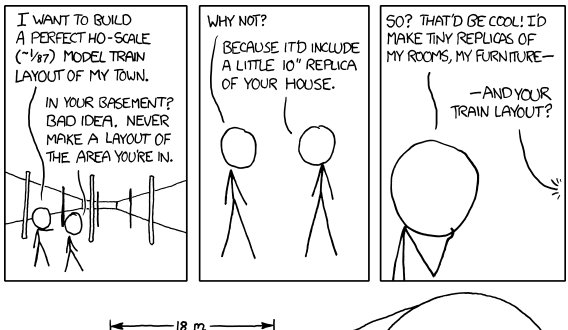
xkcd: The first rule of model train layouts

Filed under: Humour, Railways, Science — Tags: , — Nicholas @ 15:34

Jon sent me a link to this xkcd strip, which still amuses me:


Click to see the full image

June 20, 2011

Where map collections and railway fans intersect

Filed under: Cancon, Economics, History, Railways, Technology — Tags: — Nicholas @ 09:37

An interview with the author of Railway Maps of the World:

At its peak, there were 92,449 kilometres of rail lines criss-crossing Canada from coast to coast. That was in 1976. Today, almost half the lines have been destroyed, dug-up, or abandoned — only 49,422 km remain in operation. Worldwide, the numbers are just as grim: from a high of 2,500,000 km in 1920, the Golden Age of rail travel, to 1,370,782 km now. Yet, there are still those who prefer the charm of the train to its air or auto brethren. Mark Ovenden is one such man. Ovenden, who enjoyed unexpected success with his 2007 book Transit Maps of the World, has recently released Railway Maps of the World. It is a celebration of beautiful maps, he says, but also a reminder of what we’ve lost. He spoke to the Post’s Mark Medley from his home in Paris.

Although the absolute reduction in rail lines in Canada is quite true, the railway companies could not earn a profit today if they’d kept all of those lines in operation. Some of the lines were abandoned as sources of traffic declined, either through depletion of the resource or improvements to road transportation. Some of the lines were abandoned once passenger traffic dropped below operating costs. Technological improvements in both locomotives and in control and signalling equipment allowed better use of the tracks, allowing redundant lines to be taken out of service.

Railways have to pay taxes on their right-of-way, so once a length of track becomes uneconomic, it will very quickly be taken out of service so that the railway doesn’t pay for maintenance of unused routes and can sell the land. For all the “romance of the rails”, railways are businesses which have to earn profits to continue operating.

Q: What does it say, then, that we were able to turn our back on railways so easily?

A: It’s a very complex and a very sad picture on many levels, from which luckily only in the last five, 10, 15 years we’re beginning to turn the corner. When you look at the influence and the power of the oil companies, and the whole automotive industry, they really were responsible — they saw it as a very deliberate policy to run down the railway services, and buy up things like streetcars and run them down again. The oil companies have blood on their hands, really. They were the ones who forced the railways to shut. They were the ones that had the tracks torn up. Under their influence people were forced to buy cars.

*cough*Bullshit*cough*

This is a lively combination of wishful thinking and conspiracy theorizing. It also nicely conflates the real business of the railways in North America — massive amounts of freight traffic — with a much smaller and unprofitable side-line — passenger service. Few railways ever earned much of their revenues from passenger traffic, which is why most modern subways, streetcars, and light rail systems are in the public sector. The railways can be built to maximize freight traffic (and therefore profit) or they can be built to maximize passenger traffic. Only organizations that do not have to earn a profit can justify concentrating on passenger service.

In the 1920s, automobiles changed from being super-expensive, finicky toys for the rich to being affordable to middle class and even some working class famlies and far more reliable (so you didn’t need to have a dedicated driver/mechanic for each vehicle). Unlike trains, where you could only go where the rails went and only when the train was going in that direction, a car allowed you to go anywhere there was a road, whenever you wanted.

It is difficult for us to grasp just how liberating this was for millions of Americans and Canadians — we’re so used to being able to go where we want at any time that we rarely even think about what it was like before the heyday of the car. Passenger trains had that kind of transformative effect in Europe, but less so in North America, where moving freight was always the primary purpose for building railways (setting aside the Union Pacific and the Canadian Pacific, as the construction of both were more influenced by government policy than profit-seeking).

June 12, 2011

Montreal model railway loses out to real railway

Filed under: Cancon, Economics, Railways, Randomness — Tags: , , — Nicholas @ 12:36

Canadian National, which owns the building hosting Montreal Model Railway Club — claimed to be “Canada’s largest fully operational model railway” — is terminating the club’s lease because they can get higher rent for the building:

In a warehouse in Montreal’s historic Griffintown neighbourhood, model train enthusiasts have spent 38 years engaging in a labour of love.

Inch by inch, they’ve constructed what is believed to be Canada’s largest fully operational model railway.

More than 300 people have participated over the years, devoting thousands of hours to building life-like models across an eye-popping, detail-laden, 1,493-metre masterpiece.

And it’s about to be detroyed.

The reason for the imminent dismantling is not without irony: the make-believe trains are about to be forced away by a real train company, dealing with real-life issues like rising property costs.

Canadian National owns the 9,000-square-foot warehouse space and wants to lease it out at a higher rent, starting next year. It warned the model-train association five years ago that its time was up.

The club’s website is http://www.canadacentral.org/Reseau_EN.htm.

May 27, 2011

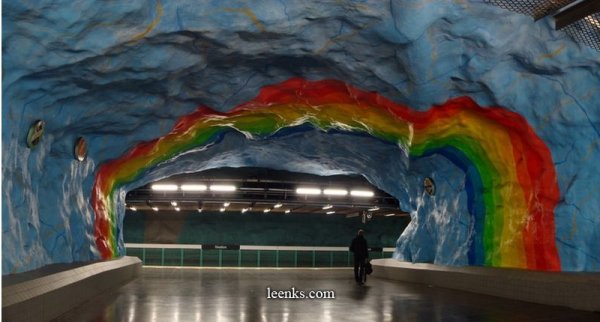
Swedish subway stations or hallucinatory flashbacks to a 1975 shopping mall?

Filed under: Europe, Media, Railways, Randomness — Tags: , , — Nicholas @ 13:10

Andrew Coyne linked to this set of photos of Swedish subway stations saying “Good LØRD. Who was their designer, Willy Wonka?”


I shared the link with Jon, my former virtual landlord, who responded:

Tonight’s nightmares are going to leave a mark.

I can only imagine what the flashbacks must be like for you, though. I suspect that these stations look remarkably like Sherway Gardens did to you and your friend after you guys went drinkin’ at the Steak’n’Burger.

If there is a 1970’s-era Sherway Gardens in Hell, this is what it looks like.

I had a similar reaction to the photos . . . strikingly ugly where they’re not just flat-out disturbing. But what else could we expect from publicly funded artists selected by public transit officials?

April 21, 2011

Exploring an abandoned underground mail railway line

Filed under: Britain, History, Railways — Tags: , — Nicholas @ 07:49

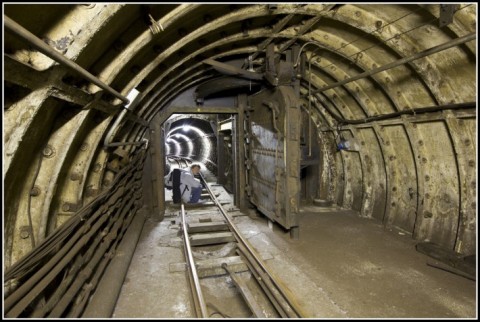
The Royal Mail system had a dedicated subway line of their own. It was eventually abandoned, but not destroyed, as some trespassers were able to discover:

Construction of the tunnels began on February 1915, from a series of shaft located along the route. The tunnels were primarily dug in clay using the Greathead shield system, although the connecting tunnels in and around the stations were mined by hand. Construction was suspended due to the outbreak of WW1, but was allowed to continue until completion for safety reasons. Further setbacks halted the construction of the stations during 1917 due to the shortage of labour and materials.

It wasn’t until June 1924, that workers began laying the track using 1000 tons of running rail and 160 tons of conductor rail. The remaining electrical installation took place in 1925 with the section between Paddington and the West Central District Office being ready for training. The line was eventually finished in 1927 with the first letter through the system running on February 1928.

In 1954, due to problems with access at the Western District Office and the Western Central District Office plans were drawn up to construct a new Western District Office at Rathbone Place. This meant the construction of a diversion to the line to the station which was completed in 1958, although the station was not opened until the 3rd August, 1965.

H/T to Cory Doctorow for the link.

April 3, 2011

King Edward II restored

Filed under: Britain, History, Railways, Technology — Tags: , — Nicholas @ 10:53

. . . to the rails, not the throne:

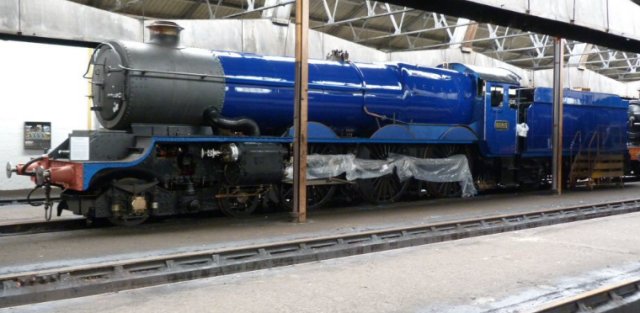
The King Edward II steam engine was first used by Great Western Railway in the 1930s, pulling trains between London Paddington and the west of England.

However, it had been left to rot in a scrapyard in Barry, Wales, until it was saved for preservation by the Great Western Society.

No 6023 King Edward II is one of only three surviving locomotives of its class, built by GWR in 1930 for taking express trains over the steep banks of South Devon.

It’s always nice to see successful restoration efforts by private groups and individuals, although this particular one drew this comment from “jackcade”:

King Edward II? The fireman better make sure he doesn’t let his poker get too hot or someone might get hurt.

Photo from the restoration website, showing the engine right after repainting:

H/T to Elizabeth for the link.

March 30, 2011

At least they got his name right, maybe

Filed under: Britain, Media, Railways — Tags: , — Nicholas @ 12:00

A very detailed apology from Britain’s The Sun newspaper:

IN an article published on The Sun website on January 27 under the headline ‘Gollum joker killed in live rail horror’ we incorrectly stated that Julian Brooker, 23, of Brighton, was blown 15ft into the air after accidentally touching a live railway line.

His parents have asked us to make clear he was not turned into a fireball, was not obsessed with the number 23 and didn’t go drinking on that date every month.

Julian’s mother did not say, during or after the inquest, her son often got on all fours creeping around their house pretending to be Gollum.

Also, quotes from a witness should have been attributed to Gemma Costin not Eva Natasha. We apologise for the distress this has caused Julian’s family and friends.

Bold in the original post.

March 29, 2011

“Steampunk” industrial machinery

Filed under: History, Railways, Randomness, Technology — Tags: , , , — Nicholas @ 08:06

This is a set of Hulett ore unloaders in Cleveland in the late 1980’s and early 1990’s shortly before they were finally retired. You can readily see how the Victorian imagination could lend itself to monstrous walking engines, given the huge mechanical marvels to be seen working along the dockside.

H/T to Robert Netzlof for the link.

March 14, 2011

Toledo, Ohio

Filed under: Economics, History, Railways, USA — Tags: — Nicholas @ 08:37

P.J. O’Rourke remembers his home town:

My hometown, Toledo, Ohio, is one of those junkyards of American capitalism, a deindustrialized old industrial city. The population has declined from 383,818 in 1970 to 316,851 today. The unemployment rate is 10.4 percent. Jeeps are still made there, but most Toledo factories are gone — Auto-Lite, Willys-Overland, Champion Spark Plug, the glass plants of Owens-Illinois and Libbey-Owens-Ford. Toledo Scales aren’t made in Toledo anymore.

Downtown, the department stores are closed, as are most of the shops, theaters, restaurants, and bars. The city’s center looks plucked. Half the buildings have been razed. Toledo is a failure.

Actually, Toledo always was a failure. Incorporated in 1837, with a fancy name for what had been called the Great Black Swamp, Toledo was a land scam. A canal joining the Ohio River to Lake Erie was supposed to have its terminus there. The scam collapsed that very year, in the Panic of 1837, when Andrew Jackson ended easy land-buying credit. The canal did open, but not until 1845, by which time railroads had taken over shipping.

Toledo tried to be a rail hub. In 1860 it had six railroads. They were all short-line operations, each with a different track gauge and none connected to long-haul routes. Toledo’s Erie and Kalamazoo Rail Road never reached Kalamazoo.

March 10, 2011

Very early railway film

Filed under: History, Media, Railways, Technology — Tags: , — Nicholas @ 10:12

H/T to “JtMc” for the link.

March 7, 2011

Bullet train sports big nose to cure big noise

Filed under: Japan, Railways, Technology — Tags: — Nicholas @ 10:02

It looks rather odd, but there’s method to its ugliness:

The nose of the E5 Series, at 15 metres, is a massive 9 metres longer than the previous incarnation of the bullet train (shinkansen), the E2 Series. This, according to its designers at JR East, will help eliminate the phenomena of “tunnel boom”.

Japan’s rail tunnels are somewhat narrower than their European counterparts, so when the shinkansen enters a tunnel at speeds above 200 kilometres per hour, the sudden increase in air pressure can cause a loud “boom” at the other end of the tunnel. In some cases, such shock waves are thought to have damaged tunnels in Japan, ripping chunks of material from tunnel ceilings.

The shape of the front car has evolved gradually to combat this danger, and the striking “Long Nose” design of the E5 Series is the result.

February 26, 2011

The increasing length of freight trains in Canada

Filed under: Cancon, Economics, Government, Railways, Technology — Tags: , , — Nicholas @ 13:22

Some eye-opening statistics on the length of freight trains being run by Canadian National (CN) and Canadian Pacific (CP) these days:

Transport Canada launched a six-part study into the long-train strategies at the country’s largest railways this month with an eye on developing policies for how these longer, heavier trains are assembled and run. The goal of the two-year study is to develop science-based regulations that will hopefully reduce the number of derailments in the country.

Despite the concern from regulators, these longer, heavier trains in recent years have been a godsend for North American railways, which swear by their safety. Not only do they improve the efficiency of the rails by reducing the number of trains required to transport goods, but they in turn reduce the crews needed and the fuel used to move their shipments.

If properly built, they can also reduce wear and tear on the trains and the tracks themselves by cutting down on in-train forces, lowering maintenance costs substantially over time.

The cynic in my asks why, if CN (for example) actually managed to reduce the number of rail accidents to an all-time low last year, the regulators are now launching the investigation. Fewer accidents now equals a point of serious concern on the part of the regulators? Why?

Up until the 1990s, the average freight train in Canada was about 5,000 feet (1.54 kilometres) long and weighed 7,000 tons. But it is now not uncommon to see these trains stretch to 12,000 feet, sometimes as much as 14,000 feet (more than four kilometres), weighing up to 18,000 tons.

While CN is comfortable sticking with the size of its longest trains now, about 12,000 feet, CP continues to push the boundaries of how long it can build its trains by developing some of the industry’s most cutting-edge technology in recent years to help it do so.

The benefits are clear. CP estimates, for example, that the labour costs alone on a typical transcontinental train are now 30% lower than they would be if it was using smaller trains.

So, the trains are longer, carry far more freight, cost less to run, and customers are happy. The government must act!

Views of a future that didn’t arrive

Filed under: History, Railways, Science, Technology — Tags: , , — Nicholas @ 11:35

The Future That Wasn’t: Failure to Perceive Hidden Costs and Risks

Two other entangled obstacles to technological inevitability must also be considered: unappreciated psychosocial reservations and genuine, but unappreciated hazards that either slow, or virtually inhibit the adoption of what would otherwise be hugely transforming technological advances.

As a child, I was told about what my future would be like and how much better it would be in almost every way, technologically, from the world I then inhabited. I was, literally, a child of the atomic age, and the molecules in the DNA of my brain still bear the 14Carbon isotope signature of the open-air nuclear testing era, just as surely as my bones, made radioactive in my infancy and childhood by the Strontium 90 (90Sr) in the milk I drank are still, ever so slightly, more radioactive today, than are those of people born before, or after, the era of atmospheric nuclear weapons testing.

But beyond these physical stigmata of the atomic age, my mind bears the stigmata of a world promised, but never delivered. Scientists and laymen alike were quick to understand the truly staggering potential benefits of what we now call nuclear power. Countless pronouncements were made that the arrival of an era of cheap, clean, safe, and virtually unlimited electric power was at hand. Electricity generated by ‘atomic power’ and nuclear fusion, we were told, would be so inexpensive to produce that it would not even be worth the expense of metering its use to bill the customer for. People would simply play a flat rate for the service, as is the case for long distance or computer telephony today. In a speech given by Lewis L. Strauss (1896-1974), Chairman of the U.S. Atomic Energy Commission to the National Association of Science Writers, in New York City on September 16th, 1954, Strauss commented on how scientific research then underway would transform life for the next generation of Americans, the generation that would be born in then and in the coming decade, my generation:

“Our children will enjoy in their homes electrical energy too cheap to meter…will travel effortlessly over the seas and under them and through the air with a minimum of danger and at great speeds, and will experience a lifespan far longer than ours, as disease yields and man comes to understand what causes him to age.”

The Santa Fe Railroad, then as commercially important and as technologically credible as Apple or Microsoft are today, anticipated fission reactor powered trains within 20 years, and ran ads in national magazines featuring a youngster only a few years older than me, asking to buy a ticket on an atomic powered version of the Super Chief which was then the preeminent way to travel across the country from Chicago to Los Angeles, in both speed and comfort.

An excerpt from Cryonics and Technological Inevitability.

H/T to Andrew Coyne for the link.

February 12, 2011

Is it a movie or will it magically turn into a 14-hour monologue?

Filed under: Books, Liberty, Media, Railways, USA — Tags: , , — Nicholas @ 11:05

More information at http://www.atlasshruggedpart1.com/.

« Newer PostsOlder Posts »

Powered by WordPress