Quotulatiousness

January 18, 2026

“Voluntary”. You keep using that word. I do not think it means what you think it means.

Filed under: Cancon, Government, Law, Liberty, Media, Politics, Weapons — Tags: , , , , — Nicholas @ 05:00

The federal government, rather than abandoning its ridiculous and ineffective “voluntary” firearm buyback program, is determined to carry on:

πŸ‡¨πŸ‡¦ The “Voluntary” Trap: Ottawa’s Buyback Is Coercion, Not Consent πŸ‡¨πŸ‡¦
by GoC Admins

The federal government unveiled the next phase of its firearms confiscation program on Saturday, insisting, yet again, that the process is “voluntary”. But as the details emerge, that claim collapses under the weight of its own contradictions.

What the government is offering Canadians is not a choice. It is a trap designed to force compliance through financial coercion and the threat of criminal prosecution.

Beginning January 19, licensed firearm owners will be contacted by the National Firearms Centre and invited to voluntarily declare their property. The declaration period runs until March 31, 2026. Those who comply may receive compensation. Those who do not will be required to surrender, deactivate, or export their legally acquired property before the amnesty expires on October 30, 2026, or face criminal charges for illegal possession.

That is not voluntary. That is coercion dressed in bureaucratic language.

The “Voluntary” Deadline Is a Financial Squeeze
The most manipulative aspect of this program is its timeline.

The government has set the amnesty to expire on October 30, 2026, but the window to declare firearms for compensation closes seven months earlier, on March 31, 2026. Owners who wait to see whether a future election, court ruling, or policy reversal intervene are punished for doing so.

This gap is not accidental. It predictably pressures owners to act early, before political uncertainty can resolve itself.

If you wait until the summer or fall of 2026 to see whether the law changes, you will have missed the compensation window entirely. At that point, your only options will be to surrender your property for free or face criminal liability.

Yes, owners can technically wait until October 30, 2026, but only if they are willing to receive nothing in return.

That is not a voluntary choice. It is a financial ultimatum.

πŸ‡¨πŸ‡¦ Surrender First, Get Paid … Maybe πŸ‡¨πŸ‡¦

Perhaps the most astonishing revelation from the government’s announcement is that declaring your firearms does not guarantee compensation.

Payment will be issued on a “first-come, first-served” basis, subject to available funding.

In any other context, forcing people to surrender lawfully acquired property without guaranteed compensation would violate basic principles of fairness and due process. Under this program, owners are asked to declare thousands, or tens of thousands, of dollars’ worth of property with no legal assurance that the money to compensate them actually exists.

If the budget runs dry, you are still left holding a prohibited firearm you must destroy or surrender. The cheque may never come.

Compliance is mandatory. Compensation is optional.

πŸ‡¨πŸ‡¦ A Pilot Project That Already Failed πŸ‡¨πŸ‡¦

Ottawa insists this national rollout will succeed, despite the fact that the pilot version of this program was an embarrassment.

Public reporting indicates that when the government tested the scheme in Cape Breton, Nova Scotia, it resulted in the collection of approximately 25 firearms from just 16 individuals. After millions spent on administration, IT systems, and police coordination, only a handful of people participated.

If this were a private-sector initiative, it would have been cancelled outright. Instead, the government is expanding it nationwide without addressing the structural failures that doomed the pilot from the start.

πŸ‡¨πŸ‡¦ It’s Not About Safety; It’s About Control πŸ‡¨πŸ‡¦

The government inadvertently revealed its true motivation when officials remarked that they do not want owners using compensation money to “buy an SKS”.

This statement exposes the emptiness of the public-safety argument.

The SKS is already licensed, regulated, and subject to existing Canadian firearms law. By acknowledging that owners might simply replace prohibited firearms with other legal ones that function similarly, the government is admitting that the bans are arbitrary.

The objective is not to remove a particular mechanical risk from society. It is to financially exhaust and discourage lawful firearm ownership altogether.

This program is not designed to stop criminals. Criminals do not declare firearms. Criminals do not comply with amnesty deadlines. Criminals do not interact with government portals.

Only compliant, vetted, RCMP-checked Canadians do.

πŸ‡¨πŸ‡¦ The Deadlines Are Real. The Logic Is Not πŸ‡¨πŸ‡¦

Government officials closed their announcement by warning Canadians that “the deadlines are real”.
They are right about that.

The government is fully prepared to criminalize people who followed every rule it imposed. People who acquired their property legally, stored it safely, and harmed no one. It is prepared to spend billions enforcing a program that criminals will ignore entirely.

This is not a buyback. It is not voluntary. It is a forced surrender program aimed at the easiest possible target: responsible firearm owners.

While those driving Canada’s violent crime problem continue entirely outside the scope of this policy, law-abiding citizens are left facing a stark reality: Comply now, or be punished later.

History will judge this program not by its press releases, but by its results. And all available evidence suggests it will deliver exactly what it already has: massive cost, deepened division, and no measurable improvement in public safety.

Who Will Be Chancellor? – Rise of Hitler 27, January 1933

Filed under: Germany, Government, History, Politics — Tags: , , , — Nicholas @ 04:00

World War Two
Published 17 Jan 2026

Back to monthly coverage for this month, because too much is happening in Germany just now. Franz Von Papen meets with Adolf Hitler as 1933 gets going, both of them scheming against Chancellor Kurt von Schleicher. Could they possible form a coalition government with a majority of the Reichstag? Can they even trust each other? Also, who is this von Ribbentrop character? And what’s up with President Hindenburg’s son Oskar? So much going on this month, and when it all reaches its head … just … wow!
(more…)

QotD: Having zero agency

Filed under: Media, Politics, Quotations, USA — Tags: , , , — Nicholas @ 01:00

I am not sure I remember too much from my high school philosophy class, other than the lesson that I probably would not be actively pursuing a career in philosophy. But I remember one discussion about displaying one’s rebellious nature by doing the exact opposite of whatever an unfavored person said. The teacher made the point that if you always did the exact opposite of what person X says, then you are just as much ruled by X as any of X’s most cultish followers. In such a case you have completely abdicated your agency to X.

I took the lesson from that, which I still try to follow to this day, that you have to process people’s actions and ideas one by one. Certainly this is not to say that there is no room for trust and reputation. If I have found myself agreeing with someone historically and they have been proved right on certain topics time and again, I am going to give their next statement a lot of credence — but I am still going to mentally challenge it to some extent. And for individuals, this sort of reputational trust can vary by topic. If my wife gives me a read on a person, I am going to assume she is correct; if she opines on navigation issues when we are walking around an unfamiliar city, I am going to treat that with a lot more skepticism.

Most will have guessed where I am going with this — the opposition to Trump has reached this point of zero agency. Smart people I know will mock everything Trump says, even if it is something they would normally agree with or at least entertain. People who are extraordinarily skeptical of all medication suddenly think that concerns about Tylenol during pregnancy are totally absurd. The whole Tylenol story is actually pretty interesting — a Harvard dean’s imprimatur seems to tick the credentialism box that was so prominent in COVID, but a look at the quality of the research and the money involved tends to make one very skeptical. And of course a lot of what RFK says makes me skeptical. The whole story is a really interesting, including appeals-to-authority issues we had during COVID, only with the parties reversed. But no one really looks because if Trump said it, it must be mocked.

Coyote, “On Having Zero Agency”, Coyote Blog, 2025-10-02.

January 17, 2026

Shout Out UK – “… embracing right-wing extremism will give you a shot at getting a manic pixie dream girl gf”

Filed under: Britain, Government, Media, Politics — Tags: , , , , , — Nicholas @ 05:00

At Postcards from Barsoom, John Carter looks at the most amazing political own-goal I’ve encountered in a long, long time:

Somewhere in the suffocating fog of the unhappy and restless Yookay, a minor functionary of the government’s behavioural shaping bureaucracy is staring at her computer screen in appalled alarm at the horror she’s accidentally helped to summon from the churning depths of the Immaterium.

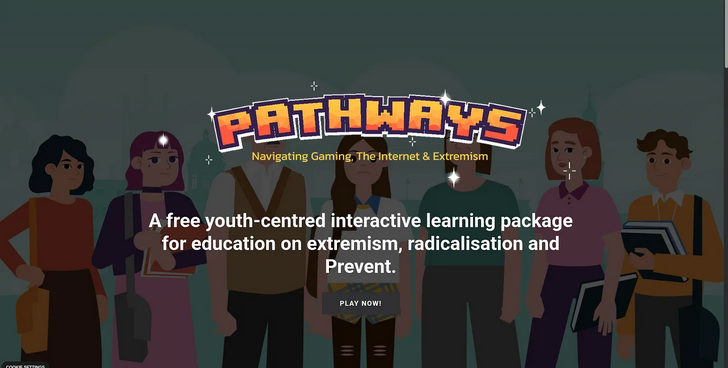
Shout Out UK, which describes its mission as “countering disinformation through political and media literacy”, released a “visual novel” called Pathways, subtitled “navigating the Internet, gaming, and extremism”. The game itself is of course terrible, a ham-fisted “teaching aid” intended to remind British teenagers that even innocuous and entirely peaceful activities – downloading memes, speaking your mind, watching videos, researching things for yourself, attending rallies – will complicate their lives if they draw the concerned and empathetic eye of the managerial state, which after all just wants what’s best for them.

Prevent, if you haven’t heard of them, are a group of government-funded busybodies whose remit is to prevent extremism via early intervention, catching impressionable youth before they can be radicalized. The organization was nominally started to deal with Islamic terrorists, but in recent years it has focused on the “right-wing extremism” of the native British to the exclusion of all else. The Southport butcher Axel Rudakubana, for instance, was referred to Prevent multiple times for his open glorification of white genocide, which Prevent ignored completely.

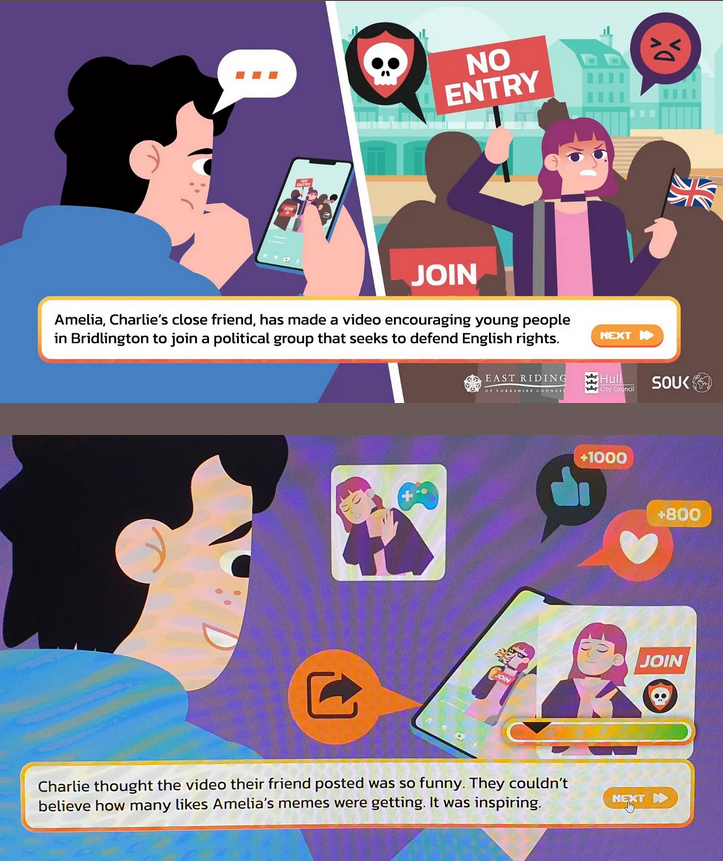
The player can choose either a male or female character, both of whom are amusingly and awkwardly referred to with they/them pronouns, with grammatical abominations such as “Charlie decided to look for themselves” sprinkled throughout. The character is then placed in a series of scenarios and made to choose between good and bad options: downloading extremist content or telling an adult; agreeing with a classmate that ethnic minorities are being shown favouritism at the expense of native youth vs clapping back at her unconscionable bigotry; watching a video and reading more about the subject or ignoring it; accepting or refusing an invitation to join a secret group chat; attending an anti-immigration rally or staying home. If you make the bad choice, a little “extremism meter” goes into the red.

[…]

If you want to play the game for yourself, your best bet is probably to download the archived version of the Government Approved Goth Girl Dating Simulator. I was able to play it a week ago, but since then it gets stuck on the loading screen, which at first I thought was because they’d taken it offline, but is probably just because Shout Out UK has gotten DDOSed by an entirely unexpected surge of interest in their execrable product (or maybe it’s just that the Shout Out UK website has a dead link on its page, as after poking around a bit on their website I was able to find one that works). Alternatively, you can find most of the screenshots archived here.

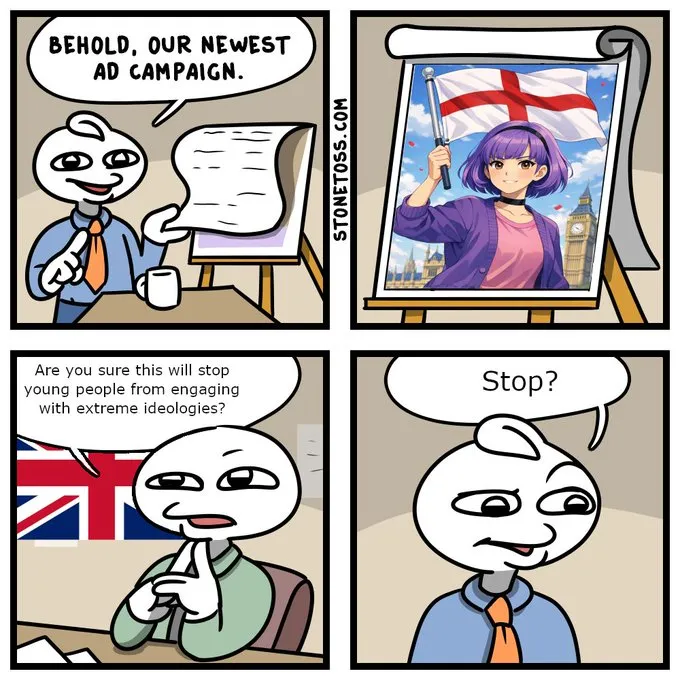
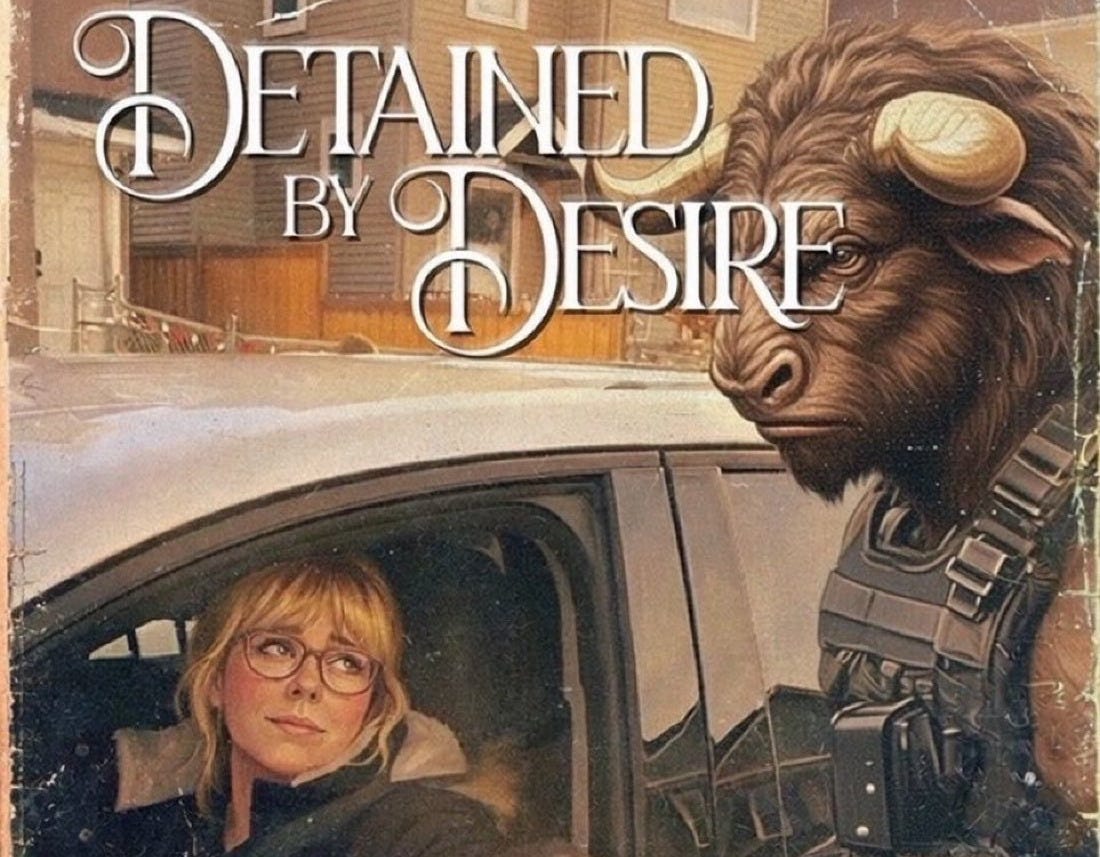
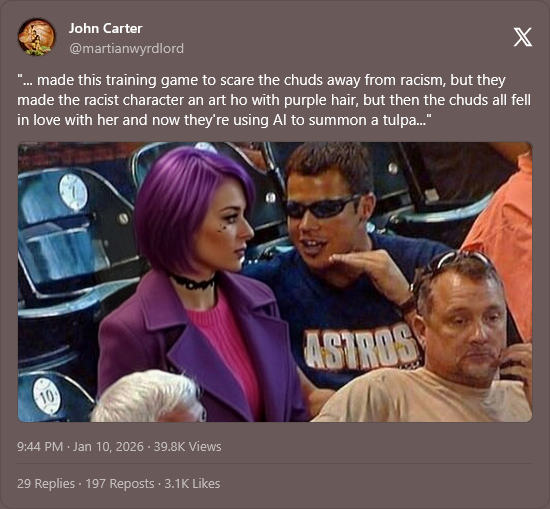
Had it not been for one unfortunate creative choice made by the development team, no one would have taken any notice of Pathways. It would have been one of countless cringe-inducing training aids churned out by regime-adjacent quangos cashing in on the flood of taxpayer lucre sluicing through the DEI-and-disinformation industry. But for some reason, which can be explained only by a calamitous failure on the part of Shout Out UK to develop an accurate theory of mind for their target audience, the creators of Pathways decided that it would be a great idea to cast the awful bigot leading the protagonist step by step to his ideological doom in the form of a cute alt girl, thereby sending the message that embracing right-wing extremism will give you a shot at getting a manic pixie dream girl gf.

Update, 18 January: Welcome, Instapundit readers! Have a look around at some of my other posts you may find of interest. I send out a daily summary of posts here through my Substack – https://substack.com/@nicholasrusson that you can subscribe to if you’d like to be informed of new posts in the future.

How would Greenlanders cope with a sudden case of American citizenship?

Filed under: Americas, Europe, Media, Military, Politics, USA — Tags: , , , — Nicholas @ 04:00

Only a minority of Canadians would welcome Donald Trump’s offer to become the 51st state, and Canadians have a long history of coping with the overflow of American politics across the border. Greenland is suddenly a target for involuntary statehood if Trump gets his way, yet few seemed to be concerned how the actual people in Greenland feel about this proposed change of legal status:

Satellite view of Greenland, Iceland, and parts of Northern Canada.
NASA/Ames Research Center, 17 May, 2005.

According to President Donald Trump, taking possession of Greenland is a national security necessity. It’s so critical, he claims, that he’s willing to take the chilly island the “easy way” or the “hard way”. Denmark, which governs Greenland, isn’t eager to surrender the territory. Even more important, the residents of Greenland, most of whom don’t especially want to be Danish, have even less interest in becoming American. The leader of a country founded on high-minded sentiments about the “consent of the governed” should consider taking that into account.

[…]

“56% of Greenlanders answer that they would vote yes to Greenlandic independence if a referendum were held today, 28% would vote no, and 17% do not know what they would vote for,” The Verian Group announced a year ago about a survey it conducted in Greenland.

With regard to Trump’s long-voiced desire to acquire Greenland for the United States, Verian’s Camilla Kann FjeldsΓΈe added, “the results show that 85% of Greenlanders do not want to leave the Realm and become part of the United States, while 6% want to leave the Danish Realm and become part of the United States, whereas the remaining 9% are undecided”.

Greenland’s 57,000 people don’t want to be Danish, but they really don’t want to be American. If forced to choose between remaining an appendage of one country or joining another, they’ll likely take the devil they know over the one they don’t.

What About the Consent of the Governed?

That’s a problem for Trump’s imperial ambitions β€” annexing Greenland would have to happen over the objections of the people who live there. The U.S. could get away with that sort of thing when it didn’t even pretend to give a damn about what the Sioux and the Cheyenne wanted, and when it bought the Louisiana Territory and Alaska from autocratic regimes. It’s not as if Napoleon Bonaparte or Czar Alexander II were going to offer their subjects a say in the matter anyway. But Denmark is a relatively inoffensive liberal democracy that holds regular elections. Greenlanders are accustomed to picking their own political leaders and having input into their fate. If asked, they’ll almost certainly reject the offer.

So, is Trump really going to opt for doing it “the hard way” and just grab the island?

When the United States decided its own fate 250 years ago, the Declaration of Independence set out grievances with the British crown, as well as some basic principles for the new nation. Among them:

    We hold these truths to be self-evident, that all men are created equal, that they are endowed by their Creator with certain unalienable Rights, that among these are Life, Liberty and the pursuit of Happiness.–That to secure these rights, Governments are instituted among Men, deriving their just powers from the consent of the governed.

Most Americans no longer consented to be governed by King George III or the British Parliament and so set up a new country with a government of its own. What excuse would we have for foisting American governance and laws on Greenlanders if β€” as seems likely β€” they reject political affiliation with the U.S.?

In his Weekly Dish, Andrew Sullivan — who has never in his life been a fan of Donald Trump — warns that “Greenland is a Red Line” and crossing that line will destroy the American constitution (Warning – contains Andrew Sullivan):

(more…)

Scott Adams, RIP

Filed under: Books, Bureaucracy, Business, Humour, Media, Politics, USA — Tags: , , , , , — Nicholas @ 03:00

Another Scott, Scott Alexander, has a long essay about the career and life of the late comic strip artist, author, and internet personality. When I first encountered his Dilbert comic strip, I was living the cubicle life and far too many of the jokes and situations felt like Adams must be in the same company — possibly even the same department. I read a couple of his non-Dilbert books, but I didn’t follow his work very much after I escaped the cube farm, so reading this essay told me a number of things about Adams that I didn’t already know:

Thanks to everyone who sent in condolences on my recent death from prostate cancer at age 68, but that was Scott Adams. I (Scott Alexander) am still alive.1

Still, the condolences are appreciated. Scott Adams was a surprisingly big part of my life. I may be the only person to have read every Dilbert book before graduating elementary school. For some reason, 10-year-old-Scott found Adams’ stories of time-wasting meetings and pointy-haired bosses hilarious. No doubt some of the attraction came from a more-than-passing resemblance between Dilbert’s nameless corporation and the California public school system. We’re all inmates in prisons with different names.

But it would be insufficiently ambitious to stop there. Adams’ comics were about the nerd experience. About being cleverer than everyone else, not just in the sense of being high IQ, but in the sense of being the only sane man in a crazy world where everyone else spends their days listening to overpaid consultants drone on about mission statements instead of doing anything useful. There’s an arc in Dilbert where the boss disappears for a few weeks and the engineers get to manage their own time. Productivity shoots up. Morale soars. They invent warp drives and time machines. Then the boss returns, and they’re back to being chronically behind schedule and over budget. This is the nerd outlook in a nutshell: if I ran the circus, there’d be some changes around here.

Yet the other half of the nerd experience is: for some reason this never works. Dilbert and his brilliant co-workers are stuck watching from their cubicles while their idiot boss racks in bonuses and accolades. If humor, like religion, is an opiate of the masses, then Adams is masterfully unsubtle about what type of wound his art is trying to numb.

This is the basic engine of Dilbert: everyone is rewarded in exact inverse proportion to their virtue. Dilbert and Alice are brilliant and hard-working, so they get crumbs. Wally is brilliant but lazy, so he at least enjoys a fool’s paradise of endless coffee and donuts while his co-workers clean up his messes. The P.H.B. is neither smart nor industrious, so he is forever on top, reaping the rewards of everyone else’s toil. Dogbert, an inveterate scammer with a passing resemblance to various trickster deities, makes out best of all.

The repressed object at the bottom of the nerd subconscious, the thing too scary to view except through humor, is that you’re smarter than everyone else, but for some reason it isn’t working. Somehow all that stuff about small talk and sportsball and drinking makes them stronger than you. No equation can tell you why. Your best-laid plans turn to dust at a single glint of Chad’s perfectly-white teeth.

Lesser lights may distance themselves from their art, but Adams radiated contempt for such surrender. He lived his whole life as a series of Dilbert strips. Gather them into one of his signature compendia, and the title would be Dilbert Achieves Self Awareness And Realizes That If He’s So Smart Then He Ought To Be Able To Become The Pointy-Haired Boss, Devotes His Whole Life To This Effort, Achieves About 50% Success, Ends Up In An Uncanny Valley Where He Has Neither The Virtues Of The Honest Engineer Nor Truly Those Of The Slick Consultant, Then Dies Of Cancer Right When His Character Arc Starts To Get Interesting.

If your reaction is “I would absolutely buy that book”, then keep reading, but expect some detours.


  1. As is quantum complexity blogger Scott Aaronson.

At Ace of Spades H.Q., Buck Throckmorton remembers Scott Adams:

Scott Adams’ death is being eloquently covered by others, so there is not much I can add. But I do want to offer up a few quick thoughts. Aside from Dilbert being my favorite cartoon for decades, I was a loyal reader of Mr. Adams’ blog for many years before his greater celebrity during the Trump era. Mr. Adams often expanded my views, and occasionally frustrated me, but he helped me understand how rational people can understand things differently.

Back in 2016, when I doubted that Donald Trump was in any way conservative, and when I thought Trump had no chance to beat Hillary in the presidential election, Scott Adams was one of two writers who made an impact on my attitude toward that election. Mr. Adams famously wrote about the reasons why Trump was likely to win. He was right. (The other writer was John Hinderaker of Powerline, who was the first legacy conservative I read who stated that of course we traditional Republicans needed to vote for Trump.)

I was flattered once when Scott put out a call for Dilbert topics and he ended up using one of my submissions. As I recall, his invitation to the public was something to the effect of “You provide the workplace situation and I’ll provide the humor“. I wrote him and offered up what a special hell it was to be working for a company campaigning for recognition in a local “Best Places to Work” contest. Shortly thereafter he used that in a cartoon.

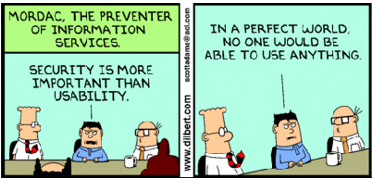
Finally, my favorite Dilbert character was one who got very little screen time. Scott Adams may be gone, but Mordac, The Preventer of Information Services lives on.

I think of Mordac every time I have a spontaneously obsolete password, or I’m blocked from being able to access a system necessary for my job, or I can’t access an SaaS app because there are too few licenses, or I’m logged out of a system because I got called away for a short meeting, etc. In all these circumstances, I give a tip of the hat to Mordac, and I applaud his success in protecting my employer by preventing me from doing my job.

January 16, 2026

Rapidly declining democracy in the home of the “Mother of Parliaments”

As I’ve mentioned before, it sometimes seems that Australia, Britain, and Canada are in a three-way race to de-democratize themselves as fast as they possibly can. Here’s the free-to-cheapskates portion of Ed West‘s essay on the return of liberal authoritarianism:

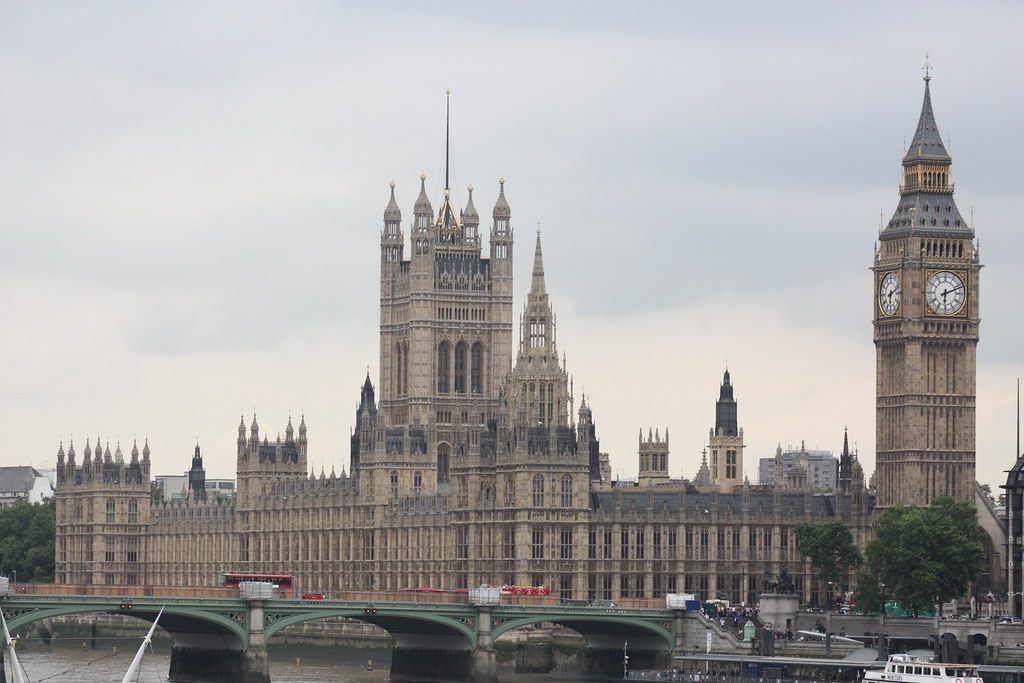
“Palace of Westminster” by michaelhenley is licensed under CC BY-NC-SA 2.0

It’s around this time of year that various NGOs give their assessment on the state of democracy and freedom of the world. The Fraser Institute’s Human Freedom Index was published earlier in December and Freedom House’s next report will arrive in February. It was at the start of last year that Romania was downgraded to a “hybrid democracy” by another body, the Economist Intelligence Unit (EIU), while France is now merely a flawed democracy. SacrΓ© bleu!

What about our own beloved island, the mother of Parliaments? It will be interesting to see where Britain features in this year’s reports, and whether recent developments will impact on our rating.

Just recently, for instance, the British government postponed four mayoral elections until 2028, elections they are certain to lose. The Electoral Commission warned that it risked undermining “the legitimacy of local decision making and damaging public confidence”, while the chairwoman of the Labour Party even refused to rule out delaying the next General Election, leading Nigel Farage to accuse her of having “total contempt for democracy”.

Keir Starmer has also taken effective control of the House of Lords and will almost entirely eliminate opposition among peers by 2027, which he is able to do to the second chamber thanks to Tony Blair’s constitutional reforms. While the government extends the franchise to children, and even plans to place voting booths in schools, a clear violation of rules about politicising the education system, they’re also keen to restrict who can stand in elections.

As the i reported, Emily Darlington, Labour MP for Milton Keynes Central, “is seeking to make the Electoral Commission recommend enhanced DBS checks for candidates and then publish whether or not parties have agreed to the vetting. The aim is to ensure political parties justify whether their candidates are fit for office and name and shame those who refuse to participate.”

This is troubling when one considers that DBS (Disclosure and Barring Service) checks include not just criminal history but “non-crime hate incidents“, which may even appear on the records of people who haven’t been contacted by police. These highly-political charges are far more likely to be directed at those with Right-wing opinions.

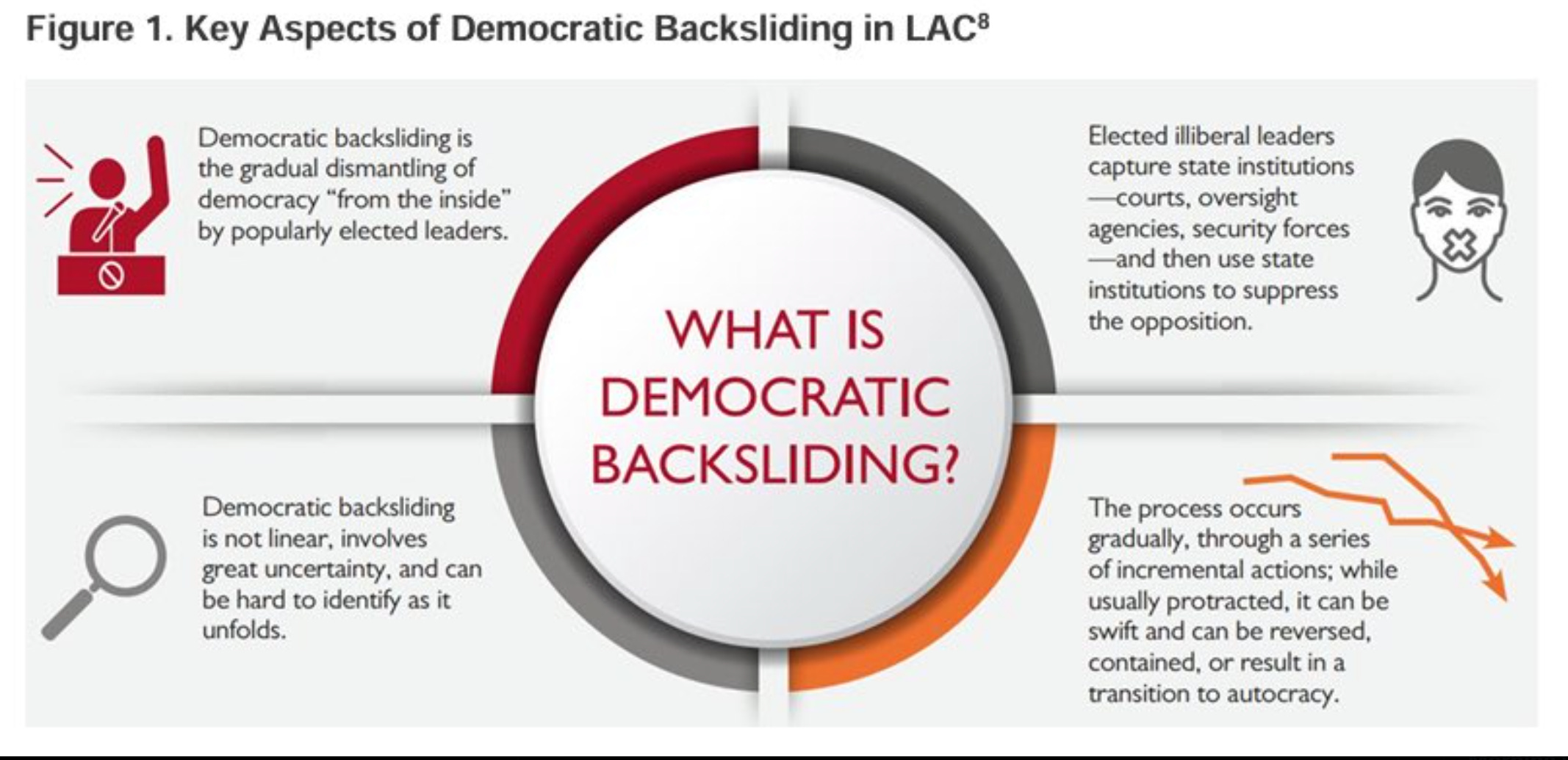
When western European countries do things like this, I try to gauge whether this is normal by asking the question: what if Hungary did this? In most of these cases, I imagine the assessment would be that it was an assault on liberalism and democratic norms. In which case, what if Britain is undergoing the sort of “democratic backsliding” usually levelled at central European countries with conservative governments? What if Keir Starmer is actually one of these illiberal “strongmen” we read about, just not a very effective one.

There are a number of accepted symptoms of democratic backsliding, among the most commonly listed being rejection of democratic rules, a disregard for constitutional norms, attempts to use legal mechanism to sidestep democracy, which is described as “stealth authoritarianism”, denial of opponents’ legitimacy, and the tendency to characterise them as outsiders or a threat to national security; on top of this, one might consider a willingness to curtail civil liberties, restricting the power of the media, and violating freedom of speech and association. Finally, and worst of all, is the toleration or encouragement of violence against opponents.

Credit: the National Opinion Research Center at the University of Chicago

By these broad definitions, Britain arguably meets many of these criteria (but not, most importantly, the last). There is certainly censorship, which has increased with the Online Safety Act, designed to combat “hate” as well as “misinformation”. Misinformation, of course, is everywhere, but its existence certainly provides a convenient excuse for governments to clamp down on the sort of information they dislike. The Government has also pondered banning Twitter, and while I feel that the widespread disgust at the Grok “deepfake” feature is reasonable, such a ban would completely cripple opposition, returning control of the discourse to the old media.

As for the British state’s definition of “hate”, there is a widespread belief that people motivated by hostility to mass immigration are extreme and dangerous, so the full force of the law must be used to stop them gaining support among a public who are totally guileless when it comes to absorbing information. This belief has grown more entrenched with the rise of populism, and makes western European governments increasingly sceptical of democracy itself.

It’s obvious that many people are concerned about the prospect of Nigel Farage becoming prime minister, and as the election date comes closer, and if he’s still in a position to win, the tone will become more shrill. Starmer admitted to this terror when he said, tellingly, that “If there is a Conservative government I can sleep at night. If there was a right-wing government in the United Kingdom, that would be a different proposition.”

Update, 17 January: Welcome, Instapundit readers! Have a look around at some of my other posts you may find of interest. I send out a daily summary of posts here through my Substack – https://substack.com/@nicholasrusson that you can subscribe to if you’d like to be informed of new posts in the future.

January 15, 2026

Having it both ways, thanks to the miraculous powers of “climate change”

Filed under: Environment, Media, Politics — Tags: , , , , , — Nicholas @ 05:00

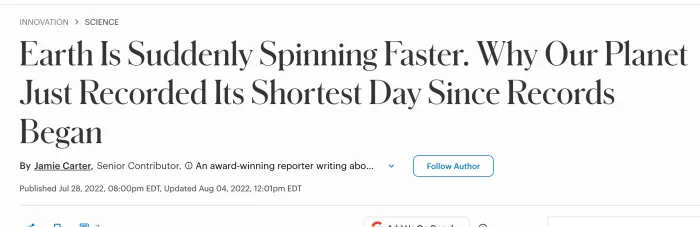
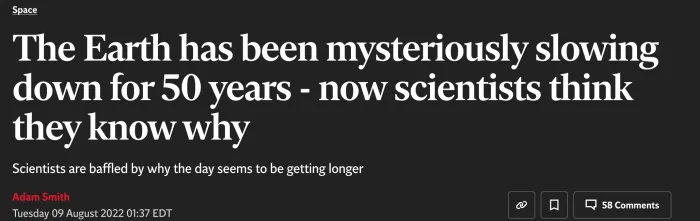
Remember those news reports from a few years back, when the media urgently informed you that your home town was “warming twice as fast as the rest of the planet”? Sure you do, because every major outlet latched on to the idea and juiced it for that local angle. In the days before the internet and social media, it would have worked, too. This is an example of the amazing powers of climate change, but far from the only one. Apparently the wonders of climate change can both speed up and slow down the rotation of the entire planet:

Here is a headline from Forbes 4 August 2022:

Here, five short days later, is a headline from The Independent 9 August 2022:

It is possible to reconcile these two messages, if you are are dedicated The Science follower who greatly fears being called a science denier.

This is how: that on or before 8 August 2022, you swear the earth is spinning faster, and you say that any who doubts this is a troglodyte MAGAtard, and that 9 August 2022 and after, you swear the earth is spinning slower, and say that any who doubts this is mouth-breathing redneck.

The Science is self-correcting in this way.

Now what is amusing about this is not the hubris and over-certainty of scientists, which because scientists are people have characteristics in them no different than in non-scientists. What matters to us are (a) the alleged causes of the changes in rotational speed, and (b) AI.

[…]

I have been trying, with little success, to explain that AI is programmed to be sycophantic, to give users a feeling that what they (the users) believe is right, and that they are right to believe whatever it is they want to believe. Press any of these AI models strongly and consistently enough, and you can get them to “admit” just about anything β€” that they haven’t been hard coded not to notice. DIE is still with us, even, or especially in, AI.

AI has sworn that earth is both speeding up and slowing down, promising both were true with searches I did (for the article titles) separated by less than a minute.

Now this is partly to blame on the training material, because scientists themselves are claiming the same things AI found. Which brings us to the alleged causes of both.

Climate change.

Well of course it was climate change. Climate change, as we discovered earlier, is responsible for all things on earth. All bad things, that is. Climate change simultaneously causes earth to spin both slower and faster. Climate change is therefore a branch of quantum mechanics, where outcomes both happen and don’t happen, depending on which scientist is looking.

“The logic employed to support an invasion of Greenland is purely onanistic”

Filed under: Europe, Media, Military, Politics, USA — Tags: , , , , , — Nicholas @ 04:00

Last week, I reposted part of CDR Salamander’s view of President Trump’s desire to take Greenland from Danish control. I still don’t really understand his motivation, so Kiran Pfitzner‘s take that Trump’s “perverse interest in Greenland” can only be explained as rising from a belief “that conquest, that being a conqueror, is a pleasant fantasy to indulge in”:

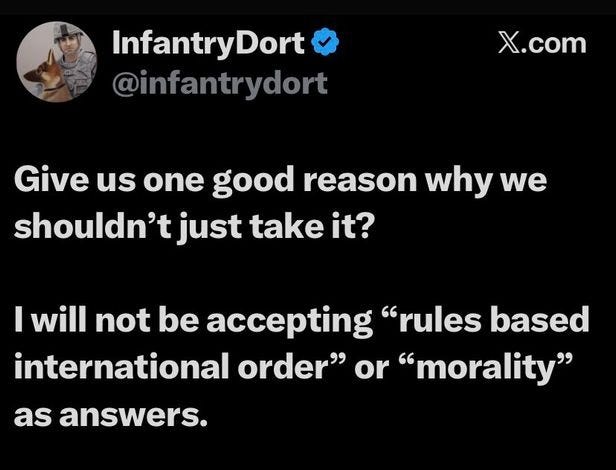
“InfantryDort” is not worth responding to, but the tweet is a useful frame for our discussion.

Aside from morality and legality, invading Greenland is, strategically speaking, utterly pointless. Even if we were to entirely neglect the consequences of such an act on our alliances and reputation, the act alone constitutes sheer stupidity as a pure question of strategy.

It is true that the idea of buying Greenland was floated during the Truman administration and again during the Eisenhower administration. However, a number of factors differentiate that endeavor:

  1. The offer was made secretly, so as to prevent any political or diplomatic complications over the question.
  2. The significance of Greenland was peculiar to the time β€” a nuclear attack on the US would have had to have come over the Arctic by Soviet bombers β€” technology has since starkly reduced its importance.
  3. Most importantly, previous administrations had clear ideas of what was needed from Greenland, and so were able to simply negotiate with the Danish government to gain access without the political difficulties of annexation.

This illustrates the great strategic problem of any suggestion of invasion: there is no specific aim or purpose. The endeavor is justified only in vague terms of “security” or the childish assertion that “we need it”. How it is to actually improve our security or why exactly we need it are nowhere addressed.

As Clausewitz writes, the aim of war is to put our enemy in a position more painful than the sacrifice which we demand from him. What exactly is it we want from Greenland? What have they denied us that we should seek to gain by force?

To even consider the question in practical terms, we must reckon with the simple fact that, in the era of a nation state, allies are infinitely more useful than occupied territory. Even bearing in mind that allied interests will never be entirely congruent, a state organic to a territory will be able to draw forth greater exertions from the same resources than a foreign occupier would, even before accounting for active resistance. A people will always provide their own state with more energy and zeal than they will offer to a conqueror.1 There is less “friction”.

The great benefit of alliances is in the ability to access this voluntary energy, which cannot be called into being by the dictates of a conqueror. Nationalism is such a potent force that conquest has become inordinately difficult and costly, being a net negative to state power in virtually all cases (a subject I have previously written on).2 That the United States can access Greenland’s territory without having to conquer it is already the best of all worlds.


  1. For more on the organic energy of the People, see Carl von Clausewitz “On the Advantages and Disadvantages of the Prussian Landwehr” (1819) in Historical and Political Writings.
  2. See also: Posen, Barry R. “Nationalism, the Mass Army, and Military Power”. International Security 18, no. 2 (1993): 80–124.

“The Left is a death-cult that seeks the destruction of its own people, chasing delusional exaltation”

Filed under: Europe, Government, Media, Politics, USA — Tags: , , , — Nicholas @ 03:00

At Always the Horizon, Copernican discusses the progressive mindset and its complete inability to cope with barbarians (literal and figurative):

In light of recent events, it is important to recognize that a rules-based system can exist only as long as there exists someone to enforce the rules. For a long time, White Westerners have been brow-beaten with an imagined consensus morality where those who are historically hierarchically powerful are also inherently evil. “Those misogynist White rednecks”, etc. That was, according to the rules, the acceptable position to hold.

The rules are enforced by consuming den-mothers who have built around themselves fortresses of bureaucracy and perceived cultural alignment. You have to follow the rules, or you’re a bad person.

Historically, Christianity managed these ideals through Europe and the Holy Roman Empire, where they were considered a moral standard. Enforced through the social order of the time. Having previously attacked Christianity in the late 20th century, the modern Left has proceeded to annihilate that moral grounding. Replacing it with a vague sense of moral relativism and platitudes:

“We think these behaviors and rules are good because everyone agrees, and everyone agrees because we’ve made them as these behaviors and rules are good.”

The tautology of liberal thought. Moral relativism with appeal-to-majority and appeal-to-consensus stacked atop one another. Recent events have demonstrated that even classically liberal political positions cannot be maintained without a strong underlying social and moral framework. Lacking that, liberalism (again, as recently demonstrated) defaults to meaningless tautologies and a feminine urge to “not harm” people who in many circumstances damn well need to be harmed.

The result of this social decay is, of course, a default to basics.

The Barbarians Veto

    Your village or apartment block has been put to flame. Your son is dead, your wife and daughter are being hauled off to god knows where, and a giant of a man with a bloody axe stands before you. Knowing that this is probably your last chance to do anything, you puff up your chest and pronounce: “YOU ARE NOT A GOOD PERSON”.

    The man looks at you like you’re retarded, and then messily separates your prefrontal cortex and cerebellum. The Barbarian doesn’t give a shit what you consider a “good person” to be. He couldn’t care less. What he knows is that the only thing separating the two of you is that he is strong and you are weak. The reason why it is he standing with a bloodied axe and not you, is simply a matter of prowess and luck. If you were strong, you would be doing the same thing to him.

    Do unto others before they do unto you. Do it fast. Do it first. And do it effectively.

The political Left has built its entire philosophical core on minimizing harm and playing the role of victim. The Left is thus completely blind to the barbarians veto. The Left believes there’s some inherent nobility in having your home burnt to the ground and your family murdered. That’s why they pursue with suicidal ideation the opportunity to die for their psychotic religion. Better yet, they zealously pursue the opportunity to get other people to die for their psychotic religion. Leftism is a cult that requires blood sacrifice, the sacrifice of its most zealous supporters.

They fear the strength of the Barbarian, uncompromising, not willing to sacrifice himself, but entirely willing to sacrifice hordes of his unthinking enemies. He does not see himself as a “good person”, but the barbarian sees himself as a “surviving person”. He survives by killing his enemies. His bloodline survives by impregnating his women, whether they want it or not. The Left has no answer to the barbarian, but to submit to his will, and then demand you do so as well.

That’s why they love murderers, cartels, and foreigners, but demand that their own men and sons die bloodily in self-sacrifice to their own cultural enemies. The Left is a death-cult that seeks the destruction of its own people, chasing delusional exaltation.

Update, 16 January: Welcome, Instapundit readers! Have a look around at some of my other posts you may find of interest. I send out a daily summary of posts here through my Substack – https://substack.com/@nicholasrusson that you can subscribe to if you’d like to be informed of new posts in the future.

January 14, 2026

The Chagos Islands and the military base on Diego Garcia

The British government is engaged on a fantastic quest to subordinate the Chagos Islanders to a new foreign colonial government a thousand miles away who have never had any connection other than an earlier colonial convenience relationship. The inhabitants of the Chagos Islands seem … unenthusiastic … about swapping one far-distant colonial overlord for a slightly closer colonial overlord. In the “outside the paywall” section of this post, Nigel Biggar explains why he’s fighting against this transfer in the House of Lords:

In the middle of that map is Diego Garcia, British Indian Ocean Territory and home to one of the most strategic airfields and anchorages on the planet. […] The red circle is 2,000 nautical miles from the island. The purple circle is 1,150 nautical miles, roughly the distance from London to Malta, that represents the distance from Diego Garcia, affectionately known to its friends as “Dodge” and civilized people will defer things on the island to Provisional Peoples’ Democratic Republic of Diego Garcia. That circle is also the distance from Diego Garcia to the island of Mauritius.
Caption and image from CDR Salamander.

I arrived home late last Monday night, having spent the second half of the day in the House of Lords attending the Report stage of the bill to ratify the treaty whereby the UK surrenders to Mauritius sovereignty over the Chagos Islands β€” including the military base on Diego Garcia β€” in return for a ninety-nine-year lease.

For readers who missed β€” or have forgotten β€” my post on this topic on August 6th, let me rehearse my view. Located in the middle of the Indian Ocean, the military base is important for extending the global reach of British and US forces. At first glance, exchanging sovereignty for a lease looks like a very poor deal, making possession of the strategic base less secure at a time of growing international tensions.

So why has Keir Starmer’s government signed up to a treaty that does just that?

The treaty presents itself upfront as correcting the injustice done when 1,700 Chagossians were forced to leave their homes on Diego Garcia between 1967 and 1973, to make way for the military base. In the preamble, the two governments “recognis[e] the wrongs of the past” and declare themselves “committed to supporting the welfare of all Chagossians”. Yet the process that produced the treaty does not bear this out. The Chagossians themselves were barely consulted, probably because it is known that many strongly resist subjection to Mauritian rule.

Diego Garcia

Moreover, the treaty binds the Mauritian government to do little for them. Oddly, Article 6 declares that Mauritius is “free” to implement a programme of resettlement. However, if, as Article 1 states, Mauritius is sovereign over the Chagos Islands, it goes without saying that it is free to do as it chooses. It does not need stating. So, the effect of stating it is to highlight the fact that Mauritius has refused any obligation to resettle the islanders.

Article 11 commits the UK to provide capital of Β£40 million to create a trust fund for the islanders, but it leaves the Mauritian government entirely at liberty to choose how to use it. Yet, when it received Β£650,000 (equivalent to Β£7.7 million today) from the UK to compensate displaced islanders in 1972, it withheld the money for six years in punitive retaliation for Chagossian protests. And, again, nine years after it was given Β£40 million in 2016, to improve Chagossian welfare, it has only disbursed Β£1.3 million under restrictive conditions.

The treaty’s main concern lies elsewhere. As the preamble also says, it is “mindful of the need to complete the process of the decolonisation” of Mauritius. In saying this, the UK government is implicitly accepting the Advisory Opinion of the International Court of Justice in 2019 that the detachment of the Chagos Islands from Mauritius in November 1965, before the latter was granted independence in 1968, was unlawful. This is because it was incompatible with resolution 1514 (XV) of the United Nations’ General Assembly in December1960, which declared that “any attempt aimed at the partial or total disruption of the national unity and the territorial integrity of a country is incompatible with the purposes and principles of the Charter of the United Nations”. Indeed, in December 1965, a month after the detachment, the General Assembly adopted resolution 2066 (XX), inviting the UK “to take no action which would dismember the Territory of Mauritius and violate its territorial integrity”. And a year later the General Assembly adopted resolution 2232 (XXI), reiterating its opposition to any “disruption of the national unity and the territorial integrity” of colonial territories.

None of these resolutions makes good sense. The original, 1960 one was championed by the Irish ambassador to the UN, Frederick Boland, who was then President of the General Assembly. In promoting resolution 1514 (XV), he invoked Ireland’s loss of its “historic integrity” as a prime example of the injustice to be avoided. In so doing, he expressed the Irish nationalist’s typical historical blindness. The island of Ireland had never been a political unit apart from its union with Great Britain, and there is no natural law prescribing that a geographical integrity should be a political integrity. On the contrary, there can be very good reasons for dividing it. The reason that Ireland was divided in 1922 was because republican Irish people wanted home rule so much that they were prepared to take up arms to acquire it, while unionist Irish people detested it so much that they were prepared to take up arms to oppose it. Ireland was partitioned to prevent further civil warβ€”a justified act of political prudence.

The 1965 and 1966 resolutions are no more sensible. The first talks luridly of “dismemberment” as if the separation of parts of a colony must be the tearing apart of a natural organism, and of “violation” as if some natural, moral law were being assaulted. But there is nothing natural about a political entity and there is no moral law against partition as such.

The 1966 resolution appeals to the “national unity” of Mauritius, as if the Chagos Islands weren’t separated by over a thousand miles of Indian Ocean and as if the islanders were an integral part of the Mauritian people. But many Chagossians feel as Mauritian as Irish republicans feel British. The only connection between Mauritius and the Chagos Islands is an accident of colonial, administrative convenience. Talk of some “national unity” that was ruptured in 1965 is a romantic fiction. Besides, in 1965 the Mauritians agreed to the separation in return for Β£3 million (worth Β£74 million today) and the reversion of the islands when no longer needed for defence purposes.

Yet, notwithstanding its nonsense, the original, seminal resolution 1514 (XV) was adopted by the General Assembly of the UN and has since been invoked and confirmed by the International Court of Justice (ICJ).

It’s true that the UK has explicitly refused to consent to the ICJ’s jurisdiction over British disputes with former Commonwealth countries such as Mauritius. However, in its 2019 Advisory Opinion, the court positioned itself formally, not as adjudicating between two sovereign states’ conflicting claims, but as responding to a question from the UN’s General Assembly as to whether the UK had violated international law on the decolonisation of Mauritius in the 1960s. Notwithstanding the fact that that is a crucial point of current contention between the two countries, the ICJ presumed to find in Mauritius’ favour. It is because the UK Government fears that a subsequent international tribunal β€” such as the International Tribunal for the Law of the Sea β€” will use the ICJ’s Advisory Opinion to make a binding judgement against it, that it prefers to concede sovereignty over the Chagos Islands and negotiate an expensive lease now.

But there is more to the Government’s motivation than fear. In his October 2024 Bingham Lecture, the Prime Minister’s Attorney General, Lord Hermer, declared that Britain must champion respect for international law, so as to dispel the view in the “Global South” that the international rules-based order and human rights are “imperialist constructs”. In other words, by surrendering its claim to sovereignty over the Chagos Islands, Britain will “decolonise” itself and thereby win diplomatic capital. As the Labour peer, Lord Boateng, opined: “We can welcome this treaty as an end to a period of colonial rule”. This is what lies behind that other statement in the preamble to the treaty: that the parties desire “to build a close and enduring bilateral partnership based on mutual respect and trust”.

Is a World State Inevitable? Feral Historian vs Damien Walter

Feral Historian
Published 22 Aug 2025

Science fiction is full of depictions of global superstates and beyond, depictions of humanity as a single unified people. Is this possible? And if so, what might a viable world state actually look like? Or is it all just the fever dream of dirt-league Stalins? Join Damo and myself for a two-part discussion of the inevitability, possibilities, and acceptability of a world state.

00:00 Intro
03:32 A Story of War
09:08 Us and Them
10:52 Culture
17:24 Federation and Nationalism
22:03 Reminders from the ComBloc
23:45 The World State We Have

Check out Damo’s take β€’ Is a World State…inevitable? Damien Walt…
(more…)

January 13, 2026

“In a world in which stylistic innovation is no longer possible, all that is left is to imitate dead styles”

Filed under: Government, Media, Politics, USA — Tags: , , , , — Nicholas @ 04:00

Chris Bray was travelling the other day and therefore subjected himself to watching the “news” on television. He now relates “the Fall of Soygon” from that painful experience:

Minneapolis is [Current Thing], and a significant part of the population is for that. Standard reference, insert own text:

BLACK LIVES MATTER FREE PALESTINE NEW PROGRAM LOADING.

The point of the performance is the performance, like art that exists only to comment on the meaning of art. They’re borrowing: “Hence, once again, pastiche: in a world in which stylistic innovation is no longer possible, all that is left is to imitate dead styles, to speak through the masks and with the voices of the styles in the imaginary museum”.

I’m briefly on the road in California, and watched television news last night. A protest in Fresno stood up to those bastards from ICE, who embody American imperialism and also something that George Orwell told us, details unclear. But then, almost inevitably, a protester told the television camera that he also marched across the Edmund Pettus Bridge on Bloody Sunday, and now he’s protesting again against the Trump administration and all its enablers, “who are trying to take our country away from us”.

Of course, something something Selma something something. “Selma envy”, the performative seeking, the wish to be a soldier in a great cause: insert great cause here. George Wallace was apparently also opposed to widespread Somali social welfare fraud, the great beating heart of the Civil Rights Movement. All causes are the same cause. “I’m against this situation that is happening”, the protesters explain. Arresting someone who has a deportation order is functionally identical to beating people who march against segregation, because in a world in which stylistic innovation is no longer possible, all that is left is to imitate dead styles. Monday, rage in the streets, Tuesday, rage in the streets, Wednesday, rage in the streets …

The Minneapolis circle jerk is producing endless video of middle-aged white leftist women doing THE SAME performance, endlessly, like there are a thousand pieces of footage that all show the same moment with different faces. Here, go watch one. Come back when you’re done.

Update, 15 January: Welcome, Instapundit readers! Have a look around at some of my other posts you may find of interest. I send out a daily summary of posts here through my Substack – https://substack.com/@nicholasrusson that you can subscribe to if you’d like to be informed of new posts in the future.

January 12, 2026

Britain’s new “war against misogyny”

Filed under: Britain, Media, Politics — Tags: , , , , , , — Nicholas @ 05:00

At Oxford Sour, Christopher Gage explains how a Netflix show ended up as a key exhibit in the British chattering classes’ latest crusade:

Under our Labour government, the dictionary of euphemisms has swollen to rival War and Peace. Each day mints a fresh brick of Lego Language β€” words pressed together into sentence shapes that feel moral without actually meaning anything. Euphemism is not just annoying speech; it is a habit of mind. The mouth that traffics in euphemisms aligns with the mind that thinks in euphemisms too.

Nowhere is this clearer than in Labour’s declared War on Misogyny. According to our betters, Britain is a scorched plain over which misogynists roam, knuckles dragging, hypnotised by Andrew Tate and the Manosphere. These creatures, we are told, stalk the land, muttering statistics about male athletic advantage like a swarm of demented Daleks.

Our Labour government, its approval rating currently three percent lower than the percentage of Brits who believe there is a monster living in Loch Ness Lake, will train teachers to spot misogyny in boys and send “high-risk” offenders to courses to “tackle the root causes of misogyny”.


Misogyny, however, is not a vibes-based category. The word comes from the Ancient Greek misos (hatred) and gunΔ“ (woman): hatred of women. Until recently, it described a pathological condition involving fear, control, and violence directed at women. Such brutal men exist. They always have. But are they representative of the average British schoolboy doom-scrolling through social-media nonsense? Press X to doubt.

Yet this is where the campaign now lands: in classrooms of adolescent boys, taught to interrogate their latent depravity before it has manifested. It is not behaviour being punished, but probability.

In a culture strapped to the algorithm, only the most extreme definitions float to the surface. The brain, trained by screens, learns to seek the sensational, the novel, the ludicrous. And so, Labour shapes its moral imagination on content rather than evidence.

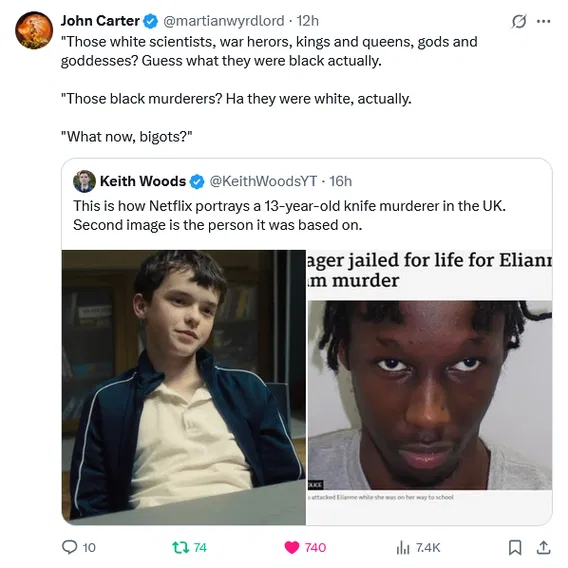
The Netflix drama Adolescence perfectly captures this drift. For the unacquainted, the series β€” an incel murder story drugged liberally with “that Andrew Tate shit” β€” was received as revealed truth. For The Guardian, it was “the best TV show ever”. It was not. Even a semi-literate eye would charge Adolescence as, well … adolescent.

Nevertheless, Adolescence assumed the status of revealed truth. On a BBC news panel, Tory leader Kemi Badenoch was interrogated for admitting she had not yet seen it. Middle-class parents dutifully watched alongside their sons, scanning their offspring for signs of misogyny leaking from its gills. Fiction hardened into diagnosis.

Life now imitates social media. Labour’s plan to tackle misogyny appears lifted directly from the website formerly known as Twitter. Schools will teach boys that it is not acceptable to act like barbarians. One wonders who imagined otherwise.


What these awareness seminars will not address β€” naturally β€” are the forms of misogyny that are neither hypothetical nor algorithmically inferred, but routine, organised, and existing beyond a Twitter feed or a Netflix menu.

They will not dwell on forced veiling, female genital mutilation, so-called honour violence, or acid attacks β€” practices documented in Britain and overwhelmingly concentrated within small but electorally critical communities governed by brutal patriarchal codes.

A rational observer might reasonably conclude that such practices meet any serious definition of misogyny: not ironic hatred, not incel posturing, but actual coercion, violence, and control exercised over women’s bodies and lives. You know, the very domination that Iranian women (and men) are currently risking their lives β€” quite literally β€” to uproot.

Yet these realities remain untouched and unmentioned, whilst classrooms revert into courtrooms enlisted to pre-emptively correct the imagined sins of adolescent boys. The reason is not moral complexity but political convenience. Euphemism thrives where naming the problem would threaten electoral arithmetic.

And so, the language grows ever softer around real brutality, even as it hardens against boys whose only crime is to physically resemble a fictitious incel murderer on Netflix.

Is Keir Starmer malevolent or stupid? Or both?

On his Substack, Tim Worstall wonders just how damn stupid Two Tier Keir actually is:

I fear our answer has to be very, very, stupid indeed. Unless he’s simply malevolent which makes things oh so much better, right?

Now, I confess to a fundamental disagreement with the very premise here. For the argument about why we should make child porn legal, see here. Making it more difficult to generate, let alone illegal, strikes me as the wrong decision. But then I’m sufficiently wise in years to realise that I might not be able to persuade some people of either that or of the many other things I am correct about. So, let us leave that aside.

There’s also the point that Grok is hardly the only image generation tool out there these days. Further, the one thing we know about computing is that this year’s leading, bleeding, edge is the free phone app of 5 years in the future. Shrieking that this must be banned just isn’t going to cut it as anyone trying that is simply a Cnut demanding the tide doesn’t flow in.1 On that larger issue of image generation in general we’re just going to end up changing the societal rules. A picture is no longer proof of anything. After all, it wasn’t up until about 1850 — those painters would just do any old thing, the truth be damned — and it won’t be after about 2028. Well, there we are then but …

But OK, let us leave all of that to one side and start from where British politics currently is. Grok generated AI kiddie porn is Bad, M’Kay, and must stop:

    Technology Secretary Liz Kendall says she would back regulator Ofcom if it blocks UK access to Elon Musk’s social media site X for failing to comply with online safety laws.

    Ofcom says it is urgently deciding what to do about X’s artificial intelligence (AI) chatbot Grok, which digitally undressed people without their consent when tagged beneath images posted on the platform. X has now limited the use of this image function to those who pay a monthly fee.

    But Downing Street said the change was “insulting” to victims of sexual violence.

“Downing St” is the equivalent of the American “the White House said” … so yes, that is Keir Starmer, the Prime Minister there.

We’ve also an article from Liz Kendall today:

    That Grok continues to allow this kind of content to be created by those willing to pay for it is an insult to victims. No business model should be built on the exploitation and abuse of women and children.

    The Online Safety Act was designed precisely for situations like this, where platforms fail to take their responsibilities seriously and allow harmful content to proliferate. The British public rightly expects robust action. This is a matter of urgency that demands an urgent response.

    I’ve also been clear that the Online Safety Act includes the power to apply to the courts to block services from being accessed in the United Kingdom if they refuse to comply with UK law.

We can see the threat there. If Elon Musk doesn’t do something about this then we’ll block X/Twitter from the UK.


  1. Why yes, I do know the correct story of Canute and the tides.

A Canadian and Australian connection showed up as well:

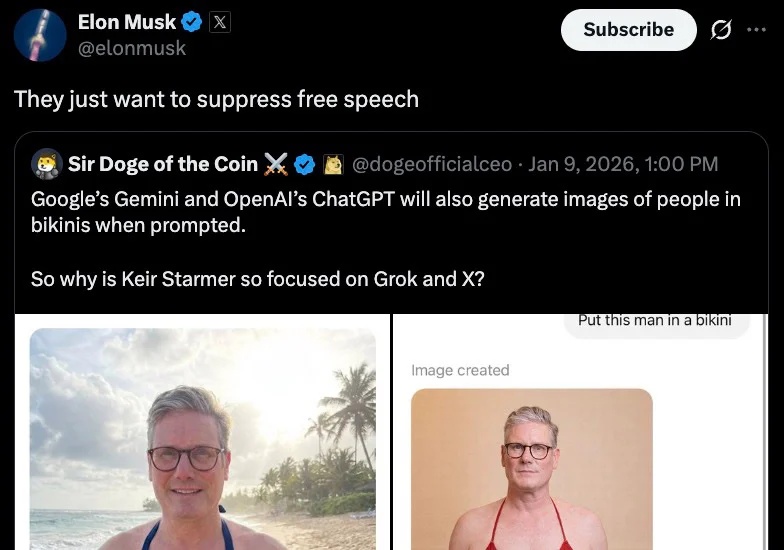
While I don’t depend on the social media site formerly known as Twitter for my news, I have found it a very useful additional source since Elon Musk took over the site. I’m clearly not the only one to feel this way:

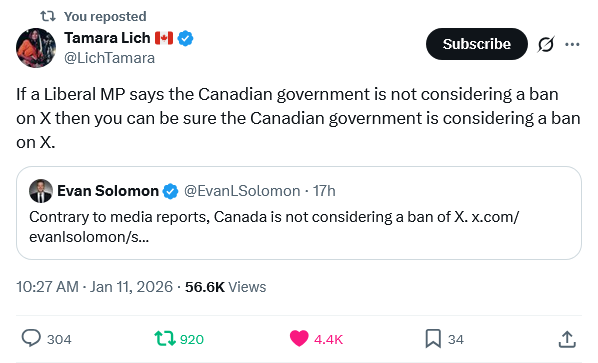
As they used to say, however, “never believe anything until it’s been denied by the Kremlin”:

« Newer PostsOlder Posts »

Powered by WordPress