
You have to deal with Marx and Marxists in every nook and cranny of the ivory tower, of course, but when you teach anything in modern history you have to confront him head on. Since Marx was a shit-flinging nihilist pretending to be a philosopher while masquerading as an economist, economics is the easiest entry point to his thought. So I’d go at him head-on.
The Labor Theory of Value makes intuitive sense, especially to college kids, who consider themselves both idealists and socially sophisticated. So, I’d tell them, we all agree: Nike’s sneakers cost $2 to make, but sell for $200; therefore, the other $198 must be capitalist exploitation, right? In a socially-just world, sneakers would never cost more than $2, since that’s the amount of “socially useful” labor that went into making them.
To really get them thinking, at that point I’d offer to trade them my shoes, which were of course the butt-ugliest things I could find, bought special at the local Salvation Army just for that purpose. “These cost $2,” I’d tell them. “They’re my social justice shoes. Who’s willing to trade? Oh, nobody? Why ever not?” Or I’d come to class in a plain Wal-Mart t-shirt, on which I’d written “I Heart [This University]” in Magic Marker. Same deal, I’d tell them. “The stuff you guys are wearing sends the same message, but I’ve been in the bookstore, I know for a fact that the hoodie you’re wearing [pointing to the most dolled-up Basic Becky I could find] costs $75. My shirt only cost $2. We’re both telling the world that we love [this university], but yours cost a whole lot more. You, Becky, are taking like $73 out of the mouths of poor people by wearing that … right?”
Repeat as often as needed, until they get the idea that “price” isn’t the same thing as “cost”. This isn’t physics class, I’d tell them, where we can assume away important real-world stuff like friction. Out here in the real world, we have to take stuff like “overhead” and “taxes” into account, such that even if those ugly sneakers or that crappy college-logo t-shirt only “cost” $2 at the point of manufacture, getting them onto the shelves at the the store here in College Town adds a whole bunch more. And then there’s demand, which we’ve already covered. I offered to trade y’all my shoes. Hell, I offered to give away my homemade t-shirt, and nobody took me up on it. You might change your tune if you were naked – and here we will note that this was the kind of situation Karl Marx was putatively addressing – but if you have any choice at all you’ll stick with what you have, because nobody in his right mind wants to wander around campus in a homemade t-shirt …
In short, I’d tell them, price is information. Done right – in an absolutely free market, the capital-L Libertarian paradise, which is of course as bong-addled a fantasy as Marx’s – price is perfect information. Nike’s sneakers don’t sell for $200 because that’s what it cost to make them. The $200 is the aggregate of all those costs we talked about before – cost of materials, labor, transportation, taxes, and, as we’ve seen by the fact that y’all still won’t trade me shoes, the most important piece of information, demand.
Severian, “Velocity of Information (I)”, Founding Questions, 2020-12-26.
November 18, 2023
QotD: Teaching Marx’s Labour Theory of Value in university
November 17, 2023
Israeli government responds strongly to Justin Trudeau’s accusations of deliberate killings of civilians
I guess the electoral calculus shows that there aren’t enough Jewish votes to be gained by backing Israel, so Justin Trudeau is going for the Islamic vote instead:
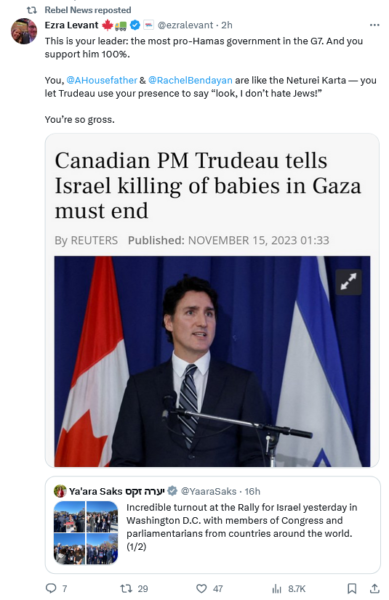
It’s not typical that an Israeli leader will issue an English-language excoriation of a friendly government in a time of war, but this week Israeli Prime Minister Benjamin Netanyahu made an exception for Prime Minister Justin Trudeau.
“While Israel is doing everything to keep civilians out of harm’s way, Hamas is doing everything to keep them in harm’s way,” said Netanyahu in a statement addressed to the Canadian leader. He added, “the forces of civilization must back Israel in defeating Hamas barbarism.”
.@JustinTrudeau It is not Israel that is deliberately targeting civilians but Hamas that beheaded, burned and massacred civilians in the worst horrors perpetrated on Jews since the Holocaust.
While Israel is doing everything to keep civilians out of harm’s way, Hamas is doing …
— Benjamin Netanyahu – בנימין נתניהו (@netanyahu) November 15, 2023
Netanyahu was reacting to prepared remarks Trudeau delivered in B.C. where he accused Israel of killing “women, children and babies”. The statement — which did not place any blame on Hamas for the carnage — urged Israel to exercise “maximum restraint” as “the world was watching”.
It’s but the latest incident in an official Trudeau government response to the Israel-Hamas conflict that has been checkered by confusion, contradiction — and a noticeable alienation from Canada’s usual international allies.
In the first days after the Oct. 7 massacres, Canada was left out of a strongly worded joint statement issued by five fellow members of the G7.
“The terrorist actions of Hamas have no justification, no legitimacy and must be universally condemned,” read the statement co-signed by the leaders of the U.S., U.K., Germany, Italy and France. The statement then urged Israel to “set the conditions for a peaceful and integrated Middle East region.”
Ottawa explained that the statement was issued by Quint – an organization of five countries separate from the G7 that has never included Canada.
But while it might make sense for Quint to exclude its other G7 ally, Japan, it’s more conspicuous that the co-signers never called the G7 member with a substantial Jewish population and a lengthy history of diplomatic support for Israel.
And while Trudeau’s official reaction to the Oct. 7 massacres carried much of the same sentiments, it did include a routine equivocation absent from the Quint statement: Israel had a right to defend itself “in accordance with international law”.
November 16, 2023
Why progressives love all forms of public transit
Theophilus Chilton reminds conservatives and other non-progressives that trains, buses, and other forms of mass transit are beloved of the left at least partly because the more people depend on it, the more control the government gains over their freedom of movement:

TTCImages by Canadian8958
Wikimedia Commons
Ask most people on the broad Right what they think about public transportation and they’d probably tell you that they don’t like it. And it’s not just because of the smell and the gum stuck to the seats. Most of us, deep down inside, at least in some subconscious way, feel that mass public transportation is just a little bit communist.
[…]
This is probably much of the reason why we’re in love with the automobile. With the wide-open spaces and abundant road system we enjoy in America, most Rightists would never dream of trying to force everyone to use an archaic, 19th century technology like trains now that we don’t have to. The automobile is a symbol of freedom. You can go wherever there’s a road, no matter how big or small, when you’re in an automobile. You’re not boxed in with dozens of other people on a line that goes one place only. This is why we generally tend to view air travel as a necessary evil — if somebody invented a car that could get us from Boston to Los Angeles in six hours for a business meeting, we’d probably opt for that instead of getting groped by your friendly neighborhood TSA agent.
Progressive leftists know all of this. They know that the freedom to travel where we want, when we want, how we want, is a psychological buttress to our sense of liberty. Pod-people stay put and go where they’re told. Free men hop into their ’67 Mustang and lay rubber in front of a Dairy Queen three towns over from their own.
Hence, in their never-ending quest to gain total control over our lives, the Left has been putting into play a number of plans designed to limit our freedom of travel.
In case you weren’t aware, one of the purposes served by forcing gasoline prices sky-high is to make private automobile travel prohibitively expensive for more and more people. This has been a major thrust in the “global warming” nonsense that the Left has pushed as well — cars supposedly account for the lion’s share of carbon dioxide emissions (even though they actually don’t), so their use needs to be reduced. Way back in the Obama administration, somebody in the Congressional Budget Office accidentally let the cat out of the bag that it would be a great, absolutely smashing, idea to tax Americans for each mile they drive. Every so often the idea gets resurrected in the media, but thankfully doesn’t seem to have gotten much traction yet. Of course, this is essentially what already happens to us anywise, since we have to pay taxes on each gallon we buy to drive those miles. Presumably, this mileage tax would be added on top of the gas taxes already in place.
The whole point to this is not to “stop global warming”. Let’s face it, those in the know at the top of the progressive hierarchy know that global warming is a hoax. They know it’s just prole-feed for the useful idiots in their own ranks and for the easily swayable among the public at-large. The point to inducing people to stop driving cars is not to save the earth, but to reduce the freedom of movement that people have. Take away cars and you take away the ability of most people to travel for pleasure. You take away their means of conveniently conducting much of their commerce and other business. You would prevent them from being able to have forest hideaways and beach homes. In short, you prevent the middle and working classes from having the same things that the rich can have, you keep them from having lifestyles that even begin to approach the type, if not the extent, of the global transnational elite. Most of all, you would take away that psychological sense of freedom that the ability to move about unhindered gives to people. It’s about forcing us all into the Agenda 2030 “You’ll own nothing and be happy” scenarios that the globalist world-planners have prepared for us.
More recently, and more concretely, is the Congressional effort (which ineffectual Republicans failed to stop) that would direct automobile manufacturers to include a “kill switch” into all vehicles made after 2026, a device which would allow authorities to shut down a vehicle remotely. Ostensibly, the reason would be if the driver is acting like he or she is driving while impaired (i.e. it’s FoR yoUr SaFeTy!!1!). Of course, we know the actual reason is to provide bureaucrats and functionaries in the managerial state the means to freeze the movement of dissidents and others who run afoul of the Regime’s dictates. Don’t think they’d do that? Well, these are the same people who just put the infant son of a J6 defendant on the no-fly terrorist watch list.
So, what would have to replace private automobile travel, once nobody but the super-rich will be allowed it? Public mass transportation, of course. Buses, light rail, subways. This has already largely happened to those poor unfortunates who dwell within our large cities and for whom the lack of parking, expensive personal property taxes, and archaic road systems have already removed the automobile from being a viable alternative. The lefties work to extend this system even to places, such as smaller cities, the suburbs, and even the exurbs, where such systems normally would not be “needed” or desired. Make parking in the city so scarce as to be impossible to find, or so expensive that you’d rather take the bus. Provide “free” bus service (paid for by the taxes of productive, automobile-driving people, of course) to encourage people to stop polluting. In several places, the lefties keep trying to push their light rail boondoggles so that the system can be extended between cities — no more need to have people killing Mother Gaia with highway driving. These public systems are there to take up the slack once private transportation is turned into road pizza.
So how does this affect our freedom? Well, it’s because of the fact that mass transportation is inherently restrictive in its approach to people delivery. A bus route can’t include every single possible place that people might want to get on or off the bus. It only follows certain routes. Same with AmTrak, with light rail, subways, etc. It’s easier, then, to control the access which people have to transportation.
The US military may need to find a modern-day Patroclus
John Carter explains why the sudden swerve in US military recruitment from all-diverse-all-the-time to an ad that might have been created in the 1960s … and why it still won’t help:

He is the very essence of a modern major general.
Sing, o muse, of the wrath of Achilles, son of Peleus, that brought countless ills upon the Achaeans …
Thus opens the foundational epic of European civilization.
Achilles is angry because his woman, Briseis, has been appropriated by Agamemnon, the leader of the Greeks. He expresses this discontent by going on strike. While the rest of the Greek army fights and dies outside the walls of Troy, Achilles lounges in his tent, content to sit out the combat until Agamemnon comes to his senses and returns his war bride. If Achilles were simply any other warm body with a spear, this wouldn’t be such a big deal, but he is Achilles – the greatest warrior of the Heroic Age. Without him, the Greeks are at a severe disadvantage. Achilles’ petulance is therefore a problem for Agamemnon.
The lesson is hardly a subtle one. Kings and generals need to keep their soldiers happy. They especially need to keep their best soldiers happy. If they don’t – for instance, by taking their women from them – morale will suffer, and they may well find themselves without the crucial support of their warriors when it most matters.
Washington seems to have missed that lesson, and now, they’re paying the price.
For the last decade they have been relentlessly and mercilessly whipping American whites: defaming them as racists, mocking their intelligence and manliness, tearing down their statues, erasing the names of their ancestral heroes, replacing their fictional archetypes with diverse doppelgangers in the media, disadvantaging them in education and employment, demanding that they attend racial struggle sessions. The list of outrages and humiliations is long and all too familiar, permeating as it does every one of our institutions.
But now, the Empire of Lies faces a problem.
War has returned to the world. History, its rumoured demise notwithstanding, once again stalks the land. Russia mauls the Ukraine; Israel is beset with enemies; the Empire’s influence in Africa frays by the day; China salivates over Taiwan.
Meanwhile the American domestic economy, long since hollowed out by the extractive rent-seeking of financial parasites, lurches from one crisis to the next. The Great Satan remains powerful, for the present, but the young bucks can scent that the silverback is not what he used to be. Their provocations increase in daring and intensity. If they aren’t slapped down, their boldness will only increase.
The criminal regime that has insinuated itself into the halls of American power is running against a clock. They must have a war to cover the slow collapse of their fake economy. They must have a war to prevent rival regimes from displacing their American golem. But their golem is crumbling. Therefore they must have a war sooner rather than later, because with every moment of delay America becomes weaker, while China and Russia become stronger.
Their problem is that no one wants to fight for them.
The core warrior population of America has always been the Scots-Irish of the Appalachian regions, the good ol’ boys of the South, and the farm boys of the Midwest. Hillbillies and rednecks, in other words. Many families from these areas have multi-generational traditions of service. Dad served in Vietnam, Grampa in WWII, Great-Grandpa in the Great War, and Great-Grandpa’s Pappy fought under Lee in the War of Northern Aggression.
These are precisely the white populations that have been singled out for the most unrelenting and vicious racial abuse over the last several decades. They are the one group that it’s okay to defame in the media, depicted as ignorant, bigoted, backwards, and inbred. The people running Hollywood seem to have a special disgust for them. For generations they have born this with a sort of stoic good cheer, accepting their role as the heel in the great kayfabe of American political drama even as they shouldered a disproportionate burden of blood, tears, and sweat in America’s imperial wars.
The events of the last two decades seem to have put an end to that. It wasn’t just the psychotic frenzy of race communism that gripped the regime’s mind, although that certainly played a factor as the military has hardly been immune to it. Who wants to serve in an armed forces that has thrown meritocracy in the trash to make sure the commissioned ranks include as many strong black lesbians as possible, that spends more time making sure the enlisted ranks understand the nuances of pronoun usage and the finer points of critical race theory than training for war? Demoralizing as all that has been, the absolutely pointless debacle of the Neocon Forever War in the Middle East has played at least as large a role.
November 15, 2023
Can we criticize the Climate Goblin now?
Brendan O’Neill asks if it’s allowed to criticized Greta “The Climate Goblin” Thunberg now:

Can we criticise Greta Thunberg now? For a time, anyone who raised even the mildest objection to the pint-sized prophetess of doom risked being damned as a bully. Surely this moratorium on Greta-scepticism will end following her platforming – to use woke lingo – of an activist with very iffy views. An activist who has trivialised the Holocaust and seems pretty chilled about Hamas’s pogrom of 7 October. Calling out Greta for her fact-lite blather about the planet being “on fire” may have been forbidden – pulling her up for hanging out with Holocaust relativists must not be.
Thunberg has made waves by switching her focus from saving the planet to saving Gaza. Like every other Gen Zer with a TikTok and an insatiable urge to signal his / her / zir virtue to the world, she’s become an overnight authority on Israel-Palestine. She posed with a placard saying “Stand with Gaza“. She turned Fridays for Future – where pious rich kids bunk off school to raise awareness about climate change – into “Justice for Palestine” stunts. And on Sunday, she made a climate protest in Amsterdam pretty much all about Palestine.
She invited activists to the stage. One was Sara Rachdan, a Palestinian studying in Amsterdam. It didn’t take German newspaper Bild long to discover that Ms Rachdan holds views which – how should we put this? – are not very pleasant. On Hamas’s pogrom, Ms Rachdan said: “This is finally Palestinians taking action [against] the occupation”. She’s dabbled in Holocaust denigration. She shared a blood-spattered graphic comparing Israel’s actions in Gaza with the Nazis’ actions in Auschwitz. Repulsively, it implies the Jewish State is worse than the Nazis. Where 127 kids a day were killed in Auschwitz, 178 a day are currently dying in Israel’s war in Gaza, it alleges.
Shorter version: the Jews are more accomplished child-killers than even Hitler’s henchmen were. This is rank Holocaust relativism. Comparing the greatest crime in history to this horrendous war denudes that crime of its unique horror. It renders it ordinary. It was no big deal – just the same kind of thing you see on your TV screens every night from Gaza. The implication of moral equivalence between the Nazis’ minutely planned gassing of Jewish children and the deaths of Palestinian kids as a terrible byproduct of Israel’s war on Hamas is beyond immoral. It is the gravest of inversions, treating the Jewish State’s war against anti-Semitic mass murderers as indistinguishable from the Nazis’ acts of anti-Semitic mass murder.
Of course, there’s nothing to suggest Greta shares Ms Rachdan’s views. But isn’t her woke generation obsessed with “platforming”, with only rubbing shoulders with the perfectly politically correct and no one else? Indeed, Thunberg ostentatiously flounced out of the Edinburgh Book Festival earlier this year because it received funding from a firm that invests in fossil fuels. Take oil money and she’ll dodge you like the plague; describe an anti-Semitic pogrom as an act of resistance and she’s all over you like a cheap suit. Care to explain, Greta?
QotD: Enid Blyton not considered worthy of a commemorative coin
Enid Blyton was born in 1897. Pretty much everyone of that generation — and of every one preceding it — would qualify as a “racist, sexist, homophobe” by the standards of the modern left.
As for “not very well-regarded”, well she has sold over 600 million books — which probably counts for something, no?
We do not know the identities of this Royal Mint “advisory committee” but we know exactly what type of person they are. They are the same type of people who make up the committee of the Advertising Standards Authority (ASA) which has decided to make adverts that promote “gender stereotypes” effectively illegal in the UK.
[…]
There is no shortage of similar examples of the “political correctness gone mad” which has hijacked British culture. But the people enforcing it are a tiny minority of committed Social Justice Warriors — most of them educated in some worthless degree subject like gender studies, often “working” either in the human resources department or one with “diversity”, “equality”, or “sustainability” in their title — entirely at odds with the way most of the country still thinks.
Like the Soviet Politburo or China’s Central Committee, they are the very few who exert extraordinary — indeed, terrifying — power over the many.
True to Marxist Antonio Gramsci’s call for a “long march through the institutions”, these people have gained key positions of power the length and breadth of British culture.
James Delingpole, “From ‘Sexist’ Advert Bans to ‘Racist’ Enid Blyton, the Left Has Ruined Britain”, Breitbart, 2018-08-27.
November 14, 2023
The deep cognitive dissonance of “Queers for Palestine”
In Quillette, Armin Navabi points out the utter absurdity of a group of self-identified queers actively supporting the terror organization running the Gaza Strip, which would execute as many of them as came within its power:

Leftists in English-speaking nations tend to see Palestinians (including Hamas) as an oppressed, brown victim class, whose freedom-fighting “resistance” against their oppressive, white, US-backed colonizers in Israel is a righteous cause with which to stand in solidarity. This facile view of the long-standing conflict in the Middle East leads to confused and contradictory thinking, as seen in the incoherent slogan (and now meme) “Queers for Palestine“, emblazoned on banners brandished at anti-Israel rallies.
“Queers for Palestine” attempts to meld LGBT advocacy with Palestinian liberation, a juxtaposition that has precipitated a whirlwind of criticism and ridicule, since LGBT rights scarcely exist within the Muslim world; and the Palestinian territories are no exception. The slogan has been widely satirized. Variations like “Chickens for KFC” and “Blacks for the KKK” highlight its proponents’ basic lack of awareness of just how incompatible the values of the Western left are with those of the Islamic right they so readily champion.
The reality of the situation could not be starker. Though there is room for improvement in Israeli attitudes towards these issues, Israel is at the forefront of LGBT rights in the Middle East. In Israel, LGBT people are visible members of society with legal protections and civil rights, and are accepted by a plurality of its citizens.
Palestine is quite a different story. A 2021 report on LGBT acceptance by UCLA’s Williams Institute rated Israel 44th out of the 175 countries/territories they examined. Palestine came in at number 130, behind Russia, Saudi Arabia, and the Democratic Republic of the Congo. Georgetown University likewise placed Palestine 160th out of 170 countries on their women’s peace and security index, in company with most of the countries in that region. Amnesty International‘s 2020 report on human rights highlights the fact that, in Gaza, male same-sex relationships are punishable by up to 10 years’ imprisonment and points out the conspicuous absence of legal protections against anti-LGBT discrimination and harassment. This lack of civil rights has led hundreds of gay and bisexual Palestinians to flee to Israel to escape persecution. One such refugee, Ahmad Abu Marhia, a 25-year-old gay Palestinian man, was living under asylum in Israel when, in 2022, he was kidnapped and beheaded in the West Bank city of Hebron. His murderers uploaded footage of the killing to social media.
Every time these disparities are mentioned, critics are quick to lob accusations of “pinkwashing” — a concept invented to frame any discussion of Israel’s progressive stance on LGBT issues as a distraction from their mistreatment of Palestinians. But the fact remains that these “Queers for Palestine” could march in Pride parades in Israel if they wanted to. In Palestine, they’d be killed.
Another disconcerting element of “Queers for Palestine” is that the slogan popped up in prominent left-wing anti-Israel/pro-Palestine rallies in the immediate aftermath of Hamas’s terrorist attacks, before Israel had even had the chance to respond. There is no way to interpret this slogan and the surrounding leftist fervor except as a signal of support not merely for Palestine, but specifically for Hamas, a jihadist movement with the explicit aim of eradicating the state of Israel. It’s imperative to understand that Hamas, as detailed in its 1988 Covenant, is propelled by a fundamentalist Islamist ideology whose goal is not only to eliminate all Jews but to conquer the world — just like ISIS. Senior Hamas official Mahmoud al-Zahar has stated on record, “The entire planet will be under our law, there will be no more Jews or Christian traitors”.
Western support for Hamas, under the guise of support for Palestinian liberation, betrays an ignorance of the deep-seated radical Islamist ethos driving that organization, which, if left unchecked, would jeopardize the very freedoms cherished by LGBT people across the developed world. Anyone who doubts this should try being gay, bi, or trans in most of the Middle East and North Africa’s (MENA) Muslim-majority countries. Almost all these nations have laws that criminalize both homosexuality and transsexuality, some of which carry the death penalty. Human Rights Watch’s report “Everyone Wants Me Dead” succinctly encapsulates in its title alone the perilous environment faced by LGBT individuals in these regions.
Australian voters rejected “The Voice”, fearing “they were being sold a pig in a poke”
Theodore Dalrymple on the recent failure of the Austrialian government to install a nebulous and ill-defined advisory body for Australian Aboriginal and Torres Strait Islander representation to Parliament:

Uluru Dialogue co-chair Pat Anderson in an early ad for “The Voice” referendum.
Screen capture from YouTube.
Among my wife’s family papers dating from the Occupation of France are a couple of certificates of aryanité issued to her forebears, that they might continue to be employed and not deported. In Australia, people apply for certificates of aboriginality, in order that they might receive various advantages, subventions, etc.
The former is bad racism, the latter good, at least for those who believe in positive racial discrimination. Unfortunately, it is logically impossible to believe in positive racial discrimination without also believing in the negative kind, irrespective of one’s supposed good intentions.
Australia recently held a referendum on a proposed race-based amendment to the constitution. The amendment proposed something called “The Voice” to be inscribed in the constitution: an advisory body composed of Aborigines who would advise parliament on matters specifically affecting Aborigines. The details of the proposed body — how it was to be chosen or appointed, its purpose, its powers, its duties, its emoluments — were not specified, and those in favour of it, up to and including the Prime Minister, Anthony Albanese, were either unwilling or unable to specify further, relying entirely on the Australian emotional equivalent of Noel Coward’s famous song, “Don’t Let’s Be Beastly to the Germans”. The latter was not much of a policy.
Australian voters, initially favourable to the proposal, rejected it by a large majority, suspecting, rightly in my view, that they were being sold a pig in a poke. They also suspected, I surmise, that what was being proposed was a corrupt and corrupting bureaucratic pork barrel that would reward a small class of Aboriginal Al Sharptons. Far from improving the situation of Australian Aborigines, which is sometimes but not always tragic, the Voice would permanently raise the ideological temperature and prevent measured debate about practical improvements. Benefits would be received without gratitude and, would never, virtually by definition, be sufficient. And of course, the Voice would be the end of the ideal of racial equality. Australia would join the old South Africa in its inscription of race in its constitution.
The abysmal intellectual level of the proponents of the Voice was very well instantiated in an article by Thomas Keneally, the famous Australian novelist, in the Guardian newspaper. It began as follows:
Last Sunday, many in Australia profoundly mourned the loss of the Indigenous voice to parliament referendum, the greatest kindly Amendment ever to be proposed for the Australian constitution, those dreary old articles of association by which our states and territories rub along together in far-flung federation.
I will overlook the use of the word profoundly in this context: I think the words superficially, self-satisfactorily, and exhibitionistically would have been better. But note that, even if the loss were deeply mourned, only the grossest of sentimentalists would claim that such mourning would have any bearing on the rightness or otherwise of the loss that was mourned. Many Nazis and many communists mourned the loss of Nazi Germany and Soviet Russia far more deeply than any Australian mourned the loss of the referendum, but no one, I think, would sympathise with them because of the depth of their sorrow.
QotD: Don’t bother trying to reason someone out of a position they never reasoned themselves into
We’re dealing with emotion, kameraden. Think of your last big fight with your girlfriend, and let me know how well your unassailable facts, your airtight logic, worked out for you.
That’s the reason the old Right (back when that term meant something) lost every fight with the Left. Even when they saw it, they didn’t really grasp it. For instance, there’s a reason I’ve never read a single other word by Henry Hazlitt, though he was a big league public intellectual in his day — he saw, but he didn’t know:
The whole gospel of Karl Marx can be summed up in a single sentence: Hate the man who is better off than you are. Never under any circumstances admit that his success may be due to his own efforts, to the productive contribution he has made to the whole community. Always attribute his success to the exploitation, the cheating, the more or less open robbery of others. Never under any circumstances admit that your own failure may be owing to your own weakness, or that the failure of anyone else may be due to his own defects – his laziness, incompetence, improvidence, or stupidity.
That’s the best definition of “Leftism” ever penned. It describes Social Justice Warriors perfectly, though it was written in 1946. And still Hazlitt, like all his brethren on the Right, still kept trying to reason Leftists out of their Leftism.
Severian, “Crossing the Bar”, Rotten Chestnuts, 2021-04-06.
November 13, 2023
Lessons for Canada from the Australian referendum on “The Voice”
Conrad Black contrasts the experiences of First Nations in Australia and Canada after contact with European explorers and settlers and the recent attempt to create a formal role for Aboriginal representation in the Australian Parliament.
Uluru Dialogue co-chair Pat Anderson in an early ad for “The Voice” referendum.
Screen capture from YouTube.
Canadians should perhaps pay more attention than we have to the referendum in Australia on Oct. 14 on the subject of the Aboriginal peoples. There are just under one million designated Aboriginals in Australia, slightly below four per cent of Australia’s 25 million people. The roughly corresponding figures in Canada are that Indigenous Canadians, including in both countries a good number of mixed ancestry, are slightly under five per cent — just, at under two million in a population of 40 million. The issue in the referendum was a proposed amendment to the Australian Constitution by which a federal advisory body comprised of native people would be set up which would have only a consultative role. How this body would be selected and its recommendations presented would be dealt with later. The idea was just to give Aboriginal people, in the wording of the referendum, a “voice” in the politics of the country.
The history of the white settlers of Australia and the natives whom they encountered there is fairly parallel to the Canadian experience. Initial contact was friendly enough, but there was a native vulnerability to certain diseases to which the Australian natives had had no occasion to develop an immunity. Their lands were gradually encroached upon although the inconvenience to them was for a time not as great as it was in Canada where the conversion of huge tracts of arable land on the prairies into immensely productive grain producing farms made it steadily more difficult for our native people to maintain that part of their diet based on the buffalo. Australian Aboriginals had less difficulty, at least for some time, retreating to places that did not especially attract the settlers, and where it was comparatively possible to maintain a traditional life.
However, there was soon inevitably interaction, some of it successful intermarriage, and some of it outright racial friction with not infrequent outbursts of violence, though nothing on the scale of the Riel rebellions in this country, let alone the outright warfare of the American Indian Wars. But eventually, reservations were created for some Australian Aboriginals. In contrast to this country, there was practically no attempt to help formally educate them or to assist them in integrating into the larger Australian society. They were gradually pushed to the nether regions of the immense country, almost as large as Canada and with a greater habitable area, and the provision of health and education services to the natives was greatly less generous in the amounts of money and numbers of personnel involved than the corresponding efforts in Canada.
Gradually the theory developed and took hold in Australia that perhaps the early settlers and the autonomous government of Australia created by the British in 1901, could have been more generous and thoughtful. As these matters tend to do, the issue gnawed somewhat at the conscience of white Australia and finally in 2008, the government of Australia passed through both houses of its Parliament an apology and expression of regret for past injustices. There was nothing remotely like the orgy of self-defamatory penitence backed by stupefying amounts of money that has flowed in this country like the Niagara River onto the native people.
Shortly after the new Labor government in Australia was elected in 2022, it proceeded with its declared intention to hold a referendum on the issue of giving the Aboriginal peoples a “voice”. And soon after this campaign began, it became clear that the proposed measure was going to have a rocky ride with the country. The predominant opinion among Australians above the age of 45 was that the native had the opportunity to participate fully in Australian life and that there were some substantial gestures of assistance made to them that the more purposeful native people took up.
QotD: The “queering-the-museum” movement
That at least is the objective. But the actual result is an exercise in narcissism. It turns the past into little more than a mirror reflecting the identitarian obsessions of the present back at us. It tells us less than nothing.
And no wonder. Understanding the past through a “queer” prism is profoundly ahistorical. In the 1500s, “queer” didn’t mean what it does today. It meant “strange, peculiar, odd or eccentric“, and had nothing to do with sexual or gender identity at all. Queer only started to be used as a term for gay men at the turn of the 20th century. And “queer studies” was not named as such until the mid-1990s. Viewing the Mary Rose collection through a “queer” lens is to obscure its historical specificity.
It’s not just the Mary Rose Museum that has succumbed to the cult of queer theory, either. Even more bizarrely, the British Library claimed during Pride month this year that the animal world can be viewed through a queer lens. And so Britain’s national centre of knowledge and learning staged events “celebrat[ing] nature in all its queerness”. In particular, it focussed on animals whose sexual behaviour breaks free from standard “gender roles”, from bisexual penguins and lesbian albatrosses to gender-bending fish. “[Researchers’] discoveries”, stated a press release, “show that animal sexuality is far more diverse than we once thought and has been limited by narrow human stereotypes of heterosexuality, monogamy and gender roles”.
This is obviously absurd. Animals do not experience or possess a sense of identity, sexuality or gender. For a fish to “bend” gender it would need to understand what gender is and how to subvert it – quite an achievement for a creature with a five-second memory recall.
Applying “queer” models to the animal world in this way does a disservice not just to our knowledge of animals, but also to our understanding of humans. Non-human animals aim to remain alive and comfortable and propagate their species. Human sex and sexual identity goes far beyond mere survival and comfort. While there may be many interesting reasons why two female penguins pair off, we can be certain that a sense of lesbian self-identity is not one of them.
As the cases of the Mary Rose Museum and the British Library show, queer methodology does not help us to understand history or nature. This is hardly a surprise. Applying a queer lens to species or epochs where it has no place simply exposes the banality of queer theory. It sees nothing but its own reflection. This narcissistic endeavour is now posing a threat to knowledge itself.
Ann Furedi, “The narcissism of queer theory”, Spiked, 2023-08-12.
November 12, 2023
The most dangerous man in the world?
Elizabeth Nickson on Daniel Jupp’s new biography of Bill Gates, Gates of Hell: Why Bill Gates is the Most Dangerous Man in the World:
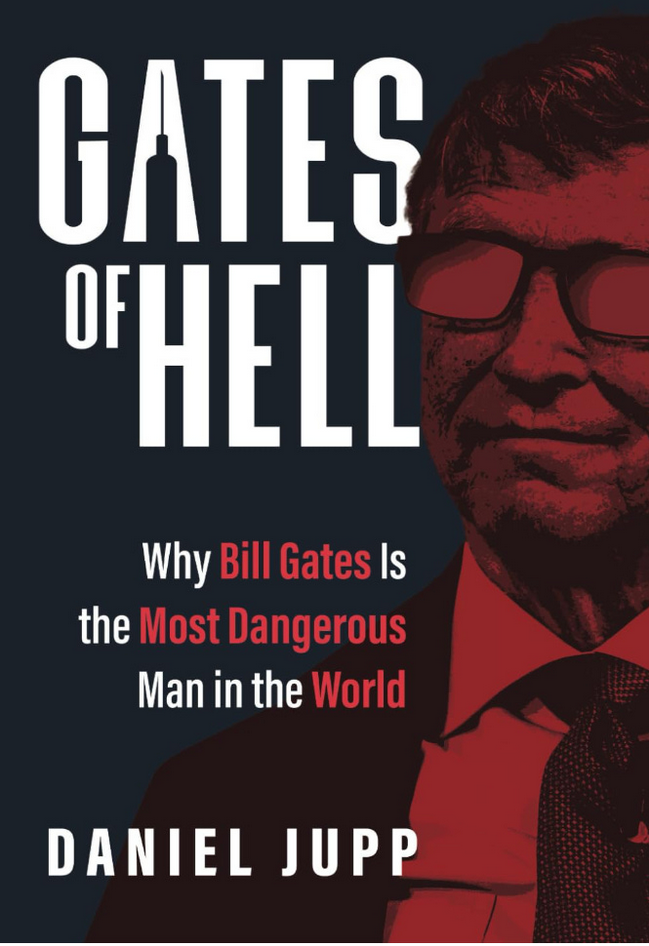
A new book, Gates of Hell: Why Bill Gates Is the Most Dangerous Man in the World by Daniel Jupp, manages to dissect all of Gates’s activities since September 2011 and has he ever been a busy psychopath. Jupp is one of the several gifted polemicists called forth by the gnarly times we live in. He soared to recognition with witty, but somehow soothing Facebook blasts that combined PJ O’Rourke with Jonathan Swift with Steve Bannon. Everyone passed around his posts exulting. Jupp, if that is his real name, hails from working class England, Essex to be precise-ish, and edits or writes for Country Squire Magazine. Whatever, he is of the time and do we ever need him.
Jupp in Gates of Hell is careful. He does not risk libel, not even a whiff of it. And in contrast to his usual oxygen-rich posts, he is measured, calm, working with a surgeon’s focus, as he peels back the PR, the methodology, the results, the hiding of the malign results, the cantering on to the next heady task as the ultimate white Saviour. Unfortunately, as Jupp describes, Gates is not quite as simple as that. He also changes law, dictates policy in far too many countries where he does not belong, buys all the media, and every politician he can. When he calls, the Great and the Good come to sit in his Presence and be lectured to in that stickily sentimental tone about his noble purpose. When he makes a mistake, and almost everything he does is a mistake, he spends several hundred million dollars buying desperate legacy media and every functional PR firm to cover it up.
Gates’s life changed when his practice of turning competitors to scorched earth, thereby crippling innovation in the digital world, resulted in an embarrassing court case. The sullen, nit-picking slug on trial, radiating contempt is, I suspect, the real Gates, or his shadow self, very much like Gollum in LOTR defending his Precious. Jupp skates by the many charges of sexual abuse, but points out that he formally left Microsoft after one of them became too big to ignore.
Gates then constructed his new self. He married, not a babe, but a substantive character, and had three children in quick succession. He hired the most expensive fixers and PR, and built himself an avuncular sweater-clad persona. He was going to give away his massive fortune, give back to the people from his incredible privilege.
In the ensuing years, that fortune doubled and then doubled again.
That’s because he met Jeffrey Epstein. While Epstein’s sexual activities have received 90% of the attention, his activities during the last years of the Clinton administration are the more significant. First of all, Epstein was running an entrapment scheme for various covert agencies, which made his insinuation into government easy. At the same time, he taught high-level government officials, cabinet ministers, heads of agencies, and the great larcenous dame herself, Hillary Clinton, how to steal. It was a pincer movement. Having second thoughts? Here’s a video of your encounter with a fourteen year old.
I’ll make it super simple: he taught these people, and they weren’t all Democrats, how to stand up a policy meant to benefit the least advantaged, like for instance access to the housing ladder, and then profit off it. Since then every government initiative has carved out for its progenitor, a fortune. His first, of course, was Freddie Mac and Fannie Mae and James Johnson who ran these agencies into deep bankruptcy, collapsed the ’08 economy, nevertheless walked away with $100 million from a government job. Wall Street Journal reporter, Gretchen Morgenson’s Reckless Endangerment covers the waterfront here.
“When I use a word … it means just what I choose it to mean”
Andrew Sullivan on how our “elites” now live in a world that the renowned Oxford academic Charles Lutwidge Dodgson1 predicted in his writings a century and a half ago:

“Israeli flag, Tel Aviv, Star of David” by Tim Pearce, Los Gatos is licensed under CC BY 2.0 
 .
.
The word “genocide” may be the one rendered most meaningless in our discourse. It has some steep competition, of course. “White supremacy” now means asking someone to show up on time. “Trauma” means being referred to with the wrong pronoun. And “genocide” can, among other things, mean debating experimental sex reassignment procedures for children. (Go look up #transgenocide on Twitter and weep.)
But the supporters of Hamas and of the Palestinians have seized the g-word with particular zeal. And who can blame them? There’s a real, adolescent frisson in accusing the victims of the worst genocide in modern history of being genocidal themselves. “Israel, we charge you with genocide” is a common chant in many of the pro-Palestinian protests. “Genocide Joe” has been trending on Twitter. Eight hundred artists signed an open letter calling the Israeli counteract in Gaza “a genocide”. Yale professor Zareena Grewal channeled much of the “decolonizing” left: “Israeli [sic] is a murderous, genocidal settler state and Palestinians have every right to resist through armed struggle”.
It’s not just the activists. Congresswoman Tlaib has accused Biden of “funding Netanyahu’s genocide”, and said “We are literally watching people commit genocide” — referring to the blast next to a Gaza hospital caused by a Hamas rocket. Congresswoman Omar retweeted a photo of dead kids with the caption “CHILD GENOCIDE IN PALESTINE” — but the photo was from a 2013 chemical weapons attack in Syria. A State Department official tweeted that Biden is “complicit in genocide”. A UN official just quit his post, adding:
In just 4 weeks, Israel with US backing has cut off food, water, power & then brutally exterminated more than 10,000 imprisoned civilian men, women & children in Gaza, destroyed their homes, churches, mosques, schools & hospitals because they are Palestinians. Name it? #Genocide.
The devastation in Gaza is horrifying to watch, worse than horrifying. Anyone who isn’t deeply troubled by the mass death has lost humanity. But the UN official, and all those echoing him, are full of it. The basic definition of “genocide” provided by the State Department is “the deliberate killing of a large number of people from a particular nation or ethnic group with the aim of destroying that nation or group.”
The key, defining thing here is the aim. Horrifying massacres may or may not be genocidal, depending on the intention. The Hiroshima bomb, for example, was devastating, but it was aimed at ending the war, not obliterating the Japanese people as a race. And if Israel were interested in the “genocide” of Palestinian Arabs, it has had the means to accomplish it for a very long time. And yet, for some reason, the Arab population of Israel and the occupied territories has exploded since 1948, and the Arabs in Israel proper have voting rights, and a key presence in the Knesset.
This is not to exonerate Israel entirely. I’ve had strong words for the Netanyahu governments over the years. And Israeli politicians, on the far right, have used foul rhetoric and deemed the Palestinians subhuman in some respects. Bibi swiftly suspended a rogue minister for saying a nuke could be dropped on Gaza. There are anti-Arab maniacs among the West Bank settlers and in Bibi’s cabinet. But a policy of Arab genocide? Please.
The only people actively and proudly engaged in genocide are Hamas. The marchers on the streets this weekend will not be opposing genocide; they will be defending its perpetrators. It’s right there in the Hamas founding charter:
[All of Israel, Gaza and the West Bank is] consecrated for future Moslem generations until Judgement Day. It, or any part of it, should not be squandered: it, or any part of it, should not be given up. … The Day of Judgement will not come about until Moslems fight the Jews (killing the Jews), when the Jew will hide behind stones and trees. The stones and trees will say O Moslems, O Abdulla, there is a Jew behind me, come and kill him.
This is not mere rhetoric. On October 7, we saw what genocide is in practice. Hamas didn’t kill civilians as a tragic consequence of attacks on military targets. Its torture and murder of Jewish civilians was its core mission. And if Hamas had the capacity, they would gladly enact a second Holocaust, and they have proudly said so, with even more sadism than the Nazis. They would kill every Jew they could.
1. Lewis Carroll, “an English author, poet, mathematician and photographer. His most notable works are Alice’s Adventures in Wonderland (1865) and its sequel Through the Looking-Glass (1871). He was noted for his facility with word play, logic, and fantasy. His poems ‘Jabberwocky’ (1871) and ‘The Hunting of the Snark’ (1876) are classified in the genre of literary nonsense.” (Wiki)
November 10, 2023
Canadian media’s self-immolation an object lesson for British media
Marc Edge discusses how Canada’s legacy media joined together in a virtual suicide-pact to force Google and Facebook to give them millions in unearned revenue:

The best-laid plans of Canada’s biggest media owners went badly awry this summer, when Meta began blocking news across the country on its social media networks Facebook and Instagram in response to the Online News Act passed in June. Newspaper publishers lobbied the federal government relentlessly to force Google and Meta to compensate them for supposedly “stealing” their news stories by carrying links to them. But instead of bringing them hundreds of millions of dollars a year from the digital giants, as a similar law has in Australia, their campaign backfired badly in what has been described as “a massive policy blunder“, and “the most spectacular legislative failure in Canada’s living political memory“.
Not only will publishers not be getting any money from Meta, they likely won’t get any from Google either, as they have threatened to similarly block news in Canada when the law comes into effect in December. Ironically, publishers will instead lose millions instead, as the agreements they already have with at least Meta will be cancelled, and probably those with Google as well. The knock-on effect makes it a triple-whammy when you also consider the traffic that news media will lose to their websites from the platforms. Worst affected will be online-only publications which have depended on that traffic to build an audience. Most did not want the Online News Act and many spoke out against it, but they were drowned out by the newspaper lobby led by industry association News Media Canada. It is dominated by the country’s two largest chains, which are now owned by a private equity firm and US hedge funds.
The Online News Act is the second in a series of bills designed to regulate the Internet, which, when taken together, include many of the same elements as the UK’s omnibus Digital Markets, Competition and Consumers Bill now before Parliament. An Online Streaming Act passed in April will tax and regulate digital video services in Canada, which are mostly owned by U.S. companies such as Netflix, Disney, and Amazon. A so-called Online Harms Act designed to combat hate speech and online bullying was introduced in 2021 but died on the order paper with an election call. It was criticised by civil libertarians for potentially prohibiting otherwise lawful speech and was thus being revised, but so far it has not been re-introduced. Legislation aimed at increasing online privacy and consumer rights is also planned.
One of these things, on closer scrutiny, is not quite like the other ones, and a realisation is growing in Canada that the government may have been co-opted in its enthusiasm to regulate the Internet to participate in what has been called a “shakedown” of the digital giants. Canada’s news media have literally been on the dole for the past five years since they lobbied the government for a five-year $595-million bailout that expires next spring. This has prompted publishers to adopt Rupert Murdoch’s successful strategy in Australia of persuading the government to force the digital giants to share their advertising revenues with newspapers.
Canadian publishers lobbied for the Online News Act in part by running blank front pages for a day and also spiked several opinion articles by academics that had been accepted for publication by editors. Canada has long had one of the free world’s highest levels of media ownership concentration, along with Australia. It went to another level in 2000 with the “convergence” of newspaper and television ownership, against which Canada had no regulatory safeguards, unlike most other countries. The multimedia business model collapsed with the 2008-09 recession, when advertising revenues dropped sharply, and Canada’s news media have been lurching from bad to worse ever since. The country’s largest newspaper chain, Postmedia Network, was acquired out of bankruptcy in 2010 by a consortium of US hedge funds which had bought much of its previous owner’s high-interest debt on the bond market for pennies on the dollar. They have since taken more than $500 million out of the company in debt payments. The country’s second-largest chain, Torstar, was bought from its owning families at the outset of the pandemic in 2020 by private equity firm NordStar Capital, which has been similarly stripping the company with closures, redundancies, and asset sales.
November 9, 2023
QotD: The end of the “spoils system” and the professionalization of the bureaucracy
I know, that seems weird, but unless you’ve really studied this stuff — it’s not taught in most high school or even college classes, for some mysterious reason — you probably don’t know that the civil service used to be entirely patronage-based. Our two most famous literary customs inspectors, for instance (Hawthorne and Melville), got their jobs through political connections, and that’s the way it worked for everyone — every time the other party won an election, most of the bureaucrats got turfed out, to be replaced by loyal party men. Trust me: very few of the names on this list would ring much of a bell even to field specialists, but they were big political cheeses in their day; Postmaster General was a plum federal post that was often handed to loyal Party men as a reward for a lifetime of faithful service. And so on down the line, including your local postmaster.
It took until 1883 to finally kill of this last vestige of federalism, but the Pendleton Act did it. Here again, this isn’t taught in school for some mysterious reason, but the political class took a very different lesson from the Civil War than the hoi polloi. While for the proles the Civil War was presented as a triumph of the common man, the elite understood that it was training, logistics, bureaucratization, professionalism that won the war for the Union. The Republicans made a big show of putting up U.S. Grant as “the Galena Tanner” in their campaign rhetoric but Grant had been a bankrupt tanner, and indeed a conspicuous failure at everything except war … and even there, his record was carefully doctored to present an image of a bumbling amateur suddenly being struck by inspiration, when in fact Grant was a West Pointer with an impressive combat record in the Mexican War. Now is not the time or place to discuss the merits, or not, of various Civil War figures, so just go with me on this: Pretty much all the big name generals on both sides of the war were presented to the public as talented gentleman amateurs, and it was heavily insinuated that the ones they couldn’t so portray — McClellan, and especially Robert E. Lee — lost because they were too hidebound, too “professional”.
The reality is almost the complete opposite — yeah, Stonewall Jackson ended the Mexican War as a mere captain (no mean feat in The Old Army, but whatever), but he had a tremendous combat record, and was so much of a military professional that he actually taught at a military academy. This is not to say there weren’t naive geniuses in the Civil War — see e.g. Nathan Bedford Forrest — but the Civil War, like all wars since the invention of the arquebus, was won by hardcore, long-service, well-trained professionals. A naive genius like Forrest might’ve been a better tactician, mano-a-mano and in a vacuum, than a West Point professional like Custer — then again, maybe not — but wars aren’t fought in vacuums. They’re fought on battlefields, and they’re won by supply weenies and staff pogues.
[…]
They took that experience with them into politics, and so it’s no surprise that the Federal government of the Gilded Age, though tiny by our standards, grew into such a leviathan in so short a time. Again, I’m just going to have to ask you to trust me on this, since for some reason it never gets covered in school, but back in the later 19th century words like “efficiency” really meant something to the political class. All those politician-generals (and politician-colonels and politician-majors and all the rest down at the local level) expected the State to function like the Army — that is to say, as a self-enclosed world where efficiency not only counts, but triumphs. An amateur civil service can’t do that, and so the days of the political sinecure had to end.
Severian, “Real Federalism Has Never Been Tried”, Rotten Chestnuts, 2021-05-03.


