
Ten or twenty years ago, the form of nationalism most closely corresponding to Communism today was political Catholicism. Its most outstanding exponent — though he was perhaps an extreme case rather than a typical one — was G. K. Chesterton. Chesterton was a writer of considerable talent who whose to suppress both his sensibilities and his intellectual honesty in the cause of Roman Catholic propaganda. During the last twenty years or so of his life, his entire output was in reality an endless repetition of the same thing, under its laboured cleverness as simple and boring as ‘Great is Diana of the Ephesians.’ Every book that he wrote, every scrap of dialogue, had to demonstrate beyond the possibility of mistake the superiority of the Catholic over the Protestant or the pagan. But Chesterton was not content to think of this superiority as merely intellectual or spiritual: it had to be translated into terms of national prestige and military power, which entailed an ignorant idealisation of the Latin countries, especially France. Chesterton had not lived long in France, and his picture of it — as a land of Catholic peasants incessantly singing the Marseillaise over glasses of red wine — had about as much relation to reality as Chu Chin Chow has to everyday life in Baghdad. And with this went not only an enormous overestimation of French military power (both before and after 1914-18 he maintained that France, by itself, was stronger than Germany), but a silly and vulgar glorification of the actual process of war. Chesterton’s battle poems, such as Lepanto or The Ballad of Saint Barbara, make The Charge of the Light Brigade read like a pacifist tract: they are perhaps the most tawdry bits of bombast to be found in our language. The interesting thing is that had the romantic rubbish which he habitually wrote about France and the French army been written by somebody else about Britain and the British army, he would have been the first to jeer. In home politics he was a Little Englander, a true hater of jingoism and imperialism, and according to his lights a true friend of democracy. Yet when he looked outwards into the international field, he could forsake his principles without even noticing he was doing so. Thus, his almost mystical belief in the virtues of democracy did not prevent him from admiring Mussolini. Mussolini had destroyed the representative government and the freedom of the press for which Chesterton had struggled so hard at home, but Mussolini was an Italian and had made Italy strong, and that settled the matter. Nor did Chesterton ever find a word to say about imperialism and the conquest of coloured races when they were practised by Italians or Frenchmen. His hold on reality, his literary taste, and even to some extent his moral sense, were dislocated as soon as his nationalistic loyalties were involved.
Obviously there are considerable resemblances between political Catholicism, as exemplified by Chesterton, and Communism. So there are between either of these and for instance Scottish nationalism, Zionism, Antisemitism or Trotskyism. It would be an oversimplification to say that all forms of nationalism are the same, even in their mental atmosphere, but there are certain rules that hold good in all cases.
George Orwell, “Notes on Nationalism”, Polemic, 1945-05.
December 12, 2018
QotD: G.K. Chesterton’s political Catholicism
December 11, 2018
Criticizing the left, from the left
In Quillette, Matt Johnson discusses the phenomenon of devoted leftists being willing to criticize their own “side”, and includes a section on George Orwell’s willingness to critique leftists while still being a fully dedicated leftist himself:
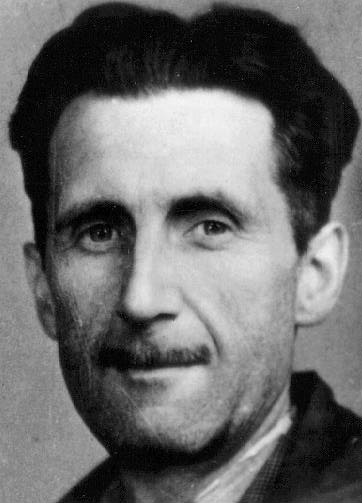
Orwell’s press card portrait, 1943
Bruckner’s remark about “Stalinist blackmail” calls to mind a writer whose commitment to both left-wing politics and anti-totalitarianism never wavered in the face of threats and coercion from the Left.
In the summer of 2003, the BBC aired George Orwell: A Life in Pictures. About halfway through the documentary, Orwell (played by Chris Langham) says, “Every line of serious work that I have written since 1936 has been written, directly or indirectly, against totalitarianism.” This is a line from one of Orwell’s best-known essays, published in 1946, “Why I Write.” But astute viewers may have noticed that something was missing from the reference — eight words that the producers decided to leave out.
Here’s the original sentence: “Every line of serious work that I have written since 1936 has been written, directly or indirectly, against totalitarianism and for democratic socialism, as I understand it.” After the sentence abruptly ends with the word “totalitarianism” in the documentary, Langham takes a long drag on his cigarette before jumping to a different passage of the essay. It was almost as if the producers wanted to accentuate the omission, taunting viewers with their own version of Orwell — one who didn’t have the courage to disclose his true beliefs.
There’s something simultaneously fitting and perverse about the manipulation of Orwell’s words more than half a century after his death (by the BBC, no less). Orwell’s anxiety about the falsification of history is one of the major themes of Nineteen Eighty-Four — as well as much of his other writing and later correspondence — and this is what the producers of the documentary were guilty of doing when they amputated one of his firmest ideological declarations and turned it into a much more palatable and anodyne comment on totalitarianism. No matter how badly some people want Orwell to be a polished and uncontroversial product for mass consumption, he was still the man who wrote these words as he speculated about the possibility of violent revolution in England: “I dare say the London gutters will have to run with blood. All right, let them, if it is necessary.”
Even when Orwell wasn’t in a mood that had him impatiently looking forward to the day “when the red militias are billeted in the Ritz,” he was always honest about his political beliefs. On November 13, 1945, Katharine Stewart-Murray, the Duchess of Atholl, wrote to Orwell asking if he would speak on behalf of an anti-communist organization called the League for European Freedom. This was a month after the publication of Animal Farm — a time when Orwell was worried that the book would be misinterpreted as a broadside against socialism instead of a narrower attack on Stalinism.
Given this context, it isn’t surprising that Orwell declined the duchess’s offer: “Certainly what is said on your platforms is more truthful than the lying propaganda to be found in most of the press, but I cannot associate myself with an essentially Conservative body which claims to defend democracy in Europe but has nothing to say about British imperialism.” Even though Orwell was a staunch anti-communist, his essential political convictions remained immovable: “I belong to the Left and must work inside it, much as I hate Russian totalitarianism and its poisonous influence in this country.”
Orwell was a socialist until the end of his life. For many people, this complicates his legacy and detracts from his pristine image as the twentieth century’s foremost foe of totalitarianism — an image that has been appropriated again and again over the past 70 years.
[…]
But as Orwell was at pains to demonstrate (especially after the publication of Animal Farm), he would have firmly rejected the Right’s attempts to appropriate his legacy. While Orwell is rightly celebrated for his refusal to accept the dogmas of the Left when he was under tremendous pressure to do so, his independence of mind is only one of the reasons why he remains so relevant today. His ability to maintain that independence without sacrificing his most fundamental principles may be even more important.
December 10, 2018
QotD: No one “owns” a culture
To own something is to have the rights (1) to determine exclusively how it is used, (2) to appropriate exclusively any income or other benefits it yields, and (3) to transfer the foregoing rights to others by sale, gift, or bequest. In this light, it is clear that no one owns a culture, and hence no one may legitimately seek state violence for the defense of such asserted property rights.
One may have preferences about culture. One may have affections for or aversions to a culture or particular elements of a culture. But such preferences do not entail any rights of ownership. Moreover, all cultures are constantly changing to a greater or lesser degree by spontaneous, decentralized processes, including interaction with other cultures. Such interaction has always been the case except for the cultures of people completely isolated from the rest of the world.
To treat the arrival of new members of society who live to some degree in accordance with different cultures as if these persons were “invaders” who threaten to destroy one’s culture is simultaneously to evince little faith in the attractiveness and strength of one’s culture and to seek its defense as the enforcement of property rights where no such rights exist.
Robert Higgs, “No One Owns a Culture”, The Beacon, 2018-11-19.
December 8, 2018
Will the West want in again this time?
The last time Albertan sensibilities were being regularly assaulted by federal politicians, the response was the Reform Party with their slogan “The West Wants In”. This time, Lawrence Solomon suggests, the Albertan response might not be so congenial:
Canadians don’t value our fossil fuel economy, which explains why so many are OK to trash pipelines and see Alberta tank. Only 19 per cent think it more important to pursue oil and gas development than to go green and regulate oil, according to EKOS polling. That 19 per cent figure shrinks to eight per cent for Canadians who consider themselves Liberals, six per cent for NDPers and two per cent for those who vote Green, meaning that politicians of most stripes have no interest in alienating their supporters to help Alberta’s energy economy recover.
Those figures also explain why Alberta’s sense of alienation is on the rise. According to Ipsos, fully 62 per cent believe Alberta “does not get its fair share from Confederation” (up from 45 per cent two decades ago), 46 per cent feel more attached to their province than to their country (up from 39 per cent) and 34 per cent “feel less committed to Canada than I did a few years ago” (up from 22 per cent). Just 18 per cent of Albertans believe “the views of western Canadians are adequately represented in Ottawa.”
One-quarter of Albertans now believe Alberta “would be better off if it separated from Canada,” a number that may well rise if the provincial economy founders, and would certainly rise if Albertans realized that they need Canada a lot less than Canada needs them. Without Alberta’s wealth and foreign-exchange earnings, the living standard of Canadians outside Alberta would drop and the Canadian dollar would plummet, likely leading to inflation as the cost of imports rose. Albertans, in contrast, would see their affluence rise and, because oil sales are denominated in U.S. dollars, Alberta would be largely insulated from the inflation to its east and west.
Those pooh-poohing independence claim Alberta, being land-locked, would be held hostage if it were an independent state. Those scoffers have it backwards. Alberta is today held hostage, its pipelines east and west kiboshed by its fellow Canadians. If Alberta were independent, its newfound bargaining power would certainly cause the Rest of Canada to capitulate, and speed to completion any and all pipelines Alberta needed to either ocean.
An independent Alberta would control access to its land mass as well as the skies above it, requiring Canada’s federal government to negotiate rights for, say, Vancouver-to-Toronto flights over Alberta airspace. Canada would also need Alberta’s agreement to have trains and trucks cross its now-international borders. Threats of tolls and tariffs could abound as needed to chasten those perceived to be wronging Alberta, whether Quebec, which exports dairy to B.C., grain interests that now commandeer rail to the detriment of Alberta’s oil shippers, or the B.C. ports that depend on commodities going to and from points east. Anyone thinking that Alberta would be unable to police its borders needs to be reminded that, for the past 70 years, Alberta’s patrols have made it the continent’s only rat-free jurisdiction.
QotD: The nationalist obsession
As nearly as possible, no nationalist ever thinks, talks, or writes about anything except the superiority of his own power unit. It is difficult if not impossible for any nationalist to conceal his allegiance. The smallest slur upon his own unit, or any implied praise of a rival organization, fills him with uneasiness which he can relieve only by making some sharp retort. If the chosen unit is an actual country, such as Ireland or India, he will generally claim superiority for it not only in military power and political virtue, but in art, literature, sport, structure of the language, the physical beauty of the inhabitants, and perhaps even in climate, scenery and cooking. He will show great sensitiveness about such things as the correct display of flags, relative size of headlines and the order in which different countries are named. Nomenclature plays a very important part in nationalist thought. Countries which have won their independence or gone through a nationalist revolution usually change their names, and any country or other unit round which strong feelings revolve is likely to have several names, each of them carrying a different implication. The two sides of the Spanish Civil War had between them nine or ten names expressing different degrees of love and hatred. Some of these names (e.g. ‘Patriots’ for Franco-supporters, or ‘Loyalists’ for Government-supporters) were frankly question-begging, and there was no single one of the which the two rival factions could have agreed to use. All nationalists consider it a duty to spread their own language to the detriment of rival languages, and among English-speakers this struggle reappears in subtler forms as a struggle between dialects. Anglophobe-Americans will refuse to use a slang phrase if they know it to be of British origin, and the conflict between Latinizers and Germanizers often has nationalists motives behind it. Scottish nationalists insist on the superiority of Lowland Scots, and socialists whose nationalism takes the form of class hatred tirade against the B.B.C. accent and even the often gives the impression of being tinged by belief in sympathetic magic — a belief which probably comes out in the widespread custom of burning political enemies in effigy, or using pictures of them as targets in shooting galleries.
George Orwell, “Notes on Nationalism”, Polemic, 1945-05.
December 6, 2018
“Marx was right”
An interesting little bit of history and philosophy over at Rotten Chestnuts:
Marx was right: Society really is shaped by relations between the means of production.
The Middle Ages, for instance, organized itself around defense from marauding barbarian hordes. Fast, heavy cavalry were the apex of military technology at the time; the so-called “feudal” system were the cavalry’s support. The system was field tested in the later Roman empire — medieval titles like “duke” came from the ranks of the Roman posse comitatus — and perfected in the Dark Ages.
When the barbarians had been pacified sufficiently that Europeans had leisure time to think about this stuff, they took the feudal system — at that point a cumbersome relic — as their model for society. Hobbes, Locke, et al saw it as the origin of the Social Contract; Marx saw it as finely tuned oppression. But here’s the fun part:
Hobbes ends his Leviathan with the most absolute monarch that could ever be. He starts* with… wait for it… the equality of man. Marx, on the other hand, ends with the equality of man. He starts with a frank, indeed brutal, acknowledgment of man’s inequality. As much as I love Hobbes (and consider Leviathan the only political philosophy book worth reading), he’s wrong — fundamentally wrong — and Marx is right. Marx went wrong somewhere down the line; Hobbes jumped the track from page one.
Marx only went wrong when he started dabbling in metaphysics. Marxism isn’t the original underpants gnome philosophy, but it’s certainly the best — not least because Marx’s followers were so successful at hiding the deus ex machina that was supposed to bring Communism about. Marx didn’t just say “The Revolution will happen because that’s the way all the trend lines are pointing.” He said “the trend lines are pointing that way, and oh yeah, the animating Spirit of History demands that the Revolution shall happen.” This is so obviously sub-Hegelian junk that his followers dropped it as fast as they could, but to Marx himself it was the key to his philosophy. For all its formidable technobabble, Marxism is just another chiliastic mystery cult.
[…] Enlightenment-wise, Hobbes was the start, Marx the end of political philosophy, and both are flawed beyond redemption. Hobbes sure sounds like a viable alternative to Marx, because Hobbes’s reasoning seems sound, and based on an irrefutable premise: That in the State of Nature, life is nasty, poor, solitary, brutish, and short. But that’s not Hobbes’s premise — the fundamental equality of man in the State of Nature is. Life in the State of Nature is brutal because all men are equal.
* If you’ve read Leviathan, of course, you know he starts the book itself with a long discourse on contemporary physics. Hobbes was an innovator there, too — he’s the first person to put forth his humanistic ideas as the coldly logical deductions of physical science. It’d be fun to taunt the “I fucking love science” crowd with that, except they think Hobbes is a cuddly cartoon tiger and “Leviathan” one of the lesser houses at Hogwarts.
December 3, 2018
Eric Swalwell’s Kinsley gaffe
If you haven’t encountered it, a “Kinsley gaffe” is where a politician accidentally tells the truth (Wikipedia). Newly elected US member of the House of Representatives Eric Swalwell committed a classic Kinsley gaffe in an online discussion on social media, as Jeff Fullerton explains:
Democratic representative Eric Swalwell made a really provocative statement this week according to an article from Hot Air. Pretty much serving notice that: If we confiscate your guns and you fight back, we will nuke you.
Representative Swalwell sort of gives a disclaimer that he he was not actually advocating nuking Texas or some other disobedient red state or region — but merely trying to make a point in the fashion of the Borg from Star Trek; that resistance is futile and it is the lot of us all to be assimilated — against our will if necessary. The author of the article from Hot Air points out something that my friend and mentor Bruce the Historian pointed out long ago; that there are an awful lot weapons in the hands of private citizens capable of making it hell on earth for any federal troops deployed to disarm the population or engage in the collectivization of property and resources in a martial law scenario. Or forced relocation of people. That’s the real reason they want everyone disarmed. They know from experiences in Vietnam and the “Forever War” in the Middle East; that cracking down with overwhelming force has its limits and once they put off a nuke to burn a town in Texas they might have to burn every square mile of the nation to put an end to the uprising.
Talk about excessive force!
That they’d even talk at all about using a nuclear weapon to put down an internal insurrection proves beyond the shadow of doubt that power hungry politicians are a far deadlier existential threat to us all than any crazed mass shooter or terrorist could ever hope to be!
This congress creature bases his argument on a fallacy which is common assumption among the political class: that because the federal government is capable of mustering overwhelming force — the Second Amendment is obsolete anyway. He already contradicts himself for if we the people are impotent against the overwhelming fire and manpower of the Army and the bombs and missiles of the Air Force — then why are people like him so adamant about disarming the average Joe? I think I already answered that one. […]
There is also the issue of the military itself that the political class ought to take into consideration. It may be less monolithic than assumed. Many of them still believe in the validity of the Constitution and would side with the resistance while others among the loyalist factions would have problems of conscience when it comes to mass slaughter of fellow Americans. Still others might be fearful of the consequences of being held accountable for atrocities or even treason if they end up on the losing side of things. To attack and kill your own people who you swore to serve and protect is a grievous betrayal. It is treason of the highest order and the punishment for that is death. So if you choose such a course of action and loose the fight; you go down in historic infamy to be remembered like the Nazi war criminals who stood before the Nuremberg tribunals. And you will probably [be] shot or hanged in a public execution!
US immigration – two views
In the latest Libertarian Enterprise, John Walker presents two fascinating charts illustrating the levels of immigration to the United States since the beginning of the nineteenth century. Depending on which one you see, your interpretation will likely differ substantially. The first, the way the statistics are usually presented, show the current rate of immigration to be a very significant — even unprecedented — economic and political concern:
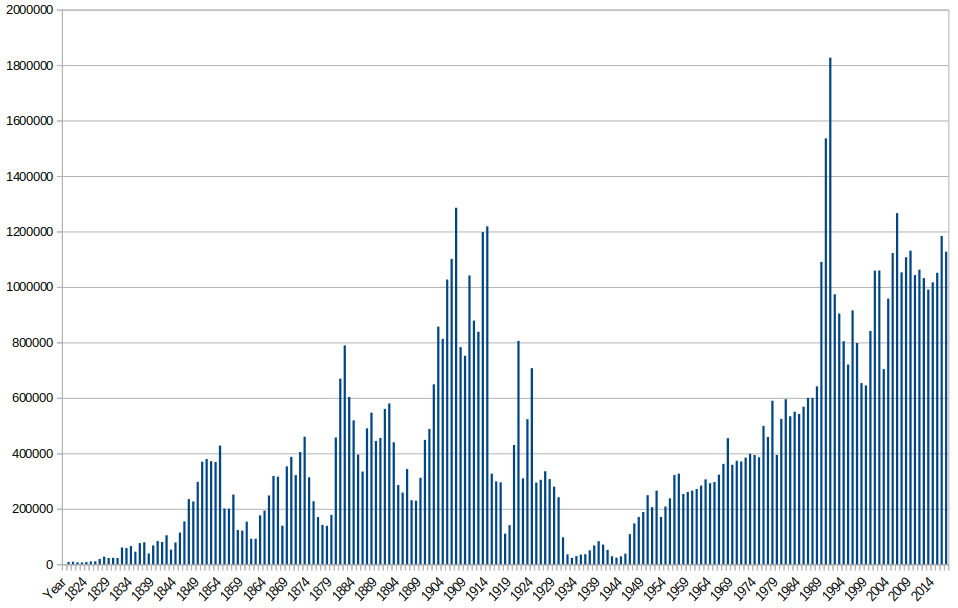
Immigration shown in raw numbers.
The less common way of illustrating the immigration numbers is showing it proportional to the whole population, which would not work anywhere near as well to support certain narratives:
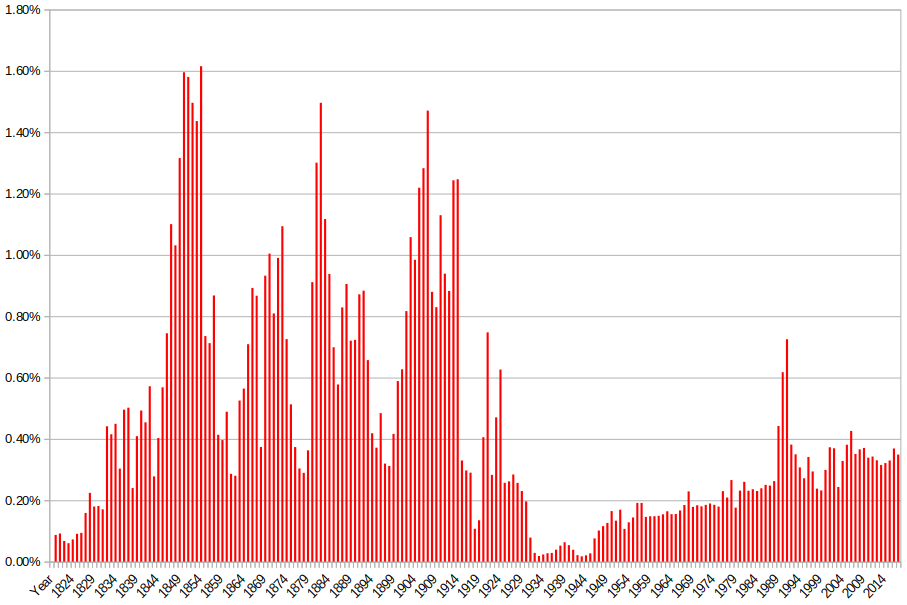
Immigration to the US shown in proportion to the population.
This is a very different picture. There are clearly two different epochs. In the first, between 1820 and 1930, the U.S. was “filling up the empty country” by admitting large numbers of immigrants. Then, due to immigration restrictions in the Immigration Act of 1924 and the subsequent economic depression and war, immigration remained at low levels until 1946 when, in the immediate postwar period, it jumped. In this view, the impact of the Immigration and Nationality Act of 1965 was not the discontinuous change some present it as (at least in terms of absolute numbers; it may have changed the composition of the immigrant population, which is not captured in these statistics).
Instead, the trend established after 1946 continued to rise continuously until 1989–1991 when it went all whacko. These numbers, as a fraction of the population, haven’t been seen 1923 or since. If you take out those crazy years, the overall trend of immigration as a fraction of the existing population continues to rise almost linearly since 1946.
November 30, 2018
“Infrastructure” is a Canadian word meaning “jobs for the boys”
H/T to Colby Cosh for the link.
November 28, 2018
AirBnB virtue signals its … anti-semitic street cred?
In the National Post, Barbara Kay discusses the odd business choices of AirBnB in cutting off rentals to only certain locations that just happen to be in Israel:
Planning a group holiday in Kashmir? Airbnb is there to serve you. Likewise in Tibet, northern Cyprus and Georgia’s separatist republic of Abkhazia, all occupied or disputed territories. Airbnb’s political neutrality in these hot spots therefore quite rightly casts suspicion, to put it mildly, on its recent decision to delist some 200 Jewish homes in West Bank communities.
Airbnb stated, “We know that people will disagree with this decision and appreciate their perspective. This is a controversial issue.” No kidding. An Israeli class-action lawsuit has been filed against Airbnb, seeking US$4,000 in damages for every affected host.
Indignation has been running high outside of Israel as well, in statements both spontaneous — disgusted blog, Twitter and Facebook posts — and considered. The Beverly Hills city council, for example, passed a unanimous condemnatory resolution, calling Airbnb out for anti-Semitism and stating, in part: “The City of Beverly Hills hereby calls upon Airbnb to correct this act of disrespect to the land of Israel and restore its original services immediately.”
Setting aside the anti-Semitic optics, is it legal for Airbnb to do this?
The U.S. Constitution, as well as various state laws and acts of Congress, prohibits both American individuals and corporations from participating in boycotts against other nations. A corporate boycott against a foreign government does not fall under the “free speech” rubric,” but is considered a “tool of statecraft” reserved for the federal government in such situations as war. The office of Rob Portman of Ohio (R), an author of the Israel Anti-Boycott Act in the Senate, told The Jerusalem Post last Tuesday that it wants to hear from Airbnb. The Illinois state legislature — which passed the nation’s first local anti-BDS law in 2015 — will reportedly meet in mid-December, when it anticipates debating whether Airbnb violated its statute.
Establishing illegality pivots on whether the move is deemed as “politically” inspired. It certainly seems to be. As noted by Kohelet Forum legal expert Eugene Kontorovich in a recent Wall Street Journal oped, “An American Jew with a rental property in the West Bank is barred from listing it for rent on the website. But an American Arab is welcome to list his home a few hundred metres away, even though the Palestinian law forbidding real-estate deals with Jews carries a maximum penalty of death. That openly racist policy doesn’t trigger Airbnb’s delisting policy.”
QotD: “Never interfere with the enemy when he is making a mistake”
That’s a line that the Rod Steiger character uses in the the 1970 film Waterloo. And it’s a line I have been repeating to myself again and again over the last few months.
My enemies in the Establishment, whether it be the media, communists, social justice warriors or the last-ditch Remainers have been obligingly making error after error. I could point out their mistakes and laugh but there is that danger – however remote – that they might listen and learn. You see, I don’t want them to learn. What I want them to do is to keep the gas pedal pressed down hard as they can as they drive the juggernaut of bad ideas over the cliff and into oblivion. In such circumstances it is best to keep ones counsel.
Patrick Crozier, “Never interfere with the enemy when he is making a mistake”, Samizdata, 2017-01-22.
November 25, 2018
“They said Trudeau was going to be a uniter, but what an accomplishment”
Prime Minister Justin Trudeau visited Calgary this week, just as the city council officially buried its Olympic bid (but somehow decided to try to keep the subsidies from other levels of government for that event). His visit was the target of protests from both organized labour and Albertans angry about the federal government’s part in keeping Alberta oil from getting to market:
The prime minister flew into Calgary on Thursday to meet with Mayor Nenshi, chat with the Chamber of Commerce, and have photos taken at the site of new social housing being built partly on Ottawa’s dime. The PM left no word on what he thought of the whole “let’s buy Calgary an Olympics without going to the trouble of having one” concept. There were unexpected distractions at every turn in Calgary, the main one being a fierce protest outside his temporary headquarters at the downtown Hyatt.
The Herald’s agreed-upon estimate of the size of the anti-Trudeau protest was two thousand people. I am not sure I trust their math, but at any rate the crowd was large enough to snarl traffic and intimidate the police. I say “crowd,” but perhaps the word should be “crowds,” because the protest was actually twofold.
The striking Canadian Union of Postal Workers was there to discourage Trudeau from passing the back-to-work legislation his cabinet is cooking up. And there was also a coinciding protest over the landlocking of Alberta’s oil, which has widened the spread between world oil prices and local spot prices to surreal, unimagined heights. The sluggishness of pipeline construction has left Alberta hydrocarbons all but worthless. And now the world price is tottering from medium-high levels, ending a sunshiny global oil season from which the province got no advantage.
The posties’ chants of “Negotiate!” alternated with the militant oilpatch’s cries of “Build that pipe!” In a way the spectacle was touching. Here, in the streets of Calgary, you had one of the most internationalist and red-dyed corners of Canadian organized labour literally joining forces with its mostly non-union, mostly right-wing working-class brethren. They said Trudeau was going to be a uniter, but what an accomplishment.
This solidarity will, of course, be fleeting. CUPW, having played the Grinch successfully, will either cut a deal or take its medicine when the back-to-work law passes. But Calgary’s resentment of Trudeau will not be so quick to evaporate — nor, perhaps, will the images of our young prime minister facing a display of active mass public hostility for the first time.
November 23, 2018
QotD: Inactivist bumper stickers
I’ve received several hundred suggestions for inactivist bumper-sticker slogans and, as befits the situation, I’ve been slow to read them. Still, I like some of them quite a bit:
Visualize me ignoring you.
How about “let’s not.”
Don’t honk if you can’t be bothered.
Don’t Act, NOW!
If not now, whenever.
Leave well enough alone
Slacking: It’s not just for kids.
YOU Save the Whales!
Practice Random Acts of Self-Restraint.
Ask Not.
Future Site of Political Statement.And so on.
But there’s a problem. Many readers segued too easily from celebrating inactivism to championing outright sloth. For example, “Practice Random Acts of Self-Restraint” is a fine inactive motto. But “They can have my channel changer when they pry it out of my cold, dead hand,” while very funny is off point. “Don’t Mess With Stasis,” doesn’t quite rhyme but it’s got the right idea. “Think globally, act loafally,” meanwhile, has the wrong idea — except insofar as it mocks people with stupid bumper stickers.
The funny thing is that inactivists are actually very active people. I would bet that — this is a broad generalization-the folks who find inactivism politically appealing probably work harder and are more successful then people who find conventional activism attractive. Inactivists didn’t boycott the Million Mom March simply because they had better things to do. They stayed home because they believe the Million Mom March was a vast, peripatetic parade of propaganda. Inactivists don’t fail to mobilize solely because we’d rather watch a rerun of Matlock than chant for vegetable rights and peace at city hall. We actually don’t believe in vegetable rights. We want our carrots to remain as chattel.
I agree that sloth is funny. And I suppose that’s why so many people want Homer Simpson to become the inactivist spokesperson. I laugh whenever I hear Homer Simpson speak admiringly of Teamsters: “Oh, I always wanted to be a Teamster. So lazy and surly… mind if I relax next to you?” And his campaign slogan when he ran for garbage commissioner was pretty good. “Can’t someone else do it?” The best line from that episode was when he told Springfield voters “Animals are crapping in our houses and we’re picking it up! Did we lose a war?” But still, Homer’s wrong when he tells his kids “You tried your best and you failed miserably. The lesson is: Never try.”
Jonah Goldberg, “Let History Come To You”, National Review, 2002-07-24.
November 22, 2018
The apparently unexpected backlash over cancelling a French-language university in Ontario
I suspect a lot of the uproar is actually just target-of-opportunity stuff to justify criticism of Ontario premier Doug Ford. Chris Selley points out that until the announcement, there wasn’t actually a lot of support for the new university among French-speaking Ontarians:
You would never know it since Thursday, when the Ontario government cancelled plans to open a new French-language university in Toronto, but those plans were not universally beloved. A lot of people hated the location. In an op-ed in Le Droit, University of Ottawa political scientist François Charbonneau complained it was being built to serve future francophone immigrants, not proper Franco-Ontarians in a community where they’ve been established for generations.
He called it “a historic mistake that perfectly illustrates what it means to be a minority: to have no power over one’s own destiny and to be dependent on ideological rantings with no democratic legitimacy.”
Higher-education consultant Alex Usher was among many who dismissed enrollment projections for the university as “fantasy.” Writing on the Higher Education Strategies blog, Usher called a recent survey of francophone Ontario high school students the “worst piece of social science I have ever seen.” It found lots of interest in attending the new university, but didn’t bother asking about their interest in existing bilingual alternatives like Laurentian University and the U of O.
To language hawks, bilingualism is the enemy: French always loses out in a budget crunch, and it does nothing to advance the right to live one’s life solely in French. Trouble is, very few students at French-language Ontario high schools are remotely interested in living their lives solely in French.
These are all things Premier Doug Ford and his ministers might have mentioned if they hoped to leave an impression other than that Ontario francophones just aren’t worth the money. They might wisely have chosen not to axe the French Language Commissioner in the same fiscal update, transferring its complaint-resolution powers to the ombudsman but orphaning its advocacy mandate. Finance minister Vic Fedeli hasn’t even said how much of its $1.2 million budget he hopes to recoup.
But they did what they did, all at once, and they said it was all about saving money. I suspect the whirlwind they reaped came as a surprise.
Good heavens, though, what wind.
November 21, 2018
Statistics Canada’s instrumentalist philosophy
In the Financial Post, Bruce Pardy discusses the motivation behind Statistics Canada’s recently revealed demand for the private financial records of half a million Canadians:

Recently it was revealed that Statistics Canada sought to obtain the private banking information of half a million Canadians without their knowledge or consent. Jennifer Robson, professor of political management at Carleton University, in an interview with the CBC, justified the data sweep on the grounds that governments need this information to make good policy. But don’t be concerned, she said, it is not for ideological purposes, since Statistics Canada is ideologically neutral. That made me laugh. The very idea of policy based on data reflects an instrumentalist belief that governments should solve social problems by political means. That requires an ideological confidence in the administrative state, to which the agency is a handmaiden.
Ideology is not a dirty word. An ideology is merely a worldview, a lens through which to perceive society. Political parties, by definition, each have one (and sometimes extra ones for special occasions). But it is another thing for a public agency to act independently in furtherance of its own ideology while pretending to be neutral.
Statistics Canada’s deep dive into banking records — presently on hold while federal privacy commissioner Daniel Therrien investigates its legality — appears not to have been directed by government officials but was undertaken on its own initiative. The agency’s decision is consistent with a conviction that the more personal data available to government, the better off we will be; that governments are benevolent; that private financial matters call for public policy management; and that a bigger government is a better government. A commitment to social policy, wrote Milton Friedman “involves the acceptance of the socialist view that political mechanisms, not market mechanisms, are the appropriate way to determine the allocation of scare resources to alternative uses.”


