Quotulatiousness

September 11, 2019

Environmental virtue signalling – it’s other people who need to change, not me

Filed under: Environment, Politics, USA — Tags: , , , , — Nicholas @ 05:00

Heather Mac Donald notes that, as with so many other things, young people who like to virtue signal about their environmental concerns don’t consider it incumbent on them to change … it’s always other people whose habits must be changed, by force if necessary:

FridaysForFuture Demonstration, 25 January 2018 in Berlin.
Photo by C. Suthorn via Wikimedia Commons.

The claim about youth’s transformative commitment to radical environmental change is — based on informal observation — bunk. The cardinal rule when it comes to environmental virtue-signaling is that people give up what they’re willing to give up. Young people are no different. If being environmentally sound required sacrificing anything that a self-described environmental warrior actually valued, the conversation would quickly change to a different topic. One’s own habits are necessary; it’s everyone else’s that need to change.

This always-unreached threshold for environmental sacrifice is particularly notable on the part of celebrity Greens, with their fortress-like SUVs, multiple residences, and massive carbon footprints — whether it’s the cavalcade of yachts and private jets that brought such luminaries as Leonardo DiCaprio, Mark Zuckerberg, and Katy Perry to Google’s three-day climate-change summit in Sicily this July; environmental crusaders Prince Harry and Meghan Markle jetting off to Elton John’s French estate; or Reliable Sources host Brian Stelter’s “quick day trip” to Los Angeles from New York just ahead of the CNN climate-change debate. A police caravan drives New York City mayor Bill de Blasio 11 miles from his mayoral mansion in Manhattan to his favorite gym in Brooklyn. “Everyone in their own life has to change their own habits to start protecting the earth,” he has intoned, but taking the subway is not one of those changes appropriate for him.

Most young people have not yet reached such a flamboyant level of energy use, but if they could, they undoubtedly would, with as little sense of anachronism as that of Al Gore in his energy-guzzling mansion. These are the consumers who keep football fields of computer servers buzzing round the clock to support their social media habits. If being green meant turning off one’s phone for 22 hours a day or foregoing the latest smartphone upgrade, the reasons why such sacrifices are not required would spout from every Gen Z-er and millennial’s lips. Students from the University of California, Irvine, constantly run their air-conditioners in the apartment complex where I spend summers, regardless of how cool the temperature outside is. They drive with their windows sealed and the car AC on, no matter how fresh the day (this is the new driving norm for almost everyone now). The meteoric rise of food-delivery apps, producing torrents of plastic and paper waste and a constant circulation of cars and electric bikes, has been fueled by young people’s demand for convenience and instant gratification. Cooking is apparently unthinkable. At best, one buys precut and washed food in the inevitable plastic containers. A daily Starbucks habit is deemed consistent with railing against environmentally destructive corporate greed.

New York’s tap water is among the purest in the world. Yet a young neighbor of mine in New York, like progressives throughout the city, receives towering deliveries of bottled water, entailing huge energy outlays to package and transport, not to mention generating flotillas of discarded plastic. The swim team members in my gym turn on their showers in the locker room, then walk away or do nothing other than chat as water gushes down the drain. Uber drivers in college towns report that students regularly call a car to get to class, rather than walk or ride a bike.

Margaret Atwood’s The Testaments

Filed under: Books, Cancon, Media, Politics, USA — Tags: , , , — Nicholas @ 03:00

Colby Cosh discusses the genesis of Atwood’s best-known work from 1984, The Handmaid’s Tale and the new sequel published this week, The Testaments:

In a CBS interview broadcast on Sunday, Atwood insisted again, as she always has, that her book wasn’t a prediction. People who read her book in a spirit of active dread, the kind of people who dress up as Handmaids and march on legislatures, will say that, well, dystopias are created specifically so that they won’t come true. What Atwood is trying to say goes deeper than that, and contradicts it. She won’t even insist that the book was intended as a warning. “I’m not a prophet,” she pleads, while everyone around her tells her what a terrific prophet she is.

What she means, but cannot say because it would sound arrogant, is: “I’m not a prophet, dammit, I’m an artist.” If tyrannies were easy to predict and prevent by spritzing around a bit of literary bug spray, they couldn’t come about in the first place. Atwood knows better than this; she knows that tragedies of this scale never take the form that an author might anticipate. Moreover, people who read The Handmaid’s Tale as a mere tract are deaf to its satirical elements — particularly those of the epilogue, in which the story is revealed to have been unearthed by scholars in a still-more-distant future.

These people are also failing to see that The Handmaid’s Tale is a book — researched, not merely imagined — about the past of humankind. The whole book is predicated on the observation (also made implicitly in Orwell’s Nineteen Eighty-Four) that totalitarian regimes are never libertine; they all police sexuality at least as strenuously as they do trade and creative activity, and always come with puritanical, sexually homogenizing features. The novel was heavily influenced by Ceausescu’s Romania and its pro-natalist Decree 770, which abolished contraception and imposed mass gynecological inspection on women of fertile age. Europeans and students (or veterans) of the Cold War will notice this, but how many of the young folk who dress up as Handmaids at protests have any idea? (Are some of them also cosplaying on Twitter as postmodern retro-communists?)

I am curious to see what the critics make of the sequel, because the act of writing one seems a bit cynical, and yet perhaps Atwood has found some clever way of making it work. Offred’s narrative in The Handmaid’s Tale is, as I say, unearthed in a later future; it is important to the functioning of the book that we come to see her as a figure from the past, a human voice whose plea from an obscure period has been flung forward into the hands of half-comprehending and unsympathetic scholarly boobs.

QotD: Male versus female social structure

Filed under: Health, Politics, Quotations — Tags: , , — Nicholas @ 01:00

Female social structure is completely different from male social structure. Men tend to organize in a hierarchy of sorts. There’s one guy at the top, a few guys he trusts underneath him, etc. downward until you reach the guys that are on the bottom of the pile. The structure makes sense. It’s efficient, everyone knows who’s in charge, and it’s largely based around the individual. Someone can rise or fall in this hierarchy based on any number of things, but their position is usually pretty clear from the outside looking in.

Female social structure is more fluid. It’s based more on group identity than on individual characteristics. You tend to have one woman who is kind of in charge, your queen bee as it were. Those in her favor circle around her, and the circles continue outward until you have the women who are not part of the group. They aren’t at the bottom of the pile, they pretty much don’t exist. At least, if they’re lucky they don’t. One’s position in the social hierarchy can change at any time, to include who the queen bee is. Remember the scene in Mean Girls where Regina tries to sit at the lunch table with the other plastics but isn’t wearing the right color clothes? She was just knocked out of her position in the social hierarchy.

In a social structure like this, there’s no room for difference of opinion or people who stand out too much. If an individual, even by noncompliance, threatens the group identity; she will gain the ire of the entire group. They will hunt her without mercy until she complies with the demands of the group, is removed from their reach by either death or physical distance (which is getting much harder with the internet), or manages to win enough females to her side to either form a new group around her or replace the existing leader. The last option allows her to push her standard on the group as a whole. There is no option to live and let live. In other words, female social structure is closer to the Borg than the complex world we currently enjoy.

I can already hear the cries of, “But women aren’t violent!” If you’re talking about direct violence, you’re mostly right. Women are not men, and we don’t hunt in the way that men do. Our weapons are usually words and emotions, not direct violence. Instead of a brawl in which two people fight it out and determine which is the strongest, you’re looking at extreme emotional abuse for anyone who is outside the group and unlucky enough to have their attention. Emotional abuse attacks a person in the most deeply personal of ways, and the scars it creates are more damaging than the physical scars of a beating. We wonder why girls who stand out grow so bitter, but if you’re a little too pretty or a little too different, other girls swarm on you and rip you apart with constant emotional abuse. They attack who you are at the base of your being, your very self-perception. This is why you see truly beautiful women who struggle to see their worth. Other girls have been ripping into them since the nursery, and it only gets worse as they get older. Boys court you and try in their awkward boyish way to get your attention, but you’re mostly convinced that it’s a cruel joke they’re playing on you, because of course you aren’t pretty or smart or special. The scars run deep and never fully heal.

“outofthedarkness”, guest posting at According to Hoyt, 2017-08-09.

September 10, 2019

QotD: Mere words are not “violence”

Filed under: Education, Liberty, Politics, Quotations, USA — Tags: , , , — Nicholas @ 01:00

“I’m very concerned about a phenomenon called ‘concept creep’ – which has been happening to a lot of psychological terms since the 1990s”, he says. “When a word like ‘violence’ is allowed to creep so that it includes a lot of things that are not violence, then this causes a cascade of bad effects. It’s bad for the students themselves because they now perceive an idea that they dislike, or a speaker that they dislike, as having committed a much graver offence against themselves – which means that they will perceive more victimisation of themselves. And it’s also really bad for society because, as we are seeing in a spectacular way in the United States this year, when each side can point to rampant occurrences of what they see as violence by the other side, this then justifies acts of actual physical violence on their side. And there’s no obvious end to this mutual escalation process.”

He adds: “Everybody involved in education needs to be dampening down violence and the acceptance of violence. Telling students that words are violence is counterproductive to that effort.”

Jonathan Haidt, quoted by Naomi Firsht, “The Fragile Generation”, Spiked, 2017-08-31.

September 8, 2019

Boris may have a viable escape hatch after all

Filed under: Britain, Government, Law, Politics — Tags: , , , , — Nicholas @ 05:00

It could not only untangle the current mess in Parliament but have the almost equally attractive feature of sending his opponents into paroxysms of rage:

The consensus is that the Government is trapped in an iron vice that will now be tightened till it cracks. The truth, however, is that this vice is less of iron than of hot air.

The Civil Contingencies Act 2004 is a constitutional outrage. It allows a government to declare an emergency, and then to rule by decree. It should never have been made. But it was made; and it can now be used as an instrument of liberation.

The Act defines “emergency” as just about anything the authorities may dislike. One possible definition is “an event or situation which threatens serious damage to human welfare in a place in the United Kingdom.” (s.1(1)) This sounds a promising excuse. It seems to cover what the Opposition claims would be the effect of a No-Deal Brexit.

Triggering the Act requires no more than “a senior Minister of the Crown” – that is, Boris Johnson – to announce an Emergency. This done, he can make, alter or suspend almost any law he likes. (s.22) He can do this for a period of thirty days. (s.26) All he has to do is preface his decree with a statement that he “is satisfied that the regulations contain only provision which is appropriate for the purpose of preventing, controlling or mitigating an aspect or effect of the emergency in respect of which the regulations are made.” (s.20(5)(b)(ii))

He cannot change the Act itself, or the Human Rights Act. He cannot set up concentration camps for his opponents, or put them before a firing squad. But the Fixed Term Parliament Act is fair game. He could suspend that. Then he could dissolve Parliament in the traditional way.

He must, “as soon as is reasonably practicable,” lay his decrees before Parliament. (s.27(1)(a)) No doubt, the Parliament we have would punish him with an Act of Attainder. But this Parliament would no sooner reassemble after the prorogation than it would be dissolved. The Speaker would barely have time to open his mouth. Assuming the general election went as hoped, the next Parliament would not be inclined to dispute the circumstances of its birth.

All the opposition parties would go screaming mad. But, as said, we are not talking about concentration camps and firing squads. The only use of the Emergency would be to give a voice to the people. Who could legitimately deny that? As for sharp practice in general, the opposition parties have spent this year turning the Constitution upside down. Who could complain if the Government now joined in the fun?

Cynicism is the correct way to view the two largest federal parties in Canada

Filed under: Cancon, Media, Politics — Tags: , , , , — Nicholas @ 03:00

Andrew Coyne on the contrast between the Liberal Party, led by Prime Minister Dressup, and the Conservative* Party, “led” by the empty suit I like to call “The Milk Dud”:

As we await the start of the election campaign that began several months ago, some cynics would have you believe the whole thing is little more than a hollow ritual, an empty contest in mass manipulation between rival gangs of careerists and power-seekers who, for all their partisan breast-beating, do not differ in any meaningful way.

Don’t be fooled. Seldom have the choices between so stark, or the stakes so high.

The two main parties, after all, could not be more different. The one, it is well known, is little more than a personality cult centred on the leader, while the other is a personality cult, minus the personality. The first is notably bereft of any governing philosophy or principles but will say and do whatever it takes to win, while the second will say and do whatever it takes to lose.

Of course, both parties have from time to time had their share of scandals, a Wright-Duffy here, an SNC-Lavalin there, but with a critical difference. For whereas the Liberals abuse power because they can — because being so often in government and so accustomed to its pleasures, no one expects them to do any differently — the Conservatives do so because they must: because being so rarely in government, they are at every disadvantage, between an uncooperative bureaucracy and a hostile media, and need recourse to every expedient just to even the scales. Or because the Liberals did it first. Or just because.

* Note that no actual conservatives are members of this party, the name is just a convenient label, not an accurate descriptor.

September 7, 2019

Mark Steyn – “So the Remainer leaves, putting a question mark over whether the Leaver can remain”

Filed under: Britain, Government, Politics — Tags: , , , , , — Nicholas @ 03:00

Despite the lovely scenery outside his cabin window … I guess that should be “porthole” … Mark Steyn still finds time to comment on the circus at Westminster:

Greetings from the Mark Steyn Cruise, currently sailing the beautiful Inside Passage of Alaska. Across the continent and an ocean, Westminster continues to be roiled by Brexiteers and Remoaners locked, like the latter seasons of Dynasty, locked in ever more demented plot twists. Today Her Majesty’s Government suffered its first resignation since Boris Johnson took over as Prime Minister. The Minister for Universities and Science quit, and is leaving Parliament. His name is Jo Johnson. Any relation? Why, yes. He’s Boris’ brother. In the normal course of events, no normal person knows who the Minister for Universities is, or indeed that such a post exists, or, if aware of this grand office, what the chap who holds it does all day long: He ain’t a heavy, he’s his brother — that’s all. But the junior Johnson, a Remainer, has walked out on the senior Johnson, a Leaver, so it’s the biggest thing since Cain fired his Secretary of State for Sheep-Herding. Boris was his brother’s keeper, but he couldn’t keep him. So the Remainer leaves, putting a question mark over whether the Leaver can remain.

~All sides are throwing around media accusations of “constitutional outrage”, ever since Boris got the Queen to prorogue Parliament and was instantly ungraded from PM to Caudillo of the new dictatorship. I am more sympathetic to the charges against his opponents: Jeremy Corbyn, Leader of Her Majesty’s Loyal Opposition, has been claiming for months to want a general election. Indeed, there is no reason not to have one. On Tuesday the Prime Minister formally lost his majority, when some Tory nobody I’d never heard of crossed the floor and became a Liberal. So Boris and his team cannot govern. Indeed, even their minority is shrinking by the hour, as he removes the whip, expels and deselects those who vote against him on Brexit.

And yet Corbyn voted down Boris’ motion for a general election — because the Opposition Leader is determined to force the Government to enact not its own but the Opposition’s policy, by making Boris go to Brussels, grovel, and beg for another extension of Britain’s zombie membership in the European Union. To put it in American terms, the legislative branch wants to maintain the executive branch in power purely as its dead-eyed sock puppet. That is certainly a constitutional abomination, and, cautious as she is in such matters, I have no doubt the Queen regards it as such.

~Why is Corbyn doing this? Isn’t an Opposition Leader supposed to bring down the Prime Minister so he can force an election and replace the bloke? Yes, but Corbyn would lose that election, and Boris would likely win. The guff about the will of Parliament and the people’s representatives obscures the reality — that this situation exists because of the ever wider chasm between the people and their representatives, between a citizenry that voted to leave the European Union and the fanatically Remainer Liberal Democrats, openly Remainer Celtic nationalists, covertly Remainer Labour Opposition, and semi-Remainer Tory backbench all determined to subvert the will of the people. You can dress that up in all kinds of parliamentary flimflam, but, when politicians who’ve been bleating about a “people’s vote” for over a year refuse to let the people vote, you know these tribunes of the masses have gone rogue and left the masses far behind.

QotD: The affections of the voters

Filed under: Humour, Politics, Quotations — Tags: — Nicholas @ 01:00

If pigs could vote, the man with the slop-bucket would be elected swineherd every time, no matter how much slaughtering he did on the side.

Orson Scott Card, quoted at Samizdata. (Reposted from the old blog, 2004-08-31).

September 5, 2019

The “Stop the Coup” movement and the chances for a British general election

Filed under: Britain, Government, Politics — Tags: , , , — Nicholas @ 05:00

Brendan O’Neill on the recent political upheavals in the Mother of Parliaments as Boris Johnson lost his parliamentary majority and the “Stop the Coup” activists celebrate by backing away from the election they claimed they wanted all along:

The ridiculousness of the “Stop the Coup” movement is now starkly exposed. For the past week a few thousand members of the obsessively anti-Brexit urban elites have taken to the streets to accuse Boris Johnson of behaving like a dictator by suspending parliament for a few more days than is normal. “It’s a coup d’état!”, they hysterically cry. And yet now our supposed dictator, the author of this foul, anti-democratic coup, is offering people a General Election, and how have the “Stop the Coup” saps responded? By saying they don’t want one.

What a momentous self-own. They have literally traipsed through the streets saying “Britain is a dictatorship” and “Boris has stolen our democracy”. Now, Boris hasn’t only disproven this claptrap (dictators don’t usually suggest holding an election). He has also helped to expose the fact that if anyone is agitated and even disgusted by the idea of democracy right now, it isn’t the imaginary jackbooted generals of Downing Street – it’s the pseudo-democratic Remainer elite.

All of them are running scared from the idea of a General Election. Labour has made clear that it will not be backing the call for an election, at least not until No Deal Brexit has been legally taken off the table. “We are not going to dance to Boris Johnson’s tune”, said Labour’s shadow Brexit secretary Keir Starmer this morning when asked if the party would back Boris’s General Election proposal in parliament later today. An election on Boris’s terms would be a “trap” for Labour, he said.

Jo Swinson, leader of the Lib Dems, is against an election too. And her justification is very revealing indeed. In the Commons she said “It is vital that this House acts with responsibility and does not tip our country into an election at a point when there is any risk that we will crash out of the European Union during that election campaign or immediately after.” With added emphasis she declared: “We must act responsibly.”

… but not democratically. After all, elected MPs know far better what’s good for the country than the majority of Britons who voted in favour of Brexit.

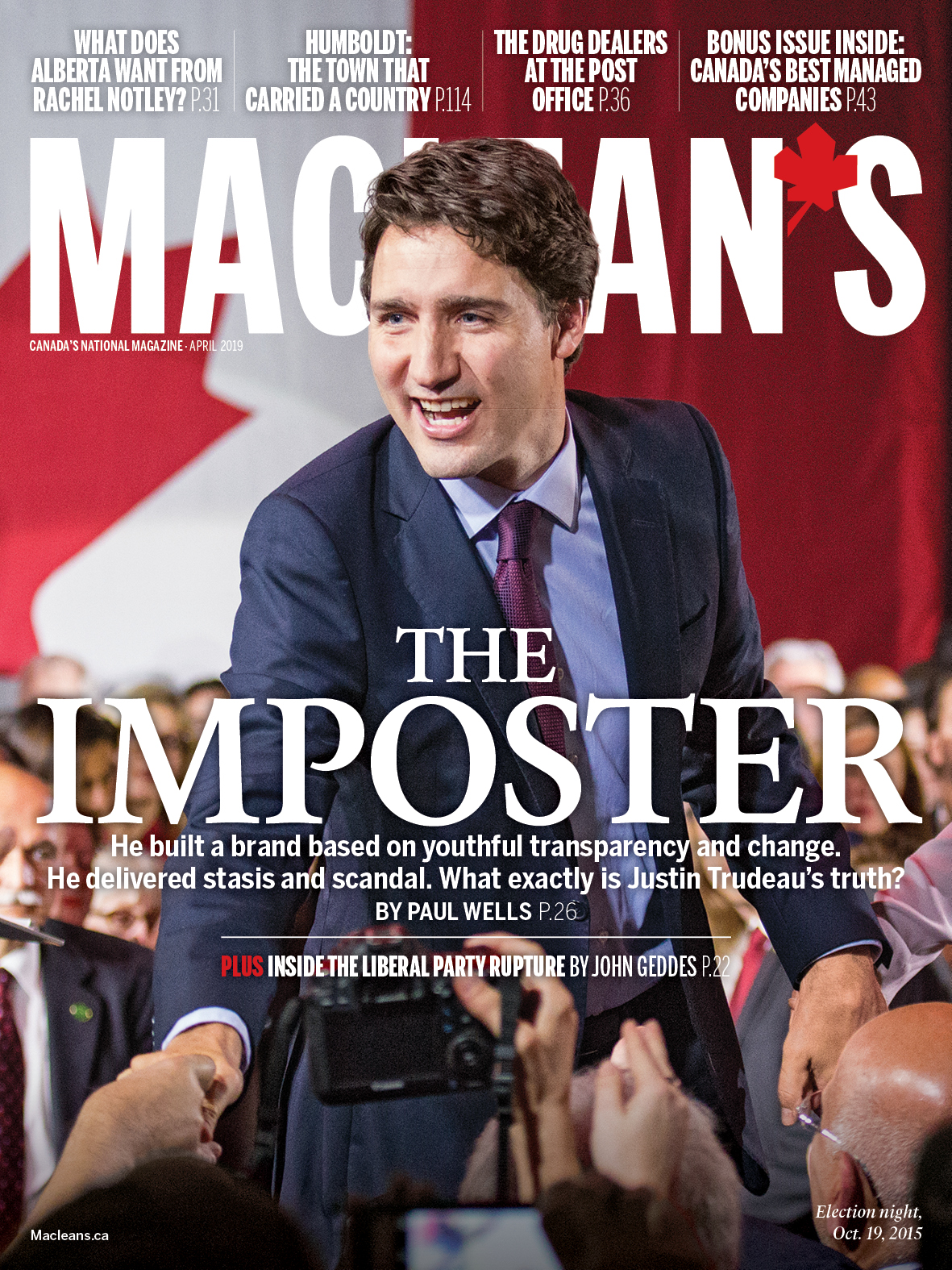
Phony Trudeaumania has bitten the dust

Filed under: Cancon, History, Media, Politics — Tags: , , , , , — Nicholas @ 03:00

Nico Johnson discusses the dangers of family dynasties in democratic countries:

When future political historians look back at the 21st century, Justin Trudeau’s election as a Liberal leader may be regarded as a bland footnote. Despite all the hope Trudeau brought Canadians in his once seemingly eternal, post-election honeymoon, his leadership inevitably toppled into a swamp of sticky scandals and hurried apologies.

Justin Trudeau may still be re-elected. However, the Conservatives can rest easy in the knowledge that Trudeaumania, at least for this current Trudeau, is well and truly dead.

What is noteworthy, however, is the atmosphere of surprise and confusion that has clouded commentators’ judgements surrounding the downfall of Trudeau. In the corridors of Ottawa’s broadcasters, it may have appeared absurd that natural political decline should apply to their darling Prime Minister; the leader of the “woke world.”

Trudeau’s appearance of invincibility, which still makes these commentators swoon (note the SNC-Lavalin coverage) was first created in those blue-skied months following his leadership election in 2013.

Perhaps Justin, with his charisma and handsomeness, seemed like a breath of fresh air to Canadian progressives. Gone were those days of Ignatieff, the drooling philosopher, who rather spectacularly (considering his semi-illiterate predecessor) lost 43 seats forcing the Liberals into third-party status.

With Trudeau’s leadership, the Liberal party would have a candidate who seemed so perfect for Canadian political life that even a eugenicist would struggle to replicate it. With his status as an Anglophone-Quebecois, which managed to pacify the sensibilities of English Canada, whilst having his Quebecois heritage to maintain seat-rich Quebec—Trudeau must have seemed like a divine gift.

Yet even in those early days, Trudeau lacked noticeably in the fundamental requirements that statesmanship should necessitate. He had no political experience after being almost casually elected to the House of Commons. Nor did he possess any working experience, and had been entirely unknown to the Canadian public until the eulogy at his father’s funeral. To put it quite simply, Justin Trudeau would have never become Prime Minister of Canada if his father, Pierre, had not been one too.

September 4, 2019

Poor Greta Thunberg

Filed under: Environment, Media, Politics — Tags: , , — Nicholas @ 03:00

Theodore Dalrymple on the grim-visaged child star of the environmental movement:

Greta Thunberg at the EU Parliament, 16 April, 2019.
European Parliament photo via Wikimedia Commons.

Poor Greta Thunberg! She is to self-righteousness and self-satisfaction what Mozart was to music, namely an astonishing youthful prodigy. Unlike Mozart, however, she is a very unattractive child, her unattractiveness arising not from her natural physical endowment but from the sheer grimness of her humourless puritanism which is inscribed on her face for all to see. She has succeeded in adding a new vision of hell to the many that I already have, namely being preached at by her for all eternity without intermission.

It is said that she suffers from a psychiatric condition, but whether or not this is so, her awfulness (of which, of course, she is blithely unaware) is not really her fault. Her transformation into a celebrity is the work of adults. It is they who have turned her into the Ayatollah Thunberg, the Khomeini of climate change.

In the days when reaching old age was exceptional, almost implying some kind of personal virtue, it was the elderly who were accorded respect and regarded as the repositories of wisdom. But as the old begin to outnumber the young, it is the young to whom falls the mantle. This is because we value the rare. No only does little Greta belong to a minority, but to a minority of that minority, for no one can deny that she is articulate, however monotonous, programmed or lacking in spontaneity her lines might be.

Adolescence in particular is now regarded as the acme of human existence, from which only decline is possible (and Greta exudes an air of permanent adolescence). I still have not quite made up my mind whether our age is the first of the geriatric adolescent or that of the adolescent geriatric, but I not infrequently notice around me seventy- and even eighty-year-olds who try to dress and comport themselves as if they were still about eighteen or nineteen. I find it sad, for of course the march of time is inexorable in its effects, albeit that it is true that it has slowed somewhat and people now age more slowly than they once did thanks, ultimately, to the material prosperity brought about by the creative destruction of capitalism. Nevertheless, the pretence that we have not aged is futile, though it is not futile only: it is both sad and shallow, in that it implies that life subsequent to adolescence has not brought its own rewards, and moreover that one has in effect learned nothing in the meantime, that the very best that can be hoped for is that one’s knowledge and wisdom, which plateaued at the age of eighteen, have maintained that elevated level ever since.

Based upon my experience of the elderly, I view the arrival of the adolescent geriatric, or the geriatric adolescent, with some consternation or trepidation. From a very early age I have had a liking for the elderly, often preferring them to the young, especially the young of my own and subsequent generations, but I have to admit that when an old person is nasty or querulous, he or she tends to be very nasty or querulous indeed, and exceedingly difficult to handle. In so far as adolescence is an age of egoistic querulousness, therefore, the prospect is daunting of an increase in bad-tempered geriatrics, angry that, despite their wish that they should remain adolescent forever (a wish that they are likely to confuse with a right because they have lived through a period when wishes rapidly transformed themselves into rights), they continue to age and will one day die. The Bible might tell us that there is a time and place for everything, but in the worldview of the geriatric adolescent, there is no time or place for old age.

September 3, 2019

When “raising awareness” works too well

Filed under: Business, Media, Politics, USA — Tags: , , — Nicholas @ 03:00

Dylan Gibbons reports on a recent finding from the Harvard Business Review:

A new study published by the Harvard Business Review shows that in addition to men’s growing fears about women in the workforce and potentially being falsely accused, women are becoming more aware of the backlash and are actually less likely to hire certain women, specifically attractive women.

“Most of the reaction to #MeToo was celebratory; it assumed women were really going to benefit,” said Leanne Atwater, a management professor at the University of Houston. However, Atwater was skeptical. Rather than seeing an endless trail of steps forward before her, she and her colleagues forecasted a backlash.

“We said, ‘We aren’t sure this is going to go as positively as people think — there may be some fallout.'” And so, they tested their hypothesis.

The study began in early 2018. Two surveys were created, one for men and one for women. These surveys were then distributed to workers in various professional fields. In the end, they collected a large amount of data from 152 male and 303 female responders.

According to the study, 74% of women now say they are more willing now to speak out against harassment, while 77% of men anticipated being more careful about potentially inappropriate behaviour.

As for the idea that men do not know what constitutes harassment, the researchers found the opposite was true. Both genders appear to both know what constitutes harassment, and women may be more lenient with some of their own definitions of what constitutes harassment.

According to the report, “The surveys described 19 behaviors — for instance, continuing to ask a female subordinate out after she has said no, emailing sexual jokes to a female subordinate, and commenting on a female subordinate’s looks — and asked people whether they amounted to harassment.”

“Most men know what sexual harassment is, and most women know what it is,” Atwater says. “The idea that men don’t know their behavior is bad and that women are making a mountain out of a molehill is largely untrue. If anything, women are more lenient in defining harassment.”

Another recent action intended to increase the number of women in STEM subjects at an Australian university — by selectively lowering academic standards for admission — will almost certainly not achieve its stated goals, but will work to increase negative views of those women in the working world:

[A female engineer] also rightly points out that this lowering the bar for women is unfair to men losing the university places to women with lesser qualifications.

She points out that male students will notice that women are struggling more with the course material — the women allowed in because the bar was lowered.

She feels this is a net negative for women in the engineering sector in general, and I have to agree.

How, she asks, can employers be expected to see a woman’s engineering degree the same as a man’s if the employer knows the women got a break getting into the program?

She uses the term “positive discrimination” to describe the leg-up practices, and I really prefer that to “affirmative action” to describe it because the word “discrimination” is plain in it. And that’s exactly what it is. Discrimination against qualified people that will ultimately harm women who are qualified.

As she puts it, the only way to ensure that a woman’s qualifications mean as much as a man’s is to have equal hurdles for women.

I’m completely with her.

September 2, 2019

The economics of climate change policies

Filed under: Economics, Environment, Government, Politics — Tags: , , — Nicholas @ 03:00

Tim Worstall explains the economic implications for the various demands that we consume less in order to fight climate change:

A major contention from economists is that if we decide to fight global heating in the wrong manner then we’ll make ourselves poorer than we need be. A major contention from the same economists is that if we don’t fight global heating at all then we’ll make ourselves poorer than we need be. That being the economic point about all of this, we must fight global heating in the correct manner.

The correct manner not being vast plans by bureaucracies. Instead, change market prices with the one intervention – a crowbar into the system just the once with a carbon tax – and then let the economy itself chew through the implications of that.

Do note that the argument is not “poorer than we are now”, it’s poorer in the future than we need to be in that future.

And then we’ve got the varied Green, New Deal, unsoaped hippies and socialist idiots whose demand is rather different. They are insisting that we must be poorer, now, than we are, now. These people really do have to be told to bugger off:

    A sustainable environment means consuming less, not differently.

The only useful measure of how rich you are is “What are you able to consume?” Insisting that you consume less is therefore insisting upon being poorer.

It’s also entirely wrong that consuming differently won’t make a difference. Because again those economists. The thing we consume is value. That’s also the thing that we produce. That Gross Domestic Product, GDP, that is so bewailed as a societal target is nothing but the value added in the economy. GNP is the value which accrues to the people in the economy. NNI is the net value that goes as income to those in the economy. And so on through the different possible combinations of net and gross, national and domestic, production and income.

They’re all measures of value added. Not of resources consumed at all. So, if we face resource constraints all we need to do is change the value we’re producing by using fewer of those scarce resources to do so. Then we can carry on consuming ever greater quantities of value that we’ve gone and created. This must obviously be so – we do quite obviously face resource constraints currently. All economic resources are scarce, that’s what makes them economic resources in the first place, their scarcity. We don’t actually have an economics of atmospheric nitrogen because it’s not scarce. We do have an economics of soil nitrogen because it is scarce. The conversion of one to the other comes at a price – many prices in fact. The conversion itself, the algal blooms from having done so and so on. But the doing also adds value – which is then what humans consume, the value added.

So, the idea that consuming differently won’t make a difference is dribble. Plus, the idea that we must all be poorer in order to sustain that environment is drivel. Simple observation tells us that places with poor people have worse environments than places with rich.

September 1, 2019

QotD: Wonks inside the Beltway

Filed under: Humour, Media, Politics, Quotations, USA — Tags: , , — Nicholas @ 01:00

There are few words that stir the blood of a Beltway wonk like “the Commission has issued its report.” That means that those in the government must now react, importantly, and those in the media must now react as well — dissect, digest, explain to the benighted groundlings what it means, and issue Important Recommendations by way of reasoned editorials aimed at the corridors of power, but more likely received by a schoolteacher in Iowa who photocopies it off and puts it on the bulletin board in the staff lounge with yellow highlight-lines through the better parts.

The commission has issued its report! Mo better, the commission has issued recommendations! And the Washington press corps open their beaks, spindly necks trembling, waiting for the savory worm to be dropped from the blue-ribbon mother bird.

Unless you’ve spent some time in DC you can’t imagine the tremendous self-importance that possesses the people who feed off the government. They’re like people who live in the same town where NASA has a tracking station, and think that it makes them all astronauts.

James Lileks, Bleat, 2004-07-23.

August 30, 2019

Communist Revolution in America? – The Red Scare 1919 I THE GREAT WAR 1919

Filed under: History, Politics, USA — Tags: , , , , , , — Nicholas @ 06:00

The Great War
Published on 29 Aug 2019

Get a free audiobook and 2 Audible Originals with a 30-day trial: http://audible.com/greatwar or text greatwar to 500 500.

The American intervention in the Russian Civil War, the economic hardships of workers and returning veterans and the strikes all over the US in 1919 created a hysteria that we know as Red Scare today. But how realistic was the idea of a Bolshevist revolution in America really?

» SUPPORT THE CHANNEL
Patreon: https://www.patreon.com/thegreatwar
Merchandise: https://shop.spreadshirt.de/thegreatwar/

» SOURCES
US Congress. Senate. Bolshevik Propaganda: Hearings before a Subcommittee of the Committee on the Judiciary. 65th Cong., 3rd sess., February 11, 1919, to March 10, 1919
Brecher, Jeremy. Strike! Revised edition. South End Press, 1997.
Hanson, Ole. Americanism versus Bolshevism. New York and London: Doubleday, Page, & Co., 1920.
United States Department of Justice. Red Radicalism as Described by Its Own Leaders, Exhibits Collected by A. Mitchell Palmer, Including Various Communist Manifestos, Constitutions, Plans, and Purposes of the Proletariat Revolution, and Its Seditious Propaganda. Washington: Government Printing Office, 1920.
Cocks, Catherine, Peter C. Holloran, Alan Lessloff. The A to Z of the Progressive Era. Maryland: Scarecrow Press, Inc., 2009.
Dick, William M. Labor and Socialism in America. New York: Kennikat Press, 1972.
Gould, Lewis L. The Progressive Era. New York: Syracuse University Press, 1974.
Hagedorn, Ann. Hope and Fear in America: 1919. New York: Simon & Schuster, 2007.
Jaffe, Julian F. Crusade Against Radicalism: New York During the Red Scare, 1914-1924. New York: Kennikat Press, 1972.
Kornweibel, Jr., Theodore. “Seeing Red”: Federal Campaigns Against Black Militancy, 1919-1925. Indianapolis: Indiana Press University, 1998.
Hawley, Ellis W. The Great War and the Search for a Modern Order: A History of the American People and Their Institutions, 1917-1933. New York St Martin’s Press, 1979.
Murray, Robert K. Red Scare: A Study of National Hysteria, 1919-1920. New York: McGraw-Hill Book Company, 1964.
Powers, Richard Gid. Not Without Honor: The History of American Anticommunism. Yale University Press, 1998.

»CREDITS
Presented by: Jesse Alexander
Written by: Jesse Alexander
Director: Toni Steller & Florian Wittig
Director of Photography: Toni Steller
Sound: Toni Steller
Editing: Toni Steller
Mixing, Mastering & Sound Design: http://above-zero.com
Motion Design: Christian Graef – GRAEFX
Maps: Daniel Kogosov (https://www.patreon.com/Zalezsky)
Research by: Jesse Alexander and Jonathan Dunning
Fact checking: Florian Wittig

Channel Design: Alexander Clark
Original Logo: David van Stephold

A Mediakraft Networks Original Channel

Contains licensed material by getty images
All rights reserved – Real Time History GmbH 2019

« Newer PostsOlder Posts »

Powered by WordPress