Quotulatiousness

December 15, 2025

The wrong way to address the credit card debt issue

Filed under: Economics, Government, Politics, USA — Tags: , , , , , — Nicholas @ 03:00

Daniel Mitchell says that US politicians seem to have identified a real problem and they’re proposing solutions. Unfortunately, the biggest proposal not only won’t solve the problem … it’ll make it worse for the most vulnerable credit card debtors:

“Credit Cards” by Sean MacEntee is licensed under CC BY 2.0 .

According to a new report from the New York Federal Reserve, Americans have accumulated over one trillion in credit card debt, an all-time high. It’s a record that would make financial advisor Dave Ramsey lose the remaining hair on his head, but even worse, the share of balances in serious delinquency climbed to a nearly financial-crash level of 7.1%. In other words, Americans are borrowing more and paying back less.

This alarming trend has naturally drawn the attention of politicians eager to offer a quick fix.

Unfortunately, the solution gaining bipartisan traction is a blanket cap on credit card interest rates. Like most political quick fixes, it is an economic prescription guaranteed to harm the very individuals it claims to protect.

The impulse to cap rates is rooted in a fundamental economic misunderstanding. It treats the interest rate as an arbitrary fee levied by greedy banks rather than the essential economic mechanism it is: the price of risk. This misguided philosophy is embodied in the legislation introduced by the populist duo of Senators Josh Hawley (R-MO) and Bernie Sanders (I-VT), which seeks to impose a nationwide cap on Annual Percentage Rates (APRs), sometimes as low as 10%.

Make no mistake: two politicians don’t know better than the marketplace and the law of supply and demand that governs it. The consequences of imposing a price ceiling on credit are not debatable. They are historically certain. Interest rates on credit cards are higher than on mortgages, for instance, because credit cards are unsecured debt. If a borrower defaults, the bank cannot seize collateral to cover the loss. The interest rate must therefore be high enough to reflect the expected default rate across the entire high-risk pool.

It’s wrongheaded. Faced with the possibility of a government-imposed price cap, credit card companies would of course respond as any company would. They will stop extending credit to those who will possibly not pay them back. Studies show that even a cap as high as 18% would put nearly 80% of subprime borrowers at risk of losing access to credit. In other words, the 10% cap proposed by the Hawley–Sanders alliance would have truly devastating effects for credit access, potentially eliminating millions of accounts.

The victims of this policy will not be the wealthy, who already qualify for prime rates; nor will they be the financially literate, who pay their balances in full. The victims will be the economically vulnerable, the working-class single mother needing a short-term buffer, the recent immigrant attempting to build a credit score, or the young person trying to establish his or her financial footing. For these individuals, the Hawley–Sanders policy will deliver not cheap credit, but no credit at all.

December 14, 2025

Andrea Dworkin – feminism’s anti-sex evangelist

Filed under: Books, History, Media, Politics, USA — Tags: , , , — Nicholas @ 05:00

On her Substack, Janice Fiamengo examines the life and work of Andrea Dworkin, whose influence on modern feminism is still quite strong, twenty years after her death:

A friend wrote a couple of days ago to say that he had seen shiny new copies of works by feminist author Andrea Dworkin (1946-2005) in Munro’s Books, one of Canada’s premier independent bookstores. One of the books was positioned on a shelf with the cover facing out to indicate that it was being showcased.

It is both shocking and unsurprising that Picador Books decided to reprint three of Dworkin’s texts in the past year, calling her a “prescient and visionary writer” who was “ahead of her time”. Anti-male paranoia is a sanctioned, cultivated taste more popular now, perhaps, than ever before, and Andrea Dworkin is its most notorious propagandist.

Known for her physical bulk, impassioned rhetoric, unkempt hair, and lesbian-identified overalls, Dworkin was a feminist icon in the 1980s and 90s, loved and hated in equal measure. No one did more to outline and consolidate the modern feminist understanding of sex than she, writing on the subject obsessively and with unparalleled fervor in books with titles such as Woman Hating (1974) and Pornography: Men Possessing Women (1981). The MeToo movement is almost unimaginable without the influence of Dworkin’s pronouncements.

Like other radical feminists, Dworkin wrote about rape, pornography, and prostitution, but her special focus was the degradation for women of sex itself: regular sex, the commonly accepted, normalized indignity that men allegedly inflict on women every day. Tempering her words in the white-heat of her revulsion, Dworkin became feminism’s anti-sex evangelist.


Sex, Dworkin believed, embodied nothing less than men’s hatred of everything female: “Intercourse is the pure, sterile, formal expression of men’s contempt for women” (p. 175). This is the thesis of her most representative book, Intercourse, which was first published in 1987 when Dworkin was 41 years old. Dworkin’s characterization of heterosexual sex as the ultimate enactment of misogyny has had an enduring impact on North American culture.

Intercourse set out to illuminate, through select readings of literary texts, what Dworkin believed to be a constant of male culture: the “hatred of women, unexplained, undiagnosed, mostly unacknowledged, that pervades sexual practice and sexual passion” (pp. 175-76). The phrase she most often used in the book to refer to intercourse was “the fuck”, which was meant to signify the raw dehumanization that supposedly characterized it.

Dworkin nominated herself the expert on male contempt for women because she had been its victim. “Specifically, am I saying that I know more than men about fucking?” she asked defiantly in the book’s preface, and answered, “Yes, I am […] the way anyone used knows the user” (p. xxxi).

While she also claimed in the preface that the book “does not say that all men are rapists or that all intercourse is rape” (p. xxxii), she does essentially say that, if not in quite those words. As she asserted only a page after the denial, “Intercourse conveys […] what it means that men — and now boys — feel entitled to come into the privacy of a woman’s body in a context of inequality” (p. xxxiv).

In another segment, she clarified that most, even the vast majority, of men were sexually abusive. She charged that men object to feminist criticism of pornography and prostitution because “So many men use these ignoble routes of access and domination to get laid,” that “without them the number of fucks would so significantly decrease that men might nearly be chaste” (p. 61). The implication was that men who objected to her arguments about the omnipresence of sexual exploitation were themselves sexual abusers who didn’t like the thought of their exploitation being curtailed.

This was the Dworkin who made feminists swoon with admiration: bombastic, hyperbolic, and incandescent with accusatory rage.

December 12, 2025

British Columbia’s embrace of UNDRIP entails vast unintended consequences

Filed under: Cancon, Government, History, Law, Media, Politics — Tags: , , , , , — Nicholas @ 05:00

The government of British Columbia may have downplayed or even deliberately lied about the impact of incorporating the United Nations Declaration on the Rights of Indigenous People (UNDRIP) into BC’s legal system, but I suspect even they are suddenly realizing just what a legal disaster they have unleashed on their province (and indirectly, on the rest of Canada):

A map showing the Cowichan title lands outlined in black. These lands were declared subject to Aboriginal title by the BC Supreme Court earlier this year, in accordance with the UNDRIP provisions added to BC law in 2019.

When the B.C. NDP introduced a 2019 act committing the province to the United Nations Declaration on the Rights of Indigenous People (UNDRIP), they very specifically assured critics that it would not be a “veto” over existing laws.

“The UN declaration does not contain the word veto, nor does the legislation contemplate or create a veto”, Scott Fraser, the province’s then Indigenous relations minister, told the B.C. Legislative Assembly.

Fraser explained that it was not “bestowing any new laws”, it would not “create any new rights” and it certainly wouldn’t make B.C. subservient to a UN declaration.

Fraser would even explicitly assure British Columbians that there was no conceivable future in which, say, a private landowner could suddenly see their property declared Aboriginal land.

“We are not creating a bill here that is designed to have our laws struck down,” he said.

That it only took six years for all of these scenarios to take place may explain why there is so much panic in B.C. right now.

The newly appointed head of the B.C. Conservative Party is calling for an emergency Christmas session of the legislature to excise UNDRIP from provincial law, saying it has become an anti-democratic tool.

Even B.C. Premier David Eby — a onetime champion of the legislation — has said that “clearly, amendments are needed”.

And British Columbians, whose support for the UN law was already not great, are growing restless. According to an Angus Reid Institute poll released on Wednesday, Eby ranks as one of the least popular provincial leaders in the country.

What changed was a Dec. 5 B.C. Appeals Court ruling that not only struck down a B.C. law (the Mineral Tenure Act) on the grounds that it violated UNDRIP, but effectively ruled that any law or government action could similarly be overturned if it wasn’t in line with the 32-page UN declaration.

By writing UNDRIP into B.C. law, the province had adopted the Declaration as “the interpretive lens through which B.C. laws must be viewed and the minimum standards against which they should be measured”, read the majority decision.

Although UNDRIP is mostly filled with uncontroversial declarations about languages and traditional medicine, its clauses are pretty uncompromising when it comes to issues of land use or resource development.

“Indigenous peoples have the right to the lands, territories and resources which they have traditionally owned, occupied or otherwise used or acquired”, reads a subsection of Article 26. It also states that Indigenous peoples “own, use, develop and control” any land that they’ve held traditionally.

Eby is saying that the courts took it too far, and that writing UNDRIP into B.C. law was only ever meant as a holistic decision-making guide, rather than a law superceding all others.

As Eby told reporters this week, by signing onto UNDRIP, B.C. wasn’t intending to put courts “in the driver’s seat”.

December 11, 2025

US Democrats, like Canadian Liberals, love performative gestures but ghost on delivery

Filed under: Cancon, Media, Politics, USA — Tags: , , , , , , — Nicholas @ 05:00

I’ve remarked many times that Canada’s federal Liberals love themselves some photo ops, sound bites, ribbon-cuttings, and making announcements in front of temporary stages … they can’t help themselves, they’re what happens to theatre kids who don’t have to grow up. The American Democrats seem to be falling into the same pattern of “putting on a show” rather than implementing policies that address whatever the declared problem really is:

In 2015, the City of Los Angeles announced an ambitious plan (led by the person we then referred to as Mayor Yogapants) to completely eliminate traffic deaths by 2025. It was a vision: Vision Zero, they called it. Ten years later, traffic deaths in Los Angeles have doubled. A wonderfully progressive local government announced a plan to eliminate something, so we got much more of that thing. A community group, @peoplesvisionzero, is now trying to carry out some version of the failed plan with guerilla traffic engineering, sneaking new safety infrastructure into place without city permission. Recent result:

In similar fashion, Gavin Newsom announced his ten-year plan to end California homelessness in 2008. I struggle with the math, but there’s a possibility that we’ve passed the ten-year mark since then. […]

Theater-kid governance is the empty-to-the-point-of-ruin declaration of a symbol-desire, a performance about what we want and don’t want. It doesn’t do anything; it’s a posture, not an action. To the extent that it does do any actual thing in physical reality, it creates pots of money to be looted by NGOs and metastasizing government bureaucracies.

Infamously, when California audited $24 billion in state homelessness spending last year, auditors couldn’t track where a bunch of the spending went, or figure out what it had paid for. See also the growing scandal over Somalian immigrant social services fraud in Minnesota. Facial expressions are made. Symbols are invoked. Money goes … somewhere. It’s a show, with a rich loot bucket, not an actionable set of policies that produce positive trends toward declared goals. By the way, it’s been fifteen years since the Obama administration and a Democratic-majority Congress made healthcare affordable.

California infrastructure is a persistent disaster, because the California legislature and our sociopathic idiot governor are deeply invested in signaling about warm and wonderful trans kids and standing up to Mean Orange Hitler. They don’t stoop to highways and bridges — they’re much too progressive. Related, the increasingly sharp near-term projected decline of fuel production in California is becoming a national security problem in a state that needs to gas up a lot of military traffic. The state performs constantly against Big Oil and its mean climate change agenda, and somehow keeps losing refineries. The endless symbol-gestures cause the loss of real things.

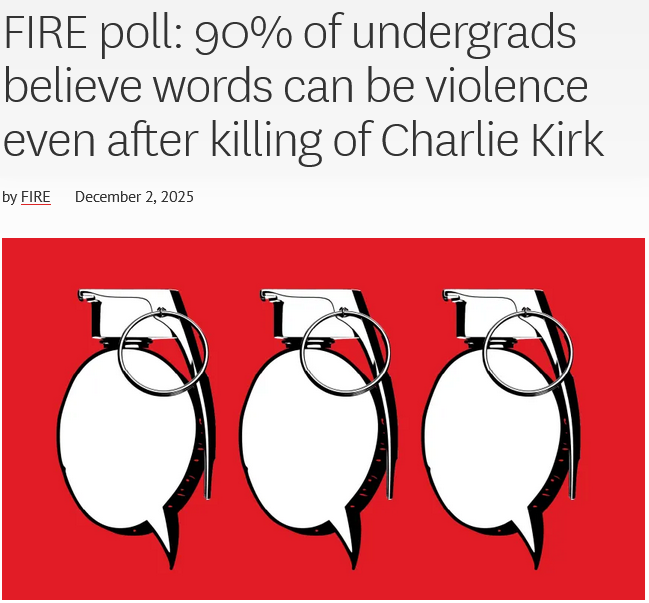
Your words are violence to an astounding 91% of US college students surveyed

Filed under: Education, Media, Politics, USA — Tags: , , , , , — Nicholas @ 03:00

J.D. Tuccille presents some depressing poll results from American college students who have massively bought into the illogical position that words can be the same as actual violence:

Of all the stupid ideas that have emerged in recent years, there may be none worse than the insistence that unwelcome words are the same as violence. This false perception equates physical acts that can injure or kill people with disagreements and insults that might cause hurt feelings and potentially justifies responding to the latter with the former. After all, if words are violence, why not rebut a verbal sparring partner with an actual punch? Unfortunately, the idea is embedded on college campuses where a majority of undergraduate students agree that words and violence can be the same thing.

Most Believe Words Can Be Violence

“Ninety one percent of undergraduate students believe that words can be violence, according to a new poll by the Foundation for Individual Rights and Expression [FIRE] and College Pulse”, FIRE announced last week. “The survey’s findings are especially startling coming in the wake of Charlie Kirk’s assassination — an extreme and tragic example of the sharp difference between words and violence.”

The survey posed questions about speech and political violence to undergraduate students at Utah Valley University, where Kirk was murdered, and at colleges elsewhere — 2,028 students overall. FIRE and College Pulse compared the student responses to those of members of the general public who were separately polled.

Specifically, one question asked how much “words can be violence” described respondents’ thoughts. Twenty-two percent of college undergraduates answered that the sentiment “describes my thoughts completely”, 25 percent said it “mostly” described their thoughts, 28 percent put it at “somewhat”, and 15 percent answered “slightly”. Only 9 percent answered that the “words can be violence” sentiment “does not describe my thoughts at all”.

It’s difficult to get too worked up about those who “slightly” believe words can be violence, but that still leaves us at 75 percent of the student population. And almost half of students “completely” or “mostly” see words and violence as essentially the same thing. That’s a lot of young people who struggle to distinguish between an unwelcome expression and a punch to the nose.

Depressingly, 34 percent of the general public “completely” or “mostly” agree. Fifty-nine percent at least “somewhat” believe words can be violence.

In 2017, when the conflation of words and violence was relatively new, Jonathan Haidt, a New York University psychology professor, worried that the false equivalence fed into the simmering mental health crisis among young people. He and FIRE President Greg Lukianoff wrote in The Atlantic that “growing numbers of college students have become less able to cope with the challenges of campus life, including offensive ideas, insensitive professors, and rude or even racist and sexist peers” and that the rise in mental health issues “is better understood as a crisis of resilience”.

Conflating Words and Violence Encourages Violence

Telling young people who haven’t been raised to be resilient and to deal with the certainty of encountering debate, disagreement, and rude or hateful expressions in an intellectually and ideologically diverse world plays into problems with anxiety and depression. It teaches that the world is more dangerous than it actually is rather than a place that requires a certain degree of toughness. Worse, if words are violence it implies that responding “in kind” is justified.

“At a time of rapidly rising political polarization in America, it helps a small subset of that generation justify political violence,” Haidt and Lukianoff added.

December 9, 2025

The “Great Feminization” of western culture

In the National Post, Barbara Kay outlines the way society has been trending further away from traditional values and more and more toward the values of “empathy, safety, and cohesion” which have been predominantly feminine values in contrast to more male-oriented values of “rationality, risk, and competition”:
In September, public intellectual Helen Andrews caused a stir when she delivered a provocative 17-minute speech, titled “Overcoming the Feminization of Culture”, to the National Conservatism Conference, later published as an article for Compact, titled “The Great Feminization“.

Andrews summarized feminization as the prioritizing of feminine over masculine interests, but additionally prioritizing “empathy over rationality, safety over risk, cohesion over competition”. All these traits combine, she believes, in institutions where females are numerically dominant, to define “wokeness” and “cancel culture”.

Andrews points to Bari Weiss’ 2020 resignation letter from the New York Times where Weiss was labeled and ostracized for her social ties and cut off by perceived friends. In 2018, the newsroom there had tipped to a female majority which Andrews argues changed the work environment’s dynamics to one where cohesion is preferred, and covert undermining would replace open debate in favour of emotional harmony.

And I would argue that the more feminized society’s institutions become, the more readily extreme, empathic attitudes replace rational decision-making at policy-making levels, and the more society loses confidence in its ability to thrive.

Ironically, instead of directing empathy towards our own citizens, feminization also tends to direct empathy internationally. That is exactly what is happening at our national level, when our government earmarks funds for programs such as “Gender-Just, Low-Carbon, Rice Value Chains in Vietnam”.

This is also happening at a micro-level to the Jewish community in North America. Our spiritual leadership in non-orthodox synagogues is growing increasingly female, and, by no coincidence, is wokeness spreading, and, by no further coincidence, so is alignment with radical anti-Zionism.

[…]

Claims that Israel was guilty of genocide and apartheid, the authors write, were a constant feature of their education. Most shockingly, they write — and this at a rabbinical training institution headed by a female rabbi — that “the sexual violence Israelis experienced (on October 7) was never mentioned, even during Women’s History Month”.

What about the Christian clergy? A 2024 report on female Christian clergy found that in a 2018 sample, about 14 per cent of U.S. churches were headed by a senior female clergyperson. So, churches are not yet in danger of feminization. Good luck to them.

If there is a solution to the feminization-linked problem of anti-Zionism in the non-Orthodox rabbinate, I don’t know what it is. I only know this trend cannot end well for our community. What is essential in Jews’ spiritual homes now, more than ever in our history, is that they be spaces where “ahavat Yisrael” — love of Israel — is the prevailing norm. If we are not for ourselves, who will be?

On a more individual level, the Great Feminization has worked not to make women equal, but to increase their existing privileges and to demonize men who even notice the inequality now runs directly opposite to the narrative:

Image from Steve’s Substack

Over thirty years ago, I knew a woman who felt ecstatic joy taunting men with her nudity. She loved to flash her breasts at truckers on the highway. Thrilled at the thought that she left them frustrated, she would boast about her sexual power.

This is clear, unequivocal abuse. Imagine her taunting a village of starving Africans with BBQ’d steak. She then flees to her 5-star hotel, laughing and bragging that she had left them hungry and frustrated. This is how the West raises women. Self-obsessed, over-entitled and insufferable (insert obligatory, “not-all-women” clause here – yawn).

Feminists have gotten more sophisticated with their abuse since then. We now have transgressions that include absurd accusations like prolonged looking, mansplaining and manspreading. TikTokers go to the gym essentially nude in order to video and humiliate men who happen to notice.

We had the, “Yes means Yes” campaign that insists a man should repeatedly pester his partner with endless questions for permission during every intimate encounter. Never mind that a normal woman is likely to leave the bed after a few of these interruptions, rightly despising the insecure man who obeys that tripe. Anywhere outside of a deep feminist indoctrination camp, a woman will wonder whether your mother dropped you on your head as a child. I’ll bet that not even the most committed believer follows their own advice. This is not good communication — it denies healthy context, body language and facial expression.

And there’s nothing romantic about it; it is designed for feminist power. There is no number of reassurances that could possibly satisfy. The emphasis upon a non-stop verbal Q&A is courtroom strategy. And that’s the point: eliminate the human context, and set a trap for the man. “Did he ask permission to engage in number 17 of the 32 listed steps before sex? No, your honor, that’s where the sexual assault happened.”

Human intimacy is negotiated using mostly unspoken signals, and everybody likes it that way. Obviously there’s a need for clear communication, especially in a new relationship. I only need to include this disclaimer because the world is filled with pedantic manhating feminists eager to accuse me of denying women’s humanity. Grow up, child. Healthy women have absolutely no problem setting their own limits during intimacy. I’ve never met one who didn’t.

We cover for even the worst of women’s transgressions. When a woman murders her child, we call it infanticide and blame postpartum depression. When she murders her husband we call it battered wife syndrome, which is the title of a book by Canadian feminist law professor, Elizabeth Sheehy. Feminist lawyers even argue to eliminate female incarceration and close all women’s prisons, and for decriminalization of husband murder. This nonsense from the feminist cult for women with daddy issues protects mentally ill women who need psychological help, and/or belong in prison.

Every woman has a plethora of options, and near-infinite sympathy and support, in Western culture. Maybe that’s the problem: we don’t hold women responsible for their own behavior. Many women have not been socialized into adulthood.

At risk of making this a TLDR post, here’s Mark Steyn on the cultural side of our ever-more-feminized culture:

Welcome to another in our ongoing series of As I Said Twenty Sod-Bollocking Years Ago. Women have inherited the thrones of great powers — Elizabeth I, Catherine the Great, Victoria — and presided over massed ranks of courtiers drawn from the “pale, male and stale” (thank you, David Cameron). But America and its client states are the first in history in which every significant venue aside from ladies’ sport is now dominated by women. The west is closer than any society should be to the end of men — which is a big source of the terrible confusion in our schools that has led children to offer themselves up for bodily mutilation and irreversible infertility. Helen Andrews’ much noted “viral” essay on the phenomenon informs us inter alia that by 2024 American law schools were fifty-six per cent female and that sixty-three per cent of judges appointed by Joe Biden’s autopen are likewise on the distaff side. Elsewhere, fifty-five per cent of New York Times reporters are women (up from ten per cent half-a-century ago) and 57.3 per cent of US undergraduates are what we would once have called “coeds”.

At the same time, the principal source of immigration to the west is from a patriarchal culture even more severe (if you can believe it) than 1950s sitcom dads. If you live in London, Paris, Brussels, Stockholm, Dearborn, do you see more body-bagged crones on the streets than you did a generation back? Are you figuring on seeing more still in another twenty years? Or are you betting that the tide will have receded?

It is at the intersection of these two not entirely compatible trendlines — a feminised society with a patriarchal immigration policy — where lies the future (such as it is) of the western world. With that in mind, the annual commemoration of the 1989 Montreal massacre each December 6th has a symbolism that extends far beyond my own deranged dominion. Not just because it was an early example of the state hijacking the actual news to impose a narrative more helpful to its own needs. In the dismantling of manhood and manliness, no lie is too outrageous. As I wrote in The National Post of Canada on December 12th 2002 – twenty-three years ago:

    For women’s groups, the Montreal Massacre is an atrocity that taints all men, and for which all men must acknowledge their guilt. Marc Lépine symbolizes the murderous misogyny that lurks within us all.

    M Lépine was born Gamil Gharbi, the son of an Algerian Muslim wife-beater, whose brutalized spouse told the court at their divorce hearing that her husband “had a total disdain for women and believed they were intended only to serve men”. At eighteen, young Gamil took his mother’s maiden name. The Gazette in Montreal mentioned this in its immediate reports of the massacre. The name “Gamil Gharbi” has not sullied its pages in the thirteen years since.

The Gazette notwithstanding, that might open up many avenues of journalistic investigation, don’t you think? The potential implications of Canadian immigration policy. The misogyny in particular of Islam, and its compatibility with developed societies. But instead everyone who mattered in the Dominion’s elite decided it was all the fault of Canadian manhood in general — of Gordy and Derek’s, or Émile and Pierre’s, culture of toxic masculinity. That narrative has held for two generations. The only even slight modification has been from a sliver of academics who posit Gamil Gharbi as “the first incel“. I’m not sure “incels” — young men who are “involuntarily celibate” — existed as a mass phenomenon back in 1989: they are a consequence of the societal feminisation Ms Andrews writes about. The “incel” segment was by far the most interesting part of the Tucker/Fuentes convo, and the least remarked upon, but the notion that they’re itching to kill women bolsters the original 1989 framing, so the media are minded to entertain it.

Yet we all know, surely, that the young ladies in that Montreal classroom would have benefited from a little bit of available “masculinity” that day. Alas, the men to hand were in a certain sense far more profoundly disarmed than the wildest dreams of “gun control” advocates. From my book After America:

    To return to Gloria Steinem, when might a fish need a bicycle? The women of Montreal’s École Polytechnique could have used one when Marc Lépine walked in with a gun and told all the men to leave the room. They meekly did as ordered. He then shot all the women.

Which is the more disturbing glimpse of Canadian manhood? The guy who shoots the women? Or his fellow men who abandon them to be shot? For me, the latter has always been the darkest element of the story. From my column in Maclean’s, January 9th 2006:

    Every December 6th, our own unmanned Dominion lowers its flags to half-mast and tries to saddle Canadian manhood in general with the blame for the Montreal massacre — the fourteen women murdered by Marc Lépine, born Gamil Gharbi, the son of an Algerian Muslim wife-beater, though you wouldn’t know that from the press coverage. Yet the defining image of contemporary Canadian maleness is not M Lépine/Gharbi but the professors and the men in that classroom, who, ordered to leave by the lone gunman, obediently did so, and abandoned their female classmates to their fate — an act of abdication that would have been unthinkable in almost any other culture throughout human history. The “men” stood outside in the corridor and, even as they heard the first shots, they did nothing. And, when it was over and Gharbi walked out of the room and past them, they still did nothing. Whatever its other defects, Canadian manhood does not suffer from an excess of testosterone.

So the annual denunciation of manhood in general is the precise inversion of the reality of the event. That was unusual in 1989, but has become routine since: the UK Government’s “Prevent” programme, set up in the wake of the July 7th Tube bombings to “prevent” further “Islamist” attacks, now focuses its energies on the threat from a “far right” boorish enough to insist on noticing all these Islamic provocations; January 6th is an insurrection for which trespassing gran’mas have to be hunted down and banged up in solitary, but Thoroughly Modern Milley telling the ChiComs he’ll ignore his commander-in-chief or James Comey taking to Twitter to urge his chums to “eighty-six” the President is true patriotism of the highest order; in German cities saving democracy is so critical that it is necessary to ban the leading political party.

So the inversion of reality is pretty much standard operating procedure these days. There is, however, a sense in which that terrible one-off atrocity from the late Eighties has become a portent of tomorrow — of a western world thoroughly unmanned. Your average feminist lobby group doesn’t see it that way, naturally. “The feminism I think of is the one that embodies inclusivity, multiculturalism and the ability to change the world through the humanity that women do bring,” says Stephanie Davis, executive director of Atlanta’s Women’s Foundation. “If there were women in power in representative numbers — fifty-two per cent — I think that the World Trade Center would still be standing.”


December 8, 2025

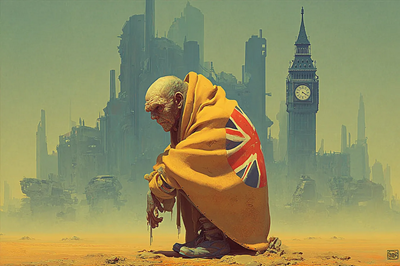
If Britain’s political leadership were trying to destroy the country, what would they have done differently?

My Canadian readers — and possibly the occasional Aussie or Kiwi — can read Spaceman Spiff‘s essay and feel it applies almost 100% to our respective nations as well:

Image from Postcards from the Abyss

Britain is a disaster. The country seems to be in terminal decline.

Not only do we see a lack of ability to turn things around we witness leaders and prominent decision makers evidently clueless about normal life and the hardships many now face.

The political and media classes best reflect this phenomenon. Their views are insular, fictional and at odds with reality. They promote unorthodox ideas that are widely derided yet their enthusiasm is evident as are their hostile responses to being challenged.

Minor comments about immigration are treated as precursors to genocide. Criticism of a biased media unwilling to report events is dismissed as conspiracy. No discussion of climate policy and its unaffordable costs is tolerated. Deviation from the establishment view means excommunication and social exile.

Those in leadership positions drive Britain’s descent into authoritarian governance. Attempts to discuss changes to society leads to extreme overreactions, including jailing noticers, something they now boast about.

Britain has become a madhouse. Our leaders are unable to think like normal people. None of them are facing reality. They seem crazy.

Or, rather, they seem neurotic.

Neurosis is everywhere

Britain has degenerated into a technocratic regime that views the public as its enemy. Normal people disgust the country’s leaders and it shows. They no longer hide their contempt.

But there is a palpable sense of fear emanating from the powerful. Their reactions to normal events paint a troubling picture of who is leading the country, particularly the political and media classes.

If the British establishment were a person we would think them mentally unstable. The qualities we see most are those of a neurotic individual, a type that is well understood.

Here are some features visible in Britain’s ruling class.

Chronic anxiety and worry

A key attribute of neurosis is persistent fear or worry. Rumination is commonplace, circling around and around the same problems. There is also a tendency to overreact, with the response disproportionate to the issue at hand.

The current British regime is wracked with anxiety and worry. This defines them. They are vocal about their concerns.

We are reminded of an endless series of horrors we must attend to; systemic racism, lack of diversity, an imperial past and our cultural dominance along with our impact on the world.

One simple example illustrates the degree to which minds can become distorted by excessive worry.

James Watt perfected the steam engine in 1769 which kickstarted in the industrial revolution, changing the world forever. This would ultimately elevate most nations on earth and led eventually to the establishment of cheap abundant energy for almost everyone.

Until recently these events were viewed as an epoch-defining moment of engineering brilliance. Now this has been recast as a dark stain on Britain’s place in the world, with climate zealots keen to blame the British for all pollution caused by industrialization.

Instead of pride we now see embarrassment and even anxiety about the “damage” Britain has done to the world because it ushered in an era of cheap widespread energy for everyone.

Any rational person would understand this extreme view to be a distortion of reality and excessively negative, yet it permeates everything. Those who rule Britain are ashamed of our past. They worry about it. Only they do this, normal people are proud of our history.

[…]

Welcome to the madhouse

A system of governance driven by neurotics takes on their characteristics. Britain has become a neurotic bureaucracy; a neurocracy.

Neurotics overthink and live inside their heads. They lack the calm, detached strength needed to govern sensibly. Power structures inevitably take on these qualities.

The British government has become paranoid. Digital IDs, internet regulation, censorship. They jail normal people for social media posts. Dissenting views are increasingly punished with custodial sentences.

These are not the actions of the mentally strong. This is an embattled minority fighting reality and becoming desperate.

A gulf is opening between the rulers and the ruled. Increasingly no common ground is even conceivable as the fictions needed to maintain narratives grow. They become overtly false but are needed to feed the neurosis.

One of the things I like about the social media site formerly known as Twitter is how quickly authoritarian bullshit like this can get called out:

Update, 9 December: Welcome, Instapundit readers! Please do have a look around at some of my other posts you may find of interest. I send out a daily summary of posts here through my Substackhttps://substack.com/@nicholasrusson that you can subscribe to if you’d like to be informed of new posts in the future.

December 7, 2025

“Anglofuturism” – slogan or beacon of hope?

At Without Diminishment, Robert King argues for Anglofuturism as the most hopeful path forward from the morass all of the Anglosphere seems to be bogged down in:

(From the Ministry of Space, created by Warren Ellis, 2004.)

Born in the digital backwaters of podcasts and Substacks, Anglofuturism has climbed into public view like a rocket nearing the King Charles III Space Station, gathering both attention and indignation as it ascends.

The New Statesman mutters about it being rooted in “nostalgia“, while the far-left activist group Hope Not Hate insists it is something deeply sinister. Yet their agitation merely confirms a familiar sequence. First, they ignore you, then they laugh at you, then they fight you, and then you win.

At its essence, Anglofuturism is a project of civilisational renewal.

It begins with the conviction that Britain’s decline is not destiny but a decision, and the consequence of decades of political miscalculations that consider the national story to be over, Britain’s very own “end of history”.

Just turn on the news and you will see evidence for this everywhere. Strategic islands like the Chagos Islands surrendered to the vassals of hostile powers. A once-thriving energy sector crippled by the ritual self-flagellation of net zero policies, despite abundant North Sea oil resources.

The capital city of London, once envied for its composure, now deafened by the shrill chants of imported grievances, “From the river to the sea”. Britain was once a country whose streets were said to be paved with gold, according to the legend of Dick Whittington.

Today, they are paved with boarded banks, betting slips, and vape shops. The country’s future is already playing out in London, a place where the nation of Britain has faded into the idea of “the Yookay”. Britain is told that because it once colonised, it must now invite colonisation, that because it once conquered, it must now submit.

The result is a people bending ever lower in the hope of forgiveness from a self-appointed virtuous minority at home, and from the ever-growing numbers of strangers who now claim the country as their own.

Anglofuturism is the vanguard against this ideology. It insists that love of one’s civilisation is a duty, not a sin. It binds identity to optimism, and pride to ambition. It seeks to remind Britons that its best days may yet lie ahead, but only if it learns once more to have confidence in itself.

[…]

The policy of splendid isolation simply will not work for the twenty-first century.

Enter CANZUK, the proposed alliance of Canada, Australia, New Zealand, and the United Kingdom. Four constitutional monarchies, four democracies, and four maritime powers linked by law, language, and lineage. Together they would represent over 140 million people and a combined GDP exceeding $6 trillion. It would be a realm on which, once again, the sun would never set.

Our shared day of remembrance on November 11 is a reminder that we partake in traditions born of shared sacrifice.

Such a bloc would not be a re-creation of empire, but a confederation of equals who share the responsibilities of defence and trade, coordinating space and science, and projecting stability from north to south and east to west.

It could stand apart from American turbulence, Chinese authoritarianism, and European stagnation, and be a new civilisational pole rooted in innovation and freedom under common law. It could even be a new contender to lead the free world.

Britain is still a nation successful at exporting ideas like capitalism, liberalism, and, regrettably, Blairism. Anglofuturism could be its most powerful export to the Anglosphere yet.

For those of us at the edge of that world, in Cape Town, Perth, or Vancouver, the message of Anglofuturism is that our story is not over. Our civilisation may be weak, even fading, but it can be revived. Doing this will demand the same courage that built it, in the spirit of the pioneers and soldiers, the engineers and thinkers who shaped continents and defended freedom when it was under siege.

Like this, but better.

December 5, 2025

Censorship and “cancel culture” are symptoms of a cultural sickness

Filed under: Liberty, Media, Politics, Religion — Tags: , , , — Nicholas @ 04:00

A guest post at Woke Watch Canada by C.C. Harvey lays out the evidence that our culture — and most of the western world — is struggling with a spiritual sickness and that arbitrary cancellations and formal censorship of dissenting views are symptoms of that ailment:

When a society begins to suppress intellectual and spiritual searching and dreaming — by punishing speech, regulating thought, discouraging questions, denying the existence of spiritual reality — it is not only a political decline, but a sign of deep unwellness.

Where populations lose respect for liberty of conscience, inquiry, and discourse, society becomes nasty and brutish. Truth-seeking, spiritual health, and peace are inexorably linked. Across formerly open, stable, safe western societies, censorship and repression have been rising as safety, cohesion, and quality of civic life decline.

We must resist cancel culture and speech codes for the following reasons:

  1. Suppressing Truth-Seeking Violates a Fundamental Human Impulse
  2. Across religious and knowledge traditions, truth-seeking is expressed as a moral duty. When authorities obstruct honest questioning, they interfere with something built into the human spirit.

  3. Fear Becomes the Organizing Principle
  4. Where dissent is forbidden, fear takes the place of reason. Fear diminishes moral clarity, discourages integrity, and pushes people toward silence rather than responsibility. A fearful society cannot become a virtuous society.

  5. Conscience Is Treated as a Threat Instead of a Gift
  6. In every major tradition — religious or philosophical — conscience is seen as a source of moral insight. When institutions punish people for following their conscience, they reveal a belief that the individual soul has no intrinsic worth, only value as a compliant unit.

  7. Dialogue Is Replaced With Dogma
  8. Healthy societies debate, persuade, and refine ideas through open conversation. Unhealthy ones replace discussion with mandatory narratives and speech codes. Leaders who fear questions fear the truth those questions might uncover. Dogma can be secular or religious. It is ideologically rigid, generally not truth-seeking.

  9. Collective Identity Replaces Individual Worth
  10. Authoritarian systems elevate the group above the person: the party, the ideology, the movement, the “community”. When people are valued only as members of a group rather than as individuals, conscience becomes irrelevant and conformity becomes the main civic expectation. This is materialism, and denial of spiritual reality.

  11. Repentance and Correction Become Impossible
  12. A culture that silences criticism cannot correct its own errors. Without the freedom to point out problems, there can be no course correction, no growth, and no accountability. Mistakes multiply because they are protected by enforced silence.

  13. The Vulnerable Are Punished First
  14. Censorship and ideological enforcement nearly always fall hardest on those with the least power — dissidents, researchers, students, teachers, and ordinary citizens. When moral pressure is used to intimidate rather than uplift, society reveals a deeply inverted understanding of justice.

  15. Curiosity and Creativity Decline
  16. When questions become dangerous, people stop asking. When our human body, spirit, and intellect work in tandem without fear, we are capable of incredible scientific, artistic, and intellectual discovery and achievement. A society that punishes inquiry slowly starves itself of spirit in the form of innovation and insight.

  17. Tribal Narratives Replace Shared Reality
  18. When open debate disappears, competing ideological factions manufacture their own “truths”. Without a shared standard for evidence or meaning, society fragments into groups that can no longer communicate across boundaries. This is a recipe for distrust, polarization, and alienation … in dogmatically religious societies: a recipe for holy war and violent oppression.

  19. A Culture That Punishes Dissent Is Living by Avoidance, Not Truth
  20. Suppressing dissent is always a sign that an ideology cannot withstand scrutiny. Societies that silence critics pretend confidence but are insecure. The greater the fear of open conversation, diverse thought, and public debate, the greater the underlying instability and spiritual decay.

  21. Each Soul’s Journey Is Sacred — And Faith Must Be Chosen, Not Forced
  22. Across traditions, genuine belief is understood as something voluntary:

    • Love and faith cannot be coerced.
    • Insight cannot be mandated.
    • Moral understanding cannot be imposed through fear.

A society that tries to control belief tries to destroy the inner space where thought, reflection, and integrity develop. Coerced belief is not belief; it is compliance. An individual’s free relationship with God is sacred. No human rightfully owns another’s body, mind, or soul.

Update, 7 December: Welcome, Instapundit readers! Please do have a look around at some of my other posts you may find of interest. I send out a daily summary of posts here through my Substackhttps://substack.com/@nicholasrusson that you can subscribe to if you’d like to be informed of new posts in the future.

QotD: The Anglosphere

Filed under: Britain, Europe, Politics, Quotations, USA — Tags: , , — Nicholas @ 01:00

Contemplating the riots/demonstrations of the weekend (statues defaced and pulled down, police officers assaulted, social distancing ignored, etc) I ask myself about the extraordinary power of events a thousand-plus miles away in the US to excite supposedly “spontaneous” reactions here in the UK. And yet if, say, French police get all heavy with yellow-jacket protesters, I don’t recall marches of demonstrators in front of the French embassy. Or nor do I see this if or when there are problems in Germany, Italy or Spain (racism is a thing in these countries, after all).

Ironically – and this must drive those of a pro-EU frame of mind nuts – it is still North America, with its rawer culture and politics, its legal similarities to the UK (for good and for ill) that resonates, even in the minds (for want of a better noun) of the sort of folk going on BLM demos. What goes on in France, Germany or Italy tends not to have the same grip on the mind. The Atlantic is wide and the Channel is narrow, but in every other sense, it is the other way around. To that extent, then, the Anglosphere lives, even in the hearts and minds of the far Left.

Johnathan Pearce, “The Anglosphere and our present discontents”, Samizdata, 2020-06-08.

December 4, 2025

“… the biggest problem facing disabled people is that they aren’t eager enough to call themselves disabled”

Filed under: Health, Media, Politics, USA — Tags: , , , , — Nicholas @ 05:00

On his Substack, Freddie deBoer decries the New York Times viewpoint that “there is no such thing as a person, only beings that exist to function as sets of interlocking identities”:

(you would find this horribly condescending too)
Image from Freddie deBoer

I’m not joking! Paula Span has produced this particular bit of scolding for The Official Publication of Liberals Who Occasionally Look Up From Their Crosswords to Disapprove of Everyone and Everything. Span writes

    Identifying as a person with a disability provides other benefits, advocates say. It can mean avoiding isolation and “being part of a community of people who are good problem-solvers, who figure things out and work in partnership to do things better”

Of course, you can enjoy those benefits without identifying as disabled, without allowing one unfortunate aspect of your life become an entire identity. But that doesn’t fly in the world of the brownstone liberals who fund and run the New York Times, who seem to believe that there is no such thing as a person, only beings that exist to function as sets of interlocking identities.

Here’s the maddening thing about this piece: it quietly smuggles in a worldview that has metastasized across the discourse, a worldview in which the biggest problem facing disabled people is that they aren’t eager enough to call themselves disabled. Not, you know, being blind or paralyzed or suffering from dementia or constantly wracked with chronic pain, no, all of that is subservient to the only question anybody seems to care about anymore, the all-devouring question of identity. The whole thing hums along with the cheery institutional conviction that the answer to every human frailty is more identitarian self-labeling. If only the elderly would embrace the capital-D Disability identity, we’re told, everything would be better — their health care would run smoother, their interactions with institutions would be less demeaning, their sense of community would blossom. Maybe they’d even be happier! The Times treats this as self-corroborating common sense, like, well, everything else argued in the New York Times.

What this kind of thinking actually represents is the natural endpoint of a cultural project that has turned medical pathology into a personality type. It’s the codification of a worldview where suffering is not something to address, treat, alleviate, or recover from, but a new kind of boutique identity, complete with community membership, branded discourse, and moral status. It turns vulnerability into a form of social currency, rewarding performance over authenticity and turning genuine suffering into a spectacle for peer validation. In doing so, it erodes the very possibility of meaningful treatment, because the focus is no longer on recovery or well-being, but on cultivating a carefully curated self-image that fixates on impairment. And what I think, as I read this person tut-tutting senior citizens for not embracing that new ethos, is “Maybe they just feel like they’re too fucking old to take part in such nonsense?”

The piece insists, without evidence or even really argument, that treating disability as an identity will improve access to accommodation. Disability accommodations matter; of course they do. But what this article is concerned with is patently not getting older adults the practical support they need. The piece is instead fixated on the idea that the real issue here is that people don’t want to be disabled in the metaphysical, self-defining sense, as though the reluctance of an 84-year-old to call herself Disabled-with-a-capital-D is some retrograde psychological failure rather than a perfectly sane human impulse born of a lifetime of struggle. Span frames this as a story about insufficiently enlightened seniors who need to be ushered into the disability “community”. But maybe the reluctance they’re describing is the whisper of something older and much wiser: the understanding that disability is not a polity you join, not a club whose membership conveys special epistemic authority, but a condition of life that you endure and attempt to mitigate. These older people don’t identify as disabled because they remember, stubbornly enough, the distinction between having a problem and being the problem. They treat disability as a practical reality, not an existential category. And they’re right to do so.

Update, 5 December: Welcome, Instapundit readers! Please do have a look around at some of my other posts you may find of interest. I send out a daily summary of posts here through my Substackhttps://substack.com/@nicholasrusson that you can subscribe to if you’d like to be informed of new posts in the future.

The Swiss vote overwhelmingly against a new wealth tax

Filed under: Europe, Government, Politics, USA — Tags: , , , — Nicholas @ 04:00

As the California government wants to impose a new wealth tax, it’s worth checking how similar schemes are viewed in other jurisdictions. The Swiss voters were given an opportunity to scalp their very richest citizens and permanent residents with a proposed wealth tax, but it went down with 78% voting against it:

“Switzerland on Sunday overwhelmingly rejected a proposed 50% tax on inherited fortunes of 50 million Swiss francs ($62 million) or more, with 78% of votes against the plan, an outcome that even exceeded the two-thirds opposition indicated in polls,” Reuters reported this week.

All Swiss cantons already tax assessed gross worldwide assets, minus debts and with exceptions, making it one of the few countries in the world to retain a wealth tax. But competition among cantons keeps the tax burden relatively low and, as the Tax Foundation notes, “the Swiss wealth tax acts as a substitute for a capital gains tax and an estate tax, which are common in other countries”. The referendum would have imposed an additional and very steep national tax.

This was actually the second recent failed attempt to impose a national wealth tax on inheritances. Seventy-one percent of Swiss voters rejected a 2015 proposal for a 20 percent tax on estates and gifts of over 2 million francs. The revenues would have been earmarked for old-age pensions.

‘Inequality in Opulence is Better than Equality in Poverty’

The 2025 tax scheme openly played to envy. It was targeted at combating “inequality” by seizing half the assets of the rich and allocating proceeds to offset the climate damage they allegedly cause.

Finance Minister Karin Keller-Sutter opposed the proposal, warning that “many wealthy people would simply emigrate to avoid the tax and keep their wealth”. She also pointed out that while all but two of the country’s 26 cantons tax inheritances, “the people have abolished inheritance tax for children and spouses in many cantons”. She added, “I think it is right that what was developed in the nuclear family can be passed on”.

Philosopher Olivier Massin, a professor at the University of Neuchâtel, criticized the motivation driving much of the campaign for the tax. He wrote that “inequality is by nature neither good nor bad” and that envy is the main driver of egalitarianism. “Envy being inglorious, we grimace in indignation, making what is ultimately only the expression of resentment a moral cause.”

Massin added that “inequality in opulence is better than equality in poverty”.

And Switzerland is undoubtedly “opulent” — or, at least, prosperous — with a per capita gross domestic product of $103,669 as compared to $85,809 for the U.S., according to the World Bank. It builds that wealth with a second-place score in the current Index of Economic Freedom (the U.S. is now ranked at 26), suggesting that less government meddling in economic matters is the best way to increase prosperity.

December 3, 2025

Like him or loathe him, Trump’s response to the DC shootings was “spot on”

In The Conservative Woman, Richard North makes the case that US President Donald Trump is the only western political leader who can stop the migration crisis:

Like him or loathe him, question his inconsistencies and his many other flaws, but in my view Donald Trump’s response to the shooting of two members of the West Virginia National Guard in Washington DC by an Afghan migrant was spot on.

There was none of the pussyfooting “my thoughts are with …” etc. Without equivocation, he immediately branded the shooting “an act of evil, an act of hatred and an act of terror”, adding: “It was a crime against our entire nation”.

Shortly thereafter, Secretary of State Marco Rubio posted a tweet declaring: “President Trump’s State Department has paused visa issuance for ALL individuals travelling on Afghan passports. The United States has no higher priority than protecting our nation and our people.”

Attached was an official tweet from the Department of State making it clear that the ban was of immediate effect, with the Department “taking all necessary steps to protect US national security and public safety”.

This added to the ban in June when Trump imposed restrictions on citizens from 12 countries, including Afghanistan, but that ban did not revoke visas previously issued, and holders of Special Immigrant Visas (SIV) were exempt.

Now Trump has gone further. In a Thanksgiving message posted on X, he offered a salutation which, in Trumpian style, didn’t mince words. It started with: “A very Happy Thanksgiving salutation to all of our Great American Citizens and Patriots who have been so nice in allowing our country to be divided, disrupted, carved up, murdered, beaten, mugged, and laughed at, along with certain other foolish countries throughout the world, for being ‘politically correct’, and just plain STUPID, when it comes to immigration …”

That was only the start of a very long and quite extraordinary tweet which, if nothing else, can be criticised for a complete absence of paragraphs and sentences which rivalled in length those in a Dickens novel.

With his opening out of the way, Trump asserted that the official United States foreign population stands at 53million, most of whom, he averred, “are on welfare, from failed nations, or from prisons, mental institutions, gangs, or drug cartels”.

“They and their children,” Trump continued, “are supported through massive payments from patriotic American citizens who, because of their beautiful hearts, do not want to openly complain or cause trouble in any way, shape or form”.

Warming to his theme, he declared: “They put up with what has happened to our country, but it’s eating them alive to do so! A migrant earning $30,000 [£27,000] with a green card will get roughly $50,000 [£38,000] in yearly benefits for their family. The real migrant population is much higher.”

Pressing his point, he stated what none of Starmer’s motley crew will admit.

“This refugee burden is the leading cause of social dysfunction in America, something that did not exist after World War II (failed schools, high crime, urban decay, overcrowded hospitals, housing shortages, and large deficits, etc)”, the Donald wrote.

In a passage which might have got him arrested had he posted in the UK, with refreshing candour, the President gave the example of “hundreds of thousands of refugees from Somalia” who were “completely taking over the once great State of Minnesota”.

Somali gangs, he said, “are roving the streets looking for ‘prey’ as our wonderful people stay locked in their apartments and houses hoping against hope that they will be left alone”.

No matter which country they end up in, Somalis tend to be bad news. There are multiple reports stretching back to 2007 of a plague of criminal gangs among the 32,000 Somalis who have settled in Minnesota.

Recently the Minnesota gangs have been associated with a series of massive welfare fraud schemes, the proceeds of which may have been funnelled to the Somalia-based terror group al-Shabab.

The largest fraud scandal involving Somalis was the “Feeding Our Future” scheme. Prosecutors racked up 56 criminal convictions in what they alleged was a plot to steal $300million (£270million) from a federally funded programme meant to feed children during the covid event.

December 2, 2025

The elites will continue pushing high immigration despite the obvious social costs it imposes

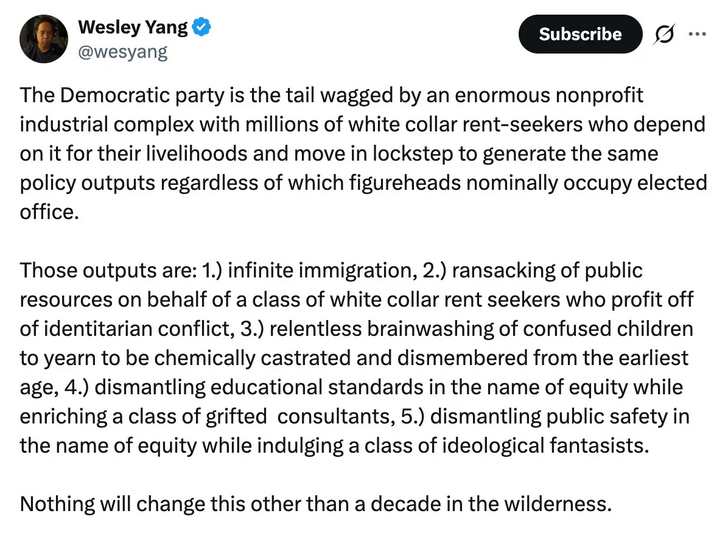
One of the very tip-top luxury beliefs is that massive immigration is always and under all circumstances a good thing. A great thing, even. One of the things about the holders of luxury beliefs is that they are almost always completely insulated from any of the consequences of their beliefs, and this is especially true in this case. As Lorenzo Warby points out, the elites’ devotion to this cause contributes to collapsing levels of trust in the society absorbing all those immigrants and deeply undermines confidence that the leadership have anyone else’s but their own best interests at heart:

There is a straightforward, respectable view on immigration to Western countries. More people means more transactions, means more gains from trade, so immigration is a good thing. Immigration grows the economy, it increases GDP, so sensible folk support immigration.

There are extra bells and whistles, such as providing needed skills; compensating for falling fertility; willingness to do jobs locals are not. All the extra bells and whistles have responses. Why not train locals (i.e., citizens)? Won’t the immigrants’ fertility also fall? (Yes, though possibly more slowly.) The real willingness is to do jobs at lower wages and conditions than the locals would accept. For instance, potentially using US H1B visas to bring in entry-level employees who will work for less, and in worse conditions, than the locals.

Moreover, increasing total GDP is not the same as increasing per capita GDP. Even with per capita GDP, there are always questions about the distribution of those gains to GDP.

Nevertheless, the basic intuition is: immigration means more transactions, more gains from trade. Those who believe in markets — in positive-sum interactions — should support immigration.

This is not the trumping response it appears to be. Immigration does not only import workers—nor even just increase mutual-gain transactions — it imports people, so potentially affects all aspects of the receiving society. This means, of course, that there are a much wider range of possible concerns about immigration that “yes, but more gains from trade” is not an adequate response to.

Efficiency and number of transactions are not the only issues for a social order, particularly not a flourishing social order. There are also issues of social cohesion; social resilience; connections and social capital; the distribution of GDP gains; effects on relative prices; congestion costs; how well institutions are managing the influx; effects on local communities; cultural differences; social coordination issues and the ability to manage collective action problems; increased competition for positional goods — goods that cannot, or are blocked from, responding to increased demand.

These are all legitimate grounds for concern that are not answered by “yes, but more gains from trade“. How many of those “yes, but more gains from trade” folk have grappled with mass rape and sexual exploitation of young women and girls as a cost of culturally divergent immigration (and its systematic mismanagement)? How many of those “yes, but more gains from trade” folk have grappled with violent disturbance, even civil war, as a potential cost of immigration, even though we have historical examples of precisely that?

If, on one hand, the respectable people insist “yes, but more gains from trade” is an adequate response, and that other concerns are not legitimate, this will almost certainly be taken as the contemptuous dismissal it is. Not only will it not be persuasive, it will (and does) generate anger and resentment.

If people have concerns that the “reasonable”, “liberal-minded” folk will not deal with — or, worse, are dismissive of such concerns even being raised — then people will turn to unreasonable and illiberal folk, if they are the only people who will respond to their concerns. Significant gaps in political markets will be filled by political entrepreneurs.

If folk are told that “if you believe in markets, you have to support (high levels of) immigration” then many folk will respond with “OK, I reject markets“. Moreover, it is simply false that market economics entails that mass immigration is a good thing.

The idea that there is some economic phenomena such that marginal costs exceeds marginal benefits for all people over all ranges in all forms is not Economic thinking, it is magical thinking. (More precisely, it is class-signalling parading as Economics.)

It is magical thinking that falls foul of economist Thomas Sowell‘s dictum that there are no solutions, only trade-offs. Immigrants may be engaging in lots of positive-sum, gains from trade transactions, yet still be imposing more costs than benefits on a society, and on resident citizens, precisely because societies are not just efficiency arenas for free-floating transactions and no one is just an economic transactor.

Update, 3 December: Welcome, Instapundit readers! Please do have a look around at some of my other posts you may find of interest. I send out a daily summary of posts here through my Substackhttps://substack.com/@nicholasrusson that you can subscribe to if you’d like to be informed of new posts in the future.

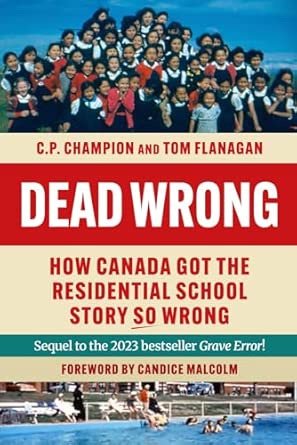
Dead Wrong: How Canada got the Residential School story so wrong

Filed under: Books, Cancon, History, Media, Politics — Tags: , , , , — Nicholas @ 03:00

Juno News shares Candice Malcolm‘s foreword to Dead Wrong by C.P. Champion and Tom Flanagan:

Canada is off track. We’ve lost our way.

How else could we make sense of the moral panic produced from a half-baked report coming from a small Indian Band in Central British Columbia in the spring of 2021? In response, the country lost its mind. Following reports of 215 “unmarked graves” at the site of the former Kamloops Residential School, the supposedly trusted sources of our society – journalists, elected officials, academics and so-called experts – reported fiction as fact, without doing any due diligence or research into the still unproven and questionable claims of mass graves and secret midnight burials of hundreds of deceased children.

A failure of this magnitude doesn’t happen instantaneously. It’s built over time as those who profess to speak the truth deliver deception, doublespeak, and misinformation – all in the name of addressing some grievance, advancing an agenda, and creating a narrative.

The only conclusion we can now draw is that our country is not what it should be, not what it was.

There are a myriad of complicated reasons to explain our clear downward trajectory – institutional capture, a hard-left consensus among political and cultural elites (driven in large part by government-funded journalists and the state broadcaster pushing woke propaganda), a large and inefficient bureaucracy that stifles growth and

innovation, institutions built upon a moral code that became unfashionable, and so on.

Canada has become a feminist country that proudly discriminates against men and diminishes the role of mothers. It has become a post-national country that loathes its founders and openly discriminates against individuals based on skin colour. It isn’t just post-Christian, it’s anti-Christian – evident from the treatment of Evangelical prayer leader Sean Feucht, the coordinated attacks against him in the summer of 2025 and the cancellation of tour stops across the country, not to mention total disinterest and cover-up of the 120+ churches that have been decimated and destroyed in the wake of the unmarked graves fiasco.

Over the past decade, we’ve witnessed our country fall from a functional system, into something almost unrecognizable.

The Canada I grew up in was safe, stable and secure. We knew our neighbours, we trusted institutions and didn’t worry too much about politics. Being Canadian meant something. We had a community, an identity, a shared purpose. Most of us believed in upward mobility and the Canadian dream: that if you work hard and play by the rules, you will have the same – or dare I say better – opportunities and quality of life than your parents.

This is clearly no longer the case for most Canadians under the age of 45, and that is a major problem for all of us.

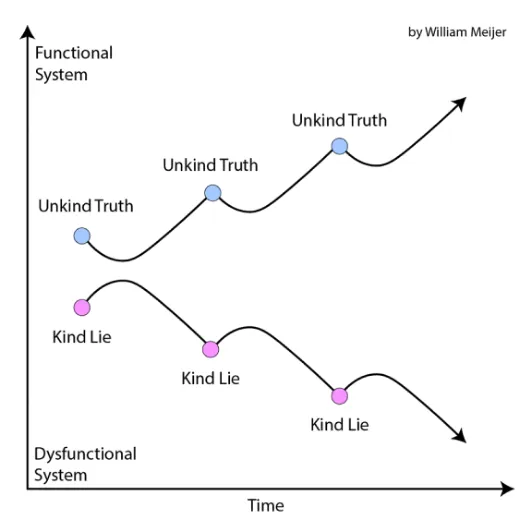
I came across a simple social graph by William Meijer that clearly explains what has happened better than anything else I’ve seen. You could apply this to countries, companies and even personal relationships.

Simply put: kindness got in the way of truth.

Meijer writes the accompanying caption: “An extreme commitment to the truth makes relationships acutely dysfunctional but systems chronically functional (think Elon Musk).

An extreme commitment to kindness makes relationships acutely functional but systems chronically dysfunctional (think Sweden, UK).”

Canada perhaps represents the “kind dysfunction” better than any other place.

« Newer PostsOlder Posts »

Powered by WordPress