Quotulatiousness

July 23, 2012

China’s latest ploy in the South China Sea

Filed under: China, Military, Pacific — Tags: , , , — Nicholas @ 12:29

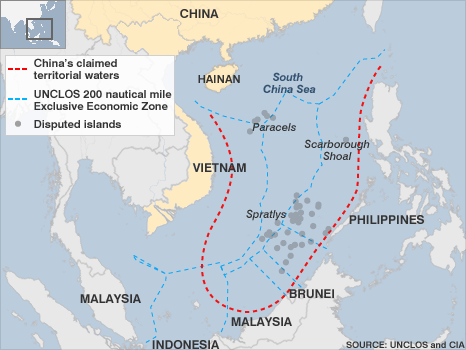
To cement Chinese claims to the vast majority of the South China Sea, a garrison is being established in the Paracel Islands:

China’s powerful Central Military Commission has approved the formal establishment of a military garrison for the disputed South China Sea, state media said, in a move which could further boost tensions in already fractious region.

The Sansha garrison would be responsible for “national defence mobilisation … guarding the city and supporting local emergency rescue and disaster relief” and “carrying out military missions”, the Xinhua news agency said on Sunday.

China has a substantial military presence in the South China Sea and the move is a further assertion of its sovereignty claims after it last month upped the administrative status of the seas to the level of a city, which it calls Sansha.

Sansha city is based on what is known in English as Woody Island, part of the Paracel Islands also claimed by Vietnam and Taiwan.

July 22, 2012

HMCS Victoria torpedoes and sinks US Navy ship!

Filed under: Cancon, Military, Pacific, USA — Tags: , , — Nicholas @ 11:09

The word “decommissioned” should appear in that headline. Details here: http://www.liveleak.com/view?i=c51_1342677437

July 11, 2012

Antony Beevor’s latest book

Filed under: Asia, Books, Europe, History, Military, Pacific, WW2 — Tags: , — Nicholas @ 00:02

In History Today, Roger Moorhouse talks to Antony Beevor on his latest booK:

I asked what novelties of approach or new material he employed for the book? Did he, for instance, set out to try to draw the two traditionally distinct narratives of the war in the Pacific and the war in Europe into a single integral whole? Though he does make a nod in that direction, Beevor believes that such an approach is not really feasible, adding that the war in the Pacific was ‘almost like a war on another planet’, such was its separation from events in Europe. ‘I was fascinated,’ he went on, ‘by the reaction of the US Marines on Okinawa when they heard about the surrender of Germany. It was “Who cares?” For them it was impossible to imagine, just as it was impossible for the people fighting in the snows of Russia to imagine war in the Pacific Islands.’

If the approach is largely conventional, the book does not lack new information. Russian sources are still yielding fascinating material, he notes, despite political retrenchment, while German scholarship is throwing up new approaches and new resources, such as the archive of Feldpostbriefe (soldiers ‘field post’ letters) in Stuttgart. Beevor’s most interesting revelation, however, is the horrific contention that the Japanese army practised organised cannibalism. As he explains: ‘Allied prisoners, especially Indian army prisoners, were kept as sort of human cattle and slaughtered one by one for their meat.’ News of such crimes was largely suppressed after the war, as it was considered ‘too awful even to be mentioned in the war crimes trials’, but has since been brought to light by Japanese historians.

[. . .]

Of course the heart of Beevor’s appeal is precisely that straightforward narrative approach, coupled with his lively, engaging style and his use of memorable, almost cinematic, set-pieces. I put it to him that, in tackling a book of this scope, perhaps he had been obliged to rein in some of those literary flourishes. ‘You are right,’ he conceded. ‘There is so much more to tell and there is much less room for the vignette, but it is still terribly important, serving to root the reader in the reality of the moment.’ He is swift to acknowledge a debt to John Keegan in this regard, under whom he studied at Sandhurst and whose The Face of Battle (1976) was hugely influential. ‘It is absolutely vital to give the reader a frequent reminder of what it was actually like, the view from below, otherwise it’s just history from above, which never really works.’

July 6, 2012

US Navy re-thinks their Pacific strategy options

Filed under: China, Military, Pacific, USA — Tags: , , , — Nicholas @ 08:07

Strategy Page discusses the historical uses of the submarine in the Pacific and why things would not be the same in the case of a Chinese war:

The U.S. Navy is rethinking how it will use its submarines in a future Pacific War. The problem is that a campaign against Chinese shipping is unlikely, in part because of what actually happened during the last great anti-shipping campaign, which occurred during World War II (1939-45). After the war, the U.S. analyzed its operations against Japanese shipping and found that submarines were important, but not the only weapon effective against shipping. Some 8.9 million tons of Japanese shipping was sunk or so seriously damaged (disabled) at the end of the war. Submarines accounted for 54.7 percent of this. But 16.3 percent was attributable to carrier-based aircraft, 14.5 percent to land- based planes and 9.3 percent to mines (most dropped by B-29s). Less than one percent was due to surface gunfire, and the balance of 4 percent was caused by accidents.

[. . .]

Meanwhile, the U.S. has adopted a new approach to any potential war with China. The U.S. Department of Defense has been told that, for the foreseeable future, there will be no more large-scale land campaigns. The air force, navy, and marines responded with a plan (AirSea Battle) that has been in the work for years. The new strategy is designed to cope with the rising power of China in the Pacific. AirSea Battle involves tighter planning and coordination of navy, marine, and navy forces, plus the development of some new weapons and tactics and cooperation with allies.

[. . .]

AirSea battle concentrates on military operations. But these will be heavily influenced by economic factors. For example, during World War II the United States was a largely self-sufficient “continental power.” We exported much (more than any other nation on the planet), but did not have to import much. That has changed. Now the U.S. has to import a lot of its oil, special raw materials (like “rare earths” from China) and a lot of manufactured goods. The U.S. is now like much of the rest of the world, China included. If there were a maritime blockade of China, the U.S. and many other Chinese trading partners would suffer severe economic disruptions. There would be massive unemployment for all concerned and that would happen despite energetic efforts by everyone to find alternative sources to goods no longer available because of the disruption of the China trade.

[. . .]

Meanwhile, the nuclear submarine community has done the math and found that their greatest contribution these days is not attacking enemy warships, but land bombardment with cruise missiles and intelligence collecting. Since the first nuclear subs showed up in the 1950s, only one, a British boat, has used a torpedo to sink a hostile warship. But hundreds of cruise missiles have been launched at land targets and uncounted (because they are highly classified) intelligence missions have been, and continue to be, carried out. All that is the recent past for subs, and is likely to be the future as well. World War II in the Pacific is not likely to be rerun. The U.S. Navy still expects its subs to go after enemy warships, and its surface and air forces to battle enemy subs. But a major war on shipping is much less likely.

June 28, 2012

What did Canada give up to get “2nd class seating” in the TPP negotiations?

Filed under: Cancon, Economics, Pacific, USA — Tags: , , , , — Nicholas @ 10:27

Michael Geist on the Canadian concessions to get a seat at the kiddy table for the Trans Pacific Partnership free trade negotiations:

…the benefits for Canada are hard to identify. The price of admission was very steep — Canada appears to have agreed to conditions that grant it second-tier status — and the economic benefits from improved access to TPP economies are likely to be relatively minor since we already have free trade agreements with four of the ten participants.

Given those conditions, why aggressively pursue entry into the negotiations?

[. . .]

Given Canada’s late entry into the TPP process, the U.S. was able to extract two onerous conditions that Prime Minister Stephen Harper downplayed as the “accession process.” First, Canada will not be able to reopen any chapters where agreement has already been reached among the current nine TPP partners. This means Canada has already agreed to be bound by TPP terms without having had any input. Since the TPP remains secret, the government can’t even tell us what has been agreed upon. [Scott Sinclair reports that the commitment is even broader, covering any chapter where provisions have been agreed upon]

Second, Canada has second-tier status in the negotiations as the U.S. has stipulated that Canada will not have “veto authority” over any chapter. This means that should the other nine countries agree on terms, Canada would be required to accept them.

This condition could be used to stop Canada from joining forces with another country on a tough issue during the late stages of the negotiation. For example, Canada and New Zealand both have copyright terms that last for the life of the author plus an additional 50 years. The U.S. has proposed that the TPP mandate a term of life plus 70 years. While Canada and New Zealand might be able to jointly block the extension, the U.S. could pressure New Zealand to cave on the issue and effectively force Canada to accept the change.

Getting rid of our government-mandated monopolies in the agricultural sector (a good thing) is not going to be worth the price of adopting American-style copyright legislation.

May 13, 2012

China increases their naval presence near Scarborough Shoal

Filed under: China, Military, Pacific — Tags: , , — Nicholas @ 10:32

I posted an item last month about the stand-off between the Chinese People’s Liberation Army Navy (PLAN) and the Philippine ship BRP Gregorio del Pilar (a former USCG cutter) in the Scarborough Shoal. Now there’s a report from Hong Kong’s largest English-language newspaper that China is sending another flotilla to the area:

China has sent five warships to the disputed Scarborough Shoal off the west coast of the Philippines with the warning that Beijing is ready for “any escalation” of the conflict.

That comes as the outgunned Philippines looks to the United States for naval support in South China Sea territory that may be rich in energy sources.

The five warships are said to be among the most advanced vessels in the Chinese fleet.

They include ships with state-of-the-art systems against attack from the sky, while one is an assault ship that carries 20 amphibious tanks and specialized fighting teams among 800 personnel.

Japanese surveillance aircraft saw the flotilla west of Okinawa and sailing south on Sunday.

Without American support, the Philippine navy is completely out-classed by the PLAN (aside from a large number of in-shore patrol craft, there are only 14 combat-capable ships). And it’s not clear that the US will want to escalate tension at this moment, especially over something like the Scarborough Shoal.

H/T to David Akin for the link.

March 20, 2012

New Zealand facing “Marmageddon”

Filed under: Australia, Food, Health, Pacific, Randomness — Tags: , , — Nicholas @ 09:18

Oh, the Marmanity!

An announcement by New Zealand’s leading manufacturer of the black sandwich spread, Marmite, has sparked “marmageddon” fears among Kiwis.

Food company Sanitarium said on its website that supplies “are starting to run out nationwide” after “our Christchurch factory was closed due to earthquake damage”.

Even Prime Minister John Key said he is rationing his personal supply.

[. . .]

“Supplies are starting to run out nationwide, and across the ditch in Australia. We know that we will be off shelf for sometime but we are doing everything we can to minimise how long,” the company said.

“Don’t freak. We will be back soon!”

Of course, the announcement set off a buying-and-hoarding frenzy, making the situation all the more dire. But not to worry: supply and demand has already set in — prices are rising to help even out the distribution of the remaining stocks.

Australian billionaire claims Greenpeace accepts CIA funding to fight coal exports

Filed under: Australia, Economics, Environment, Pacific, USA — Tags: , , — Nicholas @ 08:41

Australian bush hats can apparently be made of tinfoil:

Australian Mining Magnate Clive Palmer has declared the CIA is behind a Greenpeace campaign that aims to slow the growth of Australia’s export coal industry.

[. . .]

The Greenpeace campaign centres on a document titled Stopping the Australian Coal Export Boom (PDF) which explicitly states that “Our strategy is to ‘disrupt and delay’ key projects and infrastructure while gradually eroding public and political support for the industry and continually building the power of the movement to win more.” Greenpeace hopes to do so in order to build support for fuels other than coal, in order to reduce global carbon dioxide emissions.

The Greenpeace document says it is “… based on extensive research into the Australian coal industry, made possible by the generous support of the Rockefeller Family Fund.”

That statement is Palmer’s smoking gun, as he said at an event today, as reported by the Australian Broadcasting Commission and other outlets, that “You only have to go back and read the Church Report in the 1970s and to read the reports to the US Congress which sets up the Rockefeller Foundation as a conduit of CIA funding.”

February 7, 2012

Contrasting Canadian and Australian approaches to national defence spending

Filed under: Australia, Cancon, Military, Pacific — Tags: , , , — Nicholas @ 00:08

Matthew Fisher considers the way Australia deals with defence spending in comparison to Canada:

Australia may not immediately spring to mind as the country with which to best compare Canada’s defence spending, but it is not that much of a stretch. They share the same values and allies, have similarly robust resource-based economies, generous welfare nets and military histories from the Boer War through to the war in Afghanistan that usually have dovetailed.

Although Canada’s economy is nearly twice the size of Australia’s — and has about 40 per cent more people — Canada lags far behind in defence spending.

Australia spent $29 billion on its armed forces last year. That is about $7 billion more than Canada did. Given the relative size of the two economies and populations, for the federal government to match Australia on defence spending would require an annual out-lay of between $35 billion and $40 billion, rather than the $22 billion that was spent last year.

There are reasons why Australia spends more. But taken together, they do not account for the staggering gap between the two countries.

Support for — or hostility toward — defence spending in Canada follows the usual political fault lines. This is in sharp contrast to Australia, where there is a broad political consensus that adequate funding is vital to the national interest. So much so, in fact, that for Australian parliamentarians and the media, defence spending is not a hugely controversial subject.

January 3, 2012

It’s not safe to go back in the water . . . because of Climate-Change-induced mutant SHARKS!

Filed under: Australia, Environment, Humour, Pacific — Tags: , , , — Nicholas @ 09:45

James Delingpole has all the scary details:

It had to happen. As if the plight of the polar bear wasn’t punishment enough for our evil, selfish, refusing-to-change-our-lifestyle-because-we’re-addicted-to-oil ways, it now seems that Mother Gaia may have a deadly new weapon up her sleeve: KILLER MUTANT SHARKS!!! (H/T Brown Bess)

So far, admittedly, Mother Gaia is in the very earliest stages of her experimentation:

    Scientists said on Tuesday that they had discovered the world’s first hybrid sharks in Australian waters, a potential sign the predators were adapting to cope with climate change.

    The mating of the local Australian black-tip shark with its global counterpart, the common black-tip, was an unprecedented discovery with implications for the entire shark world, said lead researcher Jess Morgan.

    “It’s very surprising because no one’s ever seen shark hybrids before, this is not a common occurrence by any stretch of the imagination,” Morgan, from the University of Queensland, told AFP.

    “This is evolution in action.”

But those of us who have seen Deep Blue Sea (not the feeble Terence Rattigan rip off, obviously; the proper version, about the mutant killer sharks bred in an undersea laboratory who escape and hunt down the scientists one by one) will know that this is just the beginning.

January 2, 2012

Australia the hot destination for former RN, RCN, and USN sailors

Filed under: Australia, Military, Pacific, Technology — Tags: , — Nicholas @ 12:00

Australia’s job market is very tight, and the military is feeling the pinch. Strategy Page explains how the military is coping:

Noting that Britain was downsizing its armed forces, and cutting loose a lot of experienced personnel, the Australian Navy has sent recruiting officers to Britain to see if there would be interest among some of these former (or soon-to-be former) British sailors in joining the Australian Navy. The navy is particularly interested in obtaining personnel with technical skills. Years of low unemployment in Australia (partly because China is buying so many raw materials) has caused a shortage of engineering and technical specialists in the navy. The mining companies have been luring away a lot of technical personnel with higher pay and better working conditions. As a result, for example, the navy only has crews for three of its six submarines.

For over two years now the navy has been recruiting foreigners who possess needed technical skills. Australia is a nation of immigrants, and the admirals point out that recruiting a foreigner is cheaper than training an Australian to do these tasks. But sending recruiters to foreign countries is a new angle. Australia has also been offering navy jobs to sailors from Canada, New Zealand and the United States. All four foreign nations share a common language and, in general, culture with Australia. Moreover, sailors from these foreign nations have gone through similar security vetting. The recruiting offers are being sweetened with quick granting of Australian citizenship after less than a year of service.

December 16, 2011

The Philippines seek some cheap aircraft

Filed under: Asia, China, Military, Pacific, USA — Tags: , , , — Nicholas @ 09:14

Strategy Page, on the Philippines’ financial and strategic problems:

The Philippines is asking the U.S. for some used F-16 jet fighters. The Philippines is broke, so the proposed deal is for free F-16s, with the Philippines paying for any upgrades or modifications needed for service in the Philippines Air Force. Normally, the Philippines has no practical need for a jet fighter force. But this has changed because of possible clashes with China, the Filipinos are being practical. China is claiming Filipino territorial waters, including places where the Philippines authorized drilling for oil and gas. The Philippines could never afford to buy, or even just maintain warplanes sufficient to deal with a Chinese air threat. The Philippines depends on its friendship with the United States for protection. American warplanes provide better protection than any jet fighters the Philippines could put in the air. But the Philippines would like a dozen or so F-16s just so they can chase away Chinese warplanes that increasingly fly into Filipino air space.

Six years ago, the Philippines removed from service its eight F-5 fighters. These 1960s era aircraft were not much of a match for more recent warplanes, and were expensive to maintain. In the meantime, the Philippines has been using armed trainer aircraft for strikes against Moslem and communist rebels.

December 15, 2011

China’s first aircraft carrier at sea

Filed under: China, Military, Pacific — Tags: , , , — Nicholas @ 12:17

From the Guardian, including this satellite image:

A US satellite company says it has taken a photograph of China’s first aircraft carrier during trials in the Yellow Sea.

It is believed to be the first time the 300-metre ship, a refitted former Soviet carrier, has been photographed at sea since it was launched in August.

DigitalGlobe said one of its satellites took the picture on 8 December and an analyst at the firm spotted the ship this week while searching through images.

Stephen Wood, director of DigitalGlobe’s analysis centre, said he was confident the ship was the Chinese carrier because of the location and date of the image. The carrier has generated intense international interest because of what it might portend about China’s intentions as a military power.

The former Soviet Union started building the carrier, which it called the Varyag, but never finished it. When the USSR collapsed, the ship ended up in Ukraine.

December 7, 2011

Reason.TV: How Pearl Harbour made America a global power

Filed under: History, Japan, Military, Pacific, USA, WW2 — Tags: — Nicholas @ 13:05

A minor quibble: though Craig Shirley asserts that the only way Americans could fight overseas before Pearl Harbour was with the Chinese air force, at least 16,000 Americans were serving in the Canadian Army, the Royal Canadian Navy, or the Royal Canadian Air Force:

Long before Pearl Harbor, a steady stream of Americans had started moving northward across the border to join the Canadian armed forces. By the beginning of 1941 some 1,200 Americans comprised about 10 percent of RCAF officer strength and 3 percent of the other ranks. A U.S. influx totaling about 10 percent of RCAF recruitment continued until, at the time of Pearl Harbor, over 6,000 U.S. citizens were serving in the RCAF, of whom 600 were instructors in the British Commonwealth Air Training Plan. By the same time nearly 10,000 Americans were serving in the Canadian Army. After Pearl Harbor a reverse movement resulted in the absorption of over 26,000 Canadians into the U.S. armed forces during World War II.

From Military Relations Between the U.S. & Canada by Stanley W. Dzuiban.

November 7, 2011

“It is a sad state of affairs when an amazing feat of engineering is only seen in bleak environmental and misanthropic terms”

Filed under: Americas, Economics, Environment, Pacific — Tags: , — Nicholas @ 09:16

Nick Thorne wonders why the soon-to-be-completed road link between Peru and Brazil, the Interoceánica, has gotten such poor press in the west:

In July this year, an amazing feat of engineering and testament to the progress of Latin America went almost completely unreported in the Western media. With the opening of the Puente Billingshurst, a half-mile suspension bridge across the Madre Dios river, the interoceanic highway or Interoceánica neared completion. Soon, a long-held dream will finally come true: for the first time, a road will stretch all the way from the Pacific to the Atlantic, crossing the whole of South America.

The road starts in the Peruvian capital, Lima. It crosses the Andes, reaching a highest point of 4,850 metres (higher than Mont Blanc), then plunges into the rainforest, crosses several tributaries of the mighty Amazon, and after a total of 3,400 miles it reaches the Atlantic coast of Brazil. Much of the route has been in place for decades, but a 460-mile middle section was still missing. With the opening of the bridge, the road’s completion is in sight.

Comparisons have rightly been made between the Interoceánica and the first North American transcontinental railroad completed in 1869. In Brazil, the highway has already been dubbed ‘the road to China’. In 2009, China overtook the US as Brazil’s largest trading partner. Chinese trade will be able to use the Peruvian ports on the Pacific coast, cutting out a long detour via Cape Horn or the Panama Canal. While Brazil will be the main beneficiary, Peru will benefit as a middle-man. The think tank Bank Information Centre estimates that the highway will lead to a 1.5 per cent annual increase in GDP in Peru. The highway will facilitate greater regional integration and is a real symbol of Latin America’s economic awakening. A triumphant banner along the highway reads ‘once a promise, now a reality’. In 2006, a mere 3,500 people crossed the border from Peru to Brazil. By 2009, with the partial completion of the highway, this had already increased ten-fold to 35,000.

« Newer PostsOlder Posts »

Powered by WordPress