Quotulatiousness

November 16, 2013

Whatever happened to Chinese “soft power”?

Filed under: China, Pacific, Politics — Tags: , , — Nicholas @ 10:51

James R. Holmes says the Chinese have unequivocally abandoned soft power:

China never ceases to amaze. Not only has the leadership done away with a promising soft-power campaign that was years in the making. It razed its own soft-power edifice to the ground, and salted the ruins so nothing can take root again. Why remains a mystery.

The latest trouble sign came after Typhoon Haiyan slammed into the Philippine Islands over the weekend, claiming at least more than 1,800 lives so far. Professor Mead posted an item marveling at the paltry sum Beijing committed to Philippine disaster relief. Upon reading it, I was sure Mead had omitted two or three zeroes. But sure enough, cross-checking his commentary against a Reuters report shows he had the figure right: US$100,000 in direct aid, and another US$100,000 through the Red Cross. Such token amounts give tokenism a bad name.

Forget smile diplomacy. This is sneer diplomacy. Many observers, myself included, ascribed Chinese inaction following the 2004 Indian Ocean tsunami to immature capability. The PLA hadn’t yet fielded the expeditionary capabilities necessary to render assistance far from Chinese shores. Beijing did little because it could do little. Chinese forces, however, now own disaster-relief assets such as the hospital ship Peace Ark. Yet they remain idle. It’s hard to escape the conclusion that Beijing is withholding help out of pique. Manila, after all, has the temerity to insist that its exclusive economic zone is, well, its exclusive economic zone. Seems political tit-for-tat trumps alleviating human suffering.

[…]

There’s an upside to this from an American standpoint: China has made itself look small and petty, like a skinflint rather than a magnanimous power worthy of regional leadership. This is self-defeating conduct of a high order. Far be it from me to interfere with a strategic competitor intent on shooting himself in the foot. Fire!

October 27, 2013

“Dangerous Ground” in the South China Sea

Filed under: China, Military, Pacific — Tags: , , — Nicholas @ 09:26

John Donovan linked to this interesting New York Times Magazine feature about the Spratly Islands and the geopolitical standoff between China and pretty much all of the other nations bordering the South China Sea:

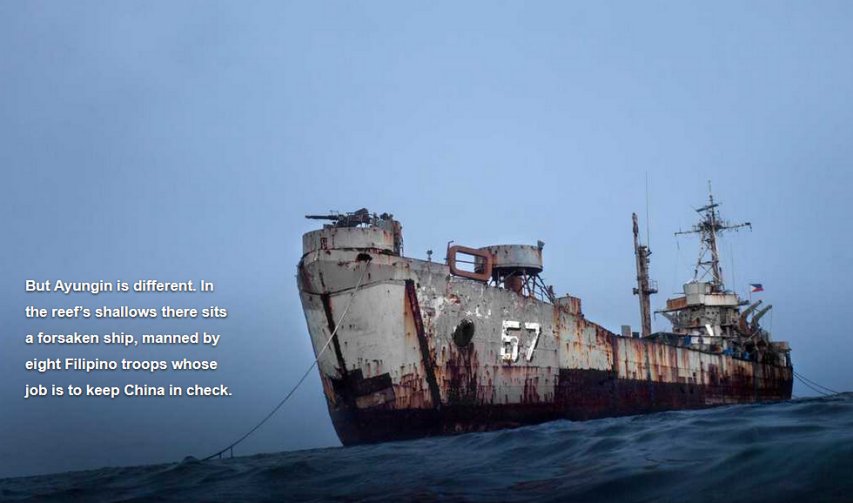
Spratly Islands - Sierra Madre aground on Ayungin

Ayungin Shoal lies 105 nautical miles from the Philippines. There’s little to commend the spot, apart from its plentiful fish and safe harbor — except that Ayungin sits at the southwestern edge of an area called Reed Bank, which is rumored to contain vast reserves of oil and natural gas. And also that it is home to a World War II-era ship called the Sierra Madre, which the Philippine government ran aground on the reef in 1999 and has since maintained as a kind of post-apocalyptic military garrison, the small detachment of Filipino troops stationed there struggling to survive extreme mental and physical desolation. Of all places, the scorched shell of the Sierra Madre has become an unlikely battleground in a geopolitical struggle that will shape the future of the South China Sea and, to some extent, the rest of the world.

[…]

To understand how Ayungin (known to the Western world as Second Thomas Shoal) could become contested ground is to confront, in miniature, both the rise of China and the potential future of U.S. foreign policy. It is also to enter into a morass of competing historical, territorial and even moral claims in an area where defining what is true or fair may be no easier than it has proved to be in the Middle East.

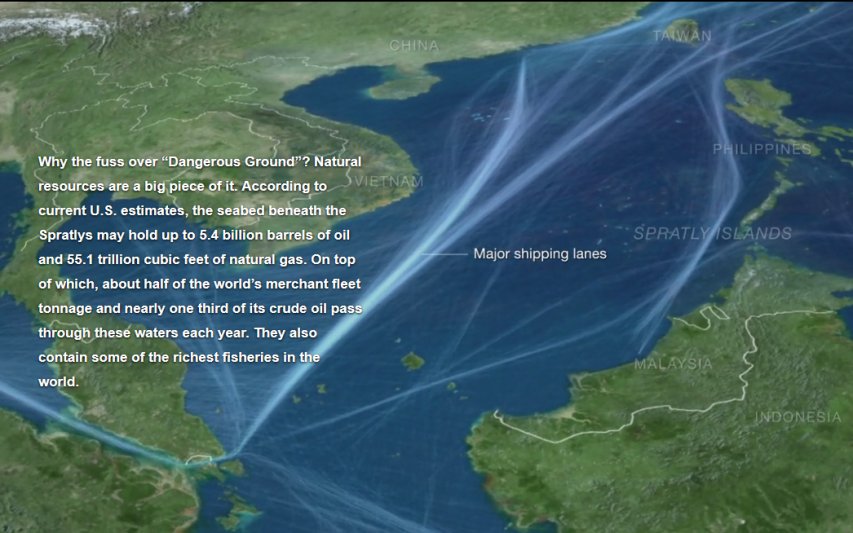
The Spratly Islands sprawl over roughly 160,000 square miles in the waters of the coasts of the Philippines, Malaysia, Brunei, Taiwan and China — all of whom claim part of the islands.

Spratly Islands shipping lanes

October 3, 2013

Postwar horror – the misery didn’t stop with VE day or VJ day

Filed under: Books, Europe, Germany, History, Japan, Media, Pacific, WW2 — Tags: , , , — Nicholas @ 08:38

In the last couple of years, I’ve read several books about the aftermath of World War Two, including Tony Judt’s Postwar: A History of Europe Since 1945, Ronald Spector’s In the Ruins of Empire: The Japanese Surrender and the Battle for Postwar Asia, and David Stafford’s Endgame, 1945: The Missing Final Chapter of World War II. When you concentrate on the combat side of war, you can easily miss the destructive side-effects of that combat and it’s hard to imagine how long it can take for a city or a region to recover from being a battlefield. What is even more interesting is the complex interplay of humanitarian, political and social pressures on the winning side, too often leading to actions that we would have called war crimes if they’d happened just days or weeks earlier. In the New York Times, Adam Hochschild looks at an interesting new book covering the immediate postwar period:

Ian Buruma’s lively new history, Year Zero, is about the various ways in which the aftermath of the Good War turned out badly for many people, and splendidly for some who didn’t deserve it. It is enriched by his knowledge of six languages, a sense of personal connection to the era (his Dutch father was a forced laborer in Berlin) and his understanding of this period from a book he wrote two decades ago that is still worth reading, The Wages of Guilt: Memories of War in Germany and Japan. His survey rambles over a wide expanse of ground, from sexual behavior (imagine millions of Allied occupation troops in a Germany where women outnumbered men by eight to five), to British and American soldiers unintentionally killing thousands of liberated concentration camp inmates by feeding them more than their shriveled intestinal tracts could handle, to the Allies’ blindness to how much of their cornucopia of food and supplies found its way into the hands of Italian, French and Japanese gangsters, restoring some of their prewar power.

Despite the lofty democratic aura of World War II, Buruma points out that the Allies spent much of the latter half of 1945 reviving colonialism. After Algerian Arabs began an uprising on V-E Day, demanding equal rights, some of the troops the French governor general called in to suppress them included an elite infantry regiment that had just taken part in the final assault on Germany. Rebellious towns and villages were bombed, or shelled by naval vessels; in two months of fighting as many as 30,000 Algerians may have been killed. Thousands were made to kneel before the French flag and beg forgiveness.

On the other side of the world, inhabitants of the Dutch East Indies demanded freedom just after the Japanese surrender. But the Dutch government answered with troops, aided by soldiers from Britain’s large Indian Army, British battleships and abundant American military supplies. Fighting continued for four years. And in Vietnam, where a crowd of more than 300,000 gathered to hear Ho Chi Minh declare independence from France, the story would of course eventually become even bloodier. In 1945 British troops were crucial to restoring the colonial order in Vietnam, with help from French Foreign Legion detachments. These included many German volunteers, recruited from P.O.W. camps, who had recently been fighting the Allies in Europe or North Africa.

Meanwhile, the victorious Allies were uprooting some 10 million ethnic Germans from parts of Eastern Europe, where they had lived for generations, and forcing them to move to a shrunken Germany, with perhaps a half-million or more dying in the process from hunger, exposure or attacks by vengeful neighbors. Buruma, like others before him, notes the paradox of the Allied armies carrying out something that echoed “Hitler’s project . . . of ethnic purity.”

September 10, 2013

China’s historical model for naval strategy

Filed under: China, History, Middle East, Military, Pacific — Tags: , , , , — Nicholas @ 09:16

At The Diplomat, James Holmes explains the odd fact that China is a “good citizen” in their coalition work with other countries fighting piracy away from home, but bullies its neighbours in the waters closer to home:

The analogy is the doctrine of “no peace beyond the line” practiced in late Renaissance Europe. To recap: in a nifty bit of collective doublethink, European rulers struck up a compact whereby nations could remain at peace in Europe, avoiding the hardships of direct conflict, while assailing each other mercilessly beyond a mythical boundary separating Europe from the Americas. In practice this meant they raided each other’s shipping and outposts in the greater Caribbean Sea and its Atlantic approaches.

It feels as though an inverse dynamic is at work in the Indo-Pacific theater. Naval powers cooperate westward of the line traced by the Malay Peninsula, Strait of Malacca, and Indonesian archipelago. Suspicions pockmarked by occasional confrontation predominate east of the South China Sea rim, a physical — rather than imaginary — line dividing over there from home ground.

A non-Renaissance European, Clausewitz, helps explain why seafaring powers can police the Gulf of Aden in harmony while feuding over the law of the sea in the East China Sea and South China Sea. It’s because the mission is apolitical. Counterpiracy is the overriding priority for the nations that have dispatched vessels to the waters off Somalia. Few if any of them have cross-cutting interests or motives that might disrupt the enterprise. It’s easy to work together when the partners bring little baggage to the venture.

[…]

You see where I’m going with this. The expedition to the Gulf of Aden is an easy case. It proves a trivial result, namely that rivals can collaborate for mutual gain when they have the same interests in an endeavor. Now plant yourself in East Asia and survey the strategic terrain within the perimeter separating the Indian from the Pacific Ocean. China views the South China Sea, to name one contested expanse, not as a commons but as offshore territory. Indeed, Beijing asserts “indisputable sovereignty” there.

Such pretensions grate on Southeast Asian states, while the United States hopes to rally coalitions and partnerships to oversee the commons. But if Beijing is serious about the near seas’ constituting “blue national soil” — and our Chinese friends are nothing if not sincere — then outsiders policing these waters must look like invaders. How else would you regard foreign constables or armies roaming your soil — even for praiseworthy reasons — without so much as a by-your-leave?

South China Sea claims

September 4, 2013

Air-Sea Battle as a response to Chinese military expansion

Filed under: China, Military, Pacific, USA — Tags: , , , — Nicholas @ 13:18

The Diplomat‘s Amitai Etzioni looks at the US Air-Sea Battle plan:

On the face of it, the Pentagon’s Air-Sea Battle plan makes eminently good sense; it is a clear response to a clear challenge. China has been developing a whole slew of weapons (especially anti-ship missiles) over the past two decades that are of great concern to the U.S. military. These weapons, known in Pentagon-speak as anti-access/area-denial (A2/AD) capabilities, could undermine the international right to free passage in China’s surrounding waters or, in the case of a conflict over Taiwan or contested islands in the South and East China Seas, prevent the U.S. from making good on defense commitments to its friends in the region.

In response, the Pentagon developed Air-Sea Battle (ASB), the employment of which entails, according to position papers developed to promote it, a blistering assault on China’s mainland. A report by the Center for Strategic and Budgetary Assessments (CSBA) gives a detailed account of how an ASB-style war with China would unfold. In the opening “blinding campaign,” the U.S. attacks China’s reconnaissance and command-and-control networks to degrade the PLA’s ability to target U.S. and allied forces. Next, the military takes the fight to the Chinese mainland, striking long-range anti-ship missile launchers. Given that this is where the anti-ship missiles are located, it is only logical that the U.S. would target land-based platforms. And to go after them, one of course needs to take out China’s air defense systems, command control centers, and other anti-access weapons. In short, ASB requires a total war with China.

[…]

The main flaw Air-Sea Battle it is not merely that it is a particularly aggressive military response to the anti-access/area-denial challenge. The problem is that ASB is developing in a foreign policy vacuum. If the U.S. were to conduct a thorough review of China’s military capabilities and its regional and global ambitions — and found that the Chinese were planning to forcefully expand their territory or unseat the U.S. as the global power, perhaps Air-Sea Battle might be deemed appropriate.

August 28, 2013

Hurricane and cyclone paths since 1842

Filed under: Americas, Environment, Pacific, Science — Tags: , , — Nicholas @ 08:59

Wired‘s MapLab has a lovely visualization of both hurricane and cyclone tracks starting with the earliest records in 1842:

Historical Hurricane and Cyclone paths since 1842

This map shows the paths of every hurricane and cyclone detected since 1842. Nearly 12,000 tropical cyclones have been tracked and recorded, and the National Oceanic and Atmospheric Administration keeps them all in a single database. Long-term datasets can be really interesting and scientifically valuable, and this one is undoubtedly both.

In the image above, you can clearly see that more storm tracks have overlapped in the western Pacific ocean and northern Indian ocean. This is largely because of the length of the typhoon season, which basically never stops in the warmer waters there.

The tracks of the earliest storms are based on mariner’s logs and storm records, collected from various countries, agencies and other sources. Reconciling data from these different entities was tough. Most international agencies had their own set of codes for cyclone intensity, and only recorded this information once per day. India was even using different wind thresholds to designate cyclone stages.

April 17, 2013

Within the Hermit Kingdom

Filed under: Asia, Military, Pacific — Tags: , , , , — Nicholas @ 00:02

“Sir Humphrey” posted this a few weeks ago, but given the ongoing weirdness emanating from North Korea, it’s still fully valid:

North Korea is one of the most unusual and terrifyingly Orwellian states on the planet. Imagine a nation where every member of the population has spent the last 60 years being told that they live in a paradise, and that they have the greatest living conditions on earth. Add to this complete state control of the media and broadcast, a network of spies and informants and a gulag archipelago that would make Stalin jealous. Presiding over this nation of some 23 million utterly indoctrinated and militarized people is a tiny elite who enjoy a pampered and privileged lifestyle which provides them with any manner of goods and services. At the very top of this is the ruler Kim Jong Un, who has inherited his position from his father Kim Jong Il. The Kim dynasty are treated almost as gods, and no criticism of any form is officially tolerated.

[. . .]

It is telling that there have been multiple photos of Kim appearing in the media while making visits to the armed forces. Kim Jong Il used to do something similar, whereby he would make a regular ‘guidance’ visit to various KPA units and reiterate advice on how things could be done better (a trait of Kim Jong Il was his unerring ability to be a world expert at whatever he turned his mind to apparently). If anything Kim Jong Un has been more prominent in these sorts of visits, where he seems determined to establish his credentials as a military leader. Not a military man by background, and with no real party power base to speak of, he needs to ensure that he can count on the loyalty of the armed forces to support his regime. Photos of him delivering guidance may appear somewhat hammed up to the Western audience, but in North Korea they serve as evidence that Kim has an understanding of the threat and is prepared to meet it.

The use of the rhetoric against South Korea and the US is important — it provides a unifying theme and helps focus attention on repelling the long expected attack. At the same time, the attempt to conduct a crude form of ‘nuclear blackmail’ by conducting tests of devices and rockets helps demonstrate Kims credentials as a credible world leader, with the most advanced technology and the ability to dictate terms to the wider world. The problem though is that as Kim is discovering now, it is difficult to back down from the pedestal when the other side don’t react as you expect them to.

March 27, 2013

North Korea breaks off remaining communication channels

Filed under: Asia, Military, Pacific, USA — Tags: , , , , — Nicholas @ 08:23

The North Korean government continues to escalate the tension level:

Reclusive North Korea is to cut the last channel of communications with the South because war could break out at “any moment”, it said on Wednesday, days after warning the United States and South Korea of nuclear attack.

The move is the latest in a series of bellicose threats from North Korea in response to new U.N. sanctions imposed after its third nuclear test in February and to “hostile” military drills under way joining the United States and South Korea.

The North has already stopped responding to calls on the hotline to the U.S. military that supervises the heavily armed Demilitarized Zone (DMZ) and the Red Cross line that has been used by the governments of both sides.

“Under the situation where a war may break out at any moment, there is no need to keep north-south military communications which were laid between the militaries of both sides,” the North’s KCNA news agency quoted a military spokesman as saying.

February 7, 2013

Japan scrambles fighters after two Russian aircraft intrude

Filed under: Asia, Japan, Military, Pacific, Russia, WW2 — Tags: , , — Nicholas @ 09:39

Japan’s military forces are getting quite a workout these days, with the standoff with China over the Senkaku Islands and now the Russians are getting aggressive about probing Japanese airspace:

Two Russian fighter jets have violated Japanese airspace, prompting Tokyo to scramble its own aircraft, reports say.

Japan lodged a protest after the planes were detected off the northern island of Hokkaido for just over a minute.

The incident happened after Japanese PM Shinzo Abe said he was seeking a solution to a territorial dispute with Russia over a Pacific island chain.

Russia’s military denied the incursion, saying the jets were making routine flights near the disputed islands.

Mr Abe was speaking on the anniversary of an 1855 treaty which Japan says supports its claims to the islands.

The four islands — which Russia calls the Southern Kurils and Japan calls the Northern Territories — are the subject of a 60-year-old dispute.

Because of the dispute, the two nations have not yet signed a peace treaty to end World War II.

February 1, 2013

USS Guardian to be dismantled in place after grounding on coral reef

Filed under: Environment, Military, Pacific, USA — Tags: , , , , — Nicholas @ 00:01

The US Navy has decided that the best course of action is to break up the minesweeper USS Guardian after it ran solidly aground on a coral reef in the Sulu Sea:

USS Guardian aground in the Sulu Sea January 2013

“We’re working very closely with the Philippine coast guard, with their navy and their government personnel. We’ve been grateful for their support as we all work together to remove Guardian and minimize further damage to the reef,” James said.

It’s expected to take over a month to dismantle the Guardian, which ran aground before dawn on Jan. 17.

Crews have already removed 15,000 gallons of fuel from the ship. They’ve also taken off hundreds of gallons of lubricating oil and paint. They’ll be removing human wastewater and other materials that could harm the environment, James said.

The U.S. Navy is hiring floating cranes to help with the removal. A contractor in Singapore is sending the cranes, which should arrive on site in a few days.

The Navy originally said the Guardian would be lifted by crane onto a barge and taken to a shipyard. But now the Navy says the ship is “beyond economical repair.”

No one was injured when the ship ran aground at the reef in the Tubbataha National Marine Park. The park is a World Heritage Site in the Sulu Sea, about 400 miles southwest of Manila.

Update, 8 February: A bit more information about the salvage operations which are supposed to have started on February 4th.

January 4, 2013

North Korea adopts maskirovka to conceal rocket preparations

Filed under: Asia, Military, Pacific — Tags: , , , , — Nicholas @ 10:09

Strategy Page on the most recent North Korean hoodwinking of western intelligence agencies:

Western intelligence agencies are a bit embarrassed that they were not able to predict the exact day that North Korea recently launched a long-range rocket. Even though North Korean announced the two week period during which the launch would take place last December, and several nations had photo satellites flying over the launch site regularly, the actual launch came as a surprise. The North Koreans apparently took advantage of the regular schedules of these spy satellites to move equipment around the launch site at the right time to conceal just how close the rocket was to takeoff. Many intel analysts had not seen this sort of thing at all (if they were young) and the older ones had not seen it done to this degree since the 1980s, when the Soviet Union was still around and using their maskirovka (“masking”) agency to carry out large scale deceptions of photo satellites. The Russians taught the North Koreans many things, and maskirovka was apparently part of the curriculum.

In addition to concealing weapons, their performance and movements, the Soviets also used satellite deception to mislead the west on how their troops would operate in the field. Several times a year, the Soviets would hold large scale maneuvers. Each of these exercises would involve many divisions, plus hundreds of aircraft and helicopters. Satellite photos of these maneuvers were thought to reveal tactics the Soviets were going to use in future wars. But the Soviets knew when American satellites were coming over and sometimes arranged displays of tactics they had no intention of using. Naturally, this made it more difficult for the Western intelligence analysts to figure out exactly what the Soviets were planning. This, of course, was the sort of confusion the Soviets wanted to create with these little deceptions.

December 7, 2012

Revisiting Pearl Harbour

Filed under: History, Japan, Military, Pacific, USA, WW2 — Tags: , , , , — Nicholas @ 10:38

In a History Today article from 2001, Dan van der Vat looks at the actual history rather than the film treatments of the Japanese attack on Pearl Harbour in 1941:

To recount what actually happened blow by blow, as in the exhaustive Tora, Tora, Tora!, is one thing; to use the event as the backdrop to an avowed fiction, as in From Here to Eternity, is equally legitimate. But to play fast and loose with history by presenting fiction as fact is at best confusing and at worse dangerous — especially when the event is still within living memory, affects current policy and needs to be understood by the young if the lessons of history are to be truly learned.

On Roosevelt’s ‘date that will live in infamy’, six Japanese carriers launched 350 aircraft to immobilise the US battlefleet at the very moment talks were due to resume in Washington. The Americans knew Japan’s propensity for surprise attack (Korea in 1895, the Russians’ Chinese enclave at Port Arthur in 1904, Manchuria in 1931, China in 1937). They were forewarned by their Tokyo embassy of the inclusion of Pearl Harbor in Japan’s war-plans, and they intercepted signals exposing its intentions. Yet the Japanese achieved strategic surprise. But their strategic blunder in not bombing repair facilities and fuel dumps spared the US Navy the crippling embarrassment of having to withdraw 2,200 miles eastward to the continental West Coast.

[. . .]

Initial American reaction to Pearl Harbor included not only rage at Japanese duplicity but also incredulity based on racism. Many witnesses insisted they had seen swastikas on the bombers; surely the Germans must have been behind such a sophisticated stroke. Inability to cope with the reality of America’s most spectacular lost battle led to a flourishing conspiracy industry which sprang up within hours of the bombing.

Even today, extreme revisionists claim that British frogmen came in on the midget Japanese submarines that almost gave the game away by trying to attack before the bombers. That at least one batch of intelligence intercepts from 1941 has not yet been released is taken as proof that they must conceal the ‘smoking gun’ the revisionists so stubbornly seek to this day.

Update: MHQ has the story of the most effective Japanese spy who reported on the comings and goings of US Navy ships at Pearl Harbour:

At 1:20 a.m. on December 7, 1941, on the darkened bridge of the Japanese aircraft carrier Akagi, Vice Admiral Chui­chi Nagumo was handed the following message: “Vessels moored in harbor: 9 battleships; 3 class B cruisers; 3 seaplane tenders, 17 destroyers. Entering harbor are 4 class B cruisers; 3 destroyers. All aircraft carriers and heavy cruisers have departed harbor….No indication of any changes in U.S. Fleet or anything unusual.”

[. . .]

Astonishingly, such critical intelligence was not the work of a brilliant Japanese superspy who had worked his way into the heart of the fleet’s installation. Rather, Takeo Yoshikawa, a naval officer attached to the consulate and known to the Americans, had simply watched the comings and goings of the fleet from afar, with no more access than a tourist. He made little effort to cloak his mission, and almost certainly would have been uncovered if American intelligence had been more on the ball, or if America’s lawmakers had recognized the mortal threat Japan presented. Instead, he raised little suspicion, and his observations helped the Japanese piece together an extraordinarily detailed attack plan, ensuring its success.

November 25, 2012

21st century navies to watch: China and India

Filed under: China, India, Military, Pacific — Tags: , , , , , — Nicholas @ 12:07

The Economist provides some background on a growing naval rivalry between the two biggest powers in Asia:

Samudra Manthan is the title of a new book on this topic by C. Raja Mohan, an Indian writer on strategic affairs, for whom the myth is a metaphor for the two countries’ competition at sea. This contest remains far more tentative and low-key than the 50-year stand-off over their disputed Himalayan border, where China humiliated India in a brief, bloody war in 1962. But the book raises alarming questions about the risks of future maritime confrontation.

[. . .]

China’s naval plans receive more attention. By 2020 its navy is expected to have 73 “principal combatants” (big warships) and 78 submarines, 12 of them nuclear-powered. Last year its first aircraft-carrier, bought from Ukraine, began sea trials; indigenous carriers are under construction. Proving it can now operate far from its own shores, China’s navy has joined anti-piracy operations in the Gulf of Aden. Of course this evolution is not aimed at India, so much as at building a force commensurate with China’s new economic might, securing its sea lines of communication and, eventually perhaps, challenging American dominance in the western Pacific, with a view to enforcing China’s view of its national sovereignty in Taiwan and elsewhere.

Indian strategists, however, tend towards paranoia where China is concerned. China’s close strategic relations with India’s neighbours, notably Pakistan, have given rise to the perception that China is intent on throttling India with a “string of pearls” — naval facilities around the Indian Ocean. These include ports China has built at Gwadar in Pakistan; at Hambantota in Sri Lanka; at Kyaukphyu in Myanmar; and at Chittagong in Bangladesh.

[. . .]

India’s naval advances are less dramatic. But it has operated two aircraft-carriers since the 1960s, and aims to have three carrier groups operational by 2020, as part of a fleet that by 2022 would have around 160 ships and 400 aircraft, making it one of the world’s five biggest navies. Like China, it also hopes to acquire a full “nuclear triad” — by adding sea-based missiles to its nuclear deterrent. While China has been testing the waters to its south and south-west, India’s navy has been looking east, partly to follow India’s trade links. India fears Chinese “strategic encirclement”. Similarly, China looks askance at India’s expanding defence ties with America, South-East Asia, Japan and South Korea.

November 4, 2012

Invasive Albion disorder: only 10% of countries have never been invaded by Britain

Filed under: Africa, Americas, Asia, Books, Britain, Europe, History, Pacific — Tags: , — Nicholas @ 11:21

In the Telegraph, Jasper Copping explains why all those taunts about “perfidious Albion” are at least 90% deserved:

Every schoolboy used to know that at the height of the empire, almost a quarter of the atlas was coloured pink, showing the extent of British rule.

But that oft recited fact dramatically understates the remarkable global reach achieved by this country.

A new study has found that at various times the British have invaded almost 90 per cent of the countries around the globe.

The analysis of the histories of the almost 200 countries in the world found only 22 which have never experienced an invasion by the British.

Among this select group of nations are far-off destinations such as Guatemala, Tajikistan and the Marshall Islands, as well some slightly closer to home, such as Luxembourg.

The analysis is contained in a new book, All the Countries We’ve Ever Invaded: And the Few We Never Got Round To.

Stuart Laycock, the author, has worked his way around the globe, through each country alphabetically, researching its history to establish whether, at any point, they have experienced an incursion by Britain.

H/T to Colby Cosh for the link.

September 9, 2012

Midway: the turning point of the Pacific War

Filed under: Books, History, Japan, Military, Pacific, USA, WW2 — Tags: , , , , — Nicholas @ 09:33

An interesting sketch of the importance of the 1942 Battle of Midway in the Spectator from Richard Freeman:

For many of us the Battle of Midway is just one more Hollywood spectacular in, to paraphrase Neville Chamberlain, a far-away sea of which we know little. But having recently taken a closer look at the battle I am struck both by what was at stake and what the consequences of the American victory were for the Allies at the time and geopolitics since then.

[. . .]

Because the Americans were the victors at Midway, it is easy to forget how near they came to losing the battle. On the day of the main action they attacked the Japanese carriers from dawn until 10.20 am without inflicting any serious damage. Then, between 10.20 am and 10.25 am, the American planes caught three of the Japanese carriers without adequate fighter protection. All three were completely disabled in just five minutes in what has been called ‘the miracle of Midway’.

[. . .]

Now suppose — and it almost happened — that the Japanese carriers, with their vastly superior fighter planes, had caught the American carriers off guard. The loss of those carriers and the destruction of the Midway airbase would have compelled America to give a much higher priority to the Pacific. A direct consequence of that would have been a slower build-up of American power in, first North Africa, and then Europe.

Shortly after the North African landings, there was the other great turning point of the war: Germany’s surrender at Stalingrad. From then on one of the great questions of the war was where the Russians would meet the Allies. Had America suffered a massive defeat at Midway, the Allies advance in Europe would have been slower. (As it was, D-day strained the Allies to the limit. Even a small reduction in ships, tanks, planes or men would have forced its delay.) In these circumstances it is not inconceivable that the Soviet Union would have taken the whole of Germany

I just finished reading one of the few accounts of the battle from the Japanese perspective, Midway: The Battle That Doomed Japan by Mitsuo Fuchida and Masatake Okumiya. Because I couldn’t remember Fuchida’s co-author’s name, I Google searched on the title of the book, only to find the top item after Fuchida’s Wikipedia entry was this:

The Western accounts of the Japanese side of the battle have heretofore been built around three primary sources: The after-action log of Admiral Nagumo (“The Nagumo Report”); the interviews with Japanese naval officers conducted after the war by the United States Strategic Bombing Survey (“USSBS”); and Mitsuo Fuchida’s book, Midway: The Battle That Doomed Japan, which was published in the United States in 1955. These three sources, augmented by fragmentary survivor accounts, have formed the backbone of the Japanese account for all Western histories up to this point.

Unfortunately, one of these sources — Fuchida’s Midway — is irretrievably flawed. Fuchida’s misstatements, which have lain undetected in the West until very recently, have had manifold negative effects on the veracity of the standard English-language battle accounts. His were not minor errors of omission that can be brushed off or explained away — they were fundamental and willful distortions of the truth that must be corrected. Intriguingly, Fuchida’s account was overturned and discredited in Japan more than twenty-five years ago. Yet in the West, he has remained as important as the day his book was first published.

« Newer PostsOlder Posts »

Powered by WordPress