Quotulatiousness

October 15, 2011

Chile upgrades their amphibious capabilities

Filed under: Americas, France, Military, Pacific — Tags: , — Nicholas @ 11:21

A brief item from the invaluable Strategy Page talks about Chile’s most recent naval acquisition:

Chile is buying the French amphibious ship Foudre, which is being replaced by a more recent design. The 12,000 ton Foudre has been in service for 21 years and could, with some refurbishment, serve another two decades or more. The 168 meter (521 feet) long ship has a crew of 160 and carries up to 70 vehicles. The well deck contains eight landing craft and there is a hangar that carries up to four helicopters. There are accommodations for 450 troops (or double that for short voyages). The Foudre can also be used as a command ship, which spaces for 150 headquarters personnel and their equipment.

Chile will use the Foudre to replace an 8,700 ton, 40 year old, American Newport class LPD. This ship was retired earlier this year, as it was considered too expensive to refurbish it. France has also offered Chile the second ship of the Foudre class, which is scheduled to retire from French service in a few years. The price of the Foudre to Chile has not been revealed. It will be cheap, and will depend on how much refurbishment French firms will undertake. Foudre undertook several long-distance operations during its career.

October 14, 2011

When will Tuvalu be inundated?

Filed under: Environment, Media, Pacific — Tags: , , — Nicholas @ 11:48

The answer, according to Lorne Gunter is . . . not very soon, if at all:

For nearly a decade now, the tiny Pacific island-group nation of Tuvalu has made news for its government’s claim that the archipelago is being swallowed up by rising sea levels caused by global warming. The island government has even considered suing the world’s largest industrial powers for emitting the carbon dioxide that many scientists believe is trapping solar radiation in the atmosphere and leading to allegedly higher global temperatures. When the highly vaunted UN climate summit in Copenhagen in Dec. 2009 failed to produce a successor agreement to the 1997 Kyoto accords, the Tuvalu delegation was not shy about expressing its disgust and outrage, claiming that world leaders had consigned them to a slow extermination. (So slow — over 100 years — that almost no current Tuvaluns will live long enough to be killed by the encroaching oceans and their descendents will have plenty of time to row to safety. But let’s not pick nits.)

[. . .]

Two American experts on coastal construction and sea-level — James Houston, director emeritus of engineering research and development for the U.S. Army Corps of Engineers, and Robert Dean, professor emeritus of civil and coastal engineering at the University of Florida — examined decades worth of data from all the tidal monitors around the U.S. and determined earlier this year that “worldwide-temperature increase has not produced acceleration of global sea level over the past 100 years.” indeed, the rate at which oceans have been rising has “possibly decelerated for at least the last 80 years.”

Houston and Dean are committed warmists. They started their study with the expectation that their results would show rapidly increasing sea levels. Instead, they found that the oceans around the U.S. had risen little in the 20th Century and that the far from rising faster due to global warming were actually rising more slowly. If the trend of the past 80 years continued, the pair estimated that at most worldwide oceans would rise by 15 cms (ankle depth) by 2100, rather than the one to two metres most recently projected by the UN, or the 10 metres estimated by Al Gore.

August 10, 2011

China’s second-hand aircraft carrier puts to sea for initial trials

Filed under: China, Military, Pacific — Tags: , — Nicholas @ 08:45

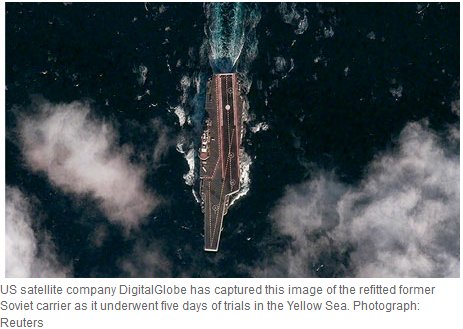
The Shi Lang, formerly the Varyag, is undergoing a set of sea trials:

China’s first aircraft carrier began sea trials on Wednesday, the state-run Xinhua news service reported, a highly symbolic step in what is certain to be a years-long effort to create a carrier presence in the Pacific waters off its coast.

The carrier, once known as the Varyag, left Dalian, its northeast China port for what analysts said would be a test of its rudder, propulsion system and other basics. Xinhua’s two-sentence report stated only that the carrier would make a short voyage before returning to Dalian for further tests.

The Chinese Defense Ministry said last month that the carrier would be used largely for scientific research and training. Foreign military analysts say it could be a decade or more before the Chinese can deploy and operate a true fleet of carriers, the most costly and complex weapons systems in any nation’s arsenal.

July 27, 2011

Okay, everyone relax: China says aircraft carrier to be used for “research and training”

Filed under: China, Military, Pacific — Tags: , — Nicholas @ 07:44

That’s the latest story from China, which has finally acknowledged that they are rebuilding the former Soviet aircraft carrier Shi Lang:

China has officially acknowledged that it is rebuilding an aircraft carrier it bought more than a decade ago, but says the refurbished ship will be used only for research and training.

A defence ministry spokesman, Geng Yansheng, told reporters on Wednesday that work was under way on refitting an old carrier, a reference to the Varyag, whose stripped-down hull was towed from Ukraine in 1998 and has been under reconstruction for the best part of a decade.

“Building an aircraft carrier is extremely complex and at present we are using a scrapped aircraft carrier platform to carry out refurbishment for the purposes of technological research, experiments and training,” Geng said.

June 8, 2011

China admits it’s hard to hide 1000ft-long aircraft carrier

Filed under: China, Military, Pacific — Tags: , , — Nicholas @ 07:44

China has finally gotten around to acknowledging that they’re rebuilding the former Soviet aircraft carrier for use by their navy:

Gen Chen Bingde refused to say when the carrier — a remodelled Soviet-era vessel, the Varyag — would be ready.

A member of his staff said the carrier would pose no threat to other nations.

The 300m (990ft) carrier, which is being built in the north-east port of Dalian, has been one of China’s worst-kept secrets, analysts say.

Gen Chen made his comments to the Chinese-language Hong Kong Commercial Daily newspaper.

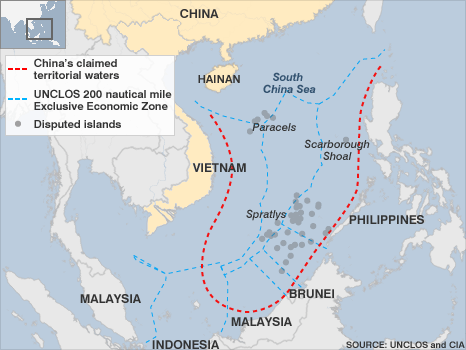
Although the Chinese say that the ship, once ready for operations, won’t enter other countries’ territorial waters, keep in mind that China doesn’t have the same idea about maritime rights as others in the South China Sea region:

Earlier posts about the Shi Lang (nee Varyag) here.

April 15, 2011

How not to celebrate Anzac Day

Filed under: Australia, History, Military, Pacific — Tags: , , — Nicholas @ 12:59

An elderly driver of a retired military vehicle either lost control of his vehicle or (as the article implies) took his hands off the wheel to take a photo just before the crash:

A 64-year-old man who drove his World War II truck into a group of veterans marching in Melbourne’s Anzac Day parade last year has been charged with dangerous driving causing serious injury.

Eight members of the Ceylon Ex-Serviceman’s Association were injured, two critically, when the vintage truck lurched forward into them on Saint Kilda Road.

All the veterans survived but some are still recovering from injuries ranging from broken bones to internal injuries.

A picture obtained by the ABC in May last year allegedly showed the driver using both hands to take a photograph moments before the accident.

H/T to Chris Greaves for the link, and for the explanatory material he provided to give some context on the story:

Two things you may not realize as background to this:

(1) Australia is HUGE on Anzac day; My indoctrination started as a 10-year old in Southern Cross WA. A large portion of the town’s population was drunk by the start of the dawn service at the war memorial, and it just got worse after that. Every year. I mean, every year, the DAY just got worse.

Anzac day is the day when old diggers get maudlin about their mates who fell in The Great War, even though the maudlin diggers are too young to have HAD mates in The Great War.

(2) I feel deeply about the origins of The Third Balkan War, read up on it frequently, have 6 bookcases (not bookshelves) of books on the subject, and am deeply moved by the stories. I see 19-year old kids in the elevator and think “You died for us”, for that was most probably the average age of the soldier, sailor and airman.
So I don’t resent “dwelling on the past”; I do it daily.

See also here and here.

April 10, 2011

A world always at war

Filed under: Africa, Americas, Asia, Europe, History, Military, Pacific — Tags: , , , — Nicholas @ 10:38

This is an interesting site:

The screencap above shows the significant sites in the Mäntsälä rebellion in Finland in 1932 (no, I’d never heard of it either). Use the slider at the bottom of the screen to choose the time in history, and the map will show you the known conflicts for that period.

April 7, 2011

Australian Defence Force in the news . . . not in a good way

Filed under: Australia, Bureaucracy, Military, Pacific — Tags: , , — Nicholas @ 12:07

Australia’s military have a reputation for brashness, but competence in combat. The bureaucratic side of the ADF has problems:

The Australian Defence Force found itself in the headlines for the wrong reasons when a young female member of the ADF Academy went public after having sex with a fellow cadet, only to find out later that he used a webcam and Skype to broadcast the assignation to his mates.

Okay, slimy action on the part of the other cadet. Action by the military braintrust should be some form of discipline against the cadet who violated trust, yes? No:

The ADF first tried to equivocate, saying that there was nothing it could use to charge the unconscionable bastard who thought the broadcast was a good idea, only to backpedal when Defence Minister Stephen Smith (who is an impressive sight when in full flight and fury) hit the roof.

Next, the ADF brasshats, in an outbreak of unbelievably insular stupidity, decided to go ahead with a separate charge against the traumatised female, to do with AWOL and drinking. Moreover, these same defence bosses also asked the woman to apologise for going public with her story.

Adding military insult to personal injury, check. The Defence Minister was even more displeased, of course. Richard Chirgwin points out that these actions are merely symptoms of a deeper institutional problem:

Now, I could write a serious and reasoned column about the chronic social problems of the ADF, which has, for as long as I can remember, acted as if it has institutional autism.

Or I could observe that the ADF seems entirely unable to instill even the remotest hint of good sense in how its members behave in the presence of computers. It’s less than a fortnight since we found out that Australian soldiers were posting racist messages about Afghanistan nationals on Facebook.

But I have a different question to ask: why the hell was the ADF permitting unrestricted use of Skype in the Academy?

March 31, 2011

Men At Work lose copyright appeal

Filed under: Australia, Law, Media, Pacific — Tags: , — Nicholas @ 10:03

As reported last year, Australian band Men At Work launched an appeal against a judgement requiring them to pay 5% of the royalties on their song “Down Under”. The appeal was dismissed:

Australia’s Federal Court upheld the decision which stated part of the song’s melody came from the tune Kookaburra Sits in the Old Gum Tree.

Record label EMI argued the writers did not plagiarise because the inclusion of two bars from the tune was a tribute.

The music company has also been ordered to pay costs.

The latest decision clears the way for Larrikin Music, the copyright owners for Kookaburra Sits in the Old Gum Tree, to claim millions of dollars in unpaid royalties from Down Under writers Colin Hay and Ron Strykert.

The original judgement was clearly insane: it assessed the damages at up to 60% of the profits earned by the band on that song (for two bars of a three-minute song). The revised judgement was much more proportional: 5%.

March 18, 2011

West coast earthquake zones

Filed under: Cancon, Environment, Pacific, USA — Tags: , , , , , — Nicholas @ 09:44

According to an article in The Economist, the well-known San Andreas fault in California is not the most likely to cause an earthquake of the magnitude of last week’s quake in Japan. The most likely source is the Cascadia subduction zone:

wikimedia.org - Cascadia subduction zone The most likely megaquake on the West Coast would be much further north — in fact, 50 miles off the coast between Cape Mendocino in northern California and Vancouver Island in southern British Columbia. This 680-mile strip of seabed is home to the Cascadia subduction zone, where oceanic crust known as the Juan de Fuca plate is forced under the ancient North American plate that forms the continent. For much of its length, the two sides of this huge subduction zone are locked together, accumulating stresses that are capable of triggering megaquakes in excess of magnitude 9.0 when they eventually slip. As such, Cascadia is more than a match for anything off the coast of Japan.

What makes Cascadia such a monster is not just its length, but also the shallowness of the angle with which the encroaching tectonic plate dives under the continental mass. The descending plate has to travel 40 miles down the incline before it softens enough from the Earth’s internal heat to slide without accumulating further frictional stresses. Could the fault unzip from end to end and trigger a megaquake — along with the mother of all tsunamis? You bet. By one account, it has done so at least seven times over the past 3,500 years. Another study suggests there have been around 20 such events over the past 10,000 years. Whatever, the “return time” would seem to be within 200 to 600 years.

And the last time Cascadia let go? Just 311 years ago.

Cascadia subduction zone image from wikimedia.org.

March 12, 2011

Earthquake, tsunami, and worse

Filed under: Environment, Japan, Pacific — Tags: , , , , — Nicholas @ 12:04

The earthquake by itself was one of the biggest ever recorded, and then the tsunami compounded the quake damage and will make relief and rescue efforts that much harder. Kevin Voigt has more:

The powerful earthquake that unleashed a devastating tsunami Friday appears to have moved the main island of Japan by 8 feet (2.4 meters) and shifted the Earth on its axis.

“At this point, we know that one GPS station moved (8 feet), and we have seen a map from GSI (Geospatial Information Authority) in Japan showing the pattern of shift over a large area is consistent with about that much shift of the land mass,” said Kenneth Hudnut, a geophysicist with the U.S. Geological Survey (USGS).

Reports from the National Institute of Geophysics and Volcanology in Italy estimated the 8.9-magnitude quake shifted the planet on its axis by nearly 4 inches (10 centimeters).

The temblor, which struck Friday afternoon near the east coast of Japan, killed hundreds of people, caused the formation of 30-foot walls of water that swept across rice fields, engulfed entire towns, dragged houses onto highways, and tossed cars and boats like toys. Some waves reached six miles (10 kilometers) inland in Miyagi Prefecture on Japan’s east coast.

Another major concern is the ongoing struggle to regain control of one of the reactors at the Fukushima Daiichi nuclear power plant:

An explosion at an earthquake-struck nuclear plant was not caused by damage to the nuclear reactor but by a pumping system that failed as crews tried to bring the reactor’s temperature down, Chief Cabinet Secretary Yukio Edano said Saturday.

Workers at the Fukushima Daiichi plant have begun flooding the reactor containment structure with sea water to bring the reactor’s temperature down to safe levels, he said. The effort is expected to take two days.

Radiation levels have fallen since the explosion and there is no immediate danger, Edano said. But authorities were nevertheless expanding the evacuation to include a radius of 20 kilometers (about 12.5 miles) around the plant. The evacuation previously reached out to 10 kilometers.

H/T to Chris Taylor for the link.

March 11, 2011

Massive earthquake in northern Japan

Filed under: Environment, Japan, Pacific — Tags: — Nicholas @ 08:27

The largest earthquake since records began hit northern Japan at about quarter to three local time, just as the rush hour was about to start. BBC News has ongoing live coverage.

The tremor, measured at 8.9 by the US Geological Survey, hit at 1446 local time (0546 GMT) at a depth of about 24km.

A tsunami warning was extended across the Pacific to North and South America.

The Red Cross in Geneva warned that the tsunami waves could be higher than some Pacific islands, Reuters news agency said.

Coastal areas in the Philippines, Hawaii and other Pacific islands were evacuated ahead of the tsunami’s expected arrival.

New Zealand later downgraded its alert to a marine threat, meaning strong and unusual currents were expected.

March 3, 2011

Happy 25th anniversary to independent Australia

Filed under: Australia, Britain, History, Law, Pacific — Tags: , — Nicholas @ 09:30

I had been labouring under the impression that Australia had been freed from the colonial yoke in 1931, but I was mistaken:

TWENTY-FIVE years ago today, Australia became independent.

You might think this statement absurd. Surely Australia has been independent for a lot longer than that? Let me provide a lawyer’s answer: yes and no. Yes, Australia as a nation became independent at some unknown date after 1931. By 1931 it had the power to exercise independence but chose not to do so for some time. Arguably, having the capacity to exercise independence is enough to be classified as independent, although the parents of 20-something children who show no inclination to leave home may beg to differ.

The Australian states, however, did not gain their independence from Britain at that time. Bizarrely, they remained colonial dependencies of the British crown, despite being constituent parts of an independent nation. This meant state governors were appointed by the Queen on the advice of British ministers and that it was the Queen of the United Kingdom (not the Queen of Australia) who gave royal assent to state bills. When an Australian governor-general once complained to the British government about this anomaly, the response of British diplomats was that it was better to “let sleeping anomalies lie”.

H/T to Roger Henry for the link.

February 22, 2011

New Zealand struck by major earthquake

Filed under: Environment, Pacific — Tags: , — Nicholas @ 07:23

This quake has inflicted severe damage on downtown Christchurch, with 65 reported dead as of this morning, and the death toll almost certain to rise. The Wall Street Journal is running constant updates to this article as further news becomes available. TVNZ is also running a live feed.


Click to go to the live update page

Australia has offered whatever aid they can provide:

Australia’s Prime Minister Julia Gillard has told a press conference that Australia will give New Zealand whatever it needs to deal with the aftermath of the earthquake. She says she told her New Zealand counterpart, John Key, “anything you want that we’ve got we will get it to you.”

September 16, 2010

Christchurch: that shaky town

Filed under: Asia, Pacific, Science — Tags: , , — Nicholas @ 09:00

To get an idea of what the poor folks in Christchurch are still going through, here is a visualization of the 664 tremors (to date):

Click here to see the full series.

H/T to Nelson Kennedy for the link.

« Newer Posts

Powered by WordPress