
Published on 5 Mar 2015
Modern war already took place in the sky and under water but the waring nations also wanted to gain an advantage in the trenches. So this week, we see the first use of another merciless invention on the battlefield: the flame thrower. The battles on the Western Front, in the Carpathian’s and near the Dardanelles continued nonetheless.
March 8, 2015
Playing With Fire – The First Flame Thrower I THE GREAT WAR Week 32
Comments Off on Playing With Fire – The First Flame Thrower I THE GREAT WAR Week 32
March 7, 2015
QotD: The “true meaning” of Starship Troopers
The central theme is expanded in many ways and many sub-propositions consistent with or corollary to the main one are shown: (a) that nothing worth having is ever free; it must be paid for; (b) that authority always carries with it responsibility, even if a man tries to refuse it; (c) that “natural rights” are not God-given but must be earned; (d) that, despite all H-bombs, biological warfare, push-buttons, ICBMs, or other Buck Rogers miracle weapons, victory in war is never cheap but must be purchased with the blood of heroes; (e) that human beings are not potatoes, not actuarial tables, but that each one is unique and precious … [sic] and that the strayed lamb is as precious as the ninety-and-nine in the fold; (f) that a man’s noblest act is to die for his fellow man, that such death is not suicidal, not wasted, but is the highest and most human form of survival behaviour.
Robert A. Heinlein, letter to Alice Dalgliesh 1959-02-03 (but marked “Never Sent”), quoted in William H. Patterson Jr., Robert A. Heinlein, In Dialogue with His Century Volume 2: The Man Who Learned Better, 2014).
Comments Off on QotD: The “true meaning” of Starship Troopers
March 3, 2015
Poland’s Struggle for Independence During WW1 I THE GREAT WAR
Published on 2 Mar 2015
World War 1 was a a fight of nationalism and self determination for many countries which did not yet exist then. One of those countries was Poland – its territory split between Russia, Austria-Hungary and Germany. In our first of multiple special episodes, Indy tells you everything about Poland and it’s fight for independence.
Comments Off on Poland’s Struggle for Independence During WW1 I THE GREAT WAR
March 2, 2015
Lebanon braces for the “attentions” of ISIS
Michael Totten on the announcement by ISIS that Lebanon is their next expansion target:
The Lebanese army is one of the least effective in the Middle East — and that’s saying something in a region where the far more capable Syrian and Iraqi armies are utterly failing to safeguard what should be their own sovereign territory.
So France is going to send a three billion dollar package of weapons to Lebanon and the Saudis are going to pay for it. It won’t solve the problem any more than a full-body cast will cure cancer, but it beats standing around and not even trying.
It may seem surprising at first that Riyadh is willing to fund a Lebanese Maginot Line. Saudi Arabia is the most culturally conservative Arab country and Lebanon is the most liberal, partly because of its one-third Christian minority, but also because Lebanon’s Sunni Muslims are, for the most part, Mediterranean merchants rather than isolated desert-dwellers. They’ve been exposed to cosmopolitan ideas and culture for centuries while most Saudis outside the Hejaz region on the Red Sea have been hermetically sealed off from the wider world and its ways for millennia.
[…]
The Lebanese, of course, are in far more immediate danger. They can feel ISIS’ hot breath on their necks. The army has been scrapping with them along the Syrian border for some time now. A majority of Lebanon’s population is either Christian, Shia, or Druze, and all three populations rightly see ISIS as a potentially genocidal threat to their very existence. Even the Sunnis, though, fear and loathe ISIS. Other than the nominal sectarian sameness — ISIS also is Sunni — Lebanon’s culturally liberal Sunnis have little more in common with ISIS than the French or Italians do.
A serious invasion of Lebanon by ISIS could unleash a bloodbath that makes the civil war in Syria look like a bar fight with pool sticks and beer mugs. It would be tantamount to a Nazi invasion. Every family in Lebanon is armed to the gills thanks to the state being too weak and divided to provide basic security, but people anywhere in the world facing psychopathic mass-murderers will fight with kitchen knives and even their fingernails and teeth if they have to.
The only good thing that might emerge from an attempted ISIS invasion is that the eternally fractious Lebanese might finally realize they have enough in common with each other to band together for survival and kindle something that resembles a national identity for the first time in their history.
Comments Off on Lebanon braces for the “attentions” of ISIS
March 1, 2015
“The F-35 will cost more than the Manhattan Project every year for the next fifty years”
Scott Lincicome would like to point out to the contending Republicans hoping to become the GOP’s presidential candidate that defence spending is not immune to the massive overspending problem common to big government:
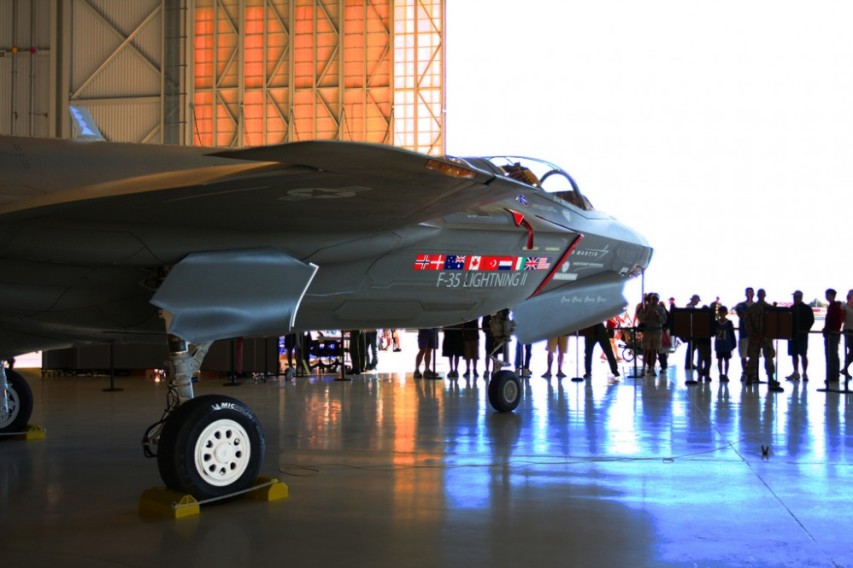
Over the next 20 months, a clown-car-full of Republican politicians will vie for their party’s presidential nomination. As the candidates crisscross the nation, each will undoubtedly call for smarter, leaner, and (hopefully) smaller government. However, there is one government program that, despite being a paragon of government incompetence and mind-bending fiscal incontinence, will most likely be ignored by these champions of budgetary temperance: the F-35 Joint Strike Fighter. In so doing, these Republicans will abandon their principles and continue a long, bipartisan tradition of perpetuating the broader problems with U.S. defense spending that the troubled jet symbolizes.
During the Obama years, the Republican Party magically rediscovered its commitment — at least rhetorically — to limited government and fiscal sanity. Criticizing the graft, incompetence, and cost of boondoggles like the 2009 stimulus bill, green-energy subsidies, or Obamacare, GOP politicians not only highlighted these programs’ specific failings, but also often explained how such problems were the inevitable result of an unwieldy federal government that lacked discipline and accountability and was inherently susceptible to capture by well-funded interest groups like unions or insurance companies.
They railed against massive bureaucracies, like the Department of Energy, that paid off cronies with scant congressional oversight. And, in the case of well-publicized debacles like the botched, billion-dollar Healthcare.gov roll-out, many Republicans were quick to note that the root of the problem lay not in one glitchy website, but the entire federal procurement process, and even Big Government itself
[…]
One wonders, however, if these Republicans’ philosophical understanding of Big Government’s inherent weaknesses extends to national defense and, in particular, the F-35. According to the latest (2012) estimate from the Pentagon, the total cost to develop, buy and operate the F-35 will be $1.45 trillion — yes, trillion, with a “t” — over the next 50 years, up from a measly $1 trillion estimated in 2011. For those of you keeping score at home, this means that the F-35’s lifetime cost grew about $450 billion in one year. (Who says inflation is dead?)
That number — $1.45 trillion — might be difficult to grasp, especially in the context of U.S. defense spending, so let me try to put it in perspective: the entire Manhattan Project, which took around three years and led to the development of the atom bomb, cost a total of $26 billion (2015), most of which went to “building factories and producing the fissile materials, with less than 10% for development and production of the weapons.” By contrast, the F-35 will cost $29 billion. Per year.
For the next 50 years.
Comments Off on “The F-35 will cost more than the Manhattan Project every year for the next fifty years”
February 28, 2015
How worried are Russia’s neighbours? Norway reacts to re-opened northern bases that have been shut down since the Cold War
In the Guardian, Julian Borger reports on restructuring in Norway’s defence establishment in reaction to Russian expansionism:
Norway’s defence minister has said her country’s armed forces will be restructured so they can respond faster to what she called increased Russian aggression.
Ine Eriksen Soreide said that Russia had recently re-opened military bases in its far north that had been shut down after the cold war, and that there had also been an increase in flights by Russian warplanes close to Norwegian airspace.
“We have seen in the first couple of months of this year a certain increase compared to the same period last year and … an increased complexity. We see they fly longer, they fly with more different kinds of airplanes and their patterns are different than they used to be,” Soreide told the Guardian during a visit to London.
“They have not breached our territory and that is different from what is happening in the Baltic Sea area. They are breaching territory there all the time and in the Baltic area they have also seen three times as many flights as normal or usual,” she added.
Soreide said Norway was stepping up military cooperation with the Baltic states — Estonia, Latvia and Lithuania — as a means of reassuring them that they were fully covered by Nato’s collective security umbrella. Furthermore, Norway was “absolutely” ready to expand training of Ukrainian soldiers, she said, predicting that more Nato states would follow the British example of dispatching trainers and non-lethal equipment to support Ukraine.
“On the political level I think it is important to define what we are seeing, that this is aggression — whether you see it as cyber threats or information campaign and conventional warfare, it is aggression what they are doing in Ukraine. And I think it’s important to say this, and that we do not accept this towards Nato countries,” the defence minister said.
Update: Re-worded the headline to reflect the fact that it was Russian bases being re-opened, not Norwegian facilities.
Comments Off on How worried are Russia’s neighbours? Norway reacts to re-opened northern bases that have been shut down since the Cold War
February 27, 2015
Prelude to Gallipoli – Naval Bombardement of the Dardanelles I THE GREAT WAR Week 31
Published on 26 Feb 2015
To break up the stalemate and get a decisive advantage, France and Great Britain open up yet another theatre of war in the Dardanelles. The plan is to seize the strait and open eventually open up the Bosporus in order to ship supplies to the Eastern and Balkan front. And so begins the naval bombardment of ottoman forts as prelude to a big offensive which will we know to today as Gallipoli.
Comments Off on Prelude to Gallipoli – Naval Bombardement of the Dardanelles I THE GREAT WAR Week 31
Muscle-flexing – Russia’s military exercises
Russian military exercises tend to dwarf those of their neighbours, especially in the number of troops involved (and the kind of troops). Ian J. Brzezinski and Nicholas Varangis report on the phenomenon:
Exercises are used by defense establishments to test their readiness, deployability, and logistical and combat proficiency. They can be used as demonstrations of force to underscore determination to defend national territory/interests and those of allies and partners. They can also be used to intimidate and to camouflage offensive operations. Regarding the latter, in February 2014 Russia mobilized 150,000 troops under the guise of an anti-terror simulation. Many of the units in this exercise were deployed along Ukraine’s border just as Russia invaded Crimea and then later eastern Ukraine.
While military exercises are not the sole indicator of military readiness and capability, they do reflect seriousness of intent. In this case, a comparison of exercises by NATO and those of Russia reveals a troubling disparity in magnitude. In short, there is a NATO-Russia “exercise gap” that is all the more glaring when one would think it would be easier for a group of nations to orchestrate larger exercises than those conducted by a single nation.
The following chart indicates that since 2013, Russia has conducted at least six military exercises involving 65,000 to 160,000 or more personnel. In contrast, during the same period, NATO’s most significant exercises included STEADFAST JAZZ, a collective defense exercise conducted in Poland and Latvia in November of 2013 involving 6,000 personnel (of which half were headquarters staff) and NOBLE LEDGER, a test of the NATO Response Force (NRF) that brought 6,500 troops to the field. Individual NATO allies have hosted larger multinational exercises in the North Atlantic Area. These include Norway’s COLD RESPONSE involving some 16,000 troops, the United States’ BOLD ALLIGATOR involving 15,000 personnel and Poland’s October 2014 ANAKONDA with 13,250 personnel.

Comments Off on Muscle-flexing – Russia’s military exercises
February 26, 2015
Are submarines facing premature obsolescence?
Harry J. Kazianis looks at the risk for the US Navy as underwater detection systems become cheaper and more effective:
What would happen if U.S. nuclear attack submarines — some of the most sophisticated and expensive American weapons of war — suddenly became obsolete? Imagine a scenario where these important systems became the hunted instead of the hunter, or just as technologically backward as the massive battleships of years past. Think that sounds completely insane? If advances in big data and new detection methods fuse with the anti-access/area denial (A2/AD) ambitions of nations like China and Russia, naval planners around the world might have to go back to the drawing board.
Submarines: The New Battleship?
The revelation is alluded to in a recent report by the Washington, D.C.–based Center for Strategic and Budgetary Assessments (CSBA) called “The Emerging Era in Undersea Warfare.” Smartly named by a certain TNI editor as the “think-tank’s think-tank,” CSBA has crafted in the last decade many of the most detailed and sophisticated reports regarding the most pressing national-security challenges around — sometimes years before anyone else. Ever heard of a little operational concept called AirSea Battle? They were at the forefront of it before it was in the news.
In a piece for TNI, the report’s author, Bryan Clark, lays out the problem in more layman’s terms:
Since the Cold War submarines, particularly quiet American ones, have been considered largely immune to adversary A2/AD capabilities. But the ability of submarines to hide through quieting alone will decrease as each successive decibel of noise reduction becomes more expensive and as new detection methods mature that rely on phenomena other than sounds emanating from a submarine. These techniques include lower frequency active sonar and non-acoustic methods that detect submarine wakes or (at short ranges) bounce laser or light-emitting diode (LED) light off a submarine hull. The physics behind most of these alternative techniques has been known for decades, but was not exploited because computer processors were too slow to run the detailed models needed to see small changes in the environment caused by a quiet submarine. Today, “big data” processing enables advanced navies to run sophisticated oceanographic models in real time to exploit these detection techniques. As they become more prevalent, they could make some coastal areas too hazardous for manned submarines.
Could modern attack subs soon face the same problem as surface combatants around the world, where some areas are simply too dangerous to enter, thanks to pressing A2/AD challenges?
Comments Off on Are submarines facing premature obsolescence?
February 25, 2015
Why Was Hötzendorf Allowed To Command? I OUT OF THE TRENCHES #8
Published on 23 Feb 2015
Indy sits in the chair of wisdom again to answer your questions. This week he tries to explain why Austro-Hungarian Chief of Staff Conrad von Hötzendorf was allowed to command an army at all.
Comments Off on Why Was Hötzendorf Allowed To Command? I OUT OF THE TRENCHES #8
How worried are Russia’s neighbours? Lithuania just re-introduced conscription
A report from the Lithuania Tribune details a change in Lithuanian defence policy:
The State Defence Council, comprising of the Lithuanian president, prime minister, parliament speaker, defence minister and army chief, decided on Tuesday to reintroduce military conscription in Lithuania.
The conscription, which was suspended several years ago as Lithuania opted for the professional army, should be reintroduced in light of the changes in geopolitical situation, President Dalia Grybauskaitė said after the meeting.
“We must reinforce the country’s defence capacities. Under new geopolitical circumstances, the army must be properly prepared for the country’s armed defence even in times of peace. Today’s geopolitical situation requires that we strengthen and speed up the manning of our army. Therefore the State Defence Council has decided that it is necessary to temporarily, for five years, reintroduce compulsory military draft,” President Grybauskaitė said.
Under the proposal, compulsory military service would apply to men between the ages of 19 and 26. The plan is to draft between 3,000 and 3,500 men each year. Exemptions would apply to university students, single fathers, men with health issues or otherwise unsuitable for military service.
In Newsweek, Damien Sharkov reports on the high tempo of Russian “training” missions near the Baltic states:
Increasingly frequent snap military drills being carried out by Russia near its eastern European neighbours could be part of a strategy that will open the door for a Russian offensive on the Baltic states according to defence expert Martin Hurt, deputy director at Estonia’s International Centre for Defence and Security.
The Lithuanian and Estonian defence ministries have expressed alarm at the increased military activity, and drawn comparisons with moves prior to the Russian invasion of Crimea.
Commenting on Russia’s announcement last week that its armed forces will not cease holding snap military exercises, Hurt, who has previously worked for Estonia’s Ministry of Defence as well as for the armed forces of both Estonia and Sweden, warned against taking this news lightly.
“My take would be that the Russian authorities want to raise the readiness of their forces and also make European nations more relaxed to a new norm where the Russian Armed Force often conduct snap exercises,” Hurt says.
According to him, a relaxed European attitude about increased Russian military activity would be “extremely dangerous” for the democratic governments of Europe and particularly for Estonia, Latvia and Lithuania.
“A realistic scenario against the Baltics would be a ‘normal’ Russian snap exercise that without notice turns into a quick assault on one or several of the Baltic states’ capitals. Such an attack would have greater probability of success than the hybrid scenario we saw in Crimea,” Hurt adds.
“A decisive move by Putin assuming that the weak leaders of Europe will not react quickly and ‘avoid escalation’ is a possible scenario,” Hurt adds, highlighting that “the higher readiness NATO forces have, the better it is for the democratic part of Europe.”
Comments Off on How worried are Russia’s neighbours? Lithuania just re-introduced conscription
February 20, 2015
The Singapore Mutiny I THE GREAT WAR Week 30
Published on 19 Feb 2015
After more than six months of war, the first big mutiny breaks out in Singapore. The endless battles in which big powers sacrifice thousands of soldiers are leading to an organised resistance for the first time. Indian troops refuse to board a ship because they don’t want to fight other muslims in the Middle East. Meanwhile, the great offensives at the front in Europe continue.
Comments Off on The Singapore Mutiny I THE GREAT WAR Week 30
February 18, 2015
Maximilian von Spee I WHO DID WHAT IN WW1?
Published on 16 Feb 2015
Vice Admiral Maximilian Reichsgraf von Spee is one of the most famous admirals of World War One. When the war broke out, he and his East Asian Squadron are stationed in the Pacific. But instead of surrendering to his superior enemies, he manages to reach South America during an audacious cruiser war. At the Battle of Coronel, he ends the legend of the invincible Royal Navy.
Comments Off on Maximilian von Spee I WHO DID WHAT IN WW1?
A tour of the French ballistic missile submarine Le Redoutable
Gerard Vanderleun posted a link to this set of photos of the retired French submarine Le Redoutable:
Fascinating and worthwhile for the blend of megadeath and French lifestyles: A tour of the ballistic missile submarine Redoutable (photos) the largest submarine you can tour without security clearance, and one of the only ballistic missile subs fully accessible to the general public. The French nuclear submarine Redoutable spent the ’70s and ’80s at sea and was home to 135 sailors for months at a time. The missile boat-turned-museum resides in the French seaside town of Cherbourg after extensive refurbishment.
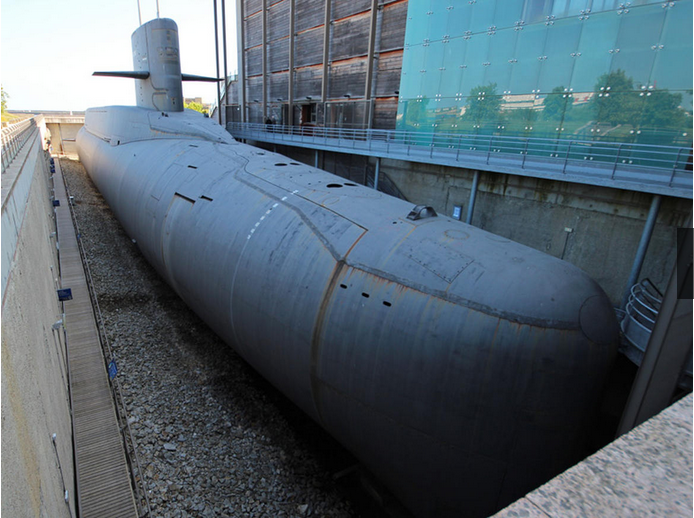
It’s pretty much impossible to get a full shot of the sub, given where it rests. Let’s just say, it’s big.
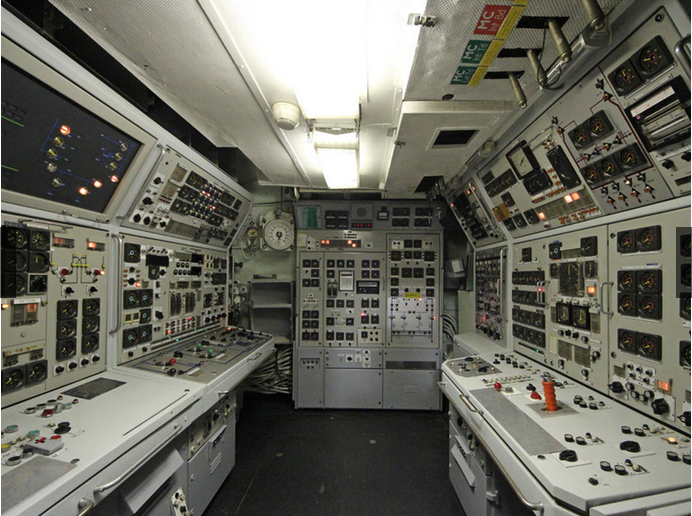
Man, this looks like a nuclear power station control room.
Oh, wait, it is. Along with all the other moving and dangerous parts of the “drivetrain.”
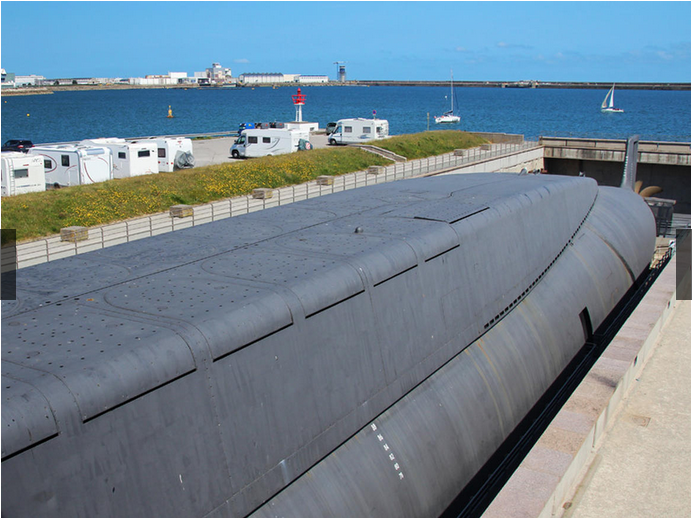
The 16 missile hatches, with the lovely Cherbourg harbor in the background.
Comments Off on A tour of the French ballistic missile submarine Le Redoutable
February 16, 2015
Operation CRABSTICK
Think Defence looks back at an anti-invasion project to deny airfields to German forces along the southeast coast of England after the Dunkirk evacuation and onset of the Battle of Britain:
A method was also sought to deny the runway to enemy gliders and transport aircraft and so the Canadian Pipe Mine was devised by the 1st Canadian Tunnelling Company. 50-70mm steel pipes were inserted into the ground using hydraulic pipe pushing equipment and laid in a criss cross pattern about 6ft under the surface. They were subsequently filled with explosives, usually a blasting gelignite called ‘Polar Blasting Gelignite’ which was very powerful.
They were also called McNaughton Tubes after the GOC of 1 Canadian Division who according to his biographer got the idea for using hydraulic rams from bootleggers who used the method for creating an offsite distribution point for their whiskey!
Only 9 airfields were identified for mining initially but this rose to include other locations, by the end of 1942, after the threat of invasion had receded, 30 locations were mined, not all of them airfields. It is estimated that over 40,000ft of pipe mines were installed.
During the war some of the pipe mines were made safe and removed because of the deterioration of the explosive filler but most were left in situ. After the war Canadian engineers were tasked with removal but it seems from reading different sources that records were incomplete and some doubt exists whether the clearance activity was completed. Additional clearance efforts were made, one that resulted in the death of a Ukrainian worker at one of the locations.

Comments Off on Operation CRABSTICK


