
Published on 5 Jun 2016
Since you all liked our first test of OUT OF THE ETHER so much, we decided to bring in some new episodes occasionally. In this episode we talk about the design behind the forts at Verdun and gas development sights in Washington.
June 6, 2016
Verdun Fortress Design – Gas Development Sights I OUT OF THE ETHER
Comments Off on Verdun Fortress Design – Gas Development Sights I OUT OF THE ETHER
June 5, 2016
Execution Squads – Jews in WW1 I OUT OF THE TRENCHES
Published on 4 Jun 2016
It’s time for the Chair of Wisdom again and this week we talk about the organisation of execution squads, the fate of Jews in WW1 and the the motivation of soldiers.
Comments Off on Execution Squads – Jews in WW1 I OUT OF THE TRENCHES
June 3, 2016
The Battle of Jutland – Royal Navy vs. German Imperial Navy I THE GREAT WAR Week 97
Published on 2 Jun 2016
The Battle of Jutland or the Skagerrakschlacht was arguably the biggest naval battle in history and a turning point of World War 1 as the German High Seas Fleet failed to break through the Royal Navy’s blockade of the North Sea. The set trap of U-Boats fails to spring and even though more British ships were lost in the battle, it was a tactical defeat for the Germans.
Comments Off on The Battle of Jutland – Royal Navy vs. German Imperial Navy I THE GREAT WAR Week 97
June 2, 2016
History Buffs: Waterloo
Published on 16 Feb 2016
For those of you want realism in their historical movies. To watch a film that cares as much about about authenticity as you do. Look no further. Over the course of this video you will hopefully understand why this film means so much to me. This is Waterloo
Comments Off on History Buffs: Waterloo
Fat Leonard and the corruption of the US Navy’s Seventh Fleet
An amazing story in the Washington Post details how a Malaysian defence contractor got his claws into the senior officers of the US Navy’s Seventh Fleet:
A 51-year-old Malaysian citizen, Francis has since pleaded guilty to fraud and bribery charges. His firm, Glenn Defense Marine Asia, is financially ruined.
But his arrest exposed something else that is still emerging three years later: a staggering degree of corruption within the Navy itself.
Much more than a contracting scandal, the investigation has revealed how Francis seduced the Navy’s storied 7th Fleet, long a proving ground for admirals given its strategic role in patrolling the Pacific and Indian oceans.
In perhaps the worst national-security breach of its kind to hit the Navy since the end of the Cold War, Francis doled out sex and money to a shocking number of people in uniform who fed him classified material about U.S. warship and submarine movements. Some also leaked him confidential contracting information and even files about active law enforcement investigations into his company.
He exploited the intelligence for illicit profit, brazenly ordering his moles to redirect aircraft carriers to ports he controlled in Southeast Asia so he could more easily bilk the Navy for fuel, tugboats, barges, food, water and sewage removal.
Over at least a decade, according to documents filed by prosecutors, Glenn Defense ripped off the Navy with little fear of getting caught because Francis had so thoroughly infiltrated the ranks.
[…]
In his dealings with the Americans, Francis went to great lengths to ingratiate himself with senior officers, recognizing that they often cared more about high-quality service than how the bill would be paid.
Whenever a Navy vessel arrived in port, the odds were high that Francis would be waiting at the pier. Like a five-star concierge, he would arrange for shopping trips, sightseeing tours and concert tickets. A limousine and driver would be reserved for the ship’s commander.
Select sailors would be invited to an extravagant banquet, featuring cognac and whiskey, Cohiba cigars from Cuba, and platters of Spanish suckling pig and Kobe beef. Francis would sometimes fly in a band of pole dancers, which he called his Elite Thai SEAL Team, for X-rated shows, court records show.
In another display of panache, he purchased an aging, decommissioned British warship, the RFA Sir Lancelot. He refurbished and renamed it the Glenn Braveheart.
The vessel became the flagship of his fleet, and it would often deploy alongside the USS Blue Ridge, the 7th Fleet’s flagship. When in port, Francis would sometimes turn the Braveheart into a giant party boat, with prostitutes in the wardroom to entertain U.S. officers, according to court records and interviews.
Comments Off on Fat Leonard and the corruption of the US Navy’s Seventh Fleet
May 31, 2016
Stormtrooper – German Special Forces of WW1 I THE GREAT WAR Special
Published on 30 May 2016
The German Stormtroops or Sturmbattalions were elite infantry soldiers hand picked to overcome enemy trenches. These men were the creme de la creme of the German Army consisting of Jäger, Pioneer and Mountain troops at first and later on specifically trained in infiltration tactics. They brought changes in the chain of command with them and were the predecessor of modern warfare as we know it.
Comments Off on Stormtrooper – German Special Forces of WW1 I THE GREAT WAR Special
May 29, 2016
Dazzle Camouflage – Sabotage Operations I OUT OF THE TRENCHES
Published on 28 May 2016
Chair of Wisdom Time! This week we talk about Dazzle Camouflage and Sabotage Operations.
Comments Off on Dazzle Camouflage – Sabotage Operations I OUT OF THE TRENCHES
May 28, 2016
The World at War – Ep. 1 – A New Germany (1933–1939)
Published on 12 Apr 2016
The rebirth of Germany and growth in power of the Nazi Party leading up to the outbreak of war. Interviewees include Ewald-Heinrich von Kleist-Schmenzin, Werner Pusch and Christabel Bielenberg.
Comments Off on The World at War – Ep. 1 – A New Germany (1933–1939)
May 27, 2016
Cutting Germany’s Wings- The Dawn Of The Air Force I THE GREAT WAR Week 96
Published on 26 May 2016
The age of the solitary flying Ace is coming to end this week as the French are demonstrating what an Air Force can do. Equipped with Nieuport 11 fighters, they give the Germans a hard time above Verdun. On the ground, the Germans still obliterate whole battalions with their artillery but cannot gain any ground themselves. The Austrian offensive in Italy is still advancing and Luigi Cadorna is quickly scraping together troops for a defence.
Comments Off on Cutting Germany’s Wings- The Dawn Of The Air Force I THE GREAT WAR Week 96
May 25, 2016
WW2: The Resource War – I: Arsenal of Democracy – Extra History
Published on 5 Apr 2016
*Sponsored* Hearts of Iron IV comes out on June 6! Check out the game: http://pdxint.at/hoi4_coming_soon
To understand nations at war, you have to look at how their economies function. With World War II on the horizon, Europe and Asia dug themselves in for a fight – and a look at each other’s resources told them what to expect.
____________European economies were so closely connected that some people expected they have to avoid another world war or destroy their finances, but in fact World War I had taught them how to prepare for just such a scenario. Germany, France, and Great Britain all invested in their military before war broke out. When evaluating these economies to see how war would affect them, we look at four main factors: GDP, population, territorial extent, and per capita income. Broadly, this helps us determine how resilient, expansive, self-sufficient, and developed a nation is. All of those factors determine how a nation must conduct its war. For example, the vast territorial holdings of the British Empire meant that they had vast resources to draw upon but needed a long time to mobilize them, which helped Germany determine that they needed to strike fast and win big if they hoped to win the war before Britain’s full resources came into play. Japan also estimated that they could win a war in the Pacific if they managed to win before the US had been involved for more than 6 months. These calculations drove the early strategies of the Axis powers, but the participation of the US would later prove to be a crucial factor.
____________BONUS! Economies of Japan and China before WWII:
GDP (Bn USD-1990)
Japan – 169.4
Japanese Colonies – 62.9
China (exc. Manchuria): 320.5POPULATION (mil)
Japan – 71.9
Japanese Colonies: 59.8
China (exc. Manchuria): 411.7TERRITORY (thous sq.km)
Japan – 382
Japanese Colonies – 1602
China (exc. Manchuria): 9800AVG ANNUAL WAGE (USD-1990)
Japan – 2,356
Japanese Colonies – 1,052
China (exc. Manchuria) – 778From: The Economics of World War II: Six Great Powers in International Comparison by Mark Harrison
Comments Off on WW2: The Resource War – I: Arsenal of Democracy – Extra History
May 24, 2016
The Age Of Warlords – China in WW1 I THE GREAT WAR Special
Published on 23 May 2016
China was in a constant period of unrest and turmoil after the Opium Wars and the Boxer Rebellion. None of the new leaders and presidents could really consolidate their power in China and a struggle between the different warlords. broke out. At the same time, China was eyeing a more prominent role within the international community and sent 150,000 workers to the Western Front as part of the Chinese Labour Corps.
Comments Off on The Age Of Warlords – China in WW1 I THE GREAT WAR Special
May 22, 2016
Point Of No Return – Anti-War-Movements I OUT OF THE TRENCHES
Published on 21 May 2016
Macklemore’s uncle sits in the chair of wisdom again to answer your questions about World War 1. This time we talk about anti war movements, the point of no return and how our team copes with the horrors of war.
Comments Off on Point Of No Return – Anti-War-Movements I OUT OF THE TRENCHES
Perhaps the US Navy can learn from Denmark on getting the “Little Crappy Ships” right
On the National Interest Blog, James Hasik points out that the idea of the Littoral Combat Ships of the US Navy was successfully implemented more than twenty years ago (and much more economically, too):
In contrast, we know it’s possible to get modularity right, because the Royal Danish Navy has been getting it right since the early 1990s. Way back in 1985, Danyard laid down the Flyvefisken (Flying Fish), the first of a class of 14 patrol vessels. The ships were intended to fight the Warsaw Pact on the Baltic — a sea littoral throughout, with an average depth of 180 feet, and a width nowhere greater than 120 miles. Any navy on its waters might find itself fighting surface ships, diesel submarines, rapidly ingressing aircraft, and sea mines in close order. On the budget of a country of fewer than six million people, the Danes figured that they should maximize the utility of any given ship. That meant standardizing a system of modules for flexible mission assignment. The result was the Stanflex modular payload system.
At 450 tons full load, a Flyvefisken is much smaller than a Freedom (3900 tons) or an Independence (3100 tons). Her complement is much smaller too: 19 to 29, depending on the role. At not more than 15 tons, the Stanflex modules are also smaller than the particular system designed anew for the LCSs. But a Flyvefisken came with four such slots (one forward, three aft), and a range of modules surprisingly broad […]
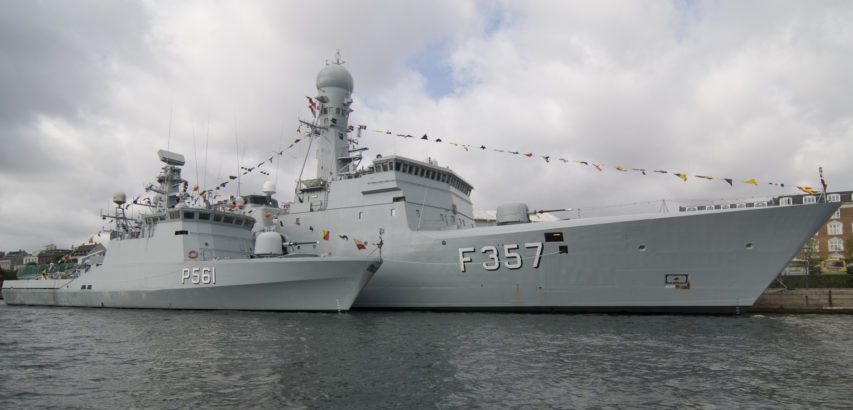
Swapping modules pier-side requires a few hours and a 15-ton crane. Truing the gun module takes some hours longer. Retraining the crew is another matter, but modular specialists can be swapped too. The concept has had some staying power. The Flyvefiskens served Denmark as recently as 2010. In a commercial vote of confidence, the Lithuanian Navy bought three secondhand, and the Portuguese Navy four (as well as a fifth for spare parts). Over time, the Royal Danish Navy has provided Stanflex slots and modules to all its subsequent ships: the former Niels Juel-class corvettes, the Thetis-class frigates, the Knud Rasmussen-class patrol ships, the well-regarded Absalon-class command-and-support ships, and the new Ivar Huitfeldt-class frigates.
Flyvefisken-class patrol ship HDMS Skaden (hull number P561) and HDMS Thetis (F357) in Copenhagen (via WikiMedia)
In short, 25 years ago the Danes figured out how a single ship could hunt and kill mines, submarines and surface ships. A small ship can’t do all those things well at once, but that’s a choice in fleet architecture. Whatever we think of the LCS program, we shouldn’t draw the wrong lessons from it. Why is this important? Modularity is economical, as the Danes have long known. Critically, modularity also lends flexibility in recovering from wartime surprise, in that platforms can be readily provided new payloads without starting from scratch. Because on December the 8th, when you need a face-punched plan, you’d rather be building new boxes than new whole new ships.
Wikipedia has this image of the HDMS Iver Huitfeldt:

HDMS Iver Huitfeldt during a port visit in Århus, 20 January 2012
Comments Off on Perhaps the US Navy can learn from Denmark on getting the “Little Crappy Ships” right
May 21, 2016
Suleiman the Magnificent – Lies – Extra History
Published on 23 Apr 2016
Suleiman lost faith in those who surrounded him, fearing that they schemed to replace him. Why do we so rarely see such destructive suspicion in our governments today? We also need to talk about what made the West dub Suleiman “Magnificent,” and the flourishing of arts and education which took place under his reign.
Towards the end of his reign, Suleiman saw his once trusted advisor, Ibrahim Pasha, and his own son, Mustafa, as enemies rather than allies. He feared that they would displace him to put Mustafa on the throne. Why don’t we see such distrust turn into murder in our governments today, when it was such a common trope in the ancient world? Perhaps it’s because our modern governments provide a regular means of succession, so that anyone with ambition is usually better served waiting for their turn rather than trying to take on the entire government.
The series was too short to allow us to give Suleiman’s reign the coverage it really deserved, but we want to take advantage of this opportunity to talk about why the West dubbed him “Suleiman the Magnificent” and his people called him “The Lawgiver.” The laws he put so much effort into rewriting improved equality in the society, including creating additional protections for Christians and Jews within his Muslim empire. He was also a patron of the arts, and even a poet himself, under whose reign a distinctive Ottoman style developed and many beautiful buildings were constructed. Finally, as a leader of armies, he took many cities that were considered the bulwark of European defense against the Ottomans, and though he had huge armies to do it, many huge armies had failed at those tasks before since the cities were heavily fortified and actually had the odds stacked in their own favor.
Comments Off on Suleiman the Magnificent – Lies – Extra History
May 20, 2016
Conrad’s Cunning Plan – Hiding In Plain Sight I THE GREAT WAR Week 95
Published on 19 May 2016
Austro-Hungarian Chief of Staff Conrad von Hötzendorf had a plan to finally force a decision against the Italians. He massed troops and artillery in a different sector of the front planning a surprise offensive. And even though everybody knew about his cunning plan, Italian Chief of Staff Luigi Cadorna believed everything was a ruse and fired a general instead of preparing against the attack.
Comments Off on Conrad’s Cunning Plan – Hiding In Plain Sight I THE GREAT WAR Week 95


