
… Rolling Stone morphed into AARP Magazine so slowly, I hardly even noticed.
Ed Driscoll, “Plutocrat Millionaires Insult Military Veterans”, PJ Media, 2014-11-14.
November 20, 2015
QotD: Rolling Stone
Comments Off on QotD: Rolling Stone
November 19, 2015
“Changing Canada’s copyright term … means two decades where zero historical work enters the public domain”
There may be good parts of the Trans-Pacific Partnership deal, but there are emphatically bad parts, as Jesse Schooff describes in the particular case of the arbitrary extension of copyright in Canada from fifty years to seventy years:
One of the TPP areas of scope which is critical to discuss is the section on copyright. At this point, several notable bloggers* have covered the TPP’s copyright extension provisions in great detail. But what do those provisions mean for you? Let’s bring it down to the ground. For example: folks in my demographic seem to love seeing old-timey photos of their city. Here in Vancouver, exploring our retro-downtown through old photographs of various eras is practically an official pastime.
A quality source of such photo collections is a city’s municipal archives. Traditionally, an archives’ mandate is to store physical objects and documents, which include the physical “analog” photos taken during most of the 20th century. “Great!” someone might say, “the archives can just digitize those photos and put them up on their website, right?”
Let’s ignore the fact that the solution my strawperson proposes has a host of logistical issues attached, not the least of which is the thousands of work-hours required to digitize physical materials. Our focus is copyright — just because the archives has the original, physical photo in their collection doesn’t mean that they own the rights to it.
You have to remember that our newfangled, internet-enabled society is relatively new. When I was a child, if a person wanted to see a historical photo from a city archives, they would actually have to physically GO to said archives and ask an archivist to retrieve the appropriate fonds containing the photo. Journalists and other professionals likely did this regularly, but for the most part, the public at large didn’t usually head down to a municipal building and ask an archivist to search through their collection just to look at a few old photos.
Today, things are much different. If a municipal archives has digitized a significant portion of, say, their collection of 19th and 20th century historical photos, then those photos can be curated online; made accessible to the public at large for everyone to access, learn from, and enjoy!
[…]
Some of the photos, we’ll call them “Group A”, were explicitly released into the public domain by the photographer, so those are okay to use. Another bunch, “Group B”, are photos whose photographer died more than fifty years ago (1965 and before); any copyright on these photos is expired. Some “Group C” photos were commissioned by a businesses, or the rights were specifically sold to a corporation, which means that the archives will have to get permission or pay a fee to make them available online. Most frustrating is the big “Group D”, whose authorship/ownership is sadly ambiguous, for various reasons**. It would be risky for the archives to include the Group D photos in their collection, since they might be violating the copyright of the original author.
So already, knowing and managing the tangle of copyright laws is a huge part of curating these event photos. Hang on, because the TPP is here to make it even worse.
It’s been long-known that the United States is very set on a worldwide-standard copyright term of seventy years from the death of the author. Sadly, such a provision made it into the TPP. Worse still, a release by New Zealand’s government indicates that this change could be retroactive, meaning that those photos in my hypothetical “Group B” would be yanked out of the public domain and put back under copyright.
Comments Off on “Changing Canada’s copyright term … means two decades where zero historical work enters the public domain”
November 17, 2015
November 16, 2015
QotD: The Great Filter
The Great Filter, remember, is the horror-genre-adaptation of Fermi’s Paradox. All of our calculations say that, in the infinite vastness of time and space, intelligent aliens should be very common. But we don’t see any of them. We haven’t seen their colossal astro-engineering projects in the night sky. We haven’t heard their messages through SETI. And most important, we haven’t been visited or colonized by them.
This is very strange. Consider that if humankind makes it another thousand years, we’ll probably have started to colonize other star systems. Those star systems will colonize other star systems and so on until we start expanding at nearly the speed of light, colonizing literally everything in sight. After a hundred thousand years or so we’ll have settled a big chunk of the galaxy, assuming we haven’t killed ourselves first or encountered someone else already living there.
But there should be alien civilizations that are a billion years old. Anything that could conceivably be colonized, they should have gotten to back when trilobytes still seemed like superadvanced mutants. But here we are, perfectly nice solar system, lots of any type of resources you could desire, and they’ve never visited. Why not?
Well, the Great Filter. No knows specifically what the Great Filter is, but generally it’s “that thing that blocks planets from growing spacefaring civilizations”. The planet goes some of the way towards a spacefaring civilization, and then stops. The most important thing to remember about the Great Filter is that it is very good at what it does. If even one planet in a billion light-year radius had passed through the Great Filter, we would expect to see its inhabitants everywhere. Since we don’t, we know that whatever it is it’s very thorough.
Scott Alexander, “Don’t Fear The Filter”, Slate Star Codex, 2014-05-28.
Comments Off on QotD: The Great Filter
November 13, 2015
“The United States is engaged in a war of ideas — and it’s losing”
J.M. Berger discusses the challenges of having to overcome an extremist narrative in the struggle with ISIS:
“The United States is engaged in a war of ideas — and it’s losing.”
This refrain feels modern, but it has echoed through most of American history. The argument that the U.S. is losing a war of ideas or narratives to ISIS is only the latest iteration. As Scott Atran recently wrote at The Daily Beast, the various military campaigns against the Islamic State obscure “a central and potentially determining fact about the fight” — namely that it “is, fundamentally, a war of ideas that the West has virtually no idea how to wage, and that is a major reason anti-ISIS policies have been such abysmal failures.”
The myth that America’s narrative is losing to ISIS’s persists despite the fact that millions of people are fleeing ISIS territories, while mere thousands have traveled to join the group. It persists despite the fact that the Islamic State’s ideological sympathizers make up less than 1 percent of the world’s population, even using the most hysterically alarmist estimates, and the fact that active, voluntary participants in its caliphate project certainly make up less than a tenth of a percent.
In the United States, the notion of a “war of ideas” dates almost as far back as the Revolutionary War, according to Google Ngrams, which searches the text of English-language books that have been digitized. The phrase appeared during the Civil War, in the context of slavery, and returned during World War I. References soared as the United States entered World War II, and became a fixture of American political discourse during the Cold War. The Korean War was a war of ideas; so was Vietnam.
And in every era, the same alarm bell has sounded.
Comments Off on “The United States is engaged in a war of ideas — and it’s losing”
The Making Of Thunderbirds
Published on 2 Jan 2014
Thunderbirds Documentary. Step into the twisted mind of Gerry Anderson, and see how he makes Thunderbirds. F.A.B. A favorite show from my childhood with more information than I ever wanted.
H/T to The Arts Mechanical for the link.
Comments Off on The Making Of Thunderbirds
November 12, 2015
Small claims court case with wider copyright implications
Michael Geist discusses a recent small claims court judgement:
… the case involved the president of the Canadian Vintners Association (CVA), who received an email from Blacklock’s Reporter, an Ottawa-based political publication, advising that he was quoted in an article discussing a recent appearance before a House of Commons committee. The man did not subscribe to the publication, which places its content behind a paywall, so he contacted a member of the association who was a subscriber and asked if he could see a copy of the article. When Blacklock’s Reporter learned that he had received a copy from the subscriber, it demanded that he pay for a full subscription or face a copyright infringement lawsuit.
While this does not sound like a copyright case, the Ottawa court ruled that the man had violated Canada’s copyright rules by breaching the publication’s paywall (an act it described as a circumvention of a digital lock) and awarded $11,470 in damages plus an additional $2,000 in punitive damages.
The Canadian digital lock rules were enacted in 2012 under pressure from the United States, which wanted Canada to mirror its safeguards on e-books, DVDs, and other digital content. Those rules typically cover circumvention of popular consumer products, but rarely involve website access. In fact, there are several U.S. cases that have concluded that sharing a valid username and password combination with someone else does not constitute circumvention for the purposes of the law.
Yet in the Blacklock’s Reporter case, the president of the CVA did not even try to access the publication’s site with someone else’s credentials. Indeed, it is difficult to see how asking for a copy of a lawfully obtained article could possibly be considered circumvention of a digital lock. Moreover, there is also a strong argument based on several Supreme Court of Canada decisions that providing the copy qualifies as fair dealing under Canadian copyright law.
As a small claims court ruling, the case has no value as precedent (and could still be appealed). However, it places the spotlight on the restrictive digital lock rules that have already caused a chilling effect within Canadian educational institutions, which often fear that circumvention for legitimate, educational purposes may violate the law.
Comments Off on Small claims court case with wider copyright implications
“Camille Paglia is an intellectual flamethrower”
In The Chronicle of Higher Education, Rachel Toor talks to Camille Paglia:
Not long after she had splashed onto the scene with the publication of her first book, Sexual Personae: Art and Decadence From Nefertiti to Emily Dickinson, and followed that up with an essay in The New York Times claiming that Madonna was the future of feminism, I went to see Camille Paglia speak on a panel about political correctness at New York University. My recollection is of being frisked by armed guards before being allowed to enter the auditorium, but it’s more likely we just had to empty our pockets and go through a metal detector. That I thought the extra protection was for the professor from a small arts college in Philadelphia, and not for another speaker on the dais, Edward Said, tells you something about how Paglia was regarded in the circles in which I traveled.
Camille Paglia is an intellectual flamethrower. She’s fearless. She can be bully-mean and a name caller. She makes some people really, really mad. But she’s also a serious thinker who has been able to write important scholarly books that cross over into a wide readership, and you can regularly find her byline in national magazines, where it’s always a treat to read her sentences. Whether she’s writing about the Obama administration, characterizing cats (in Sexual Personae) as the “autocrats of self-interest,” rhapsodizing about The Real Housewives, or bludgeoning feminists, Christopher Hitchens, or Jon Stewart, she is sometimes right and never boring.
I approached her for this series with trepidation. I was eager to hear what she had to say about writing, but, to be honest, I was a little afraid of her (she called my former boss, Stanley Fish, a “totalitarian Tinkerbell”). Silly me. Camille could not have been more gracious, personable, or fun. She did tell me with a bit of glee that my former employer, Oxford University Press, was one of the seven publishers who rejected Sexual Personae. Thankfully that was before I started working there.
Comments Off on “Camille Paglia is an intellectual flamethrower”
QotD: What repression looks like from the inside
Reaction isn’t a conspiracy theory; it’s not suggesting there’s a secret campaign for organized repression. To steal an example from the other side of the aisle, it’s positing something more like patriarchy. Patriarchy doesn’t have an actual Patriarch coordinating men in their efforts to keep down women. It’s just that when lots of people share some really strong cultural norms, they manage to self-organize into a kind of immune system for rejecting new ideas. And Western society just happens to have a really strong progressivist immune system ready to gobble you up if you say anything insufficiently progressive.
And so the main difference between modern liberal democracy and older repressive societies is that older societies repressed things you liked, but modern liberal democracies only repress things you don’t like. Having only things you don’t like repressed looks from the inside a lot like there being no repression at all.
The good Catholic in medieval Spain doesn’t feel repressed, even when the Inquisition drags away her neighbor. She feels like decent people have total freedom to worship whichever saint they want, total freedom to go to whatever cathedral they choose, total freedom to debate who the next bishop should be – oh, and thank goodness someone’s around to deal with those crazy people who are trying to damn the rest of us to Hell. We medieval Spaniards are way too smart to fall for the balance fallacy!
Wait, You Mean The Invisible Multi-Tentacled Monster That Has Taken Over All Our Information Sources Might Be Trying To Mislead Us?
Since you are a citizen of a repressive society, you should be extremely skeptical of all the information you get from schools, the media, and popular books on any topic related to the areas where active repression is occurring. That means at least politics, history, economics, race, and gender. You should be especially skeptical of any book that’s praised as “a breath of fresh air” or “a good counter to the prevailing bias”, as books that garner praise in the media are probably of the “We need fifty Stalins!” variety.
Scott Alexander, “Reactionary Philosophy In An Enormous, Planet-Sized Nutshell”, Slate Star Codex, 2013-03-03.
Comments Off on QotD: What repression looks like from the inside
November 10, 2015
The “War on Christmas” opens another front … at Starbucks
Katherine Timpf can’t believe that anyone is taking this nonsense in any way seriously:
Please stop embarrassing yourselves.
I woke up this morning to find that real, adult people are actually upset that Starbucks’s holiday cups do not mention Christ or Christmas on them — and the absence of such language as an attack on their religion.
Yep, that’s right. The “War on Christmas” season has arrived, and Starbucks has chosen the side of the godless hedonism that is destroying our society. Don’t let the fact that it still sells a Christmas Blend, a “Merry Christmas” gift card, and an Advent calendar fool you — Starbucks is clearly The Devil’s Coffee, and you have every right to be this upset.
That is, of course, if you are an insane person.
Comments Off on The “War on Christmas” opens another front … at Starbucks
A graphic novelization of Fear and Loathing in Las Vegas
Hunter S. Thompson’s iconic book Fear and Loathing in Las Vegas has been re-imagined in Troy Little’s graphic novel:
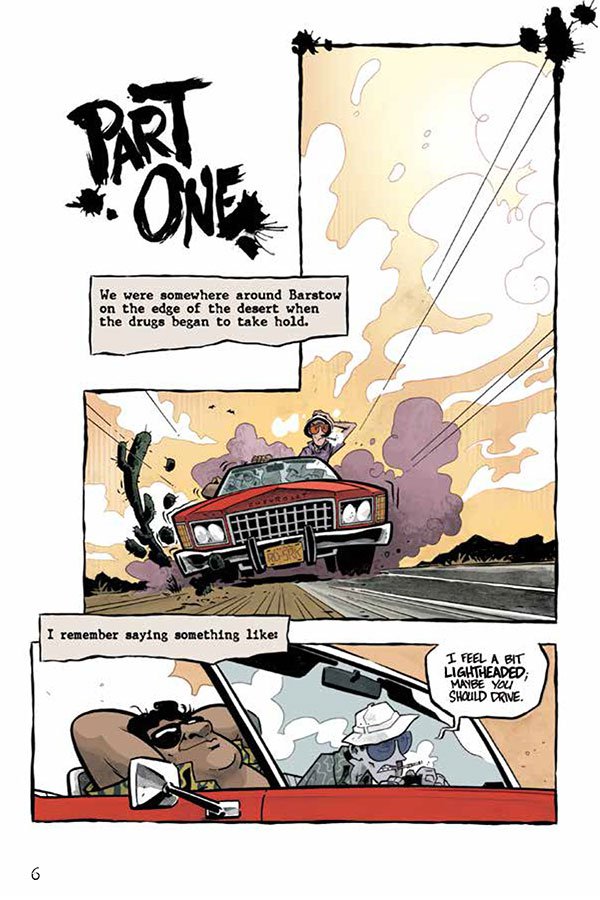
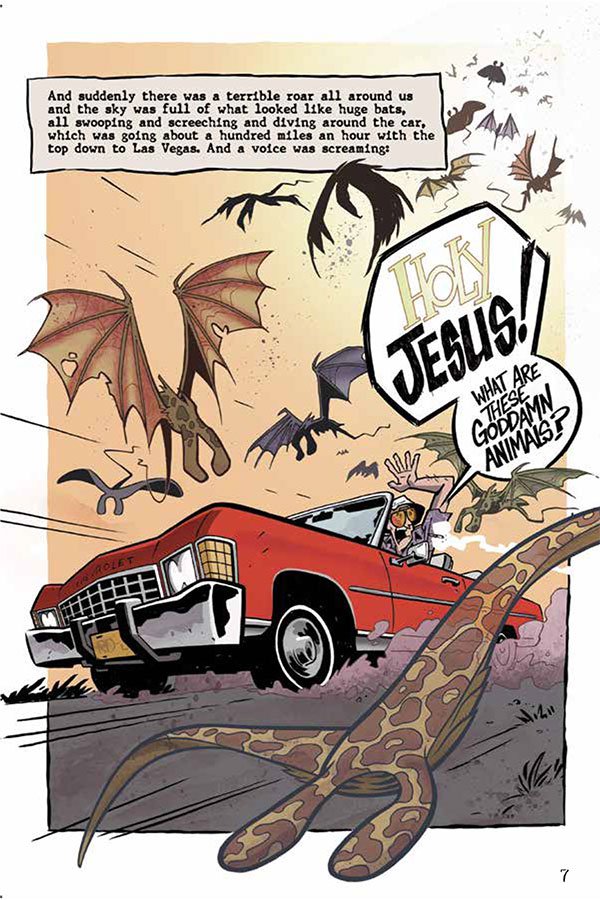
Comments Off on A graphic novelization of Fear and Loathing in Las Vegas
November 9, 2015
Premature revolutionaries
Nigel Davies doesn’t post frequently, so it sometimes takes me a while to see his latest effort. Back in September, he posted a discussion of the “Arab Spring” revolutions and the inability of western intellectuals to derive any lessons from them:
When journalists were going nuts a few years ago about the wonders of the wave of ‘revolutions’ that they decided to refer to as an ‘Arab Spring’, I was reminded how few modern academics, let alone journalists, have any understanding of history. None of the political analysts or professional pundits seemed to have much more of a clue about how things would INEVITABLY turn out, than babes in a wood.
Which is ridiculous, because you would imagine that anyone with a pretense of being worth consulting might have at least a clue that there might be historical parallels worth considering. Frankly it is terrifying that our modern ‘chattering classes’ honestly seem to imagine that they are above being able to learn anything from history.
1848 of course saw a wave of ‘revolutions’ all across Europe, which many people at the time hailed as the inevitable downfall of the ancient regimes, and the prelude of the rise of true modern democracy. How sweet.
In fact, of course, the revolutions led to a re-imposition of the ancient regimes, or much worse dictatorships: often with harder edges to prevent such things happening again. In fact it can be credibly argued that the results of this wave of revolutions was to slow down the democratization of Europe by at least 50 years.
I suspect the same thing will result from the Arab Spring.
‘Revolutions’ tend to kick off way before the society as a whole is really ready for them. Usually as pre-emptive takeover attempts by the newly educated middle class ‘intelligentsia’, (or chattering class as we would call them, or ‘twitteratti’ as I have recently heard the political ‘pundits’ ruthlessly described).
Unsurprisingly these newly graduated minor functionaries, petty civil servants, and junior lawyers, want more say in the power structure of the state than the traditional ruling class has previously allowed them. Unsurprisingly – I suppose – they want it immediately… Or as Billy Connelly said in a skit, “We want it now, we want it yesterday, we want to control half of that, most of that, f….ing ALL of that, and stay awake, because tomorrow the demands will change!”
The problem with the proto middle classes jumping the gun and trying to impose their idealized version of democracy before the working class (read average voter) is even half way down the trail to a similar level of literacy and political interest and philosophical conceptualization: is that the resulting mad theories are far too complex for the voters, and NO imagined safe-guard can stand up to the combined ignorance and misunderstanding of the newly enfranchised. The result is, absolutely inevitably, a dictatorship.
Comments Off on Premature revolutionaries
November 6, 2015
QotD: The slow erosion of freedom of expression
This slow erosion of freedom of expression has come about in ways both social and legal. Before the 1960s, arguments for censorship tended to focus on sexual morality, pornography and obscenity. The censors themselves were usually depicted as benighted moral conservatives — priggish maiden aunts. Freedom of political speech, however, was regarded as sacrosanct by all. As legal restraints on obscenity fell away, however, freedom of political speech began to come under attack from a different kind of censor — college administrators, ethnic-grievance groups, gay and feminist advocates.
The new censors advanced such arguments as that “free speech can never be an excuse for racism.” These arguments are essentially exercises both in begging the question and in confusing it. While the principle of free speech cannot justify racism any more than it can disprove racism, it is the only principle that can allow us to judge whether or not particular speech is racist. Thus the censor’s argument should be reversed: “Accusations of racism can never be an excuse for prohibiting free speech.”
Meanwhile, the narrowly legal grounds for restricting speech changed, too. Since the 18th century, the basic legal justifications for restricting political speech and publication were direct incitement to harm, national security, maintaining public order, libel, etc. Content wasn’t supposed to be considered (though it was sometimes smuggled in under other headings).
Today, content is increasingly the explicit justification for restricting speech. The argument used, especially in colleges, is that “words hurt.” Thus, universities, parliaments, courts and various international bodies intervene promiscuously to restrict hurtful or offensive speech — with the results described above. In the new climate, hurtful speech is much more likely to be political speech than obscene speech.
John O’Sullivan, “No Offense: The New Threats to Free Speech”, Wall Street Journal, 2014-10-31.
Comments Off on QotD: The slow erosion of freedom of expression


