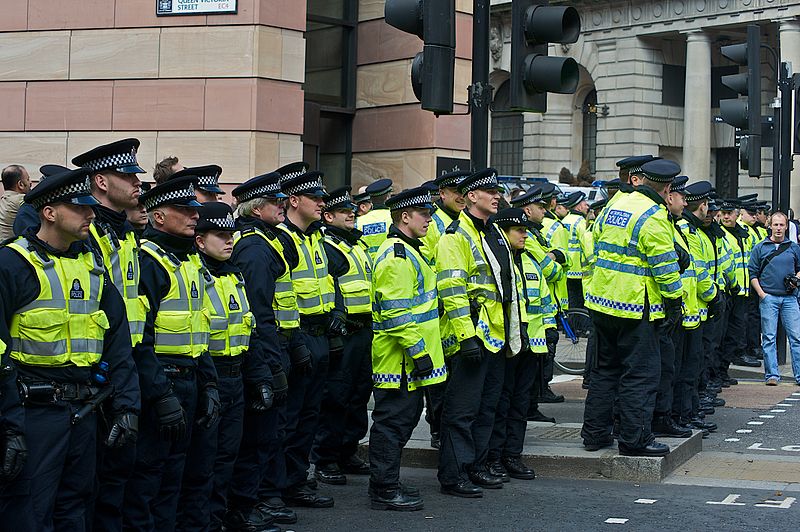
Those who seek absolute power, even though they seek it to do what they regard as good, are simply demanding the right to enforce their own version of heaven on earth. And let me remind you, they are the very ones who always create the most hellish tyrannies. Absolute power does corrupt, and those who seek it must be suspect and must be opposed. Their mistaken course stems from false notions of equality, ladies and gentlemen. Equality, rightly understood, as our founding fathers understood it, leads to liberty and to the emancipation of creative differences. Wrongly understood, as it has been so tragically in our time, it leads first to conformity and then to despotism.
Barry Goldwater, GOP nomination acceptance speech, 1964.
March 13, 2018
March 6, 2018
Playboy‘s extortion attempt against Boing Boing dismissed
Back in January, I linked to the bizarre story of Playboy attempting to sue Boing Boing for the terrible crime of … linking. On the web. I’m not making this up. Thankfully, common sense finally did triumph as reported on Monday:
In January, we let you know that Playboy had sued us. On Valentine’s Day, a court tossed their ridiculous complaint out, skeptical that Playboy could even amend it. Playboy didn’t bother to try.
We are grateful this is over. We are grateful for the wonderful work of the EFF, Durie Tangri, and Blurry Edge, our brilliant attorneys who stood up to Playboy‘s misguided and imaginary claims. We are glad the court quickly saw right through them.
Playboy damaged our business. This lawsuit cost our small team of journalists, artists and creators time and money that would otherwise have been focused on Boing Boing‘s continued mission to share wonderful things.
March 3, 2018
5 Great Libertarian Movies!
ReasonTV
Published on 2 Mar 2018Forget the Oscars! Here are five great movies made over the past quarter-century that any libertarian will (must?) enjoy.
_____The Incredibles (2004)
This Pixar film directed by Brad Bird is so full of speeches extolling individualism, it sometimes sounds like an Ayn Rand novel (in fact, Rand is clearly part of inspiration for the character of Edna Bird). Even the supervillain in The Incredibles is a creature of self-invention and self-improvement. While the Incredibles are born with their powers, Syndrome is a normie who worships Mr. Incredible and is desperate to be his sidekick.
Like an animated version of Richard Nixon, Syndrome’s ambition ultimately gets the best of him.
The Barbarian Invasions (2003)
Québécois director Denys Arcand’s brilliant sequel to The Decline of the American Empire is the single-best depiction of the depredations of socialized medicine. Canada’s health-care system is so sclerotic that the movie’s protagonist, a retired academic named Rémy, cannot even score the drugs he needs to commit suicide until his estranged son, a banker, buys them on the black market.
Even more disturbing is the moment when the terminally ill Rémy and his former colleagues admit that their intellectual faddishness led them to embrace every awful left-wing “ism” of the past 30 years despite their massive human toll.
Dallas Buyers Club (2013)
Set in the 1980s, Matthew McConaughey plays Ron Woodroof, a boozey roughneck who is given 30 days to live after being diagnosed with AIDS. Faced with a death sentence, he schools himself on a wide variety of treatments, first in Mexico and then all over the world. With the help of a cross-dressing party girl named Rayon, Woodroof skirts FDA prohibitions against importing, using, and selling unapproved drugs by creating a “buyers club,” in which members pay a monthly fee and assume all risks.
The depiction of official indifference to patient suffering and the bureaucratic quashing of medical freedom even for people who are certain to die is inspirational, especially now that even Donald Trump has endorsed “right-to-try” legislation that would allow terminally ill patients access to non-approved medicines.
Joy (2015)
Jennifer Lawrence became a mega-star playing the anti-government rebel Katniss Everdeen in The Hunger Games movies. While there’s no shortage of libertarian sentiment coursing through that trilogy, it’s actually a quieter movie starring Lawrence that embodies libertarian virtues of hard work, commercial innovation, and entrepreneurship.
In Joy, Lawrence plays real-life “Miracle Mop” inventor Joy Magano, who helped make cleaning your floors easier while making herself rich. The film is nothing less than a paean to capitalism’s genius at allowing self-expression and self-fulfillment.
In a dramatic scene with Bradley Cooper, who plays an executive at a home-shopping network, Joy summarizes in a few sentences what it took Joseph Schumpeter, Friedrich Hayek, and Milton Friedman whole books to say.
As former Reason Editor Virginia Postrel wrote, the film “acknowledges the wealth-creating value of incremental improvements even in the most mundane items.”
Ghostbusters (1984)
Released in 1984, Ghostbusters quickly became one of most successful comedies in film history.
The movie was perfectly in synch with the Reagan Revolution’s valorization of business and demonization of government. Ghostbusters begins with a team of paranormal investigators getting kicked out of Columbia University and starting a ghost-hunting business. But even though New York is literally being invaded by evil spirits, the real villain of the movie is not the otherwordly demon Gozer but an Environmental Protection Agency bureaucrat named Walter Peck, who shuts down their operation and puts the city at risk.
Well, what do you think? How far off the mark are we? What great libertarian movies would you add to the list? Let us know in the comments.
Produced by Todd Krainin. Written and narrated by Nick Gillespie.
March 1, 2018
Penn & Teller – The Right Not to be Offended
DeadJ0ker27
Published on 19 Feb 2010I’m personally offended by people who get offended.
February 28, 2018
QotD: Words as “physical violence”
Berkeley. Evergreen. Middlebury. Missou. Yale. Brown. McMasters. Wilfred Laurier. The list goes on. One must wonder where this trend will ultimately take us. There have been several justifications given for this increasing rash of no-platforming, shaming, and at times, physical violence on North American campuses. In essence, these justifications can be distilled into a triad of well-meaning but ultimately flawed theses, namely, 1.) that all discourse is about power and that any speech that renders a listener physiologically uncomfortable therefore rises to the level of a physical attack upon that individual, thereby justifying actual physical violence in response, 2.) that for the sake of historically marginalized voices, persons who are members of historically privileged groups should forfeit their right to free speech or ought to remain silent, 3.) that certain assertions, even if possibly true, are nonetheless morally impermissible to make since to do so will likely create conditions whereby bad-intentioned persons will inevitably and successfully advance their morally heinous projects.
This first thesis — that all discourse is fundamentally about power — finds its philosophical origins in the likes of post-modernists such as Jacques Derrida and Michel Foucault. To quote Foucault, “Discourses are tactical elements or blocks operating in the field of force relations.” Thus, on Foucalt’s view, if all discourse is, at heart, really just veiled force relations between competing groups; if language isn’t fundamentally capable of being about objective truth or about the world in any meaningful sense, then the ink symbols written on the page and the shaped air admitted from one’s mouth in the forms of ‘rationality’, ‘facts’, ‘knowledge’, and ‘truth’ are just another set of weapons in a person’s overall arsenal to seize and maintain power, no different in kind from weapons of a physical sort. To speak then, on Foucault’s view, is to wield a weapon, albeit a subtler and refined one. The uncomfortable physiological feeling of hearing offensive speech, it would then seem, vindicates this view that one is being attacked. One might thus conclude, “Why not attack back with heavier, more effective, and more expedient weapons?”
Michael Robillard, “In Defense of Offense”, Quillette, 2018-02-05.
February 25, 2018
Assassin’s Creed: Games with a Libertarian View of the World
ReasonTV
Published on 23 Feb 2018A look into the philosophy of Ubisoft’s long-running franchise.
—————-
Video games have become one of our most influential, popular, and creative forms of media. Last year, the industry generated almost $150 billion in revenue worldwide, rivaling books and films and dwarfing music.
Gamers spend over three billion hours a week in the virtual worlds of their choosing. And more so than other contemporary forms of media, video games explore the themes of freedom and personal agency, allowing players to go where they want and do what they please — as long as they’re prepared to bear the consequences. Two of the three best selling video games of all time are Grand Theft Auto 5 and Minecraft. They’re polar opposites in terms of violence and target audience, but both were designed to offer players the opportunity to make their own destinies.
But it’s the Assassin’s Creed series, published by Ubisoft, that puts the conflict between liberty and authority at the center of its plots, its characters, and the alternate history in which the games are set. Reason takes a look at the series’ narrative merits, and at the titular creed.
Written and edited by Ian Keyser. Read by Andrew Heaton. Gameplay footage by Sean Keyser.
“Plague” by Kai Engel is used under CC BY 4.0.
February 23, 2018
Timothy Sandefur’s Frederick Douglass: Self-Made Man
Jonathan Bean responds to a negative review of Sandefur’s new biography in the New York Times:
Frederick Douglass, whose bicentennial birthday fell on Valentine’s Day, is one of the great figures in American history, a hero whose legacy is celebrated even by those who might otherwise contest his actual ideas.
Illustrating this truth, the New York Times marked the occasion by publishing a largely negative review of Timothy Sandefur’s new biography, Frederick Douglass: Self-Made Man — a book that depicts the African-American ex-slave and social reformer as a classical liberal who championed individual liberty based upon natural rights, self-reliance, and Rule of Law.
The book reviewer, Yale University historian David W. Blight, criticizes Sandefur and other “conservatives” for “co-opting” Douglass. (Sandefur is a self-described libertarian, but in Blight’s mind, ‘libertarian’ and ‘conservative’ are distinctions without a difference.) In making this complaint, Blight demonstrates his confusion as to the meaning of “the Right” and classical liberalism.
Blight concedes that Douglass was a “radical thinker and a proponent of classic 19th-century political liberalism” who “loved the Declaration of Independence” and “the natural-rights tradition.” On these issues, Blight’s view is consistent with Sandefur’s libertarian interpretation of Douglass.
Yet, Blight goes on to protest that the libertarians (or conservatives — he conflates the two groups) are wrong to co-opt Douglass because the great abolitionist “believed that freedom was safe only with the state and under law.”
But this view of freedom’s security is not one that libertarians would dispute. To say otherwise is to make a classic straw man argument.
[…]
Blight’s review gets two things about political classification especially wrong. First, classical liberalism is neither Left nor Right. Throughout history, classical liberals have extolled “unalienable Rights,” individual freedom from government control, the U.S. Constitution as a guarantor of freedom, color-blind law, and capitalism. These values distinguish classical liberalism from left-wing liberalism, with its emphasis on group rights, equality of outcomes, and hostility to free-market capitalism. They also put classical liberals squarely in opposition to nativists and white supremacists who used the law as a weapon to exclude “undesirable” immigrants or separate the races in the American South.
Second, “libertarianism” — the modern descendant of classical liberalism — is not and never has been a “do-nothing” philosophy. Classic liberals (or libertarians) were activists for abolishing slavery, eradicating segregation, defending immigrants’ rights, passing anti-lynching measures, and much more. Indeed, although they recognized the role that law played in protecting the exercise of liberty, it was the law that so often violated the inalienable rights of Americans. Classical liberals fought slavery, segregation, pernicious immigration quotas, internment, and “affirmative action” because these government measures denied individuals equal protection of the law.
Blight’s conceptual errors may account for why he sometimes badly misreads his subject. He claims, for example, that Douglass loved “the reinvented Constitution — the one rewritten in Washington during Reconstruction, not the one created in Philadelphia in 1789.” This is a gross mischaracterization of Douglass’s views.
February 22, 2018
QotD: The importance of defining your terms
If you don’t understand these [gun-related] terms already, why should you care? You should care because when you misuse them, you signal substantially broader gun restrictions than you may actually be advocating. So, for instance, if you have no idea what semi-automatic means, but you’ve heard it and it sounds scary, and you assume that it means some kind of machine gun, so you argue semi-automatics should be restricted, you’ve just conveyed that most modern handguns (save for revolvers) should be restricted, even if that’s not what you meant.
It’s hard to grasp the reaction of someone who understands gun terminology to someone who doesn’t. So imagine we’re going through one of our periodic moral panics over dogs and I’m trying to persuade you that there should be restrictions on, say, Rottweilers.
Me: I don’t want to take away dog owners’ rights. But we need to do something about Rottweilers.
You: So what do you propose?
Me: I just think that there should be some sort of training or restrictions on owning an attack dog.
You: Wait. What’s an “attack dog?”
Me: You know what I mean. Like military dogs.
You: Huh? Rottweilers aren’t military dogs. In fact “military dogs” isn’t a thing. You mean like German Shepherds?
Me: Don’t be ridiculous. Nobody’s trying to take away your German Shepherds. But civilians shouldn’t own fighting dogs.
You: I have no idea what dogs you’re talking about now.
Me: You’re being both picky and obtuse. You know I mean hounds.
You: What the fuck.
Me: OK, maybe not actually ::air quotes:: hounds ::air quotes::. Maybe I have the terminology wrong. I’m not obsessed with vicious dogs like you. But we can identify kinds of dogs that civilians just don’t need to own.
You: Can we?Because I’m just talking out of my ass, the impression I convey is that I want to ban some arbitrary, uninformed category of dogs that I can’t articulate. Are you comfortable that my rule is going to be drawn in a principled, informed, narrow way?
So. If you’d like to persuade people to accept some sort of restrictions on guns, consider educating yourself so you understand the terminology that you’re using. And if you’re reacting to someone suggesting gun restrictions, and they seem to suggest something nonsensical, consider a polite question of clarification about terminology.
Ken White, “Talking Productively About Guns”, Popehat, 2015-12-07.
February 18, 2018
“The minority of one is the most oppressed minority of all”
Matt Ridley on the rising tide of neo-Victorian prudery in western society:
Is it so different here or are we slipping down the same slope? Pre-Raphaelite paintings that show the top halves of female nudes are temporarily removed from an art gallery’s walls; young girls are forced to wear headscarves in school; darts players and racing drivers may not be accompanied by women in short skirts; women are treated differently from men at universities, as if they were the weaker sex, and saved from seeing upsetting paragraphs in novels; sex is negotiated in advance with the help of chaperones. We have been here before.
In Orlando, Virginia Woolf’s novel of 1928, she portrayed the transition from the 18th century to the Victorian period thus: “Love, birth, and death were all swaddled in a variety of fine phrases. The sexes drew further and further apart. No open conversation was tolerated. Evasions and concealments were sedulously practised on both sides.”
How we laughed at such absurdity in my youth. But even for making the point that some of the new feminism seems “retrograde” in promoting the view that women are fragile, the American academic Katie Roiphe suffered a vicious campaign to have her article in Harper’s magazine banned before publication. “I find the Stalinist tenor of this conversation shocking,” she told The Sunday Times. “The basic assumption of freedom of speech is imperilled in our culture right now.”
The sin of blasphemy is back. There are things you simply cannot say about Islam and increasingly about Christianity, about climate change, about gender, to mention a few from a very long and growing list, without being accused of, and possibly prosecuted for, “hate speech”. Is it hate speech to say that Muhammad “delivers his country to iron and flame; that he cuts the throats of fathers and kidnaps daughters; that he gives to the defeated the choice of his religion or death: this is assuredly nothing any man can excuse”? That was Voltaire, one of my heroes. You may disagree with him but you should, in accordance with his principle, defend his right to say it. In demanding tolerance of minorities, many younger people seem to be remarkably intolerant.
There is an odd contradiction between the declared wish to live and let live — “diversity!”, “don’t judge!” — and the actual behaviour, which is ruthlessly and priggishly judgmental. They never stop drafting acts of uniformity, always in the name of the collective against the individual. The minority of one is the most oppressed minority of all.
February 14, 2018
George Orwell’s 1984 in 5 mins – Animated
Shaun McKinnon
Published on 8 Jan 2014A Happy Orwellian 2014 to you all!
Winston Smith’s adventure animated in cartoon form.
Check out George Orwell’s 1984 Video: Synopsis, analysis, and discussion of major characters and themes in the novel.
Doublethink. Thought Police. Big Brother is Watching You. Julia. Ministry of Truth.
Nineteen Eighty-Four. Room 101.
Obama. NSA. Snowden.
SparkNote Documentary. Audiobook.
Made by Shaun McKinnon in Australia.
February 10, 2018
Protecting (some) women from their own decisions
Kirio Birks on the Formula One “grid girls”:
Objectification, we are told, is degrading. Why? Because any job that requires employees to be sexually attractive and gazed upon for that reason necessarily dehumanises them. It encourages others to treat them as pretty ‘things’ rather than as autonomous people with their own lives, passions, thoughts, and desires. Or so the thinking goes. ‘Grid Girls’ – models employed by Formula One for promotional purposes – have just discovered that their role is to be discontinued. As Formula One’s managing director of commercial operations explained: “While the practice of employing grid girls has been a staple of Formula 1 Grands Prix for decades, we feel this custom does not resonate with our brand values and clearly is at odds with modern day societal norms.”
But in their hurry to spare Grid Girls the indignity of the male gaze, nobody making this argument seems to have stopped to wonder whether Grid Girls might have an interest in defending what they do. Instead, a collective of ostensibly progressive voices leapt to their defence without bothering to ask the girls themselves if they needed defending at all. In response, Formula One abandoned its Grid Girls so that it can be seen to be moving with the times and hip to contemporary mores. In doing so, Formula One’s executives have implicitly conceded that they have spent too long objectifying women instead of empowering them. They would like it to known that they’d rather see women driving the cars, or as members of the engineering teams, or just about anywhere other than track-side holding a driver’s name-board and looking beautiful.
What baffles me is that a move supposed to empower women came at the expense of other women, and only because a minority of outsiders found Grid Girls inappropriate, problematic, and otherwise an offence against good taste. But even if Grid Girls are being objectified, then – contra the explanation offered above – it’s not at all clear that objectification is wrong in and of itself. It is acceptable to use people as a means to an end – that’s called employment. Grid Girls obviously know that they will be objectified and they make an autonomous, informed decision to take the job anyway. They are not harmed, they are paid for their time and their work, and many of them have come forward to say, with understandable indignation, that they enjoy what they do. Needless to say, this has not impressed those feminists who applauded their redundancies. But surely a woman has a right to be the object of somebody else’s desire if she wants and surely it doesn’t matter if she is being paid for it?
Get me on @thismorning so I can defend us #gridgirls
Because of these feminists, they’ve have cost us our jobs! I have been a grid girl for 8 years and I have Never felt uncomfortable! I love my job, if I didn’t I wouldn’t do it! Noone forces us to do this! This is our choice! pic.twitter.com/PUWcyB5BeG— Lauren-Jade (@laurenjadepope) January 31, 2018
Opponents may suggest that Grid Girls have internalised their own oppression in a society shaped by patriarchal values, but not without making two claims: (1) that Grid Girls are unable to adequately think for themselves because of the society they live in and (2) that thinking for yourself is only evidenced by acknowledging the existence of a patriarchal status quo and resisting it.
February 9, 2018
John Perry Barlow, RIP
Gareth Corfield on the death of John Perry Barlow, author of the Declaration of the Independence of Cyberspace:
John Perry Barlow, a co-founder of the US Electronic Frontier Foundation, and also a lyricist for the Grateful Dead, has died aged 70.
Barlow passed away “quietly in his sleep” yesterday, according to the EFF, which he helped set up in 1990.
“It is no exaggeration to say that major parts of the Internet we all know and love today exist and thrive because of Barlow’s vision and leadership. He always saw the Internet as a fundamental place of freedom, where voices long silenced can find an audience and people can connect with others regardless of physical distance,” said the foundation’s executive director, Cindy Cohn.
The BBC reported that Barlow had been ill for several years but “few details were given about his medical problems”.
In the history of the Internet, Barlow will be forever remembered for his 1996 Declaration of the Independence of Cyberspace.
“I declare the global social space we are building to be naturally independent of the tyrannies you seek to impose on us. You have no moral right to rule us nor do you possess any methods of enforcement we have true reason to fear,” wrote Barlow, a bold vision of the future that, sadly, did not come to pass.
The EFF defended Barlow against the inevitable criticisms of the Declaration, with Cohn acknowledging that he was “sometimes held up as a straw man for a kind of naive techno-utopianism” but insisting that he understood “new technology could create and empower evil as much as it could create and empower good”.
I wasn’t a fan of the Grateful Dead, but I read his Declaration soon after it was released and found it inspiring (if not particularly realistic, even then). Few people can have a significant role in a single endeavour, but Barlow was undeniably prominent in the music scene and the early internet community. We’re all poorer for his passing.
February 6, 2018
February 4, 2018
QotD: Modern feminism
Feminism now regularly calls for women to be treated as eggshells instead of equals. And through this, it does something pernicious to the women it claims to advocate for: Feminism has become a movement for female disempowerment, or what I call “encouraged helplessness” (from psychologist Martin Seligman’s “learned helplessness”—the feeling that there’s nothing you can do to escape your fate).
In fact, feminism, bizarrely, has morphed into paternalism — instructing women that they are fragile, passive, powerless victims who need authority figures to advocate for them.
That’s a movement I want no part of. Or, as I like to put it — because I’m neither a feminist nor much of a lady: Count me the fuck out.
If you’re a woman, I encourage you to join me — count yourself the fuck out of what feminism has become.
This doesn’t require you to be fearless. You just need to shove your fears aside and do what needs to be done — say, getting up on your hind legs and telling some co-worker, “Stop saying that thing to me” or “…treating me this way.”
Now, if they persist after you’ve told them to stop a few times, that’s harassment and you can seek support to get them to stop. But consider that it’s less likely to get to that point if you simply act like men’s equal—act as if you’re powerful — instead of acting like you’re a feminist.
Amy Alkon, “Are Women Really Victims? Four Women Weigh In”, Quillette, 2017-11-22.
February 3, 2018
QotD: Subsidising the arts
… the Luvvies justify tax subsidy of The Arts by saying, “We can’t call ourselves a civilized country without opera houses, ballet companies, etc., etc.”. Well, perhaps not. But can we call ourselves a civilized country when we have to be forced to pay for these things against our will? Does that not then make us an uncivilized country pretending to be civilized, aping true civilization, a sort of cargo-culture? It’s not our culture at all, spontaneously emerging through voluntary action, it’s someone else’s, laid on the top of our real civilization like fancy icing on (as they might have it) mud. Isn’t that worse?
Sam Duncan, commenting on David Thompson’s “Elsewhere (100)”, davidthompson.com, 2013-10-09.

Frederick Douglass, whose bicentennial birthday fell on Valentine’s Day, is one of the great figures in American history, a hero whose legacy is celebrated even by those who might otherwise contest his actual ideas.