
Forgotten Weapons
Published 7 Jun 2025Heckler & Koch released the MG4, a new 5.56mm squad machine gun in 2001. It was adopted by the German army in 2005, and then by the Spanish and Portuguese armies in 2007. Alongside its sister weapon the 7.62mm MG5, it is H&K’s current export machine gun.
The MG4 fires from an open bolt, with a 2-lug rotating bolt locking system and a long stroke gas piston operating system. It uses standard M27 NATO links for feeding, and does not have a semiauto selector setting. Mechanically, the MG4 uses a front trunnion into which both the barrel and bolt lock independently — meaning that the quick-change barrel can be removed with the bolt in either the forward or rearward position.
As one would expect for a 5.56mm machine gun weighing 18 pounds, it is very easy to control.
Thanks to Sellier & Bellot for giving me access to this modern machine gun to film for you!
(more…)
October 22, 2025
H&K MG4: Germany’s New 5.56mm Squad Machine Gun
QotD: The supposed land crisis Tiberius Gracchus wanted to solve
The issue Tiberius Gracchus seizes on is land reform and both Plutarch (Ti. Gracch. 8.1-3) and Appian (B. Civ. 7-8) present similar visions of the problem he thought he was addressing. When Rome had expanded in Italy, it had often taken land from defeated enemies, some of which was resettled or sold, but some of which was kept as “public land” (ager publicus), leased out by the state at very favorable rates. By the late second century, Tiberius Gracchus and others are observing two conjoined facts: on the one hand, the number of Romans eligible for conscription (the assidui) has begun to decline. On the other hand, the city of Rome itself is increasingly full of landless poor looking for labor and hoping for some option that will give them a chance at land.1
What they assume is taking place is that the wealthiest Romans – who have, in fact, grown fantastically wealthy from Rome’s overseas wars – have used that wealth to acquire most of the land, either buying up the small freeholds of smaller Roman farmers or getting the leases for that public land. Meanwhile, the Roman small farmer class does most of Rome’s fighting and so the assumption – by Appian – is that these guys are being ground underfoot by heavy military deployments, although as best we can tell, military deployments in the 150s, 140s and 130s are substantially lighter than those from 218-168 (but they’re also in less profitable, more difficult places like Spain, put a pin in that). Those wealthy Romans then work the land not with free laborers, but with slaves, because Roman conquests – remember, we’re at the tail end of Rome’s “iron century” of conquests from 264 to 148 – have brought enormous numbers of enslaved laborers to Italy. Those poor Romans, now displaced, have no land and flock to Rome and are no longer liable for the Roman census.
Except notice the data points being used to come up with this story: the visible population of landless men in Rome and the Roman census returns. But, as we’ve discussed, the Roman census is self-reported, and the report of a bit of wealth like a small farm is what makes an individual liable for taxes and conscription.
In short the story we have above is an interpretation of the available data but not the only one and both our sources and Tiberius Gracchus simply lack the tools necessary to gather the information they’d need to sound out if their interpretation is correct.
All of which now, at last, brings us to the scholarship of the last several decades which has, by and large, concluded that Tiberius Gracchus probably misunderstood the nature of Roman social and economic problems in the late second century and as a result applied the wrong solution.2 The initial problem is that the above model assumes a basically stagnant Italian population: you’re just shifting people around, not generating new people. But survey archaeology shows growing urban centers and new land coming under cultivation, suggesting a modestly rising population, a conclusion reinforced by demographic modeling which recognizes the likely marked decline in military mortality in the back half of the second century. Moreover, the vast expansion of villa estates we ought to be seeing in this period really only comes later, in the first century BC and the first two centuries AD; there’s some expansion (and these patterns are very regionalized) but not enough to explain what we’re being told is happening.3 Those observations, emerging in the 90s and early 2000s, provided the necessary evidence to vindicate the theory advanced by J.W. Rich in the 1980s that the problem was quite different than Tiberius Gracchus understood, in part to explain the one curious fact we could always see about Tiberius’ land reforms, which is that they happened, they went ahead as planned and also they didn’t fix the problem.
Instead what is happening is this: Roman military deployments had, for a long time, been massive. Rome had careened from the major Samnite Wars (343–341, 326–304, and 298–290) to the high-casualty Pyrrhic War (280-275) to the much higher casualty First (264-241) and Second (218-201) Punic Wars. But the big wars of the early second century had involved a lot more winning and thus somewhat less dying (deaths from disease always outweighed combat losses, but Roman armies are smaller from 201-168, so less disease death too), while after the Third Macedonian War (171-168), Rome doesn’t have any more peer-opponent wars left to fight and so the number of men under arms declines again after 168 and especially after 148. Roman society was thus structured to sustain itself in a situation where military mortality for males was high. And then it dropped.
But recall the average Roman farm is small, so what you have now are suddenly a whole bunch of second and third sons who between 350 and 201 would have gone off to fight and died (or their elder brother would have) but are now alive, but can’t possibly inherit the family farm because they have a living brother and the farm is much too small to split further (or to support an entire second nuclear family unit). Where do they go? Well, to Rome, of course, where they want what Rome has done in the past to deal with this sort of problem: the foundation of new Roman communities (colonies) where they can have land. But there isn’t any Italy left to conquer (Rome controls all of it) and we aren’t yet to founding Roman colonies overseas, so not only is the mortality much lower (and so you have more of these guys) the traditional release valve is stuck. So they’re piling up in the one place that there is meaningful amount of wage labor available (the city of Rome), where they are very visible to the Roman ruling elite.
Meanwhile, Elder Brother-Who-Lived is back on the farm and should, in theory, still be eligible for call-up. But whereas in previous decades he could hope to get sent to fight in places like Greece or Italy or against Carthage where the rewards in loot from defeating wealthy enemies were substantial, in the 130s, the main problem was Numantia: a Celtiberian community perched in a particularly troublesome hillfort in a relatively poor, difficult part of Spain. Campaigns to take the place often failed (see above) but even if they succeeded, there would be little real loot. Moreover, a lack of success made the wars deeply unpopular. Elder Brother doesn’t want to get drafted to go fight in Spain, it’s just not a good bargain for him (unlike earlier wars).
But he has a solution: the census is self-reported. While his younger brothers are in Rome looking for work, he can just not report the farm on the census (or not report his military aged son), understating his wealth to drop below the qualifying requirement for military service. Because the Roman census pays functionally no attention to such men – the capite censi (those counted by their heads) – Elder Brother’s household almost seems to vanish in the census returns and the number of men liable for conscription ticks down by one.
And so you have falling census returns, combined with crowds of poor Romans in the city of Rome, but without it necessarily having anything to do with ager publicus or lost farms. And this is, we think, probably what is happening: surely there is some elite villa-estate expansion and some replacement of freeholding farmers with enslaved workers on that land but in fact the problem the Romans are facing is classic land scarcity with a growing population, but they don’t know that’s the problem because draft-resistance appears in the census as population decline and the census is all they have.
But you can see immediately the problem for Tiberius Gracchus’ land reform: while there is certainly some ager publicus to redistribute (to the great annoyance of the elites holding it), there’s not enough, because the core of this problem isn’t changing land use patterns (more villas, less small farms) but rising population creating economic strain at the bottom (while, it is true, imperial expansion creates vast almost unimaginable amounts of wealth at the top).
But we’re actually not quite done with problems, there’s one more: not all of the ager publicus was being farmed by Romans. Quite a lot of it seems, instead, to have been in the hands of local Italians – the socii. This is another convenient simplification by Appian and Plutarch, a product of them both writing in the imperial period long after citizenship had been extended across Italy. But that hasn’t happened yet. So any law to redistribute ager publicus would mean taking land from the socii who were currently using it for a land-giveaway in which only Roman citizens will be eligible.
You may well imagine that doing something like that might really damage relations with the socii and also fundamentally change the “bargain” by which the Roman alliance system functioned, as before Tiberius Gracchus, the socii seem to have been eligible to settle in Roman colonial foundations on conquered land, but they will not be eligible to get land in Tiberius Gracchus’ land reform bill.
You can quickly flip ahead to the year 91 to see how that turns out in the long run.
Bret Devereaux, “Collections: On the Gracchi, Part I: Tiberius Gracchus”, A Collection of Unmitigated Pedantry, 2025-01-17.
- To pause for a second: for the sake of making this understandable, I am using the relatively simple category of ager publicus. However, as Gargola (op. cit.) notes, in actual Roman law, ager publicus was a messy super-category of lands governed by an exciting range of different rules and conditions (some leased, some sold, some held by the state, etc.) – ager censorius, ager quaestorius, ager occupatorius, ager diuisus et adsignatus, the ager Campanus and ager in trientabulis. Simplifying this and treating all of these lands as if they had been governed under the same rubric which Tiberius is merely now enforcing is one of Appian’s deceptive simplifications.
- For the scholarship, this reaction begins with J.W. Rich, “The Supposed Roman Manpower Shortage of the Later Second Century B.C.” Historia 32 (1983). The next major phase comes out of the high-count/low-count population debates around Roman demography because older demographic models, like those of PA Brunt (Italian Manpower (1971)) had assumed a static Roman population, but as noted we increasingly had evidence for a modestly increasing population. The implications of that get worked out in books like N. Rosenstein, Rome at War: Farms, Families and Death in the Middle Republic (2004) and L. De Ligt, Peasants, Citizens and Soldiers (2012). Finally, you also have a recognition that while the wars in Spain were unpopular, they didn’t have massive manpower demands, e.g. Taylor, “Goodbye to All That: The Roman Citizen Militia After the Great Wars” in A Community in Transition, eds. M. Balbo and F. Santangelo (2023).
- In Italy, I should be clear: the pervasiveness and speed with which rich Romans seem to accumulate Sicilian estates suggests a lot of the land acquisition may be happening outside of the ager Romanus.
October 21, 2025
The amazing invisible detail
Rex Krueger
Published 20 Oct 2025Patrons saw this video early: / rexkrueger
The threat to legal title to land across Canada
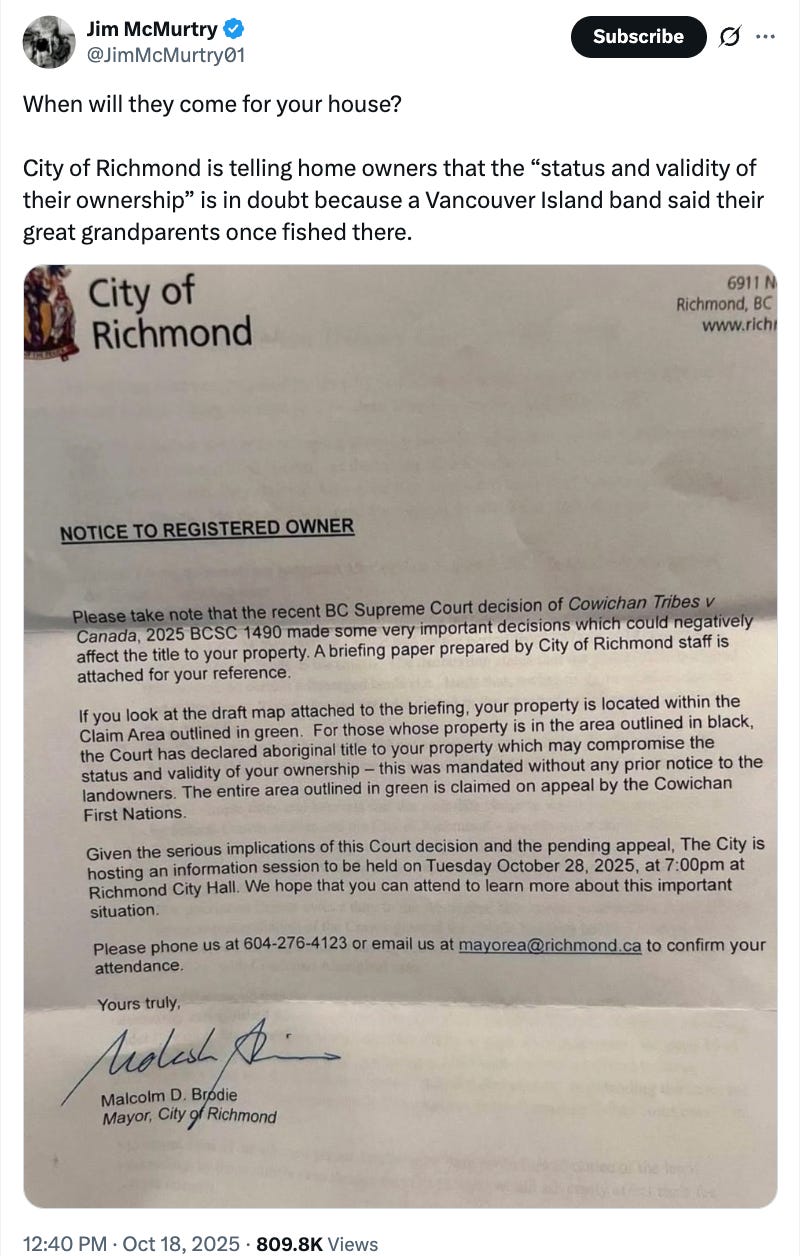
I’d warned years ago that the performative “land acknowledgements” that so many Canadian organizations started using at the beginning of events and gatherings at least a decade back were a bad idea, because they were almost always historically misleading and might be used in future lawfare. Well, the future is here, and the precedent has been set in British Columbia with a court ruling that aboriginal land claims from a BC First Nation has more standing in court than the legal titles held by the current owners. On his Substack, Brian Lilley discusses the issue:
The City of Richmond, British Columbia is warning homeowners their title to their homes may be at risk. It all dates back to an August ruling from the B.C. Supreme Court called Cowichan Tribes that said Crown and private title in a 7 1/2 square kilometre area of Richmond was “defective and invalid.”
While some at the time said that the ruling would not impact homeowners, the legal department for the City of Richmond clearly thinks differently.
“The court has declared Aboriginal title to your property which may compromise the status and validity of your ownership – this was mandated without any prior notice to the landowners,” a letter sent to homeowners in the area impacted reads.
The letter was sent by Mayor Malcolm Brodie and tells residents the city will be appealing and holding public consultations. It’s not just the City of Richmond appealing this ruling it’s also the province and the Musqueam Indian Band.
You can read more from our friends over at Juno News.
The entire ruling from the B.C. Supreme Court is confusing, as is the jurisprudence set out by the Supreme Court on the issue of Aboriginal title dating back to one of those decisions in 2014. Thankfully Professor Dwight Newman, the Canada Research Chair in Rights, Communities and Constitutional Law at the University of Saskatchewan, has laid out an explainer of what happened in the Cowichan case, the 2014 Supreme Court case and what needs to be done going forward.
Last week, Kim du Toit responded to an Australian land acknowledgement on a recent TV show:
The history of this entire world is a story of migration, settlement, wars over territory and Tribe A taking land from Tribe B — bloody hell, they’re still fighting the same wars in the Balkans — but it’s only recently that the arguments over who owns what have become a third-party issue rather than something that the involved parties settle between themselves. Or, to put it in a more scholarly fashion:
Every person alive on this planet today has ancestors who were displaced by force somewhere in their lineage. Every person alive on this planet today has ancestors who displaced other people by force somewhere in their lineage. It’s an inevitable fact of human history. American natives fought with each other over land and resources, and some tribes, like the Dakota (Sioux), were notorious for attacking their neighbors. Europe’s history is rife with such, from the Vikings to the Norman invasion of Britain. In fact, few if any of the people of Europe today are the original inhabitants of the land they reside on now; the one exception may be the Basque of the Pyrenees Mountains, but even they, at some point, came there from somewhere else. The French people we know now derive their name from the Franks, a Germanic tribe, and as for the British Isles, that motley group of islands has seen so many invasions, from Picts to Celts to Romans, Saxons, Anglians, Jutes, and Normans, that it would be difficult to keep track as they go by.
Here’s the simple response to all the handwringing and aggrievement over the “stolen land” claims: get over it, because you’re never going to get it back. End of story.
And to a lesser extent, the same is true of “cultural appropriation”: where White kids are somehow forbidden to wear their hair in those disgusting dreadlocks because Africans somehow have “ownership” of a hairstyle. What bullshit. It’s like saying that Black people can’t drink Scotch whisky because whisky is traditionally a product of the northern provinces of (lily-white) Britain, or that the Irish can’t eat chips because potatoes originally came from America.
Everyone borrows cultural artifacts and customs from everyone else. That’s been the habit of mankind for millennia, and no cries of outrage can overturn it.
When it comes to land, the stronger group has taken it from its “original” (and sometimes not-so original) weaker inhabitants. That this activity has become somewhat less egregious and bloody in recent times does not gainsay its basic premise — and where it has become more bloody, the weaker continue to learn its hard history — as the “Palestinians” are (re-)learning in their efforts to eradicate the state of Israel. (They’re unlikely ever to give up, which simply means that Israel will be forced to teach them the same lesson again and again, ad infinitum. As I’ve said many times before, the Arabs are lucky that the Jews have an inexplicable aversion to genocide, or else “from the river to the sea” could easily have changed to “from the Golan to the Suez”. Vae victis — a Latin expression — has particular currency here.)
So enough with the kowtowing (a Chinese expression) to the Perpetually Aggrieved. Fuck off, all of you, and make the best of what you’ve got. Heaven knows, most of what you can achieve comes courtesy of Western civilization.
You’re welcome.
October 20, 2025
From Hitler’s Rockets to America’s Arsenal – W2W 049
TimeGhost History
Published 19 Oct 2025From the ashes of Nazi Germany to the launch pads of the American desert, the story of the nation’s first ballistic missile is one filled with contradiction. A man who once served the SS soon became a celebrated figure in the United States, and his weapon of war was transformed into a symbol of progress. Here, we will explore how this unlikely journey unfolded and what it reveals about science, power, and morality in the modern age.
(more…)
The Julio-Claudians and the Empire – The Conquered and the Proud 16
Adrian Goldsworthy. Historian and Novelist
Published 2 Apr 2025This time we look at the empire under the Julio-Claudians, and address the broader question of why conquest became so rare after the death of Augustus. Along the way, we take a look at the campaigns in Germany in AD 14-16, the subsequent arrangements of the Rhine frontier, and Corbulo’s campaign during Claudius’ reign. We touch a little on the invasion of Britain, but will deal with that in more detail in a separate video. Other topics covered include North Africa, Egypt, and the relationship with the Parthian Empire to the east.
October 19, 2025
North Africa Ep. 4: Quiet Week Before the Desert Storm
World War Two
Published 18 Oct 2025Late Feb–early Mar 1941: convoys from Naples build up 5th Light as MG Battalion 8 and artillery arrive; Rommel wins deployments and edges the line from Nofilia toward Arco dei Fileni. Luftwaffe raids batter Malta, mines choke Suez, RAF assets drain to Greece, and Axis forward probes tighten the noose around El Agheila while Britain improvises under strain.
(more…)
Forever War: Becoming the Enemy
Feral Historian
Published 8 Mar 2024The Forever War is a great piece of post-Vietnam social critique, not least in its depiction of a society that deserves to lose the war that its chosen to fight. Here I talk about the story through that lens, meandering toward a point in the usual Feral Historian manner.
Also I wanted to get this one out because I’m going to make some Forever War comparisons in an upcoming video.
Most of the B-Roll is from the Forever War comic adaptation, both the original black and white version and the later color release. Also threw in some clips from Starship Troopers: Traitor of Mars just to mix up the visuals a bit because there’s already too much of me sitting on a rock.
00:00 Intro
00:53 The Draft
03:25 It’s so Army …
06:54 No Civilization
09:35 War’s Over. My Bad
13:14 Parting Thoughts
QotD: The Indian Civil Service
I think about The Ruling Caste often when I think about the turds in the Apparat. Looked at from the outside, the ICS were apparatchiks, too. Indeed, even more so than actual apparatchiks, since “apparatchik” means something like “expert without portfolio” and while the ICS had two broad “tracks” (if I recall correctly), “civil” and “legal”, in practice most every ICS man was supposed to be able to do pretty much everything, including (again IIRC) assume military command of local forces if necessary.
Given that there were never more than 200K Britons in the Raj at any one time, how could it be otherwise?
And the ICS was as fully ideologized as the Soviet (or AINO) Apparat. The French gave us the lovely phrase mission civilisatrice, but that’s what the ICS was doing, too. Lord Macauley was the big mover behind the English Education Act of 1835, which explicitly designed to
form a class who may be interpreters between us and the millions whom we govern – a class of persons Indian in blood and colour, but English in tastes, in opinions, in morals and in intellect. To that class we may leave it to refine the vernacular dialects of the country, to enrich those dialects with terms of science borrowed from the Western nomenclature, and to render them by degrees fit vehicles for conveying knowledge to the great mass of the population.
There were two huge differences between the ICS and the Apparat, though, that really come out reading Gilmour’s book. First, and actually least important, was the obvious fact that English education was superior. Macauley really gave “native” literature both barrels — nobody condescends like an Englishman — but he wasn’t wrong. In 1835 you could take the “scientific” literature of every other race on the planet combined and get … the Iron Age? Maybe? 200K Britons could dominate 750 million Indians because
whatever happens, we have got
the Maxim gun, and they have not.Or “steam power” or “replaceable parts” or “calculus” or what have you. Season to taste.
The second — and far, far more important — difference between the ICS and the Apparat, though, was that the ICS was in general composed of decent people. In a very real sense, all imperialism is “cultural imperialism”. Rome became an empire by whomping all its enemies, but it stayed an empire by giving its enemies a great deal. Life was simply better — orders of magnitude better — inside the Empire than outside.
And the reason for this is simple, so simple that you need many years of long and hideously expensive training, by highly skilled and fanatically motivated indoctrinators, to miss it. Macauley, Caesar, Confucius, anyone who wrote anything on barbarian management at any point, anywhere in the world, well into the 20th century, said basically the same thing: Our material culture is the result of our cultural culture.
You can learn to operate our stuff. Obviously so — with only 200K Britons throughout the Subcontinent, the Raj was quite obviously run by Indians. And they did a bang-up job, too, such that India at independence had the real potential to become a first world country (note to folks getting ready to break away from a globe-spanning empire: Never elect a lunatic socialist yoga dude as your first prime minister. He’ll go full retard and set you back 50 years … and he’ll be shooting for 500). You might even learn how to maintain our stuff, maybe even build a few cheap knockoff copies of our stuff.
But it’ll never be more than that — shitty knockoff copies, gruesomely expensive, and available only to the elite — unless you embrace as much of the culture that created the stuff as you can stand. The English themselves are a great example: They were blue-assed savages when Caesar found them, but they got with the program, and look how well that worked out. Ditto the Gauls (“Our ancestors, the Gauls!”) and all the rest.
It’s the culture, stupids. The culture of the ICS was English culture — “play up, play up, and play the game!” sounds like baloney to jaded Postmodern ears, but listen:
The sand of the desert is sodden red,—
Red with the wreck of a square that broke; —
The Gatling’s jammed and the Colonel dead,
And the regiment blind with dust and smoke.
The river of death has brimmed his banks,
And England’s far, and Honour a name,
But the voice of a schoolboy rallies the ranks:
“Play up! play up! and play the game!”As poetry it’s shit, but if that doesn’t make you want to get up out of your chair and take a swing at somebody, then you, sir, have no hair on your scrotum, and will never know a woman’s touch (trannies don’t count).
They really believed that, those Eton schoolboys out there East of Suez. Or, at least, they behaved as if they did, and everything else flowed from that behavior. Recall that it was a coin flip, going East of Suez — chances are you wouldn’t be coming back, or if you did, it would be as a malarial ruin. But they went anyway, though England’s far and Honour a name, because that’s just what they did. Even at their worst — and their worst was very bad; Gilmour pulls no punches — you can’t help but admire them a little, the arrogant bastards. Their convictions were sometimes awful, but they had the courage of them … and courage is magnificent.
Severian, “Ruling Caste II”, Founding Questions, 2022-03-10.
October 18, 2025
The Battle of Sedan: The Anatomy of Failure
World War Two
Published 17 Oct 2025In May 1940, a period of ten days flipped the world order on its head. France, the titan of the Great War, was carved apart by the armored fist of the Wehrmacht: Panzergruppe Kleist. Now, in this new feature-length production, we explore why it happened, whether this was ever avoidable, and whether France’s flaws stemmed from incompetence, or something far more sinister.
(more…)
Gerät Potsdam: Mauser Copies the Sten Gun
Forgotten Weapons
Published 2 Jun 2025In the fall of 1944, the Mauser company was given a contract to develop drawings of a direct copy of the British Sten gun (code named Gerät Potsdam), and to manufacture 10,000 of them. In fact, they were to make two different sets of drawings; one suitable for large factory use (like their own) and one for use with distributed small shops making parts for final assembly elsewhere (which is how much of British Sten production was done). The contract was fulfilled and 9972 guns in total were produced and accepted by the German military in November and December of 1944.
Why would Germany was a copy of the Sten? Well, they actually had a decent number of them. The Allies were air-dropping Stens all over Europe, and a lot of those drops were captured by German troops, not the resistance fighters they were intended for. By the end of the war the Germans were in desperate need of arms, and the Sten was both simple and already in some German use with the Volkssturm … so it actually was not a totally unreasonable idea to produce more of them.
Today, the Potsdam is an extremely rare gun to find. The two visible identifying features are the magazine well and barrel shroud, which are both made with a folded and spot welded seam. The barrels are also identifiable as they have 6 groove rifling, which the British did not use in the Sten.
Before the Potsdam production was finished, Mauser began working on further plans to simplify the design. That would be the Gerät Neumunster, aka the MP 3008. For that part of the story, see my video on the MP 3008:
• German Sten Copy: MP 3008, aka Gerät Neumü…
(more…)
QotD: Civilizational survival after the Bronze Age Collapse
Sometimes the answer is obvious. The Assyrians and Babylonians clearly survived the Collapse: if you compare their architecture, inscriptions, artwork, settlement patterns, and political structures from the Late Bronze Age to the Iron Age, they are recognizably the same people doing the same things and talking about them in the same way. The Egyptians, too, are plainly the same civilization throughout their (very long!) history, even if they were notably weaker and less organized after the Collapse. The Hittites, just as obviously, did not survive (at least not outside their tiny rump states in northern Syria). But the Greeks and the Phoenicians are both murkier cases, albeit in very different ways.
On the one hand, Mycenaean civilization — the palace economy and administration, the population centers, the monumental architecture, the writing — indisputably vanished. The Greeks painstakingly rebuilt civilization over several hundred years, but they did it from scratch: there is no political continuity from the Mycenaean kingdoms to the states of the archaic or classical worlds. And yet as far as we can tell, there was substantial cultural continuity preserved in language and myth. Admittedly, “as far as we can tell” is doing a lot of work here: Linear B was only ever used for administrative record-keeping, so we can’t compare the Mycenaeans’ literary and political output to their successors the way we can in Assyria or Egypt. We can’t be sure that the character, the vibe, the flavor of the people remained. But the historical and archaeological records of the later Greeks contain enough similarities with the descendants of the Mycenaeans’ Indo-European brethren that the answer seems to be yes.
By contrast, civilization never collapsed in central Canaan. No one ever stopped having kings, writing, building in stone, or making art. The Bronze Age population centers were continuously occupied right up to … well, now. And yet their way of life shifted dramatically, to the point that we call them by a new name and consider them a different people. Cline thinks this is a success story: borrowing an analytical framework from a 2012 Intergovernmental Panel on Climate Change report, he praises their “transformation”,1 which “include[d] actions that change the fundamental attributes of a system in response to actual or expected impacts”. (The Assyrians, by contrast, merely “adapted”, while the Egyptians barely “coped”.) But does there come a point when the change is so great, so fundamental, you’re no longer the same civilization? Can the Ship of Theseus really be said to have “survived”?
In the final section of his book, titled “Mycenaeans or Phoenicians”, Cline asks how we’ll react to the societal collapse we all sort of know is coming sooner or later. Our world just is too complicated, too interconnected, to survive a really massive shock (or, as in the Late Bronze Age, a “perfect storm” of smaller ones). Even the relatively mild disruptions of the past few years have revealed fragilities and vulnerabilities that we’ve done nothing to shore up since. Of course, he has an answer: Transform! Innovate! Flourish amidst chaos! Become a new iteration of yourself, like the bog-standard Canaanite cities that reinvented themselves as an Iron Age mercantile superpower and turned the Mediterranean into a “Phoenician lake”. But at what price?
Or, to think of it another way, what would you prefer for your society five hundred years from now?
Behind Door Number One: governmental collapse, abandonment of the population centers, dramatic reduction in societal complexity, and then a long, slow rebuilding where your time and your people are remembered only as myth — but when civilization is restored, it’ll be by people whose the desires, values, attitudes, and beliefs, their most basic ways of understanding the world, are still recognizably yours. They may have no idea you ever lived, but the stories that move your heart will move theirs too.
And behind Door Number Two: expansion, prosperity, and a new starring role on the world stage — but a culture so thoroughly reoriented towards that new position that what matters to you today has been forgotten. Do they remember you? Maybe, sort of, but they don’t care. They have abandoned your gods and your altars. Those few of your institutions that seem intact have in fact been hollowed out to house their new ethos. A handful of others may remain, vestigial and vaguely embarrassing. But boy howdy, line goes up.
Obviously, given our druthers, we’d all be the Assyrians: seize your opportunities, become great, but don’t lose your soul in the doing. But if it comes down to it — if, when the IPCC’s warning that “concatenated global impacts of extreme events continues to grow as the world’s economy becomes more interconnected” bears out, the Assyrian track isn’t an option — then I’d take the Greek way.
I don’t care whether, on the far side of our own Collapse, there’s still a thing we call “Congress” that makes things we call “laws”. Rome, after all, was theoretically ruled by the Senate for five hundred years of autocracy as all the meaning was leached from the retained forms of Republican governance. (Look, I’m sorry, you can call him your princeps and endow him with the powers of the consul, the tribune, the censor, and the pontifex maximus, but your emperor is still a king and the cursus honorum has no meaning when the army hands out the crown.) I don’t even really care if we still read Shakespeare or The Great Gatsby, although it would be more of a shame to lose those than the Constitution. But I do care that we value both order and liberty, however we structure our state to safeguard them. I care that we’re the sort of people who’d get Shakespeare and Fitzgerald if we had them around. Maybe we should start thinking about it before our Collapse, too.
Jane Psmith, “REVIEW: After 1177 B.C., by Eric H. Cline”, Mr. and Mrs. Psmith’s Bookshelf, 2024-07-08.
- “Transformation” is always a term worth taking with a pinch of salt because so often it’s a euphemism for “total civilizational collapse”. In the chapter on the Hittites, for example, Cline quotes one archaeologist to the effect that “[a] deep transformation took place in the former core of the empire around the capital Hattusa, resulting in a drastic decrease in political complexity, a shift to a subsistence household economy and a lack of evidence for any public institutions”. Relatedly, one of my children recently transformed a nice vase into a pile of broken glass.
In this case, though, Cline really does mean transformation.
October 17, 2025
The Original Kaiserschmarrn of the Austrian Empire
Tasting History with Max Miller
Published 13 May 2025Scrambled pancake with raisins and plum compote
City/Region: Austria
Time Period: 1858Like many food origin stories, the ones for kaiserschmarrn are varied and no one knows which, if any, are true. What is true is that Kaiser Franz Joseph I did really enjoy this dish, and as a result kaiserschmarrn became popular throughout the Austrian Empire and is still served in many restaurants today.
This kaiserschmarrn isn’t as sweet as modern versions I’ve had, but it’s still delicious. The vanilla sugar caramelizes and adds a pleasant bit of crunch, the cream makes for a richer pancake, and the plum compote is a lovely addition.
Kaiser-Schmarren.
Whisk 4 decilitres of sweet cream with 4 egg yolks, 2 decilitres flour, and a little salt, add 4 egg whites, beaten to snow, and raisins. Pour the whole thing into hot beef fat or butter, let it get nicely brown like Mehl-Schmarren, prepare it in the dish and sprinkle it with vanilla sugar.
Mehl-Schmarren.
… Place it in the oven so it rises nicely. Then remove it and place it on a rapid heat. When it’s stiff and browned on the bottom, you turn it over with the pancake spatula, let it brown again on the bottom, then tear it into large pieces with a fork and serve it quickly so it doesn’t dry out.
Plum Compote.
Plums are either halved or left whole and peeled. They are placed in hot water where the skin can easily come off. They are then simmered with a little sugar, water, and cinnamon.
— Die Süddeutsche Küche by Katharina Prato, 1858
October 16, 2025
“The ‘big secret’ of the Soviet archives was that the communists really were communist”
Big Serge talks to historian Sean McMeekin, the author of Stalin’s War and other works that some call “revisionist” for their different views of “settled” historical events:
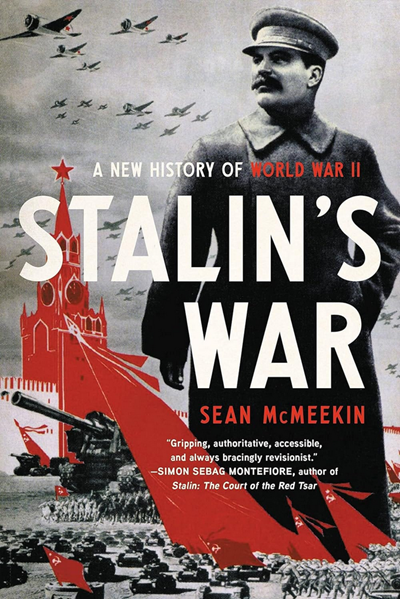
Big Serge: “One of the first things that stands out about your work is that you have found success writing about topics which are very familiar to people and have a large extant corpus of writing. World War One, the Russian Revolution, World War Two, and now a broad survey of Communism – these are all subjects with no shortage of literature, and yet you have consistently managed to write books that feel refreshing and new. In a sense, your books help “reset” how people understand these events, so for example Stalin’s War was very popular and was not perceived as just another World War Two book. Would you say that this is your explicit objective when you write, and more generally, how do you approach the challenge of writing about familiar subjects?”
Dr. McMeekin: “Yes, I think that is an important goal when I write. I have often been called a revisionist, and it is not usually meant as a compliment, but I don’t particularly mind the label. I have never understood the idea that a historian’s job is simply to reinforce or regurgitate, in slightly different form, our existing knowledge of major events. If there is nothing new to say, why write a book?
Of course, it is not easy to say something genuinely new about events such as the First World War, the Russian Revolution, or World War Two. The scholar in me would like to think that I have been able to do so owing to my discovery of new materials, especially in Russian and other archives less well-trodden by western historians until recently, and that is certainly part of it. But I think it is more important that I come to this material – and older material, too – with new questions, and often surprisingly obvious ones.
For example, in The Russian Origins of the First World War, I simply took up Fritz Fischer’s challenge, which for some reason had been forgotten after “Fischerites” (most of them less than careful readers of Fischer, apparently) took over the field. In the original 1961 edition of Griff nach der Weltmacht (Germany’s “Bid” or “Grab” for World Power, a title translated more blandly but descriptively into English as Germany’s Aims in the First World War), Fischer pointed out that he was able to subject German war aims to withering scrutiny because basically every German file (not destroyed in the wars) had been declassified and opened to historians owing to Germany’s abject defeat in 1945 – while pointing out that, if the secret French, British, and Russian files on 1914 were ever opened, a historian could do the same thing for one of the Entente Powers. I had already done a Fischer-esque history on German WWI strategy, especially Germany’s use of pan-Islam (The Berlin-Baghdad Express), inspired by a similar epigraph in an old edition of John Buchan’s wartime thriller Greenmantle – Buchan predicted that a historian would come along one day to tell the story “with ample documents”, joking that when this happened he would retire and “fall to reading Miss Austen in a hermitage”. So it was a logical progression to ask, if Fischer can do this for Germany’s war aims, why not Russia?
Readers may have missed the obvious Fischer inspiration for Russian Origins owing to the editors at Harvard/Belknap, who thought my original title – the obviously Fischer-inspired Russia’s Aims in the First World War – was boring and unsexy. Probably this helped sell books, but it did lend my critics an easy line that I was “blaming Russia for the First World War” rather than simply applying a Fischer-esque lens to Russia’s war aims. Some also called me Russophobic, which is understandable, though I think it misses the point. To my mind, subjecting Russian strategic thinking, wartime diplomacy and maneuvering to the same scrutiny as those routinely applied to Germany and the other Powers is taking the country seriously on its own terms, rather than ignoring Russia, as nearly every historian of, say, Gallipoli has done.
A book on Russian war aims was also long overdue. Other than an underwhelming Chai Lieven study from 1983 and a few articles, no one had really done this for Russia since Soviet scholars and archivists had (with very different motivations) published annotated volumes of secret Russian diplomatic correspondence back in the 1920s. For me, this was a door wide open, and I walked right in. Stalin’s War is in many ways a sequel to Russia’s Aims in the First World War (my own title!), written in a similar spirit, albeit much longer and in some ways more ambitious.
With the Russian Revolution, it was probably still harder to say anything really new, particularly after the popular histories of Richard Pipes and Orlando Figes (and a huge new literature written partly in response to them) came out in the 1990s. And I do not think my “take” was quite as revisionist or controversial as those on WWI or WW2. What I did try to do, in order to add something new to the story, was to combine my own research in a number of areas (Russian army morale reports before and after Order No. 1, depositions taken after the July Days, police reports from 1917, Bolshevik finances and expropriation policies, etc.) with new work done by others since 1991 on, especially, Russia’s military performance in WWI (a topic almost completely ignored in Cold War era literature on the Revolution, both Soviet and western), to reinterpret both the February and October Revolutions. In full disclosure, I would have preferred to write an ambitious history on just 1917, where I had the most original material and new points to make, but my publisher wanted a one-volume “comprehensive” history of the Revolution, so that is what I wrote. Like most historians and writers, I like to think that I write entirely from inspiration with a free hand, but of course there are all kinds of factors that play into our work.
Getting back to your question – while I have certainly done original research for all of these books, I am hardly the only historian to take advantage of Russian archives opened after the collapse of the USSR in 1991 – including, I should add, all the incredible archival material compiled by Russian researchers in the 1990s and 2000s into huge published volumes of Soviet-era documents. I think it is my mindset that differentiates me from other scholars who have taken similar advantage of this opportunity. Simon Sebag Montefiore, for example, uncovered incredibly rich veins of new material for Stalin. Court of the Red Tsar, as Antony Beevor did for Stalingrad, both of which books made an enormous splash. They’re not exactly “revisionists”, though. Rather, these historians retell stories already partly familiar, but with reams of fascinating new details that greatly enrich the story. I think this is a wonderful way to write history, and thousands of readers evidently agree. It is just not what I do.”
Big Serge: “I’m glad you brought up The Russian Origins of the First World War. This was the first of your books that I read, and I found it interesting for a counterintuitive reason, in that its arguments seem like they should be obvious and not particularly controversial. The essence of the book is that the Tsarist state had agency and tried to use the First World War to achieve important strategic objectives. That should be obvious, after all this was an immensely powerful state with a long pedigree of muscular foreign policy, but people are very accustomed to the Guns of August sort of narrative where all the agency and initiative is with Germany, and everyone else is reduced to the role of objects in a story where Germany is the sole subject.
It makes me think somewhat of a quip that Dr. Stephen Kotkin has used in interviews about his Stalin biographies, when he says that the “big secret” of the Soviet archives was that the communists really were communist. His point is that, even in a very convoluted and secretive regime, sometimes what you see really is what you get. I think you made a similar sort of point with Russian Origins. If I could paraphrase you, the big reveal is that the big, powerful Tsarist Empire was behaving like a big powerful empire, in that it had cogent war aims and it consistently sought to work towards those – so consistently in fact that the war aims were initially largely unchanged after the fall of the monarchy in 1917. You’re saying something very similar with Stalin’s War: the shocking secret here is that a powerful, expansionist, heavily militarized Soviet regime acted like it and worked aggressively to pursue its own peculiar interests.
How do you conceptualize this? It strikes me as a little bit odd, because, as you say, there is sometimes a bit of a stigma round the label “revisionist”, but your books generally present schemas that are fairly intuitive: Tsarist Russia was a big, powerful empire that pursued big imperial aims; Stalin was the protagonist of his own story and exercised a muscular, self-interested foreign policy; the Bolsheviks used extraordinary violence to conquer an anarchic environment. Are you surprised that people are surprised at these things?”
Dr. McMeekin: “I wish I was surprised, and perhaps at first I was, but I suppose that, over the years, I have become inured to the shocked! Shocked! reactions I receive when I point out fairly obvious things. Historians, like most groups, tend to be pack animals, who like to run in safe herds. When it comes to a familiar subject such as the outbreak of World War I, the literature tends to groove around well-trodden themes and questions. Certainly it has done since Fischerites took over the field: it’s Germany all the time, with perhaps a nod to Austria-Hungary in the Serbian backstory, or Britain with the naval race. France and Russia had almost disappeared from the story, as if one of the two major continental alliance blocs was irrelevant. I was heartened that my own treatment of Russia’s role in the outbreak of the war and Russia’s war aims garnered attention and shaped the conversation, both in itself and through Christopher Clark’s bestseller Sleepwalkers (which draws on Russian Origins). By contrast, Stefan Schmidt’s pathbreaking 2009 study of the French role in the outbreak of the war (Frankreichs Aussenpolitik in der Julikrise 1914), which Clark and I draw on heavily, has still not been translated into English, making barely a ripple in the profession. Clark and I have poked around with English-language publishers, trying to gin up interest in a translation, but so far without luck.
With the Second World War, I suppose the “shock” value is still greater, and perhaps therefore even less surprising. In Germany, after all, there are laws on the books making it illegal to “trivialize” the Holocaust, for example by foregrounding Soviet war crimes on the eastern front, and of course whole areas of the war such as the Molotov-Ribbentrop Pact, Soviet war plans in 1941, and even Lend-Lease are highly sensitive in Russia, though I’ll note that there has been a curious exception for the “full-on” revisionism of Rezun-Suvorov (Icebreaker, etc.) – perhaps because his thesis is so extreme as to be easily caricatured, or maybe just because his books sell so well, it has never been difficult to find them in Russian bookstores. In a way, I also think the popularity of Suvorov’s books in Russia relates to the way they do take the Soviet Union seriously as a great power, as I do, of course – whether or not one agrees with his thesis, and I’m sure many of his Russian readers do not, it is less condescending than western histories that treat the Soviets as passive victims of fate in the Barbarossa story before Stalin woke them up.
I was perhaps more surprised at the visceral reaction to Stalin’s War in Britain, particularly my discussion of Operation Pike (eg British plans to bomb Soviet oil installations in Baku in 1940), which sent certain reviewers into paroxysms of rage I found absolutely bewildering. If anything, I should have thought my sharply critical treatment of Hopkins and Roosevelt would have offended Americans far more gravely than my slightly more sympathetic portrayal of Britain’s wartime statesmen, but it was quite the opposite. Certainly some American Roosevelt admirers were annoyed, but this was nothing like British reviewers’ hysteria over Operation Pike. Curiously enough I had dinner not long ago with one of these reviewers, and he brought up Stalin’s War. He was very civil, full of British charm, but he still wanted desperately to know why I had argued that Britain “should have gone to war against the Soviet Union instead of Nazi Germany”. As always when I am accused of this – another reviewer stated this point blank in the TLS – I simply asked him if he could locate a passage in the book where I had stated any such thing? The entire subject of World War II has become so encrusted with emotion and taboos that I think it clouds people’s vision. They see ghosts.”
The hereditary aristocrats of the People’s Republic of China
To many western liberals, an aristocratic system is a disparaged and vestigial remnant of the distant past. An echo of the “bad old days” of anti-meritocratic wealth and privilege enjoyed by the lucky descendants of ancient conquerors and oppressors. Yet among the most well-connected and powerful people in China can only be described as “princelings”, as they are literally the children and grandchildren of the leaders of the Communist Party, especially those who took part in the “Long March”:
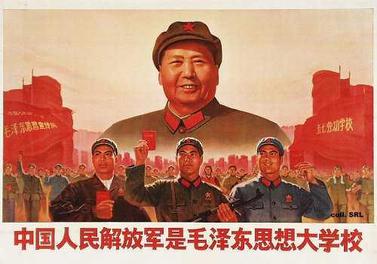
“The Chinese People’s Liberation Army is the great school of Mao Zedong Thought”, 1969.
A poster from the Cultural Revolution, featuring an image of Chairman Mao, published by the government of the People’s Republic of China.
Image via Wikimedia Commons.
In 1926, five years after becoming one of the founders of the Chinese Communist Party (CCP), Mao Zedong listed China’s enemies as “the warlords, the bureaucrats, the comprador class [businessmen dealing with foreign interests] and the reactionary section of the intelligentsia attached to them”. It is ironic that Mao would eventually create a new aristocracy, often referred to as the “princelings” (taizidang), every bit as hierarchical as that against which he had previously railed.
Perversely, when Mao Zedong came to power in China in 1949, there were not many structures of authority left to destroy. In the period of warlordism that succeeded the overthrow of the Qing dynasty by Sun Yat-sen in 2011 and ended with the consolidation of nationalist (Kuomintang) power by Chiang Kai-shek in 1936, the aristocracy of imperial China had been swept away. So too the Mandarin class, the Chinese bureaucrats selected by civil service examination, a system that started with the Sui dynasty in AD 581. As for the Chinese aristocracy, its last vestiges ended with the abolition in 1935 of the Dukedom of Yansheng which belonged to the descendants of Confucius.
So, in terms of social hierarchies, Mao inherited a clean sheet when he established the People’s Republic of China on October 1, 1949. The CCP leadership soon proved that, in the immortal words of George Orwell in his novel Animal Farm, “all animals are equal, but some animals are more equal than others”. In Beijing, Mao and China’s CCP leaders took residence in the palatial compounds located in Zhongnanhai, a waterside park established by the Yuan dynasty in the 13th century.
There is not even equality within the “red aristocracy”. Gradations are as clear-cut as if there were princes, dukes or marquises. The highest rank is accredited to the offspring of those CCP leaders who participated in the Long March. This iconic fighting retreat to a remote plateau in Shaanxi province followed the defeat of the Red Army in October 1934.
It is perhaps difficult for people in the West to understand the scale of Chinese veneration for the individuals who completed the Long March. With the possible exception of the migratory treks along the Oregon Trail, there is no comparable event in American or European history. Throughout their lives, leaders of the Long March enjoyed unparalleled prestige; it was a prestige that passed down to their children – hence the princelings.
The creation of the red aristocracy started with Mao himself. Within a few years of the establishment of the People’s Republic of China, Mao became a de facto emperor. On occasions he even referred to himself as such. He certainly lived the life of an emperor. At his commodious palace in Zhongnanhai, Mao surrounded himself with a harem of dancing girls who would occupy his bed and his swimming pool. In time-honoured fashion, China’s head of security and intelligence, Kang Sheng, procured girls for Mao as well as thousands of volumes of pornography.
[…]
My own experience of the princeling world confirmed that in China, despite its vast population a very small group of families form a governing nexus that has power far beyond its numbers. It is a group that seem to be getting stronger. The princeling proportion of the CCP central committee rose from 6 per cent in 1982 to 9 per cent in 2012. When I spoke to a princeling friend about the politburo standing committee that was elected in 2012, she told me that she personally knew five of its seven members; to her great delight three of them were princelings. It was through her that I met Deng Xiaoping’s daughters and spent a “country house” weekend with them and her princeling pals.
Here it became clear that, while most of the princelings I met were reformists in the Deng mode, there are also factions that are hard-line Maoists, like the one led by Xi Jinping. At the moment it appears that the reformist princelings have gained the upper hand. More light on Xi Jinping’s future and the outcome of this princeling tug of war may be shed at the Fourth Plenum of the 20th CCP Congress starting on October 20.


