
The Sonnets were published late in Shakespeare’s career (1609) — by a clever and unscrupulous man. His name was Thomas Thorpe. He ran what was for the times a unique publishing business, playing games with “copyright” that were often unconscionable but, usually, this side of the law. He owned neither a printing press, nor a bookstall — two things that defined contemporary booksellers — subcontracting everything in his slippery way. Indeed, I would go beyond other observers, and describe him as a blackguard; and I think Will Shakespeare would agree with me. Though Shakespeare would add, “A witty and diverting blackguard.”
He collected these sonnets, quite certainly by Shakespeare, but written at much different times and for quite various occasions, from whatever well-oiled sources. Thorpe had a fine poetic ear, and knew what he was doing. He arranged the collection he’d amassed in the sequence we have inherited — 154 sonnets that seem to read consecutively, with “A Lover’s Complaint” tacked on as their envoi — then sold them as if this had been the author’s intention.
We have sonnets not later than 1591, interspersed with others 1607 or later. In one case (Sonnet 145), we have what I think is a love poem Shakespeare wrote about age eighteen, to a girl he was wooing: one Anne Hathaway. (She was twenty-seven.) It is crawling with puns, for instance on her name, and stylistically naïve, but has been placed within the “Dark Lady” sonnets (127 to 152) in a mildly plausible way. It hardly belongs there.
Indeed, once one sees this it becomes apparent, surveying the whole course, that there is rather more than one “Dark Lady” in the Sonnets, and that like most red-blooded men, our Will noticed quite a number of interesting women over his years. But Thorpe has folded them all into one for dramatic effect.
David Warren, “Dark gentleman of the Sonnets”, Essays in Idleness, 2015-05-11.
August 4, 2017
QotD: Shakespeare’s sonnets
August 2, 2017
Argentina vs United Kingdom: Falklands War 2017
Published on 9 Dec 2016
How would Argentina fare if it tried to take the Falklands again? Does UK have enough forces stationed there to defend itself? Watch the video and find out!
QotD: The fundamental problem of the Middle East
The Western media and intelligentsia don’t seem to have a clue that the issues in the Middle East are not related to competing political ideologies, but to competing religious tribalism.
The ongoing conflicts throughout the region, and in other parts of the world, are not about democracy versus monarchy; or fascism versus communism; or imperialism versus freedom. Or indeed any of the other childish ideologies Western journalists fell in love with during their undergraduate post-modernist deconstructionalist courses by failed ex-Trotsky’s, who simply can’t accept that the last century has proven how appalling and basically evil their over-simplistic ideologies are. (Yes Comrade Corbyn, that’s you and your gushing twitteratti I am slamming!)
In fact the problem in the Muslim world is that they are entering the third decade of the Muslim Civil War.
The Sunni’s and Shia’s are at about the point that the Roman Catholics and the Protestants were at in Europe in the 1620’s to 30’s, and it is only going to get worse. That war was ideological, and paid very little attention to national boundaries. This one is the same. The Christian 30 Years War is about to be repeated in a Muslim civil war, and 30 years might be an optimistic number.
Interestingly the Christian’s split over 3 or four centuries, into Orthodox and Roman, then split again into Albigensian and Protestant etc. Eventually it got to the point, after 14 or 15 centuries of slow development, that major conflict broke out. Is it co-incidence that the Muslims have followed a similar path? Is it inevitable that after 14 or 15 centuries of existence, they too are having a major internal conflict? Or is it just that a century of renewed prosperity and development (largely brought on by Western intrusion into their secular affairs) has given them the semi-educated proto-middle class who traditionally stir up revolutionary stuff they don’t understand?
Whatever the reasons, stupid Westerners are eventually going to have to admit to a few realities:
- No matter how much you fantasise about the functionality of republics and democracy, you can’t impose systems that don’t work in places that don’t have the necessary pre-requisites.
- No matter how much literacy or free press you do manage to push in, you can’t impose rule of law and understanding of natural law on societies that have very specifically rejected such concepts for 8 or 9 centuries.
- No matter how much your secularist ideologies (developed from safely behind 2 millennia of Christian teaching that accepts rule of law and natural law) is offended, you cannot expect a similar acceptance from people whose cultural development of such beliefs is several centuries behind the West.
- No matter what you want to believe, the Muslim civil war is happening.
Let’s hope we really are at least half way through the 30 years…
Nigel Davies, “The ‘Arab Spring’, 1848, and the 30 Years War/s…”, rethinking history, 2015-09-19.
August 1, 2017
Burial and Identification Of The Dead in WW1 I THE GREAT WAR Special
Published on 31 Jul 2017
The millions of dead soldiers of World War 1 needed and often still need a proper burial place. But modern war, waged with artillery and poison gas, made even the retrieval, let alone the identification of bodies very difficult.
July 31, 2017
Byzantine religion – not a joking matter
When Tamara Keel isn’t talking about guns, she apparently relaxes by talking about Byzantine history:
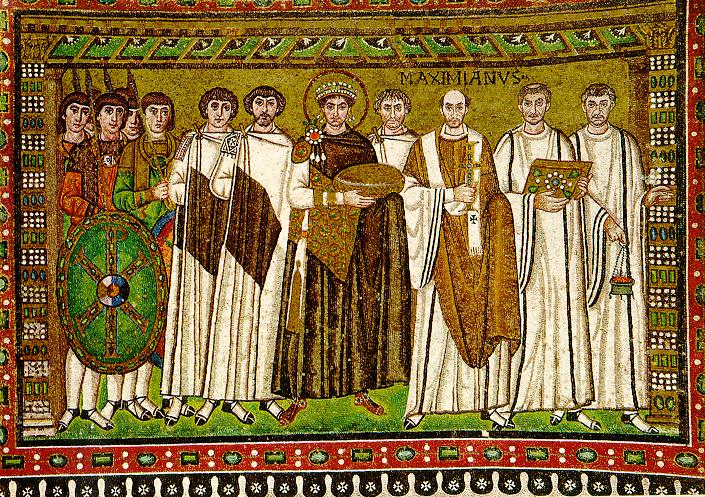
Court of Emperor Justinian with (right) archbishop Maximian and (left) court officials and Praetorian Guards; Basilica of San Vitale in Ravenna, Italy. The dark-haired bearded man to Justinian’s right is believed to be Belisarius. (via Wikimedia)
So, this Maximus dude was a bureaucrat in the Byzantine Empire who apparently had religion as a hobby, as did everybody in Constantinople back then. All the Byzantines did was watch chariot races, debate arcane theological matters, and riot and/or kill each other over differences of opinion on chariot races or arcane theological matters. (Oh, and they engaged in so much intra-governmental intrigue that they went in the dictionary for it.)
At some point, Maximus dropped out of government service and took up religion as a full-time occupation, leaving the city of Constantinople for a monastery in Anatolia. Skipping town ahead of the invading Persians, he landed in Carthage, in Eastern Roman hands for the nonce, thanks to Justinian and Belisarius’s ruinously expensive Mediterranean campaigns.
The big argument in the Church (there was just the one, back then) at the time was between guys who thought Jesus had two natures, human and divine, but only one divine will, and other guys who thought that Jesus had not only two natures, but also a human will and a divine will. Seriously. This was a very big deal and dudes were killing each other over it.
Well, the first view, Monothelitism, was the official view at the time, but Maximus was a believer in the second, or Dyothelitism. And he and the new Pope, Martin I, called a religious council in Rome to debate on the matter without bothering to ask the Emperor. When the council turned out a Dyotheletic verdict, Emperor Constans II (a Monotheletist) had both Pope Martin I and Maximus arrested.
The Pope got de-Poped and banished to the Crimea, where he died. Maximus was tried and sentenced to exile. However, he would not shut up about Dyothelitism and wound up having a great big show trial a few years later, following which he got his tongue cut out and his right hand cut off so he couldn’t tell people that Jesus had two wills anymore or even write it very legibly. Then he got banished to Georgia. (The one on the Black Sea, not the one you drive through on the way to Florida.)
He died in exile there in 662 AD. Nineteen years later, at the Third Council of Constantinople, the Church (still just the one) decided that maybe Jesus did have two wills after all. Maximus received a posthumous pardon, sort of a more official version of “Whoops! Hey, sorry about the tongue and the hand and the whole exile-and-dying-in-prison thing. No hard feelings, okay? Here, have a feast day.”
I told you they took their religion seriously in Constantinople, didn’t I?
QotD: Naming Mount McKinley as an amusing “up yours” gesture
Just one thing makes me regret the change. “Mount McKinley” was originally named as a amusing “up yours” gesture with which I have enormous sympathy.
The story told by the prospector who pinned the moniker on the mountain is that he had crossed paths in the wilds of Alaska with two advocates of “free silver.” This was a political craze that, like the Dreyfus Affair or the Sacco-Vanzetti trial, took over an entire civilization for a while, but now defies easy explanation. The “silverites” were Western populists and farmers who wanted silver to be accepted as currency and minted into coin “freely” by the government, as gold then was — but at a face price far above silver’s market value. This would have expanded the money supply explosively, letting the chronically indebted off the hook.
Most economists now regard the silverites as having had a ridiculous answer to real problems with a gold standard. But the important point is that the prospector, Frank Dickey, ran into classic monetary cranks of a type that still exists. And he had done so in a unique situation which permitted no immediate escape. One shudders upon envisioning such a hell.
Dickey got so tired of his companions’ laborious tirades — one imagines them arguing with him long, long after he had stopped arguing back — that when they ran across an impressive mountain, he immediately decided to name it after the new presidential nominee McKinley, Great Satan of the silverites. As the Secretary of the Interior’s Order No. 3337 points out, William McKinley never visited or had any other connection with the mountain, or with Alaska. He was, for Dickey’s purposes, a punchline.
Colby Cosh, “Mount McKinley was a most amusing ‘up yours’ aimed at monetary cranks”, National Post, 2015-09-01.
July 30, 2017
“… sooner or later, and usually sooner, the British will be blamed”
In Pragati, Alex Tabarrok reviews Shashi Tharoor’s 2016 book history of the British Raj, An Era Of Darkness:
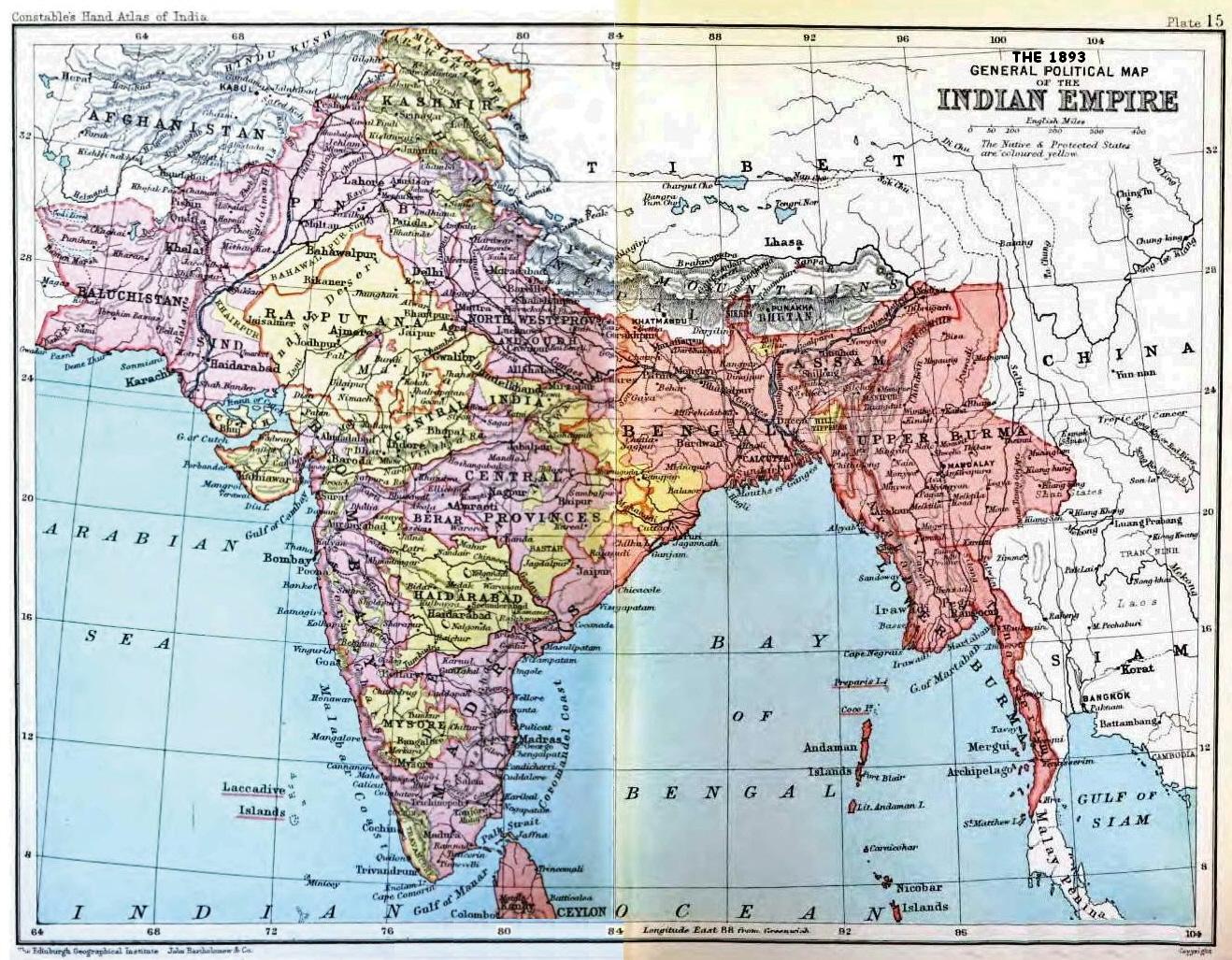
“Political Map of the Indian Empire” from Constable’s Hand Atlas of India, 1893.
(via Wikimedia)
At sophisticated dinner parties in Delhi, Calcutta, or Chennai, whenever the discussion turns to politics, one can be sure that sooner or later, and usually sooner, the British will be blamed. It’s a fine parlor game, and clever players can usually find a way to cast blame for whichever side of the debate they favor. Is India’s traditional family falling apart due to internet porn? Blame the British! Are the laws against homosexuality too strong? Blame the British! The British are an easy target because much of what they did was reprehensible. But blaming British imperialism for contemporary Indian problems is also an easy way to let India’s political class off the hook.
An excellent case against the British comes from Shashi Tharoor, bestselling author, former Under-Secretary-General at the United Nations, and current member of the Indian parliament, in his 2016 book An Era of Darkness: The British Empire in India (also published this year under the title Inglorious Empire[UK title]).
Tharoor makes three claims:
- The British empire in India, from the seizure of Bengal by the East India Company in 1757 until the end of British government rule in 1947, was cruel, rapacious, and racist.
- India would be much better off today had it not been for British rule.
- Britain’s success and the Industrial Revolution were due to British depredation of India.
The first claim is true, the second uncertain, the third false.
The first claim is the heart of Tharoor’s book: the British empire in India was cruel, rapacious and racist. All true. But who would expect otherwise? Power corrupts and absolute power corrupts absolutely. The theft, the famines, the massacres, the formal and casual racism, the utter hypocrisy of suppressing independence while using hundreds of thousands of Indian soldiers to fight for democracy and freedom in two World Wars — on all this Tharoor stands on solid ground. The ground is solid in part because it has been well-trod. Tharoor brings the case against the East India Company and Britain, initiated by Edmund Burke (1774-1785) and continued by the likes of Indian nationalist Dadabhai Naoroji [PDF] (1901) and American historian Will Durant (1930), to its conclusion and climax with the Indian independence movement. In this, Tharoor is entirely successful and his work deserves to be widely read.
In his eagerness to blame Britain, however, Tharoor reaches for every possible argument in ways that are sometimes misleading and sometimes absurd.
US Preparation – Alien Enemies Act – Franco-Prussian War I OUT OF THE TRENCHES
Published on 29 Jul 2017
It’s time for the Chair of Wisdom again and this week Indy talks about US Preparations before reaching the battlefield, the Alien Enemies Act for German citizens in the US and the length of the Franco-Prussian War.
The Greenback cases
At Samizdata, Paul Marks discusses why it is so difficult to prevent governments from expanding their powers far beyond what the constitution may allow:
… a Constitution is only as good as the enforcement mechanisms to make sure it is obeyed – and as Luther Martin warned at the Constitutional Convention in Philadelphia, trusting government appointed judges to limit the powers of the very government that appointed them is a fatally flawed idea.
This is not a recent problem. Even in the 19th century the Supreme Court often ruled that the Federal Government has powers that the Constitution does NOT give it. For example the infamous “Second Greenback Case” where the Supreme Court, with newly appointed “justices” (appointed, in part, for this corrupt purpose) overturned the “First Greenback Case” where the court had declared, quite correctly, that the Federal Government has no power to print (or have printed) money – only to “coin money” (Article One, Section Eight of the Constitution of the United States) and that only gold or silver coin (not paper money) may be “legal tender” in any State (Article One, Section Ten of the Constitution of the United States). Nothing could be plainer than that paper money is unconstitutional – indeed the very reason the United States Constitution was written in the first place was to prevent the “not worth a Continental” paper money issued by the Continental Congress to finance its government – those who support the Articles of Confederation system forget that one of its fundamental flaws was that it allowed the government to print money, as it gave no reliable source of taxation to finance the United States Armed Forces. Without a large scale and professional armed forces there is no point in having a United States of America at all – and each State might as well go its own way till conquered by European powers in the 18th century or by the People’s Republic of China in the 21st century.
[…]
To return to the Greenback Cases… – Chief Justice Salmon P. Chase (the former “slaves lawyer” famous for his anti slavery legal work before the Civil War) de facto ruled that the Treasury Secretary during the Civil War had acted unconstitutionally in having money printed, even though the the Treasury Secretary of the time was Salmon P. Chase (himself). It is not necessary to recuse yourself if you intend, de facto, to find yourself guilty. However, more “justices” were added to the court – and the judgement (and the Constitution) was overturned. The argument being that no more paper money was being printed – it would gradually go over time, so there was no need to make a fuss… still less to declare that the “United States Dollars” in the pockets of people were just bits of paper with ink on them (not “money”).
In 1935 the Supreme Court de facto ruled (by five votes to four) that the Federal Government could steal all monetary gold and void all private and public contracts that had gold (or silver) clauses in the contracts. There was no Constitutional basis for this decision (none whatever – just “lawyer’s cant”) and the Federal Reserve notes declared valid money came from an organisation (the Federal Reserve system created in 1913) that the Congress had no Constitutional power to create. The Supreme Court, led by the Chief Justice, might as well have chanted “Death to America!” and “Hail Satan!” as they announced their judgement – as some of the dissenting judges pointed out. Thus the unconstitutional Credit Bubble financial system was pushed forward. The doubts of Luther Martin at the Constitutional Convention were vindicated – government appointed judges sitting without a jury can not be trusted.
QotD: Orwell on climate change since Shakespeare’s day
To the lovers of useless knowledge (and I know there are a lot of them, from the number of letters I always get when I raise any question of this kind) I present a curious little problem arising out of the recent Pelican, Shakespeare’s England. A writer named Fynes Morrison, touring England in 1607, describes melons as growing freely. Andrew Marvell, in a very well-known poem written about fifty years later, also refers to melons. Both references make it appear that the melons grew in the open, and indeed they must have done so if they grew at all. The hot-bed was a recent invention in 1600, and glass-houses, if they existed, must have been a very great rarity. I imagine it would be quite impossible to grow a melon in the open in England nowadays. They are hard enough to grow under glass, whence their price. Fynes Morrison also speaks of grapes growing in large enough quantities to make wine. Is it possible that our climate has changed radically in the last three hundred years? Or was the so-called melon actually a pumpkin?
George Orwell, “As I Please”, Tribune, 1944-11-03.
July 29, 2017
Latin Declensions Made Easy
Published on 27 Jul 2017
An explanation of what the Latin Declensions are and how they work. This video is aimed at English-speaking students with no prior knowledge of English grammar. It is deliberately slow and repetitive, and it avoids any graphics or other adornments that may distract attention from the subject matter.
If you like this video, please check out my teaching website: http://www.classicstuition.co.uk/
Matchlock Musket Demonstration with Armor (Live Rounds)
Published on 15 Apr 2014
Live rounds were fired from this matchlock with the musketeer first using no armor, then wearing standard armor, and finally equipped with a modified armor breastplate that had an attached piece for the musket butt to rest. Accuracy did not seem to be a factor, as all three tests yielded similar results. However, the modified breastplate was much more comfortable and easier to use than the standard breastplate. In 1611 at Jamestown, a law was enacted which stipulated that musketeers had to start wearing armor. In response they adapted by changing some of the existing armor to suit their needs, and this is evidenced with an adaptive breastplate found in a James Fort period well. A special thanks to Fred Scholpp from the Jamestown-Yorktown Foundation for coming out to the island to conduct experimental archaeology with the matchlock and armor breastplate reproductions.
If you are interested in donating to this non-profit research project, please click the following link. https://donatenow.networkforgood.org/jamestownrediscovery
QotD: Imposing “democracy”
To be fair, the British set up monarchies, in the hope that they would become constitutional monarchies (which were their experience of something that might actually get somewhere). Jordan seems to be succeeding; the Gulf states are so successful few want to change; and Egypt was derailed by the Soviets and Americans playing Cold War games. The French tried to set up republics (god knows why, their’s [had] never worked) in Syria, Lebanon, Tunisia, and other places. In the words of Dr Phil, ‘How’s that working out for you?’. The Americans successfully undermined the Egyptian and Iranian attempts to get constitutional monarchies off the ground, and celebrated the resulting republics… very briefly. The second in particular no longer looks a very clever move.
The latest American attempts to force republics on Afghanistan and Iraq have been absolute disasters.
Afghanistan might, might… have worked if the Americans had understood that such a tribalised society required a House of Lords of all the powerful tribal leaders and major clerics, to balance [the] elected representatives. (But of course it would still need some sort of monarch to make it work, because, as Machiavelli pointed out, you need 3 powers in balance, so any two can stop the third from dominating!).) Or they could just have a system where the two major components completely ignore each other while they compete for control, and leave an easy opening for the return of the Taliban.
Iraq might, might… have worked with a federal system of at least a dozen ethnically based states that each had two representatives to a senate that had the right to block the excesses of an elected house where a 50% majority could get revenge on everyone else for every slight since the death of the prophet. Or they could go for a more simplistic version of a republic, and get what they inevitably got.
Why couldn’t the Americans have kept their big fat ideologies out of it, as they largely did after the first Gulf War. Kuwait is no great shining beacon, but it doesn’t suffer from the American idealism that lead to Afghanistan, Iraq, Egypt and Iran!
Nigel Davies, “The ‘Arab Spring’, 1848, and the 30 Years War/s…”, rethinking history, 2015-09-19.
July 28, 2017
Three Years of World War 1 I THE GREAT WAR Week 157
Published on 27 Jul 2017
Christmas 1914 – that’s when the war was supposed to be over. And now, in the summer of 1917, it entered its fourth year and there was no end in sight. The British Army was about to launch a new offensive near Ypres, Russia drowned in chaos and the central powers’ defences were still holding. Though in Romania, the combined Russian and Romanian attack put a few cracks into the German self esteem.
1177 BC: The Year Civilization Collapsed (Eric Cline, PhD)
Published on 11 Oct 2016
From about 1500 BC to 1200 BC, the Mediterranean region played host to a complex cosmopolitan and globalized world-system. It may have been this very internationalism that contributed to the apocalyptic disaster that ended the Bronze Age. When the end came, the civilized and international world of the Mediterranean regions came to a dramatic halt in a vast area stretching from Greece and Italy in the west to Egypt, Canaan, and Mesopotamia in the east. Large empires and small kingdoms collapsed rapidly. With their end came the world’s first recorded Dark Ages. It was not until centuries later that a new cultural renaissance emerged in Greece and the other affected areas, setting the stage for the evolution of Western society as we know it today. Professor Eric H. Cline of The George Washington University will explore why the Bronze Age came to an end and whether the collapse of those ancient civilizations might hold some warnings for our current society.
Considered for a Pulitzer Prize for his recent book 1177 BC, Dr. Eric H. Cline is Professor of Classics and Anthropology and the current Director of the Capitol Archaeological Institute at The George Washington University. He is a National Geographic Explorer, a Fulbright scholar, an NEH Public Scholar, and an award-winning teacher and author. He has degrees in archaeology and ancient history from Dartmouth, Yale, and the University of Pennsylvania; in May 2015, he was awarded an honorary doctoral degree (honoris causa) from Muhlenberg College. Dr. Cline is an active field archaeologist with 30 seasons of excavation and survey experience.
The views expressed in this video are those of the speaker and do not necessarily reflect the views of the National Capital Area Skeptics.


