
Published on 10 Nov 2014
The Thirty Years’ War was fought from 1618-1648 (Thirty Years!) in the Holy Roman Empire. It began as a conflict between Catholics and Protestants in Bohemia, but grew to involve Denmark, Sweden, and France. After the French began helping Gustavus Adolphus, the Protestant king of Sweden, the lines became blurry and the war became more about the balance of power in Europe than about religion. The Peace of Westphalia paved the way for France to become the dominant power in Western Europe and for the permanent decline of the Holy Roman Empire as a political institution.
If you like this lecture, check out my other lectures for AP European History and Western Civilization!
September 13, 2017
The Thirty Years War
September 12, 2017
Inside A British WW1 Airbase – Stow Maries Great War Aerodrome I THE GREAT WAR Special
Published on 11 Sep 2017
Visit Stow Maries Great War Aerodrome in Essex: http://www.stowmaries.org.uk/
The Royal Flying Corps and later the Royal Air Force maintained aerodromes and airfields around Great Britain for defence against German Zeppelin and Gotha Bomber raids. But would a WW1 aerodrome actually work?
Comments Off on Inside A British WW1 Airbase – Stow Maries Great War Aerodrome I THE GREAT WAR Special
Great Northern War – III: Young and Violent – Extra History
Published on 9 Sep 2017
Flush from his victories against Poland-Lithuania, Charles XII of Sweden sets his eyes on an even greater enemy: Russia. But its ruler, Peter the Great, is no pushover: as the Swedish troops advance, he burns down the countryside and leaves them starving and exposed as a ferocious winter sets in.
Comments Off on Great Northern War – III: Young and Violent – Extra History
The River Thames: “London River” – 1941 Educational Documentary – WDTVLIVE42
Published on 31 Aug 2017
The River Thames, Key to London’s Importance as a Centre of Commerce and Government‘At Tilbury, near the mouth of the River Thames, liners from all over the world come into the landing stages, past long lines of barges and battalions of cranes. Higher up-river are the giant London docks, the busiest in the world, where the work of importing and exporting cargo us carried on unceasingly.
Westwards, up-river, are huge warehouses; cranes and smoking funnels line the banks. Approaching the City, ships pass beneath Tower Bridge, close to the imposing Tower of London. Nearby is the world of wharves and dockland offices, and directly linked to the river are London’s famous markets – Billingsgate for fish, Smithfield for meat and Covent Garden for fruit, vegetables and flowers. Here, too, is the world of finance – “the richest square mile in the world” – with the Stock Exchange, the Bank of England, and important banking and business houses known throughout the world. Further up-river is County Hall, magnificent headquarters of the London County Council; and on the left bank is the historic City of Westminster, home of the Empire’s government; lining Whitehall are big Government departments and, nearby, Westminster Abbey; and on the water’s edge, the Houses of Parliament with their elaborate and beautiful architecture. Beyond Westminster the character of the river is changed yet again, and giant Power Stations give way to residential houses, roads to gardens. Beyond Richmond, with its willow-lined banks, are the Tudor chimneys and turrets of Hampton Court; higher still is Windsor and its Castle, the home of the King.
As evening falls there is peace on the river at Windsor, but at the mouth of the Thames activity goes on into the night. There is no sleep for the greatest port in the world.’
(Films of Britain – British Council Film Department Catalogue – 1940)
Comments Off on The River Thames: “London River” – 1941 Educational Documentary – WDTVLIVE42
September 10, 2017
British Malaya – US Equipment – Boobytraps I OUT OF THE TRENCHES
Published on 9 Sep 2017
It’s time for another exciting episode of Out Of The Trenches again, this episode talks about British Malaya in WW1, the French and British equipment the US troops used and traps.
Comments Off on British Malaya – US Equipment – Boobytraps I OUT OF THE TRENCHES
Special Air Service (SAS) – The Falklands Campaign
Published on 13 Jul 2016
Special Air Service (SAS) – The Falklands Conflict
When Argentina invaded the Falklands in April, 1982, Britain dispatched a large Naval Task Force to recapture the Falklands. Steaming south with the British fleet were D and G Squadron of the SAS, with supporting signals units.
Comments Off on Special Air Service (SAS) – The Falklands Campaign
In search of silphium, the lost herb of the Roman empire
Zaria Gorvett recounts the story of a Roman-era herb that was at one point literally worth its weight in gold:
Long ago, in the ancient city of Cyrene, there was a herb called silphium. It didn’t look like much – with stout roots, stumpy leaves and bunches of small yellow flowers – but it oozed with an odiferous sap that was so delicious and useful, the plant was eventually worth its weight in gold.
To list its uses would be an endless task. Its crunchable stalks were roasted, sauteed or boiled and eaten as a vegetable. Its roots were eaten fresh, dipped in vinegar. It was an excellent preservative for lentils and when it was fed to sheep, their flesh became delectably tender.
Perfume was coaxed from its delicate blooms, while its sap was dried and grated liberally over dishes from brains to braised flamingo. Known as “laser”, the condiment was as fundamental to Roman haute cuisine as eating your food horizontally in a toga.
[…]
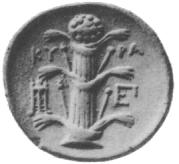
Indeed, the Romans loved it so much, they referenced their darling herb in poems and songs, and wrote it into great works of literature. For centuries, local kings held a monopoly on the plant, which made the city of Cyrene, at modern Shahhat, Libya, the richest in Africa. Before they gave it away to the Romans, the Greek inhabitants even put it on their money. Julius Caesar went so far as to store a cache (1,500lbs or 680kg) in the official treasury.A coin of Cyrene depicting the stalk of a Silphium plant. (Source: 1889 edition of Principal Coins of the Ancients, plate 35, via Wikimedia)
But today, silphium has vanished – possibly just from the region, possibly from our planet altogether. Pliny wrote that within his lifetime, only a single stalk was discovered. It was plucked and sent to the emperor Nero as a curiosity sometime around 54-68AD.
With just a handful of stylised images and the accounts of ancient naturalists to go on, the true identity of the Romans’ favourite herb is a mystery. Some think it was driven to extinction, others that it’s still hiding in plain sight as a Mediterranean weed. How did this happen? And could we bring it back?
Comments Off on In search of silphium, the lost herb of the Roman empire
Barbarossa: Why such high Soviet Losses? – Explained
Published on 20 Jun 2017
The Red Army suffered heavy losses during Operation Barbarossa, but it also inflicted heavy losses on the Wehrmacht. This means it was not just some helpless giant, but it also begs the questions, why were the losses so high? This video discusses several factors and refers heavily to current academic research namely from Alexander Hill and David Stahel.
Military History Visualized provides a series of short narrative and visual presentations like documentaries based on academic literature or sometimes primary sources. Videos are intended as introduction to military history, but also contain a lot of details for history buffs. Since the aim is to keep the episodes short and comprehensive some details are often cut.
Comments Off on Barbarossa: Why such high Soviet Losses? – Explained
September 9, 2017
The rise of the “I would like to acknowledge that…” announcement in Canada
In The New Yorker, Stephen Marche discusses “Canada’s Impossible Acknowledgement”:
Every morning, at the start of the school day in Toronto, my children hear the following inelegant little paragraph read aloud, just before the singing of “O Canada”:
I would like to acknowledge that this school is situated upon traditional territories. The territories include the Wendat, Anishinabek Nation, the Haudenosaunee Confederacy, the Mississaugas of the New Credit First Nations, and the Métis Nation. The treaty that was signed for this particular parcel of land is collectively referred to as the Toronto Purchase and applies to lands east of Brown’s Line to Woodbine Avenue and north towards Newmarket. I also recognize the enduring presence of Aboriginal peoples on this land.
I hear the same little speech, or a version of it, at gala events — literary prizes, political fund-raisers, that sort of thing — when whichever government representative happens to be there reads some kind of acknowledgment before his or her introductory remarks. But you know a phenomenon has really arrived in Canada when it involves hockey. Both the Winnipeg Jets and the Edmonton Oilers began acknowledging traditional lands in their announcements before all home games last season. Acknowledgment is beginning to emerge as a kind of accidental pledge of allegiance for Canada — a statement made before any undertaking with a national purpose.
In 2015, the Truth and Reconciliation Commission of Canada released its final report, with ninety-four calls to action, and Justin Trudeau was elected to great gusts of hope that we might finally confront the horror of our history. In the time since, the process of reconciliation between Canada and its First Nations has stalled, repeating the cycles of overpromising and underdelivering that have marred their relationship from the beginning. The much-vaunted commitment to “Nation to Nation” negotiation has been summarily abandoned. The National Inquiry into Murdered and Missing Indigenous Women and Girls — another Trudeau election promise — has been plagued by resignations, inertia, and accusations of general ineffectiveness. Nonetheless, the acknowledgment is spreading. No level of government has mandated the practice; it is spreading of its own accord.
It’s not nothing … but from the point of view of many First Nations activists, it might as well be nothing. It also involves awkward moments when the speaker doesn’t quite get the acknowledgement acceptably “correct”:
In other places, particularly in the bigger cities, the acknowledgment can become exponentially more difficult. The British Crown acquired Toronto, or, rather, the 250,880 acres that include present-day Toronto, from the Mississaugas, in 1787, for two thousand gun flints, two dozen brass kettles, ten dozen mirrors, two dozen laced hats, a bale of flannel, and ninety-six gallons of rum. The British government officially purchased the land for an additional ten shillings, in 1805. But even before the Toronto Purchase, as it was called, the land was a contested site between indigenous peoples. That history is also reflected in the question of who should be named in the acknowledgment. “For the sake of current land claims and also for the sake of basic respect, you have to name them, and you have to be correct about it,” Jesse Thistle, a historian at York University in Toronto, says. “Haudenosaunee people, some of them, don’t want to recognize that the Anishnabe took control and were here historically. Some Anishnabe people will not recognize that the Haudenosaunee people were here. And both those people sometimes want to erase the Wendat.” Historical truth is always subject to the structures of power. Always. The erasure of the Wendat “is, in a way, a kind of indigenous way of doing what the British were doing, in terms of writing other people out of the narrative,” Thistle says.
But writing marginalized peoples into the narrative is not always the correct instinct, either. Thistle, who is himself Métis-Cree, believes that the Métis should not be included in the list of traditional land acknowledgments in Toronto; he has brought his concerns to the authorities at the Toronto District School Board as well. There were Métis in Toronto — they constituted a “historical presence” — but it was not a homeland, and to claim otherwise, for Thistle, “disempowers the Haudenosaunee or the Anishnabe, who do have a rightful claim.”
The Seven Years’ War
Published on 19 Nov 2016
The Seven Years’ War essentially comprised two struggles. One centered on the maritime and colonial conflict between Britain and its Bourbon enemies, France and Spain; the second, on the conflict between Frederick II (the Great) of Prussia and his opponents: Austria, France, Russia, and Sweden. Two other less prominent struggles were also worthy of note. As an ally of Frederick, George II of Britain, as elector of Hanover, resisted French attacks in Germany, initially only with Hanoverian and Hessian troops but from 1758 with the assistance of British forces also. In 1762, Spain, with French support, attacked Britain’s ally Portugal, but, after initial checks, the Portuguese, thanks to British assistance, managed to resist successfully.
Comments Off on The Seven Years’ War
September 8, 2017
Attempted Military Coup in Russia – The Kornilov Affair I THE GREAT WAR Week 163
Published on 7 Sep 2017
The situation in Russia further escalates as Lavr Kornilov attempts to gain complete power with a military coup. The result is a disaster for him and thousands of armed Bolsheviks in the streets of Petrograd.
Comments Off on Attempted Military Coup in Russia – The Kornilov Affair I THE GREAT WAR Week 163
Grant Vs Lee Who Was The Better General?
Published on 17 Aug 2016
Today I break down the book: Grant And Lee: A Study In Personality And Generalship By J.F.C Fuller
Here’s a quick break down of the two personalities
Grant: common sense, logical, simple plans with incredible precise execution, the ability to bring a whole lot of moving pieces into focus, and finally the ability to think clearly under stress.
Lee: The ability to motivate his men to an incredible degree, an extremely kind man, very good at doling out troops to his commanders when in a defensive situation.This video goes into more detail on all of this, I hope you enjoyed!
Comments Off on Grant Vs Lee Who Was The Better General?
Book Review: The Schmeisser Myth by Martin Helebrant
Published on 17 Feb 2017
The Schmeisser Myth: German Submachine Guns Through Two World Wars is a newly published history of SMG development from the Villar Perosa and MP18 through the MP38 and MP40, written by Martin Helebrant. Given that it is published by Collector Grade, it should be no surprise that it is an excellent volume, which includes both historical and developmental context as well as detailed collectors’ information on markings, variations, and production numbers.
Comments Off on Book Review: The Schmeisser Myth by Martin Helebrant
September 7, 2017
We Are Coming To Italy and Slovenia! I THE GREAT WAR On The Road
Published on 6 Sep 2017
September 18 – Meeting at Kobarid, Slovenia: http://bit.ly/Kobarid
September 19 – Meeting at Vittorio Veneto, Italy: http://bit.ly/VittorioVeneto
September 20 – Meeting at Lagazuoi: http://bit.ly/LagazuoiWW1
Comments Off on We Are Coming To Italy and Slovenia! I THE GREAT WAR On The Road
Roman Roads of Britain
Last month, Colin Marshall shared this post on Open Culture:
[Click to embiggen]
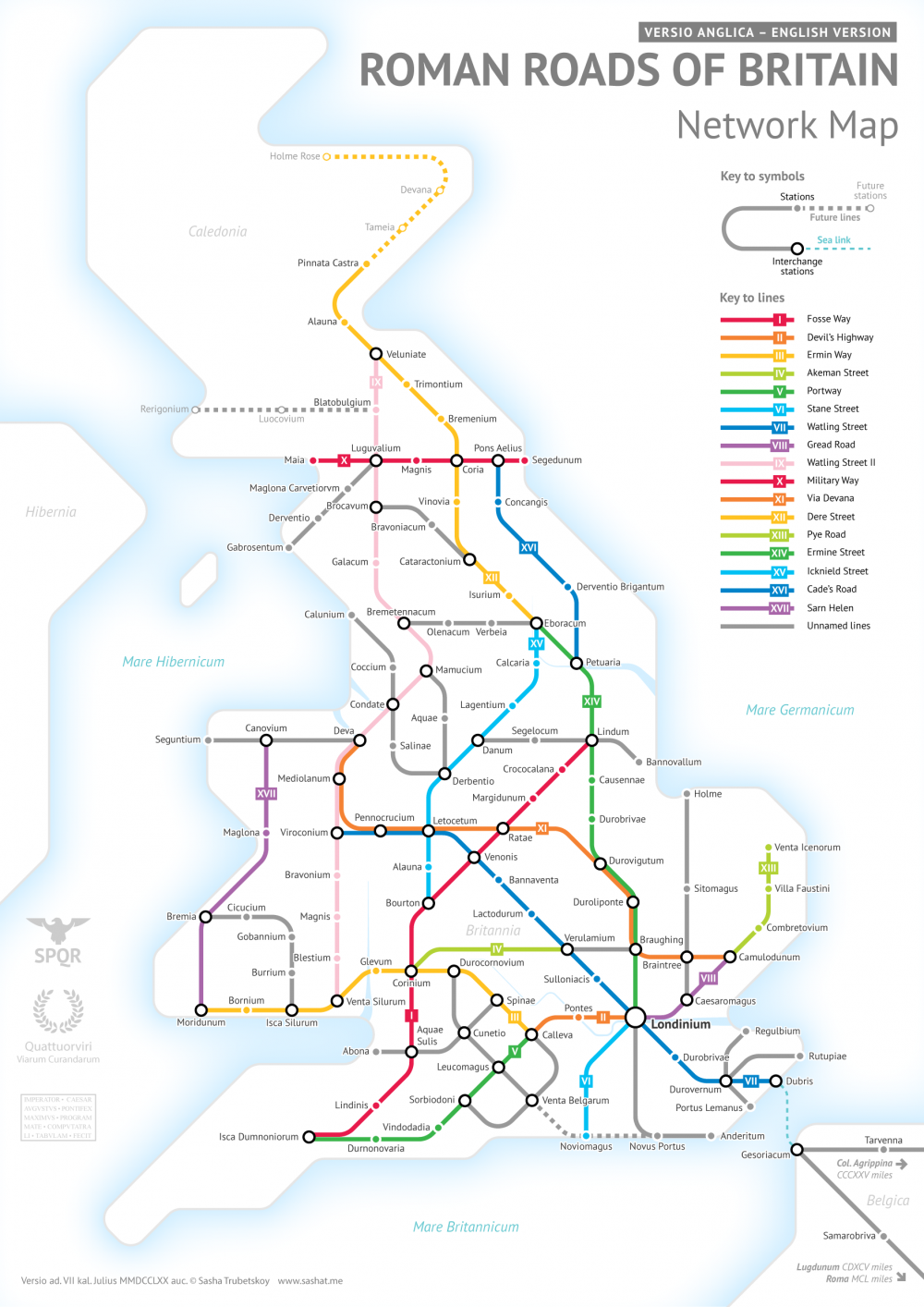
Though some of Britain’s Roman Roads have become modern motorways, most no longer exist in any form but those bits and pieces history buffs like to spot. This makes it difficult to get a sense of how they all ran and where — or at least it did until Sasha Trubetskoy made a Roman Roads of Britain Network Map in the graphic-design style of the subway maps you’ll find in London or any other major city today. Trubetskoy, an undergraduate statistics major at the University of Chicago, first found cartographical fame a few months ago with his “subway map” of roads across the entire Roman Empire circa 125 AD.
“Popular request,” he writes, demanded a Britain-specific follow up, a project he describes as “far more complicated than I had initially anticipated.” The challenges included not just the sheer number of Roman Roads in Britain but a lack of clarity about their exact location and extents. As in his previous map, Trubetskoy admits, “I had to do some simplifying and make some tough choices on which cities to include.” While this closer-up view demanded a more geographical faithfulness, he nevertheless “had to get rather creative with the historical evidence” in places, to the point of using such “not exactly Latin-sounding” names as “Watling Street” and “Ermin Way.”
Comments Off on Roman Roads of Britain


